anaheim-gazette 1911-03-02
Scanned page
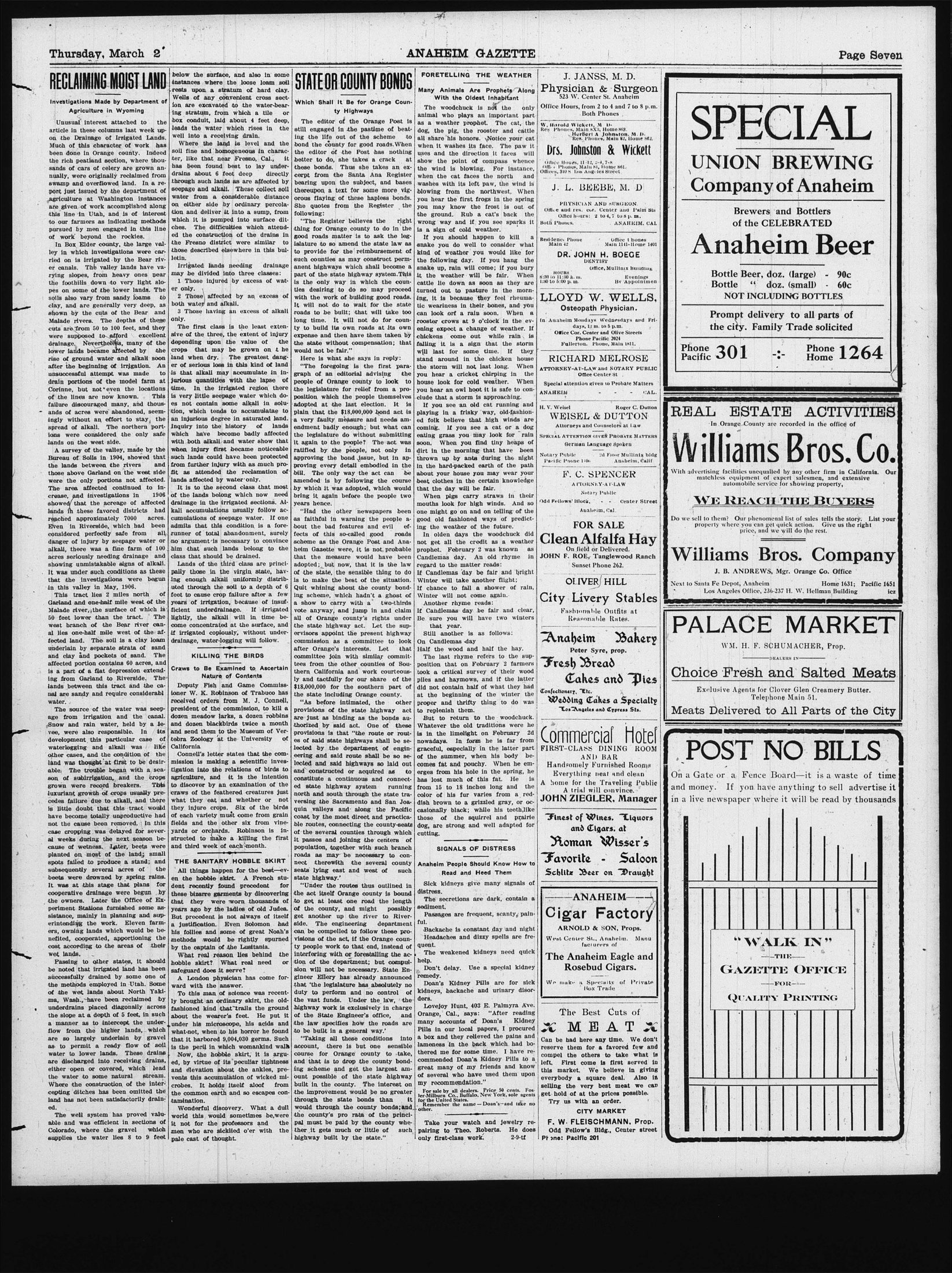
Searchable text
RECLAIMING MOIST LAND
Investigations Made by Department of Agriculture in Wyoming
Unusual interest attached to the article in these columns last week upon the Drainage of Irrigated Lands. Much of this character of work has been done in Orange county. Indeed the rich peatland section, where thousands of cars of celery are grown annually, were originally reclaimed from swamp and overflowed land. In a report just issued by the department of agriculture at Washington instances are given of work accomplished along this line in Utah, and is of interest to our farmers as indicating methods pursued by men engaged in this line of work beyond the rockies.
In Box Elder county, the large valley in which investigations were carried on is irrigated by the Bear river canals. The valley lands have varying slopes, from heavy ones near the foothills down to very light slopes on some of the lower lands. The soils also vary from sandy loams to clay, and are generally very deep, as shown by the cuts of the Bear and Malade rivers. The depths of these cuts are from 50 to 100 feet, and they were supposed to afford excellent drainage. Nevertheless, many of the lower lands became affected by the rise of ground water and alkali soon after the beginning of irrigation. An unsuccessful attempt was made to drain portions of the model farm at Corinne, but not even the locations of the lines are now known. This failure discouraged many, and thousands of acres were abandoned, seemingly without an effort to stay the spread of alkali. The northern portions were considered the only safe lands on the west side.
A survey of the valley, made by the Bureau of Soils in 1904, showed that the lands between the rivers and those above Garland on the west side below the surface, and also in some instances where the loose loam soil rests upon a stratum of hard clay. Wells of any convenient cross section are excavated to the water-bearing stratum, from which a tile or box conduit, laid about 4 feet deep, leads the water which rises in the well into a receiving drain.
Where the land is level and the soil fine and homogeneous in character, like that near Fresno, Cal., it has been found best to lay under drains about 6 feet deep directly through such lands as are affected by seepage and alkali. These collect soil water from a considerable distance on either side by ordinary percolation and deliver it into a sump, from which it is pumped into surface ditches. The difficulties which attended the construction of the drains in the Fresno district were similar to those described elsewhere in this bulletin.
Irrigated lands needing drainage may be divided into three classes:
1. Those injured by excess of water only.
2. Those affected by an excess of both water and alkali.
3. Those having an excess of alkali only.
The first class is the least extensive of the three, the extent of injury depending upon the value of the crops that may be grown on the land when dry. The greatest danger of serious loss in this kind of land is that alkali may accumulate in injurious quantities with the lapse of time. In the irrigated region there is very little seepage water which does not contain some alkali in solution, which tends to accumulatae to an injurious degree in saturated land. Inquiry into the history of lands which have become badly affected with both alkali and water show that when injury first became noticeable such lands could have been protected from further injury with as much profit as attended the reclamation of...
A survey of the valley, made by the Bureau of Soils in 1904, showed that the lands between the rivers and those above Garland on the west side were the only portions not affected. The area affected continued to increase, and investigations in 1906 showed that the acreage of affected lands in these favored districts had reached approximately 7000 acres. Even in Riverside, which had been considered perfectly safe from all danger of injury by seepage water or alkali, there was a fine farm of 100 acres seriously needing drainage and showing unmistakable signs of alkali. It was under such conditions as these that the investigations were begun in this valley in May, 1906.
This tract lies 2 miles north of Garland and one-half mile west of the Malade river, the surface of which is 50 feet lower than the tract. The west branch of the Bear river canal lies one-half mile west of the affected land. The soil is a clay loam underlain by separate strata of sand and clay and pockets of sand. The affected portion contains 60 acres, and is a part of a flat depression extending from Garland to Riverside. The lands between this tract and the canal are sandy and require considerable water.
The source of the water was seepage from irrigation and the canal. Snow and rain water, held by a levee, were also responsible. In its development this particular case of waterlogging and alkali was like other cases, and the condition of the land was thought at first to be desirable. The trouble began with a season of subirrigation, and the crops grown were record breakers. This luxuriant growth of crops usually precedes failure due to alkali, and there is little doubt that this tract would have become totally unproductive had not the cause been removed. In this case cropping was delayed for several weeks during the next season because of wetness. Later, beets were planted on most of the land; small spots failed to produce a stand; and subsequently several acres of the beets were drowned by spring rains. It was at this stage that plans for cooperative drainage were begun by the Office of Forestry.
In the irrigated region there is very little seepage water which does not contain some alkali in solution, which tends to accumulate to an injurious degree in saturated land. Inquiry into the history of lands which have become badly affected with both alkali and water show that when injury first became noticeable such lands could have been protected from further injury with as much profit as attended the reclamation of lands affected by water only.
It is to the second class that most of the lands belong which now need drainage in the irrigated sections. Alkali accumulations usually follow accumulations of seepage water. If one admits that this condition is a forerunner of total abandonment, surely no argument is necessary to convince him that such lands belong to the class that should be drained.
Lands of the third class are principally those in the virgin state, having enough alkali uniformly distributed through the soil to a depth of 6 feet to cause crop failure after a few years of irrigation, because of insufficient underdrainage. If irrigated lightly, the alkali will in time become concentrated at the surface, and if irrigated copiously, without underdrainage, water-logging will follow.
KILLING THE BIRDS
Craws to Be Examined to Ascertain Nature of Contents
Deputy Fish and Game Commissioner W. K. Robinson of Trabuco has received orders from M. J. Connell, president of the commission, to kill a dozen meadow larks, a dozen robbins and dozen blackbirds twice a month and send them to the Museum of Vertebra Zoology at the University of California.
Connell's letter states that the commission is making a scientific investigation into the relations of birds to agriculture, and it is the intention to discover by an examination of the crows of the feathered creatures just what they eat and whether or not they injure crops. Six of the birds of each variety must come from grain fields and the other six from vineyards or orchards. Robinson is instructed to make a killing the first and third week of each month.
THE SANITARY HOBBLE SKIRT
All things happen for the best—even the hobble skirt. A French student recently found precedent for these bizarre garments by discovering that alkan may accumulate in injurious quantities with the lapse of time. In the irrigated region there is very little seepage water which does not contain some alkali in solution, which tends to accumulatae to an injurious degree in saturated land. Inquiry into the history of lands which have become badly affected with both alkali and water show that when injury first became noticeable such lands could have been protected from further injury with as much profit as attended the reclamation of lands affected by water only.
It is to the second class that most of the lands belong which now need drainage in the irrigated sections. Alkali accumulations usually follow accumulations of seepage water. If one admits that this condition is a forerunner of total abandonment, surely no argument is necessary to convince him that such lands belong to the class that should be drained.
Lands of the third class are principally those in the virgin state, having enough alkali uniformly distributed through the soil to a depth of 6 feet to cause crop failure after a few years of irrigation, because of insufficient underdrainage. If irrigated lightly, the alkali will in time become concentrated at the surface, and if irrigated copiously, without underdrainage, water-logging will follow.
KILLING THE BIRDS
Craws to Be Examined to Ascertain Nature of Contents
Deputy Fish and Game Commissioner W. K. Robinson of Trabuco has received orders from M. J. Connell, president of the commission, to kill a dozen meadow larks, a dozen robbins and dozen blackbirds twice a month and send them to the Museum of Vertebra Zoology at the University of California.
Connell's letter states that the commission is making a scientific investigation into the relations of birds to agriculture, and it is the intention to discover by an examination of the crows of the feathered creatures just what they eat and whether or not they injure crops. Six of the birds of each variety must come from grain fields and the other six from vineyards or orchards. Robinson is instructed to make a killing the first and third week of each month.
THE SANITARY HOBBLE SKIRT
All things happen for the best—even the hobble skirt. A French student recently found precedent for these bizarre garments by discovering that alkan may accumulate in injurious quantities with the lapse of time. In the irrigated region there is very little seepage water which does not contain some alkali in solution, which tends to accumulatae to an injurious degree in saturated land. Inquiry into the history of lands which have become badly affected with both alkali and water show that when injury first became noticeable such lands could have been protected from further injury with as much profit as attended the reclamation of lands affected by water only.
It is to the second class that most of the lands belong which now need drainage in the irrigated sections. Alkali accumulations usually follow accumulations of seepage water. If one admits that this condition is a forerunner of total abandonment, surely no argument is necessary to convince him that such lands belong to the class that should be drained.
Lands of the third class are principally those in the virgin state, having enough alkali uniformly distributed through the soil to a depth of 6 feet to cause crop failure after a few years of irrigation, because of insufficient underdrainage. If irrigated lightly, the alkali will in time become concentrated at the surface, and if irrigated copiously, without underdrainage, water-logging will follow.
KILLING THE BIRDS
Craws to Be Examined to Ascertain Nature of Contents
Deputy Fish and Game Commissioner W. K. Robinson of Trabuco has received orders from M. J. Connell, president of the commission, to kill a dozen meadow larks, a dozen robbins and dozen blackbirds twice a month and send them to the Museum of Vertebra Zoology at the University of California.
Connell's letter states that the commission is making a scientific investigation into the relations of birds to agriculture, and it is the intention to discover by an examination of the crows of the feathered creatures just what they eat and whether or not they injure crops. Six of the birds of each variety must come from grain fields and the other six from vineyards or orchards. Robinson is instructed to make a killing the first and third week of each month.
THE SANITARY HOBBLE SKIRT
All things happen for the best—even the hobble skirt. A French student recently found precedent for these bizarre garments by discovering that alkan may accumulate in injurious quantities with the lapse of time. In the irrigated region there is very little seepage water which does not contain some alkali in solution, which tends to accumulatae to an injurious degree in saturated land. Inquiry into the history of lands which have become badly affected with both alkali and water show that when injury first became noticeable such lands could have been protected from further injury with as much profit as attended the reclamation of lands affected by water only.
It is to the second class that most of the lands belong which now need drainage in the irigated sections. Alkali accumulations usually follow accumulations of seepage water. If one admits that this condition is a forerunner of total abandonment, surely no argument is necessary to convince him that such lands belong to the class that should be drained.
Lands of the third class are principally those in the virgin state, having enough alkali uniformly distributed through the soil to a depth of 6 feet to cause crop failure after a few years of irrigation, because of insufficient underdrainage. If irrigated lightly, the alkali will in time become concentrated at the surface, and if irrigated copiously, without underdrainage, water-logging will follow.
KILLING THE BIRDS
Craws to Be Examined to Ascertain Nature of Contents
Deputy Fish and Game Commissioner W. K. Robinson of Trabuco has received orders from M. J. Connell, president of the commission, to kill a dozen meadow larks, a dozen robbins and dozens blackbirds twice a month and send them to the Museum of Vertebra Zoology at the University of California.
Connell's letter states that the commission is making a scientific investigation into the relations of birds to agriculture, and it is the intention to discover by an examination of the crows of the feathered creatures just what they eat and whether or not they injure crops. Six of the birds of each variety must come from grain fields and the other six from vineyards or orchards. Robinson is instructed to make a killing the first and third week of each month.
THE SANITARY HOBBLE SKIRT
All things happen for the best—even the hobble skirt. A French student recently found precedent for these bizarre garments by discovering that alkan may accumulate in injurious quantities with the lapse of time. In the irrigated region there is very little seepage water which does not contain some alkali in solution, which tends to accumulatae to an injurious degree in saturated land. Inquiry into the history of lands which have become badly affected with both alkali and water show that when injury first became noticeable such lands could have been protected from further injury with as much profit as attended the reclamation of lands affected by water only.
It is to the second class that most of the lands belong which now need drainage in the irigated sections. Alkali accumulations usually follow accumulations of seepage water. If one admits that this condition is a forerunner of total abandonment, surely no argument is necessary to convince him that such lands belong to the class that should be drained.
Lands of the third class are principally those in the virgin state, having enough alkali uniformly distributed through the soil to a depth of 6 feet to cause crop failure after a few years of irrigation, because of insufficient underdrainage. If irrigated lightly, the alkali will in time become concentrated at the surface, and if irrigated copiously, without underdrainage, water-logging will follow.
KILLING THE BIRDS
Craws to Be Examined to Ascertain Nature of Contents
Deputy Fish and Game Commissioner W. K. Robinson of Trabuco has received orders from M. J. Connell, president of the commission, to kill a dozen meadow larks, a dozen robbins and dozens blackbirds twice a month and send them to the Museum of Vertebra Zoology at the University of California.
Connell's letter states that the commission is making a scientific investigation into the relations of birds to agriculture, and it isthe intention to discover by an examination ofthe crowsofthefeathered creaturesjustwhattheyeatandwhetherornottheyinjuryfrockswiththelackinessoftheseancountriesandtheonlycountrieswiththeseancountriesandtheonlycountrieswiththeseancountriesandtheonlycountrieswiththeseancountriesandtheonlycountrieswiththeseancountriesandtheonlycountrieswiththeseancountriesandtheonlycountrieswiththeseancountriesandtheonlycountrieswiththeseancountriesandtheonlycountrieswiththeseancountriesandtheonlycountrieswiththeseancountriesandtheonlycountrieswiththeseancountriesandtheonlycountrieswiththeseancountriesandtheonlycountrieswiththeseancountriesandtheonlycountrieswiththeseancountriesandtheonlycountrieswiththeseancountriesandtheonlycountrieswiththeseancountriesandtheonlycountrieswiththeseancountriesandtheonlycountrieswiththeseancountriesandtheonlycountrieswiththeseancountriesandtheonlycountrieswiththeseancountriesandtheonlycountrieswiththeseancountriesandtheonlycountrieswiththeseancountriesandtheonlycountrieswiththeseancountriesandtheonlycountrieswiththeseancountriesandtheonlycountieswiththeseancountriesandtheonlycountieswiththeseancountriesandtheonlycountieswiththeseancountriesandtheonlycountieswiththeseancountriesandtheonlycountieswiththeseancountriesandtheonlycountieswiththeseancountriesandtheonlycountieswiththeseancountriesandtheonlycountieswiththeseancountriesandtheonlycountieswiththeseancountriesandtheonlycountieswiththeseancountriesandtheonlycountieswiththeseancountriesandtheonlycountieswiththeseancountiresandtheonlycountieswiththeseancountiresandtheonlycountiresandtheonlycountiresandtheonlycountiresandtheonlycountiresandtheonlycountiresandtheonlycountiresandtheonlycountiresandtheonlycountiresandtheonlycountiresandtheonlycountiresandtheonlycountiresandtheonlycountiresandtheonlycountiresandtheonlycountiresandtheonlycountiresandtheonlycountiresandtheonlycountiresandtheonlycountiresandtheonlycountires和thenous countires和thenous countires和thenous countires和thenous countires和thenous countires和thenous countires和thenous countires和thenous countires和thenous countires和thenous countires和thenous countires和thenous countires和thenous countires和thenous countires和thenous countires和thenous countires和thenous countires和thenous countires和thenous countires和thenous countires和thenous countires和thenous countires和thenous countires和thenous countires和thenous countires和thenous countires和thenous countires和thenous countires和thenous countires和thenous countires和thenous countires和thenous countires和thenous countires和thenous countires和thenous countires和thenous countires和thenous countires和thenous countires和thenous countires和thenous countires和thenous countires和thenous countires和thenous countires和thenous countires和thenous countires和thenous countires和thenous countires和thenous countires和thenous countires和 thenous countires和 thenous countires和 thenous countires和 thenous countires和 thenous countires和 thenous countires和 thenous countires和 thenous countires和 thenous countires和 thenous countines和 thenous countines和 thenous countines和 thenous countines和 thenous countines和 thenous countines和 thenous countines和 thenous countines和 thenous countines和 thenous countines和 thenous countines和 thenous countines和 thenous countines和 thenous countines和 thenous countines和 thenous countines和 thenous countines和 thenous countines和 thenous.countinesand thenus.countinesand thenus.countinesand thenus.countinesand thenus.countinesand thenus.countinesand thenus.countinesand thenus.countinesand thenus.countinesand thenus.countinesand thenus.countinesand thenus.countinesand thenus.countinesand thenus.countinesand thenus.countinesand thenus.countinesand thenus.countinesand thenus.countinesAND then us.countinesAND then us.countinesAND then us.countinesAND then us.countinesAND then us.countinesAND then us.countinesAND then us.countinesAND then us.countinesAND then us.countinesAND then us.countinesAND then us.countinesAND then us.countinesAND then us.countinesAND then us.countinesAND then us.countinesAND then us.countinesAND then us.countineSAND then us.countineSAND then us.countineSAND then us.countineSAND then us.countineSAND then us.countineSAND then us.countineSAND then us.countineSAND then us.countineSAND then us.countineSAND then us.countineSAND then us.countineSAND then us.countineSAND然后us.countineSAND然后us.countineSAND然后us.countineSAND然后us.countineSAND然后us.countineSAND然后us.countineSAND然后us.countineSAND然后us.countINESAND然后us.countINESAND然后us.countINESAND然后us.countINESAND然后us.countINESAND然后us.countINESAND然后us.accountingforthismodelofmodelofmodelofmodelofmodelofmodelofmodelofmodelofmodelofmodelofmodelofmodelofmodelofmodelofmodelofmodelofmodelofmodelofmodelofmodelofmodelofmodelofmodelofmodelofmodelofmodelofmodelofmodelofmodelofmodelofmodelofmodelofmodelofmodelofmodelofmodelofmodelofmodelof模型ofmodelof模型of模型of模型of模型of模型of模型of模型of模型of模型of模型of模型of模型of模型of模型of模型of模型of模型of模型of模型of模型of模型of模型of模型of模型of模型of模型Of modelOf modelOf modelOf modelOf modelOf modelOf modelOf modelOf modelOf modelOf modelOf modelOf modelOf modelOf modelOf modelOf modelOf modelOf modelOf modelOf modelOf modelOf modelOf modelOf modelOf modelOf modelOf modelOf modelOf modelOf modelOf modelOf modelOf modelOf modelOf modelOf modelOf modelOf modelOf modelOf modelOf modelOf modelOf modelOf modelOf modelOf modelOf modelsAnd their respective characteristics are described below:
"As before intimities provisions are justified as binding effects on this so-called nature," said Mr. Robinson.
"Quite often measures are used for measuring properties such as temperature change over time."
"The results are presented as follows:"
- "Alkalinity changes over time."
- "Water content changes over time."
- "Dissolved oxygen changes over time."
- "pH changes over time."
- "Lightness changes over time."
- "Temperature changes over time."
- "Oxygen concentration changes over time."
- "pH concentration changes over time."
- "Water content concentration changes over time."
- "pH concentration changes over time."
- "Lightness changes over time."
- "Temperature changes over time."
- "Oxygen concentration changes over time."
cedes failure due to alkali, and there is little doubt that this tract would have become totally unproductive had not the cause been removed. In this case cropping was delayed for several weeks during the next season because of wetness. Later, beets were planted on most of the land; small spots failed to produce a stand; and subsequently several acres of the beets were drowned by spring rains. It was at this stage that plans for cooperative drainage were begun by the owners. Later the Office of Experiment Stations furnished some assistance, mainly in planning and superintending the work. Eleven farmers, owning lands which would be benefited, cooperated, apportioning the cost according to the areas of their wet lands.
Passing to other states, it should be noted that irrigated land has been successfully drained by some one of the methods employed in Utah. Some of the wet lands about North Yakima, Wash., have been reclaimed by underdrains placed diagonally across the slope at a depth of 5 feet, in such a manner as to intercept the underflow from the higher lands, which are so largely underlain by gravel as to permit a ready flow of soil water to lower lands. These drains are discharged into receiving drains, either open or covered, which lead the water to some natural stream. Where the construction of the intercepting ditches has been omitted the land has not been satisfactorily drained.
The well system has proved valuable and was efficient in sections of Colorado, where the gravel which supplies the water lies 8 to 9 feet what they eat and whether or not they injure crops. Six of the birds of each variety must come from grain fields and the other six from vineyards or orchards. Robinson is instructed to make a killing the first and third week of each month.
THE SANITARY HOBBLE SKIRT
All things happen for the best—even the hobble skirt. A French student recently found precedent for these bizarre garments by discovering that they were worn thousands of years ago by the ladies of old Judea. But precedent is not always of itself a justification. Even Solomon had his follies and some of great Noah's methods would be rightly spurned by the captain of the Lusitania.
What real reason lies behind the hobble skirt? What real need or safeguard does it serve?
A London physician has come forward with the answer.
To this man of science was recently brought an ordinary skirt, the old-fashioned kind that trails the ground about the wearer's feet. He put it under his microscope, his acids and what-not, when to his horror he found that it harbored 9,004,030 germs. Such is the peril in which womankind walks.
Now, the hobble skirt, it is argued, by virtue of its peculiar tightness and elevation about the ankles, prevents this accumulation of wicked microbes. It holds itself aloof from the common earth and so escapes contamination.
Wonderful discovery. What a dull world this would sometimes be, were it not for the professors and the men who are sicklied o'er with the pale cast of thought.
"Under the routes of the act itself Orange to get at least one of the county, and get another up the side. The engineer can be compelled to visions of the act, if any people work to this interfering with or infraction of the department will not be needed Ellery has said that 'the legislature duty to perform and the vast funds. Under highway work is exempt of the State Engineer the law specifies how to be built in a general "Taking all these account, there is no course for Orange and that is to dropping scheme and getting possible of being built in the county. The improvement we through the state would through the county's pro pal must be paid by her it gets much of highway built by th
STATE OR COUNTY BONDS
Which Shall It Be for Orange County Highways
The editor of the Orange Post is still engaged in the pastime of beating the life out of the scheme to bond the county for good roads. When the editor of the Post has nothing better to do, she takes a crack at these bonds. Thus she takes an excerpt from the Santa Ana Register bearing upon the subject, and bases thereupon a text for some more vigorous flaying of these hapless bonds. She quotes from the Register the following:
"The Register believes the right thing for Orange county to do in the good roads matter is to ask the legislature to so amend the state law as to provide for the reimbursement of such counties as may construct permanent highways which shall become a part of the state highway system. This is the only way in which the counties desiring to do so may proceed with the work of building good roads. It will not do to wait for the state roads to be built; that will take too long time. It will not do for county to build its own roads at its own expense and then have them taken by the state without compensation; that would not be fair."
Here is what she says in reply:
"The foregoing is the first paragraph of an editorial advising the people of Orange county to look to the legislature for relief from a proposition which the people themselves adopted at the last election. It is plain that the $18,000,000 bond act is a very faulty measure and needs amendment badly enough; but what can the legislature do without submitting it again to the people? The act was ratified by the people, not only in approving the bond issue, but in approving every detail embodied in the bill. The only way the act can be foretelling the weather"
Many Animals Are Prophets Along With the Oldest Inhabitant
The woodchuck is not the only animal who plays an important part as a weather prophet. The cat, the dog, the pig, the rooster and cattle all share his honors. Notice your cat when it washes its face. The paw it uses and the direction it faces will show the point of compass whence the wind is blowing. For instance, when the cat faces the north and washes with its left paw, the wind is blowing from the northwest. When you hear the first frogs in the spring you may know the frost is out of the ground. Rub a cat's back the wrong way and if you see sparks it is a sign of cold weather.
If you should happen to kill a snake you do well to consider what kind of weather you would like for the following day. If you hang the snake up, rain will come; if you bury it the weather will be fair. When cattle lie down as soon as they are turned out to pasture in the morning, it is because they feel rheumatic weariness in their bones, and you can look off a rain soon. When a rooster crows at 9 o'clock in the evening expect a change of weather. If chickens come out while rain is falling it is a sign that the storm will last for some time. If they stand around in the chicken house the storm will not last long. When you hear a cricket chirping in the house look for cold weather. When you hear an owl hoot it is safe to conclude that a storm is approaching.
If you see an old cat running and playing in a frisky way, old-fashioned folk believe that high winds are coming. If you see a cat or a dog eating grass you may look for rain soon. When you find tiny heaps of dirt in the morning that have been thrown up by ants during the night in the hard-packed earth of the path about your house you may wear your
"Had the other newspapers been as faithful in warning the people about the bad features and evil effects of this so-called good roads scheme as the Orange Post and Anaheim Gazette were, it is not probable that the measure would have been adopted; but now, that it is the law of the state, the sensible thing to do is to make the best of the situation. Quit whining about the county bonding scheme, which hadn't a ghost of a show to carry with a two-thirds vote anyway, and jump in and claim all of Orange county's rights under the state highway act. Let the supervisors appoint the present highway commission as a committee to look after Orange's interests. Let that committee join with similar committees from the other counties of Southern California and work courteously and tactfully for our share of the $18,000,000 for the southern part of the state including Orange county.
"As before intimated, the other provisions of the state highway act are just as binding as the bonds authorized by said act. One of these provisions is that "the route or routes of said state highways shall be selected by the department of engineering and said route shall be so selected and said highways so laid out and constructed or acquired as to constitute a continuous and connected state highway system running north and south through the state traversing the Sacramento and San Joaquin valleys and along the Pacific coast by the most direct and practicable routes, connecting the county-seats of the several counties through which it passes and joining the centers of population, together with such branch roads as may be necessary to connect therewith the several county seats lying east and west of such state highway."
"Under the routes thus outlined in the act itself Orange county is bound you hear a cricket chirping in the house look for cold weather. When you hear an owl hoot it is safe to conclude that a storm is approaching.
If you see an old cat running and playing in a frisky way, old-fashioned folk believe that high winds are coming. If you see a cat or a dog eating grass you may look for rain soon. When you find tiny heaps of dirt in the morning that have been thrown up by ants during the night in the hard-packed earth of the path about your house you may wear your best clothes in the certain knowledge that the day will be fair.
When pigs carry straws in their mouths look for high winds. And so one might go on and on telling of the good old fashioned ways of predicting the weather of the future.
In olden days the woodchuck did not get all the credit as a weather prophet. February 2 was known as Candlemas day. An old rhyme in regard to the matter reads:
If Candlemas day be fair and bright Winter will take another flight;
If chance to fall a shower of rain, Winter will not come again.
Another rhyme reads:
If Candlemas day be fair and clear, Be sure you will have two winters that year.
Still another is as follows:
On Candlemas day
Half the wood and half the hay.
The last rhyme refers to the supposition that on February 2 farmers took a critical survey of their wood piles and haymows, and if the latter did not contain half of what they had at the beginning of the winter the proper and thrifty thing to do was to replenish them.
But to return to the woodchuck. Whatever the old traditions were he is in the limelight on February 2d nowadays. In form he is far from graceful, especially in the latter part of the summer, when his body becomes fat and pouchy. When he emerges from his hole in the spring, he has lost much of this fat. He is from 15 to 18 inches long and the color of his fur varies from a redish brown to a grizzled gray, or occasionally black; while his teeth like those of the squirrel and prairie dog, are strong and well adapted for cutting.
SIGNALS OF DISTRESS
Anaheim People Should Know How to Read and Heed Them
Sick kidneys give many signals of distress.
The secretions are dark contain a
versing the Sacramento and San Joaquin valleys and along the Pacific coast by the most direct and practicable routes, connecting the county-seats of the several counties through which it passes and joining the centers of population, together with such branch roads as may be necessary to connect therewith the several county seats lying east and west of such state highway.
"Under the routes thus outlined in the act itself Orange county is bound to get at least one road the length of the county, and might possibly get another up the river to River-side. The engineering department can be compelled to follow these provisions of the act, if the Orange county people work to that end, instead of interfering with or forestalling the action of the department; but compulsion will not be necessary. State Engineer Ellery has already announced that 'the legislature has absolutely no duty to perform and no control of the vast funds. Under the law, the highway work is exclusively in charge of the State Engineer's office, and the law specifies how the roads are to be built in a general way."
"Taking all these conditions into account, there is but one sensible course for Orange county to take, and that is to drop the county bonding scheme and get the largest amount possible of the state highway built in the county. The interest on the improvement would be no greater through the state bonds than it would through the county bonds; and the county's pro rata of the principal must be paid by the county whether it gets much or little of such highway built by the state."
SPECIAL
UNION BREWING
Company of Anaheim
Brewers and Bottlers
of the CELEBRATED
Anaheim Beer
Bottle Beer, doz. (large) - 90c
Bottle “doz. (small) - 60c
NOT INCLUDING BOTTLES
Prompt delivery to all parts of
the city. Family Trade solicited
Phone Pacific 301 - Phone Home 1264
REAL ESTATE ACTIVITIES
In Orange County are recorded in the office of
Williams Bros. Co.
With advertising facilities unequalled by any other firm in California. Our
REAL ESTATE ACTIVITIES
In Orange County are recorded in the office of
Williams Bros. Co.
With advertising facilities unequalled by any other firm in California. Our
matchless equipment of expert salesmen, and extensive
automobile service for showing property,
WE REACH THE BUYERS
Do we sell to them? Our phenomenal list of sales tells the story. List your
property where you can get quick action. Give us the right
price, and we will do the rest.
Williams Bros. Company
J. B. ANDREWS, Mgr. Orange Co. Office
Next to Santa Fe Depot, Anaheim Home 1631; Pacific 1651
Los Angeles Office, 236-237 H. W. Hellman Building icz
PALACE MARKET
WM. H. F. SCHUMACHER, Prop.
DEALERS IN
Choice Fresh and Salted Meats
Exclusive Agents for Clover Glen Creamery Butter.
Telephone Main 51.
Meats Delivered to All Parts of the City
POST NO BILLS
On a Gate or a Fence Board—it is a waste of time
and money. If you have anything to sell advertise it
in a live newspaper where it will be read by thousands
"WALK IN"
THE
GAZETTE OFFICE
FOR
QUALITY PRINTING