anaheim-gazette 1911-02-23
Scanned page
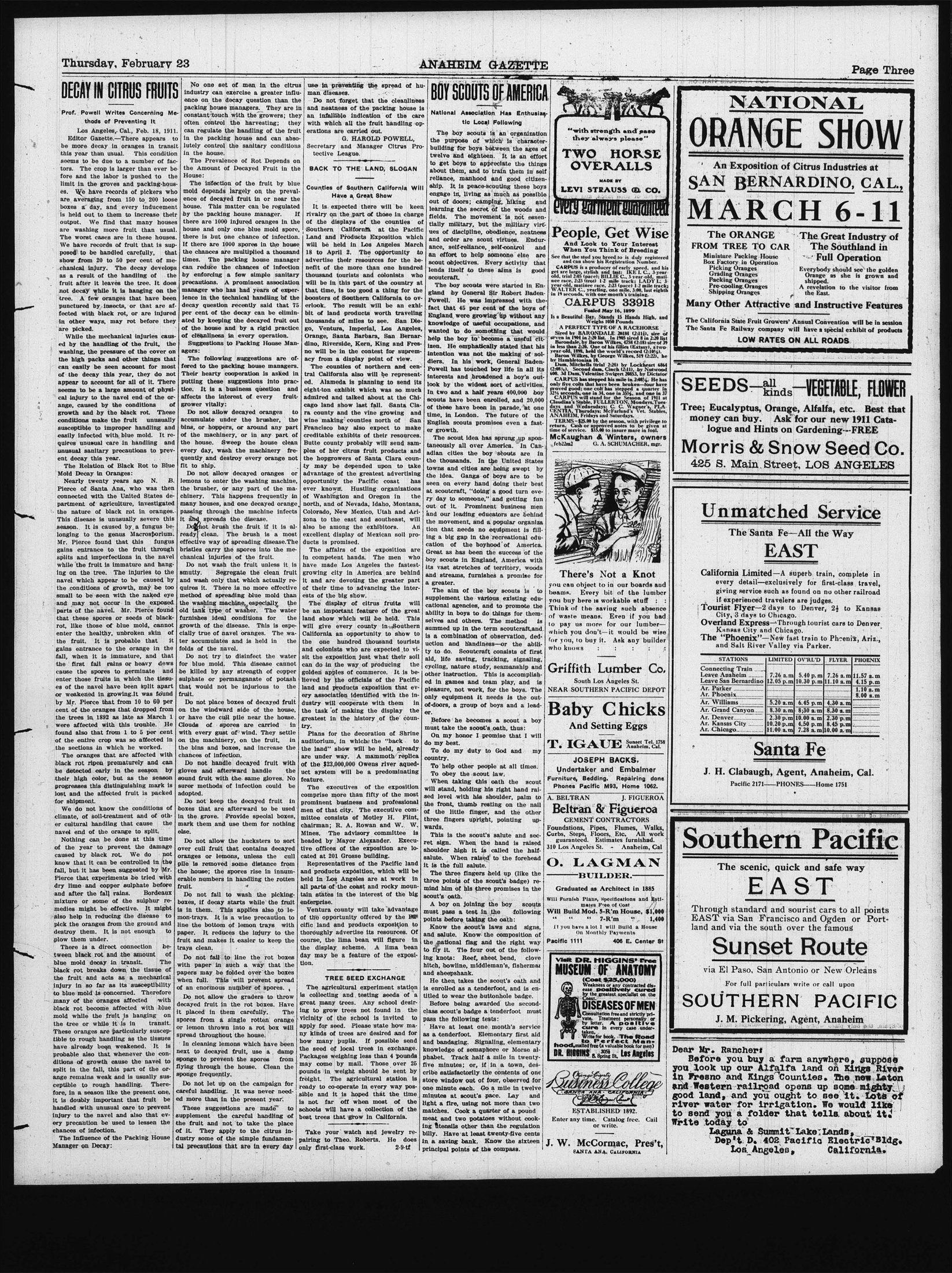
Searchable text
DECAY IN CITRUS FRUITS
Prof. Powell Writes Concerning Methods of Preventing It
Los Angeles, Cal., Feb. 18, 1911.
Editor Gazette.—There appears to be more decay in oranges in transit this year than usual. This condition seems to be due to a number of factors. The crop is larger than ever before and the labor is pushed to the limit in the groves and packing-houses. We have records of pickers who are averaging from 150 to 200 loose boxes a day, and every inducement is held out to them to increase their output. We find that many houses are washing more fruit than usual. The worst cases are in these houses. We have records of fruit that is supposed to be handled carefully, that show from 20 to 50 per cent of mechanical injury. The decay develops as a result of the handling of the fruit after it leaves the tree. It does not decay while it is hanging on the tree. A few oranges that have been punctured by insects, or that are affected with black rot, or are injured in other ways, may rot before they are picked.
While the mechanical injuries caused by the handling of the fruit, the washing, the pressure of the cover on the high packs and other things that can easily be seen account for most of the decay this year, they do not appear to account for all of it. There seems to be a large amount of physical injury to the navel end of the orange, caused by the conditions of growth and by the black rot. These conditions make the fruit unusually susceptible to improper handling and easily infected with blue mold. It requires unusual care in handling and unusual sanitary precautions to prevent decay this year.
The Relation of Black Rot to Blue Mold Decay in Oranges:
No one set of men in the citrus industry can exercise a greater influence on the decay question than the packing house managers. They are in constant touch with the growers; they often control the harvesting; they can regulate the handling of the fruit in the packing house and can absolutely control the sanitary conditions in the house.
The Prevalence of Rot Depends on the Amount of Decayed Fruit in the House:
The infection of the fruit by blue mold depends largely on the prevalence of decayed fruit in or near the house. This matter can be regulated by the packing house manager. If there are 1000 injured oranges in the house and only one blue mold spore, there is but one chance of infection. If there are 1000 spores in the house the chances are multiplied a thousand times. The packing house manager can reduce the chances of infection by enforcing a few simple sanitary precautions. A prominent association manager who has had years of experience in the technical handling of the decay question recently said that 75 per cent of the decay can be eliminated by keeping the decayed fruit out of the house and by a rigid practice of cleanliness in every operation.
Suggestions to Packing House Managers:
The following suggestions are offered to the packing house managers. Their hearty cooperation is asked in putting these suggestions into practice. It is a business question and affects the interest of every fruit-grower vitally:
Do not allow decayed oranges to accumulate under the brusher, the bins, or hoppers, or around any part of the machinery, or in any part of the house. Sweep the house clean every day, wash the machinery frequently and destroy every orange not fit to ship.
Do not allow decayed oranges or use in prevention man diseases.
Do not forget and neatness of an infallible insect with which all erations are carried.
G.H.
Secretary and Protective League
BACK TO THE COUNTIES OF SOUTHERN HAIRLAND AND PRODUCTION
It is expected rivalry on the plot of the displays in Southern California will be held in April 2nd. Advertise their need of the most thousand tourists will be in this year, is too boosters of Southwest look. The result bit of land produce thousands of miles go, Ventura, Impeach Orange, Santa Monica, Riverside, no will be in the acety from a dispersion.
The counties central California are ed. Alameda is eight-ton exhibit admired and tall cago land show ra county and th wine making county Francisco bay a creditable exhibitor Butte county problems of her citrus hopgrowers city may be deprived advantage of these
of the decay this year, they do not appear to account for all of it. There seems to be a large amount of physical injury to the navel end of the orange, caused by the conditions of growth and by the black rot. These conditions make the fruit unusually susceptible to improper handling and easily infected with blue mold. It requires unusual care in handling and unusual sanitary precautions to prevent decay this year.
The Relation of Black Rot to Blue Mold Decay in Oranges:
Nearly twenty years ago N. B. Pierce of Santa Ana, who was then connected with the United States department of agriculture, investigated the nature of black rot in oranges. This disease is unusually severe this season. It is caused by a fungus belonging to the genus Macrosporium. Mr. Pierce found that this fungus gains entrance to the fruit through splits and imperfections in the navel while the fruit is immature and hanging on the tree. The injuries to the navel which appear to be caused by the conditions of growth, may be too small to be seen with the naked eye and may not occur in the exposed parts of the navel. Mr. Pierce found that these spores or seeds of blackrot, like those of blue mold, cannot enter the healthy, unbroken skin of the fruit. It is probable that it gains entrance to the orange in the fall, when it is immature, and that the first fall rains or heavy dews cause the spores to germinate and enter those fruits in which the tissues of the navel have been split apart or weakened in growing. It was found by Mr. Pierce that from 10 to 60 per cent of the oranges that dropped from the trees in 1892 as late as March 1 were affected with this trouble. He found also that from 1 to 5 per cent of the entire crop was so affected in the sections in which he worked.
The oranges that are affected with black rot ripen prematurely and can be detected early in the season by their high color, but as the season progresses this distinguishing mark is lost and the affected fruit is packed for shipment.
We do not know the conditions of climate, of soil-treatment and of other cultural handling that cause the navel end of the orange to split.
Nothing can be done at this time of the year to prevent the damage caused by black rot. We do not know that it can be controlled in the fall, but it has been suggested by Mr. Pierce that experiments be tried with dry lime and copper sulphate before and after the fall rains. Bordeaux
Their nearly cooperation is asked in putting these suggestions into practice. It is a business question and affects the interest of every fruit-grower vitally:
Do not allow decayed oranges to accumulate under the brusher, the bins, or hoppers, or around any part of the machinery, or in any part of the house. Sweep the house clean every day, wash the machinery frequently and destroy every orange not fit to ship.
Do not allow decayed oranges or lemons to enter the washing machine, the brusher, or any part of the machinery. This happens frequently in many houses, and one decayed orange passing through the machine infects it and spreads the disease.
Do not brush the fruit if it is already clean. The brush is a most effective way of spreading disease. The bristles carry the spores into the mechanical injuries of the fruit.
Do not wash the fruit unless it is smutty. Segregate the clean fruit and wash only that which actually requires it. There is no more effective method of spreading blue mold than the washing machine, especially the old tank type of washer. The water furnishes ideal conditions for the growth of the disease. This is especially true of navel oranges. The water accumulates and is held in the folds of the navel.
Do not try to disinfect the water for blue mold. This disease cannot be killed by any strength of copper sulphate or permanganate of potash that would not be injurious to the fruit.
Do not place boxes of decayed fruit on the windward side of the house, or have the cull pile near the house. Clouds of spores are carried in with every gust of wind. They settle on the machinery, on the fruit, in the bins and boxes, and increase the chances of infection.
Do not handle decayed fruit with gloves and afterward handle the sound fruit with the same gloves. No surer methods of infection could be adopted.
Do not keep the decayed fruit in boxes that are afterward to be used in the grove. Provide special boxes, mark them and use them for nothing else.
Do not allow the hucksters to sort over cull fruit that contains decayed oranges or lemons, unless the cull pile is removed some distance from the house; the spores rise in innumerable numbers in handling the rotten fruit.
Do not fail to wash the picking-
We do not know the conditions of climate, of soil-treatment and of other cultural handling that cause the navel end of the orange to split.
Nothing can be done at this time of the year to prevent the damage caused by black rot. We do not know that it can be controlled in the fall, but it has been suggested by Mr. Pierce that experiments be tried with dry lime and copper sulphate before and after the fall rains. Bordeaux mixture or some of the sulphur remedies might be effective. It might also help in reducing the disease to pick the oranges from the ground and destroy them. It is not enough to plow them under.
There is a direct connection between black rot and the amount of blue mold decay in transit. The black rot breaks down the tissue of the fruit and acts as a mechanical injury in so far as its susceptibility to blue mold is concerned. Therefore many of the oranges affected with black rot become affected with blue mold while the fruit is hanging on the tree or while it is in transit. These oranges are particularly susceptible to rough handling as the tissues have already been weakened. It is probable also that whenever the conditions of growth cause the navel to split in the fall, this part of the orange remains weak and is usually susceptible to rough handling. Therefore, in a season like the present one, it is doubly important that fruit be handled with unusual care to prevent injury to the navel and also that every precaution be used to lessen the chances of infection.
The Influence of the Packing House Manager on Decay:
Do not keep the decayed fruit in boxes that are afterward to be used in the grove. Provide special boxes, mark them and use them for nothing else.
Do not allow the hucksters to sort over cull fruit that contains decayed oranges or lemons, unless the cull pile is removed some distance from the house; the spores rise in innumerable numbers in handling the rotten fruit.
Do not fail to wash the picking-boxes, if decay starts while the fruit is in them. This applies also to lemon-trays. It is a wise precaution to line the bottom of lemon trays with paper. It reduces the injury to the fruit and makes it easier to keep the trays clean.
Do not fail to line the rot boxes with paper in such a way that the papers may be folded over the boxes when full. This will prevent spread of an enormous number of spores.
Do not allow the graders to throw decayed fruit in the rot boxes. Have it placed in them carefully. The spores from a single rotten orange or lemon thrown into a rot box will spread throughout the house.
In cleaning lemons which have been next to decayed fruit, use a damp sponge to prevent the spores from flying through the house. Clean the sponge frequently.
Do not let up on the campaign for careful handling. It was never needed more than in the present year.
These suggestions are made to supplement the careful handling of the fruit and not to take the place of it. They apply to the citrus industry some of the simple fundamental precautions that are in every day prominent business men of that city.
Representatives and products expo held in Los Angeles all parts of the country states in their enterprise.
Ventura county of the opportunity cific land and thoroughly advertise course, the lima bldg display schedule day may be a feast.
TREE SEED
The agricultural is collecting and great many trees ing to grow trees vicinity of the so apply for seed. Piny kinds of trees how many pupils the seed of local Packages weighing may come by ma pounds in weight freight. The agr ready to co-operate sible and it is he is not far off w schools will have best trees that grow
Take your water pairing to Theo. Only first-class wo
ANAHEIM GAZETTE
use in preventing the spread of human diseases.
Do not forget that the cleanliness and neatness of the packing house is an infallible indication of the care with which all the fruit handling operations are carried out.
G. HAROLD POWELL,
Secretary and Manager Citrus Protective League.
BACK TO THE LAND, SLOGAN
Counties of Southern California Will Have a Great Show
It is expected there will be keen rivalry on the part of those in charge of the displays of the counties of Southern California at the Pacific Land and Products Exposition which will be held in Los Angeles March 18 to April 2. The opportunity to advertise their resources for the benefit of the more than one hundred thousand tourists and colonists who will be in this part of the country at that time, is too good a thing for the boosters of Southern California to overlook. The result will be an exhibit of land products worth traveling thousands of miles to see. San Diego, Ventura, Imperial, Los Angeles, Orange, Santa Barbara, San Bernardino, Riverside, Kern, King and Fresno will be in the contest for supremacy from a display point of view.
The counties of northern and central California also will be represented. Alameda is planning to send its eight-ton exhibit which was so much admired and talked about at the Chicago land show last fall. Santa Clara county and the vine growing and wine making counties north of San Francisco bay also expect to make creditable exhibits of their resources. Butte county probably will send samples of her citrus fruit products and the hopgrowers of Santa Clara county may be depended upon to take advantage of the greatest advertising
BOY SCOUTS OF AMERICA
National Association Has Enthusiastic Local Following
The boy scouts is an organization the purpose of which is character-building for boys between the ages of twelve and eighteen. It is an effort to get boys to appreciate the things about them, and to train them in self-reliance, manhood and good citizenship. It is peace-scouting these boys engage in, living as much as possible out of doors; camping, hiking and learning the secret of the woods and fields. The movement is not essentially military, but the military virtues of discipline, obedience, neatness and order are scout virtues. Endurance, self-reliance, self-control and an effort to help someone else are scout objectives. Every activity that lends itself to these aims is good scoutcraft.
The boy scouts were started in England by General Sir Robert Baden-Powell. He was impressed with the fact that 45 per cent of the boys of England were growing up without any knowledge of useful occupations, and wanted to do something that would help the boy to become a useful citizen. He emphatically stated that his intention was not the making of soldiers. In his work, General Baden-Powell has touched boy life in all its interests and broadened a boy's outlook by the widest sort of activities. In two and a half years 400,000 boy scouts have been enrolled, and 20,000 of these have been in parade, at one time, in London. The future of the English scouts promises even a faster growth.
The scout idea has sprung up spontaneously all over America. In Canadian cities the boy scouts are in the thousands. In the United States towns and cities are being swept by ideas.
"with strength and ease they always please"
TWO HORSE OVERALLS
MADE BY LEVI STRAUSS & CO.
People, Get Wise
And Look to Your Interest When You Think of Breeding
See that the stud you breed to is duly registered and can show his Registration Number.
CARPUS is a producer of early speed, and his get are large, stylish and fast: IKE L. C., 3-year-old, trial 2:05 (pace); BILLIE C., 3-year-old, matinee race; 2:23 (trot) 1-2 mile track; LADY L.; 3-year-old, matinee race; 2:23 (pace) 1-2 mile track; WALTER C., yearling, one mile, 3:00, last eighth in 19 seconds, with one month's training.
CARPUS 33918
Foaled May 16, 1899
Is a Beautiful Bay, Stands 15 Hands High, and Weights 1050 Pounds
A PERFECT TYPE OF A RACEHorse
Sired by BARONDALE 20184 (2:111), sire of seven in 1904 in 2:20 list. In 1905 sired 8 in 2:20 list Barondale, by Baron Wilkes, 4758 (2:18) sire of 39 in less than 2:20. One of his fillies (Extasy), a two-year-old, 1898, held the world's record (2:10%).
Baron Wilkes, by George Wilkes, 519 (2:22), he by Hambletonian 10.
Dam, Mitchella (trial 2:24) by Lockheart 6864 (2:08%). Second dam, Cinch (2:11), by Nutwood 600. 3d Dam, Valentine Swigert 20535, by Dictator
CARPUS has stepped his mile in 2:08%. He has only five colts that have been broken—four have proved good; one colt has stepped a quarter in 32½ seconds, one in 34, one in 35%, and one in 37 CARPUS will stand for the Season of 1911 at Claudina's Stable, FULLERTON, Mondays,Tuesdays and Wednesdays; C. C. Wagner's PLACENTIA, Thursdays; McFarland's Vet. Stables, ANAHEIM, Fridays and Saturdays.
TERMS-$25.00 by the season, with privilege to return. Cash or approved notes to be given at time of service. $35.00 to insure mare in foal.
McKaughan & Winters, owners
feb22m2
G. A. SCHUMACHER, mgr.
Alameda is planning to send its eight-ton exhibit which was so much admired and talked about at the Chicago land show last fall. Santa Clara county and the vine growing and wine making counties north of San Francisco bay also expect to make creditable exhibits of their resources. Butte county probably will send samples of her citrus fruit products and the hopgrowers of Santa Clara county may be depended upon to take advantage of the greatest advertising opportunity the Pacific coast has ever known. Hustling organizations of Washington and Oregon in the north, and of Nevada, Idaho, Montana, Colorado, New Mexico, Utah and Arizona to the east and southeast, will also be among the exhibitors. An excellent display of Mexican soil products is promised.
The affairs of the exposition are in competent hands. The men who have made Los Angeles the fastest-growing city in America are behind it and are devoting the greater part of their time to advancing the interests of the big show.
The display of citrus fruits will be an important feature of the great land show which will be held. This will give every county in Southern California an opportunity to show to the one hundred thousand tourists and colonists who are expected to visit the exposition just what their soil can do in the way of producing the golden apples of commerce. It is believed by the officials of the Pacific land and products exposition that every association identified with the industry will cooperate with them in the task of making the display the greatest in the history of the country.
Plans for the decoration of Shrine auditorium, in which the "back to the land" show will be held, already are under way. A mammoth replica of the $23,000,000 Owens river aqueduct system will be a predominating feature.
The executives of the exposition comprise more than fifty of the most prominent business and professional men of that city. The executive committee consists of Motley H. Flint, chairman; R. A. Rowan and W. W. Mines. The advisory committee is headed by Mayor Alexander. Executive offices of the exposition are located at 201 Grosse building.
Representatives of the Pacific land and products exposition, which will be held in Los Angeles are at work in all parts of the coast and rocky mountain states in the interest of the big interests and broadened a boy's outlook by the widest sort of activities. In two and a half years 400,000 boy scouts have been enrolled, and 20,000 of these have been in parade, at one time, in London. The future of the English scouts promises even a faster growth.
The scout idea has sprung up spontaneously all over America. In Canadian cities the boy scouts are in the thousands. In the United States towns and cities are being swept by the idea. Gangs of boys are to be seen on every hand doing their best at scoutcraft, "doing a good turn every day to someone," and getting fun out of it. Prominent business men and our leading educators are behind the movement, and a popular organization that needs no equipment is filling a big gap in the recreational education of the boyhood of America. Great as has been the success of the boy scouts in England, America with its vast stretches of territory, woods and streams, furnishes a promise for a greater.
The aim of the boy scouts is to supplement the various existing educational agencies, and to promote the ability in boys to do things for themselves and others. The method is summed up in the term scoutcraft, and is a combination of observation, deduction and handiness—or the ability to do. Scoutcraft consists of first aid, life saving, tracking, signaling, cycling, nature study, seamanship and other instruction. This is accomplished in games and team play, and is pleasure, not work, for the boys. The only equipment it needs is the out-of-doors, a group of boys and a leader.
Before he becomes a scout a boy must take the scout's oath, thus:
On my honor I promise that I will do my best.
To do my duty to God and my country.
To help other people at all times.
To obey the scout law.
When taking this oath the scout will stand, holding his right hand raised level with his shoulder, palm to the front, thumb resting on the nail of the little finger, and the other three fingers upright, pointing upwards.
This is the scout's salute and secret sign. When the hand is raised shoulder high it is called the half-salute. When raised to the forehead it is the full salute.
The three fingers held up (like the three points of the scout's badge) remind him of his three promises in the scout's oath.
There's Not a Knot you can object to in our boards and beams. Every bit of the lumber you buy here is workable stuff: Think of the saving such absence of waste means. Even if you had to pay us more for our lumber—which you don't—it would be wise for you, to buy it. Ask any builder who knows:
prominent business and professional men of that city. The executive committee consists of Motley H. Flint, chairman; R. A. Rowan and W. W. Mines. The advisory committee is headed by Mayor Alexander. Executive offices of the exposition are located at 201 Grosse building.
Representatives of the Pacific land and products exposition, which will be held in Los Angeles are at work in all parts of the coast and rocky mountain states in the interest of the big enterprise.
Ventura county will take advantage of the opportunity offered by the Pacific land and products exposition to thoroughly advertise its resources. Of course, the lima bean will figure in the display scheme. A lima bean day may be a feature of the exposition.
TREE SEED EXCHANGE
The agricultural experiment station is collecting and testing seeds of a great many trees. Any school desiring to grow trees not found in the vicinity of the school is invited to apply for seed. Please state how many kinds of trees are desired and for how many pupils. If possible send the seed of local trees in exchange. Packages weighing less than 4 pounds may come by mail. Those over 25 pounds in weight should be sent by freight. The agricultural station is ready to co-operate in every way possible and it is hoped that the time is not far off when most of the schools will have a collection of the best trees that grow in California.
Take your watch and jewelry repairing to Theo. Roberts. He does only first-class work.
2-9-tf
NATIONAL
ORANGE SHOW
An Exposition of Citrus Industries at
SAN BERNARDINO, CAL.,
MARCH 6-11
The ORANGE
FROM TREE TO CAR
Miniature Packing House
Box Factory in Operation
Picking Oranges
Grading Oranges
Packing Oranges
Pre-cooling.Oranges
Shipping Oranges
The Great Industry of
The Southland in
Full Operation
Everybody should see the golden
Orange as she is grown and
shipped.
A revelation to the visitor from
the East.
Many Other Attractive and Instructive Features
The California State Fruit Growers' Annual Convention will be in session
The Santa Fe Railway company will have a special exhibit of products
LOW RATES ON ALL ROADS
SEEDS—all kinds—VEGETABLE, FLOWER
Tree; Eucalyptus, Orange, Alfalfa, etc. Best that money can buy. Ask for our new 1911 Catalogue and Hints on Gardening---FREE
Morris & Snow Seed Co.
425 S. Main Street, LOS ANGELES
SEEDS—all kinds—VEGETABLE, FLOWER
Tree; Eucalyptus, Orange, Alfalfa, etc. Best that money can buy. Ask for our new 1911 Catalogue and Hints on Gardening—FREE
Morris & Snow Seed Co.
425 S. Main Street, LOS ANGELES
Unmatched Service
The Santa Fe—All the Way
EAST
California Limited—A superb train, complete in every detail—exclusively for first-class travel, giving service such as found on no other railroad if experienced travelers are judges.
Tourist Flyer—2 days to Denver, 2½ to Kansas City, 3 days to Chicago.
Overland Express—Through tourist cars to Denver, Kansas City and Chicago.
The "Phoenix"—New fast train to Phoenix, Ariz., and Salt River Valley via Parker.
STATIONS
Connecting Train ...
Leave Anaheim ...
Leave San Bernardino ...
Ar. Parker ...
Ar. Phoenix ...
Ar. Williams ...
Ar. Grand Canyon ...
Ar. Denver ...
Ar. Kansas City ...
Ar. Chicago ...
LIMITED
7.26 a.m.
12.05 p.m.
OV'RL'D
5.40 p.m.
10.30 p.m.
FLYER
7.26 a.m.
11.10 a.m.
1.10 a.m.
8.00 a.m.
PHOENIX
11.57 a.m.
4.15 p.m.
Santa Fe
J. H. Clabaugh, Agent, Anaheim, Cal.
Pacific 2171—PHONES—Home 1751
Southern Pacific
The scenic, quick and safe way
EAST
Southern Pacific
The scenic, quick and safe way
EAST
Through standard and sourist cars to all points
EAST via San Francisco and Ogden or Portland and via the south over the famous
Sunset Route
via El Paso, San Antonio or New Orleans
For full particulars write or call upon
SOUTHERN PACIFIC
J. M. Pickering, Agent, Anaheim
Dear Mr. Ranchers:
Before you buy a farm anywhere, suppose you look up our Alfalfa land on Kings River in Fresno and Kings Counties. The new Laton and Western railroad opens up some mighty good land, and you ought to see it. Lots of river water for irrigation. We would like to send you a folder that tells about it.
Write today to
Laguna & Summit Lake Lands,
Dep't D. 402 Pacific Electric Bldg.
Los Angeles, California.