anaheim-gazette 1911-02-16
Scanned page
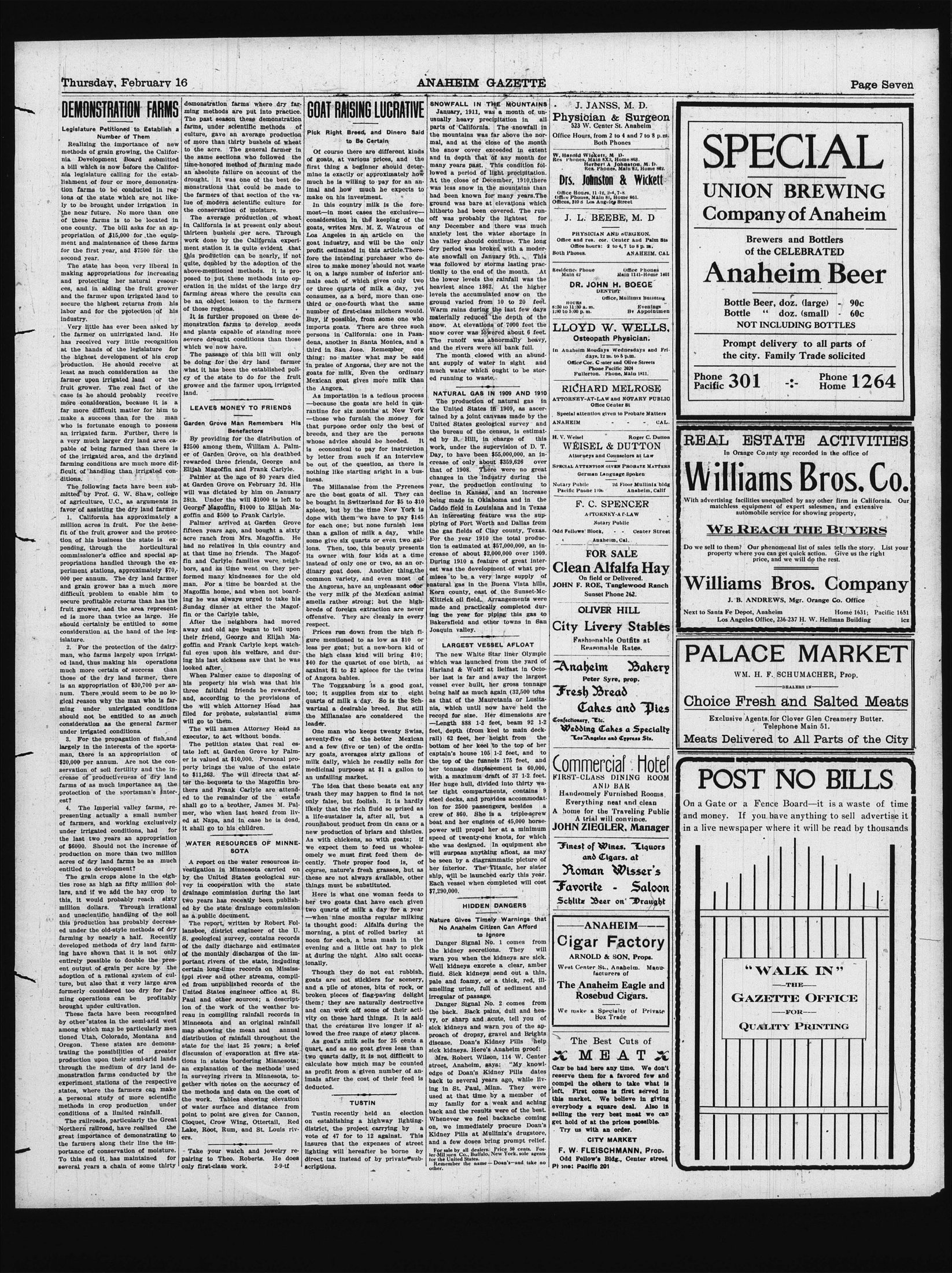
Searchable text
DEMONSTRATION FARMS
Legislature Petitioned to Establish a Number of Them
Realizing the importance of new methods of grain growing, the California Development Board submitted a bill which is now before the California legislature calling for the establishment of four or more demonstration farms to be conducted in regions of the state which are not likely to be brought under irrigation in the near future. No more than one of these farms is to be located in one county. The bill asks for an appropriation of $15,000 for the equipment and maintenance of these farms for the first year, and $7500 for the second year.
The state has been very liberal in making appropriations for increasing and protecting her natural resources, and in aiding the fruit grower and the farmer upon irrigated land to secure the highest returns from his labor and for the protection of his industry.
Very little has ever been asked by the farmer on unirrigated land. He has received very little recognition at the hands of the legislature for the highest development of his crop production. He should receive at least as much consideration as the farmer upon irrigated land or the fruit grower. The real fact of the case is he should probably receive more consideration, because it is a far more difficult matter for him to make a success than for the man who is fortunate enough to possess an irrigated farm. Further, there is a very much larger dryland area capable of being farmed than there is of the irrigated area, and the dryland farming conditions are much more difficult of handling than irrigated con-
demonstration farms where dry farming methods are put into practice. The past season these demonstration farms, under scientific methods of culture, gave an average production of more than thirty bushels of wheat to the acre. The general farmer in the same sections who followed the time-honored method of farming made an absolute failure on account of the drought. It was one of the best demonstrations that could be made to the farmers of that section of the value of modern scientific culture for the conservation of moisture.
The average production of wheat in California is at present only about thirteen bushels per acre. Through work done by the California experiment station it is quite evident that this production can be nearly, if not quite, doubled by the adoption of the above-mentioned methods. It is proposed to put these methods into operation in the midst of the large dry farming areas where the results can be an object lesson to the farmers of those regions.
It is further proposed on these demonstration farms to develop seeds and plants capable of standing more severe drought conditions than those which we now have.
The passage of this bill will only be doing for the dry land farmer what it has been the established policy of the state to do for the fruit grower and the farmer upon irrigated land.
LEAVES MONEY TO FRIENDS
Garden Grove Man Remembers His Benefactors
By providing for the distribution of $2500 among them, William A. Palmer of Garden Grove, on his deathbed rewarded three friends, George and Elijah Magoffin and Frank Carlyle.
farmer upon irrigated land or the fruit grower. The real fact of the case is he should probably receive more consideration, because it is a far more difficult matter for him to make a success than for the man who is fortunate enough to possess an irrigated farm. Further, there is a very much larger dry land area capable of being farmed than there is of the irrigated area, and the dryland farming conditions are much more difficult of handling than irrigated conditions.
The following facts have been submitted by Prof. G. W. Shaw, college of agriculture, U.C., as arguments in favor of assisting the dry land farmer
1. California has approximately a million acres in fruit. For the benefit of the fruit grower and the protection of his business the state is expending, through the horticultural commissioner's office and special appropriations handled through the experiment stations, approximately $70,000 per annum. The dry land farmer and grain grower has a much more difficult problem to enable him to secure profitable returns than has the fruit grower, and the area represented is more than twice as large. He should certainly be entitled to some consideration at the hand of the legislature.
2. For the protection of the dairy-man, who farms largely upon irrigated land, thus making his operations much more certain of success than those of the dry land farmer, there is an appropriation of $30,700 per annum. There would seem to be no logical reason why the man who is farming under unirrigated conditions should not be entitled to as much consideration as the general farmer under irrigated conditions.
3. For the propagation of fish, and largely in the interests of the sportsman, there is an appropriation of $20,000 per annum. Are not the conservation of soil fertility and the increase of productiveness of dry land farms of as much importance as the protection of the sportsman's interest?
4. The Imperial valley farms, representing actually a small number of farmers, and working exclusively under irrigated conditions, had for the last two years an appropriation of $6000. Should not the increase of production on more than two million acres of dry land farms be as much entitled to development?
The grain crops alone in the eighties rose as high as fifty million dollars, and if we add the hay crop to this it would probably reach sixty-
LEAVES MONEY TO FRIENDS
Garden Grove Man Remembers His Benefactors
By providing for the distribution of $2500 among them, William A. Palmer of Garden Grove, on his deathbed rewarded three friends, George and Elijah Magoffin and Frank Carlyle.
Palmer at the age of 80 years died at Garden Grove on February 2d. His will was dictated by him on January 28th. Under the will $1000 is left to George Magoffin, $1000 to Elijah Magoffin and $500 to Frank Carlyle.
Palmer arrived at Garden Grove fifteen years ago, and bought a sixty-acre ranch from Mrs. Magoffin. He had no relatives in this country and at that time no friends. The Magoffin and Carlyle families were neighbors, and as time went on they performed many kindnesses for the old man. For a time he boarded at the Magoffin home, and when not boarding he was always urged to take his Sunday dinner at either the Magoffin or the Carlyle table.
After the neighbors had moved away and old age began to tell upon their friend, George and Elijah Magoffin and Frank Carlyle kept watchful eyes upon his welfare, and during his last sickness saw that he was looked after.
When Palmer came to disposing of his property his wish was that his three faithful friends be rewarded, and according to the provisions of the will which Attorney Head has filed for probate, substantial sums will go to them.
The will names Attorney Head as executor, to act without bonds.
The petition states that real estate left at Garden Grove by Palmer is valued at $10,000. Personal property brings the value of the estate to $11,263. The will directs that after the bequests to the Magoffin brothers and Frank Carlyle are attended to the remainder of the estate shall go to a brother, James M. Palmer, who when last heard from lived at Napa, and in case he is dead, it shall go to his children.
WATER RESOURCES OF MINNESOTA
A report on the water resources investigation in Minnesota carried on by the United States geological survey in cooperation with the state drainage commission during the last two years has recently been published.
As importation—because the grantant for six—these who furnish that purpose on breeds, and these whose advice is economical by letter from be out of the nothing like stairiness.
The Millanais are the best goats be bought in Swain apiece, but by the dope with them for each one; but than a gallon or some give six quilons. Then, too its owner with instead of only dinary goat does common variety; the Angoras, having the very milk gourds smells rather breds of foreign offensive. They respect.
Prices run due gure mentioned less per goat; but the high class $40 for the qua-gainst $1 to $2 of Angora babies.
The Togganbob too; it supplies quartz of milk a wartzal a desirethe Millanaise leader.
One man who seventy-five of and a few (five arry goats, avera milk daily, which medicinal purpo-an unfailing man.
The idea that trash they may only false, but likely that the m a life-sustainer roundabout produc new production As with chickens we expect them omely we must cently. Their p course, nature's these are not all things must be Here is what
4. The Imperial valley farms, representing actually a small number of farmers, and working exclusively under irrigated conditions, had for the last two years an appropriation of $6000. Should not the increase of production on more than two million acres of dry land farms be as much entitled to development?
The grain crops alone in the eighties rose as high as fifty million dollars, and if we add the hay crop to this, it would probably reach sixty million dollars. Through irrational and unscientific handling of the soil this production has probably decreased under the old-style methods of dry farming by nearly a half. Recently developed methods of dry land farming have shown that it is not only entirely possible to double the present output of grain per acre by the adoption of a rational system of culture, but also that a very large area formerly considered too dry for farming operations can be profitably brought under cultivation.
These facts have been recognized by other states in the semi-arid west among which may be particularly mentioned Utah, Colorado, Montana and Oregon. These states are demonstrating the possibilities of greater production upon their semi-arid lands through the medium of dry land demonstration farms conducted by the experiment stations of the respective states, where the farmers can make a personal study of more scientific methods in crop production under conditions of a limited rainfall.
The railroads, particularly the Great Northern railroad, have realized the great importance of demonstrating to the farmers along their line the importance of conservation of moisture. To this end it has maintained for several years a chain of some thirty
WATER RESOURCES OF MINNESOTA
A report on the water resources investigation in Minnesota carried on by the United States geological survey in cooperation with the state drainage commission during the last two years has recently been published by the state drainage commission as a public document.
The report, written by Robert Follansbee, district engineer of the U.S. geological survey, contains records of the daily discharge and estimates of the monthly discharges of the important rivers of the state, including certain long-time records on Mississippi river and other streams, compiled from unpublished records of the United States engineer office at St. Paul and other sources; a description of the work of the weather bureau in compiling rainfall records in Minnesota and an original rainfall map showing the mean and annual distribution of rainfall throughout the state for the last 25 years; a brief discussion of evaporation at five stations in states bordering Minnesota; an explanation of the methods used in surveying rivers in Minnesota, together with notes on the accuracy of the methods and data on the cost of the work. Tables showing elevation of water surface and distance from point to point are given for Cannon, Cloquet, Crow Wing, Ottertail, Red Lake, Root, Rum, and St. Louis rivers.
Take your watch and jewelry repairing to Theo. Roberts. He does only first-class work.
ANAHEIM GAZETTE
GOAT RAISING LUCRATIVE
Pick Right Breed, and Dinero Said to Be Certain
Of course there are different kinds of goats, at various prices, and the first thing a beginner should determine is exactly or approximately how much he is willing to pay for an animal and how much he expects to make on his investment.
In this country milk is the foremost—in most cases the exclusive—consideration in the keeping of the goats, writes Mrs. M. Z. Watrous of Los Angeles in an article on the goat industry, and will be the only profit estimated in this article. Therefore the intending purchaser who desires to make money should not waste it on a large number of inferior animals each of which gives only two or three quarts of milk a day, yet consumes, as a herd, more than one-third or one-fourth what the same number of first-class milchers would. Buy, if possible, from some one who imports goats. There are three such persons in California: one in Pasadena, another in Santa Monica, and a third in San Jose. Remember one thing: no matter what may be said in praise of Angoras, they are not the goats for milk. Even the ordinary Mexican goat gives more milk than the Angora.
As importation is a tedious process—because the goats are held in quarantine for six months at New York—those who furnish the money for that purpose order only the best of breeds, and they are the persons whose advice should be heeded. It is economical to pay for instruction by letter from such if an interview be out of the question, as there is nothing like starting aright in a bus-
SNOWFALL IN THE MOUNTAINS
January, 1911, was a month of unusually heavy precipitation in all parts of California. The snowfall in the mountains was far above the normal, and at the close of the month the snow cover exceeded in extent and in depth that of any month for many years past. This condition followed a period of light precipitation. At the close of December, 1910, there was less snow in the mountains than had been known for many years. The ground was bare at elevations which hitherto had been covered. The runoff was probably the lightest for any December and there was much anxiety lest the water shortage in the valley should continue. The long dry period was broken with a moderate snowfall on January 9th. This was followed by storms lasting practically to the end of the month. At the lower levels the rainfall was the heaviest since 1862. At the higher levels the accumulated snow on the ground varied from 10 to 20 feet. Warm rains during the last few days materially reduced the depth of the snow. At elevations of 7000 feet the snow cover was lowered about 6 feet. The runoff was abnormally heavy, and the rivers were all bank full.
NATURAL GAS IN 1909 AND 1910
The production of natural gas in the United States in 1909, as ascertained by a joint canvass made by the United States geological survey and the bureau of the census, is estimated by B. Hill, in charge of this work, under the supervision of D. T. Day, to have been $55,000,000, an increase of only about $359,626 over that of 1908. There were no great
As importation is a tedious process—because the goats are held in quarantine for six months at New York—those who furnish the money for that purpose order only the best of breeds, and they are the persons whose advice should be heeded. It is economical to pay for instruction by letter from such if an interview be out of the question, as there is nothing like starting a right in a business.
The Millanaise from the Pyrenees are the best goats of all. They can be bought in Switzerland for $5 to $10 apiece, but by the time New York is done with them we have to pay $145 for each one; but none furnish less than a gallon of milk a day, while some give six quarts or even two gallons. Then, too, this beauty presents its owner with four kids at a time instead of only one or two, as an ordinary goat does. Another thing, the common variety, and even most of the Angoras, have an unpleasant odor the very milk of the Mexican animal smells rather strong; but the high-breds of foreign extraction are never offensive. They are cleanly in every respect.
Prices run down from the high figure mentioned to as low as $10 or less per goat; but a new-born kid of the high class kind will bring $10; $40 for the quartet of one birth, as against $1 to $2 apiece for the twins of Angora babies.
The Togganburg is a good goat, too; it supplies from six to eight quarts of milk a day. So is the Schwartzal a desirable breed. But still the Millanaise are considered the leader.
One man who keeps twenty Swiss, seventy-five of the better Mexican and a few (five or ten) of the ordinary goats, averages sixty gallons of milk daily, which he readily sells for medicinal purposes at $1 a gallon to an unfailing market.
The idea that these beasts eat any trash they may happen to find is not only false, but foolish. It is hardly likely that the rich fluid so prized as a life-sustainer is, after all, but a roundabout product from tin cans or a new production of briars and thistles. As with chickens, so with goats; if we expect them to feed us wholesomely we must first feed them decently. Their proper food is, of course, nature's fresh grasses, but as these are not always available, other things must be substituted.
Here is what one woman feeds to running to waste.
NATURAL GAS IN 1909 AND 1910
The production of natural gas in the United States in 1909, as ascertained by a joint canvass made by the United States geological survey and the bureau of the census, is estimated by B. Hill, in charge of this work, under the supervision of D. T. Day, to have been $55,000,000, an increase of only about $359,626 over that of 1908. There were no great changes in the industry during the year, the production continuing to decline in Kansas, and an increase being made in Oklahoma and in the Caddo field in Louisiana and in Texas. An interesting feature was the supplying of Fort Worth and Dallas from the gas fields of Clay county, Texas. For the year 1910 the total production is estimated at $57,000,000, an increase of about $2,000,000 over 1909. During 1910 a feature of great interest was the development of what promises to be a very large supply of natural gas in the Buena Vista hills, Kern county, east of the Sunset-McKittrick oil field. Arrangements were made and practically completed during the year for piping this gas to Bakersfield and other towns in San Joaquin valley.
LARGEST VESSEL AFLOAT
The new White Star liner Olympic which was launched from the yard of Harland & Wolff at Belfast in October last is far and away the largest vessel ever built, her gross tonnage being half as much again (32,500 tons as that of the Mauretania or Lusitania, which until now have held the record for size. Her dimensions are—Length 888 1-2 feet, beam 92 1-2 feet, depth (from keel to main deckrail) 62 feet, her height from the bottom of her keel to the top of her captain's house 105 1-2 feet, and to the top of the funnels 175 feet, and her tonnage displacement is 60,000, with a maximum draft of 37 1-2 feet. Her huge hull, divided into thirty water tight compartments, contains 9 steel decks, and provides accommodation for 2500 passengers, besides a crew of 860. She is a triple-screw boat and her engines of 45,000 horsepower will propel her at a minimum speed of twenty-one knots, for which she was designed. In equipment she will surpass anything afloat, as may be seen by a diagrammatic picture of her interior. The Titanic, her sister ship, will be launched early this year. Each vessel when completed will cost $7,290,000.
only false, but foolish. It is hardly likely that the rich fluid so prized as a life-sustainer is, after all, but a roundabout product from tin cans or a new production of briars and thistles. As with chickens, so with goats; if we expect them to feed us wholesomely we must first feed them decently. Their proper food is, of course, nature's fresh grasses, but as these are not always available, other things must be substituted.
Here is what one woman feeds to her two goats that have each given two quarts of milk a day for a year—when nine months regular milking is thought good: Alfalfa during the morning, a pint of rolled barley at noon for each, a bran mash in the evening and a little oat hay to pick at during the night. Also salt occasionally.
Though they do not eat rubbish, goats are not sticklers for scenery, and a pile of stones, bits of rock, or broken pieces of flag-paving delight them; they are naturally destructive and can work off some of their activity on these hard things. It is said that the creatures live longer if allowed the free range of stony places.
As goat's milk sells for 25 cents a quart, and as no goat gives less than two quarts daily, it is not difficult to calculate how much may be counted as profit from a given number of animals after the cost of their feed is deducted.
TUSTIN
Tustin recently held an election on establishing a highway lighting district, the project carrying by a vote of 47 for to 12 against. This insures that the expenses of street lighting will hereafter be borne by direct tax instead of by private subscriptions.
HIDDEN DANGERS
Nature Gives Timely Warnings that No Anaheim Citizen Can Afford to Ignore
Danger Signal No. 1 comes from the kidney secretions. They will warn you when the kidneys are sick. Well kidneys excrete a clear, amber fluid. Sick kidneys send out a thin, pale and foamy, or a thick, red, ill-smelling urine, full of sediment and irregular of passage.
Danger Signal No. 2 comes from the back. Back pains, dull and heavy, or sharp and acute, tell you of sick kidneys and warn you of the approach of dropsy, gravel and Brights disease. Doan's Kidney Pills help sick kidneys. Here's Anaheim proof:
Mrs. Robert Wilson, 114 W. Center street, Anaheim, says: "My knowledge of Doan's Kidney Pills dates back to several years ago, while living in St. Paul, Minn. They were used at that time by a member of my family for a weak and aching back and the results were of the best. Whenever we feel backache coming on, we immediately procure Doan's Kidney Pills at Mullinix's drugstore, and a few doses bring prompt relief.
For sale by all dealers: Price 50 cents. Foster-Milburn Co., Buffalo, New York, sole agents for the United States.
Remember the name—Doan's—and take no other.
Everything neat and clean
A home for the Traveling Public
A trial will convince.
JOHN ZIEGLER, Manager
ANAHEIM
Cigar Factory
ARNOLD & SON, Props.
West Center St., Anaheim. Manufacturers of
The Anaheim Eagle and Rosebud Cigars.
We make a Specialty of Private Box Trade
The Best Cuts of MEAT
Can be had here any time. We don't reserve them for a favored few and compel the others to take what is left. First come is first served in this market. We believe in giving everybody a square deal. Also in selling the very best meat we can get hold of at the prices possible.
Try us with an order.
CITY MARKET
F. W. FLEISCHMANN, Prop.
Odd Fellow's Bldg., Center street
Phone: Pacific 201
SPECIAL
UNION BREWING
Company of Anaheim
Brewers and Bottlers
of the CELEBRATED
Anaheim Beer
Bottle Beer, doz. (large) - 90c
Bottle “doz. (small) - 60c
NOT INCLUDING BOTTLES
Prompt delivery to all parts of
the city. Family Trade solicited
Phone Pacific 301 - Phone Home 1264
REAL ESTATE ACTIVITIES
In Orange County are recorded in the office of
RD MELROSE
LAW and NOTARY PUBLIC
Office Center 8t
given to Probate Matters
CAL.
Roger C. Dutton
L & DUTTON
and Counselors at Law
2d Floor Mullinix bldg
Anaheim, Calif.
SPENCER
ORNEY-A-P-LAW
Notary Public
Center Street
Anaheim, Cal.
DR SALE
Alfalfa Hay
ld or Delivered.
E, Tanglewood Ranch
set Phone 262.
VER HILL
very Stables
nable Outfits at
annable Rates.
Im Bakery
r Syre, prop.
Bread
mes and Pies
Etc.
Cakes a Specialty
eles and Express Sts.
mercial Hotel
SS DINING ROOM
AND BAR
Furnished Rooms
ing neat and clean
the Traveling Public
will convince.
GLER, Manager
Wines, Liquors
Tigars, at
n Wisser's
e - Saloon
Phone 301 :: Phone 1264
REAL ESTATE ACTIVITIES
In Orange County are recorded in the office of
Williams Bros. Co.
With advertising facilities unequalled by any other firm in California. Our matchless equipment of expert salesmen, and extensive automobile service for showing property,
WE REACH THE BUYERS
Do we sell to them? Our phenomenal list of sales tells the story. List your property where you can get quick action. Give us the right price, and we will do the rest.
Williams Bros. Company
J. B. ANDREWS, Mgr. Orange Co. Office
Next to Santa Fe Depot, Anaheim Home 1631; Pacific 1651
Los Angeles Office, 236-237 H. W. Hellman Building icz
PALACE MARKET
WM. H. F. SCHUMACHER, Prop.
DEALERS IN
Choice Fresh and Salted Meats
Exclusive Agents for Clover Glen Creamery Butter.
Telephone Main 51.
Meats Delivered to All Parts of the City
POST NO BILLS
On a Gate or a Fence Board—it is a waste of time and money. If you have anything to sell advertise it in a live newspaper where it will be read by thousands
On a Gate or a Fence Board—it is a waste of time and money. If you have anything to sell advertise it in a live newspaper where it will be read by thousands
"WALK IN"
THE
GAZETTE OFFICE
FOR
QUALITY PRINTING