anaheim-gazette 1911-02-02
Scanned page
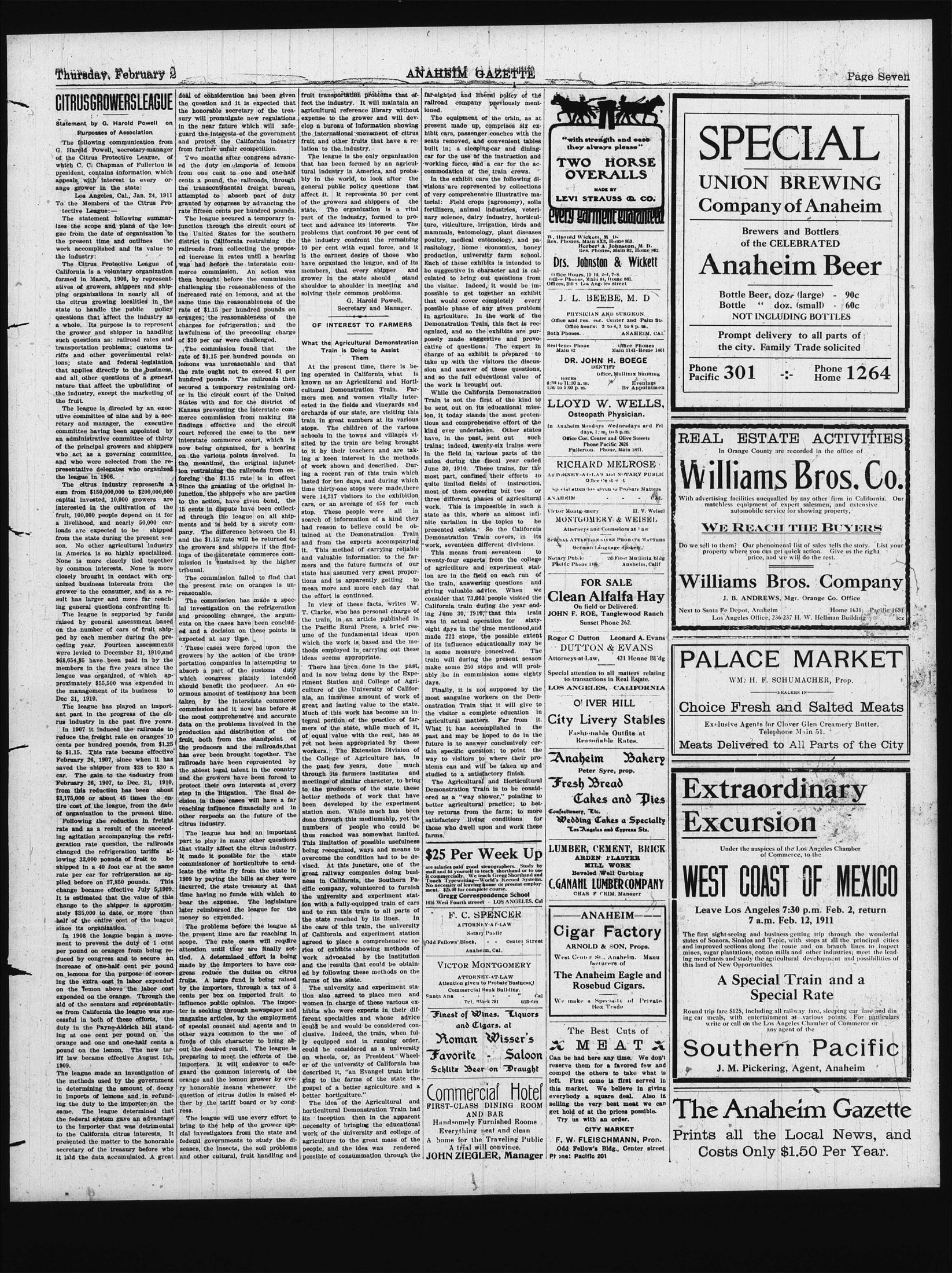
Searchable text
CITRUS GROWERS LEAGUE
Statement by G. Harold Powell on Purposes of Association.
The following communication from G. Harold Powell, secretary-manager of the Citrus Protective League, of which C. C. Chapman of Fullerton is president, contains information which appeals with interest to every orange grower in the state:
Los Angeles, Cal., Jan. 24, 1911
To the Members of the Citrus Protective League:—
The statement following summarizes the scope and plans of the league from the date of organization to the present time and outlines the work accomplished and its value to the industry:
The Citrus Protective League of California is a voluntary organization formed in March, 1906, by representatives of growers, shippers and shipping organizations in nearly all of the citrus growing localities in the state to handle the public policy questions that affect the industry as a whole. Its purpose is to represent the grower and shipper in handling such questions as: railroad rates and transportation problems; customs tariffs and other governmental relations; state and federal legislation that applies directly to the business, and all other questions of a general nature that affect the upbuilding of the industry, except the marketing of the fruit.
The league is directed by an executive committee of nine and by a secretary and manager, the executive committee having been appointed by an administrative committee of thirty of the principal growers and shippers who act as a governing committee, and who were selected from the representative delegates who organized deal of consideration has been given the question and it is expected that the honorable secretary of the treasury will promulgate new regulations in the near future which will safeguard the interests of the government and protect the California industry from further unfair competition.
Two months after congress advanced the duty on imports of lemons from one cent to one and one-half cents a pound, the railroads, through the transcontinental freight bureau, attempted to absorb part of duty granted by congress by advancing the rate fifteen cents per hundred pounds.
The league secured a temporary injunction through the circuit court of the United States for the southern district in California restraining the railroads from collecting the proposed increase in rates until a hearing was had before the interstate commerce commission. An action was then brought before the commission challenging the reasonableness of the increased rate on lemons, and at the same time the reasonableness of the rate of $1.15 per hundred pounds on oranges; the reasonableness of the charges for refrigeration; and the lawfulness of the precooling charge of $30 per car were challenged.
The commission found that the rate of $1.15 per hundred pounds on lemons was unreasonable and that the rate ought not to exceed $1 per hundred pounds. The railroads then secured a temporary restraining order in the circuit court of the United States with and for the district of Kansas preventing the interstate commerce commission from making its findings effective and the circuit court referred the case to the new interstate commerce court, which is now being organized, for a hearing on the various points involved. In the meantime, the original injunction restraining the railroads from en-
fruit transportation affects the industry. Agricultural reference expense to the general public may affect it. It represents of the growers and state. The organ part of the industry detects and advances problems that concern the industry constrain 10 per cent within is the earnest desire have organized these members, that e.g. grower in the shoulder to should solve their commuting G. Secrete OF INTEREST What the Agricultural Train is De T At the present ing operated in known as an Agricultural Demonstrators men and w ested in the fields orchards of our st train in great num stops. The child schools in the town sitited by the train to it by their te ing a keen interest of work shown ad ing a recent run
and all other questions of a geneal nature that affect the upbuilding of the industry, except the marketing of the fruit.
The league is directed by an executive committee of nine and by a secretary and manager, the executive committee having been appointed by an administrative committee of thirty of the principal growers and shippers who act as a governing committee, and who were selected from the representative delegates who organized the league in 1906.
The citrus industry represents a sum from $150,000,000 to $200,000,000 capital invested, 10,000 growers are interested in the cultivation of the fruit, 100,000 people depend on it for a livelihood, and nearly 50,000 carloads are expected to be shipped from the state during the present season. No other agricultural industry in America is so highly specialized. None is more closely tied together by common interests. None is more closely brought in contact with organized business interests from the grower to the consumer, and as a result has larger and more far reaching general questions confronting it.
The league is supported by funds raised by general assessment based on the number of cars of fruit shipped by each member during the preceding year. Fourteen assessments were levied to December 31, 1910,and $68,654.95 have been paid in by the members in the five years since the league was organized, of which approximately $55,500 was expended in the management of its business to Dec 31, 1910.
The league has played an important part in the progress of the citrus industry in the past five years.
In 1907 it induced the railroads to reduce the freight rate on oranges 10 cents per hundred pounds, from $1.25 to $1.15. This rate became effective February 26, 1907, since when it has saved the shipper from $28 to $30 a car. The gain to the industry from February 26, 1907, to Dec. 31, 1910, from this reduction has been about $3,175,000 or about 45 times the entire cost of the league, from the date of organization to the present time.
Following the reduction in freight rate and as a result of the succeeding agitation accompanying the refrigeration rate question, the railroads changed the refrigeration tariffs allowing 32,000 pounds of fruit to be shipped in a 40 foot car at the same rate per car for refrigeration as applied before on 27,850 pounds. This change became effective July 5,1909. It is estimated that the value of this hundred pounds. The railroads then secured a temporary restraining order in the circuit court of the United States with and for the district of Kansas preventing the interstate commerce commission from making its findings effective and the circuit court referred the case to the new interstate commerce court, which is now being organized, for a hearing on the various points involved. In the meantime, the original injunction restraining the railroads from enforcing the $1.15 rate is in effect Since the granting of the original injunction, the shippers who are parties to the action, have given bond, the 15 cents in dispute have been collected through the league on all shipments and is held by a surety company. The difference between the $1 and the $1.15 rate will be returned to the growers and shippers if the findings of the interstate commerce commission is sustained by the higher tribunal.
The commission failed to find that the present rate on oranges is unreasonable.
The commission has made a special investigation on the refrigeration and precooling charges, the arguments on the cases have been concluded and a decision on these points is expected at any time.
These cases were forced upon the growers by the action of the transportation companies in attempting to absorb a part of the customs duty which congress plainly intended should benefit the producer. An enormous amount of testimony has been taken by the interstate commerce commission and it now has before it the most comprehensive and accurate data on the problems involved in the production and distribution of the fruit, both from the standpoint of the producers and the railroads,that has ever been brought together. The railroads have been represented by the ablest legal talent in the country and the growers have been forced to protect their own interests at every step in the litigation. The final decision in these cases will have a far reaching influence financially and in other respects on the future of the citrus industry.
The league has had an important part to play in many other questions that vitally affect the citrus industry. It made it possible for the state commissioner of horticulture to eradicate the white fly from the state in 1909 by paying the bills as they were incurred, the state treasury at that time having no funds with which to fund operated in known as an Agricultural Demonstrators men and women in the field orchards of our state train in great numbers stops. The child schools in the town sited by the train to it by their training a keen interest of work shown at a recent run lasted for ten days time thirty-one sts were 14,217 visited cars, or an average stop. These people search of information had reason to be trained at the Dept. and from the exit. This method and valuable information and the future has assumed its mean more and more mean more and more mean more and more mean more and more mean more and more mean more and more mean more and more mean more and more mean more and more mean more and more mean more and more mean more and more mean more and more mean more and more mean more and more mean more and more mean more and more mean more and more mean more and more mean more and more mean more and more mean more and more mean more and more mean more and more mean more and more mean more
There has been and is now being riment Station as culture of the U.S., an immense great and lasting Much of this work tegal portion of mers of the state of equal value we yet not been app workers. The Ethe College of Athe past few ye through its farm meetings of similar to the producers better methods he been developed station men. We done through this numbers of per thus reached war This limitation o being recognized overcome the convised At this j great railway co nness in California cific company, veto university
Following the reduction in freight rate and as a result of the succeeding agitation accompanying the refrigeration rate question, the railroads changed the refrigeration tariffs allowing 32,000 pounds of fruit to be shipped in a 40 foot car at the same rate per car for refrigeration as applied before on 27,850 pounds. This change became effective July 5,1909. It is estimated that the value of this change to the shipper is approximately $35,000 to date, or more than half of the entire cost of the league since its organization.
In 1908 the league began a movement to prevent the duty of 1 cent per pound on oranges from being reduced by congress and to secure an increase of one-half cent per pound on lemons for the purpose of covering the extra cost in labor expended on the lemon above the labor cost expended on the orange. Through the aid of the senators and representatives from California the league was successful in both of these efforts, the duty in the Payne-Aldrich bill standing at one cent per pound on the orange and one and one-half cents a pound on the lemon. The new tariff law became effective August 5th, 1909.
The league made an investigation of the methods used by the government in determining the amount of decay in imports of lemons and in refunding the duty to the importer on the same. The league determined that the federal system gave an advantage to the importer that was detrimental to the California citrus interests. It presented the matter to the honorable secretary of the treasury before who it laid the data accumulated. A great
vision in these cases will have a far reaching influence financially and in other respects on the future of the citrus industry.
The league has had an important part to play in many other questions that vitally affect the citrus industry. It made it possible for the state commissioner of horticulture to eradicate the white fly from the state in 1909 by paying the bills as they were incurred, the state treasury at that time having no funds with which to bear the expense. The legislature later reimbursed the league for the money so expended.
The problems before the league at the present time are far reaching in scope. The rate cases will require attention until they are finally settled. A determined effort is being made by the importers to have congress reduce the duties on citrus fruits. A large fund is being raised by the importers, through a tax of 5 cents per box on imported fruit to influence public opinion. The importer is seeking through newspaper and magazine articles, by the employment of special counsel and agents and in other ways common to the use of funds of this character to bring about the desired result. The league is preparing to meet the efforts of the importers. It will endeavor to safeguard the common interests of the orange and the lemon grower by every honorable means whenever the question of citrus duties is raised either by the tariff board or by congress.
The league will use every effort to bring to the help of the grower special investigators from the state and federal governments to study the diseases, the insects, the soil problems and other cultural, fruit handling and
ANAHEIM GAZETTE
fruit transportation problems that affect the industry. It will maintain an agricultural reference library without expense to the grower and will develop a bureau of information showing the international movement of citrus fruit and other fruits that have a relation to the industry.
The league is the only organization that has been formed by an agricultural industry in America, and probably in the world, to look after the general public policy questions that affect it. It represents 90 per cent of the growers and shippers of the state. The organization is a vital part of the industry, formed to protect and advance its interests. The problems that confront 90 per cent of the industry confront the remaining 10 per cent with equal force, and it is the earnest desire of those who have organized the league, and of its members, that every shipper and grower in the state should stand shoulder to shoulder in meeting and solving their common problems.
G. Harold Powell,
Secretary and Manager.
OF INTEREST TO FARMERS
What the Agricultural Demonstration Train is Doing to Assist Them
At the present time, there is being operated in California what is known as an Agricultural and Horticultural Demonstration Train. Farmers men and women vitally interested in the fields and vineyards and orchards of our state, are visiting this train in great numbers at its various stops. The children of the various schools in the towns and villages visited by the train are being brought to it by their teachers and are taking a keen interest in the methods of work shown and described. During a recent run of this train which far-sighted and liberal policy of the railroad company previously mentioned.
The equipment of the train, as at present made up, comprises six exhibit cars, passenger coaches with the seats removed, and convenient tables built in; a sleeping-car and dining-car for the use of the instruction and working force, and a car for the accommodation of the train crews.
In the exhibit cars the following divisions are represented by collections of very comprehensive illustrative material: Field crops (agronomy), soils fertilizers, animal industries, veterinary science, dairy industry, horticulture, viticulture, irrigation, birds and mammals, entomology, plant diseases poultry, medical entomology, and parasitology, home economics, honey production, university farm school. Each of these exhibits is intended to be suggestive in character and is calculated to bring out questions from the visitor. Indeed, it would be impossible to get together an exhibit that would cover completely every possible phase of any given problem in agriculture. In the work of the Demonstration Train, this fact is recognized, and so the exhibits are purposefully made suggestive and provocative of questions. The expert in charge of an exhibit is prepared to take up with the visitors the discussion and answer of these questions, and so the full educational value of the work is brought out.
While the California Demonstration Train is not the first of the kind to be sent out on its educational mission, it today stands the most pretentious and comprehensive effort of the kind ever undertaken. Other states have, in the past, sent out such trains; indeed, twenty-six trains were in the field in various parts of the union during the fiscal year ended June 30, 1910. These trains, for the most part configured their efforts to
ING operated in California what is known as an Agricultural and Horticultural Demonstration Train. Farmers men and women vitally interested in the fields and vineyards and orchards of our state, are visiting this train in great numbers at its various stops. The children of the various schools in the towns and villages visited by the train are being brought to it by their teachers and are taking a keen interest in the methods of work shown and described. During a recent run of this train which lasted for ten days, and during which time thirty-one stops were made, there were 14,217 visitors to the exhibition cars, or an average of 458 for each stop. These people were all in search of information of a kind they had reason to believe could be obtained at the Demonstration Train and from the experts accompanying it. This method of carrying reliable and valuable information to the farmers and the future farmers of our state has assumed very great proportions and is apparently getting to mean more and more each day that the effort is continued.
In view of these facts, writes W. T. Clarke, who has personal charge of the train, in an article published in the Pacific Rural Press, a brief resume of the fundamental ideas upon which the work is based and the methods employed in carrying out these ideas seems appropriate.
There has been done in the past, and is now being done by the Experiment Station and College of Agriculture of the University of California, an immense amount of work of great and lasting value to the state. Much of this work has become an integral portion of the practice of farmers of the state, while much of it, of equal value with the rest, has as yet not been appropriated by these workers. The Extension Division of the College of Agriculture has, in the past few years, done much through its farmers institutes and meetings of similar character, to bring to the producers of the state these better methods of work that have been developed by the experiment station men. While much has been done through this mediumship, yet the numbers of people who could be thus reached was somewhat limited. This limitation of possible usefulness being recognized, ways and means to overcome the condition had to be devised. At this juncture, one of the great railway companies doing business in California, the Southern Pacific company, volunteered to furnish the university and experiment stat-
$25 Per Week Up
are salaries paid good stenographers. Study by mail and fit yourself to teach shorthand or to use it commercially. We teach Gregg Shorthand and Touch Typewriting—World's Record Systems. No necessity of leaving home or present employment. $25.00 for complete course.
Gregg Correspondence School
been developed by the experiment station men. While much has been done through this mediumship, yet the numbers of people who could be thus reached was somewhat limited. This limitation of possible usefulness being recognized, ways and means to overcome the condition had to be devised. At this juncture, one of the great railway companies doing business in California, the Southern Pacific company, volunteered to furnish the university and experiment station with a fully-equipped train of cars and to run this train to all parts of the state reached by its lines. In the cars of this train, the university of California and experiment station agreed to place a comprehensive series of exhibits showing methods of work advocated by the institution and the results that could be obtained by following these methods on the farms of the state.
The university and experiment station also agreed to place men and women in charge of these various exhibits who were experts in their different specialties and whose advice could be and would be considered conclusive. Indeed, the train, when fully equipped and in running order, could be considered as a university on wheels, or, as President Wheeler of the university of California has described it, "an Evangel train bringing to the farms of the state the gospel of a better agriculture and a better horticulture."
The idea of the Agricultural and horticultural Demonstration Train had its inception then in the apparent necessity of bringing the educational work of the university and college of agriculture to the great mass of the people, and the idea was rendered possible of consummation through the
$25 Per Week Up
are salaries paid good stenographers. Study by mail and fit yourself to teach shorthand or to use it commercially. We teach Gregg Shorthand and Touch Typewriting—World's Record Systems. No necessity of leaving home or present employment. $25.00 for complete course.
Gregg Correspondence School
1416 West Fourth street - LOS ANGELES, Cal
F. C. SPENCER
ATTORNEY-A-P-LAW
Notary Public
Odd Fellows' Block,
Center Street
Anaheim, Cal.
VICTOR MONTGOMERY
ATTORNEY-AT-LAW
Attention given to Probate Business!
Commercial Bank Building.
Santa Ana
Cal.
Tel. Black 791 u23-6m
Finest of Wines, Liquors and Cigars, at Roman Wisser's Favorite - Saloon Schlitz Beer on Draught
Commercial Hotel
FIRST-CLASS DINING ROOM AND BAR
Handsomely Furnished Rooms
Everything neat and clean
A home for the Traveling Public
A trial will convince.
JOHN ZIEGLER, Manager
ANAHEIM
Cigar Factory
ARNOLD & SON, Props.
West Center St., Anaheim. Manufacturers of The Anaheim Eagle and Rosebud Cigars.
We make a Specialty of Private Box Trade
The Best Cuts of MEAT
Can be had here any time. We don't reserve them for a favored few and compel the others to take what is left. First come is first served in this market. We believe in giving everybody a square deal. Also is selling the very best meat we can get hold of at the prices possible.
Try us with an order.
CITY MARKET
F. W. FLEISCHMANN, Pron.
Odd Fellow's Bldg., Center street
Phone: Pacific 201
SPECIAL
UNION BREWING
Company of Anaheim
Brewers and Bottlers
of the CELEBRATED
Anaheim Beer
Bottle Beer, doz. (large) - 90c
Bottle “doz. (small) - 60c
NOT INCLUDING BOTTLES
Prompt delivery to all parts of
the city. Family Trade solicited
Phone Pacific 301 - Phone Home 1264
REAL ESTATE ACTIVITIES
In Orange County are recorded in the office of
REAL ESTATE ACTIVITIES
In Orange County are recorded in the office of
Williams Bros. Co.
With advertising facilities unequalled by any other firm in California. Our matchless equipment of expert salesmen, and extensive automobile service for showing property,
WE REACH THE BUYERS
Do we sell to them? Our phenomenal list of sales tells the story. List your property where you can get quick action. Give us the right price, and we will do the rest.
Williams Bros. Company
J. B. ANDREWS, Mgr. Orange Co. Office
Next to Santa Fe Depot, Anaheim
Home 1631; Pacific 1651
Los Angeles Office, 236-237 H. W. Hellman Building
PALACE MARKET
WM: H. F. SCHUMACHER, Prop.
DEALERS IN
Choice Fresh and Salted Meats
Exclusive Agents for Clover Glen Creamery Butter.
Telephone Main 51.
Meats Delivered to All Parts of the City
Extraordinary Excursion
Under the auspices of the Los Angeles Chamber of Commerce, to the
WEST COAST OF MEXICO
Excursion
Under the auspices of the Los Angeles Chamber
of Commerce, to the
WEST COAST OF MEXICO
Leave Los Angeles 7:30 p.m. Feb. 2, return
7 a.m. Feb. 12, 1911
The first sight-seeing and business-getting trip through the wonderful
states of Sonora, Sinaloa and Tepic, with stops at all the principal cities
and improved sections along the route and on branch lines to inspect
mines, sugar plantations, cotton mills and other industries; meet the leading merchants and study the agricultural development and possibilities of
this land of New Opportunities.
A Special Train and a
Special Rate
Round trip fare $125, including all railway fare, sleeping car fare and dining car meals, with entertainment at various points. For particulars
write or call on the Los Angeles Chamber of Commerce or
any agent of the
Southern Pacific
J. M. Pickering, Agent, Anaheim
The Anaheim Gazette
Prints all the Local News, and
Costs Only $1.50 Per Year.