anaheim-gazette 1911-01-26
Scanned page
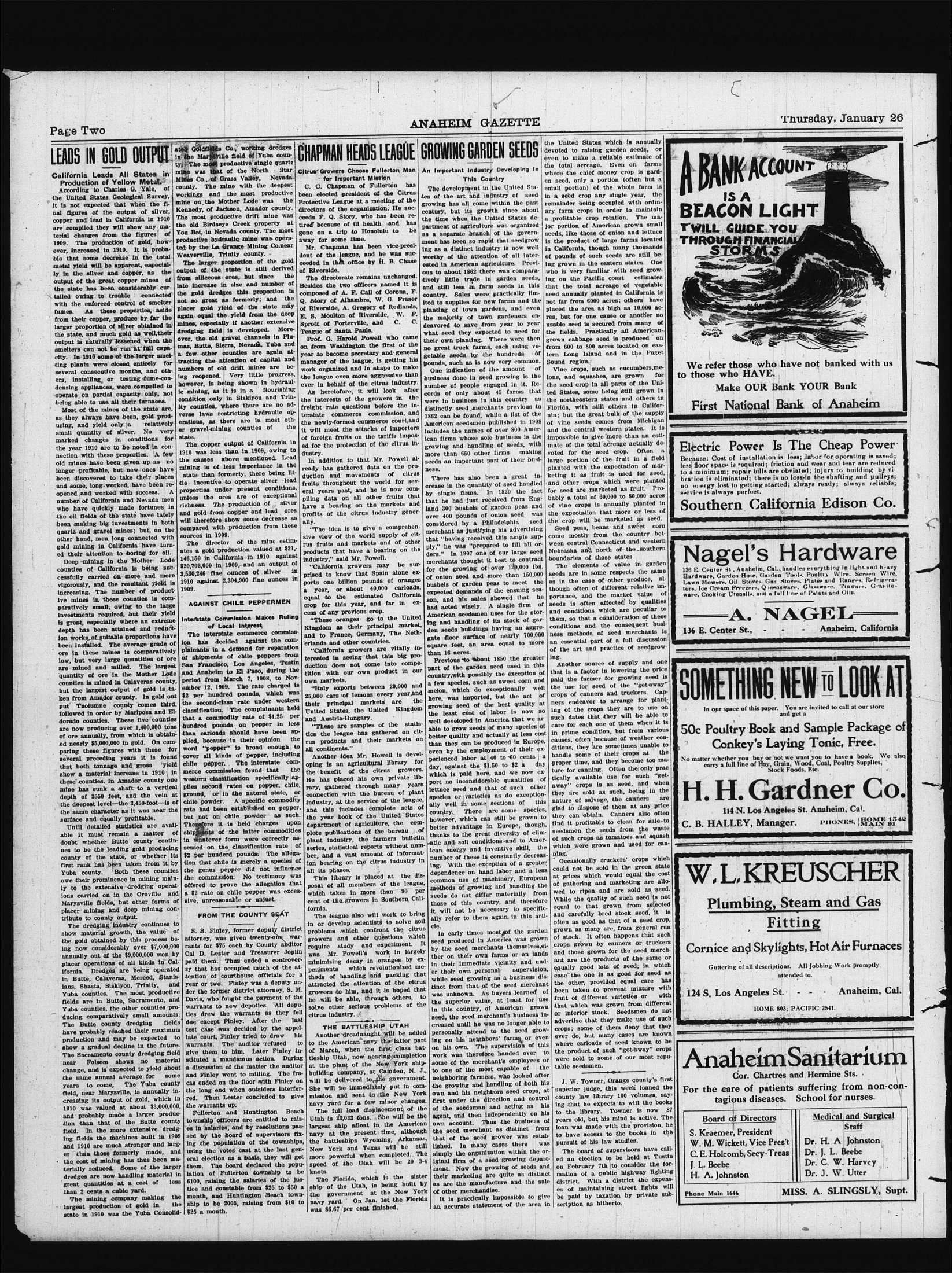
Searchable text
LEADS IN GOLD OUTPUT
California Leads All States in Production of Yellow Metal.
According to Charles G. Yale, of the United States Geological Survey, it is not expected that when the final figures of the output of silver, copper and lead in California in 1910 are compiled they will show any material changes from the figures of 1909. The production of gold, however, increased in 1910. It is probable that some decrease in the total metal yield will be apparent, especially in the silver and copper, as the output of the great copper mines of the state has been considerably curtailed owing to trouble connected with the enforced control of smelter fumes. As these properties aside from their copper, produce by far the larger proportion of silver obtained in the state, and much gold as well, their output is naturally lessened when the smelters can not be run at full capacity. In 1910 some of the larger smelting plants were closed entirely for several consecutive months, and others, installing or testing fume-condensing appliances, were compelled to operate on partial capacity only, not being able to use all their furnaces.
Most of the mines of the state are, as they always have been, gold producing, and yield only a relatively small quantity of silver. No very marked changes in conditions for the year 1910 are to be noted in connection with these properties. A few old mines have been given up as no longer profitable, but new ones have
ated Goldfields Co., working dredges in the Marysville field of Yuba county. The most productive single quartz mine was that of the North Star Mines Co., of Grass Valley, Nevada county. The mine with the deepest workings and the most productive mine on the Mother Lode was the Kennedy, of Jackson, Amador county. The most productive drift mine was the old Birdseye Creek property at You Bet, in Nevada county. The most productive hydraulic mine was operated by the La Grange Mining Co. near Weaverville, Trinity county.
The larger proportion of the gold output of the state is still derived from siliceous ores, but since the late increase in size and number of the gold dredges this proportion is not so great as formerly; and the placer gold yield of the state may again equal the yield from the deep mines, especially if another extensive dredging field is developed. Moreover, the old gravel channels in Plumas, Butte, Sierra, Nevada, Yuba and a few other counties are again attracting the attention of capital and numbers of old drift mines are being reopened. Very little progress, however, is being shown in hydraulic mining, as it is in a flourishing condition only in Siskiyou and Trinity counties, where there are no adverse laws restricting hydraulic operations, as there are in most other gravel-mining counties of the state.
The copper output of California in 1910 was less than in 1909, owing to the causes above mentioned. Lead mining is of less importance in the state than formerly, there being lit-
Most of the mines of the state are, as they always have been, gold producing, and yield only a relatively small quantity of silver. No very marked changes in conditions for the year 1910 are to be noted in connection with these properties. A few old mines have been given up as no longer profitable, but new ones have been discovered to take their places and some, long worked, have been reopened and worked with success. A number of California and Nevada men who have quickly made fortunes in the oil fields of the state have lately been making big investments in both quartz and gravel mines; but, on the other hand, men long connected with gold mining in California have turned their attention to boring for oil.
Deep mining in the Mother Lode counties of California is being successfully carried on more and more vigorously, and the resultant yield is increasing. The number of productive mines in these counties is comparatively small, owing to the large investments required, but their yield is great, especially where an extreme depth has been attained and reduction works of suitable proportions have been installed. The average grade of ore in these mines is comparatively low, but very large quantities of ore are mined and milled. The largest quantity of ore in the Mother Lode counties is mined in Calaveras county, but the largest output of gold is taken from Amador county. In gold out put Tuolumne county comes third, followed in order by Mariposa and El dorado counties. These five counties are now producing over 1,400,000 tons of ore annually, from which is obtained nearly $5,000,000 in gold. On comparing these figures with those for several preceding years it is found that both tonnage and gross yield show a material increase in 1910 in these counties. In Amador county one mine has sunk a shaft to a vertical depth of 3550 feet, and the vein at the deepest level—the 3,450-foot—is of the same character as it was near the surface and equally profitable.
Until detailed statistics are available it must remain a matter of doubt whether Butte county continues to be the leading gold producing county of the state, or whether its first rank has been taken from it by Yuba county. Both these counties owe their prominence in mining mainly to the extensive dredging operations carried on in the Oroville and ing reopened. Very little progress, however, is being shown in hydraulic mining, as it is in a flourishing condition only in Siskiyou and Trinity counties, where there are no adverse laws restricting hydraulic operations, as there are in most other gravel-mining counties of the state.
The copper output of California in 1910 was less than in 1909, owing to the causes above mentioned. Lead mining is of less importance in the state than formerly, there being little incentive to operate silver lead properties under present conditions, unless the ores are of exceptional richness. The production of silver and gold from copper and lead ores will therefore show some decrease as compared with production from these sources in 1909.
The director of the mine estimates a gold production valued at $21,146,150 in California in 1910 against $20,703,600 in 1909, and an output of 3,530,246 fine ounces of silver in 1910 against 2,304,900 fine ounces in 1909.
AGAINST CHILE PEPPERMEN
Interstate Commission Makes Ruling of Local Interest
The interstate commerce commission has decided against the complainants in a demand for reparation of shipments of chile peppers from San Francisco, Los Angeles, Tustin and Anaheim to El Paso, during the period from March 7, 1908, to November 12, 1909. The rate charged is $2 per hundred pounds, which was the second-class rate under western classification. The complainants held that a commodity rate of $1.25 per hundred pounds on pepper in less than carloads should have been applied, because in their opinion the word "pepper" is broad enough to cover all kinds of pepper, including chile pepper. The interstate commerce commission found that the western classification specifically applies second rates on pepper, chile ground, or in the natural state, or chile powder. A specific commodity rate had been established on pepper, but not on chile powder as such.
Therefore it is held charges upon shipments of the latter commodities in whatever form were correctly assessed on the classification rate of $2 per hundred pounds. The allegation that chile is merely a species of the genus pepper did not influence the commission. No testimony was offered to prove the allegation that a $2 rate on chile pepper was excessive unreasonable or unjust.
As heretofore, the interests of the freight rate questioner state commerce the newly-formed it will meet the needs of foreign fruits ed for the protection industry.
In addition to ready has gathered production and more fruits throughout eral years past, piling data on have a bearing profits of the chil ally.
"The idea is to save view of these oranges Kingdom as they and to France, erlands and other."
"California grew prised to know ports one billion a year, or about equal to the crop for this yeas process of any previe."
"These orange Kingdom as they and to France, erlands and other."
"California grew prised to know ports one billion a year, or about equal to the crop for this yeas process of any previe."
"These orange Kingdom as they and to France, erlands and other."
"California grew prised to know ports one billion a year, or about equal to the crop for this yeas process of any previe."
Until detailed statistics are available it must remain a matter of doubt whether Butte county continues to be the leading gold producing county of the state, or whether its first rank has been taken from it by Yuba county. Both these counties owe their prominence in mining mainly to the extensive dredging operations carried on in the Oroville and Marysville fields, but other forms of placer mining and deep mining contribute to county output.
The dredging industry continues to show material growth, the value of the gold obtained by this process being now considerably over $7,000,000 annually out of the $9,000,000 won by placer operations of all kinds in California. Dredges are being operated in Butte, Calaveras, Merced, Stanislaus, Shasta, Siskiyou, Trinity, and Yuba counties. The most productive fields are in Butte, Sacramento, and Yuba counties, the other counties producing comparatively small amounts. The Butte county dredging fields have probably reached their maximum production and may be expected to show a gradual decline in the future. The Sacramento county dredging field near Folsom shows no material change, and is expected to yield about the same annual average for some years to come. The Yuba county field, near Marysville, is annually increasing its output of gold, which in 1910 was valued at about $3,000,000, and probably made a larger production than that of the Butte county field. In the more extensive dredging fields the machines built in 1909 and 1910 are much stronger and larger than those formerly made, and the cost of mining has thus been materially reduced. Some of the larger dredges are now handling material in great quantities at a cost of less than 2 cents a cubic yard.
The mining company making the largest production of gold in the state in 1910 was the Yuba Consolidated chile powder. A specific commodity rate had been established on pepper, but not on chile powder as such. Therefore it is held charges upon shipments of the latter commodities in whatever form were correctly assessed on the classification rate of $2 per hundred pounds: The allegation that chile is merely a species of the genus pepper did not influence the commission. No testimony was offered to prove the allegation that a $2 rate on chile pepper was excessive, unreasonable or unjust.
FROM THE COUNTY SEAT
S. S. Finley, former deputy district attorney, was given twenty-one warrants for $75 each by County auditor Cal D. Lester and Treasurer Joplin paid them. Thus ended a controversy that has occupied much of the attention of courthouse officials for a year or two. Finley was a deputy under the former district attorney, S. M. Davis, who fought the payment of the warrants to new deputies. All deputies drew the warrants as they fell due except Finley. After the last test case was decided by the appellate court, Finley tried to draw his warrants. The auditor refused to give them to him. Later Finley instituted a mandamus action. During a discussion of the matter the auditor and Finley went to milling. The fracas ended on the floor with Finley on the long end when outsiders interfered. Then Lester concluded to give the warrants up.
Fullerton and Huntington Beach township officers are entitled to raises in salaries, and by resolutions passed by the board of supervisors fixing the population of the townships, using the votes cast at the last general election as a basis, they will get them. The board declared the population of Fullerton township to be 6100, raising the salaries of the justice and constable from $25 to $50 a month, and Huntington Beach township to be 2005, raising from $10 to $25 a month.
THE BATTLE
Another dream to the American of March, when tleship Utah, met at the plant of building companies will be delivered. She will be immed mission and send navy yard for her.
The full load Utah is 23,033 largest ship and navy at the place the battleships New York and more powerful speed of the knots.
The Florida ship of the U.S. government navy yard. C was 86.67 per
ANAHEIM GAZETTE
CHAPMAN HEADS LEAGUE
Citrus Growers Choose Fullerton Man for Important Mission
C. C. Chapman of Fullerton has been elected president of the Citrus Protective League at a meeting of the directors of the organization. He succeeds F. Q. Story, who has been retired because of ill health and has gone on a trip to Honolulu to be away for some time.
Mr. Chapman has been vice-president of the league, and he was succeeded in that office by H. B. Chase of Riverside.
The directorate remains unchanged. Besides the two officers named it is composed of A. F. Call of Corona, F. Q. Story of Alhambra, W. G. Fraser of Riverside, A. Gregory of Redlands, E. S. Moulton of Riverside, W. F. Sprott of Porterville, and C. C. Teague of Santa Paula.
Prof. G. Harold Powell who came on from Washington the first of the year to become secretary and general manager of the league, is getting his work organized and in shape to make the league even more aggressive than ever in behalf of the citrus industry.
As heretofore, it will look after the interests of the growers in the freight rate questions before the interstate commerce commission, and the newly-formed commerce court, and it will meet the attacks of importers of foreign fruits on the tariffs imposed for the protection of the citrus industry.
In addition to that Mr. Powell already has gathered data on the production and movements of citrus.
GROWING GARDEN SEEDS
An Important Industry Developing In This Country
The development in the United States of the art and industry of seed growing has all come within the past century, but its growth since about the time when the United States department of agriculture was organized as a separate branch of the government has been so rapid that seedgrowing as a distinct industry is now well worthy of the attention of all interested in American agriculture. Previous to about 1862 there was comparatively little trade in garden seeds, and still less in farm seeds in this country. Sales were practically limited to supplies for new farms and the planting of town gardens, and even the majority of town gardeners endeavored to save from year to year what seed they expected to need for their own planting. There were then no great truck farms, each using vegetable seeds by the hundreds of pounds, such as is now very common.
One indication of the amount of business done in seed growing is the number of people engaged in it. Records of only about 45 farms that were in business in this country as distinctly seed merchants previous to 1862 can be found, while a list of the American seedsmen published in 1908 includes the names of over 800 American firms whose sole business is the growing and handling of seeds, with more than 650 other firms making seeds an important part of their business.
the United States which is annually devoted to raising garden seeds, or even to make a reliable estimate of the total acreage. Even on farms where the chief money crop is garden seed, only a portion (often but a small portion) of the whole farm is in a seed crop any single year, the remainder being occupied with ordinary farm crops in order to maintain a profitable crop rotation. The major portion of American grown small seeds, like those of onion and lettuce is the product of large farms located in California, though many thousands of pounds of such seeds are still being grown in the eastern states. One who is very familiar with seed growing on the Pacific coast estimates that the total acreage of vegetable seed annually planted in California is not far from 6000 acres; others have placed the area as high as 10,000 acres, but for one cause or another no usable seed is secured from many of the fields. Practically all American-grown cabbage seed is produced on from 600 to 800 acres located on eastern Long Island and in the Puget Sound region.
Vine crops, such as cucumbers, melons, and squashes, are grown for the seed crop in all parts of the United States, some being still grown in the northeastern states and others in Florida, with still others in California; but the great bulk of the supply of vine seeds comes from Michigan and the central western states. It is impossible to give more than an estimate of the total acreage actually devoted for the seed crop. Often a large portion of the fruit in a field planted with the expectation of marketing it as fruit is used for seed.
the league even more aggressive than ever in behalf of the citrus industry.
As heretofore, it will look after the interests of the growers in the freight rate questions before the interstate commerce commission, and the newly-formed commerce court, and it will meet the attacks of importers of foreign fruits on the tariffs imposed for the protection of the citrus industry.
In addition to that Mr. Powell already has gathered data on the production and movements of citrus fruits throughout the world for several years past, and he is now compiling data on all other fruits that have a bearing on the markets and profits of the citrus industry generally.
"The idea is to give a comprehensive view of the world supply of citrus fruits and markets and of other products that have a bearing on the industry," said Mr. Powell.
"California growers may be surprised to know that Spain alone exports one billion pounds of oranges a year, or about 40,000 carloads, equal to the estimated California crop for this year, and far in excess of any previous crop.
"These oranges go to the United Kingdom as their principal market, and to France, Germany, The Netherlands and other countries.
"California growers are vitally interested in seeing that this big production does not come into competition with our own product in our own markets.
"Italy exports between 20,000 and 25,000 cars of lemons every year, and their principal markets are the United States, the United Kingdom and Austria-Hungary.
"These are samples of the statistics the league has gathered on citrus products and their markets on all continents."
Another idea Mr. Howell is developing is an agricultural library for the benefit of the citrus growers. He has placed his own private library, gathered through many years connection with the bureau of plant industry, at the service of the league, and this includes complete sets of the year book of the United States department of agriculture, the complete publications of the bureau of plant industry, the farmers bulletin series, statistical reports without number, and a vast amount of information bearing on the citrus industry in all its phases.
This library is placed at the disposal of all members of the league, which takes in more than 90 per cent of the growers in Southern Cali-
business done in seed growing is the number of people engaged in it. Records of only about 45 farms that were in business in this country as distinctly seed merchants previous to 1862 can be found, while a list of the American seedsmen published in 1908 includes the names of over 800 American firms whose sole business is the growing and handling of seeds, with more than 650 other firms making seeds an important part of their business.
There has also been a great increase in the quantity of seed handled by single firms. In 1820 the fact that he had just received from England 300 bushels of garden peas and over 400 pounds of onion seed was considered by a Philadelphia seed merchant as justifying his advertising that "having received this ample supply," he was "prepared to fill all orders." In 1907 one of our large seed merchants thought it best to contract for the growing of over 120,000 lbs. of onion seed and more than 150,000 bushels of garden peas to meet the expected demands of the ensuing season, and his sales showed that he had acted wisely. A single firm of American seedsmen uses for storing and handling of its stock of garden seeds buildings having an aggregate floor surface of nearly 700,000 square feet, an area equal to more than 16 acres.
Previous to about 1850 the greater part of the garden seed used in this country, with possibly the exception of a few species, such as sweet corn and melon, which do exceptionally well here, was imported, but the art of growing seed of the best quality at the least cost of labor is now so well developed in America that we are able to grow seeds of many species of better quality and actually at less cost than they can be produced in Europe, even by the employment of their experienced labor at 40 to 60 cents a day, against the $1.50 to $2 a day which is paid here, and we now export no inconsiderable quantities of lettuce seed and that of such other species or varieties as do exceptionally well in some sections of this country. There are some species, however, which can still be grown to better advantage in Europe, though thanks to the great diversity of climatic and soil conditions and to American energy and inventive skill, the number of these is constantly decreasing. With the exception of a greater dependence on hand labor and a less common use of machinery, European methods of growing and handling the seeds do not differ materially from business done in seed growing is the number of people engaged in it. Records of only about 45 farms that were in business in this country as distinctly seed merchants previous to 1862 can be found, while a list of the American seedsmen published in 1908 includes the names of over 800 American firms whose sole business is the growing and handling of seeds, with more than 650 other firms making seeds an important part of their business.
There has also been a great increase in the quantity of seed handled by single firms. In 1820 the fact that he had just received from England 300 bushels of garden peas and over 400 pounds of onion seed was considered by a Philadelphia seed merchant as justifying his advertising that "having received this ample supply," he was "prepared to fill all orders." In 1907 one of our large seed merchants thought it best to contract for the growing of over 120,000 lbs. of onion seed and more than 150,000 bushels of garden peas to meet the expected demands of the ensuing season, and his sales showed that he had acted wisely. A single firm of American seedsmen uses for storing and handling of its stock of garden seeds buildings having an aggregate floor surface of nearly 700,000 square feet, an area equal to more than 16 acres.
Previous to about 1850 the greater part of the garden seed used in this country,with possibly the exception of a few species,such as sweet corn and melon,which do exceptionally well here,was imported,但the artof growingseedofthebestqualityatleastcostthycanbeproducedinEuropeevenbytheemploymentoftheexperiencedlaborat40to60centsaday,againstthe$1.50to$2a daywhichispaidhere,andwenowexportnoincconsiderablequantitiesoflettuceseedandthatofsuchotherspeciesorvarietiesasdoexceptionallywellinsomesectionsofthiscountry.TherearesomepecieshoweverwhichcanstillbegrownbetteradvantageinEuropethoughthankstothegreatdiversityofclimaticandsoilconditionsandtoAmericanenergyandinventiveskill,thenumberofthesesisconstantlydecreasing.Withtheexceptionofagreaterdependenceonhandlaborandalesscommonuseofmachinery,Europeanmethodsofgrowingandhandlingthesedo.notdiffermateriallyfrombusinessdoneinseedgrowingisthenumberofpeopleengagedinit.Recordsofonlyabout45farmsthatwereinbusinessinthiscountryasdistinctlyseedmerchantspreviousto1862canbefoundwhilealistoftheAmericanseedsmenpublishedin1908includesthenamesofover800Americanfirmswhosesolebusinessisthegrowingandhandlingofseeds,以morethan650otherfirmsmakingseedsanimportantpartofthebusiness.
Therehasalsobeenagreentexceptioninthequantityofseedhandledbysinglefirms.In1820factthathehadjustreceivedfromEngland300bushelsofgardenpeasandover400poundsofonionseedwasconsideredbyaPhiladelphiaseedmerchantasjustifyinghisadvertisingthat“havingreceivedthisamplesupply,”hewas“preparedtotfillallorders.”In1907oneofourlargeseedmerchantsthoughtitbesttocontractforthegrowingofover120,000lbs.ofonionseedandmorethan150,000bushelsofgardenpeastomeetheexpecteddemandsoftheensuingseason,andhissalesshowedthathehadactedwisely.AsinglefirmofAmericanseedsmenusesforthestorageandhandlingofitsstockofgardenseedsbuildingshavinganaggregatefloorsurfaceofnearly700,000squarefeet,nareaqualtomorethan16acres.
Anothersourceofsupplyandonethatisafactorinloweringthepricepaidthefarmerforgrowingseedistheuseforseedofthe“getaway”cropsofcannersandtruckers.Cannersendeavortoarrangeforplantingofthecropstheyaretouseonsuchdatesthattheywillbeabletocareforeachoneofthemwhenitisinprimecondition,bothfromvariouscausesoftenbecauseweatherconditions,theyare sometimesunabletohandlesomeofthecropsatthepropertime,andtheybecometoomatureforcanning.Oftentheonlypraticallyavailableuseforsuch“getaway”cropsisasseed,andwhentheyaresoldassuch.beinginthenatureofsalvage,thecannersaregladtodisposeoff thematanypricetheycanobtain.Cannersalsooftenfinditprofitabletocleanfor sale-toseedsmenthesefromthewasteofsuchcropsastomatoesandsquashwhichweregrownandusedforcanning.
Occasionallytruckers’cropswhichcouldnotbe Soldinthegreen stateat priceswhichwouldequalthecostof gatheringandmarketingareallowedtoripenandare soldasseed.Whilethequalityofsuchseedisnot
industry, at the service of the league, and this includes complete sets of the year book of the United States department of agriculture, the complete publications of the bureau of plant industry, the farmers bulletin series, statistical reports without number, and a vast amount of information bearing on the citrus industry in all its phases.
This library is placed at the disposal of all members of the league, which takes in more than 90 per cent of the growers in Southern California.
The league also will work to bring in or develop scientists to solve soil problems which confront the citrus growers and other questions which require study and experiment. It was Mr. Powell's work in largely minimizing decay in oranges by experiments which revolutionized methods of handling and packing that attracted the attention of the citrus growers to him, and it is hoped that he will be able, through others, to solve other serious problems of the citrus industry.
THE BATTLESHIP UTAH
Another dreadnaught will be added to the American navy the latter part of March, when the first class battleship Utah, now nearing completion at the plant of the New York shipbuilding company, at Camden, N. J., will be delivered to the government. She will be immediately put in commission and sent to the New York navy yard for a few minor changes.
The full load displacement of the Utah is 23,033 tons. She will be the largest ship afloat in the American navy at the present time, although the battleships Wyoming, Arkansas, New York and Texas will be still more powerful when completed. The speed of the Utah will be 20 3-4 knots.
The Florida, which is the sister ship of the Utah, is being built by the government at the New York navy yard. On Jan. 1st the Florida was 86.67 per cent finished.
In early times most of the garden seed produced in America was grown by the seed merchants themselves, either on their own farms or on lands in their immediate vicinity and under their own personal supervision, while seed growing as a business distinct from that of the seed merchant was unknown. As buyers learned of the superior value, at least for use in this country, of American grown seed, the seed merchant's business increased until he was no longer able to personally attend to the seed growing on his neighbors' farms or even on his own. The supervision of this work was therefore handed over to some of the merchant's employees or to one of the most capable of the neighboring farmers, who looked after the growing and handling of both his own and his neighbors seed crops, at first under the direction and control of the seedsman and acting as his agent, and then independently on his own account. Thus the business of the seed merchant as distinct from that of the seed grower was established. In many cases there was simply the organization within the original firm of a seed growing department. Now the growing of seeds and their marketing are quite as distinct as are the manufacture and the sale of other merchandise.
It is practically impossible to give an accurate statement of the area in nature of salvage, the canners are glad to dispose of them at any price they can obtain. Canners also often find it profitable to clean for sale to seedsmen the seeds from the waste of such crops as tomatoes and squash which were grown and used for canning.
Occasionally truckers' crops which could not be sold in the green state at prices which would equal the cost of gathering and marketing are allowed to ripen and are sold as seed. While the quality of such seed is not equal to that grown from selected and carefully bred stock seed, it is often as good as that of a seed crop, grown as many are, from general run of stock. It often happens that such crops grown by canners or truckers and those grown for the seed merchant are the products of the same or equally good lots of seed, in which case the one is as good for seed as the other, provided equal care has been taken to prevent mixture with fruit of different varieties or with that which was grown from different or inferior stock. Seedsmen do not advertise that they make use of such crops; some of them deny that they ever do, but many cases are known where carloads of seed known to be the product of such "get-away" crops were sold to some of our most reputable seedsmen.
J. W. Towner, Orange county's first superior judge, this week loaned the county law library 100 volumes, saying that he expects to will the books to the library. Towner is now 87 years old, but his mind is active. The loan was made with the provision, he to have access to the books in the pursuit of his law studies.
The board of supervisors have called an election to be held at Tustin on February 7th to consider the formation of a public highway lighting district. With a district the expenses of maintaining street lights will be paid by taxation by private subscription as hitherto.
A BANK ACCOUNT
IS A
BEACON LIGHT
TWILL GUIDE YOU
THROUGH FINANCIAL
STORMS
We refer those who have not banked with us
to those who HAVE.
Make OUR Bank YOUR Bank
First National Bank of Anaheim
Electric Power Is The Cheap Power
Because: Cost of installation is less; labor for operating is saved;
less floor space is required; friction and wear and tear are reduced
to a minimum; repair bills are obviated; injury to building by vi-
Make OUR Bank YOUR Bank
First National Bank of Anaheim
Electric Power Is The Cheap Power
Because: Cost of installation is less; labor for operating is saved;
less floor space is required; friction and wear and tear are reduced
to a minimum; repair bills are obviated; injury to building by vibration is eliminated; there is no loss in the shafting and pulleys;
no energy lost in getting started; always ready; always reliable;
service is always perfect.
Southern California Edison Co.
Nagel’s Hardware
136 E. Center St., Anaheim, Cal., handles everything in light and heavy
Hardware, Garden Hose, Garden Tools, Poultry Wire, Screen Wire,
Lawn Mowers, Oil Stoves, Gas Stoves, Plates and Ranges, Refrigerators,
Ice Cream Freezers, Queensware, Glassware, Tinware, Graniteware, Cooking Utensils, and a full line of Paints and Oils.
A. NAGEL
136 E. Center St., - - - Anaheim, California
SOMETHING NEW TO LOOK AT
In our space of this paper. You are invited to call at our store
and get a
50c Poultry Book and Sample Package of Conkey's Laying Tonic, Free.
No matter whether you buy or not we want you to have a book. We also
carry a full line of Hay, Grain, Wood, Coal, Poultry Supplies,
Stock Foods, Etc.
H. H. Gardner Co.
114 N. Los Angeles St. Anaheim, Cal.
C. B. HALLEY, Manager. PHONES. HOME 1542
MAIN 91
W.L.KREUSCHER
114 N. Los Angeles St. Anaheim, Cal.
C. B. HALLEY, Manager. PHONES. HOME 1542 MAIN 91
W.L.KREUSCHER
Plumbing, Steam and Gas
Fitting
Cornice and Skylights, Hot Air Furnaces
Guttering of all descriptions. All Jobbing Work promptly attended to.
124 S. Los Angeles St. - Anaheim, Cal.
HOME 803; PACIFIC 2541.
Anaheim Sanitarium
Cor. Chartres and Hermine Sts.
For the care of patients suffering from non-contagious diseases. School for nurses.
Board of Directors
S. Kraemer, President
W. M. Wickett, Vice Pres't
C.E. Holcomb, Secy-Treas
J. L. Beebe
H. A. Johnston
Medical and Surgical Staff
Dr. H. A. Johnston
Dr. J. L. Beebe
Dr. C. W. Harvey
Dr. J. W. Utter
Phone Main 1646
MISS. A. SLINGSLY, Supt.