anaheim-gazette 1911-01-12
Scanned page
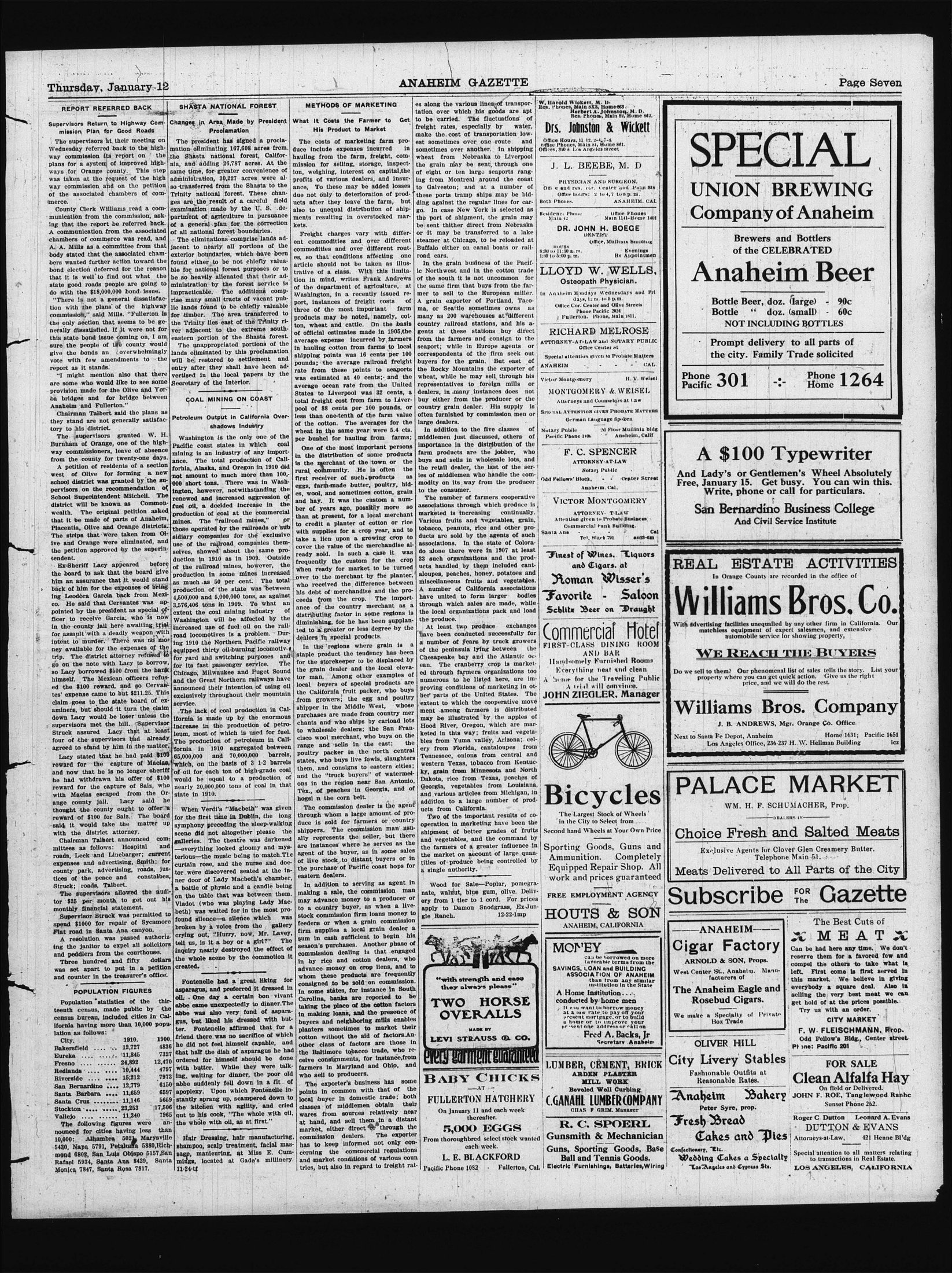
Searchable text
REPORT REFERRED BACK
Supervisors Return to Highway Commission Plan for Good Roads
The supervisors at their meeting on Wednesday referred back to the highway commission its report on the plans for a system of improved highways for Orange county. This step was taken at the request of the highway commission and on the petition of the associated chambers of commerce.
County Clerk Williams read a communication from the commission, asking that the report be referred back. A communication from the associated chambers of commerce was read, and A. A. Mills as a committee from that body stated that the associated chambers wanted further action toward the bond election deferred for the reason that it is well to find out what the state good roads people are going to do with the $18,000,000 bond issue.
"There is not a general dissatisfaction with the plans of the highway commission," said Mills. "Fullerton is the only section that seems to be generally dissatisfied. If it were not for this state bond issue coming on, I am sure the people of the county would give the bonds an overwhelmingly vote with few amendments to the report as it stands.
"I might mention also that there are some who would like to see some provision made for the Olive and Yorba bridges and for bridge between Anaheim and Fullerton."
Chairman Talbert said the plans as they stand are not generally satisfactory to his district.
The supervisors granted W. H. Burnham of Orange, one of the highway commissioners, leave of absence from the county for twenty-one days.
A petition of residents of a section west of Olive for forming a new
SHASTA NATIONAL FOREST
Changes in Area Made by President Proclamation
The president has signed a proclamation eliminating 167,608 acres from the Shasta national forest, California, and adding 26,787 acres. At the same time, for greater convenience of administration, 30,227 acres were also transferred from the Shasta to the Trinity national forest. These changes are the result of a careful field examination made by the U.S. department of agriculture in pursuance of a general plan for the correction of all national forest boundaries.
The eliminations comprise lands adjacent to nearly all portions of the exterior boundaries, which have been found either to be not chiefly valuable for national forest purposes or to be so heavily alienated that their administration by the forest service is impracticable. The additions comprise many small tracts of vacant public lands found to be chiefly valuable for timber. The area transferred to the Trinity lies east of the Trinity river adjacent to the extreme southeastern portion of the Shasta forest.
The unappropriated portions of the lands eliminated by this proclamation will be restored to settlement and entry after they shall have been advertised in the local papers by the Secretary of the Interior.
COAL MINING ON COAST
Petroleum Output in California Overshadows Industry
Washington is the only one of the Pacific coast states in which coal mining is an industry of any importance. The total production of California, Alaska, and Oregon in 1910 did not amount to much more than 100 million tons.
METHODS OF IT
What It Costs the His Product
The costs of man-made commodities are commodities and overages, so that condition article should not be derivative of a class. In mind, written of the department Washington, in a report, instances of three of the most products may be notified, wheat and cotton of official estimates average expense in hauling cotton from shipping points was pounds; the average rate from these prices was estimated at 4 average ocean rates States to Liverpool total freight cost from pool of 88 cents less than one-tenth of the cotton. The wheat in the same per bushel for haulage.
One of the most in the distribution is the merchant of rural community.
"I might mention also that there are some who would like to see some provision made for the Olive and Yorba bridges and for bridge between Anaheim and Fullerton."
Chairman Talbert said the plans as they stand are not generally satisfactory to his district.
The supervisors granted W. H. Burnham of Orange, one of the highway commissioners, leave of absence from the county for twenty-one days.
A petition of residents of a section west of Olive for forming a new school district was granted by the supervisors on the recommendation of School Superintendent Mitchell. The district will be known as Commonwealth. The original petition asked that it be made of parts of Anaheim, Placentia, Olive and Orange districts. The strips that were taken from Olive and Orange were eliminated, and the petition approved by the superintendent.
Ex-Sheriff Lacy appeared before the board to ask that the board give him an assurance that it would stand back of him for the expenses of bringing Leodora Garcia back from Mexico. He said that Cervantes was appointed by the president as special officer to receive Garcia; who is now in the county jail here awaiting trial for assault with a deadly weapon, with intent to murder. There was no money available for the expenses of the trip. The district attorney refused to go on the note with Lacy to borrow, so Lacy borrowed $500 from the bank himself. The Mexican officers refused the $100 reward, and so Cervantes' expense came to but $211.25. This claim goes to the state board of examiners, but should it turn the claim down Lacy would be loser unless the supervisors met the bill. Supervisor Struck assured Lacy that at least four of the supervisors had already agreed to stand by him in the matter.
Lacy stated that he had paid $100 reward for the capture of Macias, and now that he is no longer sheriff he had withdrawn his offer of $100 reward for the capture of Saiz, who with Macias escaped from the Orange county jail. Lacy said he thought the county ought to offer a reward of $100 for Saiz. The board said it would take the matter up with the district attorney.
Chairman Talbert announced committees as follows: Hospital and roads, Leck and Linebarger; current expenses and advertising, Smith; for county park, advertising, roads, justices of the peace and constalbes, Struck; roads, Talbert.
The supervisors allowed the auditors to get out his vertised in the local papers by the Secretary of the Interior.
COAL MINING ON COAST
Petroleum Output in California Overshadows Industry
Washington is the only one of the Pacific coast states in which coal mining is an industry of any importance. The total production of California, Alaska, and Oregon in 1910 did not amount to much more than 100,000 short tons. There was in Washington, however, notwithstanding the renewed and increased aggression of fuel oil, a decided increase in the production of coal at the commercial mines. The "railroad mines," or those operated by the railroads or subsidiary companies for the exclusive use of the railroad companies themselves, showed about the same production in 1910 as in 1909. Outside of the railroad mines, however, the production in some mines increased as much as 50 per cent. The total production of the state was between 4,500,000 and 5,000,000 tons, as against 3,576,406 tons in 1909. To what an extent the coal mining industry of Washington will be affected by the increased use of fuel oil on the railroad locomotives is a problem. During 1910 the Northern Pacific railway equipped thirty oil-burning locomotives for yard and switching purposes and for its fast passenger service. The Chicago, Milwaukee and Puget Sound and the Great Northern railways have announced their intention of using oil exclusively throughout their mountain service.
The lack of coal production in California is made up by the enormous increase in the production of petroleum, most of which is used for fuel. The production of petroleum in California in 1910 aggregated between 65,000,000 and 70,000,000 barrels, which, on the basis of 3 1-2 barrels of oil for each ton of high-grade coal would be equal to a production of nearly 20,000,000 tons of coal in that state in 1910.
When Verdi's "Macbeth" was given for the first time in Dublin, the long symphony preceding the sleep-walking scene did not altogether please the galleries. The theatre was darkened—everything looked gloomy and mysterious—the music being to match. The curtain rose, and the nurse and doctor were discovered seated at the inner door of Lady Macbeth's chamber, a bottle of physic and a candle being on the table that was between them.
One of the most frequently used materials in merchandising rural community. First receiver of surplus eggs, farm-made buys, wool, and sometimes hay. It was then at present, forced to credit a plantation with supplies for a take a lien upon a cover value of ready sold. In such frequently used customers when ready for market over to the merchant who received his debt of merchandise from the chance distribution factor diminishing, for he ted to a greater or dealer in special products.
In the regions where staple product is for the storekeeper, the grain dealer and tor man. Among local buyers of spice in California fruits from growers; the shipper in the Midwest purchases are made chants and who shop to wholesale dealers; cisco wool merchandise range and sells poultry packer in states, who buys live them, and consigns and the "truck busienss in the region Tex., of peaches to hogsln n the corn b
The commission through whom a lace duce is sold for fash shippers. The comally represents that are instances where agent of the buyer of live stock to die purchase of Pa eastern dealers.
In addition to making a sale, tha
ange county jail. Lacy said he thought the county ought to offer a reward of $100 for Salz. The board said it would take the matter up with the district attorney.
Chairman Talbert announced committees as follows: Hospital and roads, Leck and Linebarger; current expenses and advertising, Smith; for county park, advertising, roads, justices of the peace and constalbes, Struck; roads, Talbert.
The supervisors allowed the auditor $25 per month to get out his monthly financial statement.
Supervisor Struck was permitted to spend $1000 for repair of Sycamore Flat road in Santa Ana canyon.
A resolution was passed authorizing the janitor to expel all solicitors and peddlers from the courthouse.
Three hundred and fifty dollars was set apart to put in a petition and counter in the treasurer's office.
POPULATION FIGURES
Population statistics of the thirteenth census, made public by the census bureau, included cities in California having more than 10,000 population as follows:
City. 1910. 1900.
Bakersfield ... 12,727 4836
Eureka ... 11,845 7327
Fresno ... 24,892 12,470
Redlands ... 10,444 4797
Riverside ... 15,212 7973
San Bernardino ... 12,779 6150
Santa Barbara ... 11,659 6597
Santa Cruz ... 11,146 5659
Stockton ... 23,253 17,506
Vallejo ... 11,340 7965
The following figures were announced for cities having less than 10,000:
Alhambra 5021 Marysville 5430 Napa 5791 Petaluma 5880 Richmond 6802 San Luis Obispo 5157 San Rafael 5934 Santa Ana 8429 Santa Monica 7847 Santa Rosa 7817.
When Verdi's "Macbeth" was given for the first time in Dublin, the long symphony preceding the sleep-walking scene did not altogether please the galleries. The theatre was darkened—everything looked gloomy and mysterious—the music being to match. The curtain rose, and the nurse and doctor were discovered seated at the inner door of Lady Macbeth's chamber, a bottle of physic and a candle being on the table that was between them. Vladot (who was playing Lady Macbeth) was waited for in the most profound silence—a silence which was broken by a voice from the gallery crying out, "Hurry, now, Mr. Lavey, tell us, is it a boy or a girl?" The inquiry nearly destroyed the effect of the whole scene by the commotion it created.
Fontenelle had a great liking for asparagus, and preferred it dressed in oil. One day a certain bon vivant abbe came unexpectedly to dinner. The abbe was also very fond of asparagus, but liked his dressed with butter. Fontenelle affirmed that for a friend there was no sacrifice of which he did not feel himself capable, and that half the dish of asparagus he had ordered for himself should be done with butter. While they were talking, waiting for dinner, the poor old abbe suddenly fell down in a fit of apoplexy. Upon which Fontenelle instantly sprang up, scampered down to the kitchen with agility, and cried out to his cook, "The whole with oil, the whole with oil, as at first."
Hair Dressing, hair manufacturing, shampoo, scalp treatment, facial massage, manicuring, at Miss E. Cummings, located at Gade's millinery. 11-24-tf
METHODS OF MARKETING
What It Costs the Farmer to Get His Product to Market
The costs of marketing farm produce include expenses incurred in hauling from the farm, freight, commission for selling, storage, inspection, weighing, interest on capital, the profits of various dealers, and insurance. To these may be added losses due not only to deterioration of products after they leave the farm, but also to unequal distribution of shipments resulting in overstocked markets.
Freight charges vary with different commodities and over different commodities and over different routes, so that conditions affecting one article should not be taken as illustrative of a class. With this limitation in mind, writes Frank Andrews of the department of agriculture, at Washington, in a recently issued report, instances of freight costs of three of the most important farm products may be noted, namely, cotton, wheat and cattle. On the basis of official estimates made in 1905, the average expense incurred by farmers in hauling cotton from farms to local shipping points was 16 cents per 100 pounds; the average railroad freight rate from these points to seaports was estimated at 40 cents; and the average ocean rate from the United States to Liverpool was 32 cents, a total freight cost from farm to Liverpool of 88 cents per 100 pounds, or less than one-tenth of the farm value of the cotton. The averages for the wheat in the same year were 5.4 cts. per bushel for hauling from farms;
One of the most important persons in the distribution of some products is the merchant of the town or the rural community. He is often the
was estimated at 40 cents; and the average ocean rate from the United States to Liverpool was 32 cents, a total freight cost from farm to Liverpool of 88 cents per 100 pounds, or less than one-tenth of the farm value of the cotton. The averages for the wheat in the same year were 5.4 cts. per bushel for hauling from farms;
One of the most important persons in the distribution of some products is the merchant of the town or the rural community. He is often the first receiver of such products as eggs, farm-made butter, poultry, hides, wool, and sometimes cotton, grain and hay. It was the custom a number of years ago, possibly more so than at present, for a local merchant to credit a planter of cotton or rice with supplies for a crop year, and to take a lien upon a growing crop to cover the value of the merchandise already sold. In such a case it was frequently the custom for the crop when ready for market to be turned over to the merchant by the planter, who received the difference between his debt of merchandise and the proceeds from the crop. The importance of the country merchant as a distributing factor in some regions is diminishing, for he has been supplaned to a greater or less degree by the dealers in special products.
In the regions where grain is a staple product the tendency has been for the storekeeper to be displaced by the grain dealer and the local elevator man. Among other examples of local buyers of special products are the California fruit packer, who buys from growers; the egg and poultry shipper in the Middle West, whose purchases are made from country merchants and who ships by carload lots to wholesale dealers; the San Francisco wool merchant, who buys on the range and sells in the east; the poultry packer in the north central states, who buys live fowls, slaughters them, and consigns to eastern cities; and the "truck buyers" of watermelons in the region near San Antonio, Tex., of peaches in Georgia, and of hogs in the corn belt.
The commission dealer is the agent through whom a large amount of produce is sold for farmers or country shippers. The commission man usually represents the seller, but there are instances where he serves as the agent of the buyer, as in some sales of live stock to distant buyers or in the purchase of Pacific coast hops for eastern dealers.
In addition to serving as agent in making a sale, the commission man advances money to a producer or wheat, while he may sell through his representatives to foreign mills or dealers, in many instances does not buy either from the producer or the country grain dealer. His supply is often furnished by commission men or large dealers.
In addition to the five classes of middlemen just discussed, others of importance in the distribution of the farm products are the jobber, who buys and sells in wholesale lots, and the retail dealer, the last of the series of middlemen who handle the commodity on its way from the producer to the consumer.
The number of farmers cooperative associations through which produce is marketed is increasing continually. Various fruits and vegetables, grain, tobacco, peanuts, rice and other products are sold by the agents of such associations. In the state of Colorado alone there were in 1907 at least 33 such organizations and the products handled by them included cantaloupes, peaches, honey, potatoes and miscellaneous fruits and vegetables. A number of California associations have united to form larger bodies through which sales are made, while the local organizations pack and load the produce.
At least two produce exchanges have been conducted successfully for a number of years by truck growers of the peninsula lying between the Chesapeake bay and the Atlantic ocean. The cranberry crop is marketed through farmers organizations too numerous to be listed here, are improving conditions of marketing in other parts of the United States. The extent to which the cooperative movement among farmers is distributed may be illustrated by the apples of Hood River, Oregon, which are marketed in this way; fruits and vegetables from Yuma valley, Arizona; celery from Florida; cantaloupes from Tennessee, onions from central and western Texas, tobacco from Kentucky, grain from Minnesota and North Dakota, rice from Texas, peaches of Georgia, vegetables from Louisiana, and various articles from Michigan, in addition to a large number of products from California.
Two of the important results of cooperation in marketing have been the shipment of better grades of fruits and vegetables, and the command by the farmers of a greater influence in the market on account of large quantities of produce being controlled by a single authority.
Wood for Sale—Poplar, pomegranate, walnut, blue gum, olive. Deliveries from latter to lard. For prices...
The commission dealer is the agent through whom a large amount of produce is sold for farmers or country shippers. The commission man usually represents the seller, but there are instances where he serves as the agent of the buyer, as in some sales of live stock to distant buyers or in the purchase of Pacific coast hops for eastern dealers.
In addition to serving as agent in making a sale, the commission man may advance money to a producer or to a country buyer, as when a livestock commission firm loans money to feeders or when a grain commission firm supplies a local grain dealer a sum in cash sufficient to begin his season's purchases. Another phase of commission dealing is that engaged in by rice and cotton dealers, who advance money on crop liens, and to whom these products are frequently consigned to be sold on commission. In some states, for instance in South Carolina, banks are reported to be taking the place of the cotton factors in making loans, and the presence of buyers and neighboring mills enables planters sometimes to market their cotton without the aid of factors. Another class of factors are those in the Baltimore tobacco trade, who receive consignments, for instance, from farmers in Maryland and Ohio, and who sell to producers.
The exporter's business has some points in common with that of the local buyer in domestic trade; both classes of middlemen obtain their wares from sources relatively near at hand, and sell them in a distant market, either direct or through the commission dealers. The exporter has to keep informed not only concerning the commercial regulations and market conditions of various countries, but also in regard to freight rates.
TWO HORSE OVERALLS
MADE BY
LEVI STRAUSS & CO.
Every garment guaranteed
BABY CHICKS
AT FULLERTON HATCHERY
On January 11 and each week thereafter.
5,000 EGGS
From thoroughbred select stock wanted each week.
L. E. BLACKFORD
Pacific Phone 1082 - Fullerton, Cal.
Wood for Sale—Poplar, pomegranate, walnut, blue gum, olive. Delivery from 1 tier to 1 cord. For prices apply to Damon Snodgrass, Ex-Jungle Ranch.
MONEY
can be borrowed on more favorable terms from the SAVINGS, LOAN and BUILDING ASSOCIATION OF ANAHEIM than from any similar institution in the State
A Home Institution conducted by home men
If you want to borrow money at a low rate, to pay off your present mortgage, or to build a home or to improve your present one address or call on Fred A. Backs, Jr.
Secretary: Anaheim
LUMBER, CEMENT, BRICK
ARDEN PLASTER
MILL WORK
Beveled Well Curbing
C.GANAHL LUMBER COMPANY
CHAS F GRIM. Manager
R. C. SPOERL
Gunsmith & Mechanician
Guns, Sporting Goods, Base Ball and Tennis Goods.
Electric Furnishings, Batteries, Wiring
SPECIAL
UNION BREWING
Company of Anaheim
Brewers and Bottlers
of the CELEBRATED
Anaheim Beer
Bottle Beer, doz. (large) - 90c
Bottle “doz. (small) - 60c
NOT INCLUDING BOTTLES
Prompt delivery to all parts of
the city. Family Trade solicited
Phone Pacific 301 - Phone Home 1264
A $100 Typewriter
And Lady’s or Gentlemen’s Wheel Absolutely
A $100 Typewriter
And Lady's or Gentlemen's Wheel Absolutely Free, January 15. Get busy. You can win this.
Write, phone or call for particulars.
San Bernardino Business College
And Civil Service Institute
REAL ESTATE ACTIVITIES
In Orange County are recorded in the office of
Williams Bros. Co.
With advertising facilities unequalled by any other firm in California. Our matchless equipment of expert salesmen, and extensive automobile service for showing property,
WE REACH THE BUYERS
Do we sell to them? Our phenomenal list of sales tells the story. List your property where you can get quick action. Give us the right price, and we will do the rest.
Williams Bros. Company
J. B. ANDREWS, Mgr. Orange Co. Office
Next to Santa Fe Depot, Anaheim Home 1631; Pacific 1651
Los Angeles Office, 236-237 H. W. Hellman Building icz
PALACE MARKET
WM. H. F. SCHUMACHER, Prop.
DEALERS IN
Choice Fresh and Salted Meats
Exclusive Agents for Clover Glen Creamery Butter.
Telephone Main 51.
Meats Delivered to All Parts of the City
Subscribe FOR Gazette
WM. H. F. SCHUMACHER, Prop.
DEALERS IN
Choice Fresh and Salted Meats
Exclusive Agents for Clover Glen Creamery Butter.
Telephone Main 51.
Meats Delivered to All Parts of the City
Subscribe FOR The Gazette
ANAHEIM
Cigar Factory
ARNOLD & SON, Props.
West Center St., Anaheim. Manufacturers of
The Anaheim Eagle and Rosebud Cigars.
We make a Specialty of Private Box Trade
OLIVER HILL
City Livery Stables
Fashionable Outfits at Reasonable Rates.
Anaheim Bakery
Peter Syre, prop.
Fresh Bread
Cakes and Pies
Confectionary, Etc.
Wedding Cakes a Specialty
Los Angeles and Express Sts.
The Best Cuts of MEAT
Can be had here any time. We don't reserve them for a favored few and compel the others to take what is left. First come is first served in this market. We believe in giving everybody a square deal. Also in selling the very best meat we can get hold of at the prices possible.
Try us with an order.
CITY MARKET
F. W. FLEISCHMANN, Prop.
Odd Fellow's Bldg., Center street
Phone: Pacific 201
FOR SALE
Clean Alfalfa Hay
On field or Delivered.
JOHN F. ROE, Tanglewood Ranhec
Sunset Phone 262.
Roger C. Dutton Leonard A. Evans
DUTTON & EVANS
Attorneys-at-Law, 421 Henne Bl'dg
Special attention to all matters relating to transactions in Real Estate.
LOS ANGELES, CALIFORNIA