anaheim-gazette 1911-01-05
Scanned page
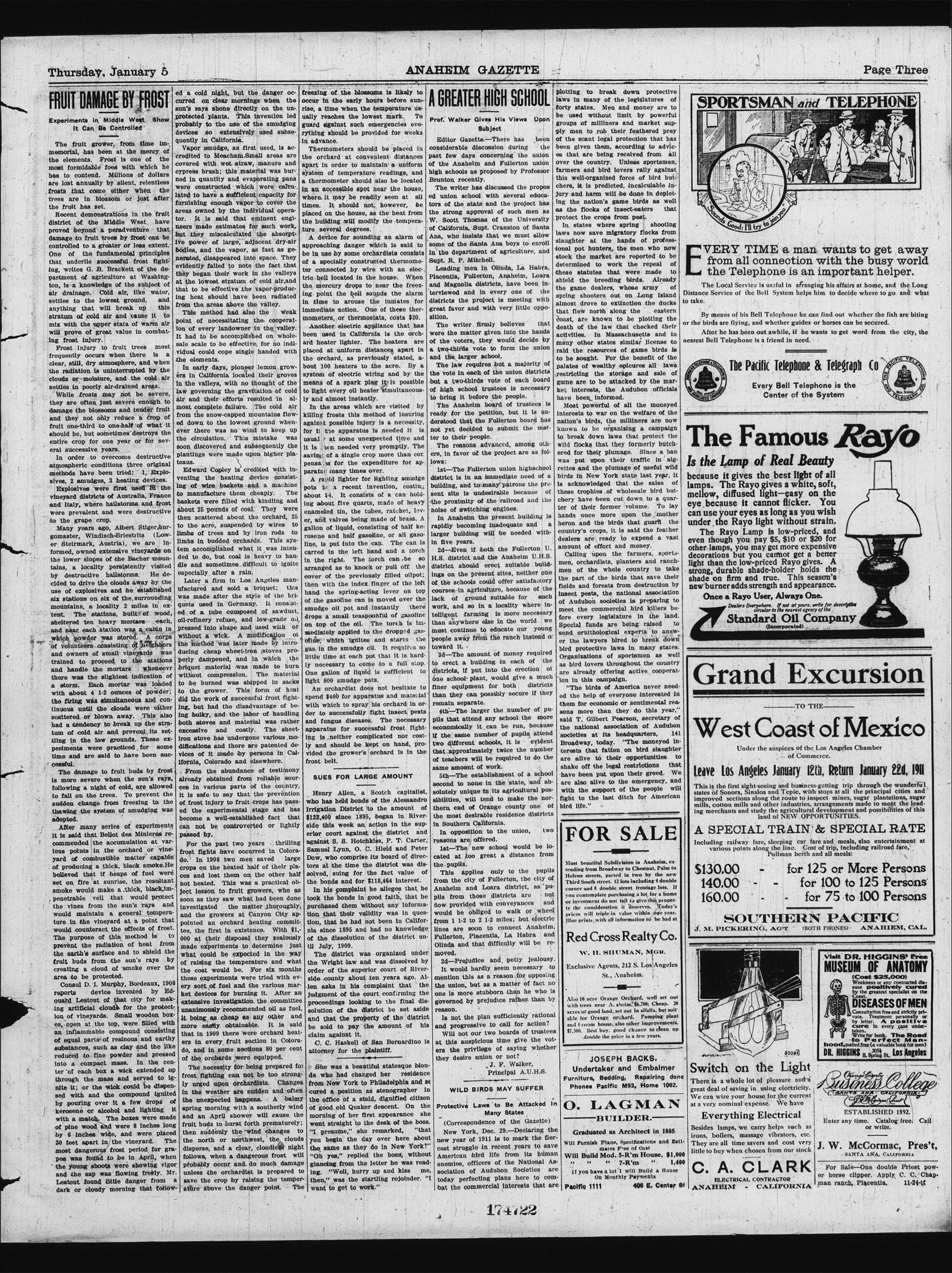
Searchable text
FRUIT DAMAGE BY FROST
Experiments in Middle West Show It Can Be Controlled
The fruit grower, from time immemorial, has been at the mercy of the elements. Frost is one of the most formidable foes with which he has to contend. Millions of dollars are lost annually by silent, relentless frosts that come either when the trees are in blossom or just after the fruit has set.
Recent demonstrations in the fruit district of the Middle West have proved beyond a peradventure that damage to fruit trees by frost can be controlled to a greater or less extent. One of the fundamental principles that underlie successful frost fighting, writes G. B. Brackett of the department of agriculture at Washington, is a knowledge of the subject of air drainage. Cold air, like water, settles to the lowest ground, and anything that will break up this stratum of cold air and cause it to mix with the upper stata of warm air will prove of great value in combating frost injury.
Frost injury to fruit trees most frequently occurs when there is a clear, still, dry atmosphere, and when the radiation is uninterrupted by the clouds or moisture, and the cold air settles in poorly air-drained areas.
While frosts may not be severe, they are often just severe enough to damage the blossoms and tender fruit and they not only reduce a crop of fruit one-third to one-half of what it should be, but sometimes destroys the entire crop for one year or for several successive years.
In order to overcome destructive atmospheric conditions three original methods have been tried: 1. Exploitation of a cold night, but the danger occurred on clear mornings when the sun's rays shone directly on the unprotected plants. This invention led probably to the use of the smudging devices so extensively used subsequently in California.
Vapor smudge, as first used, is accredited to Meacham. Small areas are covered with wet straw, manure and cypress brush; this material was burned in quantity and evaporating pans were constructed which were calculated to have a sufficient capacity for furnishing enough vapor to cover the areas owned by the individual operator. It is said that eminent engineers made estimates for such work, but they miscalculated the absorptive power of large, adjacent dry-air bodies, and the vapor, as fast as generated, disappeared into space. They evidently failed to note the fact that they began their work in the valleys at the lowest stratum of cold air, and that to be effective the vapor-producing heat should have been radiated from the areas above the valley.
This method had also the weak point of necessitating the cooperation of every landowner in the valley. It had to be accomplished on wholesale scale to be effective, for no individual could cope single handed with the elements.
In early days, pioneer lemon growers in California located their groves in the valleys, with no thought of the law governing the gravitation of cold air and their efforts resulted in almost complete failure. The cold air from the snow-capped mountains flowed down to the lowest ground whenever there was no wind to keep up the circulation. This mistake was soon discovered and subsequently the plantings were made upon higher plateaus.
Edward Copley is credited with freezing of the fruit occur in the early rise, a time when usually reaches the guard against sundrthing should be in advance.
Thermometers placed on the orchard at apart in order to system of temperature in an accessible where it may be times. It should placed on the hot building willature several degrees.
A device for approaching danger be in use by some of a specially cooled connected by tric bell located at the mercury dropping point the body in time to avoid immediate action on thermometers, or the another electric been used in Cord hearter lighted placed at uniform on orchard, as about 100 heaters system of electricity means of a spark to light every oil and almost insulated.
In the areas where killing frosts threaten possible for if the apparent usual at some it is then needed saving of a single pensa for the paratus many times.
clouds or moisture, and the cold air settles in poorly air-drained areas.
While frosts may not be severe, they are often just severe enough to damage the blossoms and tender fruit and they not only reduce a crop of fruit one-third to one-half of what it should be, but sometimes destroys the entire crop for one year or for several successive years.
In order to overcome destructive atmospheric conditions three original methods have been tried: 1. Explosives, 2 smudges, 3 heating devices.
Explosives were first used in the vineyard districts of Australia, France and Italy, where hailstorms and frost were prevalent and were destructive to the grape crop.
Many years ago, Albert Stiger, burgomaster, Windisch-Briestritts (Lower Steirmark, Austria), we are informed, owned extensive vineyards on the lower slopes of the Bacher mountains, a locality persistently visited by destructive hailstorms. He decided to drive the clouds away by the use of explosives and he established six stations on six of the surrounding mountains, a locality 2 miles in extent. The stations, built of wood, sheltered ten heavy mortars each, and near each station was a cabin in which powder was stored. A corps of volunteers consisting of neighbors and owners of small vineyards was trained to proceed to the stations and handle the mortars wheneevr there was the slightest indication of a storm. Each mortar was loaded with about 4-1-2 ounces of powder; the firing was simultaneous and continuous until the clouds were either scattered or blown away. This also had a tendency to break up the stratum of cold air and prevent its settling in the low grounds. These experiments were practiced for some time and are said to have been successful.
The damage to fruit buds by frost is more severe when the sun's rays, following a night of cold, are allowed to fall on the trees. To prevent the sudden change from freezing to the thawing the system of smudging was adopted.
After many series of experiments it is said that Bellot des Minieres recommended the accumulation at various points in the orchard or vineyard of combustible matter capable of producing a thick, black smoke. He believed that if heaps of fuel were set on fire at sunrise, the resultant smoke would make a thick, black, impenetrable vell that would protecters in California located their groves in the valleys, with no thought of the law governing the gravitation of cold air and their efforts resulted in almost complete failure. The cold air from the snow-capped mountains flowed down to the lowest ground whenever there was no wind to keep up the circulation. This mistake was soon discovered and subsequently the plantings were made upon higher plateaus.
Edward Copley is credited with inventing the heating device consisting of wire baskets and a machine to manufacture them cheaply. The baskets were filled with kindling and about 25 pounds of coal. They were then scattered about the orchard, 25 to the acre, suspended by wires to limbs of trees and by iron rods to limbs in budded orchards. This system accomplished what it was intended to do, but coal is heavy to handle and sometimes difficult to ignite especially after a rain.
Later a firm in Los Angeles manufactured and sold a briquet; this was made after the style of the briquets used in Germany. It consisted of a tube composed of sawdust, oil-refinery refuse, and low-grade oil pressed into shape and used with or without a wick. A modification of the method was later made by introducing cheap sheet-Iron stoves properly dampened, and in which the briquet material was made to burn without compression. The material to be burned was shipped in sacks to the grower. This form of heat did the work of successful frost fighting, but had the disadvantage of being bulky, and the labor of handling both stoves and material was rather excessive and costly. The sheet-Iron stove has undergone various modifications and there are patented devices of it made by persons in California, Colorado and elsewhere.
From the abundance of testimony already obtained from reliable sources in various parts of the country, it is safe to say that the prevention of frost injury to fruit crops has passed the experimental stage and has become a well-established fact that can not be controverted or lightly passed by.
For the past two years thrilling frost fights have occurred in Colorado. In 1908 two men saved large crops on the heated half of their places and lost them on the other half not heated. This was a practical object lesson to fruit growers, who as soon as they saw what had been done
A rapid lighter pots is a recent about $44. It coming about five o'clock enameled tin, thicker, and valves begged gallon of liquid, rosene and half line, is put into carved in the loft in the right. Arranged as to cover of the prince then with the in hand the spring of the gasoline smudge oil pot drops a small tilt on top of the mediately applied online, which ignites gas in the smudged little time at easily necessary tool. One gallon of light 800 smudge oil.
An orchardist spend $400 for six with which to succeed and fungus disapparatus for sitting is neither likely and should be vidied the growth frost belt.
SUES FOR
Henry Allen, who has held his Irrigation District $123,400 since side this week eror court again against S. S. H Samuel Lynn, Dow, who compacts at the time solved, suing for the bonds and
In his complaint took the bonds
sudden change from freezing to the thawing the system of smudging was adopted.
After many series of experiments it is said that Bellot des Minieres recommended the accumulation at various points in the orchard or vineyard of combustible matter capable of producing a thick, black smoke. He believed that if heaps of fuel were set on fire at sunrise, the resultant smoke would make a thick, black, impenetrable vell that would protect the vines from the sun's rays and would maintain a general temperature in the vineyard at a point that would counteract the effects of frost. The purpose of this method is to prevent the radiation of heat from the earth's surface and to shield the fruit buds from the sun's rays by creating a cloud of smoke over the area to be protected.
Consul D. I. Murphy, Bordeaux, 1908 reports device invented by Edouard Lestout of that city for making artificial clouds for the protection of vineyards. Small wooden boxes, open at the top, were filled with an inflammable compound consisting of equal parts of resinous and earthy substances, such as clay and the like reduced to fine powder and pressed into a compact mass. In the center of each box a wick extended up through the mass and served to ignite it; or the wick could be dispensed with and the compound ignited by pouring over it a few drops of kerosene or alcohol and lighting it with a match. The boxes were made of pine wood and were 8 inches long by 6 inches wide, and were placed 30 feet apart in the vineyard. The most dangerous frost period for grapes was found to be in April, when the young shoots were showing vigor and the sap was flowing freely. Mr. Lestout found little danger from a dark or cloudy morning that followed of frost injury to fruit crops has passed the experimental stage and has become a well-established fact that can not be controverted or lightly passed by.
For the past two years thrilling frost fights have occurred in Colorado. In 1908 two men saved large crops on the heated half of their places and lost them on the other half not heated. This was a practical object lesson to fruit growers, who as soon as they saw what had been done investigated the matter thoroughly, and the growers at Canyon City appointed an orchard heating committee, the first in existence. With $1,000 at their disposal they zealously made experiments to determine just what could be expected in the way of raising the temperature and what the cost would be. For six months these experiments were tried with every sort of fuel and the various market devices for burning it. After an extensive investigation the committee unanimously recommended oil as fuel, it being as cheap as any other and more easily obtainable. It is said that in 1909 there were orchard heaters in every fruit section in Colorado, and in some sections 80 per cent of the orchards were equipped.
The necessity for being prepared for frost fighting can not be too strongly urged upon orchardists. Changes in the weather are sudden and often the unexpected happens. A balmy spring morning with a southerly wind and an April shower will cause the fruit buds to burst forth prematurely; then suddenly the wind changes to the north or northwest, the clouds disperse, and a clear, cloudless night follows, when a dangerous frost will probably occur and do much damage unless the orchardist is prepared to save the crop by raising the temperature above the danger point. The
She was a bide who had clipped from New York cured a position in the office of a good old Quinn morning of her went straight to "I presume," you begin there, the same as to "Oh yes," repelling from ing. "Well, he then," was she want to get to
ANAHEIM GAZETTE
freezing of the blossoms is likely to occur in the early hours before sunrise, a time when the temperature usually reaches the lowest mark. To guard against such emergencies everything should be provided for weeks in advance.
Thermometers should be placed in the orchard at convenient distances apart in order to maintain a uniform system of temperature readings, and a thermometer should also be located in an accessible spot near the house, where it may be readily seen at all times. It should not, however, be placed on the house, as the heat from the building will modify the temperature several degrees.
A device for sounding an alarm of approaching danger which is said to be in use by some orchardists consists of a specially constructed thermometer connected by wire with an electric bell located in the house. When the mercury drops to near the freezing point the bell sounds the alarm in time to arouse the inmates for immediate action. One of these thermometers, or thermostats, costs $20.
Another electric appliance that has been used in California is the orchard heater lighter. The heaters are placed at uniform distances apart in the orchard, as previously stated, about 100 heaters to the acre. By a system of electric wiring and by the means of a spark plug it is possible to light every oil heater simultaneously and almost instantly.
In the areas which are visited by killing frosts this method of insuring against possible injury is a necessity, for if the apparatus is needed it is usually at some unexpected time and it is then needed very promptly. The saving of a single crop more than corpensales for the expenditure for apparatus many times over.
A GREATER HIGH SCHOOL
Prof. Walker Gives His Views Upon Subject
Editor Gazette.—There has been considerable discussion during the past few days concerning the union of the Anaheim and Fullerton union high schools as proposed by Professor Brunton recently.
The writer has discussed the proposed union school with several educators of the state and the project has the strong approval of such men as W. Scott Thomas of the University of California, Supt. Cranston of Santa Ana, who insists that we must allow some of the Santa Ana boys to enroll in the department of agriculture, and Supt. R. P. Mitchell.
Leading men in Olinda, La Habra, Placentia, Fullerton, Anaheim, Loara and Magnolia districts, have been interviewed and in every one of the districts the project is meeting with great favor and with very little opposition.
The writer firmly believes that were the matter given into the hands of the voters, they would decide by a two-thirds vote to form the union and the larger school.
The law requires but a majority of the vote in each of the union districts but a two-thirds vote of each board of high school trustees is necessary to bring it before the people.
The Anaheim board of trustees is ready for the petition, but it is understood that the Fullerton board has not yet decided to submit the matter to their people.
The reasons advanced, among others, in favor of the project are as follows:
1st—The Fullerton union highschool plotting to break down protective laws in many of the legislatures of forty states. Men and money are to be used without limit by powerful groups of milliners and market supply men to rob their feathered prey of the scant legal protection that has been given them, according to advice that are being received from all over the country. Unless sportsmen farmers and bird lovers rally against this well-organized force of bird butchers, it is predicted, incalculable in jury and harm will be done in depleting the nation's game birds as well as the flocks of insect-eaters that protect the crops from pest.
In states where spring shooting laws now save migratory flocks from slaughter at the hands of professional pot hunters, the men who now stock the market are reported to be determined to work the repeal of these statutes that were made to shield the breeding birds. Already the game dealers, whose army of spring shooters out on Long Island almost drove to extinction the ducks that flew north along the eastern coast, are known to be plotting their death of the law that checked their activities. In Massachusetts and in many other states similar license to raid the resources of game birds is to be sought. For the benefit of these palates of wealthy epicures all laws restricting the storage and sale of game are to be attacked by the market interests, the Audubon official have been informed.
Most powerful of all the moneyer interests to war on the welfare of the nation's birds, the milliners are now known to be organizing a campaign to break down laws that protect wild flocks that they formerly butchered for their plumage. Since a bar was put upon their traffic in all rettes and the plumage of useful wildlife in New York state last year.
A rapid lighter for lighting smudge pots is a recent invention, costing about $4. It consists of a can holding about five quarts, made of heavy enameled tin, the tubes, ratchet lever, and valves being made of brass. A gallon of liquid, consisting of half kerosene and half gasoline, or all gasoline, is put into the can. The can is carved in the left hand and a torch in the right. The torch can be so arranged as to knock or pull off the cover of the previously filled oilpot; then with the index finger of the left hand the spring-acting lever on top of the gasoline can is moved over the smudge oil pot and instantly there drops a small teaspoonful of gasoline on top of the oil. The torch is immediately applied to the dropped gasoline, which ignites and starts the gas in the smudge oil. It requires so little time at each pot that it is hardly necessary to come to a full stop. One gallon of liquid is sufficient to light 800 smudge pots.
An orchardist does not hesitate to spend $400 for apparatus and material with which to spray his orchard in order to successfully fight insect pests and fungus diseases. The necessary apparatus for successful frost fighting is neither complicated nor costly and should be kept on hand, provided the grower's orchard is in the frost belt.
SUES FOR LARGE AMOUNT
Henry Allen, a Scotch capitalist, who has held bonds of the Alessandro Irrigation District to the amount of $123,400 since 1895, began in River-side this week an action in the superior court against the district and against S. S. Hotchkiss, P. T. Carter, Samuel Lynn, O. C. Hield and Peter Dow, who comprise its board of directors at the time the district was dissolved, suing for the fact value of the bonds and for $118,464 interest.
In his complaint he alleges that he took the bonds in good faith, that he vote in each of the union districts but a two-thirds vote of each board of high school trustees is necessary to bring it before the people.
The Anaheim board of trustees is ready for the petition, but it is understood that the Fullerton board has not yet decided to submit the matter to their people.
The reasons advanced, among others, in favor of the project are as follows:
1st—The Fullerton union highschool district is in an immediate need of a building, and to many patrons the present site is undesirable because of the proximity of the railroad and the noise of switching engines.
In Anaheim the present building is rapidly becoming inadequate and a larger building will be needed within five years.
2d—Even if both the Fullerton U.H.S. district and the Anaheim U.H.S. district should erect suitable buildings on the present sites, neither one of the schools could offer satisfactory courses in agriculture, because of the lack of ground suitable for such work, and so in a locality where intelligent farming is more necessary than anywhere else in the world we must continue to educate our young people away from the ranch instead o toward it.
3d—The amount of money required to erect a building in each of the districts, if put into the erection of one school plant, would give a much finer equipment for both districts than they can possibly secure if they remain separate.
4th—The larger the number of pupils that attend any school the more economically it can be run, because if the same number of pupils attend two different schools, it is evident that approximately twice the number of teachers will be required to do the same amount of work.
5th—The establishment of a school second to none in the state, and absolutely unique in its agricultural possibilities, will tend to make the northern end of Orange county one of the most desirable residence districts in Southern California.
In opposition to the union, two reasons are offered.
1st—The new school would be located at too great a distance from the pupils.
This applies only to the pupils from the city of Fullerton, the city of Anaheim and Loara district, as pupils from those districts are not restricted to storage and sale game are be attacked by the market interests, the Audubon officials have been informed.
Most powerful of all the moneymen interests to war on the welfare of the nation's birds, the milliners are now known to be organizing a campaign to break down laws that protect wild flocks that they formerly butchered for their plumage. Since a bar was put upon their traffic in airrettes and the plumage of useful wild birds in New York state last year, is acknowledged that the sales of these trophies of wholesale bird chery have been cut down to a quarter of their former volume. To law hands once more upon the mother heron and the birds that guard this country's crops, it is said the feathery dealers are ready to expend a vast amount of effort and money.
Calling upon the farmers, sports men, orchardists, planters and ranchers of the whole country to talk about part of the birds that save fields and forests from destruction by insect pests, the national association of Audubon societies is preparing meet the commercial bird killers before every legislature in the land. Special funds are being raised send ornithological experts to answer the lawyers hired to break down bird protective laws in many states. Organizations of sportsmen as well as bird lovers throughout the country are already offering active cooperation in this campaign.
"The birds of America never need help for everyone interested them for economic or sentimental reasons more than they do this year," said T. Gilbert Pearson, secretary of the national association of Audubon societies at its headquarters. Broadway, today. "The moneyed terests that fatten on bird slaughter are alive to their opportunities shake off the legal restrictions they have been put upon their greed." We are also alive to the emergency, as with the support of the people we fight to the last ditch for American bird life."
who has held bonds of the Alessandro Irrigation District to the amount of $123,400 since 1895, began in River-side this week an action in the superior court against the district and against S. S. Hotchkiss, P. T. Carter, Samuel Lynn, O. C. Hield and Peter Dow, who comprise its board of directors at the time the district was dissolved, suing for the fact value of the bonds and for $118,464 interest.
In his complaint he alleges that he took the bonds in good faith, that he purchased them without any information that their validity was in question, that he had not been in California since 1895 and had no knowledge of the dissolution of the district until July, 1909.
The district was organized under the Wright law and was dissolved by order of the superior court of River-side county about ten years ago. Allen asks in his complaint that the judgment of the court confirming the proceedings looking to the final dissolution of the district be set aside and that the property of the district be sold to pay the amount of his claim against it.
C. C. Haskell of San Bernardino is attorney for the plaintiff.
She was a beautiful statesque blonde who had changed her residence from New York to Philadelphia and secured a position as stenographer in the office of a staid, dignified citizen of good old Quaker descent. On the morning of her first appearance she went straight to the desk of the boss. "I presume," she remarked, "that you begin the day over here about the same as they do in New York?" "Oh yes," replied the boss, without glancing from the letter he was reading. "Well, hurry up and kiss me, then," was the startling rejoinder. "I want to get to work."
Protective Laws to Be Attacked in Many States
(Correspondence of the Gazette)
New York, Dec. 29.—Declaring the new year of 1911 is to mark the fiercest struggle in recent years to save American bird life from its human enemies, officers of the National Association of Audubon Societies are today perfecting plans here to combat the commercial interests that are
SPORTSMAN and TELEPHONE
EVERY TIME a man wants to get away from all connection with the busy world the Telephone is an important helper.
The Local Service is useful in arranging his affairs at home, and the Long Distance Service of the Bell System helps him to decide where to go and what to take.
By means of bis Bell Telephone he can find out whether the fish are biting or the birds are flying, and whether guides or horses can be secured.
After he has been out awhile, if he wants to get word from the city, the nearest Bell Telephone is a friend in need.
The Pacific Telephone & Telegraph Co
Every Bell Telephone is the Center of the System
The Famous Rayo
Is the Lamp of Real Beauty
Every Bell Telephone is the Center of the System
The Famous Rayo
Is the Lamp of Real Beauty
because it gives the best light of all lamps. The Rayo gives a white, soft, mellow, diffused light—easy on the eye because it cannot flicker. You can use your eyes as long as you wish under the Rayo light without strain.
The Rayo Lamp is low-priced, and even though you pay $5, $10 or $20 for other lamps, you may get more expensive decorations but you cannot get a better light than the low-priced Rayo gives. A strong, durable shade-holder holds the shade on firm and true. This season’s new burner adds strength and appearance.
Once a Rayo User, Always One.
Dealers Everywhere. If not at yours, write for descriptive circular to the nearest agency of the Standard Oil Company (Incorporated)
Grand Excursion
TO THE
West Coast of Mexico
Under the auspices of the Los Angeles Chamber of Commerce.
Leave Los Angeles January 12th, Return January 22d, 1911
This is the first sight-seeing and business-getting trip through the wonderful states of Sonora, Sinaloa and Tepic, with stops at all the principal cities and improved sections along the route to inspect mines, sugar plantations, sugar mills, cotton mills and other industries, arrangements made to meet the leading merchants and study the agricultural development and possibilities of this land of NEW OPPORTUNITIES.
A SPECIAL TRAIN & SPECIAL RATE
Including railway fare, sleeping car fare and meals, also entertainment at various points along the line. Cost of trip, including railroad fare,
$130.00 - for 125 or More Persons
140.00 - for 100 to 125 Persons
160.00 - for 75 to 100 Persons
A SPECIAL TRAIN & SPECIAL RATE
Including railway fare, sleeping car fare and meals, also entertainment at various points along the line. Cost of trip, including railroad fare, Pullman berth and all meals:
$130.00 - for 125 or More Persons
140.00 - for 100 to 125 Persons
160.00 - for 75 to 100 Persons
SOUTHERN PACIFIC
J. M. PICKERING, AGT (BOTH PHONES) ANAHIEM, CAL.
Switch on the Light
There is a whole lot of pleasure and a great deal of saving in using electricity. We can wire your house for the current at a very nominal expense. We have Everything Electrical
Besides lamps, we carry helps such as irons, boilers, massage vibrators, etc. They are all time savers and cost very little to buy when chosen from our stock
C. A. CLARK
ELECTRICAL CONTRACTOR
ANAHEIM - CALIFORNIA
Visit DR. HIGGINS' Free MUSEUM OF ANATOMY
(Cost $25,000)
Weakness or any contracted disease positively cured by the greatest specialist on the Coast.
DISEASES OF MEN
Consultation free and strictly private. Treatment personally or by letter. A positive cure in every case undertaken.
Write for book. The Road to Perfect Manhood, mailed free (a valuable book for men)
DR. HIGGINS 3054 & Spring St. Los Angeles
Business College
ESTABLISHED 1892.
Enter any time. Catalog free. Call or write.
J. W. McCormac, Pres't,
SANTA ANA, CALIFORNIA
For Sale—One double Priest power horse clipper. Apply C. C. Chapman ranch, Placentia. 11-24-tf