anaheim-gazette 1910-12-08
Scanned page
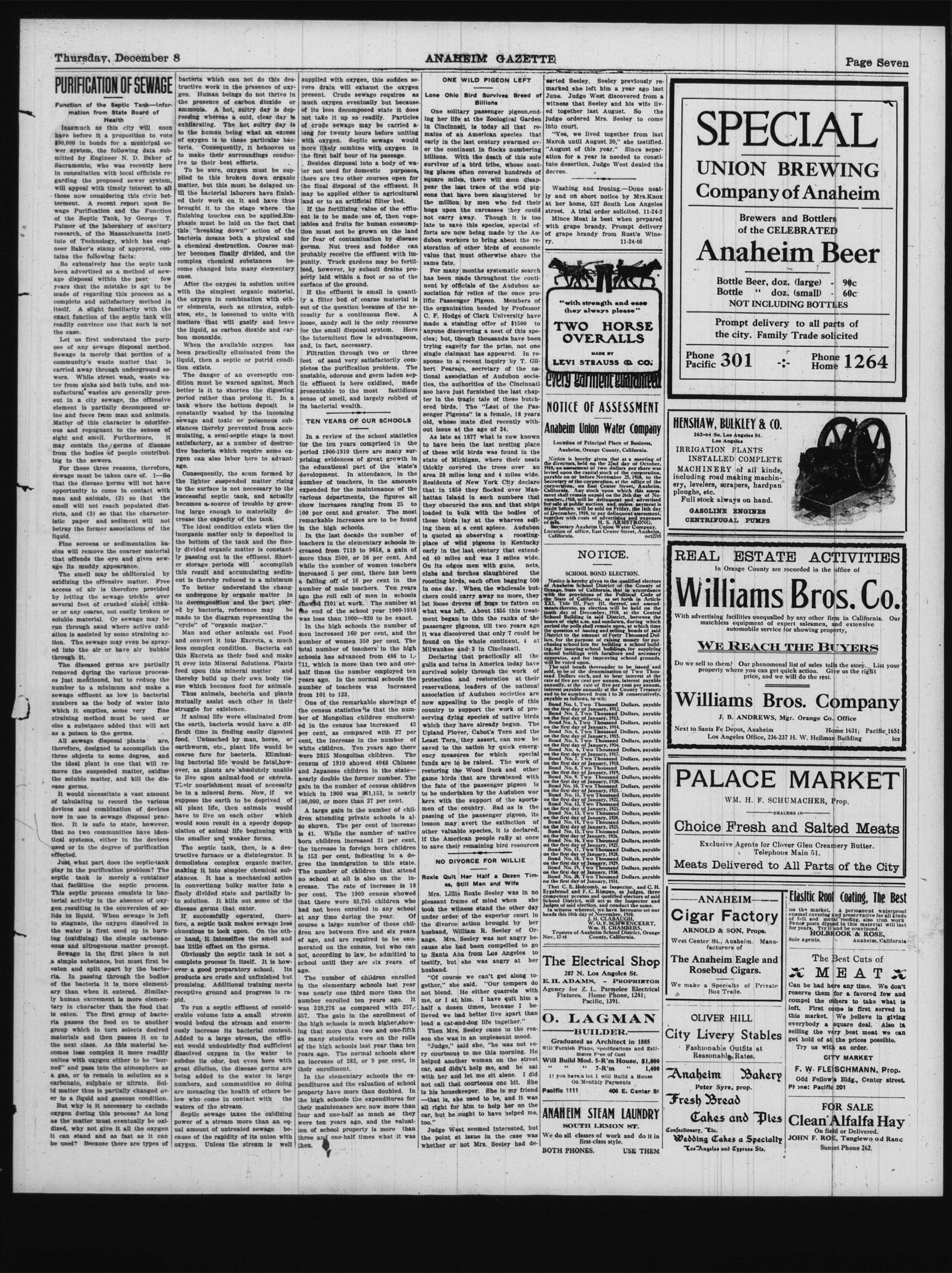
Searchable text
PURIFICATION OF SEWAGE
Function of the Septic Tank—Information from State Board of Health
Inasmuch as this city will soon have before it a proposition to vote $90,000 in bonds for a municipal sewer system, the following data submitted by Engineer N. D. Baker of Sacramento, who was recently here in consultation with local officials regarding the proposed sewer system, will appeal with timely interest to all those now considering this civic betterment. A recent report upon Sewage Purification and the Function of the Septic Tank, by George T. Palmer of the laboratory of sanitary research, of the Massachusetts Institute of Technology, which has engineer Baker's stamp of approval, contains the following facts:
So extensively has the septic tank been advertised as a method of sewage disposal within the past few years that the mistake is apt to be made of regarding this process as a complete and satisfactory method in itself. A slight familiarity with the exact function of the septic tank will readily convince one that such is not the case.
Let us first understand the purpose of any sewage disposal method. Sewage is merely that portion of a community's waste matter that is carried away through underground sewers. While street wash, waste water from sinks and bath tubs, and manufactural wastes are generally present in a city sewage, the offensive element is partially decomposed urine and feces from man and animals. Matter of this character is odoriferous and repugnant to the senses of sight and smell. Furthermore, it may contain the germs of disease from the bodies of people contributing to the sewers.
For these three reasons, therefore, bacteria which can not do this destructive work in the presence of oxygen. Human beings do not thrive in the presence of carbon dioxide or ammonia. A hot, sultry day is depressing whereas a cold, clear day is exhilarating. The hot sultry day is to the human being what an excess of oxygen is to these particular bacteria. Consequently, it behooves us to make their surroundings conducive to their best efforts.
To be sure, oxygen must be supplied to this broken down organic matter, but this must be delayed until the bacterial laborers have finished their work on it and have thus brought it to the stage where the finishing touches can be applied. Emphasis must be laid on the fact that this "breaking down" action of the bacteria means both a physical and a chemical destruction. Coarse matter becomes finally divided, and the complex chemical substances become changed into many elementary ones.
After the oxygen in solution unites with the simplest organic material, the oxygen in combination with other elements, such as nitrates, sulphates, etc., is loosened to unite with matters that will gasify and leave the liquid, as carbon dioxide and carbon monoxide.
When the available oxygen has been practically eliminated from the liquid, then a septic or putrid condition exists.
The danger of an overseptic condition must be warned against. Much better is it to shorten the digesting period rather than prolong it. In a tank where the bottom deposit is constantly washed by the incoming sewage and toxic or poisonous substances thereby prevented from accumulating, a semi-septic stage is most satisfactory, as a number of destructive bacteria which require some oxygen can also labor here to advantage.
Consequently, the scum formed by supplied with oxygen were drain will present. Crude oil much oxygen even of its less decomposition not take it up so long for twenty days with oxygen. Seems more likely combinate the first half hour.
Besides disposal not used for there are two others: the final disposal may be applied elsewhere or to an artifact.
If the fertilizing agent is to be made tables and fruits itation must not be for fear of contact germs. Nut tree probably receive the purity. Truck gasized, however, by properly laid within surface of the ground.
If the effluent by a filter bed out of the question necessity for a compost loose, sandy soil for the small displacement intermittent flies and, in fact, necesit Filtration through feet of sand very completes the purification unstable, odorousotic effluent is he presentable to the sense of smell, and its bacterial wealth.
TEN YEARS ON
In a review of for the ten years period 1900-1910 that prising evidences in the educational development...
While street wash, waste water from sinks and bath tubs, and manufactural wastes are generally present in a city sewage, the offensive element is partially decomposed urine and feces from man and animals. Matter of this character is odoriferous and repugnant to the senses of sight and smell. Furthermore, it may contain the germs of disease from the bodies of people contributing to the sewers.
For these three reasons, therefore, sewage must be taken care of. 1—So that the disease germs will not have opportunity to come in contact with man and animals, (2) so that the smell will not reach populated districts, and (3) so that the characteristic paper and sediment will not betray the former associations of the liquid.
Fine screens or sedimentation basins will remove the coarser material that offends the eye and gives sewage its muddy appearance.
The smell may be obliterated by oxidizing the offensive matter. Free access of air is therefore provided by letting the sewage trickle over several feet of crushed stone, clinker or any coarse, not easily broken or soluble material. Or sewage may be run through sand where active oxidation is assisted by some straining action. The sewage may even be sprayed into the air or have air bubble through it.
The diseased germs are partially removed during the various processes just mentioned, but to reduce the number to a minimum and make a sewage effluent as low in bacterial numbers as the body of water into which it empties, some very fine straining method must be used or else a substance added that will act as a poison to the germs.
All sewage disposal plants are, therefore, designed to accomplish the three objects to some degree, and the ideal plant is one that will remove the suspended matter, oxidize the soluble matter, and kill the disease germs.
It would necessitate a vast amount of tabulating to record the various devices and combination of devices now in use in sewage disposal practice. It is safe to state, however, that no two communities have identical systems, either in the devices used or in the degree of purification effected.
Just what part does the septic-tank play in the purification problem? The septic tank is merely a container that facilities the septic process. This septic process consists in bacterial activity in the absence of ammonia.
The danger of an overseptic condition must be warned against. Much better is it to shorten the digesting period rather than prolong it. In a tank where the bottom deposit is constantly washed by the incoming sewage and toxic or poisonous substances thereby prevented from accumulating, a semi-septic stage is most satisfactory, as a number of destructive bacteria which require some oxygen can also labor here to advantage.
Consequently, the scum formed by the lighter suspended matter rising to the surface is not necessary to the successful septic tank, and actually becomes a source of trouble by growing large enough to materially decrease the capacity of the tank.
The ideal condition exists when the inorganic matter only is deposited in the bottom of the tank and the finely divided organic matter is constantly passing out in the effluent. Shorter storage periods will accomplish this result and accumulating sediment is thereby reduced to a minimum.
To better understand the changes undergone by organic matter in its decomposition and the part played by bacteria, reference may be made to the diagram representing the "cycle" of "organic matter."
Man and other animals eat Food and convert it into Excreta, a much less complex condition. Bacteria eat this Excreta as their food and make it over into Mineral Solutions. Plants feed upon this mineral matter and thereby build up their own body tissue which becomes food for animals.
Thus animals, bacteria and plants mutually assist each other in their struggle for existence.
If animal life were eliminated from the earth, bacteria would have a difficult time in finding easily digested food. Untouched by man, horse, or earthworm, etc., plant life would be coarse fare for bacteria. Eliminating bacterial life would be fatal, however, as plants are absolutely unable to live upon animal-food or excreta. Their nourishment must of necessity be in a mineral form. Now, if we suppose the earth to be deprived of all plant life, then animals would have to live on each other which would soon result in a speedy depopulation of animal life beginning with the smaller and weaker forms.
The septic tank, then, is a destructive furnace or a disintegrator. It demolishes complex organic matter, making it into simpler chemical substances. It has a mechanical action in converting bulky matter into a finely divided state and partially inactivation. It bills out some of its waste per cent.
In a review of for the ten years period 1900-1910 there is prising evidences of educational development. In number of teachers expended for the various departments show increases ranging 100 per cent and remarkable increase in the high school.
In the last decade teachers in the eleven increased from 7119 more than 2500, or while the number increased 5 per cent a falling off of 1 number of male teachers ago the roll call showed 1101 at work the end of the school was less than 1000.
In the high school men increased 1600 number of women total number of schools has advanced 711, which is more half times the number years ago. In the number of teachers from 101 to 133.
One of the remains census statistics of Mongolian ed in the census per cent, as compared white children. There were 2815 Mongolian census of 1910 shirts and Japanese children nearly double the gain in the number which in 1900 was 100,000, or more than A large gain in children attending pr so shown. The price is 41. While they born children increase the increase in fo is 153 per cent, agree the immigrant The number of children no school at all increase. The rate per cent. The
of tabulating to record the various devices and combination of devices now in use in sewage disposal practice. It is safe to state, however, that no two communities have identical systems, either in the devices used or in the degree of purification effected.
Just what part does the septic-tank play in the purification problem? The septic tank is merely a container that facilities the septic process. This septic process consists in bacterial activity in the absence of oxygen resulting in the conversion of solids to liquid. When sewage is left to stagnate, the oxygen dissolved in the water is first used up in burning (oxidizing) the simple carbonaceous and nitrogenous matter present.
Sewage in the first place is not a simple substance, but must first be eaten and split apart by the bacteria. In passing through the bodies of the bacteria it is more elementary than when it entered. Similarly human excrement is more elementary in character than the food that is eaten. The first group of bacteria passes the food on to another group which in turn selects desired materials and then passes it on to the next class. As this material becomes less complex it more readily unites with oxygen either to be "burned" and pass into the atmosphere as a gas, or to remain in solution as a carbonate, sulphate or nitrate. Solid matter thus is partially changed over to a liquid and gaseous condition.
But why is it necessary to exclude oxygen during this process? As long as the matter must eventually be oxidized, why not give it all the oxygen it can stand and as fast as it can be used? Because there are types of suppose the earth to be deprived of all plant life, then animals would have to live on each other which would soon result in a speedy depopulation of animal life beginning with the smaller and weaker forms.
The septic tank, then, is a destructive furnace or a disintegrator. It demolishes complex organic matter, making it into simpler chemical substances. It has a mechanical action in converting bulky matter into a finely divided state and partially into solution. It kills out some of the disease germs that enter.
If successfully operated, therefore, a septic tank makes sewage less obnoxious to look upon. On the other hand, it intensifies the smell and has little effect on the germs.
Obviously the septic tank is not a complete process in itself. It is however a good preparatory school. Its products are crude and unfinished but promising. Additional training meets receptive ground and progress is rapid.
To run a septic effluent of considerable volume into a small stream would befoul the stream and enormously increase its bacterial content. Added to a large stream, the effluent would undoubtedly find sufficient dissolved oxygen in the water to subdue its odor, but even here with great dilution, the disease germs are being added to the water in large numbers, and communities so doing are menacing the health of others below who come in contact with the waters of the stream.
Septic sewage taxes the oxidizing power of a stream more than an equal amount of untreated sewage because of the rapidity of its union with oxygen. Unless the stream is well
ANAHEIM GAZETTE
supplied with oxygen, this sudden severe drain will exhaust the oxygen present. Crude sewage requires as much oxygen eventually but because of its less decomposed state it does not take it up so readily. Particles of crude sewage may be carried along for twenty hours before uniting with oxygen. Septic sewage would more likely combine with oxygen in the first half hour of its passage.
Besides disposal into a body of water not used for domestic purposes, there are two other courses open for the final disposal of the effluent. It may be applied either to agricultural land or to an artificial filter bed.
If the fertilizing value of the effluent is to be made use of, then vegetables and fruits for human consumption must not be grown on the land for fear of contamination by disease germs. Nut trees and fodder can probably receive the effluent with impunity. Truck gardens may be fertilized, however, by subsoil drains properly laid within a foot or so of the surface of the ground.
If the effluent is small in quantity a filter bed of coarse material is out of the question because of the necessity for a continuous flow. A loose, sandy soil is the only recourse for the small disposal system. Here the intermittent flow is advantageous, and, in fact, necessary.
Filtration through two or three feet of sand very satisfactorily completes the purification problem. The unstable, odorous and germ laden septic effluent is here oxidized, made presentable to the most fastidious sense of smell, and largely robbed of its bacterial wealth.
TEN YEARS OF OUR SCHOOLS
In a review of the school statistics for the ten years comprised in the period 1900-1910 there are many surprising evidences of great growth in the educational part of the state's development. In attendance in the ONE WILD PIGEON LEFT
Lone Ohio Bird Survives Breed of Billions
One solitary passenger pigeon, ending her life at the Zoological Garden in Cincinnati, is today all that remains of an American species that early in the last century swarmed over the continent in flocks numbering billions. With the death of this sole survivor of a bird tribe, whose nesting places often covered hundreds of square miles, there will soon disappear the last trace of the wild pigeons that have been slaughtered by the million by men who fed their hogs upon the carcasses they could not carry away. Though it is too late to save this species, special efforts are now being made by the Audubon workers to bring about the restoration of other birds of economic value that must otherwise share the same fate.
For many months systematic search has been made throughout the continent by officials of the Audubon association for relics of the once prolific Passenger Pigeon. Members of the organization headed by Professor C. F. Hodge of Clark University have made a standing offer of $1500 to anyone discovering a nest of this species; but, though thousands have been trying eagerly for the prize, not one single claimant has appeared. In response to a recent inquiry by T. Gilbert Pearson, secretary of the national association of Audubon societies, the authorities of the Cincinnati zoo have just furnished the last chapter in the tragic tale of these butchered birds. The "Last of the Passenger Pigeons" is a female, 18 years old, whose mate died recently without issue at the age of 24.
As late as 1877 what is now known to have been the last nesting place of these wild birds was found in the state of Michigan, where their nests thickly covered the trees over an area 28 miles long and 4 miles wide.
Washing and Ironing.—Done neatly and on short notice by Mrs.Knox at her home, 527 South Los Angeles street. A trial order solicited. 11-24-2
Mince Meat is best when prepared with grape brandy. Prompt delivery of grape brandy from Rust's Winery.
NOTICE OF ASSESSMENT
Anabeim Union Water Company
Location of Principal Place of Business,
Anabeim, Orange County, California.
Notice is hereby given that at a meeting of the directors, held on the 22nd day of October, 1910, an assessment of two dollars per share was levied upon the capital stock of the corporation.
TEN YEARS OF OUR SCHOOLS
In a review of the school statistics for the ten years comprised in the period 1900-1910 there are many surprising evidences of great growth in the educational part of the state's development. In attendance, in the number of teachers, in the amounts expended for the maintenance of the various departments, the figures all show increases ranging from 25 to 100 per cent and greater. The most remarkable increases are to be found in the high schools.
In the last decade the number of teachers in the elementary schools increased from 7119 to 9658, a gain of more than 2500, or 36 per cent. And while the number of women teachers increased 5 per cent, there has been a falling off of 16 per cent in the number of male teachers. Ten years ago the roll call of men in schools showed I101 at work. The number at the end of the school year 1909-1910 was less than 1000—920 to be exact.
In the high schools the number of men increased 160 per cent, and the number of women 350 per cent. The total number of teachers in the high schools has advanced from 486 to 1,711, which is more than two and one-half times the number employed ten years ago. In the normal schools the number of teachers was increased from 101 to 133.
One of the remarkable showings of the census statistics is that the number of Mongolian children enumerated in the census has increased 43 per cent, as compared with 27 per cent, the increase in the number of white children. Ten years ago there were 2815 Mongolian children. The census of 1910 showed 4048 Chinese and Japanese children in the state—nearly double the former number. The gain in the number of census children which in 1900 was 361,153, is nearly 100,000, or more than 27 per cent.
A large gain in the number of children attending private schools is also shown. The per cent of increase is 41. While the number of native born children increased 31 per cent, the increase in foreign born children is 153 per cent, indicating a degree the immigration to this state. The number of children that attend no school at all is also on the increase. The rate of increase is 18 per cent. The 1909 census showed unstable, odorous and germ laden septic effluent is here oxidized, made presentable to the most fastidious sense of smell, and largely robbed of its bacterial wealth.
Ten years after being the last nesting place of these wild birds was found in the state of Michigan, where their nests thickly covered the trees over an area 28 miles long and 4 miles wide. Residents of New York City declare that in 1850 they flocked over Manhattan Island in such numbers that they obscured the sun and that ships loaded in bulk with the bodies of these birds lay at the wharves selling them at a cent apiece. Audubon is quoted as observing a roosting place of wild pigeons in Kentucky early in the last century that extended 40 miles and was 3 miles wide. On its edges men with guns, nets, clubs and torches slaughtered the roosting birds, each often bagging 500 in one day. When the wholesale butchers could carry away no more, they let loose droves of hogs to fatten on what was left. About 1855 this treatment began to thin the ranks of the passenger pigeons, till two years ago it was discovered that only 7 could be found on the whole continent, 4 at Milwaukee and 3 in Cincinnati.
Declaring that practically all the gulls and terns in America today have survived solely through the work of protection and restoration at their reservations, leaders of the national association of Audubon societies are now appealing to the people of this country to support the work of preserving dying species of native birds which they have already begun. The Upland Plover, Cabot’s Tern and the Least Tern, they assert, can now be saved to the nation by quick emergency measures for which special funds are to be raised. The work of restoring the Wood Duck and other game birds that are threatened with the fate of the passenger pigeon is to be undertaken by the Audubon workers with the support of the sportsmen of the country. Sad as is the passing of the passenger pigeon, its lesson may avert the extinction of other valuable species, it is declared, if the American people rally at once to save their remaining bird resources.
NO DIVORCE FOR WILLIE
Roxie Quit Her Half a Dozen Times, Still Man and Wife
Mrs. Lillie Roxie Seeley was in no
A large gain in the number of children attending private schools is also shown. The per cent of increase is 41. While the number of native born children increased 31 per cent, the increase in foreign born children is 153 per cent, indicating in a degree the immigration to this state. The number of children that attend no school at all is also on the increase. The rate of increase is 18 per cent. The 1909 census showed that there were 83,795 children who had not been enrolled in any school at any time during the year. Of course a large number of these children are between five and six years of age, and are required to be enumerated on the census, but who can not, according to law, be admitted to school until they are six years of age.
The number of children enrolled in the elementary schools last year was nearly one third more than the number enrolled ten years ago. It was 329,276 as compared with 257,-857. The gain in the enrollment of the high schools is much higher, showing that more than two and one-fifth as many students were on the rolls of the high schools last year than ten years ago. The normal schools show an increase of 282, or 9 per cent, in their enrollment.
In the elementary schools the expenditures and the valuation of school property have more than doubled. In the high schools the expenditures for their maintenance are now more than four and one-half as much as they were ten years ago, and the valuation of school property is more than three and one-half times what it was then.
NO DIVORCE FOR WILLIE
Roxie Quit Her Half a Dozen Times, Still Man and Wife
Mrs. Lillie Roxie Seeley was in no pleasant frame of mind when she took the witness stand the other day under order of the superior court in the divorce action brought by her husband, William R. Seeley of Orange. Mrs. Seeley was not angry because she had been compelled to go to Santa Ana from Los Angeles to testify, but she was angry at her husband.
“Of course we can't get along together,” she said. “Our tempers do not blend. He either quarrels with me, or I at him. I have quit him a half a dozen times, because I believed we had better live apart than lead a cat-and-dog life together.”
Then Mrs. Seeley came to the reason she was in an unpleasant mood.
“Judge,” said she, “he was not very courteous to me this morning. He helped another woman on the street car, and didn't help me, and he sat with her and let me sit alone. I did not call that courteous one bit. She is his housekeeper. She is my friend —that is, she used to be, and it was all right for him to help her on the car, but he ought to have helped me, too.”
Judge West seemed interested, but the point at issue in the case was whether or not Mrs. Seeley had de-
SPECIAL
UNION BREWING
Company of Anaheim
Brewers and Bottlers
of the CELEBRATED
Anaheim Beer
Bottle Beer, doz. (large) - 90c
Bottle “doz. (small) - 60c
NOT INCLUDING BOTTLES
Prompt delivery to all parts of
the city. Family Trade solicited
Phone Pacific 301 - Phone Home 1264
HENSHAW, BULKLEY & CO.
262-64 So. Los Angeles St.
Los Angeles
IRRIGATION PLANTS
INSTALLED COMPLETE
MACHINERY of all kinds,
HENSHAW, BULKLEY & CO.
262-64 So. Los Angeles St.
Los Angeles
IRRIGATION PLANTS
INSTALLED COMPLETE
MACHINERY of all kinds,
including road making machinery,
levelers, scrapers, hardpan ploughs, etc.
Full stock always on hand.
GASOLINE ENGINES
CENTRIFUGAL PUMPS
REAL ESTATE ACTIVITIES
In Orange County are recorded in the office of
Williams Bros. Co.
With advertising facilities unequalled by any other firm in California. Our matchless equipment of expert salesmen, and extensive automobile service for showing property,
WE REACH THE BUYERS
Do we sell to them? Our phenomenal list of sales tells the story. List your property where you can get quick action. Give us the right price, and we will do the rest.
Williams Bros. Company
J. B. ANDREWS, Mgr. Orange Co. Office
Next to Santa Fe Depot, Anaheim
Home 1631; Pacific 1651
Los Angeles Office, 236-237 H. W. Hellman Building icz
PALACE MARKET
WM. H. F. SCHUMACHER, Prop.
DEALERS IN
Choice Fresh and Salted Meats
Exclusive Agents for Clover Glen Creamery Butter.
Telephone Main 51.
Meats Delivered to All Parts of the City
Choice Fresh and Salted Meats
Exclusive Agents for Clover Glen Creamery Butter.
Telephone Main 51.
Meats Delivered to All Parts of the City
ANAHEIM
Cigar Factory
ARNOLD & SON, Props.
West Center St., Anaheim. Manufacturers of
The Anaheim Eagle and Rosebud Cigars.
We make a Specialty of Private Box Trade.
OLIVER HILL
City Livery Stables
Fashionable Outfits at Reasonable Rates.
Anaheim Bakery
Peter Syre, prop.
Fresh Bread
Cakes and Pies
Confectionery, Etc.
Wedding Cakes a Specialty
Los Angeles and Express Sts.
Elasltic Roof Coating, The Best
on the market. A permanent waterproof enamel covering and preservative for all kinds of felt and metal roofing, also iron work. Fence posts dipped in this material will last for years. Try it and be convinced.
HOLBROOK & ROSE,
Sole Agents, Anaheim, California
The Best Cuts of MEAT
Can be had here any time. We don't reserve them for a favored few and compel the others to take what is left. First come is first served in this market. We believe in giving everybody a square deal. Also is selling the very best meat we can get hold of at the prices possible.
Try us with an order.
CITY MARKET
F. W. FLEISCHMANN, Prop.
Odd Fellow's Bldg., Center street.
Phone: Pacific 201
FOR SALE
Clean'Alfalfa Hay
On field or Delivered.
JOHN F. ROE, Tanglewood Ranch
Sunset Phone 262.