anaheim-gazette 1910-12-01
Scanned page
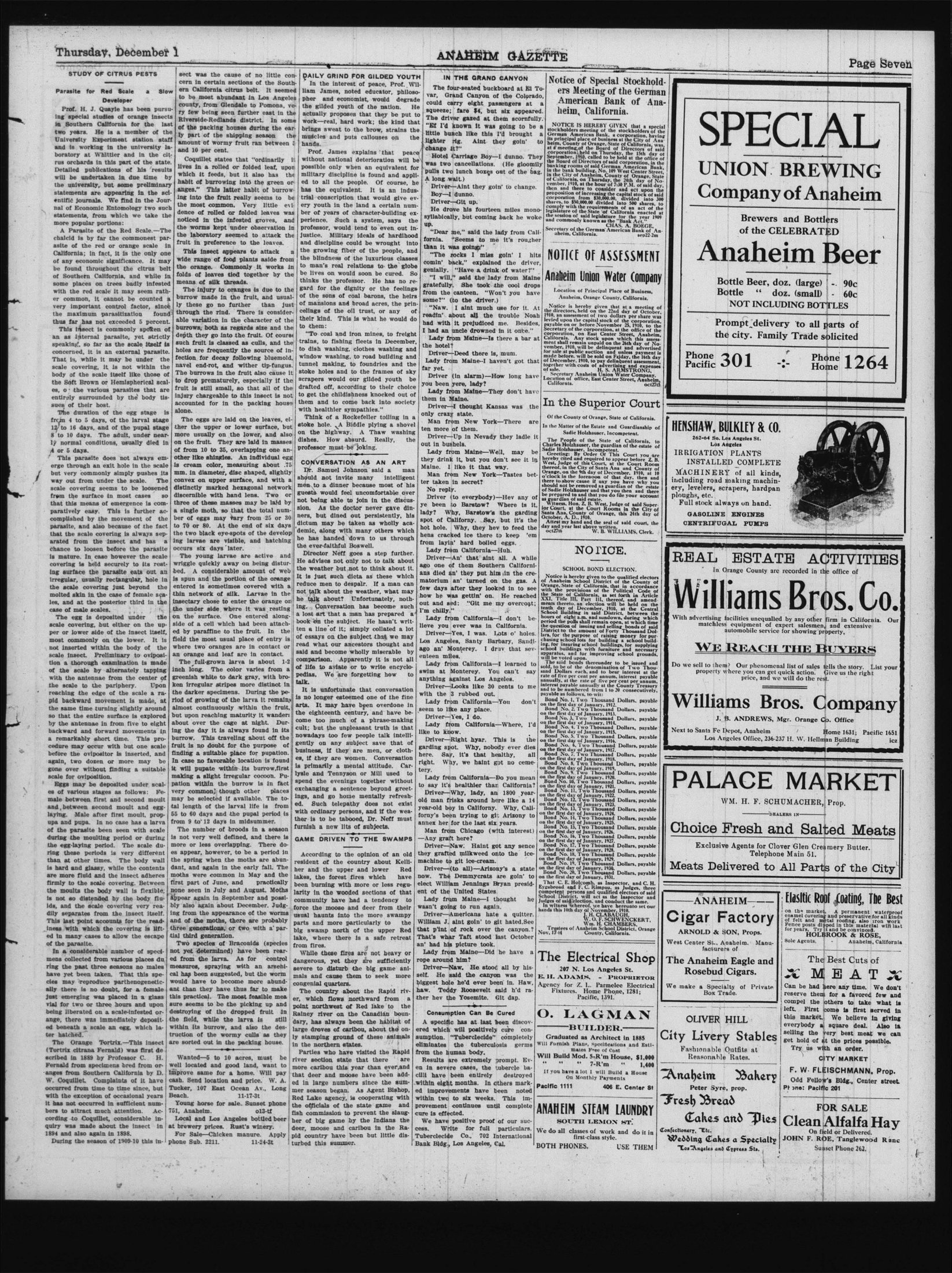
Searchable text
STUDY OF CITRUS PESTS
Parasite for Red Scale a Slow Developer
Prof. H. J. Quayle has been pursuing special studies of orange insects in Southern California for the last two years. He is a member of the University Experiment station staff and is working in the university laboratory at Whittier and in the citrus orchards in this part of the state. Detailed publications of his results will be undertaken in due time by the university, but some preliminary statements are appearing in the scientific journals. We find in the Journal of Economic Entomology two such statements, from which we take the more popular portions:
A Parasite of the Red Scale.—The chalcid is by far the commonest parasite of the red or orange scale in California; in fact, it is the only one of any economic significance. It may be found throughout the citrus belt of Southern California, and while in some places on trees badly infested with the red scale it may seem rather common, it cannot be counted a very important control factor, since the maximum parasitization found thus far has not exceeded 5 percent.
This insect is commonly spoken of as internal parasite, yet strictly speaking, so far as the scale itself is concerned, it is an external parasite. That is, while it may be under the scale covering, it is not within the body of the scale itself like those of the Soft Brown or Hemispherical scales, o the various parasites that are entirely surrounded by the body tissues of their host.
The duration of the egg stage is from 4 to 5 days, of the larval stage 12 to 16 days, and of the pupal stage 8 to 10 days. The adult, under nearly normal conditions, usually died in 4 or 5 days.
This parasite does not always emerge through an exit hole in the scale but very commonly simply pushes itssect was the cause of no little concern in certain sections of the Southern California citrus belt. It seemed to be most abundant in Los Angeles county, from Glendale to Pomona, very few being seen further east in the Riverside-Redlands district. In some of the packing houses during the early part of the shipping season the amount of wormy fruit ran between 5 and 10 per cent.
Coquillet states that "ordinarily it lives in a rolled or folded leaf, upon which it feeds, but it also has the habit of burrowing into the green oranges." This latter habit of burrowing into the fruit really seems to be the most common. Very little evidence of rolled or folded leaves was noticed in the infested groves, and the worms kept under observation in the laboratory seemed to attack the fruit in preference to the leaves.
This insect appears to attack a wide range of food plants aside from the orange. Commonly it works in folds of leaves tied together by the means of silk threads.
The injury to oranges is due to the burrow made in the fruit, and usually these go no further than just through the rind. There is considerable variation in the character of the burrows, both as regards size and the depth they go into the fruit. Of course such fruit is classed as culls, and the holes are frequently the source of infection for decay following bluemold, navel end-rot, and wither tip-fungus. The burrows in the fruit also cause it to drop prematurely, especially if the fruit is still small, so that all of the injury chargeable to this insect is not accounted for in the packing house alone.
The eggs are laid on the leaves, either the upper or lower surface, but more usually on the lower, and also on the fruit. They are laid in masses of from 10 to 35, overlapping one another like shingles. An individual egg is cream color, measuring about .75 mm. in diameter, disc shaped, slightly
DAILY GRIND F
In the interest William James, noted pher and economist the gilded youth actually proposes work—real, hard brings sweat to the muscles and puts hands.
Prof. James e without national possible only when military discipline ed to all the pee has the equivalent trial conscription eery youth in the ber of years of c experience. Such a professor, would justice. Military and discipline courethe growing fiberthe blindness of tto man's real rebe lives on would thinks the professi gard for the dignr of the sons of cof mansions and b ceilings of the oil their kind. This is to them:
"To coal and iron trains, to fishing to dish washing, o window washing, t tunnel making, to stoke holes and to scrapers would ou drafted off, accordo to get the childish them and to come with healthier symm Think of a Rock stoke hole. A Bid on the highway. dishes. How abs professor must be
CONVERSATION
Dr. Samuel John
The duration of the egg stage is from 4 to 5 days, of the larval stage 12 to 16 days, and of the pupal stage 8 to 10 days. The adult, under nearly normal conditions, usually died in 4 or 5 days.
This parasite does not always emerge through an exit hole in the scale but very commonly simply pushes its way out from under the scale. The scale covering seems to be loosened from the surface in most cases so that this means of emergence is comparatively easy. This is further accomplished by the movement of the parasite, and also because of the fact that the scale covering is always separated from the insect and has a chance to loosen before the parasite is mature. In case however the scale covering is held securely to its resting surface the parasite eats out an irregular, usually rectangular, hole in the scale covering just beyond the molted skin in the case of female scales, and at the posterior third in the case of male scales.
The egg is deposited under the scale covering, but either on the upper or lower side of the insect itself, most commonly on the lower. It is not inserted within the body of the scale insect. Preliminary to oviposition a thorough examination is made of the scale by alternately tapping with the antennae from the center of the scale to the pariphery. Upon reaching the edge of the scale a rapid backward movement is made, at the same time turning slightly around so that the entire surface is explored by the antennae in from five to eight backward and forward movements in a remarkably short time. This procedure may occur with but one scale before the ovipositor is inserted, and again, two dozen or more may be gone over without finding a suitable scale for oviposition.
Eggs may be deposited under scales of various stages as follows: Female between first and second moult and between second moult and egg-laying. Male after first moult, propupa and pupa. In no case has a larva of the parasite been seen with scale during the moulting period or during the egg-laying period. The scale during these periods is very different than at other times. The body wall is hard and glassy, while the contents are more fluid and the insect adheres firmly to the scale covering. Between the mouls the body wall is flexible, is not so distended by the body flu
The eggs are laid on the leaves, either the upper or lower surface, but more usually on the lower, and also on the fruit. They are laid in masses of from 10 to 35, overlapping one another like shingles. An individual egg is cream color, measuring about .75 mm. in diameter, disc shaped, slightly convex on upper surface, and with a distinctly marked hexagonal network discernible with hand lens. Two or three of these masses may be laid by a single moth, so that the total number of eggs may vary from 25 or 30 to 70 or 80. At the end of six days the two black eye-spots of the developing larvae are visible, and hatching occurs six days later.
The young larvae are active and wriggle quickly away on being disturbed. A considerable amount of web is spun and the portion of the orange entered is sometimes covered with a thin network of silk. Larvae in the insectary chose to enter the orange on the under side where it was resting on the surface. One entered alongside of a cell which had been attached by paraffine to the fruit. In the field the most usual place of entry is where two oranges are in contact or an orange and leaf are in contact.
The full-grown larva is about 1-2 inch long. The color varies from a greenish white to dark gray, with broken irregular stripes more distinct in the darker specimens. During the period of growing of the larva it remains almost continuously within the fruit, but upon reaching maturity it wanders about over the cage at night. During the day it is always found in its burrow. This traveling about off the fruit is no doubt for the purpose of finding a suitable place for pupation. In case no favorable location is found it will pupate within its burrow, first making a slight irregular cocoon. Pupation within the burrow is in fact very common though other places may be selected if available. The total length of the larval life is from 55 to 60 days and the pupal period is from 9 to 12 days in midsummer.
The number of broods in a season is not very well defined, and there is more or less overlapping. There does appear, however, to be a period in the spring when the moths are abundant, and again in the early fall. The moths were common in May and the first part of June, and practically none seen in July and August. Moths appear again in September and possibly in winter.
The burrows in the fruit also cause it to drop prematurely, especially if the fruit is still small, so that all of the injury chargeable to this insect is not accounted for in the packing house alone.
The eggs are laid on the leaves, either the upper or lower surface, but more usually on the lower, and also on the fruit. They are laid in masses of from 10 to 35, overlapping one another like shingles. An individual egg is cream color, measuring about .75 mm. in diameter, disc shaped, slightly convex on upper surface, and with a distinctly marked hexagonal network discernible with hand lens. Two or three of these masses may be laid by a single moth, so that the total number of eggs may vary from 25 or 30 to 70 or 80. At the end of six days the two black eye-spots of the developing larvae are visible, and hatching occurs six days later.
The young larvae are active and wriggle quickly away on being disturbed. A considerable amount of web is spun and the portion of the orange entered is sometimes covered with a thin network of silk. Larvae in the insectary chose to enter the orange on the under side where it was resting on the surface. One entered alongside of a cell which had been attached by paraffine to the fruit. In the field the most usual place of entry is where two oranges are in contact or an orange and leaf are in contact.
The full-grown larva is about 1-2 inch long. The color varies from a greenish white to dark gray, with broken irregular stripes more distinct in the darker specimens. During the period of growing of the larva it remains almost continuously within the fruit, but upon reaching maturity it wanders about over the cage at night. During the day it is always found in its burrow. This traveling about off the fruit is no doubt for the purpose of finding a suitable place for pupation. In case no favorable location is found it will pupate within its burrow, first making a slight irregular cocoon. Pupation within the burrow is in fact very common though other places may be selected if available. The total length of the larval life is from 55 to 60 days and the pupal period is from 9 to 12 days in midsummer.
The number of broods in a season is not very well defined, and there is more or less overlapping. There does appear, however, to be a period in the spring when the moths are abundant, and again in the early fall. The moths were common in May and the first part of June, and practically none seen in July and August. Moths appear again in September and possi-
CONVERSATION
Dr. Samuel John should not invite men to a dinner but guests would feel not being able to talk as they do diction may be taken demic, along with he has handed down he ever-faithful Book Director Neff go He advises not only weather but no It is just such did reduce men to despair not talk about them he talk about? Conversation a lost art that a man book on the subject ten a line of it; sixty of essays on his su read what our ancestor said and become wise comparison. Apparent life to aviate on pedias. We are for talk.
It is unfortunate is no longer esteem arts. It may have eighteen cent come too much o cult; but the unpleasant nowadays too few gently on any sub business, if they are es, if they are worn is primarily a mem lyle and Tennyson spendthe evenings exchanging a senten ings,and go home ed.Such telepath with ordinary person ther is to be taboo furnish a new lits o
GAME DRIVEN TO
According to ther resident of ther cou her and ther upper lakes,the forest fi been burning with n larity in ther wooden community have
male between first and second moult and between second moult and egg-laying. Male after first moult, prop-upa and pupa. In no case has a larva of the parasite been seen with scale during the moulting period or during the egg-laying period. The scale during these periods is very different than at other times. The body wall is hard and glassy, while the contents are more fluid and the insect adheres firmly to the scale covering. Between the mouls the body wall is flexible, is not so distended by the body fluids, and the scale covering very readily separates from the insect itself. This last point accounts for the readiness with which the covering is lifted in many cases to allow the escape of the parasite.
In a considerable number of specimens collected from various places during the past three seasons no males have yet been taken. That this species may reproduce parthenogenetically there is no doubt, for a female just emerging was placed in a glass vial for two or three hours and upon being liberated on a scale-infested orange, there was immediately deposited beneath a scale an egg, which later hatched.
The Orange Tortrix—This insect (Tortrix citrana Fernald) was first described in 1889 by Professor C. H. Fernald from specimens bred from oranges from Southern California by D. W. Coquillet. Complaints of it have occurred from time to time since, but with the exception of occasional years it has not occurred in sufficient numbers to attract much attention. According to Coquillet, considerable inquiry was made about the insect in 1894 and also again in 1898.
During the season of 1909-10 this in-
DAILY GRIND FOR GILDED YOUTH
In the interest of peace, Prof. William James, noted educator, philosopher and economist, would degrade the gilded youth of the nation. He actually proposes that they be put to work—real, hard work; the kind that brings sweat to the brow, strains the muscles and puts callouses on the hands.
Prof. James explains that peace without national deterioration will be possible only when an equivalent for military discipline is found and applied to all the people. Of course, he has the equivalent. It is an industrial conscription that would give every youth in the land a certain number of years of character-building experience. Such a system, says the professor, would tend to even out injustice. Military ideals of hardihood and discipline could be wrought into the growing fiber of the people, and the blindness of the luxurious classes to man's real relations to the globe be lives on would soon be cured. So thinks the professor. He has no regard for the dignity or the feelings of the sons of coal barons, the heirs of mansions and broad acres, the princesses of the oil trust, or any of their kind. This is what he would do to them:
"To coal and iron mines, to freight trains, to fishing fleets in December, to dish washing, clothes washing and window washing, to road building and tunnel making, to foundries and the stoke holes and to the frames of sky scrapers would our gilded youth be drafted off, according to their choice to get the childishness knocked out of them and to come back into society with healthier sympathies."
Think of a Rockefeller toiling in a stoke hole. A Biddle plying a shovel on the highway. A Thaw washing dishes. How absurd. Really, the professor must be joking.
CONVERSATION AS AN ART
Dr. Samuel Johnson said a man
IN THE GRAND CANYON
The four-seated buckboard at El Torvar, Grand Canyon of the Colorado, could carry eight passengers at a squeeze; fare $4, but six appeared. The driver gazed at them scornfully.
"Ef I'd known it was going to be a little bunch like this I'd brought a lighter rig. Aint they goin' to change it?"
Hotel Carriage Boy—I dunno. They was two cancellations. (He gloomily pulls two lunch boxes out of the bag. A long wait.)
Driver—Aint they goin' to change.
Boy—I dunno.
Driver—Glt up.
He drove his fourteen miles monosyllabically, but coming back he woke up.
"Dear me," said the lady from California. "Seems to me it's rougher than it was going."
"The rocks I miss goin' I hits comin' back," explained the driver, genially. "Have a drink of water?"
"I will," said the lady from Maine gratefully. She took the cool drops from the canteen. "Won't you have some?" (to the driver.)
"Naw. I aint much use for it. At readin' about all the trouble Noah had with it prejudiced me. Besides, I had an uncle drowned in it once."
Lady from Maine—Is there a bar at the hotel?
Driver—Deed there is, mum.
Lady from Maine--I haven't got that far yet.
Driver (in alarm)—How long have you been yere, lady?
Lady from Maine—They don't have them in Maine.
Driver—I thought Kansas was the only crazy state.
Man from New York—There are ten more of them.
Driver—Up in Nevady they ladle it out in bushels.
Lady from Maine—Well, may be they drink it, but you don't see it in Maine. I like it that way.
Man from New York—Tastes bet.
Notice of Special Stockholders Meeting of the German American Bank of Anaheim, California.
NOTICE IS HEREBY GIVEN that a special stockholders meeting of the stockholders of the German American Bank, a corporation, having its principal place of business at the City of Anaheim, County of Orange, State of California, was at a meeting of the Board of Directors of said corporation, held on Thursday, the 15th day of September, 1910, called to be held at the office of the Board of Directors of said corporation, in the banking rooms of said German American Bank, in the bank building, No. 109 West Center Street, in the City of Anaheim, County of Orange, State of California, on Thursday, the 24th day of November, 1910, at the hour of 7:30 P.M. of said day, then and there to consider and act upon the proposition of increasing the capital stock of said corporation from $30,000.00, divided into 300 shares, to $50,000.00 divided into 500 shares, to comply with the requirements of an act of the legislature of the State of California enacted at the session of said legislature for the year 1909 and commonly known as the "Bank Act."
CHAS. A. BOEGE,
Secretary of the German American Bank of Anaheim, California.
NOTICE OF ASSESSMENT
Anaheim Union Water Company
Location of Principal Place of Business,
Anaheim, Orange County, California.
Notice is hereby given that at a meeting of the directors, held on the 22nd day of October, 1910, an assessment of two dollars per share was levied upon the capital stock of the corporation, payable on or before November 25, 1910, to the Secretary of the corporation, at the office of the corporation, on East Center Street, Anaheim, California. Any stock upon which this assessment shall remain unpaid on the 26th day of November, 1910, will be delinquent and advertised for sale at public auction and unless payment is made before will be sold on Friday, the 16th day of December, 1910, to pay delinquent assessment together with costs of advertising and expenses of sale.
H. S. ARMSTRONG,
Secretary Anaheim Union Water Company.
Location of office, East Center Street, Anaheim, California.
In the Superior Court
Of the County of Orange, State of California.
In the Matter of the Estate and Guardianship of Sadie Holzhauser, Incompetent.
The People of the State of California, to Charles Holzhauser, the guardian of the estate of Sadie Holzhauser, Incompetent.
Greeting: By Order Of This Court you are hereby cited and required to appear before Z. B. West, Judge of this Court, at the Court Room thereof, in the City of Santa Ana and County of Orange, on the 9th day of December, 1910, at 10
CONVERSATION AS AN ART
Dr. Samuel Johnson said a man should not invite many intelligent men to a dinner because most of his guests would feel uncomfortable over not being able to join in the discussion. As the doctor never gave dinners, but dined out persistently, his dictum may be taken as wholly academic, along with many others which he has handed down to us through the ever-faithful Boswell.
Director Neff goes a step further. He advises not only not to talk about the weather but not to think about it. It is just such dicta as these which reduce men to despair. If a man can not talk about the weather, what may he talk about? Unfortunately, nothing. Conversation has become such a lost art that a man has prepared a book on the subject. He hasn't written a line of it; simply collated a lot of essays on the subject that we may read what our ancestors thought and said and become wholly miserable by comparison. Apparently it is not all of life to aviate or to write encyclopedias. We are forgetting how to talk.
It is unfortunate that conversation is no longer esteemed one of the fine arts. It may have been overdone in the eighteenth century, and have become too much of a phrase-making cult; but the unpleasant truth is that nowadays too few people talk intelligently on any subject save that of business, if they are men, or clothes, if they are women. Conversation is primarily a mental attitude. Carlyle and Tennyson or Mill used to spend the evenings together without exchanging a sentence beyond greetings, and go home mentally refreshed. Such telepathy does not exist with ordinary persons, and if the weather is to be tabooed, Dr. Neff must furnish a new lits of subjects.
GAME DRIVEN TO THE SWAMPS
According to the opinion of an old resident of the country about Kellher and the upper and lower Red lakes, the forest fires which have been burning with more or less regularity in the wooded sections of that community have had a tendency to scrapers would our gilded youth be drafted off, according to their choice to get the childishness knocked out of them and to come back into society with healthier sympathies."
Think of a Rockefeller toiling in a stoke hole. A Biddle plying a shovel on the highway. A Thaw washing dishes. How absurd. Really, the professor must be joking.
IN THE SUPERIOR Court
Of the County of Orange, State of California.
In the Matter of the Estate and Guardianship of Sadie Holzhauser, Incompetent.
The People of the State of California, to Charles Holzhauser, the guardian of the estate of Sadie Holzhauser, Incompetent.
Greeting: By Order Of This Court you are hereby cited and required to appear before Z.B.West, Judge of this Court, at the Court Room thereof, in the City of Santa Ana and County of Orange, on the 9th day of December, 1910, at 10 o'clock in the forenoon of that day, then and there to show cause if any you have why you should not be removed as guardian of the estate of Sadie Holzhauser and that you then and there be prepared to and that you do file your account as guardian of said estate.
Witness, Hon. Z.B.West, Judge of said Superior Court, at the Court Rooms in the City of Santa Ana, County of Orange, this 24th day of October, A.D., 1910.
Attest my hand and the seal of said court, the day and year last above written.
oct2716 W.B.WILLIAMS,Clerk.
NOTICE.
SCHOOL BOND ELECTION.
Notice is hereby given to the qualified electors of Anaheim School District of the County of Orange, State of California, that in accordance with the provisions of the Political Code of the State of California, as set forth in Article XXI. Title III, Part III thereof, and amendments thereto, an election will be held on the tenth day of December, 1910, at the Central School Building in said District, between the hours of eight a.m. and sundown, during which period the polls shall remain open, at which time the question of issuing and selling bonds of said District to the amount of Forty Thousand Dollars, for the purpose of raising money for purchasing school lots for building a school building, for insuring school buildings, for supplying school buildings with furniture and necessary apparatus, and for improving school grounds, will be voted upon.
The said bonds thereunder to be issued and sold, to be of the denomination of Two Thousand Dollars each, and to bear interest at the rate of five per cent per annum, interest payable annually at the rate of five per cent per annum, interest payable annually at the County Treasury and to be numbered from 1 to 20 consecutively, payable as follows, to wit:
Bond No. 1, Two Thousand Dollars, payable on the first day of January, 1912.
Bond No. 2, Two Thousand Dollars, payable on the first day of January, 1913.
Bond No. 3, Two Thousand Dollars, payable on the first day of January, 1914.
Bond No. 4, Two Thousand Dollars, payable on the first day of January, 1915.
Bond No. 5, Two Thousand Dollars, payable on the first day of January, 1916.
Bond No. 6, Two Thousand Dollars, payable on the first day of January, 1917.
Bond No. 7, Two Thousand Dollars, payable on the first day of January, 1918.
Bond No. 8, Two Thousand Dollars, payable on the first day of January, 1919.
Bond No. 9, Two Thousand Dollars, payable on the first day of January, 1920.
Bond No. 10, Two Thousand Dollars, payable on the first day of January, 1921.
Bond No. 11, Two Thousand Dollars, payable on the first day of January, 1922.
Bond No. 12, Two Thousand Dollars, payable on the first day of January, 1923.
Bond No. 13, Two Thousand Dollars, payable on the first day of January, 1924.
Bond No. 14, Two Thousand Dollars, payable on the first day of January, 1925.
Bond No. 15, Two Thousand Dollars, payable on the first day of January, 1926.
Bond No. 16, Two Thousand Dollars, payable on the first day of January, 1927.
Bond No. 17, Two Thousand Dollars, payable on the first day of January, 1928.
Bond No. 18, Two Thousand Dollars, payable on the first day of January, 1929.
Bond No. 19, Two Thousand Dollars, payable on the first day of January, 1930.
Bond No. 20, Two Thousand Dollars, payable on the first day of January, 1931.
That C.E.Holcomb, as Inspector,and C.H.Eygabroad and F.C.Rimpau,sas Judges,the three competent persons and qualified electors of said School Districtwill act asthe Inspector and
GAME DRIVEN TO THE SWAMPS
According to the opinion of an old resident of the country about Kellher and the upper and lower Red lakes, the forest fires which have been burning with more or less regularity in the wooded sections of that community have had a tendency to force the moose and deer from their usual haunts into the more swampy parts and more particularly to the big swamp north of the upper Red lake, where there is a safe retreat from fires.
While these fires are not heavy or dangerous, yet they are sufficiently severe to disturb the big game animals and cause them to seek more congenial quarters.
The country about the Rapid river, which flows northward from a point northwest of Red lake to the Rainey river on the Canadian boundary, has always been the habitat of large droves of caribou, about the only stamping ground of these animals in the northern states.
Parties who have visited the Rapid river section state that there are more caribou this year than ever, and that deer and moose have been added in large numbers since the summer season began. As Agent Bishop, Red Lake agency, is cooperating with the officials of the state game and fish commission to prevent the slaughter of big game by the Indians the deer, moose and caribou in the Rapid country have been but little disturbed this summer.
Man from Chicago (with interest)—Any graft here?
Driver—Naw: Haint got any sence they grafted milkweed onto the ice-machine to git ice-cream.
Driver—(to all)—Arizona's a state now. The Demmycrats are goin' to elect William Jennings Bryan president of the United States.
Lady from Maine—I thought he wasn't going to run again.
Driver—Americans hate a quitter. William J.aint goin' to git hated.See that p'int of rock over the canyon? That's what Taft stood last October an' had his picture took.
Lady from Maine—Did he have a rope around him?
Driver—Naw. He stood all by himself. He said the canyon was the biggest hole he'd ever been in. Haw, haw. Teddy Roosevelt said h'd rather hev the Yosemite. Git dap.
Consumption Can Be Cured
A specific has at last been discovered which will positively cure consumption. "Tuberclecide" completely eliminates the tuberculosis germs from the human body.
Results are extremely prompt. Even in severe cases, the tubercle bacillus have been entirely destroyed within eight months. In others marked improvements have been noted within two to six weeks. This improvement continues until complete cure is effected.
We have positive proof of our success. Write for full particulars. Tuberclecide Co., 702 International Bank Bldg., Los Angeles, Cal.
ANAHEIM STEAM LAUNDRY
SOUTH LEMON ST.
We do all classes of work and do it in first-class style.
BOTH PHONES. USE THEM
SPECIAL
UNION BREWING
Company of Anaheim
Brewers and Bottlers
of the CELEBRATED
Anaheim Beer
Bottle Beer, doz. (large) - 90c
Bottle “doz. (small) - 60c
NOT INCLUDING BOTTLES
Prompt delivery to all parts of
the city. Family Trade solicited
Phone Pacific 301 - Phone Home 1264
HENSHAW, BULKLEY & CO.
262-64 So. Los Angeles St.
Los Angeles
IRRIGATION PLANTS
INSTALLED COMPLETE
MACHINERY of all kinds.
HENSHAW, BULKLEY & CO.
262-64 So. Los Angeles St.
Los Angeles
IRRIGATION PLANTS
INSTALLED COMPLETE
MACHINERY of all kinds,
including road making machinery,
levelers, scrapers, hardpan ploughs, etc.
Full stock always on hand.
GASOLINE ENGINES
CENTRIFUGAL PUMPS
REAL ESTATE ACTIVITIES
In Orange County are recorded in the office of
Williams Bros. Co.
With advertising facilities unequalled by any other firm in California. Our matchless equipment of expert salesmen, and extensive automobile service for showing property,
WE REACH THE BUYERS
Do we sell to them? Our phenomenal list of sales tells the story. List your property where you can get quick action. Give us the right price, and we will do the rest.
Williams Bros. Company
J. B. ANDREWS, Mgr. Orange Co. Office
Next to Santa Fe Depot, Anaheim
Home 1631; Pacific 1651
Los Angeles Office, 236-237 H. W. Hellman Building
PALACE MARKET
WM. H. F. SCHUMACHER, Prop.
DEALERS IN
Choice Fresh and Salted Meats
Exclusive Agents for Clover Glen Creamery Butter.
Telephone Main 51.
Meats Delivered to All Parts of the City
WM. H. F. SCHUMACHER, Prop.
DEALERS IN
Choice Fresh and Salted Meats
Exclusive Agents for Clover Glen Creamery Butter.
Telephone Main 51.
Meats Delivered to All Parts of the City
ANAHEIM
Cigar Factory
ARNOLD & SON, Props.
West Center St., Anaheim. Manufacturers of
The Anaheim Eagle and Rosebud Cigars.
We make a Specialty of Private Box Trade.
ELASITIC ROOF COATING, The Best
on the market. A permanent waterproof enamel covering and preservative for all kinds of felt and metal roofing, also iron work. Fence posts dipped in this material will last for years. Try it and be convinced.
HOLBROOK & ROSE,
Sole Agents, Anaheim, California
The Best Cuts of MEAT
Can be had here any time. We don't reserve them for a favored few and compel the others to take what is left. First come is first served in this market. We believe in giving everybody a square deal. Also in selling the very best meat we can get hold of at the prices possible.
Try us with an order.
CITY MARKET
F. W. FLEISCHMANN, Prop.
Odd Fellow's Bldg., Center street.
Phone: Pacific 201
OLIVER HILL
City Livery Stables
Fashionable Outfits at Reasonable Rates.
Anaheim Bakery
Peter Syre, prop.
Fresh Bread
Takes and Pies
Confectionery, Etc.
Wedding Takes a Specialty
Los Angeles and Cypress Sts.
FOR SALE
Clean Alfalfa Hay
On field or Delivered.
JOHN F. ROE, Tanglewood Ranch
Sunset Phone 262.