anaheim-gazette 1910-12-01
Scanned page
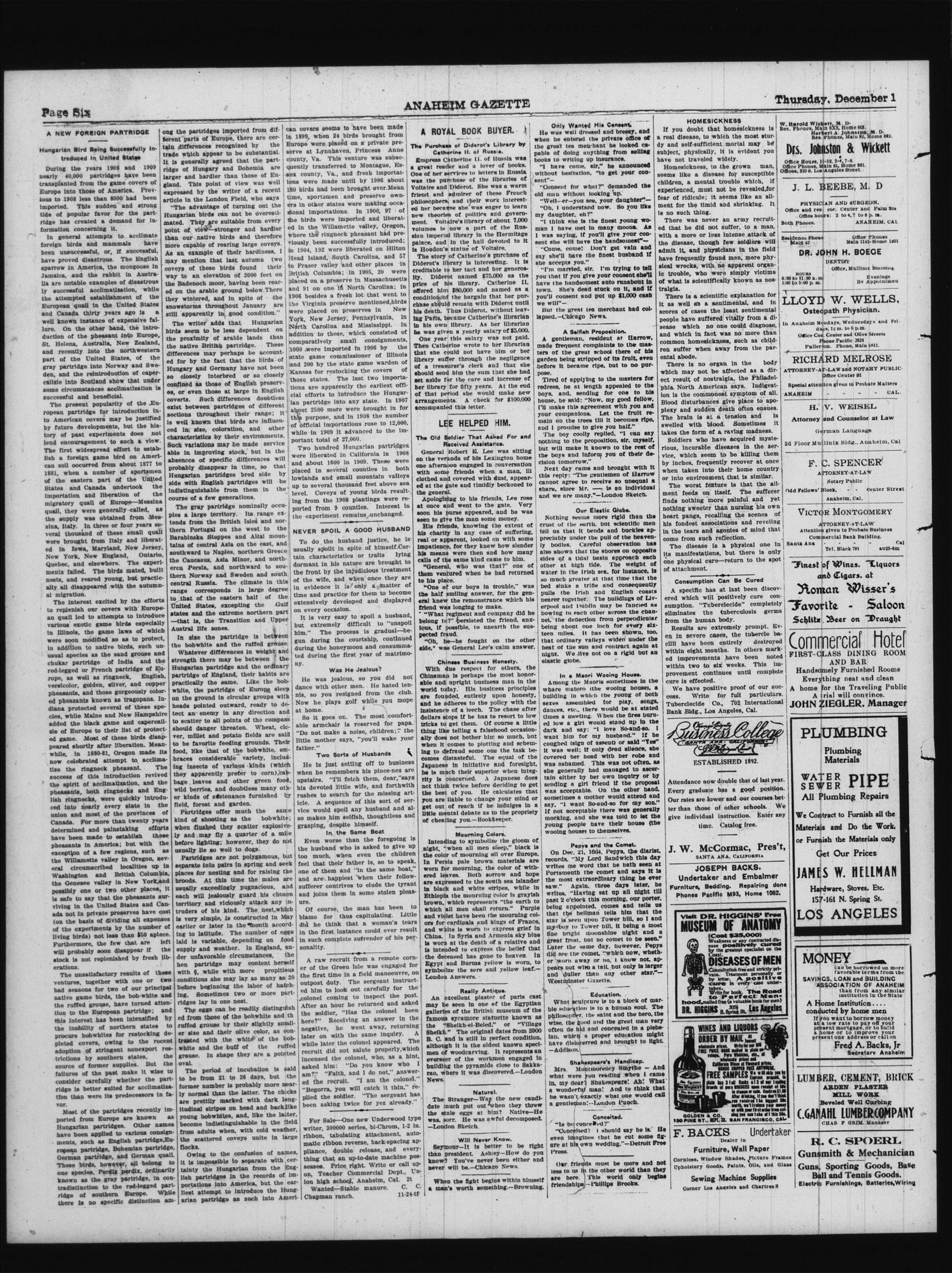
Searchable text
A NEW FOREIGN PARTRIDGE
Hungarian Bird Being Successfully Introduced in United States
During the years 1908 and 1909 nearly 40,000 partridges have been transplanted from the game covers of Europe into those of America. Previous to 1908 less than 8000 had been imported. This sudden and strong tide of popular favor for the partridge has created a demand for information concerning it.
In general attempts to acclimate foreign birds and mammals have been unsuccessful, or, if successful, have proved disastrous. The English sparrow in America, the mongoose in Jamaica, and the rabbit in Australia are notable examples of disastrously successful acclimatization, while the attempted establishment of the European quail in the United States and Canada thirty years ago is a well known instance of expensive failure. On the other hand, the introduction of the pheasant into Europe, St. Helena, Australia, New Zealand, and recently into the northwestern part of the United States, of the gray partridge into Norway and Sweden, and the reintroduction of capercaillie into Scotland show that under some circumstance acclimatization is successful and beneficial.
The present popularity of the European partridge for introduction into American covers may be justified by future developments, but the history of past experiments does not lend encouragement to such a view. The first widespread effort to establish a foreign game bird on American soil occurred from about 1877 to 1881, when a number of sportsmen long the partridges imported from different parts of Europe, there are certain differences recognized by the trade which appear to be substantial. It is generally agreed that the partridge of Hungary and Bohemia are larger and harder than those of England. This point of view was well expressed by the writer of a recent article in the London Field, who says:
"The advantage of turning out the Hungarian birds can not be overestimated. They are suitable from every point of view—stronger and harder than our native birds and therefore more capable of rearing large coveys. As an example of their hardiness, I may mention that last autumn two coveys of these birds found their way to an elevation of 2000 feet on the Badenoch moor, having been reared on the arable ground below. There they wintered, and in spite of the snowstorms throughout January are still apparently in good condition."
The writer adds that Hungarian birds seem to be less dependent on the proximity of arable lands than the native British partridge. These differences may perhaps be accounted for by the fact that the birds of Hungary and Germany have not been so closely interbred or so closely confined as those of English preserves, or even those at large in English coverts. Such differences doubtless exist between partridges of different sections throughout their range; it is well known that birds are influenced in size, coloration, and other characteristics by their environments. Such variations may be made serviceable in improving stock, but in the absence of specific differences will probably disappear in time, so that Hungarian partridges bred side by side can covers seems to have in 1899, when 24 bird Europe were placed on serve at Lynnhaven, county, Va. This venom frequently transferred to sex county, Va., and lions were made until 180 birds had been born time, sportsmen and others in other states were social importations. The birds were imported in the Willamette where the ringneck pluvis previously been successfully in 1904, 192 were liberated Head Island, South Ocidental in Fraser valley and British Columbia; in placed on a preserve and 91 on one 16 Nov. 1906 besides a fresh off the Virginia preserve were placed on presse York, New Jersey, North Carolina and addition to these, which comparatively small 1000 were imported state game commission and 200 by the state Kansas for restocking those states. The limitations are apparently special efforts to introduce partridge into and about 2500 more were this purpose, and in no official importation while in 1909 it advanced total of 27,000.
Two hundred Hunters were liberated in Canaan and about 1600 in Nebraska placed in several coves.
The present popularity of the European partridge for introduction into American covers may be justified by future developments, but the history of past experiments does not lend encouragement to such a view. The first widespread effort to establish a foreign game bird on American soil occurred from about 1877 to 1881, when a number of sportsmen of the eastern part of the United States and Canada undertook the importation and liberation of the migratory quail of Europe—Messina quail, they were generally called, as the supply was obtained from Messina, Italy. In three or four years several thousand of these small quail were brought from Italy and liberated in Iowa, Maryland, New Jersey, New York, New England, Ontario, Quebec, and elsewhere. The experiments failed. The birds mated, built nests, and reared young, but practically all disappeared with the autumnal migration.
The interest excited by the efforts to replenish our covers with European quail led to attempts to introduce various exotic game birds especially in Illinois, the game laws of which were soon modified so as to protect, in addition to native birds, such unusual species as the sand grouse and chukar partridge of India and the red-legged or French partridge of Europe, as well as ringneck, English versicolor, golden, silver, and copper pheasants, and those gorgeously colored pheasants known as tragopans. Indiana protected several of these species, while Maine and New Hampshire added the black game and capercaillie of Europe to their list of protected game. Most of these birds disappeared shortly after liberation. Meanwhile, in 1880-81, Oregon made its now celebrated attempt to acclimatize the ringneck pheasant. The success of this introduction revived the spirit of acclimatization, and the pheasants, both ringnecks and English ringnecks, were quickly introduced into nearly every state in the union and most of the provinces of Canada. For more than twenty years determined and painstaking efforts have been made to establish these pheasants in America; but with the exception of a few regions, such as the Willamette valley in Oregon, several circumscribed localities up in Washington and British Columbia, the Genesee valley in New York, and possibly one or two other places, it is safe to say that the pheasants survive closely interbred or so closely confined as those of English preserves, or even those at large in English coverts. Such differences doubtless exist between partridges of different sections throughout their range; it is well known that birds are influenced in size, coloration, and other characteristics by their environments. Such variations may be made serviceable in improving stock, but in the absence of specific differences will probably disappear in time, so that Hungarian partridges bred side by side with English partridges will be indistinguishable from them in the course of a few generations.
The gray partridge nominally occupies a large territory. Its range extends from the British Isles and northern Portugal on the west to the Barabinska Steppes and Altai mountains of central Asia on the east, and southward to Naples, northern Greece the Caucasus, Asia Minor, and northern Persia, and northward to southern Norway and Sweden and south central Russia. The climate in this range corresponds in large degree to that of the eastern half of the United States, excepting the Gulf states and the extreme northern part—that is, the Transition and Upper Austral life zones.
In size the partridge is between the bobwhite and the ruffed grouse. Whatever differences in weight and strength there may be between the Hungarian partridge and the ordinary partridge of England, their habits are practically the same. Like the bobwhite, the partridge of Eurong sleep on the ground in circular groups with heads pointed outward, ready to detect an enemy in any direction and to scatter to all points of the compass should danger threaten. Wheat, clover, millet and potato fields are said to be favorite feeding grounds. Their food, like that of the bobwhite, embraces considerable variety, including insects of various kinds (which they apparently prefer to corn), cabbage leaves and other green food, wild berries, and doubtless many other kinds of sustenance furnished by field, forest and garden.
Partridges offer much the same kind of shooting as the bobwhite; when flushed they scatter explosively and may fly a quarter of a mile before lighting; however, they do not usually lie so well to dogs.
Partridges are not polygamous, but separate into pairs in spring and seek places for nesting and for raising the broods. At this time the males are usually exceedingly pugnacious, and each will jealously guard his chosen so closely interbred or so closely confined as those of English preserves, or even those at large in English coverts. Such differences doubtlessly exist between partridges of different sections throughout their range; it is well known that birds are influenced in size, coloration, and other characteristics by their environments. Such variations may be made serviceable in improving stock, but in the absence of specific differences will probably disappear in time, so that Hungarian partridges bred side by side with English partridges will be indistinguishable from them in the course of a few generations.
The gray partridge nominally occupies a large territory. Its range extends from the British Isles and northern Portugal on the west to the Barabinska Steppes and Altai mountains of central Asia on the east, and southward to Naples, northern Greece the Caucasus, Asia Minor, and northern Persia, and northward to southern Norway and Sweden and south central Russia. The climate in this range corresponds in large degree to that of the eastern half of the United States, excepting the Gulf states and the extreme northern part—that is, the Transition and Upper Austral life zones.
In size the partridge is between the bobwhite and the ruffed grouse. Whatever differences in weight and strength there may be between the Hungarian partridge and the ordinary partridge of England, their habits are practically the same. Like the bobwhite, the partridge of Eurong sleep on the ground in circular groups with heads pointed outward, ready to detect an enemy in any direction and to scatter to all points of the compass should danger threaten. Wheat, clover, millet and potato fields are said to be favorite feeding grounds. Their food, like that of the bobwhite, embraces considerable variety, including insects of various kinds (which they apparently prefer to corn), cabbage leaves and other green food, wild berries, and doubtless many other kinds of sustenance furnished by field, forest and garden.
Partridges offer much the same kind of shooting as the bobwhite; when flushed they scatter explosively and may fly a quarter of a mile before lighting; however, they do not usually lie so well to dogs.
Partridges are not polygamous, but separate into pairs in spring and seek places for nesting and for raising the broods. At this time the males are usually exceedingly pugnacious, and each will jealously guard his chosen so closely interbred or so closely confined as those of English preserves, or even those at large in English coverts. Such differences doubtlessly exist between partridges of different sections throughout their range; it is well known that birds are influenced in size, coloration, and other characteristics by their environments. Such variations may be made serviceable in improving stock, but in the absence of specific differences will probably disappear in time, so that Hungarian partridges bred side by side with English partridges will be indistinguishable from them in the course of a few generations.
The gray partridge nominally occupies a large territory. Its range extends from the British Isles and northern Portugal on the west to the Barabinska Steppes and Altai mountains of central Asia on the east, and southward to Naples, northern Greece the Caucasus, Asia Minor, and northern Persia, and northward to southern Norway and Sweden and south central Russia. The climate in this range corresponds in large degree to that of the eastern half of the United States, excepting the Gulf states and the extreme northern part—that is, the Transition and Upper Austral life zones.
In size the partridge is between the bobwhite and the ruffed grouse. Whatever differences in weight and strength there may be between the Hungarian partridge and the ordinary partridge of England, their habits are practically the same. Like the bobwhite, the partridge of Eurong sleep on the ground in circular groups with heads pointed outward, ready to detect an enemy in any direction and to scatter to all points of the compass should danger threaten. Wheat, clover, millet and potato fields are said to be favorite feeding grounds. Their food, like that of the bobwhite, embraces considerable variety, including insects of various kinds (which they apparently prefer to corn), cabbage leaves and other green food, wild berries, and doubtless many other kinds of sustenance furnished by field, forest and garden.
Partridges offer much the same kind of shooting as the bobwhite; when flushed they scatter explosively and may fly a quarter of a mile before lighting; however, they do not usually lie so well to dogs.
Partridges are not polygamous, but separate into pairs in spring and seek places for nesting and for raising the broods. At this time the males are usually exceedingly pugnacious,and each will jealously guard his chosen so closely interbred or so closely confined as those of English preserves,or even those at large in English coverts. Such differences doubtlessly exist between partridges of different sections throughout their range; it is well known that birds are influenced in size,coloration,and other characteristics by their environments. Such variations may be made serviceable in improving stock,but in the absence of specific differences will probably disappear in time,so that Hungarian partridges bred side by side with English partridges will be indistinguishable from them in the course of a few generations.
The gray partridge nominally occupies a large territory. Its range extends from the British Isles和northern Portugal onthe westtotheBarabinskaSteppesandAltaimountainsofcentralAsiaontheeast,andsouthwardtoNaples,northernGreecetheCaucasus,theAsiaMinor,andnorthernPersia,andnorthwardtosouthernNorwayandSwedenandsouthcentralRussia.TheclimateinthisrangecorrespondsinlargedegreetothatoftheeasternhalfoftheUnitedStatesexceptingtheGulfstatesandtheextremelongerpartitionfromeveryoccasion.
Itisveryeasytobutextremelydiffershim."Theprocessgunduringthecoordinationduringthefirstny.
To dothehusbandusuallyspoiltintspaintaincharacteristicsinthedormantinhisnaturalthefrontbytheinjuryofthewife,andwherein evidenceitisocetimeandpracticeforsextremelongerdevelopmentoneveryoccasion.
Itisveryeasytobutextremelydiffershim."Theprocessgunduringthecoordinationduringthefirstny.
Two Sorts o
Heisjustsettlingwhenherememberupstairs."I'llfetchhisdevotedlittlewrushestosearchforicle.A sequencevicewouldspollandsomakehimselfgrasping,despineb
IntheSaf
Evenworsethanthehusbandwhofoottuchwhenhefeelthattheirfatheroneofthemandtwandarehappiestsuffercontrivesandjoinsthemin
lish ringnecks, were quickly introduced into nearly every state in the union and most of the provinces of Canada. For more than twenty years determined and painstaking efforts have been made to establish these pheasants in America; but with the exception of a few regions, such as the Willamette valley in Oregon, several circumscribed localities up in Washington and British Columbia, the Genesee valley in New York, and possibly one or two other places, it is safe to say that the pheasants surviving in the United States and Canada not in private preserves have cost (on the basis of dividing all expenses of the experiments by the number of living birds) not less than $50 apiece. Furthermore, the few that are left will probably soon disappear if the stock is not replenished by fresh liberations.
The unsatisfactory results of these ventures, together with one or two bad seasons for two of our principal native game birds, the bob-white and the ruffed grouse, have turned attention to the European partridge; and this interest has been intensified by the inability of northern states to procure bobwhites for restocking depleted covers, owing to the recent adoption of stringent nonexport restrictions by southern states, the source of former supplies. But the failures of the past make it wise to consider carefully whether the partridge is better suited for acclimatization than were its predecessors in favor.
Most of the partridges recently imported from Europe are known as Hungarian partridges. Other names have been applied to various consignments, such as English partridge, European partridge, Bohemian partridge, German partridge, and German quail. These birds, however, all belong to one species, Perdix perdix, ordinarily known as the gray partridge, in contradistinction to the red-legged partridge of southern Europe. While there is no specific distinction am-
Partridges offer much the same kind of shooting as the bobwhite; when flushed they scatter explosively and may fly a quarter of a mile before lighting; however, they do not usually lie so well to dogs.
Partridges are not polygamous, but separate into pairs in spring and seek places for nesting and for raising the broods. At this time the males are usually exceedingly pugnacious, and each will jealously guard his chosen territory and viciously attack any intruders of his kind. The nest, which is very simple, is constructed in May earlier or later in the month according to latitude. The number of eggs laid is variable, depending on food supply and weather. In England, under unfavorable circumstances, the hen partridge may content herself with 6, while with more propitious conditions she may lay as many as 20 before beginning the labor of hatching. Sometimes two or more partridges lay in one nest.
The eggs can be readily distinguish ed from those of the bobwhite and th ruffed grouse by their slightly smaller size and their olive color, as contrasted with the white of the bobwhite and the buff of the ruffed grouse. In shape they are a pointed oval.
The period of incubation is said to be from 21 to 26 days, but the former number is probably more nearly normal than the latter. The chicks are prettily marked with dark longitudinal stripes on head and back like young bobwhites, and, like the latter, become indistinguishable in the field from adults when, with cold weather, the scattered coveys unite in large flocks.
Owing to the confusion of names, it is impossible to separate with certainty the Hungarian from the English partridges in the records of importations into America, but the earliest attempt to introduce the Hungarian partridge as such into Ameri-
In the SaEven worse than the husband who too much, when feel that their father one of them and and are happiest sufferer contrives and joins them in nature.
Of course, the blame for thus did he think that in the first instance in such complete sonality.
A raw recruit fferer of the Green Ic
the first time in an outpost duty. Th ed him to look out colonel coming t
After an hour he
the soldier, "Has here?" Receiving negative, he w
later on with th while later the co recruit did not s incensed the colo asked him: "Do am?" "Faith, an ed the recruit.
"Begorra, you w plied the soldier. been asking twice.
For Sale—One writer, 300000 ser ribbon, tabulating matic ribbon reve pliance, double thing that an up seses. Price rig on, Teacher Colon high school,
Wanted—Stabl Chapman ranch.
ANAHEIM GAZETTE
can covers seems to have been made in 1899, when 24 birds brought from Europe were placed on a private preserve at Lynnhaven, Princess Anne county, Va. This venture was subsequently transferred to Montague, Essex county, Va., and fresh importations were made until by 1906 about 150 birds had been brought over. Mean time, sportsmen and preserve owners in other states were making occasional importations. In 1900, 97 of the birds were imported and liberated in the Willamette valley, Oregon, where the ringneck pheasant had previously been successfully introduced; in 1904, 192 were liberated on Hilton Head Island, South Carolina, and 57 in Fraser valley and other places in British Columbia; in 1905, 20 were placed on a preserve in Massachusetts and 91 on one in North Carolina; in 1906 besides a fresh lot that went to the Virginia preserve mentioned, birds were placed on preserves in New York, New Jersey, Pennsylvania, in North Carolina and Mississippi. In addition to these, which consisted of comparatively small consignments, 1000 were imported in 1906 by the state game commissioner of Illinois and 200 by the state game warden of Kansas for restocking the covers of those states. The last two importations are apparently the earliest official efforts to introduce the Hungarian partridge into any state. In 1907 about 2500 more were brought in for this purpose, and in 1908 the number of official importations rose to 12,000, while in 1909 it advanced to the important total of 27,000.
Two hundred Hungarian partridges were liberated in California in 1908 and about 1600 in 1909. These were placed in several counties in both
A ROYAL BOOK BUYER.
The Purchase of Diderot's Library by Catherine II. of Russia.
Empress Catherine II. of Russia was a great reader and a lover of books. One of her services to letters in Russia was the purchase of the libraries of Voltaire and Diderot. She was a warm friend and admirer of these French philosophers, and their work interested her because she was eager to learn new theories of politics and government. Voltaire's library of about 7,000 volumes is now a part of the Russian imperial library in the Hermitage palace, and in the hall devoted to it is Houdon's statue of Voltaire.
The story of Catherine's purchase of Diderot's library is interesting. It is creditable to her tact and her generosity. Diderot named $75,000 as the price of his library. Catherine II. offered him $80,000 and named as a condition of the bargain that her purchase should remain with Diderot until his death. Thus Diderot, without leaving Paris, became Catherine's librarian in his own library. As her librarian he was given a yearly salary of $5,000.
One year this salary was not paid. Then Catherine wrote to her librarian that she could not have him or her library suffer through the negligence of a treasurer's clerk and that she should send him the sum that she had set aside for the care and increase of her library for fifty years. At the end of that period she would make new arrangements. A check for $100,000 accompanied this letter.
LEE HELPED HIM.
The Old Soldier That Asked For and Received Assistance.
General Robert E. Lee was sitting on the veranda of his Lexington home one afternoon engaged in conversation with some friends when a man, ill
Only Wanted His Consent.
He was well dressed and breezy, and when he entered the private office of the great tea merchant he looked capable of doing anything from selling books to writing up insurance.
"I have come, sir," he announced without hesitation, "to get your consent"—
"Consent for what?" demanded the old man without looking up.
"Well—er—you see, your daughter"—
"Oh, I understand now. So you like my daughter, eh?"
"I think she is the finest young woman I have met in many moons. As I was saying, if you'll give your consent she will have the handsomest"—
"Come, come! Don't get vain and say she'll have the finest husband if she accepts you."
"I'm married, sir. I'm trying to tell you that if you give your consent she'll have the handsomest auto runabout in town. She's dead stuck on it, and if you'll consent and put up $1,000 cash we will"—
But the great tea merchant had collapsed.-Chicago News.
A Selfish Proposition.
A gentleman, resident at Harrow, made frequent complaints to the masters of the great school there of his garden being stripped of its fruit, even before it became ripe, but to no purpose.
Tired of applying to the masters for redress, he at length appealed to the boys, and, sending for one to his house, be said: "Now, my good fellow, I'll make this agreement with you and your companions. Let the fruit remain on the trees till it becomes ripe, and I promise to give you half."
The boy coolly replied, "I can say nothing to the proposition, sir, myself, but will make it known to the rest of the boys and inform you of their decision tomorrow."
Next day came and brought with it
NEVER SPOIL A GOOD HUSBAND
To do the husband justice, he is usually spoilt in spite of himself. Certain characteristics or traits lying dormant in his nature are brought to the front by the injudicious treatment of the wife, and when once they are in evidence it is only a matter of time and practice for them to become extensively developed and displayed on every occasion.
It is very easy to spoil a husband, but extremely difficult to "unspoil him." The process is gradual—begin during the courtship, continued during the honeymoon and consummed during the first year of matrimony.
Was He Jealous?
He was jealous, so you did not dance with other men. He hated tennis, so you resigned from the club. Now he plays golf while you mope at home.
So it goes on. The most comfortable armchair is reserved for papa. "Do not make a noise, children;" the little mother says, "you'll wake your father."
Two Sorts of Husbands
He is just setting off to business when he remembers his pince-nez are upstairs. "I'll fetch them, dear," says his devoted little wife, and forthwith rushes to search for the missing article. A sequence of this sort of service would spoil any husband and also makes him selfish, thoughtless and grasping, despite himself.
In the Same Boat
Even worse than the foregoing is the husband who is asked to give up too much, when even the children feel that their father is, so to speak, one of them and "in the same boat," and are happiest when their fellow-sufferer contrives to elude the tyrant and joins them in some stolen pleas-
LEE HELPED HIM.
The Old Soldier That Asked For and Received Assistance.
General Robert E. Lee was sitting on the veranda of his Lexington home one afternoon engaged in conversation with some friends when a man, ill clothed and covered with dust, appeared at the gate and timidly beckoned to the general.
Apologizing to his friends, Lee rose at once and went to the gate. Very soon his purse appeared, and he was seen to give the man some money.
His friends, knowing the extent of his charity in any case of suffering, real or apparent, looked on with some impatience, for they knew how slender his means were then and how many calls of the same kind came to him.
"General, who was that?" one of them ventured when he had returned to his place.
"One of our boys in trouble," was the half smiling answer, for the general knew the remonstrance which his friend was longing to make.
"What regiment and company did he belong to?" persisted the friend, anxious if possible, to unearth the suspected fraud.
"Oh, he—he fought on the other side," was General Lee's calm answer.
Chinese Business Honesty.
With due respect for others, the Chinaman is perhaps the most honorable and upright business man in the world today. His business principles are founded entirely upon honesty, and he adheres to the policy with the insistence of a leech. The chase after dollars stops if he has to resort to low tricks to get them. Of course a little thing like telling a falsehood occasionally does not bother him so much, but when it comes to plotting and scheming to defraud someone one task becomes distasteful. The equal of the Japanese in initiative and foresight, he is much their superior when integrity is concerned. A Japanese does not think twice before deciding to get the best of you. He calculates that you are liable to change your mind or get out of reach if he indulges in a little mental debate as to the propriety of cheating you.—Bookkeeper.
Mourning Colors.
Intending to symbolize the gloom of night, "when all men sleep," black is the color of mourning all over Europe. In Persia pale brown materials are worn for mourning, the color of withered leaves. Both sorrow and hope are expressed to the south sea islander in black and white stripes, while in Ethiopia the mourning color is grayish
Tired of applying to the masters for redress, he at length appealed to the boys, and, sending for one to his house, he said: "Now, my good fellow, I will make this agreement with you and your companions. Let the fruit remain on the trees till it becomes ripe, and I promise to give you half."
The boy coolly replied, "I can say nothing to the proposition, sir. myself, but will make it known to the rest of the boys and inform you of their decision tomorrow."
Next day came and brought with it this reply: "The gentlemen of Harrow cannot agree to receive so unequal a share, since Mr. — is an individual and we are many."—London Sketch.
Our Elastic Globe.
Nothing seems more rigid than the crust of the earth, but scientific men tell us that it bends and buckles appreciably under the pull of the heavens bodies. Careful observation has also shown that the shores on opposite sides of a tidal basin approach each other at high tide. The weight of water in the Irish sea, for instance, is so much greater at that time that the bed sinks a trifle and consequently pulls the Irish and English coasts nearer together. The buildings of Liverpool and Dublin may be fancied as bowing to each other across the channel; the deflection from perpendicular being about one inch for every sixteen miles. It has been shown, too, that ordinary valleys widen under the heat of the sun and contract again at night. We live not on a rigid but an elastic globe.
In a Maori Wooing House.
Among the Maoris sometimes in the whare matoro (the wooling house), a building in which the young of both sexes assembled for play, songs, dances, etc., there would be at stated times a meeting. When the fires burned low a girl would stand up in the dark and say: "I love So-and-so. I want him for my husband." If he coughed (sign of assent) or said "Yes" it was well; if only dead silence, she covered her head with her robe and was ashamed. This was not often, as she generally had managed to ascertain either by her own inquiry or by sending a girl friend if the proposal was acceptable. On the other hand, sometimes a mother would attend and say, "I want So-and-so for my son." If not acceptable there was generally mocking, and she was told to let the young people have their house (the wooling house) to themselves.
Pepys and the Comet.
On Dec. 21, 1604, Pepys, the diarist, records, "My Lord Sandwich this day writes me word that he hath seen at Portsmouth the comet and says it is the most extraordinary thing he ever saw." Again, three days later, he writes: "Having sat up all night till past 3 o'clock this morning our porter."
A sequence of this sort of service would spoil any husband and also makes him selfish, thoughtless and grasping, despite himself.
In the Same Boat
Even worse than the foregoing is the husband who is asked to give up too much, when even the children feel that their father is, so to speak, one of them and "in the same boat," and are happiest when their fellow-sufferer contrives to elude the tyrant and joins them in some stolen pleasure.
Of course, the man has been to blame for thus capitulating. Little did he think that a woman's tears in the first instance could ever result in such complete surrender of his personality.
A raw recruit from a remote corner of the Green Isle was engaged for the first time in a field manoeuvre, on outpost duty. The sergeant instructed him to look out carefully for the colonel coming to inspect the post. After an hour he returned and asked the soldier, "Has the colonel been here?" Receiving an answer in the negative, he went away, returning later on with the same inquiry. A while later the colonel appeared. The recruit did not salute properly, which incensed the colonel, who, as a hint, asked him: "Do you know who I am?" "Faith, and I do not," answered the recruit. "I am the colonel."
"Begorra, you will catch it thin," replied the soldier. "The sergeant has been asking twice for yez already."
For Sale—One new Underwood type writer, 300000 series, bi-Chrom, 1-2 in. ribbon, tabulating attachment, automatic ribbon reverse, back-spacing appliance, double release, and everything that an up-to-date machine possesses. Price right. Write or call upon, Teacher Commercial Dept., Union high school, Anaheim, Cal. 2t
Wanted—Stable manure. C. C. Chapman ranch.
Mourning Colors.
Intending to symbolize the gloom of night, "when all men sleep," black is the color of mourning all over Europe. In Persia pale brown materials are worn for mourning, the color of withered leaves. Both sorrow and hope are expressed to the south sea islander in black and white stripes, while in Ethiopia the mourning color is grayish brown, which represents "the earth to which all men shall return." Purple and violet have been the mourning colors for cardinals and kings of France, and white is worn to express grief in China. In Syria and Armenia sky blue is worn at the death of a relative and is intended to express the belief that the deceased has gone to heaven. In Egypt and Burma yellow is worn, to symbolize the sere and yellow leaf.
Really Antique.
An excellent plaster of paris cast may be seen in one of the Egyptian galleries of the British museum of the famous sycamore statuette known as the "Shelkh-el-Beled," or "Village Shelkh." The original dates from 3900 B.C. and is still in perfect condition, although it is the oldest known specimen of woodcarving. It represents an overseer of the workmen engaged in building the pyramids close to Sakka rao, where it was discovered.
Natural.
The Stranger—Was the new candidate put out when they threw the stale eggs at him? Native—He was, sorry. He was awful decomposed.
Will Never Know.
Seymour—It is better to be right than president. Ashley—How do you know? You've never been either and never will be—Chicago News.
When the fight begins within himself a man's worth something—Browning.
Pepys and the Comet.
On Dec. 21, 1604, Pepys, the dlarist, records, "My Lord Sandwich this day writes me word that he hath seen at Portsmouth the comet and says it is the most extraordinary thing he ever saw." Again, three days later, he writes, "Having sat up all night till past 2 o'clock this morning, our porter, being appointed, comes and tells us that the bellman tells him that the star is seen upon Tower hill, so I and my boy to Tower hill, it being a most fine bright moonshine night and a great frost, but no comet to be seen." Later the same day, however, Pepys did see the comet, "which now, whether worn away or no, I know not, appears not with a tail, but only is larger and duller than any other star."—Westminster Gazette.
Education.
What sculpture is to a block of marble education is to a human soul. The philosopher, the saint and the hero, the wise, the good and the great man very often die bid and concealed in a plebeian, which a proper education might have disinterred and brought to light.
Shakespeare's Handicap.
Mrs. Montimorency Smythe — And what were you reading when I came in my dear? Shakespeare! Ah! What a wonderful man! And to think that he wasn't exactly what one would call a gentleman!—London Punch.
Conceited.
"Is be conceded?"
"Concedited? I should say he is. He even imagines that he cut some figure at his own wedding."—Detroit Free Press.
Our friends must be more and not less to us in the other world than they are here. This world only begins friendships—Phillips Brooks.
THURSDAY, DECEMBER 1
HOMESICKNESS
If you doubt that homesickness is a real disease, to which the most sturdy and self-sufficient mortal may be subject, physically, it is evident you have not traveled widely.
Homesickness, to the grown man, seems like a disease for susceptible children, a mental trouble which, if experienced, must not be revealed for fear of ridicule; it seems like an alliment for the timid and shrinking. It is no such thing.
There was never an army recruited that he did not suffer, to a man, with a more or less intense attack of the disease, though few soldiers will admit it, and physicians in the field have frequently found men, mere physical wrecks, with no apparent organic trouble, who were simply victims of what is scientifically known as nostralgia.
There is a scientific explanation for it as well as a sentimental, and in scores of cases the least sentimental people have suffered vitally from a disease which no one could diagnose, and which in fact was no more than common homesickness, such as children suffer when away from the parental abode.
There is no organ in the body which may not be affected as a direct result of nostralgia, the Philadelphia North American says. Indigestion is the commonest symptom of all. Blood disturbances give place to apoplexy and sudden death often ensues. The brain is at a tension and is swelled with blood. Sometimes it takes the form of a raving madness.
Soldiers who have acquired mysterious, incurable diseases in the service, which seem to be killing them by inches, frequently recover at once when taken into their home country.
W. Harold Wickett, M.D.
Res. Phones, Main 8X3, Home 868.
Herbert A. Johnston, M.D.
Res. Phones, Main 82, Home 862.
Drs. Johnston & Wickett
Office Hours, 11-12, 2-4, 7-8.
Office Phones, Main 81, Home 861.
Offices, $10 8. Los Angeles Street.
J. L. BEEBE, M.D
PHYSICIAN AND SURGEON.
Office and res. cor. Center and Palm Sts
Office hours: 2 to 4,7 to 8 p.m.
Both Phones.
ANAHEIM, CAL
Residence Phone
Main 42
Office Phones
Main 1141-Home 1401
DR. JOHN H. BOEGE
DENTIST
Office, Mullinix Building
HOURS
8:30 to 11:30 a.m.
1:30 to 5:00 p.m.
Evenings
By Appointmen
LLOYD W. WELLS,
Osteopath Physician.
In Anaheim Mondays, Wednesdays and Fridays, 12 m., to 5 p.m.
Office Cor. Center and Olive Streets
Phone Pacific 2024
Fullerton. Phone, Main 1811.
RICHARD MELROSE
ATTORNEY-AT-LAW and NOTARY PUBLIC
Office Center St
Special attention given to Probate Matters
ANAHEIM - - - - CAL.
H. V. WEISEL
Attorney and Counselor at Law
German Language
2d Floor Mullinix Bldg., Anaheim, Cal.
F. C. SPENCER
ATTORNEY-AT-LAW
to the masters for which appealed to the king for one to his law, my good fellow,ament with you and Let the fruit re-ill it becomes ripe, give you half."
Replied: "I can say position, sir, myself, known to the rest of you of their deand brought with it gentlemen of Harrow receive so unequal a
— is an individual — London Sketch.
Plastic Globe.
More rigid than the but scientific men finds and buckles appull of the heaven-soul observation has the shores on opposite coasts
from perpendicular inch for every six-has been shown, too,
keys widen under the contract again at not on a rigid but an
Wooing House.
Is sometimes in the wooling house), a
the young of both for play, songs,
would be at stated When the fires burnstand up in the I love So-and-so. I my husband." If he
assent) or said "Yes"
only dead silence, she with her robe and
this was not often, as managed to ascerour own inquiry or by lend if the proposal
On the other hand, other would attend and
and-so for my son."
there was generally was told to let the gave their house (the themselves.
H. Pepys, the diarist,
and Sandwich this day that he hath seen at comet and says it is ordinary thing he ever three days later, he sat up all night till morning our porter.
Consumption Can Be Cured
A specific has at last been discovered which will positively cure consumption. "Tuberclecide" completely eliminates the tuberculosis germs from the human body.
Results are extremely prompt. Even in severe cases, the tubercle bacilli have been entirely destroyed within eight months. In others marked improvements have been noted within two to six weeks. This improvement continues until complete cure is effected.
We have positive proof of our success. Write for full particulars. Tuberclecide Co., 702 International Bank Bldg., Los Angeles, Cal.
Business College
ESTABLISHED 1892.
Attendance now double that of last year. Every graduate has a good position. Our rates are lower and our courses better than those of other schools. We give individual instruction. Enter any time. Catalog free.
J. W. McCormac, Pres't,
SANTA ANA. CALIFORNIA
JOSEPH BACKS,
Undertaker and Embalmer
Furniture, Bedding. Repairing done Phones Pacific M93, Home 1062.
Office Center St
Special attention given to Probate Matters
ANAHEIM - - - - CAL.
H. V. WEISEL
Attorney and Counselor at Law
German Language
2d Floor Mullinix Bldg., Anaheim, Cal.
F. C. SPENCER
ATTORNEY-AT-LAW
Notary Public
Odd Fellows' Block, - - Center Street Anaheim, Cal.
VICTOR MONTGOMERY
ATTORNEY-AT-LAW
Attention given to Probate Business
Commercial Bank Building.
Santa Ana - - - - Cal
Tel. Black 791 au23-6m
Finest of Wines. Liquors and Cigars, at Roman Wisser's Favorite - Saloon Schlitz Beer on Draught
Commercial Hotel
FIRST-CLASS DINING ROOM AND BAR
Handsomely Furnished Rooms Everything neat and clean A home for the Traveling Public A trial will convince JOHN ZIEGLER, Manager
PLUMBING
Plumbing Materials
WATER PIPE
SEWER All Plumbing Repairs
We Contract to Furnish all the Materials and Do the Work, or Furnish the Materials only Get Our Prices
JAMES W. HELLMAN
Hardware, Stoves, Etc.
157-161 N Spring St
J. W. McCormac, Pres't,
SANTA ANA, CALIFORNIA
JOSEPH BACKS.
Undertaker and Embalmer
Furniture, Bedding. Repairing done
Phones Pacific M93, Home 1062.
Visit DR. HIGGINS' FREE
MUSEUM OF ANATOMY
(Cost $25,000)
Weakness or any contracted disease positively cured by the greatest specialist on the Coast.
DISEASES OF MEN
Consultation free and strictly private. Treatment personally or by letter. A positive cure in every case undertaken.
Write for book. The Road to Perfect Manhood, mailed free (a valuable book for men).
DR. HIGGINS
3054 S. Spring St. Los Angeles
WINES AND LIQUORS
ORDER BY MAIL At lowest wholesale prices. Write for our NO FREE PRICE BOOK mailed in plain envelopes. Pure Whiskies, etc., at wholesale prices and California Wines at Vineyard prices. GOODS SHIPPED FREE ANYWHERE.
FREE SAMPLES We will ship you by Express prepaid, in plain box 3 full flasks of 1/3 of our leading brands of pure WHISKIES upon receipt of 50c in stamps or coins. Costs us $1.80 After drinking, if you don't think you received the biggest 50c worth, we'll return your money or with your first order from catalog you can take off this 50c.
F. BACKS Undertaker
Dealer in
Furniture, Wall Paper
Cornices, Window Shades, Picture Frames
Upholstery Goods, Paints, Oils, and Glass
Sewing Machine Supplies
Corner Los Angeles and Chartres S
All Plumbing Repairs
We Contract to Furnish all the Materials and Do the Work,
or Furnish the Materials only
Get Our Prices
JAMES W. HELLMAN
Hardware, Stoves. Etc.
157-161 N. Spring St.
LOS ANGELES
MONEY
can be borrowed on more favorable terms from the SAVINGS, LOAN and BUILDING ASSOCIATION OF ANAHEIM than from any similar institution in the State
A Home Institution... conducted by home men
If you want to borrow money at a low rate to pay off your present mortgage, or to build a home or to improve your present one address or call on Fred A. Backs, Jr.
Secretary Anaheim
LUMBER, CEMENT, BRICK
ARDEN PLASTER
MILL WORK
Beveled Well Curbing
C.GANAHL LUMBER COMPANY
CHAS F GRIM. Manager
R. C. SPOERL
Gunsmith & Mechanician
Guns, Sporting Goods, Base Ball and Tennis Goods.
Electric Furnishings, Batteries, Wiring