anaheim-gazette 1910-10-27
Scanned page
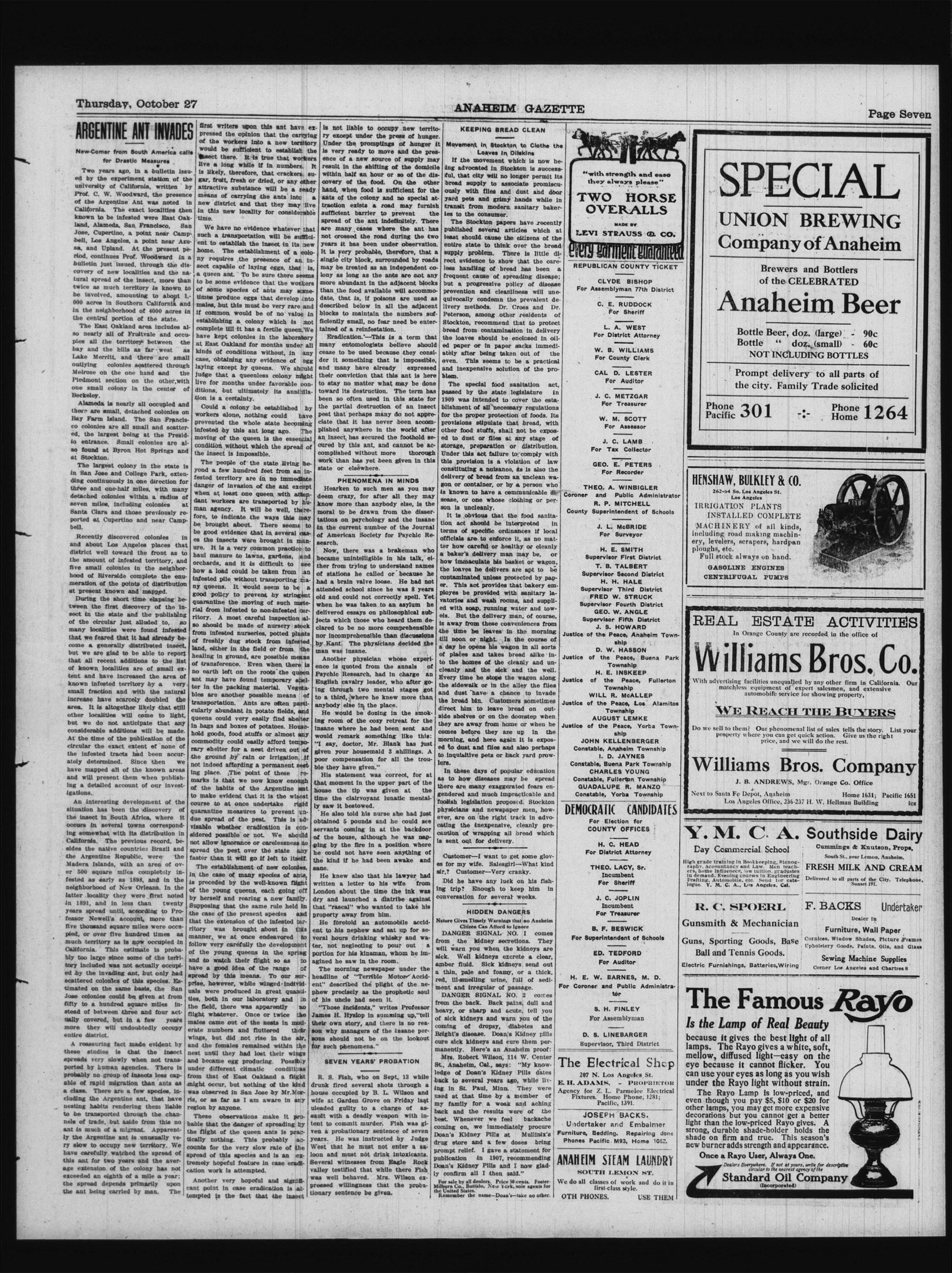
Searchable text
ARGENTINE ANT INVADES
New Comer from South America calls for Drastic Measures
Two years ago, in a bulletin issued by the experiment station of the university of California, written by Prof. C. W. Woodward, the presence of the Argentine Ant was noted in California. The exact localities then known to be infested were East Oakland, Alameda, San Francisco, San Jose, Cupertino, a point near Campbell, Los Angeles, a point near Azusa, and Upland. At the present period, continues Prof. Woodward in a bulletin just issued, through the discovery of new localities and the natural spread of the insect, more than twice as much territory is known to be involved, amounting to about 1,000 acres in Southern California and in the neighborhood of 4000 acres in the central portion of the state.
The East Oakland area includes also nearly all of Fruitvale and occupies all the territory between the bay and the hills as far west as Lake Merritt, and there are small outlying colonies scattered through Melrose on the one hand and the Piedmont section on the other, with one small colony in the center of Berkeley.
Alameda is nearly all occupied and there are small, detached colonies on Bay Farm Island. The San Francisco colonies are all small and scattered, the largest being at the Presidio entrance. Small colonies are also found at Byron Hot Springs and at Stockton.
The largest colony in the state is in San Jose and College Park, extending first writers upon this ant have expressed the opinion that the carrying of the workers into a new territory would be sufficient to establish the insect there. It is true that workers live a long while if in numbers. It is likely, therefore, that crackers, sugar, fruit, fresh or dried, or any other attractive substance will be a ready means of carrying the ants into a new district and that they may live in this new locality for considerable time.
We have no evidence whatever that such a transportation will be sufficient to establish the insect in its new home. The establishment of a colony requires the presence of an insect capable of laying eggs, that is, a queen ant. To be sure there seems to be some evidence that the workers of some species of ants may sometimes produce eggs that develop into males, but this must be very rare and if common would be of no value in establishing a colony which is not complete till it has a fertile queen. We have kept colonies in the laboratory at East Oakland for months under all kinds of conditions without, in any case, obtaining any evidence of egg laying except by queens. We should judge that a queenless colony might live for months under favorable conditions, but ultimately its annihilation is a certainty.
Could a colony be established by workers alone, nothing could have prevented the whole state becoming infested by this ant long ago. The moving of the queen is the essential condition without which the spread of the insect is impossible.
The people of the state living beyond a few hundred feet from an in-
Alameda is nearly all occupied and there are small, detached colonies on Bay Farm Island. The San Francisco colonies are all small and scattered, the largest being at the Presidio entrance. Small colonies are also found at Byron Hot Springs and at Stockton.
The largest colony in the state is in San Jose and College Park, extending continuously in one direction for three and one-half miles, with many detached colonies within a radius of seven miles, including colonies at Santa Clara and those previously reported at Cupertino and near Campbell.
Recently discovered colonies in and about Los Angeles places that district well toward the front as to the amount of infested territory, and five small colonies in the neighborhood of Riverside complete the enumeration of the points of distribution at present known and mapped.
During the short time elapsing between the first discovery of the insect in the state and the publishing of the circular just alluded to, so many localities were found infested that we feared that it had already become a generally distributed insect, but we are glad to be able to report that all recent additions to the list of known localities are of small extent and have increased the area of known infested territory by a very small fraction and with the natural increase have scarcely doubled the area. It is altogether likely that still other localities will come to light, but we do not anticipate that any considerable additions will be made. At the time of the publication of the circular the exact extent of none of the infested tracts had been accurately determined. Since then we have mapped all of the known areas and will present them when publishing a detailed account of our investigations.
An interesting development of the situation has been the discovery of the insect in South Africa, where it occurs in several towns corresponding somewhat with its distribution in California. The previous record, besides the native countries Brazil and the Argentine Republic, were the Madera Islands, with an area of over 500 square miles completely infested as early as 1898, and in the neighborhood of New Orleans. In the latter locality they were first noted
Could a colony be established by workers alone, nothing could have prevented the whole state becoming infested by this ant long ago. The moving of the queen is the essential condition without which the spread of the insect is impossible.
The people of the state living beyond a few hundred feet from an infested territory are in no immediate danger of invasion of the ant except when at least one queen with attendant workers are transported by human agency. It will be well, therefore, to indicate the ways this may be brought about. There seems to be good evidence that in several cases the insects were brought in manure. It is a very common practice to haul manure to lawns, gardens, and orchards, and it is difficult to see how a load could be taken from an infested pile without transporting many queens. It would seem to be a good policy to prevent by stringent quarantine the moving of such material from infested to non-infested territory. A most careful inspection also should be made of nursery stock from infested nurseries, potted plants of freshly dug stock from infested land, either in the field or from the healing in ground, are possible means of transference. Even when there is no earth left on the roots the queen may have found temporary shelter in the packing material. Vegetables are another possible means of transportation. Ants are often particularly abundant in potato fields, and queens could very easily find shelter in bags and boxes of potatoes. Household goods, food stuffs or almost any commodity could easily afford temporary shelter for a nest driven out of the ground by rain or irrigation. If not indeed affording a permanent resting place. The point of these remarks is that we now know enough of the habits of the Argentine ant to make evident that it is the wisest course to at once undertake rigid quarantine measures to prevent undue spread of the pest. This is advisable whether eradication is considered possible or not. We should not allow ignorance or carelessness to spread the pest over the state any faster than it will go if left to itself.
The establishment of new colonies, in the case of many species of ants, is preceded by the well-known flight of the young queens, each going off by herself and rearing a new family.
PHENOMENA
Hearken to deem crazy, know more moral to be tainted on pests on pests in the current American search.
Now, there became uninterest from trying stations had a brain attended school old and could when he was delivered essents which clared to be nor incompressible by Kant. The man was insulted.
Another presence is quoted Psychic Research English cavalry through to a third, w anybody else.
He would ing room of insane where would remain "I say, doctor given your poor compensation they have.
His statement that moment house the time the claim saw it best.
He also told obtained 5 per servants comofthe house pling by the he could not the kind if his sane.
He knew a written a let London about dry and laun
An interesting development of the situation has been the discovery of the insect in South Africa, where it occurs in several towns corresponding somewhat with its distribution in California. The previous record, besides the native countries Brazil and the Argentine Republic, were the Madera Islands, with an area of over 500 square miles completely infested as early as 1898, and in the neighborhood of New Orleans. In the latter locality they were first noted in 1891, and in less than twenty years spread until, according to Professor Newell's account, more than five thousand square miles were occupied, or over five hundred times as much territory as is now occupied in California. This estimate is probably too large since some of the territory included was not actually occupied by the invading ant, but only had scattered colonies of this species. Estimated on the same basis, the San Jose colonies could be given at from fifty to a hundred square miles instead of between three and four actually covered, but in a few years more they will undoubtedly occupy entire district.
A reassuring fact made evident by these studies is that the insect spreads very slowly when not transported by human agencies. There is probably no group of insects less capable of rapid migration than ants as a class. There are a few species, including the Argentine ant, that have nesting habits rendering them liable to be transported through the channels of trade, but aside from this no ant is much of a migrant. Apparently the Argentine ant is unusually slow to occupy new territory. We have carefully watched the spread of this ant for two years and the average extension of the colony has not exceeded an eighth of a mile a year; the spread depends primarily upon the ant being carried by man. The course to at once undertake rigid quarantine measures to prevent undue spread of the pest. This is advisable whether eradication is considered possible or not. We should not allow ignorance or carelessness to spread the pest over the state any faster than it will go if left to itself.
The establishment of new colonies, in the case of many species of ants, is preceded by the well-known flight of the young queens, each going off by herself and rearing a new family. Supposing that the same rule held in the case of the present species and that the extension of the infested territory was brought about in this manner, we at once endeavored to follow very carefully the development of the young queens in the spring and to watch their flight so as to have a good idea of the range of spread by this means. To our surprise, however, while winged individuals were produced in great quantities, both in our laboratory and in the field, there was apparently no flight whatever. Once or twice the males came out of the nests in moderate numbers and fluttered their wings, but did not rise in the air, and the females remained within the nest until they had lost their wings and became egg producing. Possibly under different climatic conditions from that of East Oakland a flight might occur, but nothing of the kind was observed in San Jose by Mr. Morris, or as far as I am aware in any region by anyone.
These observations make it probable that the danger of spreading by the flight of the queen ants is practically nothing. This probably accounts for the very slow rate of the spread of this species and is an extremely hopeful feature in case eradication work is attempted.
Another very hopeful and significant point in case eradication is attempted is the fact that the insect
ANAHEIM GAZETTE
is not liable to occupy new territory except under the press of hunger. Under the promptings of hunger it is very ready to move and the presence of a new source of supply may result in the shifting of the domicile within half an hour or so of the discovery of the food. On the other hand, when food is sufficient for the ants of the colony and no special attraction exists a road may furnish sufficient barrier to prevent the spread of the ant indefinitely. There are many cases where the ant has not crossed the road during the two years it has been under observation. It is very probable, therefore, that a single city block, surrounded by roads may be treated as an independent colony as long as the ants are not any more abundant in the adjacent blocks than the food available will accommodate, that is, if poisons are used as described below in all the adjacent blocks to maintain the numbers sufficiently small, no fear need be entertained of a reinfestation.
Eradication.'—This is a term that many entomologists believe should cease to be used because they consider it something that is impossible, and many have already expressed their conviction that this ant is here to stay no matter what may be done toward its destruction. The term has been so often used in this state for the partial destruction of an insect pest that perhaps many do not appreciate that it has never been accomplished anywhere in the world after an insect has secured the foothold secured by this ant, and cannot be accomplished without more thorough work than has yet been given in this state or elsewhere.
KEEPING BREAD CLEAN
Movement in Stockton to Clothe the Loaves In Dilskins
If the movement which is now being advocated in Stockton is successful, that city will no longer permit its bread supply to associate promiscuously with flies and dust and door yard pets and grimy hands while in transit from modern sanitary bakeries to the consumer.
The Stockton papers have recently published several articles which at least should cause the citizens of the entire state to think over the bread supply problem. There is little direct evidence to show that the careless handling of bread has been a frequent cause of spreading disease; but a progressive policy of disease prevention and cleanliness will unequivocally condemn the prevalent delivery methods. Dr. Cross and Dr. Peterson, among other residents of Stockton, recommend that to protect bread from contamination in delivery the loaves should be enclosed in oiled paper or in paper sacks immediately after being taken out of the oven. This seems to be a practical and inexpensive solution of the problem.
The special food sanitation act, passed by the state legislature in 1909 was intended to cover the establishment of all necessary regulations for the proper protection of foods. Its provisions stipulate that bread, with other food stuffs, shall not be exposed to dust or flies at any stage of storage, preparation or distribution. Under this act failure to comply with this provision is a violation of law constituting a nuisance, as is also the
PHENOMENA IN MINDS
Hearken to such men as you may deem crazy, for after all they may know more than anybody else, is the moral to be drawn from the dissertations on psychology and the insane in the current number of the Journal of American Society for Psychic Research.
Now, there was a brakeman who became unintelligible in his talk, either from trying to understand names of stations he called or because he had a brain valve loose. He had not attended school since he was 8 years old and could not correctly spell. Yet when he was taken to an asylum he delivered essays on philosophical subjects which those who heard them declared to be no more comprehensible nor incomprehensible than discussions by Kant. The physicians decided the man was insane.
Another physician whose experience is quoted from the annals of Psychic Research, had in charge an English cavalry leader, who after going through two mental stages got to a third, where he knew more than anybody else in the place.
He would be dozing in the smoking room of the cozy retreat for the insane where he had been sent and would remark something like this: "I say, doctor, Mr. Blank has just given your housemaid 3 shillings. A poor compensation for all the trouble they have given."
His statement was correct, for at that moment in the upper part of the house the tip was given at the time the clairvoyant lunatic mentally saw it bestowed.
He also told his nurse she had just obtained 5 pounds and he could see servants coming in at the backdoor of the house, although he was napping by the fire in a position where he could not have seen anything of the kind if he had been awake and sane.
He knew also that his lawyer had written a letter to his wife from London about the time the ink was dry and launched a dispute against their conviction that this ant is here to stay no matter what may be done toward its destruction. The term has been so often used in this state for the partial destruction of an insect pest that perhaps many do not appreciate that it has never been accomplished anywhere in the world after an insect has secured the foothold secured by this ant, and cannot be accomplished without more thorough work than has yet been given in this state or elsewhere.
The special food sanitation act, passed by the state legislature in 1909 was intended to cover the establishment of all necessary regulations for the proper protection of foods. Its provisions stipulate that bread, with other food stuffs, shall not be exposed to dust or flies at any stage of storage, preparation or distribution. Under this act failure to comply with this provision is a violation of law constituting a nuisance, as is also the delivery of bread from an unclean wagon or container, or by a person who is known to have a communicable sease, or one whose clothing or person is uncleanly.
It is obvious that the food sanitation act should be interpreted in terms of specific ordinances if local officials are to enforce it, as no matter how careful or healthy or cleanly a baker's delivery man may be, or how immaculate his basket or wagon, the loaves he delivers are apt to be contaminated unless protected by paper. This act provides that bakery employees be provided with sanitary lavatories and wash rooms, and supplied with soap, running water and towels. But the delivery man, of course, is away from these conveniences from the time he leaves in the morning till noon or night. In the course of a day he opens his wagon in all sorts of places and takes bread alike into the homes of the cleanly and uncleanly and the sick and the well. Every time he stops the wagon along the sidewalk or in the alley the flies and dust have a chance to invade the bread bin. Customers sometimes direct him to leave bread on outside shelves or on the doorstep when they are away from home or when he comes before they are up in the morning, and here again it is exposed to dust and flies and also perhaps to inquisitive pets or back yard prowlers.
In these days of popular education as to how diseases may be spread there are many exaggerated fears engendered and much impracticable and foolish legislation proposed. Stockton physicians and newspaper men, however, are on the right track in advocating the inexpensive, cleanly precaution of wrapping all bread which is sent out for delivery.
Customer—I want to get some gloves for my wife. Salesgirl—What kind sir,? Customer—Very cranky.
Did he have any luck on his fishing trip? Enough to keep him in conversation for several weeks.
CAL D. LESTER
For Auditor
J. C. METZGAR
For Treasurer
W. M. SCOTT
For Assessor
J. C. LAMB
For Tax Collector
GEO. E. PETERS
For Recorder
THEO. A. WINBIGLER
Coroner and Public Administrator
R. P. MITCHELL
County Superintendent of Schools
J. L. McBRIDE
For Surveyor
H. E. SMITH
Supervisor First District
T. B. TALBERT
Supervisor Second District
H. H. HALE
Supervisor Third District
FRED W. STRUCK
Supervisor Fourth District
GEO. W. ANGLE
Supervisor Fifth District
J. S. HOWARD
Justice of the Peace, Anaheim Township
D. W. HASSON
Justice of the Peace, Buena Pa Township
H. E. INSKEEP
Justice of the Peace, Fullerton Township
WILL R. McALLEP
Justice of the Peace, Los Alamite Township
AUGUST LEMKE
Justice of the Peace, Yorba Township
JOHN KELLENBERGER
Constable, Anaheim Township
I. D. JAYNES
Constable, Buena Park Township
CHARLES YOUNG
Constable, Fullerton Township
GUADALUPE R. MANZO
Constable, Yorba Township
He also told his nurse she had just obtained 5 pounds and he could see servants coming in at the backdoor of the house, although he was napping by the fire in a position where he could not have seen anything of the kind if he had been awake and sane.
He knew also that his lawyer had written a letter to his wife from London about the time the ink was dry and launched a diatribe against that "rascal" who wanted to take his property away from him.
He foretold an automobile accident to his nephew and sat up for several hours drinking whisky and water, not neglecting to pour out a portion for his kinsman, whom he imagined he saw in the room.
The morning newspaper under the headline of "Terrible Motor Accident" described the plight of the nephew precisely as the prophetic soul of his uncle had seen it.
"Those incidents," writes Professor James H. Hyslop in summing up, "tell their own story, and there is no reason why managers of the insane persons should not be on the lookout for such phenomena."
SEVEN YEARS' PROBATION
R. S. Fish, who on Sept. 13 while drunk fired several shots through a house occupied by B. L. Wilson and wife at Garden Grove on Friday last uleaded guilty to a charge of assault with a deadly weapon with intent to commit murder. Fish was given a probationary sentence of seven years. He was instructed by Judge West that he must not enter a saloon and must not drink intoxicants. Several witnesses from Eagle Rock valley testified that while there Fish was well behaved. Mrs. Wilson expressed willingness that the probationary sentence be given.
Customer—I want to get some gloves for my wife. Salesgirl—What kind sir,? Customer—Very cranky.
Did he have any luck on his fishing trip? Enough to keep him in conversation for several weeks.
HIDDEN DANGERS
Nature Gives Timely Warnings that no Anaheim Citizen Can Afford to Ignore
DANGER SIGNAL NO. I comes from the kidney secretions. They will warn you when the kidneys are sick. Well kidneys excrete a clear, amber fluid. Sick kidneys send out a thin, pale and foamy, or a thick, red, ill-smelling urine, full of sediment and irregular of passage.
DANGER SIGNAL NO. 2 comes from the back. Back pains, dull and heavy, or sharp and acute, tell you of sick kidneys and warn you of the coming of dropsy, diabetes and Bright's disease. Doan's Kidney pills cure sick kidneys and cure them permanently. Here's an Anaheim proof:
Mrs. Robert Wilson, 114 W. Center St., Anaheim, Cal., says: "My knowledge of Doan's Kidney Pills dates back to several years ago, while living in St. Paul, Minn. They were used at that time by a member of my family for a weak and aching back and the results were of the best. Whenever we feel backache coming on, we immediately procure Doan's Kidney Pills at Mullinix's drug store and a few doses bring prompt relief. I gave a statement for publication in 1907, recommending Doan's Kidney Pills and I now gladly confirm all I then said."
For sale by all dealers. Price 50 cents. Foster-Milburn Co., Buffalo, New York, sole agents for the United States.
Remember the name—Doan's—take no other.
SPECIAL
UNION BREWING
Company of Anaheim
Brewers and Bottlers
of the CELEBRATED
Anaheim Beer
Bottle Beer, doz. (large) - 90c
Bottle “doz. (small) - 60c
NOT INCLUDING BOTTLES
Prompt delivery to all parts of
the city. Family Trade solicited
Phone Pacific 301 - Phone Home 1264
REAL ESTATE ACTIVITIES
In Orange County are recorded in the office of
Williams Bros. Co.
With advertising facilities unequalled by any other firm in California. Our matchless equipment of expert salesmen, and extensive automobile service for showing property,
WE REACH THE BUYERS
Do we sell to them? Our phenomenal list of sales tells the story. List your property where you can get quick action. Give us the right price, and we will do the rest.
Williams Bros. Company
J. B. ANDREWS, Mgr. Orange Co. Office
Next to Santa Fe Depot, Anaheim
Home 1631; Pacific 1651
Los Angeles Office, 236-237 H. W. Hellman Building
Y. M. C. A. Southside Dairy
Day Commercial School
High grade training in Bookkeeping, Stenography, Accountancy and Law. Men teachers, home influences, low tuition, graduates in demand. Evening courses in Engineering Drafting, Automobile, etc. Send for catalogue. Y. M. C. A., Los Angeles, Cal.
FRESH MILK AND CREAM
Delivered to all parts of the City. Telephone, Sunset 191.
R. C. SPOERL
Gunsmith & Mechanician
Guns, Sporting Goods, Base Ball and Tennis Goods.
Electric Furnishings, Batteries, Wiring
F. BACKS
Undertaker
Dealer in
Furniture, Wall Paper
Cornices, Window Shades, Picture Frames
Upholstery Goods, Paints, Oils, and Glass
Sewing Machine Supplies
Corner Los Angeles and Chartres 8
The Famous Rayo
Is the Lamp of Real Beauty
because it gives the best light of all lamps. The Rayo gives a white, soft, mellow, diffused light—easy on the eye because it cannot flicker. You can use your eyes as long as you wish under the Rayo light without strain.
The Rayo Lamp is low-priced, and even though you pay $5, $10 or $20 for other lamps, you may get more expensive decorations but you cannot get a better light than the low-priced Rayo gives. A strong, durable shade-holder holds the shade on firm and true. This season's new burner adds strength and appearance.
Once a Rayo User, Always One.
Dealers Everywhere. If not at yours, write for descriptive circular to the nearest agency of the Standard Oil Company (Incorporated)