anaheim-gazette 1910-10-27
Scanned page
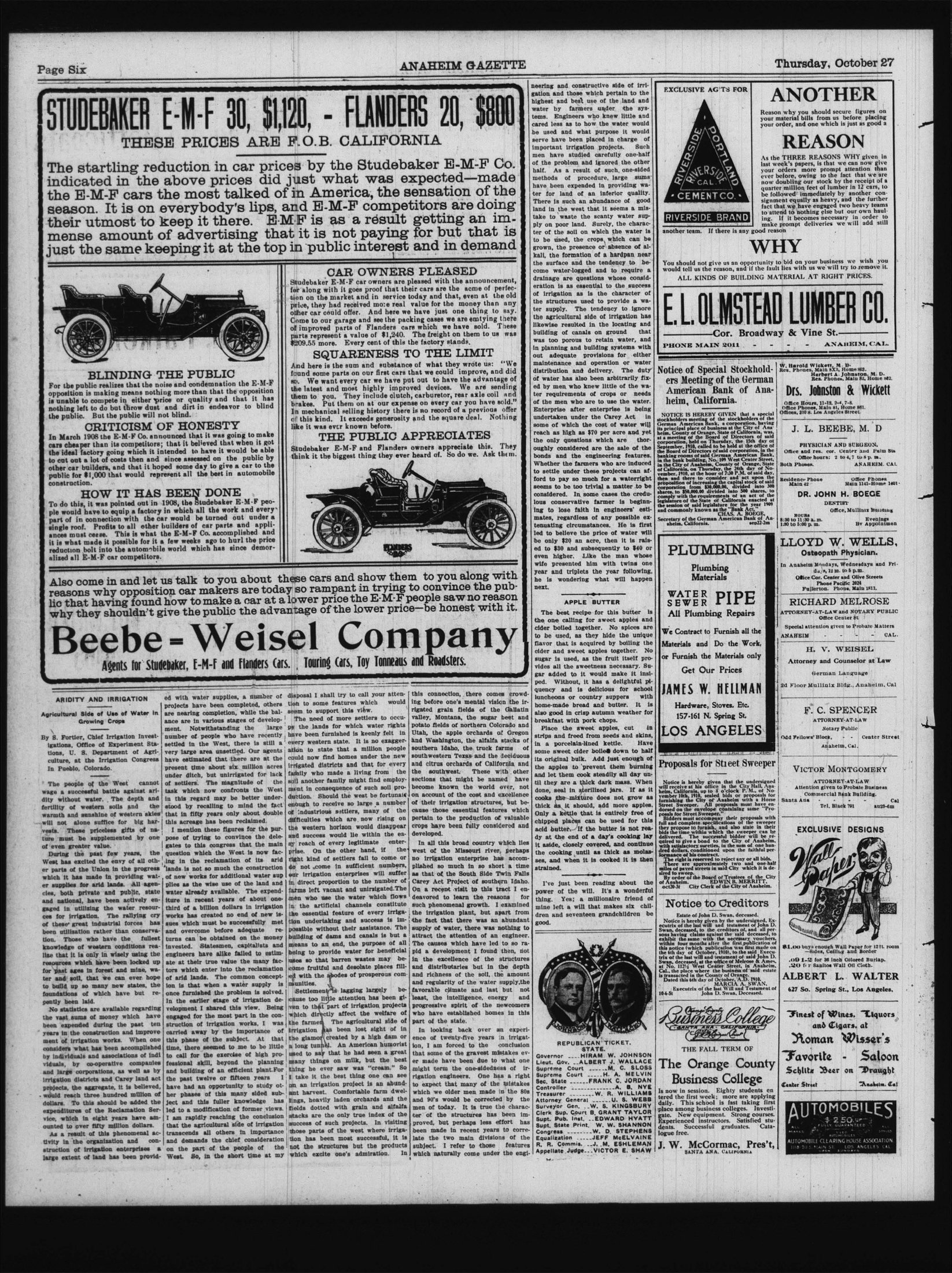
Searchable text
STUDEBAKER E-M-F 30, $1,120, - F
THESE PRICES ARE F.O.B. CAL
The startling reduction in car prices by the indicated in the above prices did just what the E-M-F cars the most talked of in American season. It is on everybody's lips, and E-M-Fs their utmost to keep it there. E-M-F is as a mense amount of advertising that it is not just the same keeping it at the top in public.
BLINDING THE PUBLIC
For the public realizes that the noise and condemnation the E-M-F opposition is making means nothing more than that the opposition is unable to compete in either price or quality and that it has nothing left to do but throw dust and dirt in endeavor to blind the public. But the public will not blind.
CRITICISM OF HONESTY
In March 1908 the E-M-F Co. announced that it was going to make cars cheaper than its competitors; that it believed that when it got the ideal factory going which it intended to have it would be able to cut out a lot of costs then and since assessed on the public by other car builders, and that it hoped some day to give a car to the public for $1,000 that would represent all the best in automobile
CAR
Studebaker E-M-F for along with it go tion on the market price, they had recee other car could offer Come to our garage of improved parts parts represent a va $209.55 more. Ever
SQUARE
And here is the sun found some parts so. We want every the latest and most them to you. The brakes. Put them In mechanical selling of this kind. It ex like it was ever kn
THE P
Studebaker E-M-F think it the biggest
BLINDING THE PUBLIC
For the public realizes that the noise and condemnation the E-M-F opposition is making means nothing more than that the opposition is unable to compete in either price or quality and that it has nothing left to do but throw dust and dirt in endeavor to blind the public. But the public will not blind.
CRITICISM OF HONESTY
In March 1908 the E-M-F Co. announced that it was going to make cars cheaper than its competitors; that it believed that when it got the ideal factory going which it intended to have it would be able to cut out a lot of costs then and since assessed on the public by other car builders, and that it hoped some day to give a car to the public for $1,000 that would represent all the best in automobile construction.
HOW IT HAS BEEN DONE
To do this, it was pointed out in 1908, the Studebaker E-M-F people would have to equip a factory in which all the work and every part of in connection with the car would be turned out under a single roof. Profits to all other builders of car parts and appliances must cease. This is what the E-M-F Co. accomplished and it is what made it possible for it a few weeks ago to hurl the price reduction bolt into the automobile world which has since demoralized all E-M-F car competitors.
Also come in and let us talk to you about these cars and reasons why opposition car makers are today so rampant that having found how to make a car at a lower price they shouldn't give the public the advantage of the Beebe = Weisel Cars
Agents for Studebaker, E-M-F and Flanders Cars. Touring Cars,
ARIDITY AND IRRIGATION
Agricultural Side of Use of Water in Growing Crops
By S. Fortier, Chief Irrigation Investigations, Office of Experiment Stations, U. S. Department of Agriculture, at the Irrigation Congress In Pueblo, Colorado.
The people of the West cannot wage a successful battle against aridity without water. The depth and fertility of western soils and the warmth and sunshine of western skies will not alone suffice for big harvests. These priceless gifts of nature must be supplemented by one of even greater value.
During the past few years, the West has excited the envy of all other parts of the Union in the progress which it has made in providing water supplies for arid lands. All agencies, both private and public, state ed with water supplies, a number of projects have been completed, others are nearing completion, while the balance are in various stages of development. Notwithstanding the large number of people who have recently settled in the West, there is still a very large area unsettled. Our agents have estimated that there are at the present time about six million acres under ditch, but unirrigated for lack of settlers. The magnitude of the task which now confronts the West in this regard may be better understood by recalling to mind the fact that in fifty years only about double this acreage has been reclaimed.
I mention these figures for the purpose of trying to convince the delegates to this congress that the main question which the West is now facing in the reclamation of its arid lands is not so much the construction of new works for additional water supplies as the wise use of the land and water already available. The expenditure I shall try to dispose of to some features seem to support this.
The need of more pay for the lands for which have been furnished is every western state. Action to state that could now find homes irrigated districts and family who made a soil another family meant in consequenceduction. Should we enough to receive so of industrious settlers difficulties which are the western horizon and success would lie reach of every legal prise. On the other right kind of settlers do not come in sufficient irrigation enterprise in direct proportion to farms left vacant and men who use the wa
During the past few years, the West has excited the envy of all other parts of the Union in the progress which it has made in providing water supplies for arid lands. All agencies, both private and public, state and national, have been actively engaged in utilizing the water resources for irrigation. The rallying cry of these great industrial forces has been utilization rather than conservation. Those who have the fullest knowledge of western conditions realize that it is only in wisely using the resources which have been locked up for past ages in forest and mine, water and soil, that we can ever hope to build up so many new states, the foundations of which have but recently been laid.
No statistics are available regarding the vast sums of money which have been expended during the past ten years in the construction and improvement of irrigation works. When one considers what has been accomplished by individuals and associations of individuals, by co-operative companies and large corporations, as well as by irrigation districts and Carey land act projects, the aggregate, it is believed, would reach three hundred million of dollars. To this should be added the expenditures of the Reclamation Service, which in eight years have amounted to over fifty million dollars.
As a result of this phenomenal activity in the organization and construction of irrigation enterprises a large extent of land has been provid-
in this regard may be better understood by recalling to mind the fact that in fifty years only about double this acreage has been reclaimed.
I mention these figures for the purpose of trying to convince the delegates to this congress that the main question which the West is now facing in the reclamation of its arid lands is not so much the construction of new works for additional water supplies as the wise use of the land and water already available. The expenditure in recent years of about one-third of a billion dollars in irrigation works has created no end of new issues which must be successfully met and overcome before adequate returns can be obtained on the money invested. Statesmen, capitalists and engineers have alike failed to estimate at their true value the many factors which enter into the reclamation of arid lands. The common conception is that when a water supply is once furnished the problem is solved. In the earlier stage of irrigation development I shared this view. Being engaged for the most part in the construction of irrigation works, I was carried away by the importance of this phase of the subject. At that time, there seemed to me to be little to call for the exercise of high professional skill, beyond the planning and building of an efficient plant. For the past twelve or fifteen years I have had an opportunity to study other phases of this many sided subject and this fuller knowledge has led to a modification of former views. I am rapidly reaching the conclusion that the agricultural side of irrigation transcends all others in importance and demands the chief consideration on the part of the people of the West. So, in the short time at my
ANAHEIM GAZETTE
120, - FLANDERS 20, $800
F.O.B. CALIFORNIA
Prices by the Studebaker E-M-F Co.
just what was expected—made
in America, the sensation of the
and E-M-F competitors are doing
M-F is as a result getting an imat it is not paying for but that is
up in public interest and in demand
CAR OWNERS PLEASED
Studebaker E-M-F car owners are pleased with the announcement,
for along with it goes proof that their cars are the acme of perfection on the market and in service today and that, even at the old
price, they had received more real value for the money than any
other car could offer. And here we have just one thing to say.
Come to our garage and see the packing cases we are emtying there
of improved parts of Flanders cars which we have sold. These
parts represent a value of $1,240. The freight on them to us was
$209.55 more. Every cent of this the factory stands.
SQUARENESS TO THE LIMIT
And here is the sum and substance of what they wrote us: “We
found some parts on our first cars that we could improve, and did
so. We want every car we have put out to have the advantage of
the latest and most highly improved devices. We are sending
them to you. They include clutch, carburetor, rear axle coil and
brakes. Put them on at our expense on every car you have sold.”
In mechanical selling history there is no record of a previous offer
of this kind. It exceeds generosity and the square deal. Nothing
like it was ever known before.
THE PUBLIC APPRECIATES
Studebaker E-M-F and Flanders owners appreciate this. They
think it the biggest thing they ever heard of. So do we. Ask them.
neering and constructive side of irrigation and those which pertain to the highest and best use of the land and water by farmers under the systems. Engineers who knew little and cared less as to how the water would be used and what purpose it would serve have been placed in charge of important irrigation projects. Such men have studied carefully one-half of the problem and ignored the other half. As a result of such, one-sided methods of procedure, large sums have been expended in providing water for land of an inferior quality. There is such an abundance of good land in the west that it seems a mistake to waste the scanty water supply on poor land. Surely, the character of the soil on which the water is to be used, the crops which can be grown, the presence or absence of alkali, the formation of a hardpan near the surface and the tendency to become water-logged and to require a drainage are questions whose consideration is as essential to the success of irrigation as is the character of the structures used to provide a water supply. The tendency to ignore the agricultural side of irrigation has likewise resulted in the locating and building of canals on ground that was too porous to retain water, and in planning and building systems with out adequate provisions for either maintenance and operation or water distribution and delivery. The duty of water has also been arbitrarily fixed by men who knew little of the water requirements of crops or needs of the men who are to use the water. Enterprise after enterprise is being undertaken under the Carey Act in some of which the cost of water will reach as high as $70 per acre and yet the only questions which are thoroughly considered are the sale of the bonds and the engineering features. Whether the farmers who are induced to settle under these projects can af-
We want every car we have put out to have the advantage of the latest and most highly improved devices. We are sending them to you. They include clutch, carburetor, rear axle coil and brakes. Put them on at our expense on every car you have sold.” In mechanical selling history there is no record of a previous offer of this kind. It exceeds generosity and the square deal. Nothing like it was ever known before.
THE PUBLIC APPRECIATES
Studebaker E-M-F and Flanders owners appreciate this. They think it the biggest thing they ever heard of. So do we. Ask them.
these cars and show them to you along with pay so rampant in trying to convince the pub-a lower price the E-M-F people saw no reasonantage of the lower price—be honest with it.
Diesel Company
Cars. Touring Cars, Toy Tonneaus and Roadsters.
disposal I shall try to call your attention to some features which would seem to support this view.
The need of more settlers to occupy the lands for which water rights have been furnished is keenly felt in every western state. It is no exaggeration to state that a million people could now find homes under the new irrigated districts and that for every family who made a living from the soil another family might find employment in consequence of such soil production. Should the west be fortunate enough to receive so large a number of industrious settlers, many of the difficulties which are now rising on the western horizon would disappear and success would lie within the easy reach of every legitimate enterprise. On the other hand, if the right kind of settlers fall to come or do not come in sufficient numbers, our irrigation enterprises will suffer in direct proportion to the number of farms left vacant and uninsigated. The men who use the water which flows this connection, there comes crowding before one’s mental vision the irrigated grain fields of the Gallatin valley, Montana, the sugar beet and potato fields of northern Colorado and Utah, the apple orchards of Oregon and Washington, the alfalfa stacks of southern Idaho, the truck farms of southwestern Texas and the deciduous and citrus orchards of California and the southwest. These with other sections that might be named have become known the world over, not on account of the cost and excellence of their irrigation structures, but because those essential features which pertain to the production of valuable crops have been fully considered and developed.
In all this broad country which lies west of the Missouri river perhaps no irrigation enterprise has accomplished so much in so short a time as that of the South Side Twin Falls Carey Act Project of southern Idaho. On a recent visit to this tract I endeavored to learn the reasons for of water has also been arbitrarily fixed by men who knew little of the water requirements of crops or needs of the men who are to use the water. Enterprise after enterprise is being undertaken under the Carey Act in some of which the cost of water will reach as high as $70 per acre and yet the only questions which are thoroughly considered are the sale of the bonds and the engineering features. Whether the farmers who are induced to settle under these projects can afford to pay so much for a waterright seems to be too trivial a matter to be considered. In some cases the credulous conservative farmer is beginning to lose faith in engineers’ estimates, regardless of any possible extenuating circumstances. He is first led to believe the price of water will be only $20 an acre, then it is raised to $30 and subsequently to $40 or even higher. Like the man whose wife presented him with twins one year and triplets the year following, he is wondering what will happen next.
APPLE BUTTER
The best recipe for this butter is the one calling for sweet apples and cider boiled together. No spices are to be used, as they hide the unique flavor that is acquired by boiling the cider and sweet apples together. No sugar is used, as the fruit itself provides all the sweetness necessary. Sugar added to it would make it insiped. Without it has a delightful piquency and is delicious for school luncheons or country suppers with home-made bread and butter. It is also good in crisp autumn weather for breakfast with pork chops.
Place the sweet apples, cut in strips and freed from seeds and skins, in a porcelain-lined kettle. Have some sweet cider boiled down to half its original bulk. Add just enough of the apples to prevent them burning and let them cook steadily all day until they are a thick dark mass. When done, seal in sterilized jars. If as it cooks the mixture does not grow as thick as it should, add more apples. Only a kettle that is entirely free of chipped places can be used for this acid butter. If the butter is not ready at the end of a day’s cooking lay it aside, closely covered, and continue the cooking until as thick as molasses, and when it is cooked it is then strained.
I've just been reading about the power of the will. It's a wonderful thing. Yes: a millionaire friend of
enough to receive so large a number of industrious settlers, many of the difficulties which are now rising on the western horizon would disappear and success would lie within the easy reach of every legitimate enterprise. On the other hand, if the right kind of settlers fail to come or do not come in sufficient numbers, our irrigation enterprises will suffer in direct proportion to the number of farms left vacant and unirrigated. The men who use the water which flows in the artificial channels constitute the essential feature of every irrigation undertaking and success is impossible without their assistance. The building of dams and canals is but a means to an end, the purpose of all being to provide water for beneficial uses so that barren wastes may become fruitful and desolate places filled with the abodes of prosperous communities.
Settlement is lagging largely because too little attention has been given to that part of irrigation projects which directly affect the welfare of the farmer. The agricultural side of irrigation has been lost sight of in the glamor created by a high dam or a long tunnel. An American humorist used to say that he had seen a great many things on milk, but the best thing he ever saw was "cream." So I take it the best thing one can see on an irrigation project is an abundant harvest. Comfortable farm dwellings, heavily laden orchards and the fields dotted with grain and alfalfa stacks are the only true index of the success of such projects. In visiting those parts of the west where irrigation has been most successful, it is not the structures but the products which excite one's admiration. In
In all this broad country which lies west of the Missouri river, perhaps no irrigation enterprise has accomplished so much in so short a time as that of the South Side Twin Falls Carey Act Project of southern Idaho. On a recent visit to this tract I endeavored to learn the reasons for such phenomenal growth. I examined the irrigation plant, but apart from the fact that there was an abundant supply of water, there was nothing to attract the attention of an engineer. The causes which have led to so rapid a development I found then, not in the excellence of the structures and distributaries but in the depth and richness of the soil, the amount and regularity of the water supply, the favorable climate and last but not least, the intelligence, energy and progressive spirit of the newcomers who have established homes in this part of the state.
In looking back over an experience of twenty-five years in irrigation, I am forced to conclude that some of the gravest mistakes ever made have been due to what one might term the one-sidedness of irrigation engineers. One has a right to expect that many of the mistakes which we older men made in the 80s and 90's would be corrected by the men of today. It is true the character of the structures has been improved, but perhaps less effort has been made in recent years to correlate the two main divisions of the subject. I refer to those features which naturally come under the engi-
I've just been reading about the power of the will. It's a wonderful thing. Yes; a millionaire friend of mine left a will that makes six children and seventeen grandchildren be good.
REPUBLICAN TICKET.
STATE.
Governor ... HIRAM W. JOHNSON
Lieut. Gov. ... ALBERT J. WALLACE
Supreme Court ... M. C. SLOSS
Supreme Court ... H. A. MELVIN
Sec. State ... FRANK C. JORDAN
Controller ... A. B. NYE
Treasurer ... W. R. WILLIAMB
Attorney General ... U. S. WEBB
Surveyor Gen. ... W. S. KINGSBURY
Clerk Sup. Court B. GRANT TAYLOR
Supt. Pub. Inst... EDWARD HYATT
Supt. State Print. W. W. SHANNON
Congress ... W. D. STEPHENS
Equalization ... JEFF McELVAINE
R. R. Commis... J. M. ESHLEMAN
Appellate Judge... VICTOR E. SHAW
EXCLUSIVE AGTS FOR
ANOTHER
Reason why you should secure figures on your material bills from us before placing your order, and one which is just as good a REASON
As the THREE REASONS WHY given in last week's papers, is that we can now give your orders more prompt attention than ever before, owing to the fact that we are now doubling our stock by the receipt of a quarter million feet of lumber in 12 cars, to be followed immediately by another consignment equally as heavy, and the further fact that we have engaged two heavy teams to attend to nothing else but our own hauling. If it becomes necessary in order to make prompt deliveries we will add still another team. If there is any good reason
WHY
You should not give us an opportunity to bid on your business we wish you would tell us the reason, and if the fault lies with us we will try to remove it.
ALL KINDS OF BUILDING MATERIAL AT RIGHT PRICES.
E. L. OLMSTEAD LUMBER CO.
Cor. Broadway & Vine St.
PHONE MAIN 2011 - ANAHEIM, CAL.
Notice of Special Stockholders Meeting of the German American Bank of Anaheim, California.
NOTICE IS HEREBY GIVEN that a special stockholder meeting of the stockholders of the German American Bank, a corporation, having its principal place of business at the City of Anaheim, County of Orange, State of California, was at a meeting of the Board of Directors of said corporation, held on Thursday, the 15th day of September, 1910, called to be held at the office of the Board of Directors of said corporation, in the banking rooms of said German American Bank, in the bank building, No. 109 West Center Street, in the City of Anaheim, County of Orange, State of California, on Thursday, the 24th day of November, 1910, at the hour of 7:30 P.M. of said day.
W. Harold Wickett, M.D.
Res. Phones, Main 8X8, Home 863.
Herbert A. Johnston, M.D.
Res. Phones, Main 82, Home 862.
Drs. Johnston & Wickett
Office Hours, 11-12, 2-4, 7-8.
Office Phones, Main 81, Home 861.
Offices, 310 8. Los Angeles Street.
J. L. BEEBE, M.D.
PHYSICIAN AND SUBGEON.
Office and res. cor. Center and Palm Sts
Office hours: 2 to 4, 7 to 8 p.m.
Both Phones.
ANAHEIM, CAL.
NOTICE IS HEREBY GIVEN that a special stockholders meeting of the stockholders of the German American Bank, a corporation, having its principal place of business at the City of Anaheim, County of Orange, State of California, was at a meeting of the Board of Directors of said corporation, held on Thursday, the 15th day of September, 1910, called to be held at the office of the Board of Directors of said corporation, in the banking rooms of said German American Bank, in the bank building, No. 109 West Center Street, in the City of Anaheim, County of Orange, State of California, on Thursday, the 24th day of November, 1910, at the hour of 7:30 P.M. of said day, then and there to consider and act upon the proposition of increasing the capital stock of said corporation from $30,000.00, divided into 300 shares, to $50,000.00 divided into 500 shares, to comply with the requirements of an act of the legislature of the State of California enacted at the session of said legislature for the year 1909 and commonly known as the "Bank Act."
CHAS. A. BOEGE,
Secretary of the German American Bank of Anaheim, California.
PLUMBING
Plumbing Materials
WATER PIPE
All Plumbing Repairs
We Contract to Furnish all the Materials and Do the Work or Furnish the Materials only
Get Our Prices
JAMES W. HELLMAN
Hardware, Stoves. Etc.
157-161 N. Spring St.
LOS ANGELES
Proposals for Street Sweeper
Notice is hereby given that the undersigned will receive at his office in the City Hall, Anaheim, California, up to 8 o'clock P.M., of November 10th, 1910, sealed bids or proposals for furnishing the City of Anaheim with a Horse Street Sweeper. All proposals must have enclosed on the envelope containing same "Proposals for Street Sweeper."
Bidders must accompany their proposals with full and complete specifications of the sweeper they propose to furnish, and also state in their bids the time within which the sweeper can be delivered. The successful bidder will be required to give a bond to the City of Anaheim, with satisfactory sureties, in the sum of one hundred dollars, conditioned upon the faithful performance of his contract.
The right is reserved to reject any or all bids. There are approximately two and one-half miles of paved streets in said City which it is desired to sweep.
By order of the Board of Trustees of the City of Anaheim.
EDWIN B. MERRITT,
oct20-3t
City Clerk of the City of Anaheim.
HERbert A. Johnston, M.D.
Res. Phones, Main 82, Home 862.
Drs. Johnston & Wickett
Office Hours, 11-12, 2-4, 7-8.
Office Phones, Main 81, Home 861.
Offices, 310 S. Los Angeles Street.
J. L. BEEBE, M. D
PHYSICIAN AND SURGEON.
Office and res. cor. Center and Palm Sts
Office hours: 2 to 4, 7 to 8 p.m.
Both Phones.
ANAHEIM, CAL.
Residency Phone
Main 42
Office Phones
Main 1141-Home 1401
DR. JOHN H. BOEGE
DENTIST
Office, Mullinix Building
HOURS
8:30 to 11:30 a.m.
Evenings
1:80 to 5:00 p.m.
LLOYD W. WELLS,
Osteopath Physician.
In Anaheim Mondays, Wednesdays and Fridays, 12 m. to 5 p.m.
Office Cor. Center and Olive Streets
Phone Pacific 2024
Fullerton. Phone, Main 1811.
RICHARD MELROSE
ATTORNEY-AT-LAW and NOTARY PUBLIC
Office Center 8t
Special attention given to Probate Matters
ANAHEIM
H. V. WEISEL
Attorney and Counselor at Law
German Language
2d Floor Mullinix Bldg., Anaheim, Cal.
F. C. SPENCER
ATTORNEY-AT-LAW
Notary Public
Odd Fellows' Block,
Center Street
Anaheim, Cal.
VICTOR MONTGOMERY
ATTORNEY-AT-LAW
Attention given to Probate Business
Commercial Bank Building.
Santa Ana
Tel. Black 791 au23-6m
EXCLUSIVE DESIGNS
Notice to Creditors
Estate of John D. Swan, deceased.
Notice is hereby given by the undersigned, Executrix of the last will and testament of John D. Swan, deceased, to the creditors of, and all persons having claims against the said deceased, to exhibit the same with the necessary vouchers, within four months after the first publication of this notice (which publication was first made on the 6th day of October, 1910), to the said Executrix of the last will and testament of said John D. Swan, deceased, at the office of Melrose & Ames, at No. 1124 West Center Street, in Anaheim, Cal., the place where the business of said estate is transacted in the County of Orange.
Dated this 6th day of October, 1910.
MARCIA A. SWAN,
Executrix of the last Will and Testament of John D. Swan, Deceased.
THE FALL TERM OF
The Orange County Business College
Is now in session. Eighty students entered the first week; more are applying daily. This school is fast taking first place among business colleges. Investigate. New equipment. Strong courses. Experienced instructors. Satisfied students. Successful graduates. Catalogue free.
J. W. McCormac, Pres't,
SANTA ANA, CALIFORNIA