anaheim-gazette 1910-10-20
Scanned page
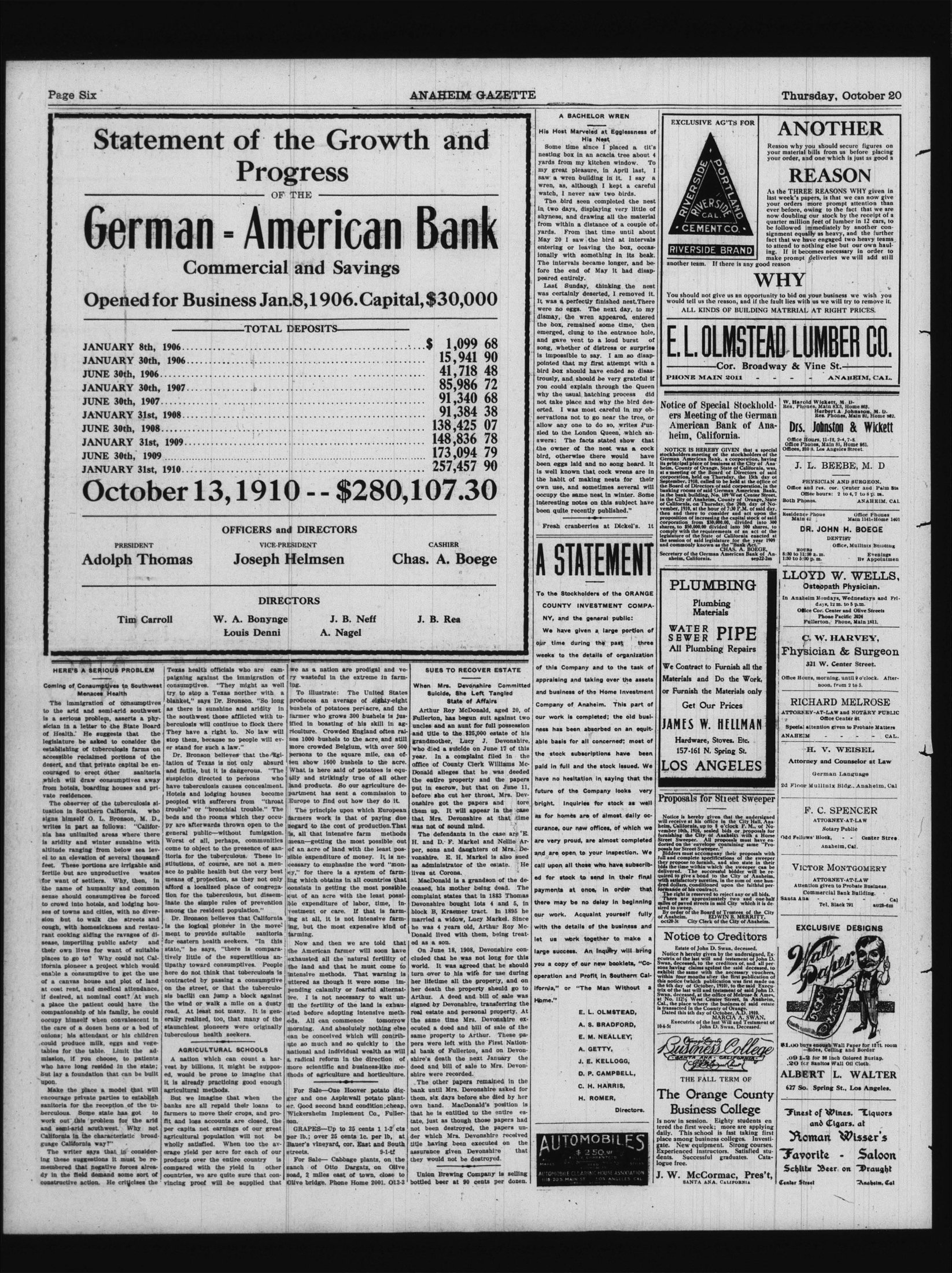
Searchable text
Statement of the Gr
Progress
OF THE
German = Americ
Commercial and Sav
Opened for Business Jan.8,1906
TOTAL DEPOSITS
JANUARY 8th, 1906
JANUARY 30th, 1906
JUNE 30th, 1906
JANUARY 30th, 1907
JUNE 30th, 1907
JANUARY 31st, 1908
JUNE 30th, 1908
JANUARY 31st, 1909
JUNE 30th, 1909
JANUARY 31st, 1910
JUNE 30th, 1906
JANUARY 30th, 1907
JUNE 30th, 1907
JANUARY 31st, 1908
JUNE 30th, 1908
JANUARY 31st, 1909
JUNE 30th, 1909
JANUARY 31st, 1910
October 13, 1910 -- $2
OFFICERS and DIRECTORS
PRESIDENT Adolph Thomas
VICE-PRESIDENT Joseph Helmsen
DIRECTORS
Tim Carroll
W. A. Bonynge
J. B.
Louis Denni
A. Nagel
HERE'S A SERIOUS PROBLEM
Coming of Consumptives to Southwest Menaces Health
The immigration of consumptives to the arid and semi-arid southwest is a serious problem, asserts a physician in a letter to the State Board of Health. He suggests that the legislature be asked to consider the establishing of tuberculosis farms on accessible reclaimed portions of the desert, and that private capital be encouraged to erect other sanitoria which will draw consumptives away from hotels, boarding houses and private residences.
The observer of the tuberculosis situation in Southern California, who signs himself O. L. Bronson, M. D., writes in part as follows: "California has unlimited areas where there is aridity and winter sunshine with altitude ranging from below sea level to an elevation of several thousand feet. These portions are irrigable and fertile but are unproductive wastes for want of settlers. Why, then, in the name of humanity and common sense should consumptives be forced Texas health officials who are campaigning against the immigration of consumptives. "They might as well try to stop a Texas norther with a blanket," says Dr. Bronson. "So long as there is sunshine and aridity in the southwest those afflicted with tuberculosis will continue to flock there They have a right to. No law will stop them, because no people will ever stand for such a law."
Dr. Bronson believes that the agitation of Texas is not only absurd and futile, but it is dangerous. "The suspicion directed to persons who have tuberculosis causes concealment. Hotels and lodging houses become peopled with sufferers from "throat trouble" or "bronchial trouble." The beds and the rooms which they occupy are afterwards thrown open to the general public—without fumigation. Worst of all, perhaps, communities come to object to the presence of sanitaria for the tuberculous. These institutions, of course, are not a menace to public health but the very best means of protection, as they not only afford a localized place of congregation for the tuberculous, but disseminate as a nation are rery wasteful in the ering.
To illustrate: The produces an average bushels of potatoes per farmer who grows 300 bushels in boasting of agriculture. Crowded buses 1000 bushels to more crowded Belgium persons to the square ten show 1600 bushels What is here said of itally and strikingly the land products. So our department has sent a Europe to find out how The principle upon farmers work is that negard to the cost of is, all that intensive mean—getting the man of an acre of land will sible expenditure of necessary to emphasize ey," for there is a ling which obtains in some consists in getting th out of an acre with
The observer of the tuberculosis situation in Southern California, who signs himself O. L. Bronson, M. D., writes in part as follows: "California has unlimited areas where there is aridity and winter sunshine with altitude ranging from below sea level to an elevation of several thousand feet. These portions are irrigable and fertile but are unproductive wastes for want of settlers. Why, then, in the name of humanity and common sense should consumptives be forced to crowd into hotels, and lodging houses of towns and cities, with no diversion but to walk the streets and cough, with homesickness and restaurant cooking aiding the ravages of disease, imperiling public safety and their own lives for want of suitable places to go to? Why could not California pioneer a project which would enable a consumptive to get the use of a canvas house and plot of land at cost rent, and medical attendance, if desired, at nominal cost? At such a place the patient could have the companionship of his family, he could occupy himself when convalescent in the care of a dozen hens or a bed of onions; his attendant or his children could produce milk, eggs and vegetables for the table. Limit the admission, if you choose, to patients who have long resided in the state; but lay a foundation that can be built upon.
Make the place a model that will encourage private parties to establish sanitoria for the reception of the tuberculous. Some state has got to work out this problem for the arid and semi-arid southwest. Why not California in the characteristic broad-gauge California way?"
The writer says that in considering these suggestions it must be remembered that negative forces already in the field demand some sort of constructive action. He criticises the peopleled with sufferers from "throat trouble" or "bronchial trouble." The beds and the rooms which they occupy are afterwards thrown open to the general public—without fumigation. Worst of all, perhaps, communities come to object to the presence of sanitria for the tuberculous. These institutions, of course, are not a menace to public health but the very best means of protection, as they not only afford a localized place of congregation for the tuberculous, but disseminate the simple rules of prevention among the resident population."
Dr. Bronson believes that California is the logical pioneer in the movement to provide suitable sanitoria for eastern health seekers. "In this state," he says, "there is comparatively little of the superstitious antipathy toward consumptives. People here do not think that tuberculosis is contracted by passing a consumptive on the street, or that the tuberculosis bacilli can jump a block against the wind or walk a mile on a dusty road. At least not many. It is generally realized, too, that many of the staunchiest pioneers were originally tuberculous health seekers.
AGRICULTURAL SCHOOLS
A nation which can count a harvest by billions, it might be supposed, would be prone to imagine that it is already practicing good enough agricultural methods.
But we imagine that when the banks are all repaid their loans to farmers to move their crops, and profit and loss accounts are closed, the per capita net earnings of our great agricultural population will not be wholly satisfied. When too the average yield per acre for each of our products over the entire country is compared with the yield in other countries, we are quite sure that convincing proof will be supplied that
ANAHEIM GAZETTE
the Growth and Progress
OF THE
American Bank
Financial and Savings
Jan. 8, 1906. Capital, $30,000
DEPOSITS
$ 1,099 68
15,941 90
41,718 48
85,986 72
91,340 68
91,384 38
138,425 07
148,836 78
173,094 79
257,457 90
A BACHELOR WREN
His Host Marveled at Egglessness of His Nest
Some time since I placed a tit's nesting box in an acacia tree about 4 yards from my kitchen window. To my great pleasure, in April last, I saw a wren building in it. I say a wren, as, although I kept a careful watch, I never saw two birds.
The bird seen completed the nest in two days, displaying very little of shyness, and drawing all the material from within a distance of a couple of yards. From that time until about May 20 I saw the bird at intervals entering or leaving the box, occasionally with something in its beak. The intervals became longer, and before the end of May it had disappeared entirely.
Last Sunday, thinking the nest was certainly deserted, I removed it. It was a perfectly finished nest. There were no eggs. The next day, to my dismay, the wren appeared, entered the box, remained some time, then emerged, clung to the entrance hole, and gave vent to a loud burst of song, whether of distress or surprise is impossible to say. I am so disappointed that my first attempt with a bird box should have ended so disastrously, and should be very grateful if you could explain through the Queen why the usual hatching process did not take place and why the bird deserted. I was most careful in my observations not to go near the tree, or allow any one to do so, writes Puzzled to the London Queen, which answers: The facts stated show that the owner of the nest was a cock bird, otherwise there would have been eggs laid and no song heard. It is well known that cock wrens are in
we as a nation are prodigal and very wasteful in the extreme in farming.
To illustrate: The United States produces an average of eighty-eight bushels of potatoes per acre, and the farmer who grows 300 bushels is justified in boasting of his skill in agriculture. Crowded England often raises 1000 bushels to the acre, and still more crowded Belgium, with over 500 persons to the square mile, can often show 1600 bushels to the acre. What is here said of potatoes is equally and strikingly true of all other land products. So our agriculture department has sent a commission to Europe to find out how they do it.
The principle upon which European farmers work is that of paying due regard to the cost of production. That is, all that intensive farm methods mean—getting the most possible out of an acre of land with the least possible expenditure of money. It is necessary to emphasize the word "money," for there is a system of farming which obtains in all countries that consists in getting the most possible out of an acre with the least possi-
SUES TO RECOVER ESTATE
When Mrs. Devonshire Committed Suicide, She Left Tangled State of Affairs
Arthur Roy McDonald, aged 20, of Fullerton, has begun suit against two uncles and an aunt for full possession and title to the $25,000 estate of his grandmother, Lucy J. Devonshire, who died a suicide on June 17 of this year. In a complaint filed in the office of County Clerk Williams McDonald alleges that he was deeded the entire property and the papers put in escrow, but that on June 11, before she cut her throat, Mrs. Devonshire got the papers and tore them up. It will appear in the case that Mrs. Devonshire at that time was not of sound mind.
The defendants in the case are E. H. and D. F. Markel and Nellie Arper, sons and daughters of Mrs. Devonshire. E. H. Markel is also sued as administrator of the estate. He lives at Corona.
MacDonald is a grandson of the deceased, his mother being dead. The complaint states that in 1883 Thomas trously, and should be very grateful if you could explain through the Queen why the usual hatching process did not take place and why the bird deserted. I was most careful in my observations not to go near the tree, or allow any one to do so, writes Puzzled to the London Queen, which answers: The facts stated show that the owner of the nest was a cock bird, otherwise there would have been eggs laid and no song heard. It is well known that cock wrens are in the habit of making nests for their own use, and sometimes several will occupy the same nest in winter. Some interesting notes on this subject have been quite recently published."
Fresh cranberries at Dickel's. It
A STATEMENT
To the Stockholders of the ORANGE COUNTY INVESTMENT COMPANY, and the general public:
We have given a large portion of our time during the past three weeks to the details of organization of this Company and to the task of appraising and taking over the assets and business of the Home Investment Company of Anaheim. This part of our work is completed; the old business has been absorbed on an equitable basis for all concerned; most of the stock subscriptions have been paid in full and the stock issued. We have no hesitation in saying that the future of the Company looks very bright. Inquiries for stock as well as for homes are of almost daily occurrence, our new offices, of which we are very proud, are almost completed and are open to your inspection. We call upon all those who have subscribed for stock to send in their final payments at once, in order that
Europe to find out how they do it.
The principle upon which European farmers work is that of paying due regard to the cost of production. That is, all that intensive farm methods mean—getting the most possible out of an acre of land with the least possible expenditure of money. It is necessary to emphasize the word "money," for there is a system of farming which obtains in all countries that consists in getting the most possible out of an acre with the least possible expenditure of labor, time, investment or care. If that is farming at all, it is not intensive farming, but the most expensive kind of farming.
Now and then we are told that the American farmer will soon have exhausted all the natural fertility of the land and that he must come to intensive methods. That warning is uttered as though it were some impending calamity or fearful alternative. I is not necessary to wait until the fertility of the land is exhausted before adopting intensive methods. All can commence tomorrow morning. And absolutely nothing else can be conceived which will contribute so much and so quickly to the national and individual wealth as will a radical reform in the direction of more scientific and business-like methods of agriculture and horticulture.
For Sale—One Hoover potato digger and one Aspinwall potato planter. Good second hand condition; cheap. Wickersheim Implement Co., Fullerton.
GRAPES—Up to 25 cents 1 1-2 cts per lb.; over 25 cents 1c. per lb, at Bauer's vineyard, cor. East and South streets.
For Sale—Cabbage plants, on the ranch of Otto Dargatz, on Olive road, 2 miles east of town, close to Olive bridge. Phone Home 2001. O13-3
Union Brewing Company is selling bottled beer at 90 cents per dozen.
bright. Inquiries for stock as well as for homes are of almost daily occurrence, our new offices, of which we are very proud, are almost completed and are open to your inspection. We call upon all those who have subscribed for stock to send in their final payments at once, in order that there may be no delay in beginning our work. Acquaint yourself fully with the details of the business and let us work together to make a large success. An inquiry will bring you a copy of our new booklets, "Cooperation and Profit in Southern California," or "The Man Without a Home."
E. L. OLMSTEAD,
A. S. BRADFORD,
E. M. NEALLEY,
A. GETTY,
J. E. KELLOGG,
D. P. CAMPBELL,
C. H. HARRIS,
H. ROMER,
Directors.
Thursday, October 20
EXCLUSIVE AG'TS FOR
ANOTHER
Reason why you should secure figures on your material bills from us before placing your order, and one which is just as good a REASON
As the THREE REASONS WHY given in last week's papers, is that we can now give your orders more prompt attention than ever before, owing to the fact that we are now doubling our stock by the receipt of a quarter million feet of lumber in 12 cars, to be followed immediately by another consignment equally as heavy, and the further fact that we have engaged two heavy teams to attend to nothing else but our own hauling. If it becomes necessary in order to make prompt deliveries we will add still another team. If there is any good reason
WHY
You should not give us an opportunity to bid on your business we wish you would tell us the reason, and if the fault lies with us we will try to remove it.
ALL KINDS OF BUILDING MATERIAL AT RIGHT PRICES.
E.L. OLMSTEAD LUMBER CO.
Cor. Broadway & Vine St.
PHONE MAIN 2011 - - - - ANAHEIM, CAL.
Notice of Special Stockholders Meeting of the German American Bank of Anaheim, California.
NOTICE IS HEREBY GIVEN that a special stockholders meeting of the stockholders of the German American Bank, a corporation, having its principal place of business at the City of Anaheim, County of Orange, State of California, was at a meeting of the Board of Directors of said
Notice of Special Stockholders Meeting of the German American Bank of Anaheim, California.
NOTICE IS HEREBY GIVEN that a special stockholders meeting of the stockholders of the German American Bank, a corporation, having its principal place of business at the City of Anaheim, County of Orange, State of California, was at a meeting of the Board of Directors of said corporation, held on Thursday, the 15th day of September, 1910, called to be held at the office of the Board of Directors of said corporation, in the banking rooms of said German American Bank, in the bank building, No. 109 West Center Street, in the City of Anaheim, County of Orange, State of California, on Thursday, the 24th day of November, 1910, at the hour of 7:30 P.M. of said day, then and there to consider and act upon the proposition of increasing the capital stock of said corporation from $30,000.00, divided into 300 shares, to $50,000.00 divided into 500 shares, to comply with the requirements of an act of the legislature of the State of California enacted at the session of said legislature for the year 1909 and commonly known as the "Bank Act."
CHAS. A. BOEGE,
Secretary of the German American Bank of Anaheim, California.
PLUMBING
Plumbing Materials
WATER SEWER All Plumbing Repairs
We Contract to Furnish all the Materials and Do the Work, or Furnish the Materials only
Get Our Prices
JAMES W. HELLMAN
Hardware, Stoves. Etc.
157-161 N. Spring St.
LOS ANGELES
Proposals for Street Sweeper
Notice is hereby given that the undersigned will receive at his office in the City Hall, Anaheim, California, up to 8 o'clock P.M., of November 10th, 1910, sealed bids or proposals for furnishing the City of Anaheim with a Horse Street Sweeper. All proposals must have enclosed on the envelope containing same "Proposals for Street Sweeper."
Bidders must accompany their proposals with full and complete specifications of the sweeper they propose to furnish, and also state in their bids the time within which the sweeper can be delivered. The successful bidder will be required to give a bond to the City of Anaheim, with satisfactory sureties, in the sum of one hundred dollars, conditioned upon the faithful performance of his contract.
The right is reserved to reject any or all bids. There are approximately two and one-half
Notice is hereby given that the undersigned will receive at his office in the City Hall, Anaheim, California, up to 8 o'clock P.M., of November 10th, 1910, sealed bids or proposals for furnishing the City of Anaheim with a Horse Street Sweeper. All proposals must have endorsed on the envelope containing same "Proposals for Street Sweeper."
Bldders must accompany their proposals with full and complete specifications of the sweeper they propose to furnish, and also state in their bids the time within which the sweeper can be delivered. The successful bidder will be required to give a bond to the City of Anaheim, with satisfactory sureties, in the sum of one hundred dollars, conditioned upon the faithful performance of his contract.
The right is reserved to reject any or all bids. There are approximately two and one-half miles of paved streets in said City which it is desired to sweep.
By order of the Board of Trustees of the City of Anaheim. EDWIN B. MERRITT, oct20-3t City Clerk of the City of Anaheim.
Notice to Creditors
Estate of John D. Swan, deceased.
Notice is hereby given by the undersigned, Executrix of the last will and testament of John D. Swan, deceased, to the creditors of, and all persons having claims against the said deceased, to exhibit the same with the necessary vouchers, within four months after the first publication of this notice (which publication was first made on the 6th day of October, 1910), to the said Executrix of the last will and testament of said John D. Swan, deceased, at the office of Melrose & Ames, at No. 112½ West Center Street, in Anaheim, Cal., the place where the business of said estate is transacted in the County of Orange.
Dated this 6th day of October, A.D. 1910.
MARCIA A. SWAN,
Executrix of the last Will and Testament of John D. Swan, deceased.
THE FALL TERM OF
The Orange County Business College
Is now in session. Eighty students entered the first week; more are applying daily. This school is fast taking first place among business colleges. Investigate. New equipment. Strong courses. Experienced instructors. Satisfied students. Successful graduates. Catalogue free.
J. W. McCormac, Pres't,
SANTA ANA, CALIFORNIA