anaheim-gazette 1910-10-13
Scanned page
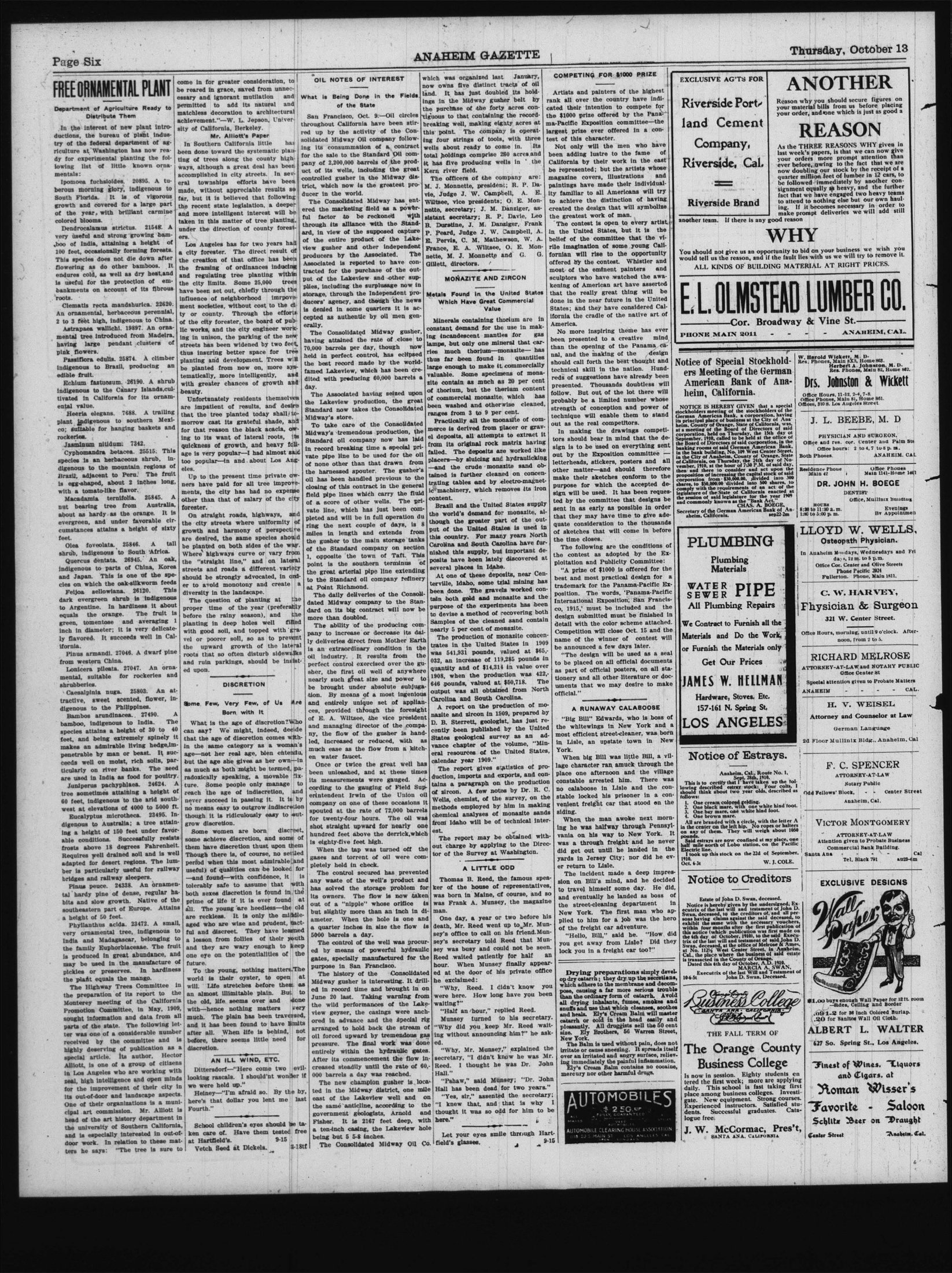
Searchable text
FREE ORNAMENTAL PLANT
Department of Agriculture Ready to Distribute Them
In the interest of new plant introductions, the bureau of plant industry of the federal department of agriculture at Washington has now ready for experimental planting the following list of little known ornaments:
Ipomoea fuchsiaoides. 20895. A tuberous morning glory, indigenous to South Florida. It is of vigorous growth and covered for a large part of the year, with brilliant carmine colored blooms.
Dendrocalamus strictus. 21548. A very useful and strong growing bamboo of India, attaining a height of 100 feet, occasionally forming forests. This species does not die down after flowering as do other bamboos. It endures cold, as well as dry heat, and is useful for the protection of embankments on account of its fibrous roots.
Clematis recta mandshurica. 22620: An ornamental, herbaceous perennial, 2 to 3 feet high, indigenous to China.
Astrapaea wallichi. 19897. An ornamental tree introduced from Madeira, having large pendant clusters of pink flowers.
Passiflora edulis. 25874. A climber indigenous to Brazil, producing an edible fruit.
Echium fastuosum. 26190. A shrub indigenous to the Canary Islands, cultivated in California for its ornamental value.
Heeria elegans. 7688. A trailing plant indigenous to southern Mexico; suitable for hanging baskets and rockeries.
Jasminum nitidum: 7342.
Cyphomandra betacea. 25515. This species is an herbaceous shrub, indigenous to the mountain regions of Brazil, adjacent to Peru. The fruit come in for greater consideration, to be reared in grace, saved from unnecessary and ignorant mutilation and permitted to add its natural and matchless decoration to architectural achievement."—W. L. Jepson, University of California, Berkeley.
Mr. Alliott's Paper
In Southern California little has been done toward the systematic planting of trees along the county highways, although a great deal has been accomplished in city streets. In several townships efforts have been made, without appreciable results so far, but it is believed that following the recent state legislation, a deeper and more intelligent interest will be taken in this matter of tree planting, under the direction of county foresters.
Los Angeles has for two years had a city forester. The direct result of the creation of that office has been the framing of ordinances inducing and regulating tree planting within the city limits. Some 25,000 trees have been set out, chiefly through the influence of neighborhood imrpvement societies, without cost to the city or county. Through the efforts of the city forester, the board of public works, and the city engineer working in unison, the parking of the new streets has been widened by two feet, thus insuring better space for tree planting and development. Trees will be planted from now on, more systematically, more intelligently, and with greater chances of growth and beauty.
Unfortunately residents themselves are impatient of results, and desire that the tree planted today shall tomorrow cast its grateful shade, and for that reason the black acacia, owing to its want of lateral roots, its quickness of growth, and heavy foliage is very popular—I had almost said too popular—in and about Los Angeles.
Echium fastuosum. 26190. A shrub indigenous to the Canary Islands, cultivated in California for its ornamental value.
Heeria elegans. 7688. A trailing plant indigenous to southern Mexico; suitable for hanging baskets and rockeries.
Jasminum nitidum: 7342.
Cyphomandra betacea. 25515. This species is an herbaceous shrub, indigenous to the mountain regions of Brazil, adjacent to Peru. The fruit is egg-shaped, about 2 inches long, with a tomato-like flavor.
Macadamia ternifolia. 25845. A nut bearing tree from Australia, about as hardy as the orange. It is evergreen, and under favorable circumstances attains a height of sixty feet.
Olea foveolata. 25846. A tall shrub, indigenous to South Africa.
Quercus dentata. 26945. An oak, indigenous to parts of China, Korea and Japan. This is one of the species on which the oak-silkworm feeds.
Feijoa sellowiana. 26120. This dark evergreen shrub is indigenous to Argentine. In hardiness it about equals the orange. The fruit is green, tomentose and averaging 1 inch in diameter; it is very delicately flavored. It succeeds well in California.
Pinus armandi. 27046. A dwarf pine from western China.
Lonicera pileata. 27047. An ornamental, suitable for rockeries and shrubberies.
Caesalpinia nuga. 25803. An attractive, sweet scented, flower, indigenous to the Philippines.
Bambos arundinacea. 27490. A bamboo, indigenous to India. The species attains a height of 30 to 40 feet, and being extremely spiny it makes an admirable living hedge, impenetrable by man or beast. It succeeds well on moist, rich soils, particularly on river banks. The seed are used in India as food for poultry.
Juniperus pachyphlaea. 24624. A tree sometimes attaining a height of 60 feet, indigenous to the arid southwest at elevations of 4000 to 5000 ft.
Eucalyptus microtheca. 23495. Indigenous to Australia; a tree attaining a height of 150 feet under favorable conditions. Successfully resists frosts above 18 degrees Fahrenheit. Requires well drained soil and is well adapted for desert regions. The lumber is particularly useful for railway bridges and railway sleepers.
Pinus peuce. 24338. An ornamental hardy pine of dense, regular habitatically, more intelligently, and with greater chances of growth and beauty.
Unfortunately residents themselves are impatient of results, and desire that the tree planted today shall tomorrow cast its grateful shade, and for that reason the black acacia, owing to its want of lateral roots, its quickness of growth, and heavy foliage is very popular—I had almost said too popular—in and about Los Angeles.
Up to the present time private owners have paid for all tree improvements, the city has had no expense other than that of salary of the city forester.
On straight roads, highways, and the city streets where uniformity of growth and harmony of perspective are desired, the same species should be planted on both sides of the way. Where highways curve or vary from the "straight line," and on lateral streets and roads a different variety should be strongly advocated, in order to avoid monotony and create a diversity in the landscape.
The question of planting at the proper time of the year (preferably before the rainy season), and the planting in deep holes well filled with good soil, and topped with gravel or poorer soil, so as to prevent the upward growth of the lateral roots that so often disturb sidewalks and ruin parkings, should be insisted upon.
DISCRETION
Some Few, Very Few, of Us Are Born with It
What is the age of discretion? Who can say? We might, indeed, decide that the age of discretion comes within the same category as a woman's age—not her real age, bien entendu, but the age she gives as her own—in as much as both might be termed, paradoxically speaking, a movable fixture. Some people only manage to reach the age of indiscretion, and never succeed in passing it. It is by no means easy to outgrow indiscretion though it is ridiculously easy to outgrow discretion.
Some women are born discreet, some achieve discretion, and some of them have discretion thrust upon them Though there is, of course, no settled period when this most admirable and useful of qualities can be looked for—and found—with confidence, it is tolerably safe to assume that with both sexes discretion is found in them life is ever found at thematically, more intelligently, and with greater chances of growth and beauty.
Unfortunately residents themselves are impatient of results, and desire that the tree planted today shall tomorrow cast its grateful shade, and for that reason the black acacia, owing to its want of lateral roots, its quickness of growth, and heavy foliage is very popular—I had almost said too popular—in and about Los Angeles.
Up to the present time private owners have paid for all tree improvements, the city has had no expense other than that of salary of the city forester.
On straight roads, highways, and the city streets where uniformity of growth and harmony of perspective are desired, the same species should be planted on both sides of the way. Where highways curve or vary from the "straight line," and on lateral streets and roads a different variety should be strongly advocated, in order to avoid monotony and create a diversity in the landscape.
The question of planting at the proper time of the year (preferably before the rainy season), and the planting in deep holes well filled with good soil, and topped with gravel or poorer soil, so as to prevent the upward growth of the lateral roots that so often disturb sidewalks and ruin parkings, should be insisted upon.
DISCRETION
Some Few, Very Few, of Us Are Born with It
What is the age of discretion? Who can say? We might, indeed, decide that the age of discretion comes within the same category as a woman's age—not her real age, bien entendu, but the age she gives as her own—in as much as both might be termed, paradoxically speaking, a movable fixture. Some people only manage to reach the age of indiscretion, and never succeed in passing it. It is by no means easy to outgrow indiscretion though it is ridiculously easy to outgrow discretion.
Some women are born discreet, some achieve discretion, and some of them have discretion thrust upon them Though there is, of course, no settled period when this most admirable and useful of qualities can be looked for—and found—with confidence, it is tolerably safe to assume that with both sexes discretion is found in them
60 feet, indigenous to the arid southwest at elevations of 4000 to 5000 ft.
Eucalyptus microtheca. 23495. Indigenous to Australia; a tree attaining a height of 150 feet under favorable conditions. Successfully resists frosts above 18 degrees Fahrenheit. Requires well drained soil and is well adapted for desert regions. The lumber is particularly useful for railway bridges and railway sleepers.
Pinus peuce. 24338. An ornamental hardy pine of dense, regular habits and slow growth. Native of the southeastern part of Europe. Attains a height of 50 feet.
Phyllanthus acida. 23472. A small, very ornamental tree, indigenous to India and Madagascar, belonging to the family Euphorbiaceae. The fruit is produced in great abundance, and may be used in the manufacture of pickles or preserves. In hardiness the plant equals the mango.
The Highway Trees Committee in the preparation of its report to the Monterey meeting of the California Promotion Committee, in May, 1909, sought information and data from all parts of the state. The following letter was one of a considerable number received by the committee and is highly deserving of publication as a special article. Its author, Hector Alliott, is one of a group of citizens in Los Angeles who are working with zeal, high intelligence and open minds for the improvement of their city in its out-of-door and landscape aspects. One of their organizations is a municipal art commission. Mr. Alliott is head of the art history department in the university of Southern California, and is especially interested in out-of-door work. In relation to these matters he says: "The tree is sure to never succeed in passing it. It is by no means easy to outgrow indiscretion though it is ridiculously easy to outgrow discretion.
Some women are born discreet, some achieve discretion, and some of them have discretion trust upon them. Though there is, of course, no settled period when this most admirable and useful) of qualities can be looked for—and found—with confidence, it is tolerably safe to assume that with both sexes discretion is found in the prime of life if it is ever found at all. The young are heedless—the old are reckless. It is only the middle-aged who are wise and prudent, tactful and discreet. They have learned a lesson from follies of their youth and they are wary enough to keep one eye on the potentialities of the future.
To the young, nothing matters.The world is their oyster, to open at will. Life stretches before them as an almost illimitable plain. But to the old, life seems over and done with—hence nothing matters very much. The plain has been traversed, and it has been found to have limits after all. When life is behind, not before, there seems little need for discretion.
AN ILL WIND, ETC.
Dittersdorf—"Here come two evil-looking rascals. I shouldn't wonder if we were held up."
Heiney—"I'm afraid so. By the by, here's that dollar you lent me last Fourth."
School children's eyes should be taken care of. Have them tested free at Hartfield's.
Vetch Seed at Dickela.
ANAHEIM GAZETTE
OIL NOTES OF INTEREST
What is Being Done in the Fields of the State
San Francisco, Oct. 9.—Oil circles throughout California have been stirred up by the activity of the Consolidated Midway Oil company following its consummation of a contract for the sale to the Standard Oil company of 2,200,000 barrels of the product of its wells, including the great controlled gusher in the Midway district, which now is the greatest producer in the world.
The Consolidated Midway has entered the marketing field as a powerful factor to be reckoned with through its alliance with the Standard, in view of the supposed capture of the entire product of the Lakeview gusher and other independent producers by the Associated. The Associated is reported to have contracted for the purchase of the output of the Lakeview and other supplies, including the surplusage now in storage, through the Independent producers' agency, and though the news is denied in some quarters it is accepted as authentic by oil men generally.
The Consolidated Midway gusher, having attained the rate of close to 70,000 barrels per day, though now held in perfect control, has eclipsed the best record made by the world-famed Lakeview, which has been credited with producing 60,000 barrels a day.
The Associated having seized upon the Lakeview production, the great Standard now takes the Consolidated Midway's store.
To take care of the Consolidated Midway's tremendous production, the Standard oil company now has laid in record breaking time a special private pipe line to be used for the oil of none other than that drawn from the harnessed spouter. The gusher's which was organized last January, now owns five distinct tracts of oil land. It has just doubled its holdings in the Midway gusher belt by the purchase of the forty acres contiguous to that containing the record-breaking well, making eighty acres at this point. The company is operating four strings of tools, with three wells about ready to come in. Its total holdings comprise 260 acres and it has five producing wells in the Kern river field.
The officers of the company are: M. J. Monnette, president; R. P. Davie, Judge J. W. Campbell, A. E. Wiltsee, vice presidents; O. E. Monnette, secretary; J. M. Danziger, assistant secretary; R. P. Davie, Leo B. Durstine, J. M. Danziger, Frank P. Peard, Judge J. W. Campbell, A. E. Pervis, C. M. Mathewson, W. A. France, E. A. Wiltsee, O. E. Monnette, M. J. Monnette and G. Gillett, directors.
MOÑAZITE AND ZIRCON
Metals Found in the United States Which Have Great Commercial Value
Minerals containing thorium are in constant demand for the use in making incandescent mantles for gas lamps, but only one mineral that carries much thorium—monazite—has thus far been found in quantities large enough to make it commercially valuable. Some specimens of monazite contain as much as 20 per cent of thorium, but the thorium content of commercial monazite, which has been washed and otherwise cleaned, ranges from 3 to 9 per cent.
Practically all the monazite of commerce is derived from placer or gravel deposits, all attempts to extract it from its original rock matrix having failed. The deposits are worked like placers—by sluicing and hydraulicking—and the crude monazite sand obtained is further cleaned on concen-
COMPETING FOR $1000 PRIZE
Artists and painters of the highest rank all over the country have indicated their intention to compete for the $1000 prize offered by the Panama-Pacific Exposition committee—the largest prize ever offered in a contest of this character.
Not only will the men who have been adding lustre to the fame of California by their work in the east be represented; but the artists whose magazine covers, illustrations and paintings have made their individuality familiar to all Americans will try to achieve the distinction of having created the design that will symbolize the greatest work of man.
The contest is open to every artist in the United States, but it is the belief of the committee that the virile imagination of some young Californian will rise to the opportunity offered by the contest. Whistler and most of the eminent painters and sculptors who have watched the awakening of American art have asserted that the really great thing will be done in the near future in the United States; and they have considered California the cradle of the native art of America.
No more inspiring theme has ever been presented to a creative mind than the opening of the Panama canal, and the making of the design should call forth the best thought and technical skill in the nation. Hundreds of suggestions have already been presented. Thousands doubtless will follow. But out of the lot there will probably be a limited number whose strength of conception and power of technique will enable them to stand out as the real competitors.
In making the drawings competitors should bear in mind that the design is to be used on everything sent out by the Exposition committee — letterheads, stickers, posters and all other matter—and should therefore
The Associated having seized upon the Lakeview production, the great Standard now takes the Consolidated Midway's store.
To take care of the Consolidated Midway's tremendous production, the Standard oil company now has laid in record breaking time a special private pipe line to be used for the oil of none other than that drawn from the harnessed spouter. The gusher's oil has been handled previous to the closing of this contract in the general field pipe lines which carry the fluid of a score of other wells. The private line, which has just been completed and will be in full operation during the next couple of days, is 8 miles in length and extends from the gusher to the main storage tanks of the Standard company on section 1, opposite the town of Taft. This point is the southern terminus of the great arterial pipe line extending to the Standard oil company refinery at Point Richmond.
The daily deliveries of the Consolidated Midway company to the Standard on its big contract will now be more than doubled.
The ability of the producing company to increase or decrease its daily deliveries direct from Mother Earth is an extraordinary condition in the oil industry. It results from the perfect control exercised over the gusher, the first oil well of anywhere nearly such great size and power to be brought under absolute subjugation. By means of a most ingenious and entirely unique set of appliances, provided through the foresight of E. A. Wiltsee, the vice president and managing director of the company, the flow of the gusher is handled, increased or reduced, with as much ease as the flow from a kitchen water faucet.
Once or twice the great well has been unleashed, and at these times its measurements were gauged. According to the gauging of Field Superintendent Irwin of the Union oil company on one of these occasions it spotted at the rate of 72,000 barrels for twenty-four hours. The oil was shot straight upward for nearly one hundred feet above the derrick, which is eighty-five feet high.
When the tap was turned off the gases and torrent of oil were completely held in check.
The control secured has prevented any waste of the well's product and has solved the storage problem for its owners. The flow is now taken valuable. Some specimens of monazite contain as much as 20 per cent of thorium, but the thorium content of commercial monazite, which has been washed and otherwise cleaned, ranges from 3 to 9 per cent.
Practically all the monazite of commerce is derived from placer or gravel deposits, all attempts to extract it from its original rock matrix having failed. The deposits are worked like placers—by sluicing and hydraulicking—and the crude monazite sand obtained is further cleaned on concentrating tables and by electro-magnetic machinery, which removes its iron content.
Brazil and the United States supply the world's demand for monazite, although the greater part of the output of the United States is used in this country. For many years North Carolina and South Carolina have furnished this supply, but important deposits have been lately discovered at several places in Idahe.
At one of these deposits, near Centerville, Idaho, some trial mining has been done. The gravels worked contain both gold and monazite and the purpose of the experiments has been to devise a method of recovering both Samples of the cleaned sand contain nearly 5 per cent of monazite.
The production of monazite concentrates in the United States in 1909 was 541,931 pounds, valued at $65,032, an increase of 119,285 pounds in quantity and of $14,314 in value over 1908, when the production was 422,646 pounds, valued at $50,718. The output was all obtained from North Carolina and South Carolina.
A report on the production of monazite and zircon in 1909, prepared by D. B. Sterrett, geologist, has just recently been published by the United States geological survey as an advance chapter of the volume, "Mineral resources of the United States, calendar year 1909."
The report gives statistics of production, imports and exports, and contains a paragraph on the production of zircon. A few notes by Dr. R. C. Wells, chemist, of the survey, on the methods employed by him in making chemical analyses of monazite sands from Idaho will be of technical interest.
The report may be obtained without charge by applying to the Director of the Survey at Washington.
A LITTLE ODD
Thomas B. Reed, the famous speaker of the house of representatives, was born in Maine, of course, and so reeds of suggestions have already been presented. Thousands doubtless will follow. But out of the lot there will probably be a limited number whose strength of conception and power of technique will enable them to stand out as the real competitors.
In making the drawings competitors should bear in mind that the design is to be used on everything sent out by the Exposition committee—letterheads, stickers, posters and all other matter—and should therefore make their sketches conform to the purpose for which the accepted design will be used. It has been requested by the committee that designs be sent in as early as possible in order that they may have time to give adequate consideration to the thousands of sketches that will come in before the time closes.
The following are the conditions of the contest as adopted by the Exploitation and Publicity Committee:
"A prize of $1000 is offered for the best and most practical design for a trademark for the Panama-Pacific Exposition. The words 'Panama-Pacific International Exposition; San Francisco,' 1915," must be included and the design submitted must be finished in detail with the color scheme attached. Competition will close Oct. 15 and the name of the winner of contest will be announced a few days later.
"The design will be used as a seal to be placed on all official documents as part of official posters, on all stationery and all other literature or documents that we may desire to make official."
A LITTLE ODD
Thomas B. Reed, the famous speaker of the house of representatives, was born in Maine, of course, and so was Frank A. Munsey, the magazine man.
One day, a year or two before his death, Mr. Reed went up to Mr. Munsey's office to call on his friend. Munsey's secretary told Reed that Munsey was busy and could not be seen. Reed waited patiently for half an hour. When Munsey finally appeared at the door of his private office he exclaimed:
"Why, Reed. I didn't know you were here. How long have you been waiting?"
"Half an hour," replied Reed.
Munsey turned to his secretary. "Why did you keep Mr. Reed waiting without announcing him?" he asked.
"Why, Mr. Munsey," explained the secretary, "I didn't know he was Mr. Reed. I thought he was Dr. John Hall."
"Pshaw," said Munsey; "Dr. John Hall has been dead for two years."
"Yes, sir," assented the secretary; "I knew that, and that is why I thought it was so odd for him to be here."
Let your eyes smile through Hartfield's glasses.
Drying preparations simply develop dry catarrh; they dry up the secretion which adheres to the membrane and decompose, causing a far more serious trouble than the ordinary form of catarrh. All drying inhalants, fumes, smokes and snuffs and use that which cleanses, soothes and heals. Ely's Cream Balm will mast catarrh or cold in the head easily and pleasantly. All druggists sell the 50 cent size. Ely Brothers, 56 Warren Street New York.
The Balm is used without pain, does no irritate or cause sneezing. It spreads its over an irritated and angry surface, relieving immediately the painful inflammation. Ely's Cream Balm contains no cocaine mercury nor other harmful drugs.
EXCLUSIVE AG'TS FOR
Riverside Portland Cement Company,
Riverside, Cal.
= Riverside Brand
ANOTHER
Reason why you should secure figures on your material bills from us before placing your order, and one which is just as good a REASON
As the THREE REASONS WHY given in last week's papers, is that we can now give your orders more prompt attention than ever before, owing to the fact that we are now doubling our stock by the receipt of a quarter million feet of lumber in 12 cars, to be followed immediately by another consignment equally as heavy, and the further fact that we have engaged two heavy teams to attend to nothing else but our own hauling. If it becomes necessary in order to make prompt deliveries we will add still another team. If there is any good reason
WHY
You should not give us an opportunity to bid on your business we wish you would tell us the reason, and if the fault lies with us we will try to remove it.
ALL KINDS OF BUILDING MATERIAL AT RIGHT PRICES.
E. L. OLMSTEAD LUMBER CO.
Cor. Broadway & Vine St.
PHONE MAIN 2011 - ANAHEIM, CAL.
Notice of Special Stockholders Meeting of the German American Bank of Anaheim, California.
NOTICE IS HEREBY GIVEN that a special stockholders meeting of the stockholders of the German American Bank, a corporation, having its principal place of business at the City of Anaheim, County of Orange, State of California, was at a meeting of the Board of Directors of said corporation, held on Thursday, the 15th day of September, 1910, called to be held at the office of the Board of Directors of said corporation, in the banking rooms of said German American Bank, in the bank building, No. 109 West Center Street, in the City of Anaheim, County of Orange, State of California, on Thursday, the 24th day of November, 1910, at the hour of 7:30 P.M., of said day, then and there to consider and act upon the proposition of increasing the capital stock of said
NOTICE IS HEREBY GIVEN that a special stockholders meeting of the stockholders of the German American Bank, a corporation, having its principal place of business at the City of Anaheim, County of Orange, State of California, was at a meeting of the Board of Directors of said corporation, held on Thursday, the 15th day of September, 1910, called to be held at the office of the Board of Directors of said corporation, in the banking rooms of said German American Bank, in the bank building, No. 109 West Center Street, in the City of Anaheim, County of Orange, State of California, on Thursday, the 24th day of November, 1910, at the hour of 7:30 P.M. of said day, then there to consider and act upon the proposition of increasing the capital stock of said corporation from $30,000.00, divided into 300 shares, to $50,000.00 divided into 500 shares, to comply with the requirements of an act of the legislature of the State of California enacted at the session of said legislature for the year 1909 and commonly known as the "Bank Act."
CHAS. A. BOEGE.
Secretary of the German American Bank of Anaheim, California.
PLUMBING
Plumbing Materials
WATER PIPE
SEWER
All Plumbing Repairs
We Contract to Furnish all the Materials and Do the Work, or Furnish the Materials only
Get Our Prices
JAMES W. HELLMAN
Hardware, Stoves. Etc.
157-161 N. Spring St,
LOS ANGELES
Notice of Estrays.
Anaheim, Cal., Route No. 1,
Sept. 28th, 1910.
This is to certify that I have taken up the following described estray stock: Four colts, I should think about two year olds, described as follows:
1. One cream colored gelding.
2. One black mare, with one white hind foot.
3. One bay mare, one white hind foot.
4. One brown mare.
All are branded with a circle, with the letter A in the center on the left hip. No ropes or halters on any of them. They will weigh about 1050 pounds.
Said estrays are now confined at my place, one half mile north of Lobo station, on the Pacific Electric line.
I took up this stock on the 22d of September, 1910.
Oct. 6-3t
W. J. COLE.
Notice to Creditors
Drs. Johnston & Wickett
Office Hours, 11-12, 2-4, 7-8
Office Phones, Main 81, Home 861.
Offices, 310-8. Los Angeles Street
J. L. BEEBE, M. D
PHYSICIAN AND SURGEON.
Office and res. cor. Center and Palm Sts
Office hours: 2 to 4, 7 to 8 p.m.
Both Phones.
Residence Phone
Main 42
Office Phones
Main 1141-Home 1401
DR. JOHN H. BOEGE
DENTIST
Office, Mullinix building
HOURS
8:30 to 11:30 a.m.
1:30 to 5:00 p.m.
LLOYD W. WELLS,
Osteopath Physician.
In Anaheim Mondays, Wednesdays and Fridays, 12 m. to 5 p.m.
Office Cor. Center and Olive Streets
Phone Pacific 2024
Fullerton. Phone, Main 1811.
C.W.HARVEY,
Physician & Surgeon
321 W. Center Street.
Office Hours, morning, until 9 o'clock. Afternoon, from 2 to 5.
RICHARD MELROSE
ATTORNEY-AT-LAW and NOTARY PUBLIC
Office Center St.
Special attention given to Probate Matters
ANAHEIM - - - CAL.
H.V.WEISEL
Attorney and Counselor at Law
German Language
2d Floor Mullinix Bldg., Anaheim, Cal.
F.C.SPENCER
ATTORNEY-AT-LAW
Notary Public
Odd Fellows' Block,
Anaheim, Cal.
VICTOR MONTGOMERY
ATTORNEY-AT-LAW
Attention given to Probate Business
Commercial Bank Building.
Santa Ana
Tel. Black 791 au28-6m
EXCLUSIVE DESIGNS
Notice to Creditors
Estate of John D. Swan, deceased.
Notice is hereby given by the undersigned, Executrix of the last will and testament of John D. Swan, deceased, to the creditors of, and all persons having claims against the said deceased, to exhibit the same with the necessary vouchers, within four months after the first publication of this notice (which publication was first made on the 6th day of October, 1910), to the said Executrix of the last will and testament of said John D. Swan, deceased, at the office of Melrose & Ames, at No. 112½ West Center Street, in Anaheim, Cal., the place where the business of said estate is transacted in the County of Orange.
Dated this 6th day of October, A.D. 1910.
MARCIA A. SWAN,
Executrix of the last Will and Testament of John D. Swan, Deceased.
THE FALL TERM OF
The Orange County Business College
Is now in session. Eighty students entered the first week; more are applying daily. This school is fast taking first place among business colleges. Investigate. New equipment. Strong courses. Experienced instructors. Satisfied students. Successful graduates. Catalogue free.
J. W. McCormac, Pres't,
SANTA ANA, CALIFORNIA