anaheim-gazette 1910-10-13
Scanned page
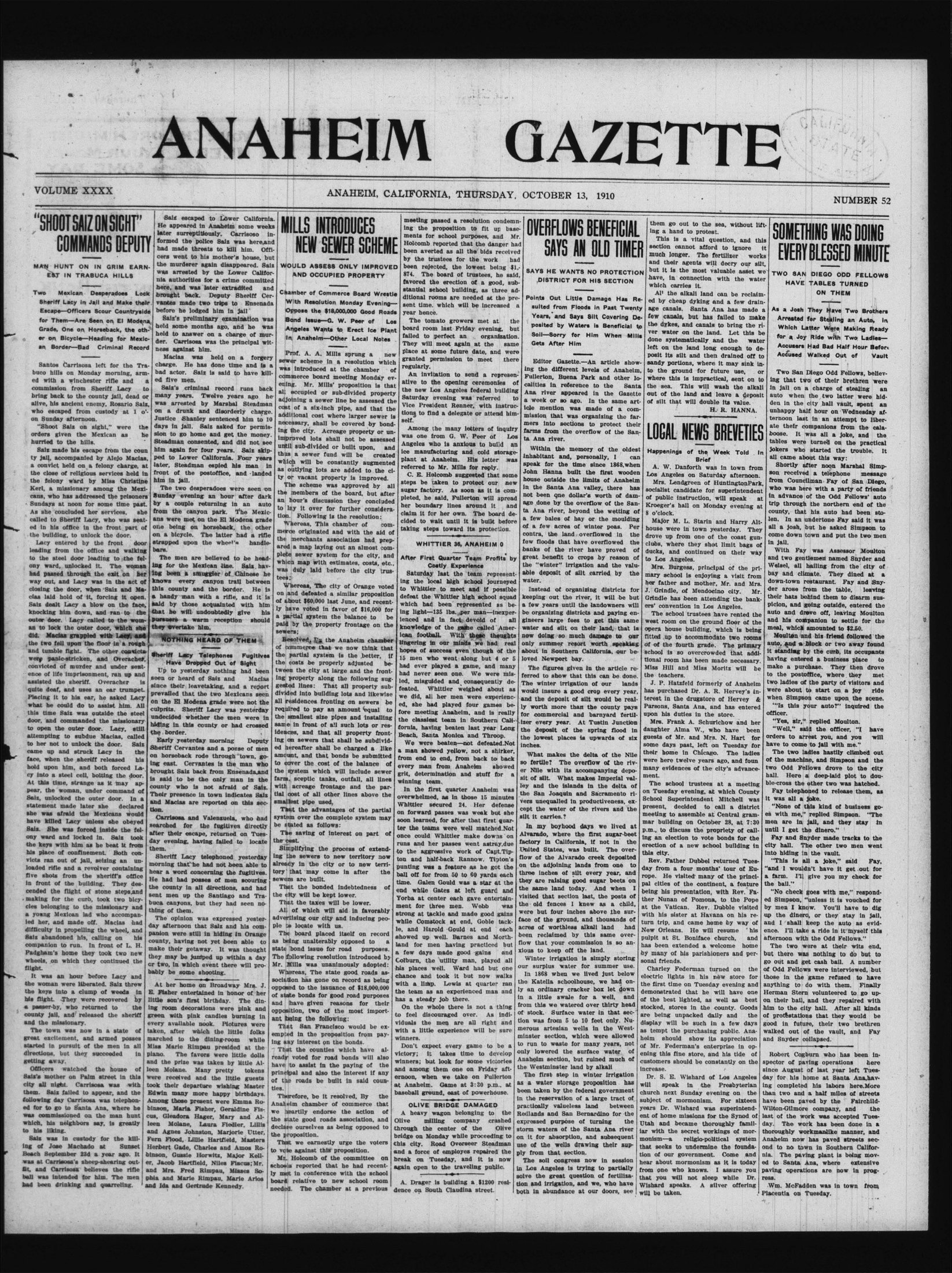
Searchable text
"SHOOT SAIZ ON SICHT"
COMMANDS DEPUTY
MAN HUNT ON IN GRIM EARNEST IN TRABUCA HILLS
Two Mexican Desperadoes Lock Sheriff Lacy in Jail and Make their Escape—Officers Scour Countryside for Them—Are Seen on El Modena Grade, One on Horseback, the other on Bicycle—Heading for Mexican Border—Bad Criminal Record
Santos Carrisosa left for the Trabuco hills on Monday morning, armed with a winchester rifle and a commission from Sheriff Lacy to bring back to the county jail, dead or alive, his ancient enemy, Rosario Salz, who escaped from custody at 1 o'clock on Sunday afternoon.
"Shoot Salz on sight," were the orders given the Mexican as he hurried to the hills.
Salz made his escape from the county jail, accompanied by Alejo Macias, a convict held on a felony charge, at the close of religious services held in Lower California. He appeared in Anaheim some weeks later surreptitiously. Carrisoso informed the police Salz was here, and had made threats to kill him. Officers went to his mother's house, but the murderer again disappeared. Salz was arrested by the Lower California authorities for a crime committed here, and was later extradited and brought back. Deputy Sheriff Cervantes made two trips to Ensenada before he lodged him in jail.
Salz's preliminary examination was held some months ago, and he was held to answer on a charge of murder. Carrisosa was the principal witness against him.
Macias was held on a forgery charge. He has done time and is a bad actor. Salz is said to have killed five men.
Salz's criminal record runs back many years. Twelve years ago he was arrested by Marshal Steadman on a drunk and disorderly charge. Justice Shanley sentenced him to 10 days in jail. Salz asked for permission to go home and get the money. Steadman consented, and did not see him again for four years. Salz skipped to Lower California. Four years later, Steadman espied his man in front of the postoffice, and landed.
MILLS INTRODUCTION
NEW SEWER
WOULD ASSESS ONLY AND OCCUPIED PRIVATE
Chamber of Commerce With Resolution Monday
Oppose the $18,000,000 Bond Issue—G. W. P.
Angeles Wants to Erase In Anaheim—Other Law
Prof. A. A. Mills sprouted sewer scheme in a rescue was introduced at the commerce board meeting. Mr. Mills' proposal all occupied or sub-division adjoining a sewer line be cost of a six-inch pipe, additional cost where necessary, shall be covering the city. Acreage promised improved lots shall not until sub-divided or built thus a sewer fund will which will be constantly as outlying lots are added.
"Shoot Salz on sight," were the orders given the Mexican as he hurried to the hills.
Salz made his escape from the county jail, accompanied by Alejo Macias, a convict held on a felony charge, at the close of religious services held in the felony ward by Miss Christine Kerl, a missionary among the Mexicans, who has addressed the prisoners Sundays at noon for some time past. As she concluded her services, she called to Sheriff Lacy, who was seated in his office in the front part of the building, to unlock the door.
Lacy entered by the front door leading from the office and walking to the steel door leading to the felony ward, unlocked it. The woman had passed through the exit on her way out, and Lacy was in the act of closing the door, when Salz and Macias laid hold of it, forcing it open. Salz dealt Lacy a blow on the face, knocking him down, and ran to the outer door. Lacy called to the woman to lock the outer door, which she did. Macias grappled with Lacy, and the two fell upon the floor in a rough and tumble fight. The other convicts were panic-stricken, and Overacher, convicted of murder and under sentence of life imprisonment, ran up and assisted the sheriff. Overacher is quite deaf, and uses an ear trumpet. Placing it to his ear, he asked Lacy what he could do to assist him. All this time Salz was outside the steel door, and commanded the missionary to open the outer door. Lacy, still attempting to subdue Macias, called to her not to unlock the door. Salz came up and struck Lacy in the face, when the sheriff released his hold upon him, and both forced Lacy into a steel cell, bolting the door. At this time, strange as it may appear, the woman, under command of Salz, unlocked the outer door. In a statement made later she declared she was afraid the Mexicans would have killed Lacy unless she obeyed Salz. She was forced inside the felony ward and locked in. Salz took the keys with him as he beat it from his place of confinement. Both convicts ran out of jail, seizing an unloaded rifle and a revolver containing five shots from the sheriff's office in front of the building. They descended the flight of stone steps and making for the cush took two blows.
Salz's criminal record runs back many years. Twelve years ago he was arrested by Marshal Steadman on a drunk and disorderly charge. Justice Shanley sentenced him to 10 days in jail. Salz asked for permission to go home and get the money. Steadman consented, and did not see him again for four years. Salz skipped to Lower California. Four years later, Steadman espied his man in front of the postoffice, and landed him in jail.
The two desperadoes were seen on Sunday evening an hour after dark by a couple returning in an auto from the canyon park. The Mexicans were met on the El Modena grade one being on horseback, the other on a bicycle. The latter had a rifle strapped upon the wheel's handlebars.
The men are believed to be heading for the Mexican line. Salz having been a smuggler of Chinese he knows every canyon trail between this county and the border. He is a handy man with a rifle, and it is said by those acquainted with him that he will undoubtedly give his pursuers a warm reception should they overtake him.
NOTHING HEARD OF THEM
Sheriff Lacy Telephones Fugitives
Have Dropped Out of Sight
Up to yesterday nothing had been seen or heard of Salz and Macias since their leavetaking, and a report prevailed that the two Mexicans seen on the El Modena grade were not the culprits. Sheriff Lacy was yesterday undecided whether the men were in hiding in this county or had crossed the border.
Early yesterday morning Deputy Sheriff Cervantes and a posse of men on horseback rode through town, going east. Cervantes is the man who brought Salz back from Ensenada,and is said to be the only man in the county who is not afraid of Salz. Their presence in town indicates Salz and Macias are reported on this section.
Carrisosa and Valenzuela, who had searched for the fugitives directly after their escape, returned on Tuesday evening, having failed to locate them.
Sheriff Lacy telephoned yesterday morning that he had not been able to hear a word concerning the fugitives. He had had posses of men scouring the county in all directions, and had sent men up the Santiago and Traffic department.
Salz is said to have killed five men.
Salz's criminal record runs back many years. Twelve years ago he was arrested by Marshal Steadman on a drunk and disorderly charge. Justice Shanley sentenced him to 10 days in jail. Salz asked for permission to go home and get the money. Steadman consented, and did not see him again for four years. Salz skipped to Lower California. Four years later, Steadman espied his man in front of the postoffice, and landed him in jail.
The two desperadoes were seen on Sunday evening an hour after dark by a couple returning in an auto from the canyon park. The Mexicans were met on the El Modena grade one being on horseback, the other on a bicycle. The latter had a rifle strapped upon the wheel's handlebars.
The men are believed to be heading for the Mexican line. Salz having been a smuggler of Chinese he knows every canyon trail between this county and the border. He is a handy man with a rifle, and it is said by those acquainted with him that he will undoubtedly give his pursuers a warm reception should they overtake him.
Resolved: By the Anahee of commerce that we nowthe partial system is therestocks be properly adtween the city at large an ing property along the fo-gested lines: That all divided into building lots al residences fronting one required to pay an amountthe smallest size pipes are same in front of all such idences, and that all pro-ing on sewers that shall be chained hereafter shall be chargedamount, and that bonds beto cover the cost ofthe system which will insure farm,sceptic tanks,outfairwith acreage frontage antil cost of all other linessmallest pipe used.
That the advantages ofsystem over the completebe stated as follows:
The saving of interestthe cost.
Simplifying the processingthe sewers to new tealready in the city or to torythat may come in assewens are built.
That the bonded indebtethe city will be kept lower
Saiz, unlocked the outer door. In a statement made later she declared she was afraid the Mexicans would have killed Lacy unless she obeyed Saiz. She was forced inside the felony ward and locked in. Saiz took the keys with him as he beat it from his place of confinement. Both convicts ran out of jail, seizing an unloaded rifle and a revolver containing five shots from the sheriff's office in front of the building. They descended the flight of stone steps and making for the curb, took two bicycles belonging to the missionary and a young Mexican lad who accompanied her, and made off. Macias had difficulty in propelling the wheel, and Saiz abandoned his calling on his companion to run. In front of L. H. Padgham's home they took two new wheels, on which they continued the flight.
It was an hour before Lacy and the woman were liberated. Saiz threw the keys into a clump of weeds in his flight. They were recovered by a passer-by, who returned to the county jail, and released the sheriff and the missionary.
The town was now in a state of great excitement, and armed posses started in pursuit of the men in all directions, but they succeeded in getting away.
Officers watched the house of Saiz's mother on Palm street in this city all night. Carrisosa was with them. Saiz failed to appear, and the following day Carrisosa was telephoned for to go to Santa Ana, where he was commissioned on the man hunt which, his neighbors say, is greatly to his liking.
Saiz was in custody for the killing of Jose Machado at Sunset Beach September 23d a year ago. It was at Carrisosa's sheep-shearing outfit, and Carrisosa believes the rifle ball was intended for him. The men had been drinking and quarreling.
Carrisosa and Valenzuela, who had searched for the fugitives directly after their escape, returned on Tuesday evening, having failed to locate them.
Sheriff Lacy telephoned yesterday morning that he had not been able to hear a word concerning the fugitives. He had had posses of men scouring the county in all directions, and had sent men up the Santiago and Trabuca canyons, but they had seen nothing of them.
The opinion was expressed yesterday afternoon that Saiz and his companion were still in hiding in Orange county, having not yet been able to make their getaway. It was thought they may be jumped up within a day or two, in which event there will probably be some shooting.
At her home on Broadway Mrs. J. E. Fisher entertained in honor of her little son's first birthday. The dining room decorations were pink and green with pink candles burning in every available nook. Pictures were taken, after which the little folks marched to the dining-room while Miss Marie Rimpau presided at the piano. The favors were little dolls and the prize was taken by little Aleen Molane. Many pretty tokens were received and the little guests took their departure wishing Master Edwin many more happy birthdays. Among those present were Emma Robinson, Maria Fisher, Geraldine Fiscus, Gleadora Hager, Mary and Aleen Molane, Laura Fiedler, Lillis and Agnes Johnston, Marjorie Utter, Fern Flood, Lillie Hartfield, Masters Herbert Gade, Charles and Amos Robinson, Gussie Horwitz, Major Keller, Jacob Hartfield, Niles Fiscus; Mr. and Mrs. Fred Rimpau, Misses Sophia and Marie Rimpau, Marie Arlos and Ida and Gertrude Kennedy.
HEIM GAZETE
ANAHEIM, CALIFORNIA, THURSDAY, OCTOBER 13, 1910
MILLS INTRODUCES NEW SEWER SCHEME
WOULD ASSESS ONLY IMPROVED AND OCCUPIED PROPERTY
Chamber of Commerce Board Wrestle With Resolution Monday Evening—Oppose the $18,000,000 Good Roads Bond Issue—G. W. Peer of Los Angeles Wants to Erect Ice Plant in Anaheim—Other Local Notes
Prof. A. A. Mills sprung a new sewer scheme in a resolution which was introduced at the chamber of commerce board meeting Monday evening. Mr. Mills' proposition is that all occupied or sub-divided property adjoining a sewer line be assessed the cost of a six-inch pipe, and that the additional cost where larger sewer is necessary, shall be covered by bonding the city. Acreage property or unimproved lots shall not be assessed until sub-divided or built upon, and thus a sewer fund will be created which will be constantly augmented as outlying lots are added to the ci-meeting passed a resolution condemning the proposition to fit up basements for school purposes, and Mr. Holcomb reported that the danger had been averted as all the bids received by the trustees for the work had been rejected, the lowest being $1,874. The board of trustees, he said, favored the erection of a good, substantial school building, as three additional rooms are needed at the present time. which will be increased a year hence.
The tomato growers met at the board room last Friday evening, but failed to perfect an organization. They will meet again at the same place at some future date, and were granted permission to meet there regularly.
An invitation to send a representative to the opening ceremonies of the new Los Angeles federal building Saturday evening was referred to Vice President Renner, with instructions to find a delegate or attend himself.
Among the many letters of inquiry was one from G. W. Peer of Los Angeles who is anxious to build an ice manufacturing and cold storage plant at Anaheim. His letter was referred to Mr. Mills for reply.
OVERFLOWS BENEFICIAL SAYS AN OLD TIMER
SAYS HE WANTS NO PROTECTION DISTRICT FOR HIS SECTION
Points Out Little Damage Has Resulted from Floods in Past Twenty Years, and Says Silt Covering Deposited by Waters is Beneficial to Soil—Sorry for Him When Mills Gets After Him
Editor Gazette.—An article showing the different levels of Anaheim, Fullerton, Buena Park and other localities in reference to the Santa Ana river appeared in the Gazette a week or so ago. In the same article mention was made of a commission that was organizing the farmers into sections to protect their farms from the overflow of the Santa Ana river.
Within the memory of the oldest inhabitant and, personally, I can speak for the time since 1868, when John Hanna built the first wooden them going a h
LOGAN
Happenin
A. W.
Los Angles
commerce board meeting Monday evening. Mr. Mills' proposition is that all occupied or sub-divided property adjoining a sewer line be assessed the cost of a six-inch pipe, and that the additional cost where larger sewer is necessary, shall be covered by bonding the city. Acreage property or unimproved lots shall not be assessed until sub-divided or built upon, and thus a sewer fund will be created which will be constantly augmented as outlying lots are added to the city or vacant property is improved.
The scheme was approved by all the members of the board, but after an hour's discussion they concluded to lay it over for further consideration. Following is the resolution:
Whereas, This chamber of commerce originated and with the aid of the merchants association had prepared a map laying out an almost complete sewer system for the city, and which map with estimates, costs, etc., was duly laid before the city trustees;
Whereas, The city of Orange voted on and defeated a similar proposition of about $60,000 last June, and recently have voted in favor of $16,000 for partial system the balance to be paid by the property frontage on the sewers;
Resolved, By the Anaheim chamber of commerce that we now think that the partial system is the better, if the costs be properly adjusted between the city at large and the fronting property along the following suggested lines: That all property subdivided into building lots and likewise all residences fronting on sewers be required to pay an amount equal to the smallest size pipes and installing same in front of all such lots or residences, and that all property fronting on sewers that shall be subdivided hereafter shall be charged a like amount, and that bonds be submitted to cover the cost of the balance of the system which will include sewer farm, sceptic tanks, outfall, all lines with acreage frontage and the partial cost of all other lines above the smallest pipe used.
That the advantages of the partial system over the complete system may be stated as follows:
The saving of interest on part of the cost.
Simplifying the process of extending the sewers to new territory now ready in the city or to new territory that may come in after the sewers are built.
That the bonded indebtedness of the city will be kept lower.
An invitation to send a representative to the opening ceremonies of the new Los Angeles federal building Saturday evening was referred to Vice President Renner, with instructions to find a delegate or attend himself.
Among the many letters of inquiry was one from G. W. Peer of Los Angeles who is anxious to build an ice manufacturing and cold storage plant at Anaheim. His letter was referred to Mr. Mills for reply.
C. E. Holcomb suggested that some steps be taken to protect our new sugar factory. As soon as it is completed, he said, Fullerton will spread her boundary lines around it and claim it for her own. The board decided to wait until it is built before taking steps toward its protection.
WHITTIER 36, ANAHEIM 0
After First Quarter Team Profits by Costly Experience
Saturday last the team representing the local high school journeyed to Whittier to meet and if possible defeat the Whittier high school squad which had been represented as being light—135 lbs. per man—inexperienced and in fact devoid of all knowledge of the game called American football. With these thoughts lingering in our minds we had real hopes of success even though of the 15 men who went along but 4 or 5 had ever played a game, and many had never seen one. We were misled, misguided and consequently defeated. Whittier weighed about as we did, all her men were experienced, she had played four games before meeting Anaheim, and is really the classiest team in Southern California, having beaten last year Long Beach, Santa Monica and Throop.
We were beaten—not defeated.Not a man showed yellow, not a shirker, from end to end, from back to back every man from Anaheim showed grit, determination and stuff for a winning team.
In the first quarter Anaheim was overwhelmed, as in those 15 minutes Whittier secured 24. Her defense on forward passes was weak but she soon learned, for after that first quarter the teams were well matched.Not once could Whittier make downs on runs and her passes went astray due to the aggressive work of Capt.Tipton and half-back Rannow. Tipton's punting was a feature as he got the ball off for from 50 to 60 yards each time. Galen Gould was a star at the end while Gates at left guard and Yorba at center each gave entertainFullerton, Buena Park and other localities in reference to the Santa Ana river appeared in the Gazette a week or so ago. In the same article mention was made of a commission that was organizing the farmers into sections to protect their farms from the overflow of the Santa Ana river.
Within the memory of the oldest inhabitant and personally, I can speak for the time since 1868, when John Hanna built the first wooden house outside the limits of Anaheim in the Santa Ana valley, there has not been one dollar’s worth of damage done by the overflow of the Santa Ana river, beyond the wetting of a few bales of hay or the moulding of a few acres of winter peas. Per contra, the land overflowed in the few floods that have overflowed the banks of the river have proved of great benefit to crops by reason of the “winter” irrigation and the valuable deposit of silt carried by the water.
Instead of organizing districts for keeping out the river, it will be but a few years until the landowners will be organizing districts and paying engineers large fees to get this same water and silt on their land, that is now doing so much damage to our only summer resort worth speaking about in Southern California, our beloved Newport bay.
The figures given in the article referred to show that this can be done. The winter irrigation of our lands would insure a good crop every year, and the deposit of silt would be really worth more than the county pays for commercial and barnyard fertilizer every year. At Tustin Junction the deposit of the spring flood in the lowest places is upwards of six inches.
What makes the delta of the Nile so fertile? The overflow of the river Nile with its accompanying deposit of silt. What makes Imperial valley and the islands in the delta of the San Joaquin and Sacramento rivers unequalled in productiveness, except the water of the rivers and the silt it carries.?
In my boyhood days we lived at Alvarado, where the first sugar-beet factory in California, if not in the United States, was built. The overflow of the Alvarado creek deposited on the adjoining lands from one to three inches of silt every year, and they are raising good sugar beets on the same land today. And when I visited that section last, the posts of where th
That the advantages of the partial system over the complete system may be stated as follows:
The saving of interest on part of the cost.
Simplifying the process of extending the sewers to new territory now ready in the city or to new territory that may come in after the swens are built.
That the bonded indebtedness of the city will be kept lower.
That the taxes will be lower.
All of which will aid in favorably advertising our city and inducing people to locate with us.
The board placed itself on record being unalterably opposed to a state bond issue for road purposes. The following resolution introduced by Mr. Mills was unanimously adopted: Whereas, The state good roads association has gone on record as being opposed to the issuance of $18,000,000 state bonds for good road purposes and have given reasons for their opposition, two of the most important being the following:
That San Francisco would be exempted in the proposition from paying any interest on the bonds.
That the counties which have already voted for road bonds will also give to assist in the paying of the principal and also the interest if any of the roads be built in said counties.
Therefore, be it resolved, By the Oakheim chamber of commerce that heartily endorse the action of the state good roads association, and declare ourselves as being opposed to the proposition.
That we earnestly urge the voters vote against this proposition.
Mr. Holcomb of the committee on boards reported that he had recent-ment in conference with the school board relative to new school room added. The chamber at a previous Whittier secured 24. Her defense on forward passes was weak but she soon learned, for after that first quarter the teams were well matched. Not once could Whittier make downs on runs and her passes went astray due to the aggressive work of Capt. Tipton and half-back Rannow. Tipton's punting was a feature as he got the ball off for from 50 to 60 yards each time. Galen Gould was a star at the end while Gates at left guard and Yorba at center each gave entertainment for three men. Webb was strong at tackle and made good gains while Comstock at end, Goble tackle, and Harold Gould at end each showed up well. Barnes and Morthland for men having practiced but a few days made good gains and Colburn, the utility man, played all his places well. Ward had but one chance and took it but now walks with a limp. Lewis at quarter ran the team as an experienced man and has a steady job there.
On the whole there is not a thing to feel discouraged over. As individuals the men are all right and with a little experience will be sure winners.
Don't expect every game to be a victory; it takes time to develop winners; but look for some victories and among them one on Friday afternoon, when we take on Fullerton at Anaheim. Game at 3:30 p.m., at baseball ground, east of powerhouse.
OLIVE BRIDGE DAMAGED
A heavy wagon belonging to the Olive milling company crashed through the center of the Olive bridge on Monday while proceeding to this city. Road Overseer Steadman and a force of employees repaired the break on Tuesday, and it is now again open to the traveling public.
A. Drager is building a $1200 residence on South Claudina street.
In my boyhood days we lived at Alvarado, where the first sugar-beet factory in California, if not in the United States, was built. The overflow of the Alvarado creek deposited on the adjoining lands from one to three inches of silt every year, and they are raising good sugar beets on the same land today. And when I visited that section last, the posts of the old fences I knew as a child, were but four inches above the surface of the ground, and thousands of acres of worthless alkali land had been reclaimed by this same overflow that your commission is so anxious to keep off the land.
Winter irrigation is simply storing our surplus water for summer use.
In 1868 when we lived just below the Katella schoolhouse, we had only an ordinary cracker box let down in a little swale for a well, and from this we watered over thirty head of stock. Surface water in that section was from 5 to 10 feet only. Numerous artesian wells in the Westminster section, which were allowed to run to waste for many years, not only lowered the surface water of Anaheim section, but ruined much of the Westminster land by alkali.
The first step in winter irrigation as a water storage proposition has been taken by the federal government in the reservation of a large tract of practically valueless land between Redlands and San Bernardino for the expressed purpose of turning the storm waters of the Santa Ana river on it for absorption, and subsequent use of the wells drawing their supply from that section.
The soil congress now in session in Los Angeles is trying to partially solve the great question of fertilization and irrigation, and we, who have both in abundance at our doors, see vers unequalled in productiveness, except the water of the rivers and the silt it carries.?
In my boyhood days we lived at Alvarado, where the first sugar-beet factory in California, if not in the United States, was built. The overflow of the Alvarado creek deposited on the adjoining lands from one to three inches of silt every year, and they are raising good sugar beets on the same land today. And when I visited that section last, the posts of the old fences I knew as a child, were but four inches above the surface of the ground, and thousands of acres of worthless alkali land had been reclaimed by this same overflow that your commission is so anxious to keep off the land.
Winter irrigation is simply storing our surplus water for summer use.
In 1868 when we lived just below the Katella schoolhouse, we had only an ordinary cracker box let down in a little swale for a well, and from this we watered over thirty head of stock. Surface water in that section was from 5 to 10 feet only. Numerous artesian wells in the Westminster section, which were allowed to run to waste for many years, not only lowered the surface water of Anaheim section, but ruined much of the Westminster land by alkali.
The first step in winter irrigation as a water storage proposition has been taken by the federal government in the reservation of a large tract of practically valueless land between Redlands and San Bernardino for the expressed purpose of turning the storm waters of the Santa Ana river on it for absorption, and subsequent use of the wells drawing their supply from that section.
The soil congress now in session in Los Angeles is trying to partially solve the great question of fertilization and irrigation, and we, who have both in abundance at our doors, see vers unequalled in productiveness, except the water of the rivers and the silt it carries.?
ZETTE
1910
NUMBER 52
BENEFICIAL BOLD TIMER
PROTECTION
S SECTION
image Has Ren Past Twenty
Covering Des Beneficial to
When Millis
article shows of Anaheim,
and other loto the Santa
in the Gazette
the same artde of a commizing the farprotect their
w of the San-
of the oldest
ally, I can
since 1868,when first wooden
them go out to the sea, without lifting a hand to protest.
This is a vital question, and this section cannot afford to ignore it much longer. The fertilizer works and their agents will decry our silt, but it is the most valuable asset we have, in connection with the water which carries it.
All the alkali land can be reclaimed by cheap dyking and a few drainage canals. Santa Ana has made a few canals, but has failed to make the dykes, and canals to bring the river water on the land. Let this be done systematically and the water left on the land long enough to deposit its silt and then drained off to sandy portions, where it may sink into the ground for future use, or where this is impractical, sent on to the sea. This will wash the alkali out of the land and leave a deposit of silt that will double its value.
H. R. HANNA.
LOGAL NEWS BREVETIES
Happenings of the Week Told In Brief
A. W. Danforth was in town from Los Angeles on Saturday afternoon.
SOMETHING WAS DOING EVERY BLESSED MINUTE
TWO SAN DIEGO ODD FELLOWS HAVE TABLES TURNED ON THEM
As a Josh They Have Two Brothers Arrested for Stealing an Auto, in Which Latter Were Making Ready for a Joy Ride with Two Ladies—Accusers Had Bad Half Hour Before Accused Walked Out of Vault
Two San Diego Odd Fellows, believing that two of their brethren were in jail on a charge of stealing an auto when the two latter were hidden in the city hall vault, spent an unhappy half hour on Wednesday afternoon last in an attempt to liberate their companions from the calaboose. It was all a joke, and the tables were turned on the practical jokers who started the trouble. It all came about this way:
Shortly after noon Marshal Simpson received a telephone message
LOGICAL NEWS BREVETIES
Happenings of the Week Told In Brief
A. W. Danforth was in town from Los Angeles on Saturday afternoon.
Mrs. Lendgreen of HuntingtonPark, socialist candidate for superintendent of public instruction, will speak at Kroeger's hall on Monday evening at 8 o'clock.
Major M. L. Starin and Harry Althouse were in town yesterday. They drove up from one of the coast gunclubs, where they shot limit bags of ducks, and continued on their way to Los Angeles.
Mrs. Burgess, principal of the primary school is enjoying a visit from her father and mother, Mr. and Mrs. J. Grindle, of Mendocino city. Mr. Grindle has been attending the bankers' convention in Los Angeles.
The school trustees have rented the west room on the ground floor of the opera house building, which is being fitted up to accommodate two rooms of the fourth grade. The primary school is so overcrowded that additional room has been made necessary. Miss Hill and Miss Moritz will be the teachers.
J. P. Hatzfeld formerly of Anaheim has purchased Dr. A. R. Hervey's interest in the drugstore of Hervey & Parsons, Santa Ana, and has entered upon his duties in the store.
Mrs. Frank A. Schurichow and her daughter Alma W., who have been guests of Mr. and Mrs. N. Hart for some days past, left on Tuesday for their home in Chicago. The ladies were here twelve years ago, and foun many evidences of the city's advancement.
The school trustees at a meeting on Tuesday evening, at which County School Superintendent Mitchell was present, decided to call a district meeting to assemble at Central grammar building on October 28, at 7:30 p.m., to discuss the propriety of calling an election to vote bonds for the erection of a new school building in this city.
Rev. Father Dubbel returned Tuesday from a four months' tour of Europe. He visited many of the principal cities of the continent, a feature being his presentation, with Rev. Father Nunan of Pomona to the Pope.
Two San Diego Odd Fellows, believing that two of their brethren were in jail on a charge of stealing an auto when the two latter were hidden in the city hall vault, spent an unhappy half hour on Wednesday afternoon last in an attempt to liberate their companions from the calaboose. It was all a joke, and the tables were turned on the practical jokers who started the trouble. It all came about this way:
Shortly after noon Marshal Simpson received a telephone message from Councilman Fay of San Diego, who was here with a party of friends in advance of the Odd Fellows' auto trip through the northern end of the county, that his auto had been stolen. In an undertone Fay said it was all a josh, but he asked Simpson to come down town and put the two men in jail.
With Fay was Assessor Moulton and two gentlemen named Snyder and Welsel, all hailing from the city of bay and climate. They dined at a down-town restaurant. Fay and Snyder arose from the table, leaving their hats behind them to disarm suspicion, and going outside, entered the auto and drove off, leaving Moulton and his companion to settle for the meal, which amounted to $2.50.
Moulton and his friend followed the auto, and a block or two away found it standing by the curb, its occupants having entered a business place to make a purchase. They then drove to the postoffice, where they met two ladies of the party of visitors and were about to start on a joy ride when Simpson came upon the scene.
"Is this your auto?" inquired the officer.
"Yes, sir," replied Moulton.
"Well," said the officer, "I have orders to arrest you, and you will have to come to jail with me."
The two ladies hastily climbed out of the machine, and Simpson and the two Odd Fellows drove to the city hall. Here a deep-laid plot to double-cross the other two was hatched.
Fay telephoned to release them, as it was all a joke.
"None of this kind of business goes with me," replied Simpson. "The men are in jail, and they stay in until I get the dinero."
Fay and Snyder made tracks to the city hall. The other two men went into hiding in the vault.
"This is all a joke," said Fay, "and I wouldn't have it get out for a farm. I'll give you my check for the ball."
No check goes with me," responded Simpson. "Unless it is vouched for."
School Superintendent Mitchell was present, decided to call a district meeting to assemble at Central grammar building on October 28, at 7:30 p.m., to discuss the propriety of calling an election to vote bonds for the erection of a new school building in this city.
Rev. Father Dubbel returned Tuesday from a four months' tour of Europe. He visited many of the principal cities of the continent, a feature being his presentation, with Rev. Father Nunan of Pomona, to the Pope at the Vatican. Rev. Dubble visited with his sister at Havana on his return trip, and came home by way of New Orleans. He will resume his pulpit at St. Boniface church, and has been extended a welcome home by many of his parishioners and personal friends.
Charley Federman turned on the electric lights in his new store for the first time on Tuesday evening and demonstrated that he will have one of the best lighted, as well as best stocked, stores in the county. Goods are being unpacked daily and the display will be such in a few days as tempt the purchasing public. Anaheim should show its appreciation of Mr. Federman's enterprise in opening this fine store, and his tide of customers should be constantly on the increase.
Dr. S. E. Wishard of Los Angeles will speak in the Presbyterian church next Sunday evening on the subject of mormonism. For sixteen years Dr. Wishard was superintendent of home missions for the Synod of Utah and became thoroughly familiar with the secret workings of mormonism—a religio-political system that seeks to undermine the foundation of our government. Come and hear about mormonism as it is today from one who knows. I assure you that you will not sleep while Dr. Wishard speaks. A silver offering will be taken.
Robert Cogburn who has been inspector of paving operations here since August of last year left Tuesday for his home at Santa Ana, having completed his labors here. More than two and a half miles of streets have been paved by the Fairchild-Wilton-Gilmore company, and the last of the work was accepted Tuesday. The work has been done in a thoroughly workmanlike manner, and Anaheim now has paved streets second to no town in Southern California. The paving plant is being moved to Santa Ana, where extensive paving operations are now in progress.
Wm. McFadden was in town from Placentia on Tuesday.