anaheim-gazette 1910-09-29
Scanned page
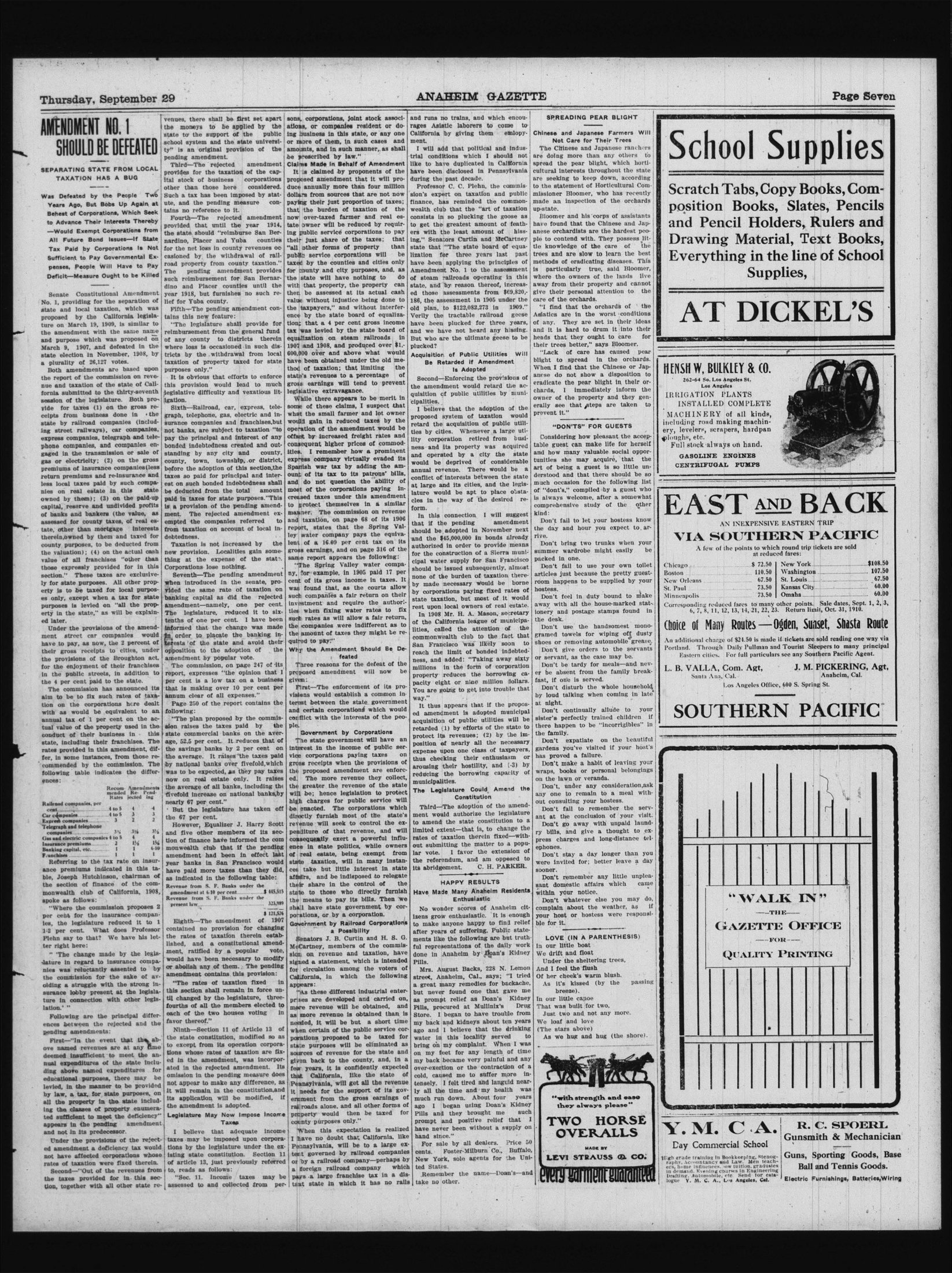
Searchable text
AMENDMENT NO. 1 SHOULD BE DEFEATED
SEPARATING STATE FROM LOCAL TAXATION HAS A BUG
Was Defeated by the People Two Years Ago, But Bob's Up Again at Behest of Corporations, Which Seek to Advance Their Interests Thereby—Would Exempt Corporations from All Future Bond Issues—If State Tax Paid by Corporations Is Not Sufficient to Pay Governmental Expenses, People Will Have to Pay Deficit—Measure Ought to be Killed
Senate Constitutional Amendment No. 1, providing for the separation of state and local taxation, which was proposed by the California legislature on March 19, 1909, is similar to the amendment with the same name and purpose which was proposed on March 9, 1907, and defeated in the state election in November, 1908, by a plurality of 26,127 votes.
Both amendments are based upon the report of the commission on revenue and taxation of the state of California submitted to the thirty-seventh session of the legislature. Both provide for taxes (1) on the gross receipts from business done in the state by railroad companies (including street railways), car companies, express companies, telegraph and telephone companies, and companies engaged in the transmission or sale of gas or electricity; (2) on the gross premiums of insurance companies (less revenues, there shall be first set apart the moneys to be applied by the state to the support of the public school system and the state university" is an original provision of the pending amendment.
Third—The rejected amendment provides for the taxation of the capital stock of business corporations other than those here considered. Such a tax has been imposed by statute, and the pending measure contains no reference to it.
Fourth—The rejected amendment provided that until the year 1914, the state should "reimburse San Bernardino, Placer and Yuba counties for the net loss in county revenues occasioned by the withdrawal of railroad property from county taxation." The pending amendment provides such reimbursement for San Bernardino and Placer counties until the year 1918, but furnishes no such relief for Yuba county.
Fifth—The pending amendment contains this new feature:
"The legislature shall provide for reimbursement from the general fund of any county to districts wherein loss is occasioned in such districts by the withdrawal from local taxation of property taxed for state purposes only."
It is obvious that efforts to enforce this provision would lead to much legislative difficulty and vexatious litigation.
Sixth—Railroad, car, express, telegraph, telephone, gas, electric and insurance companies and franchises, but not banks, are subject to taxation "to pay the principal and interest of any bonded indebtedness created and outstanding by any city and county, town, township, or district, before the adoption of this section," terms so paid for principal and inter-sons, corporations, organizations, or companies making business in this state or more of them, in some amounts, and in such manner as prescribed by law.
Claims Made In Behalf
It is claimed by proposed amendment thatduce annually more than dollars from sources tha paying their just propety that the burden of the now over-taxed farmer's estate owner will be reducing public service corporation their just share of the "all other forms of public service corporation taxed by the counties for county and city property with that property, then be assessed at a value without injustice,the taxpayers," and wence by the state boarding that a 4 per cent tax was levied by the equalization on steamers 1907 and 1908, and pres600,000 over and above have been obtained under that of taxation; that state's revenues to a gross earnings will the legislative extravagant.
While there appear some of these claims what the small farmers would gain in reduced operation of the ammen offset by increased from consequent higher prices. I remember he express company virtuous Spanish war tax by count of its tax to it.
the report of the commission on revenue and taxation of the state of California submitted to the thirty-seventh session of the legislature. Both provide for taxes (1) on the gross receipts from business done in the state by railroad companies (including street railways), car companies, express companies, telegraph and telephone companies, and companies engaged in the transmission or sale of gas or electricity; (2) on the gross premiums of insurance companies (less return premiums and re-insurance and less local taxes paid by such companies on real estate in this state owned by them); (3) on the paid-up capital, reserve and undivided profits of banks and bankers (the value, as assessed for county taxes, of real estate, other than mortgage interests therein, owned by them and taxed for county purposes, to be deducted from the valuation); (4) on the actual cash value of all franchises "other than those expressly provided for in this section." These taxes are exclusively for state purposes. All other property is to be taxed for local purposes only, except when a tax for state purposes is levied on "all the property in the state," as will be explained later.
Under the provisions of the amendment street car companies would have to pay, as now, the 2 percent of their gross receipts to cities, under the provisions of the Broughton act, for the enjoyment of their franchises in the public streets, in addition to the 4 per cent paid to the state.
The commission has announced its aim to be to fix such rates of taxation on the corporations here dealt with as would be equivalent to an annual tax of 1 per cent on the actual value of the property used in the conduct of their business in this state, including their franchises. The rates provided in this amendment differ, in some instances, from those recommended by the commission. The following table indicates the differences:
| Recommended Rates | Amendments Pendied |
| :--- | :--- |
| Railroad companies, per cent | 4 to 5 | 4 |
| Car companies | 4 to 5 | 3 |
| Express companies | 3 | 2 |
| Telegraph and telephone companies | 3½ | 3½ |
| Gas and electric companies | 4 to 5 | 4 |
| Insurance premiums | 2 | 1½ |
| Banking capital, etc. | 1 | 6-10 |
| Franchises | 1 | 1 |
Referring to the tax rate on insurance premiums indicated in this table, Joseph Hutchinson, chairman of the section of finance of the commonwealth club of California, 1908, makes no followings:
It is obvious that efforts to enforce this provision would lead to much legislative difficulty and vexatious litigation.
Sixth—Railroad, car, express, telegraph, telephone, gas, electric and insurance companies and franchises, but not banks, are subject to taxation "to pay the principal and interest of any bonded indebtedness created and outstanding by any city and county, town, township, or district, before the adoption of this section,the taxes so paid for principal and interest on such bonded indebtedness shall be deducted from the total amount paid in taxes for state purposes." This is a provision of the pending amendment. The rejected amendment exempted the companies referred to from taxation on account of local indebtedness.
Taxation is not increased by the new provision. Localities gain something at the expense of the state. Corporations lose nothing.
Seventh—The pending amendment when introduced in the senate, provided the same rate of taxation on banking capital as did the rejected amendment—namely, one per cent. The legislature, reduced it to six-tenths of one per cent. I have been informed that the change was made in order to placate the banking interests of the state and avoid their opposition to the adoption of the amendment by popular vote.
The commission, on page 247 of its report, expresses "the opinion that I per cent is a low tax on a business that is making over 10 per cent per annum clear of all expenses."
Page 250 of the report contains the following:
"The plan proposed by the commission raises the taxes paid by the state commercial banks on the average, 52.5 per cent. It reduces that of the savings banks by 2 per cent on the average. It raises the taxes paid by national banks over fivefold, which was to be expected, as they pay taxes now on real estate only. It raises the average of all banks, including the fivefold increase on national banks,by nearly 67 per cent."
But the legislature has taken off the 67 per cent.
However, Equalizer J. Harry Scott and five other members of its section of finance have informed the comm wealth club that if the pending amendment had been in effect last year banks in San Francisco would have paid more taxes than they did, as indicated in the following table:
Revenue from S. F. Banks under the amendment at 6-10 per cent $445,515
Revenue from S. F. Banks under the
While there appears some of these claims what the small farmer would gain in reduced operation of the ammendment by increased fee consequent higher prices. I remember how express company virtue Spanish war tax by count of its tax to it and do not question most of the corporation creased taxes under its protection themselves manner. The commission and taxation, on page report, states that they water company percent of a 16.09 per gross earnings, and on same report appears "The Spring Valley ny, for example, in 1910 cent of its gross income was found that, as such companies a fair investment and require times when fixing water such rates as will allow the companies were to the amount of taxes required to pay."
Why the Amendment feated Three reasons for proposed amendments given:
First—The enforcement visions would establish interest between the state and certain corporate conflict with the intele.
Government by State government interest in the income vice corporations pay gross receipts when they proposed amended ed. The more revenge greater the revenge will be; hence legislation high charges for pu be enacted. The co directly furnish most revenue will seek to penditure of that re consequently exert aence in state politics of real estate, being state taxation, will take but little affairs, and be indisj their share in the o state to those who he means to pay it
Referring to the tax rate on insurance premiums indicated in this table, Joseph Hutchinson, chairman of the section of finance of the commonwealth club of California, 1908, spoke as follows:
"Where the commission proposes 2 per cent for the insurance companies, the legislature reduced it to 1 1/2 per cent. What does Professor Plehn say to that? We have his letter right here:
"The change made by the legislature in regard to insurance companies was reluctantly assented to by the commission for the sake of avoiding a struggle with the strong insurance lobby present at the legislature in connection with other legislation."
Following are the principal differences between the rejected and the pending amendments:
First—"In the event that the above named revenues are at any time deemed insufficient to meet the annual expenditures of the state including above named expenditures for educational purposes, there may be levied, in the manner to be provided by law, a tax, for state purposes, on all the property in the state including the classes of property enumerated sufficient to meet the deficiency" appears in the pending amendment and not in its predecessor.
Under the provisions of the rejected amendment a deficiency tax would not have affected corporations whose rates of taxation were fixed therein.
Second—"Out of the revenues from the taxes provided for in this section, together with all other state re-
But the legislature has taken off the 67 per cent.
However, Equalizer J. Harry Scott and five other members of its section of finance have informed the commonwealth club that if the pending amendment had been in effect last year banks in San Francisco would have paid more taxes than they did, as indicated in the following table:
Revenue from S. F. Banks under the amendment at 6-10 per cent $445,515
Revenue from S. F. Banks under the present law 323,989
Eighth—The amendment of 1907 contained no provision for changing the rates of taxation therein established, and a constitutional amendment, ratified by a popular vote, would have been necessary to modify or abolish any of them. The pending amendment contains this provision:
"The rates of taxation fixed in this section shall remain in force until changed by the legislature, three-fourths of all the members elected to each of the two houses voting in favor thereof."
Ninth—Section 11 of Article 13 of the state constitution, modified so as to except from its operation corporations whose rates of taxation are fixed in the amendment, was incorporated in the rejected amendment. Its omission in the pending measure does not appear to make any difference, as it will remain in the constitution,and its application will be modified, if the amendment is adopted.
Legislature May Now Impose Income Taxes
I believe that adequate income taxes may be imposed upon corporations by the legislature under the existing state constitution. Section 11 of article 13, just previously referred to, reads as follows:
"Sec. 11. Income taxes may be assessed to and collected from per-
high charges for public revenue will seek to penditure of that re- consequently exert an ence in state politics of real estate, being state taxation, will ce take but little affairs, and be indisputable their share in the c-state to those who means to pay it shall have state governments, or by a co-government by Railroad.
Senators J. B. Curran McCartney, members-sion on revenue and signed a statement, wfor circulation among California, in which appears:
"As these different prises are developed more revenue will be needed, it will be b-when certain of the p-porations proposed thate state purposes will sources of revenue f-given back to the c few years, it is con-that California, like Pennsylvania, will get it needs for the sup-ernment from the g railroads alone, and a property would ther county purposes only."
sons, corporations, joint stock associations, or companies resident or doing business in this state, or any one or more of them, in such cases and amounts, and in such manner, as shall be prescribed by law."
Claims Made in Behalf of Amendment
It is claimed by proponents of the proposed amendment that it will produce annually more than four million dollars from sources that are not now paying their just proportion of taxes; that the burden of taxation of the now over-taxed farmer and real estate owner will be reduced by requiring public service corporations to pay their just share of the taxes; that "all other forms of property than public service corporations will be taxed by the counties and cities only for county and city purposes, and, as the state will have nothing to do with that property, the property can then be assessed at its actual cash value without injustice being done to the taxpayers," and without interference by the state board of equalization that a 4 per cent gross income tax was levied by the state board of equalization on steam railroads in 1907 and 1908, and produced over $1,600,000 over and above what would have been obtained under the old method of taxation; that limiting the state's revenues to a percentage of gross earnings will tend to prevent legislative extravagance.
While there appears to be merit in some of these claims, I suspect that what the small farmer and lot owner would gain in reduced taxes by the operation of the amendment would be offset by increased freight rates and consequent higher prices of commodities. I remember how a prominent express company virtually evaded its Spanish war tax by adding the amount of its tax to its patrons' bills.
and runs no trains, and which encourages Asiatic laborers to come to California by giving them employment.
I will add that political and industrial conditions which I should not like to have duplicated in California have been disclosed in Pennsylvania during the past decade.
Professor C. C. Plehn, the commission's expert on taxation and public finance, has reminded the commonwealth club that the "art of taxation consists in so plucking the goose as to get the greatest amount of feathers with the least amount of hissing," Senators Curtin and McCartney state that "The state board of equalization for three years last past have been applying the principles of Amendment No. 1 to the assessment of steam railroads operating in this state, and by reason thereof, increased those assessments from $69,820,-186, the assessment in 1905 under the old plan, to $122,082,273 in 1909." Verily the tractable railroad geese have been plucked for three years, and we have not heard any hissing. But who are the ultimate geese to be plucked?
Acquisition of Public Utilities Will Be Retarded if Amendment Is Adopted
Second—Enforcing the provisions of the amendment would retard the acquisition of public utilities by municipalities.
I believe that the adoption of the proposed system of taxation would retard the acquisition of public utilities by cities. Whenever a large utility corporation retired from business and its property was acquired and operated by a city the state would be deprived of considerable annual revenue. There would be a
SPREADING PEAR BLIGHT
Chinese and Japanese Farmers Will Not Care for Their Trees
The Chinese and Japanese ranchers are doing more than any others to spread the pear blight, which horticultural interests throughout the state are seeking to keep down, according to the statement of Horticultural Commissioner Bloomer, who has recently made an inspection of the orchards up-state.
Bloomer and his corps of assistants have found that the Chinese and Japanese orchardists are the hardest people to contend with. They possess little knowledge of the care of the trees and are slow to learn the best methods of eradicating diseases. This is particularly true, said Bloomer, where the owners of the lands live away from their property and cannot give their personal attention to the care of the orchards.
"I find that the orchards of the Asiatics are in the worst conditions of any. They are set in their ideas and it is hard to drum it into their heads that they ought to care for their trees better," says Bloomer.
"Lack of care has caused pear blight to spread in the orchards. When I find that the Chinese or Japanese do not show a disposition to eradicate the pear blight in their orchards, I immediately inform the owner of the property and they generally see that steps are taken to prevent it."
"DON'TS" FOR GUESTS
Considering how pleasant the acceptable guest can make life for herself and how many valuable social opportunities she may acquire, that the art of being a guest is so little understood and that there should be so
state's revenues to a percentage of gross earnings will tend to prevent legislative extravagance.
While there appears to be merit in some of these claims, I suspect that what the small farmer and lot owner would gain in reduced taxes by the operation of the amendment would be offset by increased freight rates and consequent higher prices of commodities. I remember how a prominent express company virtually evaded its Spanish war tax by adding the amount of its tax to its patrons' bills, and do not question the ability of most of the corporations paying increased taxes under this amendment to protect themselves in a similar manner. The commission on revenue and taxation, on page 68 of its 1906 report, states that the Spring Valley water company pays the equivalent of a 16.09 per cent tax on its gross earnings, and on page 316 of the same report appears the following:
"The Spring Valley water company, for example, in 1905 paid 17 percent of its gross income in taxes. It was found that, as the courts allow such companies a fair return on their investment and require the authorities when fixing water rates to fix such rates as will allow a fair return, the companies were indifferent as to the amount of taxes they might be required to pay."
Why the Amendment Should Be Defeated
Three reasons for the defeat of the proposed amendment will now be given:
First—The enforcement of its provisions would establish a common interest between the state government and certain corporations which would conflict with the interests of the people.
Government by Corporations
The state government will have an interest in the income of public service corporations paying taxes on gross receipts when the provisions of the proposed amendment are enforced. The more revenue they collect, the greater the revenue of the state will be; hence legislation to protect high charges for public service will be enacted. The corporations which directly furnish most of the state's revenue will seek to control the expenditure of that revenue, and will consequently exert a powerful influence in state politics, while owners of real estate, being exempt from state taxation, will in many instances take but little interest in state affairs, and be indisposed to relegate their share in the control of the state to those who directly furnish the means to pay its bills. Then we Second—Enforcing the provisions of the amendment would retard the acquisition of public utilities by municipalities.
I believe that the adoption of the proposed system of taxation would retard the acquisition of public utilities by cities. Whenever a large utility corporation retired from business and its property was acquired and operated by a city the state would be deprived of considerable annual revenue. There would be a conflict of interests between the state at large and its cities, and the legislature would be apt to place obstacles in the way of the desired reform.
In this connection I will suggest that if the pending amendment should be adopted in November next and the $45,000,000 in bonds already authorized in order to provide means for the construction of a Sierra municipal water supply for San Francisco should be issued subsequently, almost none of the burden of taxation thereby made necessary would be borne by corporations paying fixed rates of state taxation, but most of it would rest upon local owners of real estate.
In 1908 Mr. H. A. Mason, secretary of the California league of municipalities, called the attention of the commonwealth club to the fact that San Francisco was likely soon to reach the limit of bonded indebtedness, and added: "Taking away sixty millions in the form of corporation property reduces the borrowing capacity eight or nine million dollars. You are going to get into trouble that way."
It thus appears that if the proposed amendment is adopted municipal acquisition of public utilities will be retarded (1) by efforts of the state to protect its revenues; (2) by the imposition of nearly all the necessary expense upon one class of taxpayers, thus checking their enthusiasm or arousing their hostility, and (-3) by reducing the borrowing capacity of municipalities.
The Legislature Could Amend the Constitution
Third—The adoption of the amendment would authorize the legislature to amend the state constitution to a limited extent—that is, to change the rates of taxation therein fixed—without submitting the matter to a popular vote. I favor the extension of the referendum, and am opposed to its abridgement. C. H. PARKER.
HAPPY RESULTS
Have Made Many Anaheim Residents Enthusiastic
anese do not show a disposition to eradicate the pear blight in their orchards. I immediately inform the owner of the property and they generally see that steps are taken to prevent it."
"DON'T'S" FOR GUESTS
Considering how pleasant the acceptable guest can make life for herself and how many valuable social opportunities she may acquire, that the art of being a guest is so little understood and that there should be so much occasion for the following list of "dont's," compiled by a guest who is always welcome, after a somewhat comprehensive study of the other kind:
Don't fail to let your hostess know the day and hour you expect to arrive.
Don't bring two trunks when your summer wardrobe might easily be packed in one.
Don't fail to use your own toilet articles just because the pretty guestroom happens to be supplied by your hostess.
Don't feel in duty bound to make away with all the house-marked stationery and postage stamps found in the desk.
Don't use the handsomest monogramed towels for wiping off dusty shoes or removing automobile grease.
Don't give orders to the servants or servant, as the case may be.
Don't be tardy for meals—and never be absent from the family breakfast, if one is served.
Don't disturb the whole household by loud talking when coming in late at night.
Don't continually allude to your sister's perfectly trained children if there happen to be "incorrigibles" in the family.
Don't expatiate on the beautiful gardens you've visited if your host's has proved a failure.
Don't make a habit of leaving your wraps, books or personal belongings on the lawn or veranda.
Don't, under any consideration, ask any one to remain to a meal without consulting your hostess.
Don't fail to remember the servant at the conclusion of your visit.
Don't go away with unpaid laundry bills, and give a thought to express charges and long-distance telephones.
Don't stay a day longer than you were invited for; better leave a day sooner.
Don't remember any little unpleasant domestic affairs which came within your notice.
high charges for public service will be enacted. The corporations which directly furnish most of the state's revenue will seek to control the expenditure of that revenue, and will consequently exert a powerful influence in state politics, while owners of real estate, being exempt from state taxation, will in many instances take but little interest in state affairs, and be indisposed to relegate their share in the control of the state to those who directly furnish the means to pay its bills. Then we shall have state government by corporations, or by a corporation.
Government by Railroad Corporations a Possibility
Senators J. B. Curtin and H. S. G. McCartney, members of the commission on revenue and taxation, have signed a statement, which is intended for circulation among the voters of California, in which the following appears:
"As these different industrial enterprises are developed and carried on, more revenue will be obtained, and as more revenue is obtained than is needed, it will be but a short time when certain of the public service corporations proposed to be taxed for state purposes will be eliminated as sources of revenue for the state and given back to the county, and, in a few years, it is confidently expected that California, like the state of Pennsylvania, will get all the revenue it needs for the support of its government from the gross earnings of railroads alone, and all other forms of property would then be taxed for county purposes only."
When this expectation is realized I have no doubt that California, like Pennsylvania, will be to a large extent governed by railroad companies or by a railroad company—perhaps by a foreign railroad company which pays a large franchise tax in a distant state in which it has no rails
Third—The adoption of the amendment would authorize the legislature to amend the state constitution to a limited extent—that is, to change the rates of taxation therein fixed—without submitting the matter to a popular vote. I favor the extension of the referendum, and am opposed to its abridgement. C. H. PARKER.
HAPPY RESULTS
Have Made Many Anaheim Residents Enthusiastic
No wonder scores of Anaheim citizens grow enthusiastic. It is enough to make anyone happy to find relief after years of suffering. Public statements like the following are but truthful representations of the daily work done in Anaheim by Doan's Kidney Pills.
Mrs. August Backs, 228 N. Lemon street, Anaheim, Cal., says; "I tried a great many remedies for backache, but never found one that gave me as prompt relief as Doan's Kidney Pills, procured at Mullinix's Drug Store. I began to have trouble from my back and kidneys about ten years ago and I believe that the drinking water in this locality served to bring on my complaint. When I was on my feet for any length of time my back became very painful and any over-exertion or the contraction of a cold, caused me to suffer more intensely. I felt tired and languid nearly all the time and my health was much run down. About four years ago I began using Doan's Kidney Pills and they brought me such prompt and positive relief that I have never been without a supply on hand since."
For sale by all dealers. Price 50 cents. Foster-Milburn Co., Buffalo, New York, sole agents for the United States.
Remember the name—Doan's—and take no other.
LOVE (IN A PARENTHEIS)
In our little boat
We drift and float
Under the sheltering trees,
And I feel the flush
Of her cheek's warm blush.
As it's kissed (by the passing breeze).
In our little canoe
That was built for two,
Just two and not any more.
We loaf and love
(The stars above)
As we hug and hug (the shore).
School Supplies
Scratch Tabs, Copy Books, Composition Books, Slates, Pencils and Pencil Holders, Rulers and Drawing Material, Text Books, Everything in the line of School Supplies,
AT DICKEL'S
HENSH W, BULKLEY & CO.
262-64 So. Los Angeles St.
Los Angeles
IRRIGATION PLANTS
INSTALLED COMPLETE
MACHINERY of all kinds,
including road making machinery, levelers, scrapers, hardpan ploughs, etc.
Full stock always on hand.
GASOLINE ENGINES
CENTRIFUGAL PUMPS
EAST AND BACK
AN INEXPENSIVE EASTERN TRIP
VIA SOUTHERN PACIFIC
A few of the points to which round trip tickets are sold at reduced fares:
Chicago $72.50 New York $108.50
Boston 110.50 Washington 107.50
New Orleans 67.50 St. Louis 67.50
St. Paul 73.50 Kansas City 60.00
Minneapolis 73.50 Omaha 60.00
Corresponding reduced fares to many other points. Sale dates, Sept. 1, 2, 3, 6, 7, 8, 11, 12, 13, 14, 21, 22, 23. Return limit, Oct. 31, 1910.
Choice of Many Routes — Ogden, Sunset, Shasta Route
An additional charge of $24.50 is made if tickets are sold reading one way via Portland. Through Daily Pullman and Tourist Sleepers to many principal Eastern cities. For full particulars see any Southern Pacific Agent.
L. B. VALLA, Com. Agt,
Santa Ana, Cal.
J. M. PICKERING, Agt,
Anahcim, Cal.
Los Angeles Office, 600 S. Spring St.
SOUTHERN PACIFIC
"WALK IN"
THE
GAZETTE OFFICE
FOR
QUALITY PRINTING
Y. M. C. A.
Day Commercial School
High grade training in Bookkeeping, Stenography, Accountancy and Law. Men teachers, home influences, low tuition, graduates in demand. Evening courses in Engineering Drafting, Automobile, etc. Send for catalogue Y. M. C. A., Los Angeles, Cal.
R. C. SPOERL
Gunsmith & Mechanician
Guns, Sporting Goods, Base Ball and Tennis Goods.
Electric Furnishings, Batteries, Wiring