anaheim-gazette 1910-09-22
Scanned page
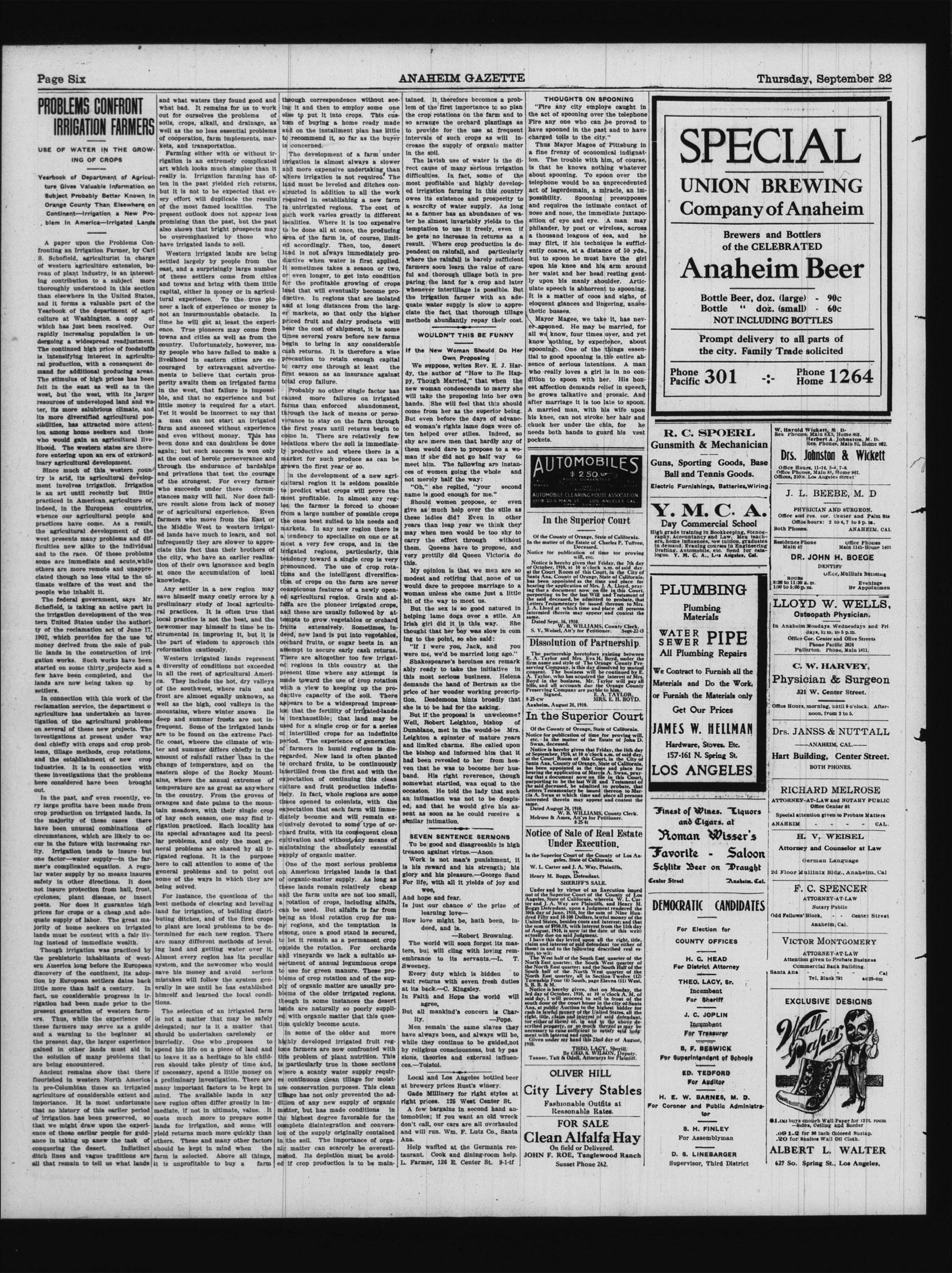
Searchable text
PROBLEMS CONFRONT IRRIGATION FARMERS
USE OF WATER IN THE GROWING OF CROPS
Yearbook of Department of Agriculture Gives Valuable Information on Subject Probably Better Known In Orange County Than Elsewhere on Continent—Irrigation a New Problem in America—Irrigated Lands
A paper upon the Problems Confronting an Irrigation Farmer, by Carl S. Schofield, agriculturist in charge of western agriculture extension, bureau of plant industry, is an interesting contribution to a subject more thoroughly understood in this section than elsewhere in the United States, and it forms a valuable part of the Yearbook of the department of agriculture at Washington, a copy of which has just been received. Our rapidly increasing population is undergoing a widespread readjustment. The continued high price of foodstuffs is intensifying interest in agricultural production, with a consequent demand for additional producing areas. The stimulus of high prices has been felt in the east as well as in the west, but the west, with its larger resources of undeveloped land and water, its more salubrious climate, and its more diversified agricultural possibilities, has attracted more attention among home seekers and those who would gain an agricultural livelihood. The western states are therefore entering upon an era of extraordinary agricultural development.
Since much of this western coun-
The stimulus of high prices has been felt in the east as well as in the west, but the west, with its larger resources of undeveloped land and water, its more salubrious climate, and its more diversified agricultural possibilities, has attracted more attention among home seekers and those who would gain an agricultural livelihood. The western states are therefore entering upon an era of extraordinary agricultural development.
Since much of this western country is arid, its agricultural development involves irrigation. Irrigation is an art until recently but little practiced in American agriculture or, indeed, in the European countries, whence our agricultural people and practices have come. As a result, the agricultural development of the west presents many problems and difficulties new alike to the individual and to the race. Of these problems some are immediate and acute, while others are more remote and unappreciated though no less vital to the ultimate welfare of the west and the people who inhabit it.
The federal government, says Mr. Schofield, is taking an active part in the irrigation development of the western United States under the authority of the reclamation act of June 17, 1902, which provides for the use of money derived from the sale of public lands in the construction of irrigation works. Such works have been started on some thirty projects and a few have been completed, and the lands are now being taken up by settlers.
In connection with this work of the reclamation service, the department of agriculture has undertaken an investigation of the agricultural problems on several of these new projects. The investigations at present under way deal chiefly with crops and crop problems, tillage methods, crop rotations, and the establishment of new crop industries. It is in connection with these investigations that the problems here considered have been brought out.
In the past, and even recently, very large profits have been made from crop production on irrigated lands. In the majority of these cases there have been unusual combinations of circumstances, which are likely to occur in the future with increasing rarity. Irrigation tends to insure but one factor—water supply—in the farmer's complicated equation. A regular water supply by no means insures safety in other directions. It does not insure protection from hall, frost, cyclones, plant disease, or insectments to believe that certain prosperity awaits them on irrigated farms in the west, that failure is impossible, and that no experience and but little money is required for a start. Yet it would be incorrect to say that a man can not start an irrigated farm and succeed without experience and even without money. This has been done and can doubtless be done again; but such success is won only at the cost of heroic perseverance and through the endurance of hardships and privations that test the courage of the strongest. For every farmer who succeeds under these circumstances many will fail. Nor does failure result alone from lack of money or of agricultural experience. Even farmers who move from the East or the Middle West to western irrigated lands have much to learn, and not infrequently they are slower to appreciate this fact than their brothers of the city, who have an earlier realization of their own ignorance and begin at once the accumulation of local knowledge.
Any settler in a new region may save himself many costly errors by a preliminary study of local agricultural practices. It is often true that local practice is not the best, and the newcomer may himself in time be instrumental in improving it, but it is the part of wisdom to approach this reformation cautiously.
Western irrigated lands represent a diversity of conditions not exceeded in all the rest of agricultural America. They include the hot, dry valleys of the southwest, where rain and frost are almost equally unknown, as well as the high, cool valleys in the mountains, where winter snows lie deep and summer frosts are not infrequent. Some of the irrigated lands are to be found on the extreme Pacific coast, where the climate of winter and summer differs chiefly in the amount of rainfall rather than in the change of temperature, and on the eastern slope of the Rocky Mountains, where the annual extremes of temperature are as great as anywhere in the country. From the groves of oranges and date palms to the mountain meadows, with their single crop of hay each season, one may find irrigation practiced. Each locality has its special advantages and its peculiar problems, and only the most general problems are shared by all irrigated regions. It is the purpose here to call attention to some of the general problems and to point out some of the ways in which they are being solved.
For instance, the questions of the first season as an insurance total crop failure.
Probably no other single caused more failures farms than enforced through the lack of management to stay on the first years until retirements in. There are rare locations where the soil is productive and where market for such products grown the first year or later.
In the development of cultural region it is seen to predict what crops will most profitable. In all regions the farmer is forced from a large number of farms—the ones best suited to markets. In any new tendency to specialize most a very few crops, irrigated regions, particularly tendency toward a single pronounced. The use of items and the intelligence of crops on the faecal conspicuous features of cultured agricultural region.
Falfa are the pioneer irrigators and these are usually for tempts to grow vegetable fruits extensively. Sweeted new land is put into orchard fruits, or sugarcane attempt to secure early收获.
There are altogether too many regions in this county present time where any made toward the use of with a view to keeping dactylic capacity of these appears to be a widespread that the fertility of it is inexhaustible; that it used for a single crop or of intertilled crops for a period. The experience of farmers in humid regions New land is to orchard fruits, to be intertilled from the first expectation of continuing culture and fruit produce itself. In fact, whole regimes opened to colonists expectation that each farmland distantly become and will closely devoted to some chard fruits, with its conservation and without maintaining the absolute supply of organic matter.
One of the most serious on American irrigated land organic-matter supplies these lands remain relatively untouched and the farm units are not
In the past, and even recently, very large profits have been made from crop production on irrigated lands. In the majority of these cases there have been unusual combinations of circumstances, which are likely to occur in the future with increasing rarity. Irrigation tends to insure but one factor—water supply—in the farmer's complicated equation. A regular water supply by no means insures safety in other directions. It does not insure protection from hall, frost, cyclones, plant disease, or insect pests. Nor does it guarantee high prices for crops or a cheap and adequate supply of labor. The great majority of home seekers on irrigated lands must be content with a fair living instead of immediate wealth.
Though irrigation was practiced by the prehistoric inhabitants of western America long before the European discovery of the continent, its adoption by European settlers dates back little more than half a century. In fact, no considerable progress in irrigation had been made prior to the present generation of western farmers. Thus, while the experience of these farmers may serve as a guide and a warning to the beginner at the present day, the larger experience gained in other lands must aid in the solution of many problems that are being encountered.
Ancient remains show that there flourished in western North America in pre-Columbian times an irrigated agriculture of considerable extent and importance. It is most unfortunate that no history of this earlier period of irrigation has been preserved, so that we might draw upon the experience of those earlier people for guidance in taking up anew the task of conquering the desert. Indistinct ditch lines and vague traditions are all that remain to tell us what lands oranges and date palms to the mountain meadows, with their single crop of hay each season, one may find irrigation practiced. Each locality has its special advantages and its peculiar problems, and only the most general problems are shared by all irrigated regions. It is the purpose here to call attention to some of the general problems and to point out some of the ways in which they are being solved.
For instance, the questions of the best methods of clearing and leveling land for irrigation, of building distributing ditches, and of the first crops to plant are local problems to be determined for each new region. There are many different methods of leveling land and getting water over it. Almost every region has its peculiar system, and the newcomer who would save his money and avoid serious mistakes will follow the system generally in use until he has established himself and learned the local conditions.
The selection of an irrigated farm is not a matter that may be safely delegated; nor is it a matter that should be undertaken carelessly or hurriedly. One who proposes to spend his life on a piece of land and to leave it as a heritage to his children should take plenty of time and, if necessary, spend a little money on a preliminary investigation. There are many important factors to be kept in mind. The available lands in any new region often differ greatly in immediate, if not in ultimate, value. It costs much more to prepare some lands for irrigation, and some will yield returns much more quickly than others. These and many other factors should be kept in mind when the farm is selected. Above all things, it is unprofitable to buy a farm times opened to colonization expectation that each farm diately become and will closely devoted to some chard fruits, with its common cultivation and without maintaining the absolute supply of organic matter.
One of the most serious on American irrigated land of organic-matter supply, these lands remain relatively and the farm units are not a rotation of crops, include can be used. But alfalfa being an ideal rotation for my regions, and the ten strong, once a good stand to let it remain as a perimeter outside the rotation. For and vineyards we lack a sortment of annual legume to use for green manureblems of crop rotation and plenty of organic matter areblems of the older irrigation though in some instanceslands are naturally so priced with organic matter that tion quickly become acutely.
In some of the older highly developed irrigations farmers are now concerned this problem of plant nurseries is particularly true in therwhere a scanty water supply continuous clean tillageuse conservation purposes tillagehas not only preventionof any new supply matter, but has made conthe highest degree favor complete disintegrationof the supply originalin the soil. The importantnic matter can scarcely be mated. Its depletion muled if crop production is
through correspondence without seeing it and then to employ some one else to put it into crops. This custom of buying a home ready made and on the installment plan has little to recommend it, so far as the buyer is concerned.
The development of a farm under irrigation is almost always a slower and more expensive undertaking than where irrigation is not required. The land must be leveled and ditches constructed in addition to all the work required in establishing a new farm in unirrigated regions. The cost of such work varies greatly in different localities. Where it is too expensive to be done all at once, the producing area of the farm is, of course, limited accordingly. Then, too, desert land is not always immediately productive when water is first applied. It sometimes takes a season or two, or even longer, to get into condition for the profitable growing of crops land that will eventually become productive. In regions that are isolated and at long distances from the larger markets, so that only the higher priced fruit and dairy products will bear the cost of shipment, it is some times several years before new farms begin to bring in any considerable cash returns. It is therefore a wise precaution to retain enough capital to carry one through at least the first season as an insurance against total crop failure.
Probably no other single factor has caused more failures on irrigated farms than enforced abandonment, through the lack of means or perseverance to stay on the farm through the first years until returns begin to come in. There are relatively few locations where the soil is immediately productive and where there is a market for such produce as can be grown the first year or so.
It therefore becomes a problem of the first importance to so plan the crop rotations on the farm and to so arrange the orchard plantings as to provide for the use at frequent intervals of such crops as will increase the supply of organic matter in the soil.
The lavish use of water is the direct cause of many serious irrigation difficulties. In fact, some of the most profitable and highly developed irrigation farming in this country owes its existence and prosperity to a scarcity of water supply. As long as a farmer has an abundance of water he almost invariably yields to the temptation to use it freely, even if he gets no increase in returns as a result. Where crop production is dependent on rainfall, and particularly where the rainfall is barely sufficient farmers soon learn the value of careful and thorough tillage both in preparing the land for a crop and later whenever intertillage is possible. But the irrigation farmer with an adequate water supply is slow to appreciate the fact that thorough tillage methods abundantly repay their cost.
WOULDN'T THIS BE FUNNY
If the New Woman Should Do Her Own Proposing
We suppose, writes Rev. E. J. Hardy, the author of "How to Be Happy, Though Married," that when the new woman condescends to marry she will take the proposing into her own hands. She will feel that this should come from her as the superior being. But even before the days of advanced woman's rights lame dogs were often helped over stiles. Indeed, so shy are mere men that hardly any of them would dare to propose to a woman if she did not go half way to meet him. The following are instances of women going the whole and
THOUGHTS ON SPOONING
"Fire any city employee caught in the act of spooning over the telephone Fire any one who can be proved to have spooned in the past and to have charged tolls to the city."
Thus Mayor Magee of Pittsburg in a fine frenzy of economical indignation. The trouble with him, of course, is that he knows nothing whatever about spooning. To spoon over the telephone would be an unprecedented act of legerdemain, a miracle, an impossibility. Spooning presupposes and requires the intimate contact of nose and nose, the immediate juxtaposition of eye and eye. A man may philander, by post or wireless, across a thousand leagues of sea, and he may flirt, if his technique is sufficiently coarse, at a distance of 50 yds., but to spoon he must have the girl upon his knee and his arm around her waist and her head resting gently upon his manly shoulder. Articulate speech is abhorrent to spooning. It is a matter of coos and sighs, of eloquent glances and lingering, anaesthetic busses.
Mayor Magee, we take it, has never spooned. He may be married, for all we know, four times over, and yet know nothing, by experience, about spooning. One of the things essential to good spooning is the entire absence of serious intentions. A man who really loves a girl is in no condition to spoon with her. His honest affection demands relief in speech, he grows talkative and prosaic. And after marriage it is too late to spoon. A married man, with his wife upon his knee, can not stroke her hair and chuck her under the chin, for he needs both hands to guard his vest pockets.
Probably no other single factor has caused more failures on irrigated farms than enforced abandonment, through the lack of means or perseverance to stay on the farm through the first years until returns begin to come in. There are relatively few locations where the soil is immediately productive and where there is a market for such produce as can be grown the first year or so.
In the development of a new agricultural region it is seldom possible to predict what crops will prove the most profitable. In almost any region the farmer is forced to choose from a large number of possible crops the ones best suited to his needs and markets. In any new region there is a tendency to specialize on one or at most a very few crops, and in the irrigated regions, particularly, this tendency toward a single crop is very pronounced. The use of crop rotations and the intelligent diversification of crops on the farm are never conspicuous features of a newly opened agricultural region. Grain and alfalfa are the pioneer irrigated crops, and these are usually followed by attempts to grow vegetables or orchard fruits extensively. Sometimes, indeed, new land is put into vegetables, orchard fruits, or sugar beets in an attempt to secure early cash returns. There are altogether too few irrigated regions in this country at the present time where any attempt is made toward the use of crop rotation with a view to keeping up the productive capacity of the soil. There appears to be a widespread impression that the fertility of irrigated lands is inexhaustible; that land may be used for a single crop or for a series of intertilled crops for an indefinite period. The experience of generation of farmers in humid regions is disregarded. New land is often planted to orchard fruits, to be continuously intertilled from the first and with the expectation of continuing this clean culture and fruit production indefinitely. In fact, whole regions are some times opened to colonists, with the expectation that each farm will immediately become and will remain exclusively devoted to some type of orchard fruits, with its consequent clean cultivation and without any means of maintaining the absolutely essential supply of organic matter.
One of the most serious problems on American irrigated lands is that of organic-matter supply. As long as these lands remain relatively cheap and the farm units are not too small, day, the author of How to Be Happy, Though Married, that when the new woman condescends to marry she will take the proposing into her own hands. She will feel that this should come from her as the superior being. But even before the days of advanced woman's rights lame dogs were often helped over stiles. Indeed, so shy are mere men that hardly any of them would dare to propose to a woman if she did not go half way to meet him. The following are instances of women going the whole and not merely half the way:
"Oh," she replied, "your second name is good enough for me."
Should women propose, or even give as much help over the stile as these ladies did? Even in other years than leap year we think they may when men would be too shy to carry the effort through without them. Queens have to propose, and very prettily did Queen Victoria do this.
My opinion is that we men are so modest and retiring that none of us would dare to propose marriage to a woman unless she came just a little bit of the way to meet us.
But the sex is so good natured in helping lame dogs over a stile. An Irish girl did it in this way. She thought that her boy was slow in coming to the point, so she said:
"If I were you, Jack, and you were me, we'd be married long ago."
Shakespearse's heroines are remarkably ready to take the initiative in this most serious business. Helena demands the hand of Bertram as the price of her wonder working prescription. Desdemona hints broadly that she is to be had for the asking.
But if the proposal is unwelcome? Well, Robert Leighton, bishop of Dumblane, met in the would-be Mrs. Leighton a spinster of mature years and limited charms. She called upon the bishop and informed him that it had been revealed to her from heaven that he was to become her husband. His right reverence, though somewhat startled, was equal to the occasion. He told the lady that such an intimation was not to be despised, and that he would give his assent as soon as he could receive a similar intimation.
SEVEN SENTENCE SERMONS
To be good and disagreeable is high treason against virtue.—Anon.
Work is not man's punishment, it is his reward and his strength; his glory and his pleasure.—George Sand For life, with all it yields of joy and woe,
And hope and fear.
In the Superior Court
Of the County of Orange, State of California.
In the matter of the Estate of Charles P. Tuffree, Deceased.
Notice for publication of time tor proving will, etc.
Notice is hereby given that Friday, the 7th day of October, 1910, at 10 o'clock a.m. of said day at the Court Room of this Court, in the City of Santa Ana, County of Orange, State of California, has been appointed as the time and place for hearing the application of Mrs. J. A. Lloyd, praying that she document now on life in this Court, purporting to be the last Will and Testament of the said deceased, be admitted to probate, that Letters Testamentary be issued thereon to Mrs. J. A. Lloyd at which time and place persons interested therein may appear and contest the same.
Dated Sept. 16, 1910.
W. B. WILLIAMS, County Clerk.
S. V. Weisel, Att'y for Petitioner.
Sept-22-13
Dissolution of Partnership
The partnership heretofore existing between E. A. Taylor and Mrs. Eva H. Boyd, under the firm name and style of The Orange County Preserving Company, is this day dissolved by mutual consent. The business will be continued by E. A. Taylor, who has acquired the interest of Mrs. Boyd in the business, Mr. Taylor will pay all bills, and all accounts due to The Orange County Preserving Company are payable to him.
Signed,
E. A. TAYLOR,
MRS. E. H. BOYD.
Anabeim, August 24, 1910.
In the Superior Court
Of the County of Orange, State of California.
Notice for publication of time for proving will, etc.
In the matter of the Estate of John D. Swan, deceased.
Notice is hereby given that Friday, the 16th day of September, 1910, at 10 o'clock a.m. of said day at the Court Room of this Court, in the City of Santa Ana, County of Orange, State of California, has been appointed as the time and place for hearing the application of Marcia A. Swan, praying that she document now on file in this Court, purporting to be the last Will and Testament of the said deceased, be admitted to probate, that Letters Testamentary be issued thereon to Marcia A. Swan at which time and place persons interested therein may appear and contest the same.
Dated August 24, 1910.
W. B. WILLIAMS, County Clerk.
Melrose & Ames, Att'y for Petitioner.
8-25-4t
Notice of Sale of Real Estate Under Execution.
In the Superior Court of the County of Los Angeles, State of California.
W. L. Carter and J. A. Way, Plaintiffs,
vs.
Henry M. Boggs, Defendant.
SHERIFF'S SALE.
Under and by virtue of an Execution issued out of the Superior Court of the County of Los Angeles, State of California wherein W. L. Carr
SEVEN SENTENCE SERMONS
To be good and disagreeable is high treason against virtue.—Anon.
Work is not man's punishment, it is his reward and his strength; his glory and his pleasure.—George Sand For life, with all it yields of joy and woe,
And hope and fear.
Is just our chance o' the prize of learning love—
How love might be, hath been, indeed, and is.
—Robert Browning.
The world will soon forget its masters, but will cling with loving remembrance to its servants.—L. T. Sweeney.
Every duty which is bidden to wait returns with seven fresh duties at its back.—C. Kingsley.
In Faith and Hope the world will agree,
But all mankind's concern is Charity.
—Pope.
Men remain the same slaves they have always been, and always will be, while they continue to be guided, not by religious consciousness, but by passions, theories and external influences.—Tolstol.
Local and Los Angeles bottled beer at brewery prices Rust's winery.
Gade Millinery for right styles at right prices. 125 West Center St.
A few bargains in second hand automobiles; if you want an old wreck don't call, our cars are all overhauled and will run. Wm. F. Lutz Co., Santa Ana.
Help wanted at the Germania restaurant. Cook and dining-room help. L. Farmer, 126 E. Center St. 9-1-tf
Notice of Sale of Real Estate Under Execution.
In the Superior Court of the County of Los Angeles, State of California.
W. L. Carter and J. A. Way, Plaintiffs,
vs.
Henry M. Boggs, Defendant.
SHERIFF'S SALE.
Under and by virtue of an Execution issued out of the Superior Court of the County of Los Angeles, State of California, wherein W. L. Carter and J. A. Way are Plaintiffs, and Henry M. Boggs Defendant, upon a Judgment rendered the 30th day of June, 1910, for the sum of Nine Hundred Fifty and 18-100 Dollars, lawful money of the United States, besides costs and interest; and that the sum of $950.18, with interest from the 11th day of August, 1910, is now (at the date of this writ) actually due on said Judgment.
I have this day levied upon all the right, title, claim and interest of said defendant (or either of them) in and to the following described real estate, to-wit:
The West half of the South East quarter of the North East quarter; the South West quarter of the North East quarter; and the South Half of the South half of the North West quarter of the North East quarter, all in Section Twelve (12) Township Four (4) South, page Eleven (11) West, S.B.B. & M.
Notice is hereby given, that on Monday, the 3rd day of October, 1910, at 10 o'clock A.M. of said day, I will proceed to sell in front of the south door of the court house in the city of Santa Ana, at public Auction to the highest bidder for cash in lawful money of the United States, all the right, title, claim and interest of said defendant, (or either of them) of, in and to the above described property, or so much thereof as may be necessary to raise sufficient to satisfy said judgment with interest and costs.
Given under my hand this 22nd day of August, 1910.
THEO, LACY, Sheriff,
By GEO. S. WILSON, Deputy.
Tanner, Taft & Odell, Attorneys for Plaintiff.
OLIVER HILL
City Livery Stables
Fashionable Outfits at Reasonable Rates.
FOR SALE
Clean Alfalfa Hay
On field or Delivered.
JOHN F. ROE, Tanglewood Ranch
Sunset Phone 262.
SPECIAL
UNION BREWING
Company of Anaheim
Brewers and Bottlers
of the CELEBRATED
Anaheim Beer
Bottle Beer, doz. (large) - 90c
Bottle “doz. (small) - 60c
NOT INCLUDING BOTTLES
Prompt delivery to all parts of
the city. Family Trade solicited
Phone Pacific 301 - Phone Home 1264
R. C. SPOERL
Gunsmith & Mechanician
Guns, Sporting Goods, Base
Ball and Tennis Goods
R. C. SPOERL
Gunsmith & Mechanician
Guns, Sporting Goods, Base Ball and Tennis Goods.
Electric Furnishings, Batteries, Wiring
Y. M. C. A.
Day Commercial School
High grade training in Bookkeeping, Stenography, Accountancy and Law. Men teachers, home influences, low tuition, graduates in demand. Evening courses in Engineering Drafting, Automobile, etc. Send for catalogue. Y. M. C. A., Los Angeles, Cal.
PLUMBING
Plumbing Materials
WATER PIPE
SEWER
All Plumbing Repairs
We Contract to Furnish all the Materials and Do the Work, or Furnish the Materials only
Get Our Prices
JAMES W. HELLMAN
Hardware, Stoves, Etc.
157-161 N. Spring St.
LOS ANGELES
Finest of Wines, Liquors and Tigars, at Roman Wisser's Favorite - Saloon Schlitz Beer on Draught
Center Street Anaheim, Cal.
W. Harold Wickett, M.D.
Res Phones, Main 8X3, Home 863.
Herbert A. Johnston, M.D.
Res Phones, Main 82, Home 862.
Drs. Johnston & Wickett
Office Hours, 11-12, 2-4, 7-8.
Office Phones, Main 81, Home 861.
Offices, 310 S. Los Angeles Street
J. L. BEEBE, M.D
PHYSICIAN AND SURGEON.
Office and res. cor. Center and Palm Sts
Office hours: 2 to 4, 7 to 8 p.m.
Both Phones.
ANAHEIM, CAL.
Residence Phone
Main 42
Office Phones
Main 1141-Home 1401
DR. JOHN H. BOEGE
DENTIST
Office, Mullinix Building
HOURS
8:30 to 11:30 a.m.
Evenings
1:30 to 5:00 p.m.
LLOYD W. WELLS,
Osteopath Physician.
In Anaheim Mondays. Wednesdays and Fridays, 12 m. to 5 p.m.
Office Cor. Center and Olive Streets
Phone Pacific 2024
Fullerton. Phone, Main 1811.
C. W. HARVEY,
Physician & Surgeon
321 W. Center Street.
Office Hours, morning, until 9 o'clock. Afternoon, from 2 to 5.
Drs. JANSS & NUTTALL
ANAHEIM, CAL.
Hart Building, Center Street.
BOTH PHONES.
RICHARD MELROSE
ATTORNEY-AT-LAW and NOTARY PUBLIC
Office Center 8t
Special attention given to Probate Matters
ANAHEIM - - - - CAL.
H. V. WEISEL
Attorney and Counselor at Law
German Language
2d Floor Mullinix Bldg., Anaheim, Cal.
F. C. SPENCER
ATTORNEY-AT-LAW
Finest of Wines. Liquors and Cigars. at Roman Wisser's Favorite - Saloon Schlitz Beer on Draught Center Street Anaheim, Cal.
DEMOCRATIC CANDIDATES
For Election for COUNTY OFFICES
H. C. HEAD
For District Attorney
THEO. LACY, Sr.
Incumbent
For Sheriff
J. C. JOPLIN
Incumbent
For Treasurer
B, F. BESWICK
For Superintendent of Schools
ED. TEDFORD
For Auditor
H. E. W. BARNES, M. D.
For Coroner and Public Administrator
S. H. FINLEY
For Assemblyman
D. S. LINEBARGER
Supervisor, Third District
ATTORNEY-AT-LAW and NOTARY PUBLIC Office Center St
Special attention given to Probate Matters
ANAHEIM - - - - CAL.
H. V. WEISEL
Attorney and Counselor at Law
German Language
2d Floor Mullinix Bldg., Anaheim, Cal
F. C. SPENCER
ATTORNEY-AT-LAW
Notary Public
Odd Fellows' Block, - - Center Street
Anaheim, Cal.
VICTOR MONTGOMERY
ATTORNEY-AT-LAW
Attention given to Probate Business
Commercial Bank Building.
Santa Ana - - - - Cal
Tel. Black 791 au28-61m
EXCLUSIVE DESIGNS
$1.00 buys enough Wall Paper for 12ft. room—sides, Ceiling and Border
.091-2 for 36 inch Colored Burlap.
.20 for Sanitos Wall Oil Cloth.
ALBERT L. WALTER
627 So. Spring St., Los Angeles,