anaheim-gazette 1910-07-28
Scanned page
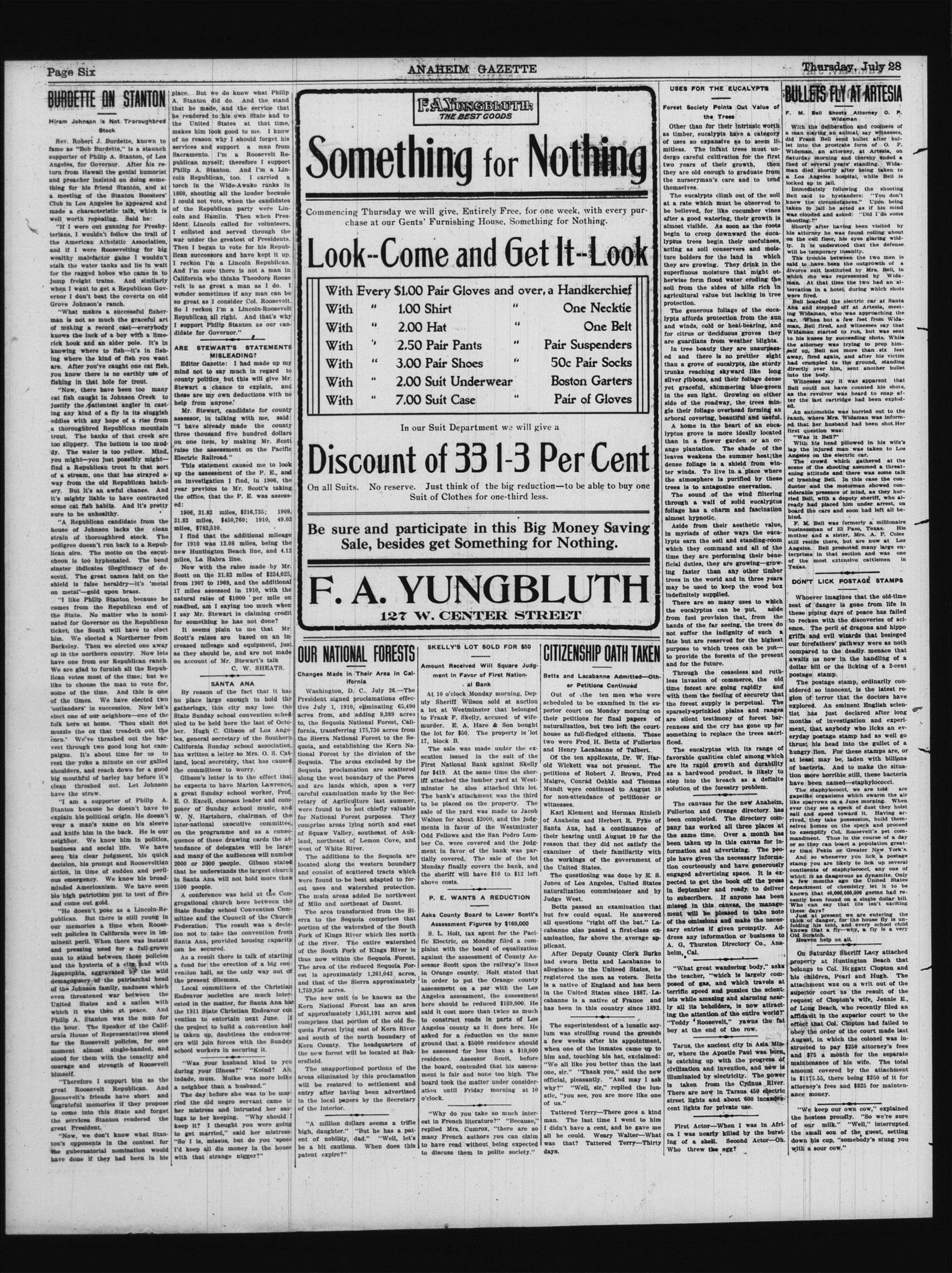
Searchable text
BURDETTE ON STANTON
Hiram Johnson is Not Thoroughbred Stock
Rev. Robert J. Burdette, known to fame as "Bob Burdette," is a staunch supporter of Philip A. Stanton, of Los Angeles, for Governor. After his return from Hawaii the genial humorist and preacher insisted on doing something for his friend Stanton, and at a meeting of the Stanton Boosters' Club in Los Angeles he appeared and made a characteristic talk, which is well worth repeating. Said he:
"If I were out gunning for Presbyterians, I wouldn't follow the trail of the American Atheistic Association, and if I were Roosevelting for big wealthy malefactor game I wouldn't stalk the water tanks and lie in wait for the ragged hobos who came in to jump freight trains. And similarly when I want to get a Republican Governor I don't beat the coverts on old Grove Johnson's ranch.
"What makes a successful fisherman is not so much the graceful art of making a record cast—everybody knows the luck of a boy with a lime-rick hook and an alder pole. It's in knowing where to fish—it's in fishing where the kind of fish you want are. After you've caught one cat fish, you know there is no earthly use of fishing in that hole for trout.
"Now, there have been too many cat fish caught in Johnson Creek to justify the patientest angler in casting any kind of a fly in its sluggish eddies with any hope of a rise from a thoroughbred Republican mountain trout. The banks of that creek are too slippery. The bottom is too muddy. The water is too yellow. Mind, you might—you just possibly might—find a Republican trout in that sort of place. But we do know what Philip A. Stanton did do. And the stand that he made, and the service that he rendered to his own State and to the United States at that time, makes him look good to me. I know of no reason why I should forget his services and support a man from Sacramento. I'm a Roosevelt Republican myself; therefore I support Philip A. Stanton. And I'm a Lincoln Republican, too. I carried a torch in the Wide-Awake ranks in 1860, shouting all the louder because I could not vote, when the candidates of the Republican party were Lincoln and Hamlin. Then when President Lincoln called for volunteers, I enlisted and served through the war under the greatest of Presidents. Then I began to vote for his Republican successors and have kept it up. I reckon I'm a Lincoln Republican. And I'm sure there is not a man in California who thinks Theodore Roosevelt is as great a man as I do. I wonder sometimes if any man can be so great as I consider Col. Roosevelt. So I reckon I'm a Lincoln-Roosevelt Republican all right. And that's why I support Philip Stanton as our candidate for Governor."
ARE STEWART'S STATEMENTS MISLEADING?
Editor Gazette: I had made up my mind not to say much in regard to county politics, but this will give Mr. Stewart a chance to explain, and these are my own deductions with no help from anyone.
Mr. Stewart, candidate for county assessor, in talking with me, said: "I have already made the county three thousand five hundred dollars on one item, by making Mr. Scott raise the assessment on the Pacific Electric Railroad."
This statement caused me to look up the assessment of the P. E., and
Now, there have been too many cat fish caught in Johnson Creek to justify the patientest angler in casting any kind of a fly in its sluggish eddies with any hope of a rise from a thoroughbred Republican mountain trout. The banks of that creek are too slippery. The bottom is too muddy. The water is too yellow. Mind, you might—you just possibly might—find a Republican trout in that sort of a stream, one that has strayed away from the old Republican hatchery. But it's an awful chance. And it's mighty liable to have contracted some cat fish habits. And it's pretty sure to be unhealthy.
"A Republican candidate from the house of Johnson lacks the clean strain of thoroughbred stock. The pedigree doesn't run back to a Republican sire. The motto on the escutcheon is too hyphenated. The bend sinister indicates illegitimacy of descent. The great names laid on the shield is false heraldry—it's 'metal on metal'—gold upon brass.
"I like Philip Stanton because he comes from the Republican end of the State. No matter who is nominated for Governor on the Republican ticket, the South will have to elect him. We elected a Northerner from Berkeley. Then we elected one away up in the northern country. Now lets have one from our Republican ranch. We are glad to furnish all the Republican votes most of the time; but we like to choose the man to vote for, some of the time. And this is one of the times. We have elected two 'outlanders' in succession. Now let's elect one of our neighbors—one of the folk here at home. 'Thou shalt not muzzle the ox that treadeth out the corn.' We've thrashed out the harvest through two good long hot campaigns. It's about time for us to rest the yoke a minute on our galled shoulders, and reach down for a good big mouthful of barley hay before it’s clean threshed out. Let Johnson have the straw.
"I am a supporter of Philip A. Stanton because he doesn’t have to explain his political origin. He doesn’t wear a man’s name on his sleeve and knife him in the back. He is our neighbor. We know him in politics, business and social life. We have seen his clear judgment, his quick decision, his prompt and Rooseveltian action, in time of sudden and perilous emergency. We know his broad-minded Americanism. We have seen his high patriotism put to test of fire county politics, but this will give Mr. Stewart a chance to explain, and these are my own deductions with no help from anyone."
Mr. Stewart, candidate for county assessor, in talking with me, said: "I have already made the county three thousand five hundred dollars on one item, by making Mr. Scott raise the assessment on the Pacific Electric Railroad."
This statement caused me to look up the assessment of the P. E., and on investigation I find, in 1906, the year previous to Mr. Scott’s taking the office, that the P. E. was assessed:
1906, 31.83 miles, $216,735; 1909, 31.83 miles, $450,760; 1910, 49.03 miles, $782,510.
I find that the additional mileage for 1910 was 13.08 miles, being the new Huntington Beach line, and 4.12 miles, La Habra line.
Now with the raise made by Mr. Scott on the 31.83 miles of $234,025, from 1907 to 1909, and the additional 17 miles assessed in 1910, with the natural raise of $1000 per mile on roadbed, am I saying too much when I say Mr. Stewart is claiming credit for something he has not done?
It seems plain to me that Mr. Scott’s raises are based on an increased mileage and equipment, just as they should be, and are not made on account of Mr. Stewart’s talk.
C.W.SHEATS.
SANTA ANA
By reason of the fact that it has no place large enough to hold the gatherings, this city may lose the State Sunday school convention scheduled to be held here the last of October. Hugh C. Gibson of Los Angeles, general secretary of the Southern California Sunday school association, has written a letter to Mrs. O. S. Catland, local secretary, that has caused the committees to worry.
Gibson’s letter is to the effect that he expects to have Marion Lawrence, a great Sunday school worker, Prof. E.O.Excell, chorous leader and composer of Sunday school music, and W.N.Hartshorn, chairman of the inter-national executive committee, on the programme and as a consequence of these drawing cards the attendance of delegates will number 2000 or 3000 people. Gibson stated that he understands the largest church in Santa Ana will not hold more than 1500 people.
A conference was held at the Con-
"I am a supporter of Philip A. Stanton because he doesn't have to explain his political origin. He doesn't wear a man's name on his sleeve and knife him in the back. He is our neighbor. We know him in politics, business and social life. We have seen his clear judgment, his quick decision, his prompt and Rooseveltian action, in time of sudden and perilous emergency. We know his broad-minded Americanism. We have seen his high patriotism put to test of fire and come out gold.
"He doesn't pose as a Lincoln-Republican. But there is still young in our memories a time when Roosevelt policies in California were in imminent peril. When there was instant and pressing need for a full-grown man to stand between those policies and the hysteria of a city mad with Japanophia, aggravated by the wild demagoguery of the patriarchal head of the Johnson family, madness which even threatened war between the United States and a nation with which it was then at peace. And Philip A. Stanton was the man for the hour. The Speaker of the California House of Representatives stood for the Roosevelt policies, for one moment almost single-handed, and stood for them with the tenacity and courage and strength of Roosevelt himself.
"Therefore I support him as the great Roosevelt Republican. And Roosevelt's friends have short and ungrateful memories if they propose to come into this State and forget the services Stanton rendered the great President.
"Now, we don't know what Stanton's opponents in the contest for the gubernatorial nomination would have done if they had been in his E. O. Excell, chorous leader and composer of Sunday school music, and W. N. Hartshorn, chairman of the inter-national executive committee, on the programme and as a consequence of these drawing cards the attendance of delegates will be large and many of the audiences will number 2000 or 3000 people. Gibson stated that he understands the largest church in Santa Ana will not hold more than 1500 people.
A conference was held at the Congregational church here between the State Sunday school Convention Committee and the Council of the Church Federation. The result was a decision not to take the convention from Santa Ana, provided housing capacity can be secured.
As a result there is talk of starting a fund for the erection of a big convention hall, as the only way out of the present dilemma.
Local committees of the Christian Endeavor societies are much interested in the matter, for Santa Ana has the 1911 State Christian Endeavor convention to entertain next June. If the project to build a convention hall is taken up, doubtless the endeavors will join forces with the Sunday school workers in securing it.
"Was your husband kind to you during your illness?" "Koind? An indade, mum. Moike was more loike a neighbor than a husband."
The day before she was to be married the old negro servant came to her mistress and intrusted her savings to her keeping. "Why should I keep it? I thought you were going to get married," said her mistress. "So I is, missus, but do you 'spouse' I'd keep all dis money in the house with that strange nigger?"
The additions located along the and consist of scars were found to be best uses and waist The main areas area of Milo and north.
The area transferra to the Sequio portion of the water Fork of Kings River of the river. Thus now within The area of the rest is approximate and that of the S1,759,950 acres.
The new unit Kern National Forest comprises that porquoia Forest lying and south of the Kern County. That the new forest will ersfield.
The unapportioned areas eliminated will be restored entry after having in the local paper of the Interior.
"A million dollars high, daughter." ent of nobility, could be a bit cautious patent expire?"
ANAHEIM GAZETTE
F.A.YUNGBLUTH;
THE BEST GOODS
Something for Nothing
Commencing Thursday we will give, Entirely Free, for one week, with every purchase at our Gents' Furnishing House, Something for Nothing.
Look--Come and Get It--Look
With Every $1.00 Pair Gloves and over, a Handkerchief
With " 1.00 Shirt " One Necktie
With " 2.00 Hat " One Belt
With " 2.50 Pair Pants " Pair Suspenders
With " 3.00 Pair Shoes " 50c Pair Socks
With " 2.00 Suit Underwear Boston Garters
With " 7.00 Suit Case " Pair of Gloves
In our Suit Department we will give a
Discount of 33 1-3 Per Cent
With " 2,00 Suit Underwear Boston Garters
With " 7,00 Suit Case " Pair of Gloves
In our Suit Department we will give a
Discount of 331-3 Per Cent
On all Suits. No reserve. Just think of the big reduction—to be able to buy one
Suit of Clothes for one-third less.
Be sure and participate in this Big Money Saving
Sale, besides get Something for Nothing.
F. A. YUNGBLUTH
127 W. CENTER STREET
OUR NATIONAL FORESTS
Changes Made in Their Area in California
Washington, D. C., July 26.—The President signed proclamations effective July 1, 1910, eliminating 65,490 acres from, and adding 9,389 acres to, the Sequoia National Forest, California, transferring 175,730 acres from the Sierra National Forest to the Sequoia, and establishing the Kern National Forest by the division of the Sequoia. The areas excluded by the Sequoia proclamation are scattered along the west boundary of the Forest and are lands which, upon a very careful examination made by the Secretary of Agriculture last summer, were found to be not chiefly valuable for National Forest purposes. They comprise areas lying north and east of Squaw Valley, southeast of Aukland, northeast of Lemon Cove, and west of White River.
The additions to the Sequoia are located along the western boundary and consist of scattered tracts which were found to be best adapted to forest uses and watershed protection. The main areas added lie northwest
SKELLY'S LOT SOLD FOR $50
Amount Received Will Square Judgment in Favor of First National Bank
At 10 o'clock Monday morning, Deputy Sheriff Wilson sold at auction a lot at Westminster that belonged to Frank F. Skelly, accused of wifemurder. E. A. Hare & Son bought the lot for $50. The property is lot 17, block B.
The sale was made under the execution issued in the suit of the First National Bank against Skelly for $419. At the same time the sheriff attached the lumber yard at Westminster he also attached this lot. The bank's attachment was the third to be placed on the property. The sale of the yard was made to Jacob Walton for about $2000, and the judgments in favor of the Westminster Odd Fellows and the San Pedro Lumber Co. were covered and the judgment in favor of the bank was partially covered. The sale of the lot Monday finally covers the bank, and the sheriff will have $10 to $12 left above costs.
CITIZENSHIP OATH TAKEN
Betts and Lacabanne Admitted—Other Petitions Continued
Out of the ten men who were scheduled to be examined in the superior court on Monday morning on their petitions for final papers of naturalization, but two left the courthouse as full-fledged citizens. Those two were Fred H. Betts of Fullerton and Henry Lacabanne of Talbert.
Of the ten applicants, Dr. W. Harold Wickett was not present. The petitions of Robert J. Brown, Fred Maigre, Conrad Oehkle and Thomas Mundt were continued to August 10 for non-attendance of petitioner or witnesses.
Karl Klement and Herman Rinleib of Anaheim and Herbert R. Pyke of Santa Ana, had a continuance of their hearing until August 10 for the reason that they did not satisfy the examiner of their familiarity with the workings of the government of the United States.
The questioning was done by E. S. Jones of Los Angeles, United States naturalization commissioner and by Judge West.
retary of Agriculture last summer, were found to be not chiefly valuable for National Forest purposes. They comprise areas lying north and east of Squaw Valley, southeast of Aukland, northeast of Lemon Cove, and west of White River.
The additions to the Sequoia are located along the western boundary and consist of scattered tracts which were found to be best adapted to forest uses and watershed protection. The main areas added lie northwest of Milo and northeast of Daunt.
The area transformed from the Sierra to the Sequoia comprises that portion of the watershed of the South Fork of Kings River which lies north of the river. The entire watershed of the South Fork of Kings River is thus now within the Sequoia Forest. The area of the reduced Sequoia Forest is approximately 1,261,043 acres, and that of the Sierra approximately 1,759,950 acres.
The new unit to be known as the Kern National Forest has an area of approximately 1,951,191 acres and comprises that portion of the old Sequoia Forest lying east of Kern River and south of the north boundary of Kern County. The headquarters of the new forest will be located at Bakersfield.
The unapportioned portions of the areas eliminated by this proclamation will be restored to settlement and entry after having been advertised in the local papers by the Secretary of the Interior.
"A million dollars seems a trifle high, daughter." "But he has a patient of nobility, dad." "Well, let's be a bit cautious. When does this patent expire?"
"Why do you take so much interest in French literature?" "Because," replied Mrs. Cumrox, "there are so many French authors you can claim to have read without being expected to discuss them in polite society."
Karl Klement and Herman Rinleib of Anaheim and Herbert R. Pyke of Santa Ana, had a continuance of their hearing until August 10 for the reason that they did not satisfy the examiner of their familiarity with the workings of the government of the United States.
The questioning was done by E. S. Jones of Los Angeles, United States naturalization commissioner and by Judge West.
Betts passed an examination that but few could equal. He answered all questions "right off the bat." La-cabanne also passed a first-class examination, far above the average applicant.
After Deputy County Clerk Burke had sworn Betts and La-cabenne to allegiance to the Uniteed States, he registered the men as voters. Betts is a native of England and has been in the United States since 1887. La-cabanne is a native of France and has been in this country since 1892.
The superintendent of a lunatic asylum was strolling round the grounds a few weeks after his appointment, when one of the inmates came up to him and, touching his hat, exclaimed: "We all like you better than the last one, sir." "Thank you," said the new official, pleasantly. "And may I ask why?" "Well, sir," replied the lunatic, "you see, you are more like one of us."
Tattered Terry—There goes a kind man. The last time I went to him I didn't have a cent, and he gave me all he could. Weary Walter—What was that? Tattered Terry—Thirty days.
USES FOR THE EUCALYPTS
Forest Society Points Out Value of the Trees
Other than for their intrinsic worth as timber, eucalyptus have a category of uses so expansive as to seem limitless. The infant trees must undergo careful cultivation for the first two years of their growth, then they are old enough to graduate from the nurseryman's care and to tend themselves.
The eucalyptus climb out of the soil at a rate which must be observed to be believed, for like cucumber vines after a good watering, their growth is almost visible. As soon as the roots begin to creep downward the eucalyptus trees begin their usefulness, acting as soil conservers and moisture holders for the land in which they are growing. They drink in the superfluous moisture that might otherwise form flood water eroding the soil from the sides of hills rich in agricultural value but lacking in tree protection.
The generous foliage of the eucalyptus affords protection from the sun and winds, cold or heat-bearing, and for citrus or deciduous groves they are guardians from weather blights.
In tree beauty they are unsurpassed and there is no prettier sight than a grove of eucalyptus, the sturdy trunks reaching skyward like long silver ribbons, and their foliage dense yet graceful, shimmering blue-green in the sun light. Growing on either side of the roadway, the trees mingle their foliage overhead forming an arboral covering, beautiful and useful.
A home in the heart of an eucalyptus grove is more ideally located than in a flower garden or an orange plantation. The shade of the leaves weakens the summer heat; the dense foliage is a shield from winter winds. To live in a place where
silver ribbons, and their foliage dense yet graceful, shimmering blue-green in the sun light. Growing on either side of the roadway, the trees mingle their foliage overhead forming an arboral covering, beautiful and useful.
A home in the heart of an eucalyptus grove is more ideally located than in a flower garden or an orange plantation. The shade of the leaves weakens the summer heat; the dense foliage is a shield from winter winds. To live in a place where the atmosphere is purified by these trees is to antagonize enervation.
The sound of the wind filtering through a wall of solid eucalyptus foliage has a charm and fascination almost hypnotic.
Aside from their aesthetic value, in myriads of other ways the eucalyptus earn the soil and standing-room which they command and all of the time they are performing their beneficial duties, they are growing—growing faster than any other timber trees in the world and in three years may be used to keep the wood box indefinitely supplied.
There are so many uses to which the eucalyptus can be put, aside from fuel provision that, from the hands of the far seeing, the trees do not suffer the indignity of such a fate but are reserved for the highest purpose to which trees can be put—to provide the forests of the present and for the future.
Through the ceaseless and ruthless invasion of commerce, the old time forest are going rapidly and with them the feeling of security that the forest supply is perpetual. The sparsely-sprinkled plains and ranges are silent testimony of forest barrenness and the cry has gone up for something to replace the trees sacrificed.
The eucalyptus with its range of favorable qualities chief among which are its rapid growth and durability as a hardwood product, is likely to step into the breach as a definite solution of the forestry problem.
The canvass for the new Anaheim, Fullerton and Orange directory has been completed. The directory company has worked all three places at the same time. Over a month has been taken up in this canvas for information and advertising. The people have given the necessary information courteously and have generously engaged advertising space. It is expected to get the book off the press in September and ready to deliver to subscribers. If anyone has been
Witnesses say it was apparent that Bell could not have counted his shots, as the revolver was heard to snap after the last cartridge had been exploded.
An automobile was hurried out to the ranch, where Mrs. Widaman was informed that her husband had been shot.Her first question was:
"Was it Bell?"
With his head pillowed in his wife's lap the injured man was taken to Los Angeles on the electric car.
The crowd which gathered at the scene of the shooting assumed a threatening attitude and there was some talk of lynching Bell. In this case the conductor and the motorman showed considerable presence of mind, as they hurried Bell, with a deputy sheriff, who already had placed him under arrest, on board the cars and soon had left all behind.
F. M. Bell was formerly a millionaire businessman of El Paso, Texas. His mother and a sister, Mrs. A. P. Coles still reside there, but are now at Los Angeles. Bell promoted many large enterprises in that section and was one of the most extensive cattlemen in Texas.
DON'T LICK POSTAGE STAMPS
Whoever imagines that the old-time zest of danger is gone from life in these piping days of peace has failed to recken with the discoveries of science. The peril of dragons and hippogriffs and evil wizards that besieged our forefathers' pathway were as not compared to the deadly menace that awaits us now in the handling of a dollar bill or the licking of a 2-cent postage stamp.
The postage stamp, ordinarily considered so innocent, is the latest region of terror that the doctors have explored. An eminent English scientist has just declared after long months of investigation and experiment, that anybody who licks an everyday postage stamp had as well go thrust his head into the gullet of a hungry lion. For these stamps are, or at least may be, laden with billions of bacteria. And to make the situation more horrible still, these bacteria have been named—staphylococci.
The staphylococci, we are told are gaplike organisms which swarm the air like sparrows on a June morning. When ever they see a speck of dust they hoist sail and speed toward it. Having arrived, they take possession, build themselves homes on the speck and proceed to exemplify Col. Roosevelt's pet commandment. Thus in the course of a day or so they can boast a population greater than Pekin or Greater New York's.
And so whenever you lick a postage stamp you are likely to lick up several contiguous of staphylococci, any one of which is as dangerous as dynamite. Only a few months ago the United States department of chemistry let it to be known that 40,000,000,000 germs had recently been found on a single dollar bill.
The canvass for the new Anaheim, Fullerton and Orange directory has been completed. The directory company has worked all three places at the same time. Over a month has been taken up in this canvas for information and advertising. The people have given the necessary information courteously and have generously engaged advertising space. It is expected to get the book off the press in September and ready to deliver to subscribers. If anyone has been missed in this canvas, the management will be pleased to take note of the omissions and make the necessary entries if given promptly. Address any information or business to A. G. Thurston Directory Co., Anaheim, Cal.
"What great wandering body," asks the teacher, "which is largely composed of gas, and which travels at terrific speed and puzzles the scientists while amazing and alarming nearly all its beholders, is now attracting the attention of the entire world?" "Teddy Roosevelt," yawns the fat boy at the end of the row.
Tarus, the ancient city in Asia Minor, where the Apostle Paul was born, is catching up with the progress of civilization and invention, and now is illuminated by electricity. The power is taken from the Cydnus River. There are now in Tarsus 450 electric street lights and about 600 incandescent lights for private use.
First Actor—When I was in Africa I was nearly killed by the bursting of a shell. Second Actor—Oh. Who threw the egg?
We keep our own cow," explained the hostess proudly. "So we're sure of our milk." "Well," interrupted. The small son of the guest, setting down his cup, "somebody's stung you with a sour cow."