anaheim-gazette 1910-06-23
Scanned page
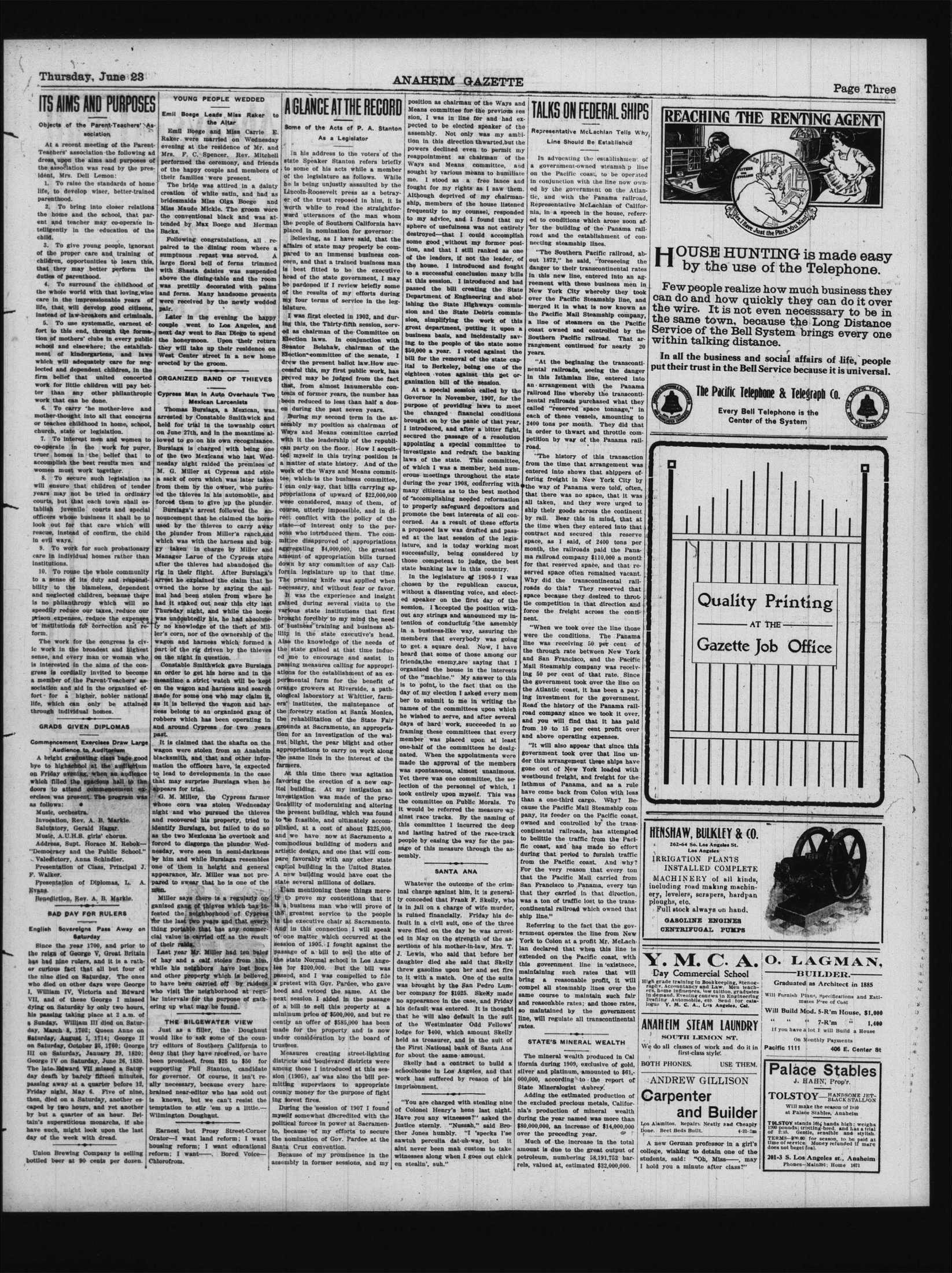
Searchable text
ITS AIMS AND PURPOSES
Objects of the Parent-Teachers' Association
At a recent meeting of the Parent-Teachers' association the following ad dress upon the aims and purposes of the association was read by the president, Mrs. Dell Lemon:
1. To raise the standards of home life, to develop wiser, better-trained parenthood.
2. To bring into closer relations the home and the school, that parent and teacher may co-operate intelligently in the education of the child.
3. To give young people, ignorant of the proper care and training of children, opportunities to learn this, that they may better perform the duties of parenthood.
4. To surround the childhood of the whole world with that loving, wise care in the impressionable years of life, that will develop good citizens, instead of law-breakers and criminals.
5. To use systematic, earnest effort to this end, through the formation of mothers' clubs in every public school and elsewhere; the establishment of kindergartens, and laws which will adequately care for neglected and dependent children, in the firm belief that united concerted work for little children will pay better than any other philanthropic work that can be done.
6. To carry the mother-love and mother-thought into all that concerns or teaches childhood in home, school, church, state or legislation.
7. To interest men and women to co-operate in the work for purer, truer homes in the belief that to accomplish the best results men and women must work together.
YOUNG PEOPLE WEDDED
Emil Boege Leads Miss Raker to the Altar
Emil Boege and Miss Carrie E. Raker were married on Wednesday evening at the residence of Mr. and Mrs. F. C. Spencer. Rev. Mitchell performed the ceremony, and friends of the happy couple and members of their families were present.
The bride was attired in a dainty creation of white satin, and had as bridesmaids Miss Olga Boege and Miss Maude Mickle. The groom wore the conventional black and was attended by Max Boege and Herman Backs.
Following congratulations, all repaired to the dining room where a sumptuous repast was served. A large floral bell of ferns trimmed with Shasta daisies was suspended above the dining-table and the room was prettily decorated with palms and ferns. Many handsome presents were received by the newly wedded pair.
Later in the evening the happy couple went to Los Angeles, and next day went to San Diego to spend the honeymoon. Upon their return they will take up their residence on West Center street in a new home erected by the groom.
ORGANIZED BAND OF THIEVES
Cypress Man in Auto Overhauls Two Mexican Larcenists
Thomas Bursiaga, a Mexican, was arrested by Constable Smithwick and held for trial in the township court on June 27th, and in the meantime allowed to go on his own recognizance. Bursiaga is charged with being one of the two Mexicans who last Wednesday night raided the premises of M. G. Miller at Cypress and stole
firm belief that united concerted work for little children will pay better than any other philanthropic work that can be done.
6. To carry the mother-love and mother-thought into all that concerns or teaches childhood in home, school, church, state or legislation.
7. To interest men and women to co-operate in the work for purer, truer homes in the belief that to accomplish the best results men and women must work together.
8. To secure such legislation as will ensure that children of tender years may not be tried in ordinary courts, but that each town shall establish juvenile courts and special officers whose business it shall be to look out for that care which will rescue, instead of confirm, the child in evil ways.
9. To work for such probationary care in individual homes rather than institutions.
10. To rouse the whole community to a sense of its duty and responsibility to the blameless, dependent and neglected children, because there is no philanthropy which will so speedily reduce our taxes, reduce our prison expenses, reduce the expenses of institutions for correction and reform.
The work for the congress is civic work in the broadest and highest sense, and every man or woman who is interested in the aims of the congress is cordially invited to become a member of the Parent-Teachers' association and aid in the organized effort for a higher, nobler national life, which can only be attained through individual homes.
GRADS GIVEN DIPLOMAS
Commencement Exercises Draw Large Audience to Auditorium
A bright graduating class bade good bye to highschool at the auditorium on Friday evening, when an audience which filled the spacious hall to the doors to attend commencement exercises was present. The program was as follows:
Music, orchestra.
Invocation, Rev. A. B. Markle.
Salutatory, Gerald Hagar.
Music, A.U.H.S. girls' chorus.
Address, Supt. Horace M. Rebok—"Democracy and the Public School."
Valedictory, Anna Schindler.
Presentation of Class, Principal J. F. Walker.
Presentation of Diplomas, L. A. Evans.
Benediction Rev. A. B. Markle.
ORGANIZED BAND OF THIEVES
Cypress Man in Auto Overhauls Two Mexican Larcenists
Thomas Bursiaga, a Mexican, was arrested by Constable Smithwick and held for trial in the township court on June 27th, and in the meantime allowed to go on his own recognizance. Bursiaga is charged with being one of the two Mexicans who last Wednesday night raided the premises of M. G. Miller at Cypress and stole a sack of corn which was later taken from them by the owner, who pursued the thieves in his automobile, and forced them to give up the plunder.
Bursiaga's arrest followed the announcement that he claimed the horse used by the thieves to carry away the plunder from Miller's ranch,and which was with the harness and buggy taken in charge by Miller and Manager Larue of the Cypress store after the thieves had abandoned the rig in their flight. After Bursiaga's arrest he explained the claim that he owned the horse by saying the animal had been stolen from where he had it staked out near this city last Thursday night, and while the horse was undoubtedly his, he had absolutely no knowledge of the theft of Miller's corn, nor of the ownership of the wagon and harness which formed a part of the rig driven by the thieves on the night in question.
Constable Smithwick gave Bursiaga an order to get his horse and in the meantime a strict watch will be kept on the wagon and harness and search made for some one who may claim it, as it is believed the wagon and harness belong to an organized gang of robbers which has been operating in and around Cypress for two years past.
It is claimed that the shafts on the wagon were stolen from an Anaheim blacksmith, and that and other information the officers have, is expected to lead to developments in the case that may surprise Bursiaga when he appears for trial.
G. M. Miller, the Cypress farmer whose corn was stolen Wednesday night and who pursued the thieves and recovered his property, tried to identify Bursiaga, but failed to do so as the two Mexicans he overtook and forced to disgorge the plunder Wednesday, were seen in semi-darkness by him and while Bursiaga resembles one of them in height and general appearance, Mr. Miller was not prepared to swear that he is one of the men.
Miller says there is a regularly or proved may be judged that, from almost innumerable tests of former years, they been reduced to less than en during the past seven days.
During my second term assembly my position as Ways and Means committee with it the leadership o can party on the floor. I ted myself in this trying matter of state history work of the Ways and Means which is the business I can only say, that bills appropriations of upward were considered, many course, utterly impossible direct conflict with the state-of-interest only sons who introduced them mittee disapproved of an aggregating $4,000,000 amount of appropriation down by any committee formula legislature up to The pruning knife was necessary, and without firing.
It was the experience gained during several various state institutions brought forth by my mind of business training and utility in the state executive Also the knowledge of this state gained at that time me to encourage and passing measures calling for the establishment perimental farm for these orange growers at Riversideological laboratory at Whites' institutes, the main forestry station at Sutherland rehabilitation of these grounds at Sacramento, a tion for an investigation nut blight, the pear blight appropriations to carry on the same lines in the intre farmers.
At this time there was favoring the erection of ititol building. At my investigation was made of feasibility of modernizing the present building, which to be feasible, and ultimately plished, at a cost of about $500 commodious building of artistic design, and one that pare favorably with any capital building in the Unite A new building would have state several millions of dollars.
I am mentioning these things to prove my contention.
BAD DAY FOR RULERS
English Sovereigns Pass Away on Saturday
Since the year 1700, and prior to the reign of George V, Great Britain has had nine rulers, and it is a rather curious fact that all but four of the nine died on Saturday. The ones who died on other days were George I, William IV, Victoria and Edward VII, and of these George I missed dying on Saturday by only two hours, his passing taking place at 2 a.m. of a Sunday. William III died on Saturday, March 8, 1702; Queen Anne on Saturday, August 1, 1714; George II on Saturday, October 25, 1760; George III on Saturday, January 29, 1820; George IV on Saturday, June 26, 1830.
The late Edward VII missed a Saturday death by barely fifteen minutes, passing away at a quarter before 12, Friday night, May 6. Five of nine, then, died on a Saturday, another escaped by two hours, and yet another by but a quarter of an hour. Britain's superstitious monarchs, if she have such, might look upon the last day of the week with dread.
Union Brewing Company is selling bottled beer at 90 cents per dozen.
Miller says there is a regularly organized gang of thieves which has infested the neighborhood of Cypress for the last two years and that everything portable that has any commercial value is carried off as the result of their raids.
Last year Mr. Miller had ten bales of hay and a calf stolen from him, while his neighbors have lost hogs and other property which is believed to have been carried off by raiders who visit the neighborhood at regular intervals for the purpose of gathering up what may be found.
THE BILGEWATER VIEW
Just as a filler, the Doughnut would like to ask some of the country editors of Southern California to deny that they have received, or have been promised, from $25 to $50 for supporting Phil Stanton, candidate for governor. Of course, it isn't really necessary, because every hare-brained near-editor who has sold out is known, but we can't resist the temptation to stir 'em up a little.—Wilmington Doughnut.
Earnest but Prosy Street-Corner Orator—I want land reform; I want housing reform; I want educational reform; I want—Bored Voice—Chlorofrom.
A GLANCE AT THE RECORD
Some of the Acts of P. A. Stanton
As a Legislator
In his address to the voters of the state Speaker Stanton refers briefly to some of his acts while a member of the legislature as follows. While he is being unjustly assaulted by the Lincoln-Roosevelt press as a betrayer of the trust reposed in him, it is worth while to read the straightforward utterances of the man whom the people of Southern California have placed in nomination for governor:
Believing, as I have said, that the affairs of state may properly be compared to an immense business concern, and that a trained business man is best fitted to be the executive head of the state government, I may be pardoned if I review briefly some of the results of my efforts during my four terms of service in the legislature.
I was first elected in 1902, and during this, the Thirty-fifth session, served as chairman of the Committee on Election laws. In conjunction with Senator Belshaw, chairman of the Election committee of the senate, I drew the present ballot law. How successful this, my first public work, has proved may be judged from the fact that, from almost innumerable contests of former years, the number has been reduced to less than half a dozen during the past seven years.
During my second term in the assembly my position as chairman of Ways and Means committee carried with it the leadership of the republican party on the floor. How I acquitted myself in this trying position is a matter of state history. And of the work of the Ways and Means commit-
position as chairman of the Ways and Means committee for the previous session, I was in line for and had expected to be elected speaker of the assembly. Not only was my ambition in this direction thwarted, but the powers declined even to permit my reappointment as chairman of the Ways and Means committee, and sought by various means to humiliate me. I stood as a free lance and fought for my rights as I saw them. Although deprived of my chairmanship, members of the house listened frequently to my counsel, responded to my advice, and I found that my sphere of usefulness was not entirely destroyed—that I could accomplish some good without my former position, and that I still ranked as one of the leaders, if not the leader, of the house. I introduced and fought to a successful conclusion many bills at this session. I introduced and had passed the bill creating the State Department of Engineering and abolishing the State Highways commission and the State Debris commission, simplifying the work of this great department, putting it upon a business basis, and incidentally saving to the people of the state some $50,000 a year. I voted against the bill for the removal of the state capital to Berkeley, being one of the eighteen votes against this pet organization bill of the session.
At a special session called by the Governor in November, 1907, for the purpose of providing laws to meet the changed financial conditions brought on by the panic of that year, I introduced, and after a bitter fight, secured the passage of a resolution appointing a special committee to investigate and redraft the banking laws of the state. This committee, of which I was a member, held numerous meetings throughout the state.
TALKS ON FEDERAL SHIPS
Representative McLachlan Tells Why Line Should Be Established
In advocating the establishment of a government-owned steamship line on the Pacific coast, to be operated in conjunction with the line now owned by the government on the Atlantic, and with the Panama railroad, Representative McLachlan of California, in a speech in the house, referred to conditions which arose soon after the building of the Panama railroad and the establishment of connecting steamship lines.
"The Southern Pacific railroad, about 1872," he said, "foreseeing the danger to their transcontinental rates in this new line, entered into an agreement with these business men in New York City whereby they took over the Pacific Steamship line, and merged it in what is now known as the Pacific Mall Steamship company, a line of steamers on the Pacific coast owned and controlled by the Southern Pacific railroad. That arrangement continued for nearly 20 years.
"At the beginning the transcontinental railroads, seeing the danger in this Isthmian line, entered into an arrangement with the Panama railroad line whereby the transcontinental railroads purchased what they called "reserved space tonnage," in each of these vessels, amounting to 2400 tons per month. They did that in order to thwart and throttle competition by way of the Panama railroad.
"The history of this transaction from the time that arrangement was entered into shows that shippers of
proved may be judged from the fact that, from almost innumerable contests of former years, the number has been reduced to less than half a dozen during the past seven years.
During my second term in the assembly my position as chairman of Ways and Means committee carried with it the leadership of the republican party on the floor. How I acquitted myself in this trying position is a matter of state history. And of the work of the Ways and Means committee, which is the business committee, I can only say, that bills carrying appropriations of upward of $22,000,000 were considered, many of them, of course, utterly impossible, and in direct conflict with the policy of the state—of interest only to the persons who introduced them. The committee disapproved of appropriations aggregating $4,000,000, the greatest amount of appropriation bills turned down by any committee of any California legislature up to that time. The pruning knife was applied when necessary, and without fear or favor.
It was the experience and insight gained during several visits to the various state institutions that first brought forcibly to my mind the need of business training and business ability in the state executive's head. Also the knowledge of the needs of the state gained at that time induced me to encourage and assist in passing measures calling for appropriations for the establishment of an experimental farm for the benefit of orange growers at Riverside, a pathological laboratory at Whittier, farmers' institutes, the maintenance of the forestry station at Santa Monica, the rehabilitation of the State Fair grounds at Sacramento, an appropriation for an investigation of the walnut blight, the pear blight and other appropriations to carry on work along the same lines in the interest of the farmers.
At this time there was agitation favoring the erection of a new capitol building. At my instigation an investigation was made of the practicability of modernizing and altering the present building, which was found to be feasible, and ultimately accomplished, at a cost of about $325,000, and we have now at Sacramento a commodious building of modern and artistic design, and one that will compare favorably with any other state capitol building in the United States. New building would have cost the state several millions of dollars.
I am mentioning these things merely to prove my contention that it
At a special session called by the Governor in November, 1907, for the purpose of providing laws to meet the changed financial conditions brought on by the panic of that year, I introduced, and after a bitter fight, secured the passage of a resolution appointing a special committee to investigate and redraft the banking laws of the state. This committee, of which I was a member, held numerous meetings throughout the state during the year 1908, conferring with many citizens as to the best method of accomplishing needed reformation to properly safeguard depositors and promote the best interests of all concerned. As a result of these efforts a proposed law was drafted and passed at the last session of the legislature, and is today working most successfully, being considered by those competent to judge, the best state banking law in this country.
In the legislature of 1908-9 I was chosen by the republican caucus, without a dissenting voice, and elected speaker on the first day of the session. I accepted the position without any strings and announced my intention of conducting the assembly in a business-like way, assuring the members that everybody was going to get a square deal. Now, I have heard that some of those among our friends,the enemy,are saying that I organized the house in the interests of the "machine." My answer to this is to point, to the fact that on the day of my election I asked every member to submit to me in writing the names of the committees upon which he wished to serve, and after several days of hard work, succeeded in so framing these committees that every member was placed upon at least one-half of the committees he designated. When the appointments were made the approval of the members was spontaneous, almost unanimous. Yet there was one committee, the selection of the personnel of which, I took entirely upon myself. This was the committee on Public Morals. To it would be referred the measure against race tracks. By the naming of this committee I incurred the deep and lasting hatred of the race-track people by easing the way for the passage of this measure through the assembly.
SANTA ANA
Whatever the outcome of the criminal charge against him, it is generally conceded that Frank E Skelly who in this Isthmian line, entered into an arrangement with the Panama railroad line whereby the transcontinental railroads purchased what they called "reserved space tonnage," in each of these vessels, amounting to 2400 tons per month. They did that in order to thwart and throttle competition by way of the Panama railroad.
"The history of this transaction from the time that arrangement was entered into shows that shippers offering freight in New York City by the way of Panama were told, often, that there was no space, that it was all taken, and they were urged to ship their goods across the continent by rail. Bear this in mind, that at the time when they entered into that contract and secured this reserve space, as I said, of 2400 tons per month, the railroads paid the Panama railroad company $110,000 a month for that reserved space, and that reserved space often remained vacant. Why did the transcontinental railroads do this? They reserved that space because they desired to throttle competition in that direction and force the freight across the continent.
"When we took over the line those were the conditions. The Panama line was receiving 50 per cent of the through rate between New York and San Francisco, and the Pacific Mall Steamship company was receiving 50 per cent of that rate. Since the government took over the line on the Atlantic coast, it has been a paying investment for the government. Read the history of the Panama railroad company since we took it over, and you will find that it has paid from 10 to 15 per cent profit over and above operating expenses.
"It will also appear that since this government took over that line under this arrangement these ships have gone out of New York loaded with westbound freight, and freight for the Isthmus of Panama, and as a rule have come back from Colon with less than a one-third cargo. Why? Because the Pacific Mall Steamship company, its feeder on the Pacific coast, owned and controlled by the transcontinental railroads, has attempted to belittle the traffic from the Pacific coast, and has made no effort during that period to furnish traffic from the Pacific coast. And why? For the very reason that every ton thatthe Pacific Mail carried from San Francisco to Panama, every ton that they carried in that direction,
HENSH
IRRIG
IN
MACI
includi
ery, lev
SANTA ANA
Whatever the outcome of the criminal charge against him, it is generally conceded that Frank F. Skelly, who is in jail on a charge of wife murder, is ruined financially. Friday his default in a civil suit, one of the three were filed on the day he was arrested in May on the strength of the assertions of his mother-in-law, Mrs. T. J. Lewis, who said that before her daughter died she said that Skelly threw gasoline upon her and set fire to it with a match. One of the suits was brought by the San Pedro Lumber company for $1025. Skelly made no appearance in the case, and Friday his default was entered. It is thought that he will also default in the suit of the Westminster Odd Fellows' lodge for $400, which amount Skelly held as treasurer, and in the suit of the First National bank of Santa Ana for about the same amount.
Skelly had a contract to build a schoolhouse in Los Angeles, and that work has suffered by reason of his imprisonment.
"You are charged with stealing nine of Colonel Henry's hens last night. Have you any witnesses?" asked the justice sternly. "Nussah," said Brother Jones humbly. "I 'specks I'se sawtuh perculia dat-uh-way, but it aint never been mah custom to take witnesses along when I goes out chick en stealin', suh."
The mineral wealth produced in California during 1909, exclusive of gold, silver and platinum, amounted to $61,-000,000, according to the report of State Mineralogist Aubrey.
Adding the estimated production of the excluded precious metals, California's production of mineral wealth during the year named was more than $80,000,000, an increase of $14,000,000 over the preceding year.
Much of the increase in the total amount is due to the great output of petroleum, numbering 58,191,752 barrels, valued at, estimated $32,000,000.
REACHING THE RENTING AGENT
HOUSE HUNTING is made easy by the use of the Telephone.
Few people realize how much business they can do and how quickly they can do it over the wire. It is not even necessary to be in the same town, because the Long Distance Service of the Bell System brings every one within talking distance.
In all the business and social affairs of life, people put their trust in the Bell Service because it is universal.
The Pacific Telephone & Telegraph Co.
Every Bell Telephone is the Center of the System
The Pacific Telephone & Telegraph Co.
Every Bell Telephone is the Center of the System
Quality Printing
AT THE
Gazette Job Office
HENSHAW, BULKLEY & CO.
262-64 So. Los Angeles St.
Los Angeles
IRRIGATION PLANTS
INSTALLED COMPLETE
MACHINERY of all kinds,
including road making machinery, levelers, scrapers, hardpan
HENSHAW, BULKLEY & CO.
262-64 So. Los Angeles St.
Los Angeles
IRRIGATION PLANTS
INSTALLED COMPLETE
MACHINERY of all kinds,
including road making machinery,
levelers, scrapers, hardpan ploughs, etc.
Full stock always on hand.
GASOLINE ENGINES
CENTRIFUGAL PUMPS
Y. M. C. A.
Day Commercial School
High grade training in Bookkeeping, Stenography, Accountancy and Law. Men teachers, home influences, low tuition, graduates in demand. Evening courses in Engineering Drafting Automobile, etc. Send for catalogue Y. M. C. A., Los Angeles, Cal.
ANAHEIM STEAM LAUNDRY
SOUTH LEMON ST.
We do all classes of work and do it in first-class style!
BOTH PHONES. USE THEM.
ANDREW GILLISON
Carpenter and Builder
Los Alamitos, kepairs, Neatly and Cheaply
Done. Beet Beds Built.
4-21-3m
A new German professor in a girl's college, wishing to detain one of the students, said: "Oh, Miss——, may I hold you a minute after class?"
O. LAGMAN,
BUILDER.
Graduated as Architect in 1885
Will Furnish Plans, Specifications and Estimates Free of Cost
Will Build Mod. 5-R'm House, $1,000
" " " 7-R'm " 1,400
If you have a lot I will Build a House
On Monthly Payments
Pacific 1111 406 E. Center St
Palace Stables
J. HAHN, Prop'r.
TOLSTOY—HANDSOME JET-BLACK STALLION
Will make the season of 1910 at Palace Stables, Anaheim
TOLSTOY stands 16½ hands high; weighs 1200 pounds; trotting-bred, and has a trial of 2:15. Gentle, sensible and stylish.
TERMS—$70.00 for season, to be paid at time of service. Money refunded if mare does not beget foal.
201-3 S. Los Angeles st., Anaheim
Phones—Main891; Home 1671