anaheim-gazette 1910-06-09
Scanned page
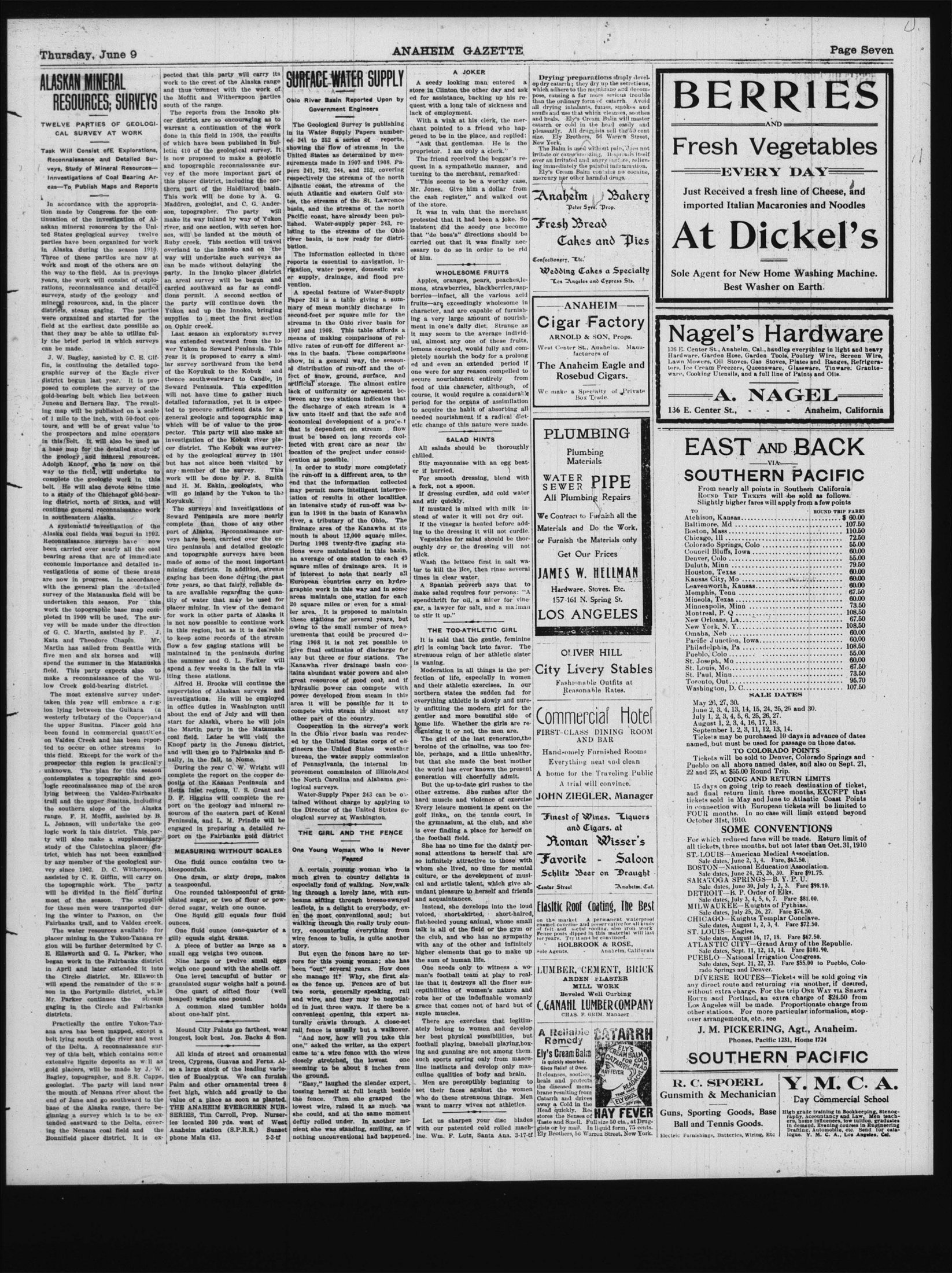
Searchable text
ALASKAN MINERAL RESOURCES; SURVEYS
TWELVE PARTIES OF GEOLOGICAL SURVEY AT WORK
Task Will Consist of E. Explorations, Reconnaissance and Detailed Surveys, Study of Mineral Resources—Investigations of Coal Bearing Areas—To Publish Maps and Reports
In accordance with the appropriation made by Congress for the continuation of the investigation of Alaskan mineral resources by the United States geological survey twelve parties have been organized for work in Alaska during the season 1910. Three of these parties are now at work and most of the others are on the way to the field. As in previous years, the work will consist of explorations, reconnaissance and detailed surveys, study of the geology and mineral resources, and, in the placer districts, steam gaging. The parties were organized and started for the field at the earliest date possible so that they may be able to utilize fully the brief period in which surveys can be made.
J. W. Bagley, assisted by C. E. Griffin, is continuing the detailed topographic survey of the Eagle river district begun last year. It is proposed to complete the survey of the gold-bearing belt which lies between Juneau and Berners Bay. The resulting map will be published on a scale of 1 mile to the inch, with 50-foot contours, and will be of great value to the prospectors and mine operators in this belt. It will also be used as a base map for the detailed study of the geology and mineral resources. Adolph Knopf, who is now on the way to the field, will undertake topected that this party will carry its work to the crest of the Alaska range and thus connect with the work of the Moffit and Witherspoon parties south of the range.
The reports from the Innoko placer district are so encouraging as to warrant a continuation of the work done in this field in 1908, the results of which have been published in bulletin 410 of the geological survey. It is now proposed to make a geologic and topographic reconnaissance survey of the more important part of this placer district, including the northern part of the Haiditarod basin. This work will be done by A. G. Maddren, geologist, and C. G. Anderson, topographer. The party will make its way inland by way of Yukon river, and one section, with seven horses, will be landed at the mouth of Ruby creek. This section will travel overland to the Innoko and on the way will undertake such surveys as can be made without delaying the party. In the Innoko placer district an areal survey will be begun and carried southward as far as conditions permit. A second section of the party will continue down the Yukon and up the Innoko, bringing supplies to meet the first section on Ophir creek.
Last season an exploratory survey was extended westward from the lower Yukon to Seward Peninsula. This year it is proposed to carry a similar survey northward from the bend of the Koyukuk to the Kobuk and thence southwestward to Candle, in Seward Peninsula. This expedition will not have time to gather much detailed information, yet it is expected to procure sufficient data for a general geologic and topographic map which will be of value to the prospector. This party will also make an investigation of the Kobuk river placer district. The Kobuk was surveyed by the geological survey in 1901 but has not since been visited by any member of the survey. This means of making comparative rates of run-off eases in the basin. This show, in a general view distribution of runoff effect of snow, ground artificial storage. The lack of uniformity or tween any two stations the discharge of each law unto itself and the economical development that is dependent on must be based on localized with great care location of the project as possible.
In order to study
A systematic investigation of the Alaska coal fields was begun in 1902. Reconnaissance surveys have now been carried over nearly all the coal bearing areas that are of immediate economic importance and detailed investigations of some of these areas are now in progress. In accordance with the general plan the detailed survey of the Matanuska field will be undertaken this season. For this work the topographic base map completed in 1909 will be used. The survey will be made under the direction of G. C. Martin, assisted by F. J. Katz and Theodore Chapin. Mr. Martin has sailed from Seattle with five men and six horses and will spend the summer in the Matanuska field. This party expects also to make a reconnaissance of the Willow Creek gold-bearing district.
The most extensive survey undertaken this year will embrace a region lying between the Gulkana (a westerly tributary of the Copper) and the upper Susitna. Placer gold has been found in commercial quantities on Valdez Creek and has been reported to occur on other streams in this field. Except for the work of the prospector this region is practically unknown. The plan for this season contemplates a topographic and geologic reconnaissance map of the area lying between the Valdez-Fairbanks trail and the upper Susitna, including the southern slope of the Alaska range. F. H. Moffit, assisted by B. L. Johnson, will undertake the geologic work in this district. This party will also make a supplementary study of the Chistochina placer district, which has not been examined by any member of the geological survey since 1902. D. C. Witherspoon, assisted by C. E. Giffin, will carry on the topographic work. The party will be divided in the field during most of the season.
The surveys and investigations of Seward Peninsula are more nearly complete than those of any other part of Alaska. Reconnaissance surveys have been carried over the entire peninsula and detailed geologic and topographic surveys have been made of some of the most important mining districts. In addition, stream gaging has been done during the past four years, so that fairly reliable data are available regarding the quantity of water that may be used for placer mining. In view of the demand for work in other parts of Alaska it is not now possible to continue work in this region, but as it is desirable to keep some records of the stream flow a few gaging stations will be maintained in the peninsula during the summer and G. L. Parker will spend a few weeks in the fall in visiting these stations.
Alfred H. Brooks will continue the supervision of Alaskan surveys and investigations. He will be employed in office duties in Washington until about the end of July and will then start for Alaska, where he will join the Martin party in the Matanuska coal field. Later he will visit the Knopf party in the Juneau district, and will then go to Fairbanks and finally, in the fall, to Nome.
During the year C. W. Wright will complete the report on the copper deposits of the Kasaan Peninsula and Hetta Inlet regions, U. S. Grant and D. F. Higgins will complete the report on the geology and mineral resources of the eastern part of Kenai Peninsula, and L. M. Prindle will be engaged in preparing a detailed report on the Fairbanks gold district.
MEASURING WITHOUT SCALES
One fluid ounce contains two tablespoonfuls.
One dram, or sixty drops, makes a teaspoonful.
One rounded tablespoonful of granulated sugar or two flours or powders of snow, ground artificial storage. The lack of uniformity or tween any two stations, the discharge of each law unto itself and the economical development that is dependent on must be based on local location of the project as possible.
In order to study the run-off in a different end that the information may permit more information of results in an intensive study of gun in 1908 in the basin river, a tributary of drainage area of the mouth is about 12,000 During 1908 twenty-tions were maintained an average of one square miles of drainage interest to note European countries graphic work in this areas maintain one 20 square miles or larger area. It is proper these stations for showing to the small requirements that could bring 1908 it is not give final estimates any but three or four Kanawha river drains abundant water great resources of hydraulic power can power developed from area it will be posed compete with steam other part of the cooperation in therin the Ohio river bled by the United States engineers the United bureau, the water sufice Pennsylvania, ther provement commissiones North Carolina a logical surveys.
Water-Supply Papertained without chargethe Director of therological survey at W
trail and the upper Susitna, including the southern slope of the Alaska range. F. H. Moffit, assisted by B. L. Johnson, will undertake the geologic work in this district. This party will also make a supplementary study of the Chistochina placer district, which has not been examined by any member of the geological survey since 1902. D. C. Witherspoon, assisted by C. E. Giffin, will carry on the topographic work. The party will be divided in the field during most of the season. The supplies for these men were transported during the winter to Paxson, on the Fairbanks trall, and to Valdez creek.
The water resources available for placer mining in the Yukon-Tanana region will be further determined by C. E. Ellsworth and G. L. Parker, who began work in the Fairbanks district in April and later extended it into the Circle district. Mr. Ellsworth will spend the remainder of the season in the Fortymile district, while Mr. Parker continues the stream gaging in the Circle and Fairbanks districts.
Practically the entire Yukon-Tanana area has been mapped, except a belt lying south of the river and west of the Delta. A reconnaissance survey of this belt, which contains some extensive lignite deposits as well as gold placers, will be made by J. W. Bagley, topographer, and S.R. Capps, geologist. The party will land near the mouth of Nenana river about the end of June and go southward to the base of the Alaska range, there beginning a survey which is to be extended eastward to the Delta, covering the Nenana coal field and the Bonnifield placer district. It is ex-
MEASURING WITHOUT SCALES
One fluid ounce contains two tablespoonfuls.
One dram, or sixty drops, makes a teaspoonful.
One rounded tablespoonful of granulated sugar, or two of flour or powdered sugar, weigh one ounce.
One liquid gill equals four fluid ounces.
One fluid ounce (one-quarter of a gill) equals eight drams.
A piece of butter as large as a small egg weighs two ounces.
Nine large or twelve small eggs weigh one pound with the shells off.
One level teacupful of butter or granulated sugar weighs half a pound.
One quart of sifted flour (well heaped) weighs one pound.
A common sized tumbler holds about one-half pint.
Mound City Palnts go farthest, wear longest, look best. Jos. Backs & Son.
All kinds of street and ornamental trees, Cypress, Guavas and Ferns. Also a large stock of the leading varieties of Eucalyptus. We can furnish Palm and other ornamental trees 8 feet high, which add greatly to the value of a place as soon as planted.
THE ANAHEIM EVERGREEN NURSERIES, Tim Carroll, Prop. Nurseries located 200 yds. west of West Anaheim station (S.P.R.R.) Sunset phone Main 413.
2-3-tf
SURFACE-WATER SUPPLY
Ohio River Basin Reported Upon by Government Engineers
The Geological Survey is publishing in its Water Supply Papers numbered 241 to 252 a series of reports, showing the flow of streams in the United States as determined by measurements made in 1907 and 1908. Papers 241, 242, 244, and 252, covering respectively the streams of the north Atlantic coast, the streams of the south Atlantic and eastern Gulf states, the streams of the St. Lawrence basin, and the streams of the north Pacific coast, have already been published. Water-supply paper 243, relating to the streams of the Ohio river basin, is now ready for distribution.
The information collected in these reports is essential to navigation, irrigation, water power, domestic water supply, drainage, and flood prevention.
A special feature of Water-Supply Paper 243 is a table giving a summary of mean monthly discharge in second-feet per square mile for the streams in the Ohio river basin for 1907 and 1908. This table affords a means of making comparisons of relative rates of run-off for different areas in the basin. These comparisons show, in a general way, the seasonal distribution of run-off and the effect of snow, ground, surface, and artificial storage. The almost entire lack of uniformity or agreement between any two stations indicates that the discharge of each stream is a law unto itself and that the safe and economical development of a project that is dependent on stream flow must be based on long records collected with great care as near the location of the project under consideration as possible.
In order to study more completely the runoff in a different area to the
fect of snow, ground, surface, and artificial storage. The almost entire lack of uniformity or agreement between any two stations indicates that the discharge of each stream is a law unto itself and that the safe and economical development of a project that is dependent on stream flow must be based on long records collected with great care as near the location of the project under consideration as possible.
In order to study more completely the run-off in a different area, to the end that the information collected may permit more intelligent interpretation of results in other localities, an intensive study of run-off was begun in 1908 in the basin of Kanawha river, a tributary of the Ohio. The drainage area of the Kanawha at its mouth is about 12,000 square miles. During 1908 twenty-five gaging stations were maintained in this basin, an average of one station to each 49 square miles of drainage area. It is of interest to note that nearly all European countries carry on hydrographic work in this way and in some areas maintain one station for each 20 square miles or even for a smaller area. It is proposed to maintain these stations for several years, but owing to the small number of measurements that could be procured during 1908 it is not yet possible to give final estimates of discharge for any but three or four stations. The Kanawha river drainage basin contains abundant water powers and also great resources of good coal, and if hydraulic power can compete with power developed from steam in this area it will be possible for it to compete with steam in almost any other part of the country.
Cooperation in the survey's work in the Ohio river basin was rendered by the United States corps of engineers the United States weather bureau, the water supply commission of Pennsylvania, the internal improvement commission of Illinois, and the North Carolina and Alabama geological surveys.
Water-Supply Paper 243 can be obtained without charge by applying to the Director of the United States geological survey at Washington.
THE GIRL AND THE FENCE
One Young Woman Who Is Never Feazed
A certain young woman who is much given to country delights is especially fond of walking. Now, walking through a lovely lane, with sunbeams glitting through breeze sweared secure nourishment entirely from food of this character, although, of course, it would require a considerable period for the organs of assimilation to acquire the habit of absorbing all needed nourishment if a radical dietetic change of this nature were made.
SALAD HINTS
All salads should be thoroughly chilled.
Stir mayonnaise with an egg beater if hurried.
For smooth dressing, blend with a fork, not a spoon.
If dressing curdles, add cold water and stir quickly.
If mustard is mixed with milk instead of water it will not dry out.
If the vinegar is heated before adding to the dressing it will not curdle.
Vegetables for salad should be thoroughly dry or the dressing will not stick.
Wash the lettuce first in salt water to kill the lice, then rinse several times in clear water.
A Spanish proverb says that to make salad requires four persons: "A spendthrift for oil, a miser for vinegar, a lawyer for salt, and a man to stir it up."
THE TOO-ATHLETIC GIRL
It is said that the gentle, feminine girl is coming back into favor. The strenuous reign of her athletic sister is waning.
Moderation in all things is the perfection of life, especially in women and their athletic exercises. In our northern states the sudden fad for everything athletic is slowly and surely unfitting the modern girl for the gentler and more beautiful side of home life. Whether the girls are recognizing it or not, the men are.
The girl of the last generation,the heroine of the crinoline, was too feeble, perhaps, and a little unhealthy, but that she made the best mother the world has ever known the present generation will cheerfully admit.
But the up-to-date girl rushes to the other extreme. She rushes after the hard muscle and violence of exercise Every leisure moment is spent on the golf links,, on the tennis court, in the gymnasium, at the club, and she is ever finding a place for herself on the football field.
She has no time for the dainty personal attentions to herself that are so infinitely attractive to those with whom she lived, no time for mental culture, or the development of musical and artistic talent, which give abundant pleasure to herself and friends and acquaintances.
THE GIRL AND THE FENCE
One Young Woman Who Is Never Feazed
A certain young woman who is much given to country delights is especially fond of walking. Now, walking through a lovely lane, with sunbeams slifting through breeze-swayed leaflets, is a delight to everybody, even the most conventional soul; but walking through the really truly country, encountering everything from wire fences to bulls, is quite another story.
But even the fences have no terrors for this young woman; she has been "out" several years. How does she manage it? Why, she first sizes the fence up. Fences are of but two sorts, generally speaking, rail and wire, and they may be negotiated in just three ways. If there be a convenient opening, this expert naturally crawls through. A close-set rail fence is usually but a walkover.
"And now, how will you take this one," asked the writer, as the expert came to a wire fence with the wires closely stretched, the lowest one seeming to be about 8 inches from the ground.
"Easy," laughed the slender expert, tossing herself at full length beside the fence. Then she grasped the lowest wire, raised it as much as she could, and at the same moment deftly rolled under. In another moment she was standing, smiling, as if nothing unconventional had happened.
She has no time for the dainty personal attentions to herself that are so infinitely attractive to those with whom she lived, no time for mental culture, or the development of musical and artistic talent, which give abundant pleasure to herself and friends and acquaintances.
Instead, she develops into the loud voiced, short-skirted, short-haired, flat-heeled young animal, whose small talk is all of the field or the gym or the club, and who has no sympathy with any of the other and infinitely higher elements that go to make up the sum of human life.
One needs only to witness a woman's football team at play to realize that it destroys all the finer susceptibilities of women's nature and robs her of the indefinable womanly grace that comes not of hard but of suple muscles.
There are exercises that legitimately belong to women and develop her best physical possibilities, but football playing, baseball playing, boxing and gunning are not among them. Such sports spring only from masculine instincts and develop only masculine qualities of body and brain.
Men are perceptibly beginning to set their faces against the women who do these strenuous things. Men want to marry wives not athletics.
Let us sharpen your disc blades with our patented cold rolled machine. Wm. F. Lutz, Santa Ana. 3-17-tf
BERRIES
AND
Fresh Vegetables
EVERY DAY
Just Received a fresh line of Cheese, and imported Italian Macaronies and Noodles
At Dickel's
Sole Agent for New Home Washing Machine.
Best Washer on Earth.
Nagel’s Hardware
136 E. Center St., Anaheim, Cal., handles everything in light and heavy
Hardware, Garden Hose, Garden Tools, Poultry Wire, Screen Wire,
Lawn Mowers, Oil Stoves, Gas Stoves, Plates and Ranges, Refrigerators,
Ice Cream Freezers, Queensware, Glassware, Tinware; Graniteware, Cooking Utensils, and a full line of Paints and Oils.
A. NAGEL
136 E. Center St., Anaheim, California
EAST AND BACK
VIA
EAST AND BACK
VIA
SOUTHERN PACIFIC
From nearly all points in Southern California
Round Trip Tickets will be sold as follows.
Slightly higher fares will apply from a few points
TO ROUND TRIP FARES
Atchison, Kansas $60.00
Baltimore, Md 107.50
Boston, Mass 110.50
Chicago, Ill 72.50
Colorado Springs, Colo 55.00
Council Bluffs, Iowa 60.00
Denver, Colo 55.00
Duluth, Minn 79.50
Houston, Texas 60.00
Kansas City, Mo 60.00
Leavenworth, Kansas 60.00
Memphis, Tenn 67.50
Mineola, Texas 60.00
Minneapolis, Minn 73.50
Montreal, P.Q 108.50
New Orleans, La 67.50
New York, N.Y. 108.50
Omaha, Neb 60.00
Pacific Junction, Iowa 60.00
Philadelphia, Pa 108.50
Pueblo, Colo 55.00
St. Joseph, Mo 60.00
St. Louis, Mo 67.50
St. Paul, Minn 73.50
Toronto, Ont 95.70
Washington, D.C. 107.50
SALE DATES
May 26, 27, 30.
June 2, 3, 4, 13, 14, 15, 24, 25, 26 and 30.
July 1, 2, 3, 4, 5, 6, 25, 26, 27.
August 1, 2, 3, 4, 16, 17, 18.
September 1, 2, 3, 11, 12, 13, 14.
Tickets may be purchased 10 days in advance of dates named, but must be used for passage on those dates.
TO COLORADO POINTS
Tickets will be sold to Denver, Colorado Springs and Pueblo on all above named dates, and also on Sept. 21, 22 and 23, at $55.00 Round Trip.
GOING AND RETURN LIMITS
15 days on going trip to reach destination of ticket,
and final return limit three months. EXCFPT that tickets sold in May and June to Atlantic Coast Points in connection with European tickets will be limited to FOUR months. In no case will limit extend beyond October 31st, 1910.
SOME CONVENTIONS
For which reduced fares will be made. Return limit of all tickets, three months, but not later than Oct.31,1910.
ST. LOUIS—American Medical Association.
Sale dates, June 2, 3, 4. Fare,$67.50.
BOSTON—National Education Association.
Sale dates, June 24, 25, 26, 30. Fare$91.75.
SARATOGA SPRINGS—B.Y.P.U.
Sale dates, June 30 July 1,2,3 Fare$98.10.
DETROIT—B.P. Order of Elks.
SOME CONVENTIONS
For which reduced fares will be made. Return limit of all tickets, three months, but not later than Oct. 31, 1910
ST. LOUIS—American Medical Association.
Sale dates, June 2, 3, 4. Fare, $67.50.
BOSTON—National Education Association.
Sale dates, June 24, 25, 26, 30. Fare $91.75.
SARATOGA SPRINGS—B. Y. P. U.
Sale dates, June 30, July 1, 2, 3. Fare $98.10.
DETROIT—B. P. Order of Elks.
Sale dates, July 3, 4, 5, 6, 7. Fare $81.00.
MILWAUKEE—Knights of Pythias.
Sale dates, July 25, 26, 27. Fare $74.50.
CHICAGO—Knights Templar Conclave.
Sale dates, August 1, 2, 3, 4. Fare $72.50.
ST. LOUIS—Eagles.
Sale dates, August 16, 17, 18. Fare $67.50.
ATLANTIC CITY—Grand Army of the Republic.
Sale dates, Sept. 11, 12, 13, 14. Fare $101.90.
PUEBLO—National Irrigation Congress.
Sale dates, Sept. 21, 22, 23. Fare $55.00 to Pueblo, Colorado Springs and Denver.
DIVERSE ROUTES—Tickets will be sold going via any direct route and returning via another, if desired, without extra charge. For the trip ONE WAY VIA SHASTA Route and Portland, an extra charge of $24.50 from Los Angeles will be made. Proportionate charge from other stations. For more particular information, stop-over arrangements, etc., see
J. M. PICKERING, Agt., Anaheim.
Phones, Pacific 1231, Home 1724
SOUTHERN PACIFIC
R. C. SPOERL
Gunsmith & Mechanician
Guns, Sporting Goods, Base Ball and Tennis Goods.
Electric Furnishings, Batteries, Wiring, Etc
Y. M. C. A.
Day Commercial School
High grade training in Bookkeeping, Stenography, Accountancy and Law. Men teachers, home influences, low tuition, graduates in demand. Evening courses in Engineering Drafting, Automobile, etc. Send for catalogue. Y. M. C. A., Los Angeles, Cal.