anaheim-gazette 1910-06-09
Scanned page
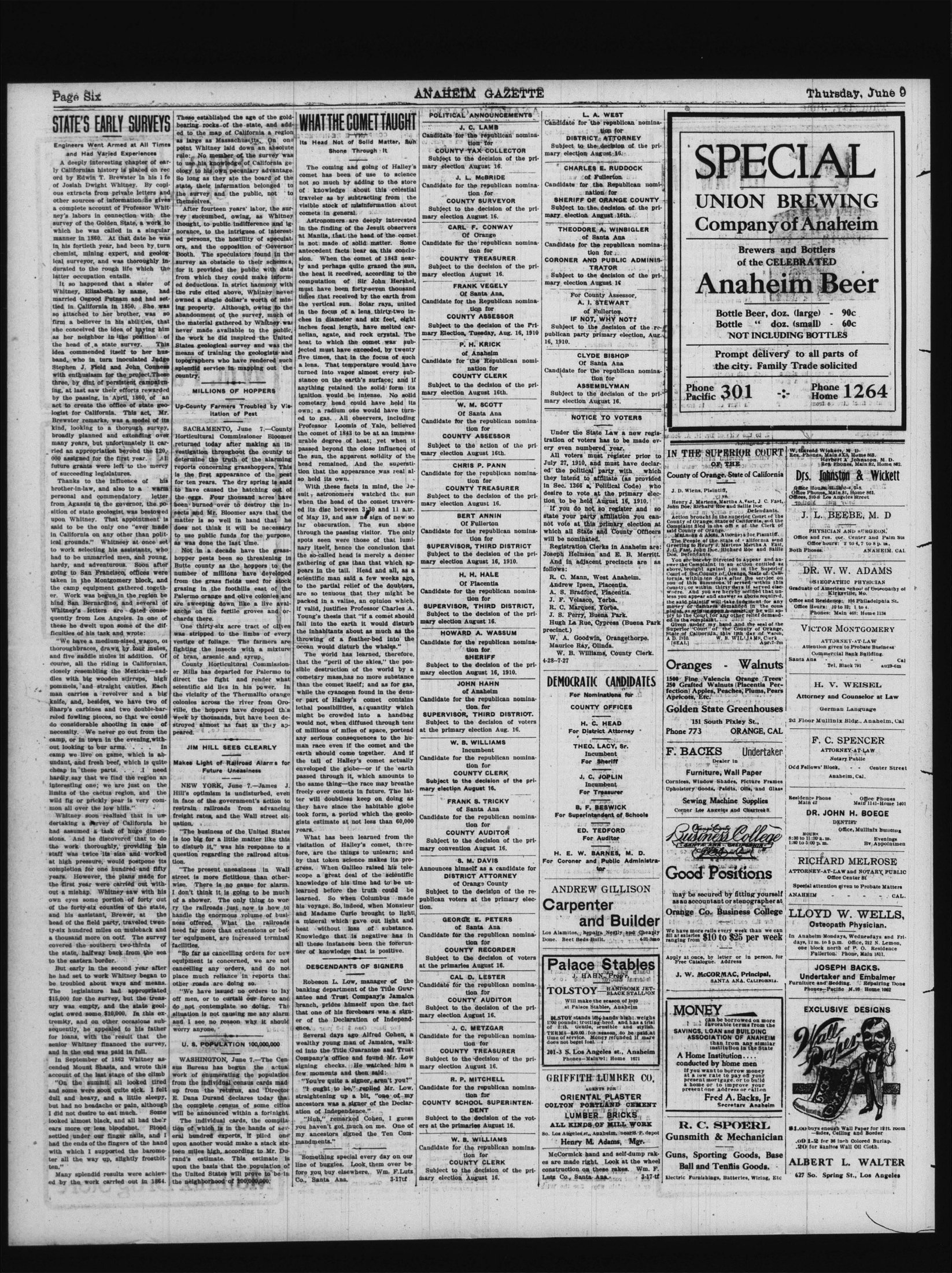
Searchable text
STATE'S EARLY SURVEYS
Engineers Went Armed at All Times and Had Varied Experiences
A deeply interesting chapter of early Californian history is placed on record by Edwin T. Brewster in his life of Josiah Dwight Whitney. By copious extracts from private letters and other sources of information he gives a complete account of Professor Whitney's labors in connection with the survey of the Golden State, a work to which he was called in a singular manner in 1860. At that date he was in his fortileth year, had been by turn chemist, mining expert, and geological surveyor, and was thoroughly indurated to the rough life which the latter occupation entails.
It so happened that a sister of Whitney, Elizabeth by name, had married Osgood Putnam and had settled in California in 1850. She was so attached to her brother, was so firm a believer in his abilities, that she conceived the idea of having him as her neighbor in the position of the head of a state survey. This idea commended itself to her husband, who in turn inoculated Judge Stephen J. Field and John Conness with enthusiasm for the project. These three, by dint of persistent campaigning, at last saw their efforts rewarded by the passing, in April, 1860, of an act to create the office of state geologist for California. This act, Mr. Brewster remarks, was a model of its kind, looking to a thorough survey, broadly planned and extending over many years, but unfortunately it carried an appropriation beyond the $20,000 assigned for the first year. All future grants were left to the mercy of succeeding legislatures.
These established the age of the gold-bearing rocks of the state, and added to the map of California a region as large as Massachusetts. On one point Whitney laid down an absolute rule: No member of the survey was to use his knowledge of California geology to his own pecuniary advantage. So long as they ate the board of the state, their information belonged to the survey and the public, not to themselves.
After fourteen years' labor, the survey succumbed, owing, as Whitney thought, to public indifference and ignorance, to the intrigues of interested persons, the hostility of speculators, and the opposition of Governor Booth. The speculators found in the survey an obstacle to their schemes, for it provided the public with data from which they could make informed deductions. In strict harmony with the rule cited above, Whitney never owned a single dollar's worth of mining property. Although, owing to the abandonment of the survey, much of the material gathered by Whitney was never made available to the public, the work he did inspired the United States geological survey and was the means of training the geologists and topographers who have rendered such splendid service in mapping out the country.
MILLIONS OF HOPPERS
Up-County Farmers Troubled by Visitation of Pest
SACRAMENTO, June 7.—County Horticultural Commissioner Bloomer returned today after making an investigation throughout the county to determine the truth of the alarming reports concerning grasshoppers. This is the first appearance of the pest.
WHAT THE COUNTY
Its Head Not of Shone T
The coming and comet has been not so much by of knowledge traveler as by visible stock of comets in general.
Astronomers are in the finding of that at Manila, that there is not made of antecedent facts by vision. When the comet is only and perhaps quite the heat it receives computation of must have been few times that received the vertical sun. In the focus of angles in diameter inches focal length nelian, agate, and heat to which this object must have five times that in a lens. That temp turned into vapor stance on the earth anything retained ignition would be cometary head coown; a radium omitted to gas. All of Professor Loomis the comet of 1843urable degree of passed beyond that the sun, the apparent head remained.
with enthusiasm for the project. These three, by dint of persistent campaigning, at last saw their efforts rewarded by the passing, in April, 1860, of an act to create the office of state geologist for California. This act, Mr. Brewster remarks, was a model of its kind, looking to a thorough survey, broadly planned and extending over many years, but unfortunately it carried an appropriation beyond the $20,000 assigned for the first year. All future grants were left to the mercy of succeeding legislatures.
Thanks to the influence of his brother-in-law, and also to a warm personal and commendatory letter from Agassiz to the governor, the position of state geologist was bestowed upon Whitney. That appointment is said to be the only one "ever made in California on any other than political grounds." Whitneey at once set to work selecting his assistants, who had to be unmarried men, and young, hardy, and adventurous. Soon after going to San Francisco, offices were taken in the Montgomery block, and the camp equipment gathered together. Work was begun in the region behind San Bernardino, and several of Whitney's letters are dated consequently from Los Angeles. In one of these he dwelt upon some of the difficulties of his task and wrote:
"We have a medium-sized wagon, or thoroughbraces, drawn by four mules, and five saddle mules in addition. Of course, all the riding is Californian, closely resembling the Mexican—saddles with big wooden stirrups, high pommels, and straight cantles. Each man carries a revolver and a big knife, and, besides, we have two of Sharp's carbines and two double-barreled fowling pieces, so that we could do considerable shooting in case of necessity. We never go out from the camp, or in town in the evening, without looking to our arms. In camp we live on game, which is abundant, and fresh beef, which is quite cheap in these parts. I need hardly say that we find the region an interesting one; we are just on the limits of the cactus region, and the wild fig or prickly pear is very common all over the low hills."
Whitney soon realized that in undertaking a Survey of California he had assumed a task of huge dimensions. And he discovered that to do the work thoroughly, providing his staff was twice its size and worked at high pressure, would postpone its completion for one hundred and fifty years. However, the plans made for the first year were carried out without a mishap. Whitney saw with his own eyes some portion of forty out country.
MILLIONS OF HOPPERS
Up-County Farmers Troubled by Visitation of Pest
SACRAMENTO, June 7.—County Horticultural Commissioner Bloomer returned today after making an investigation throughout the county to determine the truth of the alarming reports concerning grasshoppers. This is the first appearance of the pest for ten years. The dry spring is said to have caused the hatching out of the eggs. Four thousand acres have been burned over to destroy the insects and Mr. Bloomer says that the matter is so well in hand that he does not think it will be necessary to use public funds for the purpose as was done the last time.
Not in a decade have the grasshopper pests been so threatening in Butte county as the hoppers to the number of millions have developed from the grass fields used for stock grazing in the foothills east of the Palermo orange and olive colonies and are sweeping down like a live avalanche on the fertile groves and orchards there.
One thirty-six acre tract of olives was stripped to the limbs of every vestige of foliage. The farmers are fighting the insects with a mixture of bran, arsenic and syrup.
County Horticultural Commissioner Mills has departed for Palermo to direct the fight and render what scientific aid lies in his power. In the vicinity of the Thermalto orange colonies across the river from Oroville, the hoppers have dropped this week by thousands, but have been destroyed almost as fast as they appeared.
JIM HILL SEES CLEARLY
Makes Light of Railroad Alarms for Future Uneasiness
NEW YORK, June 7.—James J. Hill's optimism is undisturbed, even in face of the government's action to restrain railroads from advancing freight rates, and the Wall street situation.
"The business of the United States is too big for a little matter like this to disturb it," was his response to a question regarding the railroad situation.
"The present uneasiness in Wall street is more fictitious than otherwise. There is no cause for alarm. I don't think it is going to be much carried into vigor any thing retained on cometary head coown; a radium owned to gas. All o Professor Loomis the comet of 1843urable degree of passed beyond thatthe sun,the apparent head remained,tion that the appearso held its own.
With these facts suit astronomers when the head offeds disc between May 19,and saw lar obscuration through the passing spots seen were thinary itself,hencethe so-called head gathering of gas tpears in the tail.scientific man saidto the partial reliefare so tenuous tha packed in a valise;if valid,justifies PrYoung's thesis thatfall into the earththe inhabitants aboutthrowing of a feederocean would disturbThe world hasthat the "peril of thible destruction ocometary mass,hasthan than the comet itswhile the cyanogener part of Halley'slethal possibilities,might be crowdedwould not,when diolof millions of milesany serious consequenceman race even ifthe earth should comethe tail of Halleyenveloped the globepassed through it,the same thing—thefreely over cometster will doubtlessthey have since thie took form,a periodgists estimate at nyeears.
What has beenvisitation of Halleyfore,are the thingby that token secrgress. When Galllscope a great dealknowledge of his trelearned before thielearned.So when
Whitney soon realized that in undertaking a survey of California he had assumed a task of huge dimensions. And he discovered that to do the work thoroughly, providing his staff was twice its size and worked at high pressure, would postpone its completion for one hundred and fifty years. However, the plans made for the first year were carried out without a mishap. Whitney saw with his own eyes some portion of forty out of the forty-six counties of the state, and his assistant, Brewer, at the head of the field party, traveled twenty-six hundred miles on muleback and a thousand more on ootf. The survey covered the southern two-thirds of the state, halfway back from the sea to the eastern border.
But early in the second year after he had set to work Whitney began to be troubled about ways and means. The legislature had appropriated $15,000 for the survey, but the treasury was empty, and the state geologist owed some $10,000. In this extremity, and on other occasions subsequently, he appealed to his father for loans, with the result that the senior Whitney financed the survey, and in the end was paid in full.
In September of 1862 Whitney ascended Mount Shasta, and wrote this account of the last stage of the climb
"On the summit all looked tired and some were soon quite sick. I felt dull and heavy, and a little sleepy, but had no headache or pain, although I did not desire to eat much. Some looked almost black, and all had their ears more or less bloodshot. Blood settled under our finger nails, and I had the ends of the fingers of the hand with which I supported the barometer all the way up, slightly frostbitten."
Many splendid results were achieved by the work carried out in 1864.
WASHINGTON, June 7.—The Census Bureau has begun the actual work of enumerating the population from the individual census cards made up from the returns, and Director E. Dana Durand declares today that the complete census of some cities will be announced within a fortnight.
The individual cards, the compilation of which is in the hands of several hundred experts, if piled upon another would make a stack sixteen miles high, according to Mr. Durand's estimate. This estimate is upon the basis that the population of the United States will prove to be in the neighborhood of 100,000,000.
"The business of the United States is too big for a little matter like this to disturb it," was his response to a question regarding the railroad situation.
"The present uneasiness in Wall street is more fictitious than otherwise. There is no cause for alarm. I don't think it is going to be much of a shower. The only thing to worry the railroads just now is how to handle the enormous volume of business offered. What the railroads need far more than extensions or better equipment, are increased terminal facilities.
"So far as cancelling orders for new equipment is concerned, we are not cancelling any orders, and do not place much reliance in reports that other roads are doing so.
"We have issued no orders to lay off men, or to curtail our force and do not contemplate so doing. The situation is not causing me any alarm and I see no reason why it should worry anyone."
WHAT THE COMET TAUGHT
Its Head Not of Solid Matter, Sun Shone Through It
The coming and going of Halley's comet has been of use to science not so much by adding to the store of knowledge about this celestial traveler as by subtracting from the visible stock of misinformation about comets in general.
Astronomers are deeply interested in the finding of the Jesuit observers at Manila, that the head of the comet is not made of solid matter. Some antecedent facts bear on this conclusion. When the comet of 1843 nearly and perhaps quite grazed the sun, the heat it received, according to the computation of Sir John Hershel, must have been forty-seven thousand times that received by the earth from the vertical sun. Solar rays, united in the focus of a lens, thirty-two inches in diameter and six feet, eight inches focal length, have melted carneilan, agate, and rock crystal. The heat to which the comet was subjected must have exceeded, by twenty five times, that in the focus of such a lens. That temperature would have turned into vapor almost every substance on the earth's surface; and if anything retained the solid form its ignition would be intense. No solid cometary head could have held its own; a radium one would have turned to gas. All observers, including Professor Loomis of Yale, believed the comet of 1843 to be at an immeasurable degree of heat; yet when it passed beyond the close influence of the sun, the apparent solidity of the head remained. And the superstition that the appearance was real al-
POLITICAL ANNOUNCEMENTS
J. C. LAMB
Candidate for the republican nomination for
COUNTY TAX COLLECTOR
Subject to the decision of the primary election August 16.
J. L. McBRIDE
Candidate for the republican nomination for
COUNTY SURVEYOR
Subject to the decision of the primary election August 16.
CARL F. CONWAY
Of Orange
Candidate for the republican nomination for
COUNTY TREASURER
Subject to the decision of the primary election August 16.
FRANK VEGELY
Of Santa Ana,
Candidate for the Republican nomination for
COUNTY ASSESSOR
Subject to the decision of the Primary Election, Tuesday, Aug. 16, 1910
P. H. KRICK
of Anaheim
Candidate for the Republican nomination for
COUNTY CLERK
Subject to the decision of the primary election August 16th.
W. M. SCOTT
Of Santa Ana
Candidate for the republican nomination for
COUNTY ASSESSOR
Subject to the action of the primary election August 16th.
CHRIS P. PANN
Candidate for the republican nomina-
L. A. WEST
Candidate for the republican nomination for
DISTRICT ATTORNEY
Subject to the decision of the primary election August 16.
CHARLES E. RUDDOCK
of Fullerton
Candidate for the Republican nomination for
SHERIFF OF ORANGE COUNTY
Subject to the decision of the primary election August 16th.
THEODORE A. WINBIGLER
of Santa Ana
Candidate for the republican nomination for
CORONER AND PUBLIC ADMINISTRATOR
Subject to the decision of the primary election August 16
For County Assessor,
A. I. STEWART
of Fullerton.
IF NOT, WHY NOT?
Subject to the decision of the republican party primary election, Aug. 16, 1910.
CLYDE BISHOP
Of Santa Ana
Candidate for the republican nomination for
ASSEMBLYMAN
Subject to the decision of the primary election August 16.
NOTICE TO VOTERS
Under the State Law a new registration of voters has to be made every even numbered year.
All voters must register prior to July 27, 1910, and must have declared the political party with which
stance on the earth's surface; and if anything retained the solid form its ignition would be intense. No solid cometary head could have held its own; a radium one would have turned to gas. All observers, including Professor Loomis of Yale, believed the comet of 1843 to be at an immeasurable degree of heat; yet when it passed beyond the close influence of the sun, the apparent solidity of the head remained. And the superstition that the appearance was real also held its own.
With these facts in mind, the Jesuit astronomers watched the sun when the head of the comet traversed its disc between 3:30 and 11 am. of May 19, and saw no sign of new soar obscuration. The sun shone through the passing visitor. The only spots seen were those of that luminary itself, hence the conclusion that the so-called head is merely a denser gathering of gas than that which appears in the tail. Head and all, as a scientific man said a few weeks ago, to the partial relief of the doubters, are so tenuous that they might be packed in a valise, an opinion which, if valid, justifies Professor Charles A. Young's thesis that "If a comet should fall into the earth it would disturb the inhabitants about as much as the throwing of a feather-bed into the ocean would disturb the whales."
The world has learned, therefore, that the "peril of the skies," the possible destruction of the world by a cometary mass, has no more substance than the comet itself; and as for gas, while the cyanogen found in the denser part of Halley's comet contains lethal possibilities, a quantity which might be crowded into a handbag would not, when diffused through tens of millions of miles of space, portend any serious consequences to the human race even if the comet and the earth should come together. And if the tail of Halley's comet actually enveloped the globe—or if the earth passed through it, which amounts to the same thing—the race may breathe freely over comets in future. The latter will doubtless keep on doing as they have since the habitable globe took form, a period which the geologists estimate at not less than 60,000 years.
What has been learned from the visitation of Halley's comet, therefore, are the things to unlearn; and by that token science makes its progress. When Galileo raised his telescope a great deal of the scientific knowledge of his time had to be unlearned before the truth could be learned. So when Columbus made landfall into vapor almost every day on the earth's surface; and if anything retained the solid form its ignition would be intense. No solid cometary head could have held its own; a radium one would have turned to gas. All observers, including Professor Loomis of Yale, believed the comet of 1843 to be at an immeasurable degree of heat; yet when it passed beyond the close influence of the sun, the apparent solidity of the head remained. And the superstition that the appearance was real also held its own.
With these facts in mind, the Jesuit astronomers watched the sun when the head of the comet traversed its disc between 3:30 and 11 am. of May 19, and saw no sign of new soar obscuration. The sun shone through the passing visitor. The only spots seen were those of that luminary itself, hence the conclusion that the so-called head is merely a denser gathering of gas than that which appears in the tail. Head and all, as a scientific man said a few weeks ago, to the partial relief of the doubters, are so tenuous that they might be packed in a valise, an opinion which, if valid, justifies Professor Charles A. Young's thesis that "If a comet should fall into the earth it would disturb the inhabitants about as much as the throwing of a feather-bed into the ocean would disturb the whales."
The world has learned, therefore, that the "peril of the skies," the possible destruction of the world by a cometary mass, has no more substance than the comet itself; and as for gas, while the cyanogen found in the denser part of Halley's comet contains lethal possibilities, a quantity which might be crowded into a handbag would not, when diffused through tens of millions of miles of space, portend any serious consequences to the human race even if the comet and the earth should come together. And if the tail of Halley's comet actually enveloped the globe—or if the earth passed through it, which amounts to the same thing—the race may breathe freely over comets in future. The latter will doubtless keep on doing as they have since the habitable globe took form, a period which the geologists estimate at not less than 60,000 years.
What has been learned from the visitation of Halley's comet, therefore, are the things to unlearn; and by that token science makes its progress. When Galileo raised his telescope a great deal of the scientific knowledge of his time had to be unlearned before the truth could be learned. So when Columbus made landfall into vapor almost every day on the earth's surface; and if anything retained the solid form its ignition would be intense. No solid cometary head could have held its own; a radium one would have turned to gas. All observers, including Professor Loomis of Yale, believed the comet of 1843 to be at an immeasurable degree of heat; yet when it passed beyond the close influence of the sun, the apparent solidity of the head remained. And the superstition that the appearance was real also held its own.
With these facts in mind, the Jesuit astronomers watched the sun when the head of the comet traversed its disc between 3:30 and 11 am. of May 19, and saw no sign of new soar obscuration. The sun shone through the passing visitor. The only spots seen were those of that luminary itself, hence the conclusion that the so-called head is merely a denser gathering of gas than that which appears in the tail. Head and all, as a scientific man said a few weeks ago, to the partial relief of the doubters, are so tenuous that they might be packed in a valise, an opinion which, if valid, justifies Professor Charles A. Young's thesis that "If a comet should fall into the earth it would disturb the inhabitants about as much as the throwing of a feather-bed into the ocean would disturb the whales."
The world has learned, therefore, that the "peril of the skies," the possible destruction of the world by a cometary mass, has no more substance than the comet itself; and as for gas, while the cyanogen found in the denser part of Halley's comet contains lethal possibilities, a quantity which might be crowded into a handbag would not, when diffused through tens of millions of miles of space, portend any serious consequences to the human race even if the comet and the earth should come together. And if the tail of Halley's comet actually enveloped the globe—or if the earth passed through it, which amounts to the same thing—the race may breathe freely over comets in future. The latter will doubtless keep on doing as they have since the habitable globe took form, a period which the geologists estimate at not less than 60,000 years.
What has been learned from the visitation of Halley's comet, therefore, are the things to unlearn; and by that token science makes its progress. When Galileo raised his telescope a great deal of the scientific knowledge of his time had to be unlearned before the truth could be learned. So when Columbus made landfall into vapor almost every day on the earth's surface; and if anything retained the solid form its ignition would be intense. No solid cometary head could have held its own; a radium one would have turned to gas. All observers, including Professor Loomis of Yale, believedthe comet of 1843 to be at an immeasurable degree of heat; yet when it passed beyondthe close influenceofthe sun,the apparent solidityoftheheadremained.Andthesuperstitionthattheappearancewasrealalsohelditsown.
With these facts in mind,the Jesuit astronomers watchedthe sunwhentheheadofthecomettraverseditsdiscbetween3:30and11am.ofMay19,andsawno.signofnewsoarsobscuration.Thesunshonethroughthepassingvisitor.Theonlyspotsseenwerethoseofthatluminaryitself,hencetheconclusionthattheso-calledheadismerelya densergatheringofgasthanthatwhichappearsinthetail.Headandall.asascientificmansaidafewweeksago,tothepartialreliefofthedoubters,aesotennuousthattheymightbepackedinavalise,anopinionwhichifvalid,justifiesProfessorCharlesA.Young'sthesisthat"Ifacometshouldfallintotheearthitwoulddisturbtheinhabitantsaboutasmuchasthethrowingofafeatherbedintoetheoceanwoulddisturbthewhales."
The world has learned,thesefactsontherelationsoftheprimaryelectionAugust16th.
W.M.SCOTT
OfSanta Ana
Candidatefortherepublicnominationfor
COUNTYASSESSOR
SubjecttotheactionoftheprimaryelectionAugust16th.
CHRISP.PANN
Candidatefortherepublicnominationfor
COUNTYTREASURER
SubjecttothedecisionoftheprimaryelectionAugust16.
BERTANNIN
OfFullerton
Candidatefortherepublicnominationfor
SUPERVISOR,THIRDDISTRICT
SubjecttothedecisionoftheprimaryelectionAugust16.
H.H.HALE
OfPlacentia
Candidatefortherepublicnominationfor
SUPERVISOR,THIRDDISTRICT.
SubjecttothedecisionoftheprimaryelectionAugust16.
HOWARDA.WASSUM
Candidatefortherepublicnominationfor
SHERIFF
SubjecttothedecisionoftheprimaryelectionAugust16.
JOHNHAHN
ofAnaheim
Candidatefortherepublicnominationfor
COUNTYOFFICES
H.C.CHEAD
ForDistrictAttorney
THEO.LACY,Sr.
Incumbent
ForSheriff
J.C.JOPLIN
Incumbent
ForTreasurer
B.F.BESWICK
ForSuperintendentofSchools
ED.TEDFORD
ForAuditor
H.E.W.BARNES,M.D.
ForCoronerandPublicAdministrator
ANDREWGILLISON
DESCENDANTS OF SIGNERS
Robeson L. Low, manager of the banking department of the Title Guarantee and Trust Company's Jamaica branch, prides himself upon the fact that one of his forebears was a signer of the Declaration of Independence.
Several days ago Alfred Cohen, a wealthy young man of Jamaica, walked into the Title Guarantee and Trust Company's office and found Mr. Low signing checks. He watched him a few moments and then said:
"You're quite a signer, aren't you?"
"I ought to be," replied Mr. Low, straightening up a bit, "one of my ancestors was a signer of the Declaration of Independence."
"Huh," remarked Cohen, I guess you haven't got much on me. One of my ancestors signed the Ten Commandments."
Something special every day on our line of buggies. Look them over before you buy elsewhere. Wm. F.Lutz Co., Santa Ana.
FRANK S. TRICKY
of Santa Ana
Candidate for the republican nomination for
COUNTY AUDITOR
Subject to the decision of the primary convention August 16.
S. M. DAVIS
Announces himself as a candidate for DISTRICT ATTORNEY
of Oranges County
Subject to the decision of the republican voters at the primary election.
GEORGE E. PETERS
of Santa Ana
Candidate for the republican nomination for
COUNTY RECORDER
Subject to the decision of voters at the primaries August 16.
CAL D. LESTER
Candidate for the republican nomination for
COUNTY AUDITOR
Subject to the decision of the primary election August 16.
J. C. METZGAR
Candidate for the republican nomination for
COUNTY TREASURER
Subject to the decision of the primary election August 16.
R. P. MITCHELL
Candidate for the republican nomination for
COUNTY SCHOOL SUPERINTENDENT
Subject to the decision of the voters at the primaries August 16.
W. B. WILLIAMS
Candidate for the republican nomination for
COUNTY CLERK
Subject to the decision of the primary election August 16.
B. F. BESWICK
For Superintendent of Schools
ED. TEDFORD
For Auditor
H. E. W. BARNES, M. D.
For Coroner and Public Administrator
ANDREW GILLISON
Carpenter and Builder
Los Alamitos, Repairs Neatly and Cheaply Done. Beet Beds Built.
Palace Stables
J. HAHN, Prop.
TOLSTOY—HANDSOME JET-BLACK STALLION
Will make the season of 1910 at Palace Stables, Anaheim
BLSTOY stands 104 hands high; weighs 1200 pounds; trotting, bred, and has a trial of 2:15. Gentle, sensible and stylish.
TERMS—$20.00 for season, to be paid at time of service. Money refunded if mare does not beget foal.
201-3 S. Los Angeles st., Anaheim
Phones—Main wl; Home 1671
GRIFFITH LUMBER CO.
AGENTS FOR ORIENTAL PLASTER COLTON PORTLAND CEMENT LUMBER BRICKS ALL KINDS OF MILL WORK
So. Los Angeles st., Anaheim, near S. P. depot Henry M. Adams, Mgr.
McCormick hand and self-dump rakes are made right. Look at the wheel construction on these rakes. Wm. F. Lutz Co., Santa Ana. 3-17-tf
SPECIAL
UNION BREWING
Company of Anaheim
Brewers and Bottlers
of the CELEBRATED
Anaheim Beer
Bottle Beer, doz. (large) - 90c
Bottle “doz. (small) - 60c
NOT INCLUDING BOTTLES
Prompt delivery to all parts of
the city. Family Trade solicited
Phone Pacific 301 Phone Home 1264
IN THE SUPERIOR COURT
OF THE
IN THE SUPERIOR COURT OF THE
County of Orange, State of California
J. D. Wiens, Plaintiff,
vs.
Henry J. Martena, Martha A. Fast, J. C. Fast,
John Doe; Richard Roe and Sailie Doe
Defendants.
Action brought in the Superior Court of the County of Orange, State of California, and the Complaint filed in the office of the Clerk of said County of Orange.
MELROSS & AMES, Attorneys for Plaintiff.
The People of the State of California send Greeting to Henry J. Martena Martha A. Fast, J. C. Fast, John Doe, Richard Roe and Sailie Doe, Defendants.
You are hereby Directed to Appear and answer the Complaint in an action entitled as above, brought against you in the Superior Court of the County of Orange, State of California, within ten days after the service on you of this summons. If served within this county; or within thirty days if served elsewhere. And you are hereby notified that unless you appear and answer as above required, the said plaintiff will take judgment for any money or damages demanded in the complaint, as arising upon contract or be will apply to the Court for any other relief demanded in the complaint.
Given under my hand and the seal of the Superior Court of the County of Orange, State of California, this 19th day of March, A.D. 1910.
W. B. WILLIAMS, Clerk
[SEAL]
Oranges - Walnuts
1500 Fine Valencia Orange Trees
250 Grafted Walnuts (Placentia Perfection) Apples, Peaches, Plums, Pears Apricots, Etc.
Golden State Greenhouses
151 South Pixley St., Phone 773 ORANGE, CAL
F. BACKS Undertaker
Dealer in
Furniture, Wall Paper
Cornices, Window Shades, Picture Frames
Upholstery Goods, Pallets, Oils, and Glass
Sewing Machine Supplies
Corner Los Angeles and Chantree 8
Good Positions may be secured by fitting yourself
W. Harold Wickett, M.D.
Res. Phones, Main 8Xa Home 863.
Herbert A Johnston, M.D.
Res. Phones, Main 82 Home 862.
Drs. Johnston & Wickett
Office Hours: M.D. 11:42-4:35.
Office Phones, Main 81, Home 861.
Offices: 810-8 Los Angeles Street
J. L. BEEBE, M.D
PHYSICIAN AND SURGEON.
Office and res. cor. Center and Palm Sts
Office hours: 2 to 4, 7 to 8 p.m.
Both Phones.
ANAHEIM, CAL
DR. W. W. ADAMS
OSIEOPATHIC PHYSICIAN
Graduate of American School of Orthopathy of Kirksville, Mo.
Office and Residence: 16 Philadelphia St.
Office Hours: 10 to 12; 1 to 4.
Phones: Main 463; Home 1134
VICTOR MONTGOMERY
ATTORNEY-AT-LAW
Attention given to Probate Business
Commercial Bank Building.
Santa Ana Cal
Tel. Black 791 au29-6m
H. V. WEISEL
Attorney and Counselor at Law
German Language
2d Floor Mullinix Bldg., Anaheim, Cal
F. C. SPENCER
ATTORNEY-AT-LAW
Notary Public
Odd Fellows' Block,
Center Street Anaheim, Cal.
Residence Phone Main 42 Office Phones Main 1141-Home 1401
DR. JOHN H. BOEGE
DENTIST
HOURS
8:30 to 11:30 a.m.
Evenings
1:30 to 5:00 p.m.
Bv Appointmen
RICHARD MELROSE
ATTORNEY-AT-LAW and NOTARY PUBLIC
Office Center 8f
Special attention given to Probate Matters
ANAHEIM CAL.
BESWICK
Indent of Schools
EDFORD
Auditor
ARNES, M. D.
Public Administrator
GILLISON
ter
d Builder
Nestly and Cheaply
ilt.
Stables
HANDSOME JET-BLACK STALLION
the season of 1910
Tables, Anaheim
LUMBER CO.
PLASTER
TILAND CEMENT
BRICKS
OF MILL WORK
anaheim, near S.P. depot
Adams, Mgr.
and self-dump rak.
Look at the wheel
these rakes. Wm. F.
Ana.
Sewing Machine Supplies
Corner Los Angeles and Chartreuse.
Business College
CANTON AND CALIFORNIA
Good Positions
may be secured by fitting yourself as an accountant or stenographer at Orange Co. Business College
We have more calls every week than we can fill at salaries ranging from $10 to $25 per week
Apply at once, by letter or in person, for Free Catalogue. Address
J. W. McCORMAC, Principal,
SANTA ANA, CALIFORNIA.
MONEY
can be borrowed on more favorable terms from the SAVINGS, LOAN and BUILDING ASSOCIATION OF ANAHEIM than from any similar institution in the State
A Home Institution... conducted by home men
If you want to borrow money at a low rate to pay off your present mortgage, or to build a home or to improve your present one address or call on Fred A. Backs, Jr.
Secretary Anaheim
R. C. SPOERL
Gunsmith & Mechanician
Guns, Sporting Goods, Base Ball and Tennis Goods.
Electric Furnishings, Batteries, Wiring, Etc
DR. JOHN H. BOEGE
DENTIST
Office, Mullinix Building
HOURS
8:30 to 11:30 a.m.
1:30 to 5:00 p.m.
Evenings
Bv Appointmen
RICHARD MELROSE
ATTORNEY-AT-LAW and NOTARY PUBLIC Office Center St
Special attention given to Probate Matters
ANAHEIM - CAL.
LLOYD W. WELLS,
Osteopath Physician.
In Anaheim Mondays, Wednesdays and Fridays, 12 m. to 5 p.m. Office, 212 N. Lemon, one block north of P.O. Residence Fullerton. Phone, Main 1811.
JOSEPH BACKS.
Undertaker and Embalmer
Furniture and Bedding. Repairing Done Phones—Pacific M.98 Home 1062
EXCLUSIVE DESIGNS
$1.00 buys enough Wall Paper for 19ft. room —Sides, Ceiling and Border
.09 1-2 for 36 inch Colored Burlap.
.20 for Sanitos Wall Oil Cloth.
ALBERT L. WALTER
627 So. Spring St., Los Angeles