anaheim-gazette 1910-03-31
Scanned page
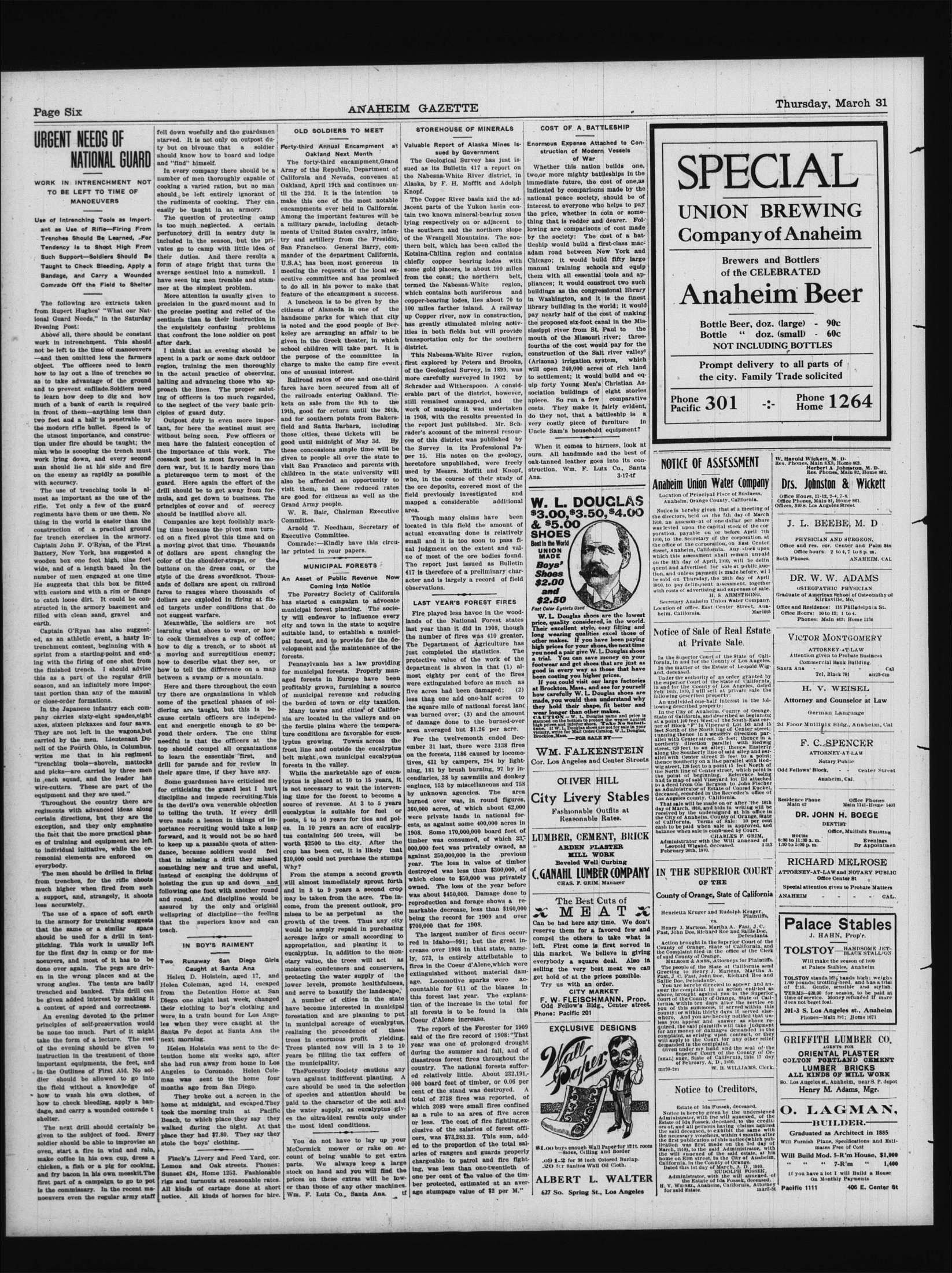
Searchable text
URGENT NEEDS OF NATIONAL GUARD
WORK IN INTRENCHMENT NOT TO BE LEFT TO TIME OF MANOEUVERS
Use of Intrenching Tools as Important as Use of Rifle—Firing From Trenches Should Be Learned, For Tendency Is to Shoot High From Such Support—Soldiers Should Be Taught to Check Bleeding, Apply a Bandage, and Carry a Wounded Comrade Off the Field to Shelter
The following are extracts taken from Rupert Hughes' "What our National Guard Needs," in the Saturday Evening Post:
Above all, there should be constant work in intrenchment. This should not be left to the time of manoeuvers—and then omitted less the farmers object. The officers need to learn how to lay out a line of trenches so as to take advantage of the ground and to prevent enfilade.Soldiers need to learn how deep to dig and how much of a bank of earth is required in front of them—anything less than two feet and a half is penetrable by the modern rifle bullet. Speed is of the utmost importance, and construction under fire should be taught; the man who is scooping the trench must work lying down, and every second man should lie at his side and fire on the enemy as rapidly as possible fell down woefully and the guardsmen starved. It is not only on outpost duty but on bivouac that a soldier should know how to board and lodge and "find" himself.
In every company there should be a number of men thoroughly capable of cooking a varied ration, but no man should be left entirely ignorant of the rudiments of cooking. They can easily be taught in an armory.
The question of protecting camp is too much neglected. A certain perfunctory drill in sentry duty is included in the season, but the privates go to camp with little idea of their duties. And there results a form of stage fright that turns the average sentinel into a numskull. I have seen big men tremble and stammer at the simplest problem.
More attention is usually given to precision in the guard-mount and in the precise posting and relief of the sentinels than to their instruction in the exquisitely confusing problems that confront the lone soldier on post after dark.
I think that an evening should be spent in a park or some dark outdoor region, training the men thoroughly in the actual practice of observing, halting and advancing those who approach the lines. The proper saluting of officers is too much regarded, to the neglect of the very basic principles of guard duty.
Outpost duty is even more important, for here the sentinel must see without being seen. Few officers or men have the faintest conception of the importance of this work. The cossack post is most favored in modern war, but it is hardly more than a picturesque term to most of the
OLD SOLDIERS THAT
Forty-third Annual Enquiry Oakland Next Month
The forty-third encampment Army of the Republic, California and Nevada, Oakland, April 19th and till the 23d. It is the way make this one of the encampments ever held Among the important feats a military parade, includes of United States try and artillery from San Francisco. General mander of the department U.S.A.; has been most meeting the requests of ecutive committee and to do all in his power feature of the encampment.
A luncheon is to be held citizens of Alameda in handsome parks for which is noted and the good pikeley are arranging and given in the Greek these school children will take the purpose of the co-charge to make the car one of unusual interest.
Railroad rates of one fares have been secure the railroads entering kets on sale from the 19th, good for return uand for southern points field and Santa Barbara those cities, these tickets good until midnight of these concessions ample given to people all over visit San Francisco and children in the state u
how to lay out a line of trenches so as to take advantage of the ground and to prevent enfilade.Soldiers need to learn how deep to dig and how much of a bank of earth is required in front of them—anything less than two feet and a half is penetrable by the modern rifle bullet. Speed is of the utmost importance, and construction under fire should be taught; the man who is scooping the trench must work lying down, and every second man should lie at his side and fire on the enemy as rapidly as possible with accuracy.
The use of trenching tools is almost as important as the use of the rifle. Yet only a few of the guard regiments have them or use them. Nothing in the world is easier than the construction of a practical ground for trench exercises in the armory. Captain John F. O'Ryan, of the First Battery, New York, has suggested a wooden box one foot high, nine feet wide, and of a length based on the number of men engaged at one time. He suggests that this box be fitted with castors and with a rim or flange to catch loose dirt. It could be constructed in the armory basement and filled with clean sand, gravel and earth.
Captain O'Ryan has also suggested, as an athletic event, a hasty intrenchment contest, beginning with a sprint from a starting-point and ending with the firing of one shot from the finished trench. I should advise this as a part of the regular drill season, and an infinitely more important portion than any of the manual or close-order formations.
In the Japanese infantry each company carries sixty-eight spades,eight axes, sixteen pickaxes and four saws. They are not left in the wagons, but carried by the men. Lieutenant Dunell of the Fourth Ohio, in Columbus, writes me that in his regiment "trenching tools—shovels, mattocks and picks—are carried by three men in each squad, and the leader has wire-cutters. These are part of the equipment and they are used."
Throughout the country there are regiments with advanced ideas along certain directions, but they are the exception, and they only emphasize the fact that the more practical phases of training and equipment are left to individual initiative, while the ceremonial elements are enforced on everybody.
The men should be drilled in firing from trenches, for the rifle shoots much higher when fired from such a support, and, strangely, it shoots in the actual practice of observing, halting and advancing those who approach the lines. The proper saluting of officers is too much regarded, to the neglect of the very basic principles of guard duty.
Outpost duty is even more important, for here the sentinel must see without being seen. Few officers or men have the fairest conception of the importance of this work. The cossack post is most favored in modern war, but it is hardly more than a picturesque term to most of the guard. Here again the effort of the drill should be to get away from formula, and get down to business. The principles of cover and of secrecy should be instilled above all.
Companies are kept foolishly marking time because the pivot man turned on a fixed pivot this time and on a moving pivot that time. Thousands of dollars are spent changing the color of the shoulder-straps, or the buttons on the dress coat, or the style of the dress swordknot. Thousands of dollars are spent on railroad fares to ranges where thousands of dollars are exploded in firing at fixed targets under conditions that do not suggest warfare.
Meanwhile, the soldiers are not learning what shoes to wear, or how to cook themselves a cup of coffee; how to dig a trench, or to shoot at a moving and surreptitious enemy; how to describe what they see, or how to tell the difference on a map between a swamp or a mountain.
Here and there throughout the country there are organizations in which some of the practical phases of soldiering are taught, but this is because certain officers are independent and energetic enough to go beyond their orders. The one thing needful is that the officers at the top should compel all organizations to learn the essentials first, and drill for parade and for review in their spare time, if they have any.
Some guardsmen have criticised me for criticising the guard lest I hurt discipline and impede recruiting. This is the devil's own venerable objection to telling the truth. If every drill were made a lesson in things of importance recruiting would take a leap forward, and it would not be so hard to keep up a passable quota of attendance, because soldiers would feel that in missing a drill they missed something new and true and useful, instead of escaping the doldrums of hoisting the gun up and down and following one foot with another round and round. And discipline would be
Railroad rates of one fares have been secure; the railroads entering kets on sale from the 19th, good for return umpires good until midnight of these concessions ample given to people all over visit San Francisco and children in the state umpire also be afforded an umpire visit them, as these are good for citizens at Grand Army people.
W. R. Bair, Chairman Committee.
Arnold T. Needham, Executive Committee.
Comrade:—Kindly have lar printed in your paper.
MUNICIPAL FOR
An Asset of Public Rent
Coming Into N
The Forestry Society has started a campaign municipal forest planting will endeavor to increase suitable land, to establish pal forest, and to provide development and the main forests.
Pennsylvania has a lot for municipal forests. Aged forests in Europe profitably grown, furnishes of municipal revenue for the burden of town ordns.
Many towns and cities are located in the fertile plains where nature conditions are favorable lyptus growing. Town frost line and outside belt might own municipal forests in the valley.
While the marketable lyptus is placed at 10 miles is not necessary to walking time for the forest source of revenue. At eucalyptus is suitable posts, 5 to 10 years for es. In 10 years an acutus containing 500 trees worth $2500 to the city crop has been cut, it $10,000 could not purchase Why?
From the stumps a will almost immediately and in 8 to 9 years may be taken from ther
Throughout the country there are regiments with advanced ideas along certain directions, but they are the exception, and they only emphasize the fact that the more practical phases of training and equipment are left to individual initiative, while the ceremonial elements are enforced on everybody.
The men should be drilled in firing from trenches, for the rifle shoots much higher when fired from such a support, and, strangely, it shoots less accurately.
The use of a space of soft earth in the armory for trenching suggests that the same or a similar space should be used for a drill in tent-pitching. This work is usually left for the first day in camp or for manoeuvers, and most of it has to be done over again. The pegs are driven in the wrong places and at the wrong angles. The tents are badly trenched and banked. This drill can be given added interest by making it a contest of speed and correctness.
An evening devoted to the primer principles of self-preservation would be none too much. Part of it might take the form of a lecture. The rest of the evening should be given to instruction in the treatment of those important equipments, the feet, and in the Outlines of First Aid. No soldier should be allowed to go into the field without a knowledge of how to wash his own clothes, of how to check bleeding, apply a bandage, and carry a wounded comrade to shelter.
The next drill should certainly be given to the subject of food. Every soldier should be able to improvise an oven, start a fire in wind and rain, make coffee in his own cup, dress a chicken, a fish or a pig for cooking, and fry bacon in his own messkit. The first part of a campaign to go to pot is the commissary. In the recent manoeuvers even the regular army staff is the devil's own venerable objection to telling the truth. If every drill were made a lesson in things of importance recruiting would take a leap forward, and it would not be so hard to keep up a passable quota of attendance, because soldiers would feel that in missing a drill they missed something new and true and useful, instead of escaping the doldrums of hoisting the gun up and down and following one foot with another round and round. And discipline would be assured by the only and original wellspring of discipline—the feeling that the superiors know and can teach.
IN BOY'S RAIMENT
Two Runaway San Diego Girls Caught at Santa Ana
Helen D. Holstein, aged 17, and Helen Coleman, aged 14, escaped from the Detention Home at San Diego one night last week, changed their clothing to boy’s clothing and were in a train bound for Los Angeles when they were caught at the Santa Fe depot at Santa Ana the next morning.
Helen Holstein was sent to the detention home six weeks ago, after she had run away from home in Los Angeles to Coronado. Helen Coleman was sent to the home four months ago from San Diego.
They broke out a screen in the home at midnight, and escaped. They took the morning train at Pacific Beach, to which place they say they walked during the night. At that place they had $7.80. They say they stole the boys’ clothing.
Finch’s Livery and Feed Yard, cor. Lemon and Oak streets. Phones: Sunset 424, Home 1253. Fashionable rigs and turnouts at reasonable rates. All kinds of cartage done at short notice. All kinds of horses for hire.
From the stumps a will almost immediately and in 8 to 9 years may be taken from them come, from the present mises to be as perpetual growth of the trees. Would be amply repaid acreage large or small appropriation, and p eucalyptus. In addition etary value, the trees moisture condensers are protecting the water at lower levels, promoted and serve to beautify.
A number of citizens have become interested foreststation and are paid in municipal acreage realizing the precedent trees in enormous pr Trees planted now w years be filling the city municipality.
The Forestry Society town against indifferent care should be used of species and attention paid to the character of the water supply, as es the ultra-ideal resi erthe most ideal condition.
You do not have McCormick mower count of being unabli parts. We always stock on hand and you prices on these extra er than those of any Wm. F. Lutz Co., S
OLD SOLDIERS TO MEET
Forty-third Annual Encampment at Oakland Next Month
The forty-third encampment, Grand Army of the Republic, Department of California and Nevada, convenes at Oakland, April 19th and continues until the 23d. It is the intention to make this one of the most notable encampments ever held in California. Among the important features will be a military parade, including detachments of United States cavalry, infantry and artillery from the Presidio, San Francisco. General Barry, commander of the department California, U.S.A., has been most generous in meeting the requests of the local executive committee and has promised to do all in his power to make that feature of the encampment a success.
A luncheon is to be given by the citizens of Alameda in one of the handsome parks for which that city is noted and the good people of Berkeley are arranging an affair to be given in the Greek theater, in which school children will take part. It is the purpose of the committee in charge to make the camp fire event one of unusual interest.
Railroad rates of one and one-third fares have been secured from all of the railroads entering Oakland. Tickets on sale from the 9th to the 19th, good for return until the 26th, and for southern points from Bakersfield and Santa Barbara, including those cities, these tickets will be good until midnight of May 3d. By these concessions ample time will be given to people all over the state to visit San Francisco and parents with children in the state university will
STOREHOUSE OF MINERALS
Valuable Report of Alaska Mines Issued by Government
The Geological Survey has just issued as its Bulletin 417 a report on the Nabesna-White River district, in Alaska, by F. H. Moffit and Adolph Knopf.
The Copper River basin and the adjacent parts of the Yukon basin contain two known mineral-bearing zones lying respectively on or adjacent to the southern and the northern slope of the Wrangell Mountains. The southern belt, which has been called the Kotsina-Chitina region and contains chiefly copper bearing lodes with some gold placers, is about 100 miles from the coast; the northern belt, termed the Nabesna-White region, which contains both auriferous and copper-bearing lodes, lies about 70 to 100 miles farther inland. A railway up Copper river, now in construction, has greatly stimulated mining activities in both fields but will provide transportation only for the southern district.
This Nabesna-White River region, first explored by Peters and Brooks, of the Geological Survey, in 1899, was more carefully surveyed in 1902 by Schrader and Witherspoon. A considerable part of the district, however, still remained unmapped, and the work of mapping it was undertaken in 1908, with the results presented in the report just published. Mr. Schrader’s account of the mineral resources of this district was published by the Survey in its Professional Paper 15. His notes on the geology, heretofore unpublished, were freely used by Messrs. Moffit and Knopf,
COST OF A BATTLESHIP
Enormous Expense Attached to Construction of Modern Vessels of War
Whether this nation builds one, two, or more mighty battleships in the immediate future, the cost of one, as indicated by comparisons made by the national peace society, should be of interest to everyone who helps to pay the price, whether in coin or something that is redder and dearer. Following are comparisons of cost made by the society: The cost of a battleship would build a first-class macadam road between New York and Chicago; it would build fifty large manual training schools and equip them with all essential tools and appliances; it would construct two such buildings as the congressional library in Washington, and it is the finest library building in the world; it would pay nearly half of the cost of making the proposed six-foot canal in the Mississippi river from St. Paul to the mouth of the Missouri river; three-fourths of the cost would pay for the construction of the Salt river valley (Arizona) irrigation system, which will open 240,000 acres of rich land to settlement; it would build and equip forty Young Men’s Christian Association buildings of eight stories apiece. So run a few comparative costs. They make it fairly evident, do they not, that a battleship is a very costly piece of furniture in Uncle Sam’s household equipment?
When it comes to harness, look at ours. All handmade and the best of oak-tanned leather goes into its construction. Wm. F. Lutz Co., Santa
Railroad rates of one and one-third fares have been secured from all of the railroads entering Oakland. Tickets on sale from the 9th to the 19th, good for return until the 26th, and for southern points from Bakersfield and Santa Barbara, including those cities, these tickets will be good until midnight of May 3d. By these concessions ample time will be given to people all over the state to visit San Francisco and parents with children in the state university will also be afforded an opportunity to visit them, as these reduced rates are good for citizens as well as the Grand Army people.
W. R. Bair, Chairman Executive Committee.
Arnold T. Needham, Secretary of Executive Committee.
Comrade:—Kindly have this circular printed in your papers.
MUNICIPAL FORESTS
An Asset of Public Revenue Now Coming Into Notice
The Forestry Society of California has started a campaign to advocate municipal forest planting. The society will endeavor to influence every city and town in the state to acquire suitable land, to establish a municipal forest, and to provide for the development and the maintenance of the forests.
Pennsylvania has a law providing for municipal forests. Properly managed forests in Europe have been profitably grown, furnishing a source of municipal revenue and reducing the burden of town or city taxation.
Many towns and cities of California are located in the valleys and on the fertile plains where the temperature conditions are favorable for eucalyptus growing. Towns across the frost line and outside the eucalyptus belt might own municipal eucalyptus forests in the valley.
While the marketable age of eucalyptus is placed at 10 to 15 years, it is not necessary to wait the intervening time for the forest to become a source of revenue. At 3 to 5 years eucalyptus is suitable for fuel or posts, 5 to 10 years for ties and poles. In 10 years an acre of eucalyptus containing 500 trees, will be worth $2500 to the city. After the crop has been cut, it is likely that $10,000 could not purchase the stumps Why?
From the stumps a second growth will almost immediately sprout forth and in 8 to 9 years a second crop may be taken from the acre. The more carefully surveyed in 1902 by Schrader and Witherspoon. A considerable part of the district, however, still remained unmapped, and the work of mapping it was undertaken in 1908, with the results presented in the report just published. Mr. Schrader's account of the mineral resources of this district was published by the Survey in its Professional Paper 15. His notes on the geology, heretofore unpublished, were freely used by Messrs. Moffit and Knopf, who, in the course of their study of the ore deposits, covered most of the field previously investigated and mapped a considerable additional area.
Though many claims have been located in this field the amount of actual excavating done is relatively small and it is too soon to pass final judgment on the extent and value of most of the ore bodies found. The report just issued as Bulletin 417 is therefore of a preliminary character and is largely a record of field observations.
LAST YEAR'S FOREST FIRES
Fire played less havoc in the woodlands of the National Forest states last year than it did in 1908, though the number of fires was 410 greater. The Department of Agriculture has just completed the statistics. The protective value of the work of the department is shawin in that (1) almost eighty per cent of the fires were extinguished before as much as five acres had been damaged; (2) less than one and one-half acres to the square mile of national forest land was burned over; (3) and the amount of damage done to the burned-over area averaged but $1.26 per acre.
For the twelfemonth ended December 31 last, there were 3138 fires on the forests, 1186 caused by locomotives, 431 by campers, 294 by lightning, 181 by brush burning, 97 by incendiaries, 38 by sawmills and donkey engines, 153 by miscellaneous and 758 by unknown agencies. The area burned over was, in round figures, 360,000 acres, of which about 62,000 were private lands in national forests, as against some 400,000 acres in 1908. Some 170,000,000 board feet of timber was consumed, of which 33,000,000 feet was privately owned, as against 250,000,000 in the previous year. The loss in value of timber destroyed was less than $300,000, of which close to $50,000 was privately owned. The loss of the year before was about $450,000. Damage done to settlement; it would build and equip forty Young Men's Christian Association buildings of eight stories apiece. So run a few comparative costs. They make it fairly evident, do they not, that a battleship is a very costly piece of furniture in Uncle Sam's household equipment?
When it comes to harness, look at ours. All handmade and the best of oak-tanned leather goes into its construction. Wm. F. Lutz Co., Santa Ana.
W. L. DOUCLAS
$3.00,$3.50,$4.00 & $5.00 SHOES
Best in the World
UNION MADE
Boys' Shoes
$2.00 and $2.50
Fast Color Eyelets Used
W. L. Douglas shoes are the lowest price, quality considered, in the world. Their excellent style, easy fitting and long wearing qualities excel those of other makes. If you have been paying high prices for your shoes, the next time you need a pair give W.L.Douglas shoes a trial. You can save money on your footwear and get shoes that are just as good in every way as those that have been costing you higher prices.
If you could visit our large factories at Brockton, Mass., and see for yourself how carefully W.L.Douglas shoes are made, you would then understand why they hold their shape, fit better and wear longer than other makes.
CAUTION — W.L.Douglas name and price stamped on the bottom to protect the wear against high prices and interior shows. Take No Substance. If W.L.Douglas shoes are not for sale in your vicinity, write for Mail Order Catalog. W.L.Douglas, Brockton, Mass.
FOR SALE BY
WM.FALKENSTEIN
Cor. Los Angeles and Center Streets
OLIVER HILL
City Livery Stables
Fashionable Outfits at Reasonable Rates.
LUMBER,CEMENT,BRICK
ARDEN PLASTER
MILL WORK
Beveled Well Curbing
C.GANAHL LUMBER COMPANY
CHAS.F.GRIM.Manager
source of revenue. At 3 to 5 years eucalyptus is suitable for fuel or posts, 5 to 10 years for ties and poles. In 10 years an acre of eucalyptus containing 500 trees, will be worth $2500 to the city. After the crop has been cut, it is likely that $10,000 could not purchase the stumps Why?
From the stumps a second growth will almost immediately sprout forth and in 8 to 9 years a second crop may be taken from the acre. The income, from the present outlook, promises to be as perpetual as the growth of the trees. Thus any city would be amply repaid in purchasing acreage large or small according to appropriation, and planting it to eucalyptus. In addition to the monetary value, the trees will act as moisture condensers and conservers, protecting the water supply of the lower levels, promote healthfulness, and serve to beautify the landscape.
A number of cities in the state have become interested in municipal foreststation and are planning to put in municipal acreage of eucalyptus, realizing the precedence of these trees in enormous profit yielding. Trees planted now will in 3 to 10 years be filling the tax coffers of the municipality.
The Forestry Society cautions any town against indifferent planting. A care should be used in the selection of species and attention should be paid to the character of the soil and the water supply, as eucalyptus gives the ultra-ideal results only under the most ideal conditions.
You do not have to lay up your McCormick mower or rake on account of being unable to get extra parts. We always keep a large stock on hand and you will find the prices on these extras will be lower than those of any other machines. Wm. F. Lutz Co., Santa Ana. tf burned over was, in round figures, 360,000 acres, of which about 62,000 were private lands in national forests, as against some 400,000 acres in 1908. Some 170,000,000 board feet of timber was consumed, of which 33,000,000 feet was privately owned, as against 250,000,000 in the previous year. The loss in value of timber destroyed was less than $300,000, of which close to $50,000 was privately owned. The loss of the year before was about $450,000. Damage done to reproduction and forage shows a remarkable decrease, less than $160,000 being the record for 1909 and over $700,000 that for 1908.
The largest number of fires occurred in Idaho—991; but the great increase over 1908 in that state, namely, 573, is entirely attributable to fires in the Coeur d'Alene, which were extinguished without material damage. Locomotive sparks were accountable for 611 of the blazes in this forest last year. The explanation of the increase in the total for all forests is to be found in this Coeur d'Alene increase.
The report of the Forester for 1909 said of the fire record of 1908: "That year was one of prolonged drought during the summer and fall, and of disastrous forest fires throughout the country. The national forests suffered relatively little. About 232,191,000 board feet of timber, or 0.06 per cent of the stand was destroyed. A total of 2728 fires was reported, of which 2089 were small fires confined as a rule to an area of five acres or less. The cost of fire fighting, exclusive of the salaries of forest officers, was $73,283.33. This sum, added to the proportion of the total salaries of rangers and guards properly chargeable to patrol and fire fighting, was less than one-twentieth of one per cent of the value of the timber protected, estimated at an average stumpage value of $2 per M."
THURSDAY, MARCH 31
SPECIAL
UNION BREWING
Company of Anaheim
Brewers and Bottlers
of the CELEBRATED
Anaheim Beer
Bottle Beer, doz. (large) - 90c
Bottle “doz. (small) - 60c
NOT INCLUDING BOTTLES
Prompt delivery to all parts of
the city. Family Trade solicited
Phone Pacific 301 - Phone Home 1264
NOTICE OF ASSESSMENT
NOTICE OF ASSESSMENT
Anaheim Union Water Company
Location of Principal Place of Business,
Anaheim, Orange County, California.
Notice is hereby given that at a meeting of the directors, held on the 5th day of March 1910, an assessment of one dollar per share was levied upon the capital stock of the corporation, payable on or before April 7th 1910, to the Secretary of the corporation, at the office of the corporation, on East Center Street, Anaheim, California. Any stock upon which this assessment shall remain unpaid on the 8th day of April 1910, will be delinquent and advertised for sale at public auction, and unless payment is made before, will be sold on Thursday, the 28th day of April 1910, to pay delinquent assessment, together with costs of advertising and expenses of sale.
H. 8 ARMSTRONG,
Secretary Anaheim Union Water Company.
Location of office, East Center Street, Anaheim, California.
Notice of Sale of Real Estate at Private Sale.
In the Superior Court of the State of California, in and for the County of Los Angeles.
In the matter of the Estate of Leopold Wigand, deceased.
Under the authority of an order granted by the superior Court of the State of California, in and for the County of Los Angeles, dated Feb 16th, 1910, I will sell at private sale the following described property:
An undivided one-half interest in the following described property:
In the City of Anaheim, County of Orange, State of California, and described as beginning at a point 100 feet West of the South-East corner of Block "F" in Vineyard Lot D3 and 15 feet North of the North line of Center street; running thence in a westerly direction parallel with Center street; 25 feet; thence in a northerly direction parallel with Hedwig street; 120 feet to an alley; thence Easterly along the Southerly line of said alley and parallel with Center street; 25 feet to a point; thence Southerly on a line parallel with Hedwig street; 120 feet to a point 15 feet North of the North line of Center street, which point is the point of beginning. Reference being had to map of said Vineyard lot D3 attached to a deed from Ole Bergson to John Fischer as Administrator of Estate of Conrad Kuckel, deceased, recorded in the Recorder's office of Los Angeles county, California.
That sale will be made on or after the 18th day of March, 1910, and bids in writing will be received by the undersigned at his office in the City of Anaheim, County of Orange, State of California. Terms of Sale: 10 per cent cash to be paid when sale is approved, and balance when sale is confirmed by Court.
CHARLES F. GRIM,
Administrator with the Will annexed to Leopold Wigand, deceased.
3313 February 26th, 1910.
IN THE SUPERIOR COURT OF THE
County of Orange, State of California
W. Harold Wickett, M.D.
Res. Phones, Main 8X8, Home 863.
Herbert A. Johnston, M.D.
Res. Phones, Main 82, Home 862.
Drs. Johnston & Wickett
Office Hours, 11-12, 2-4, 7-8.
Office Phones, Main 81, Home 861.
Offices, 310 S. Los Angeles Street
J. L. BEEBE, M. D
PHYSICIAN AND SURGEON.
Office and res. cor. Center and Palm Sts
Office hours: 2 to 4,7 to 8 p.m.
Both Phones.
ANAHEIM, CAL
DR. W. W. ADAMS
OSIOPATHIC PHYSICIAN
Graduate of American School of Osteopathy of Kirksville, Mo.
Office and Residence: 116 Philadelphia St.
Office Hours: 10 to 12; 1 to 4.
Phones: Main 463; Home 1134
VICTOR MONTGOMERY
ATTORNEY-AT LAW
Attention given to Probate Business
Commercial Bank Building.
Santa Ana
Tel. Black 791
an23-6m
H. V. WEISEL
Attorney and Counselor at Law
German Language
2d Floor Mulliplix Bldg., Anaheim, Cal.
F. C. SPENCER
ATTORNEY-AT LAW
Notary Public
Odd Fellows' Block,
Center Street
Anaheim, Cal.
Residence Phone
Main 42
Office Phones
Main 1141-Home 1401
DR. JOHN H. BOEGE
DENTIST
Office, Mullinix Building
HOURS
8:30 to 11:30 a.m.
1:30 to 5:00 p.m.
RICHARD MELROSE
ATTORNEY-AT-LAW and NOTARY PUBLIC
Office Center 8t
Special attention given to Probate Matters
ANAHEIM
CAL.
IN THE SUPERIOR COURT OF THE
County of Orange, State of California
Henrietta Kruger and Rudolph Kruger,
Plaintiffs,
vs.
Henry J. Martens, Martha A. Fast, J.C.
Fast, John Doe, Richard Roe and Salille Doe,
Defendants.
Action brought in the Superior Court of the
County of Orange, State of California, and
the Complaint filed in the office of the Clerk
of said County of Orange.
MELROSE & AMES, Attorneys for Plaintiffs.
The people of the State of California send
Greeting to Henry J. Martens, Martha A.
Fast, J.C. Fast, John Doe, Richard Roe and
Salille Doe, Defendants.
You are hereby directed to appear and answer
the complaint in an action entitled as
above, brought against you in the Superior
Court of the County of Orange, State of California, within ten days after the service on
you of this summons, if served within this
county; or within thirty days if served elsewhere. And you are hereby notified that unless you appear and answer as above required, the said plaintiffs will take judgment
for any money or damages demanded in the
complaint, as arising upon contract, or they
will apply to the Court for any other relief
demanded in the complaint.
Given under my hand and the seal of the
Superior Court of the County of Or-
[SEAL] ange, State of California, this 17 day
of February, A.D., 1910.
mr10-2m
W. B. WILLIAMS, Clerk.
Notice to Creditors.
Estate of Ida Fossek, deceased.
Notice is hereby given by the undersigned
Administrator, with the will annexed, of the
Estate of Ida Fossek, deceased, to the creditors of, and all persons having claims against
the said deceased, to exhibit the same with
the necessary vouchers, within 4 months after
the first publication of this notice (which publication was first made on the 3rd day of
March, 1910), to the said Administrator, with
the will annexed of the said estate, at his
home on Elm street, in the City of Anaheim,
California, in the County of Orange.
Dated this 1st day of March, A.D., 1910.
RUDOLPH FOSSEK,
Administrator, with the will annexed, of the
Estate of Ida Fossek, deceased.
H. V. WEISSEL, Anaheim, California, Attorney
for said Estate.
Residence Phone
Main 42
Office Phones
Main 1141-Home 1401
DR. JOHN H. BOEGE
DENTIST
Office, Mullinix Building
HOURS
8:30 to 11:30 a.m.
1:30 to 5:00 p.m.
Evenings
By Appointmen
RICHARD MELROSE
ATTORNEY-AT-LAW and NOTARY PUBLIC
Office Center St
Special attention given to Probate Matters
ANAHEIM
Palace Stables
J. HAHN, Prop'r.
TOLSTOY—HANDSOME JETBLACK STALLION
Will make the season of 1910
at Palace Stables, Anaheim
TOLSTOY stands 16ft; hands high; weighs
1:00 pounds; trotting-bred, and has a trial
of 2:15. Gentle, sensible and stylish.
TERMS—$20.00 for season, to be paid at
time of service. Money refunded if mare
does not beget foal.
201-3 S. Los Angeles st., Anaheim
Phones—Main 891; Home 1671
GRIFFITH LUMBER CO.
AGENTS FOR
ORIENTAL PLASTER
COLTON PORTLAND CEMENT
LUMBER BRICKS
ALL KINDS OF MILL WORK
So. Los Angeles st., Anaheim, near S. P. depot
Henry M. Adams, Mgr.
O. LAGMAN,
BUILDER.
Graduated as Architect in 1885
Will Furnish Plans, Specifications and Estimates Free of Cost
Will Build Mod. 5-R'm House, $1,000
" " " 7-R'm " 1,400
If you have a lot I will Build a House
On Monthly Payments
Pacific 1111 406 E. Center St