anaheim-gazette 1910-03-10
Scanned page
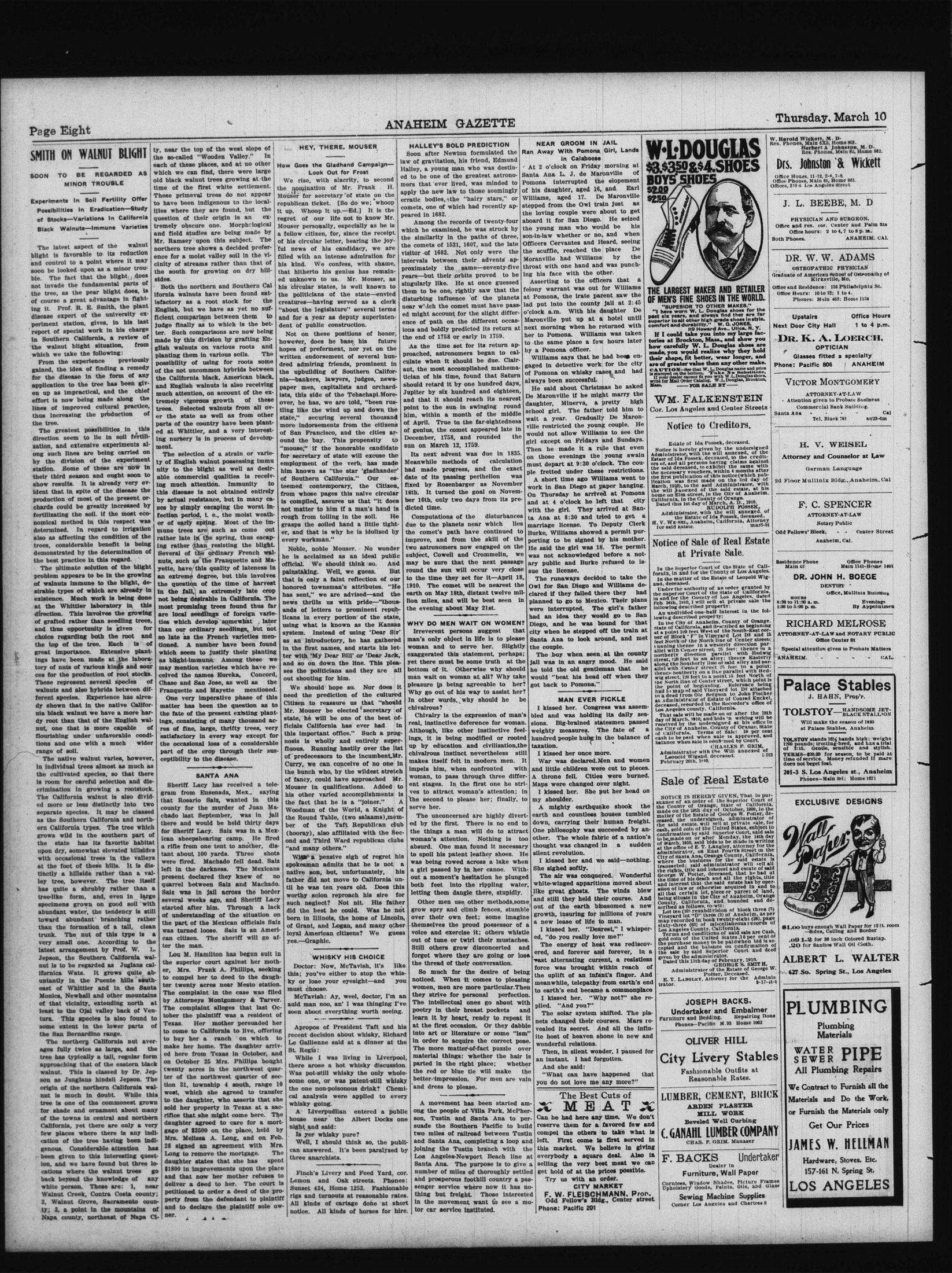
Searchable text
SMITH ON WALNUT BLIGHT
SOON TO BE REGARDED AS MINOR TROUBLE
Experiments In Soil Fertility Offer Possibilities in Eradication—Study of Stocks—Variations in California Black Walnuts—Immune Varieties
The latest aspect of the walnut blight is favorable to its reduction and control to a point where it may soon be looked upon as a minor trouble. The fact that the blight does not invade the fundamental parts of the tree, as the pear blight does, is of course a great advantage in fighting it. Prof. R. E. Smith, the plant disease expert of the university experiment station, gives, in his last report of special work in his charge in Southern California, a review of the walnut blight situation, from which we take the following:
From the experience previously gained, the idea of finding a remedy for the disease in the form of any application to the tree has been given up as impractical, and the chief effort is now being made along the lines of improved cultural practice, thus increasing the production of the tree.
The greatest possibilities in this direction seem to lie in soil fertilization, and extensive experiments along such lines are being carried on by the division of the experiment station. Some of these are now in their third season and ought soon to try, near the top of the west slope of the so-called "Wooden Valley." In each of these places, and at no other which we can find, there were large old black walnut trees growing at the time of the first white settlement. These primeval trees do not appear to have been indigenous to the localities where they are found, but the question of their origin is an extremely obscure one. Morphological and field studies are being made by Mr. Ramsey upon this subject. The northern tree shows a decided preference for a moist valley soil in the vicinity of streams rather than that of the south for growing on dry hillsides.
Both the northern and Southern California walnuts have been found satisfactory as a root stock for the English, but we have as yet no sufficient comparison between them to judge finally as to which is the better. Such comparisons are now being made by this division by grafting English walnuts on various roots and planting them in various soils. The possibility of using for roots some of the not uncommon hybrids between the California black, American black, and English walnuts is also receiving much attention, on account of the extremely vigorous growth of these trees. Selected walnuts from all over the state as well as from other parts of the country have been planted at Whittler, and a very interesting nursery is in process of development.
The selection of a strain or variety of English walnut possessing immunity to the blight as well as desirous state," securing several more indorsements from San Francisco, and round the bay. This pre-“mouse,” if the honorary secretary of state will employment of the vera him known as "the stare."
for the disease in the form of any application to the tree has been given up as impractical, and the chief effort is now being made along the lines of improved cultural practice, thus increasing the production of the tree.
The greatest possibilities in this direction seem to lie in soil fertilization, and extensive experiments along such lines are being carried on by the division of the experiment station. Some of these are now in their third season and ought soon to show results. It is already very evident that in spite of the disease the production of most of the present orchards could be greatly increased by fertilizing the soil. If the most economical method in this respect was determined. In regard to irrigation also as affecting the condition of the trees, considerable benefit is being demonstrated by the determination of the best practice in this regard.
The ultimate solution of the blight problem appears to be in the growing of walnuts immune to the blight, desirable types of which are already in existence. Much work is being done at the Whittler laboratory in this direction. This involves the growing of grafted rather than seedling trees, and thus opportunity is given for choice regarding both the root and the top of the tree. Each is of great importance. Extensive plantings have been made at the laboratory of nuts of various kinds and sources for the production of root stocks. These represent several species of walnuts and also hybrids between different species. Experience has already shown that in the native California black walnut we have a more hardy root than that of the English walnut, one that is more capable of flourishing under unfavorable conditions and one with a much wider range of soil.
The native walnut varies, however, in individual trees almost as much as the cultivated species, so that there is room for careful selection and discrimination in growing a rootstock. The California walnut is also divided more or less distinctly into two separate species. It may be classed as the Southern California and northern California types. The tree which grows wild in the southern part of the state has its favorite habitat upon dry, somewhat elevated hillsides with occasional trees in the valleys at the foot of these hills. It is distinctly a hillside rather than a valley tree, however. The tree itself has quite a shrubby rather than a tree-like form, and even in large the California black, American black, and English walnuts is also receiving much attention, on account of the extremely vigorous growth of these trees. Selected walnuts from all over the state as well as from other parts of the country have been planted at Whittier, and a very interesting nursery is in process of development.
The selection of a strain or variety of English walnut possessing immunity to the blight as well as desirable commercial qualities is receiving much attention. Immunity to this disease is not obtained entirely by actual resistance, but in many cases by simply escaping the worst infection period, i.e., the moist weather of early spring. Most of the immune trees are such as come out rather late in the spring, thus escaping rather than resisting the blight. Several of the ordinary French walnuts, such as the Franquette and Mayette, have this quality of lateness in an extreme degree, but this involves the question of the time of harvest in the fall, an extremely late crop not being desirable in California. The most promising trees found thus far are local seedlings of foreign varieties which develop somewhat later than our ordinary seedlings, but not so late as the French varieties mentioned. A number have been found which seem to justify their planting as blight-immune. Among these we may mention varieties which have received the names Eureka, Concord, Chase and San Jose, as well as the Franquette and Mayette mentioned.
One very imperative phase of this matter has been the question as to the fate of the present existing plantings, consisting of many thousand acres of fine, large, thrifty trees, very satisfactory in every way except for the occasional loss of a considerable part of the crop through their susceptibility to the disease.
SANTA ANA
Sheriff Lacy has received a telegram from Ensenada, Mex., saying that Rosario Salz, wanted in this county for the murder of Juan Machado last September, was in jail there and would be held thirty days for Sheriff Lacy. Salz was in a Mexican sheepshearing camp. He fired a rifle from one tent to another, distant about 100 yards. Three shots were fired. Machado fell dead. Salz left in the darkness. The Mexicans present declared they knew of no quarrel between Salz and Machado. Salz was in jail across the border several weeks ago and Sheriff Lacy.
Noble, noble Mousser, he is acclaimed as an official. We should thank painstaking. Well, we that is only a faint relic honored townsman's aid has sent," we are advancing news thrills us with hands of letters to prolicans in every portion using what is known as system. Instead of us as an introductory hero in the first names, and ter with 'My Dear Bill' and so on down the lists the politicians and out shouting for him.
We should hope so need the prediction of Citizen to reassure us Mr. Mousser be elected state, he will be one officials California has this important office." nosis is wholly and fluous. Running hastily of predecessors to the Curry, we can conceive the bunch who, by the end of fancy, could have a Mousser in qualification his other varied account the fact that he is a Woodman of the World Round Table, (two berer of the Taft Ri (hooray), also affiliated on and Third Ward r "and many others."
With a pensive sigil spokesman admits that native son, but, unofficial father did not move till he was ten years worthy scion reproach
The California walnut is also divided more or less distinctly into two separate species. It may be classed as the Southern California and northern California types. The tree which grows wild in the southern part of the state has its favorite habitat upon dry, somewhat elevated hillsides with occasional trees in the valleys at the foot of these hills. It is distinctly a hillside rather than a valley tree, however. The tree itself has quite a shrubby rather than a tree-like form, and, even in large specimens grown on good soil with abundant water, the tendency is still toward abundant branching rather than the formation of a tall, clean trunk. The nut of this type is a very small one. According to the latest arrangement by Prof. W. L. Jepson, the Southern California walnut is to be regarded as Juglans californica Wats. It grows quite abundantly in the Puente hills southeast of Whittier and in the Santa Monica, Newhall and other mountains of that vicinity, extending north at least to the Ojal valley back of Ventura. This species is also found to some extent in the lower parts of the San Bernardino range.
The northern California nut averages fully twice as large, and the tree has typically a tall, regular form approaching that of the eastern black walnut. This is classed by Dr. Jepson as Junglans hindsii Jepson. The origin of the northern California walnut is much in doubt. While this tree is one of the commonest grown for shade and ornament about many of the towns in central and northern California, yet there are only a very few places where there is any indication of the tree having been indigenous. Considerable attention has been given to this interesting question, and we have found but three locations where the walnut trees go back beyond the knowledge of any white person. These are: 1, near Walnut Creek, Contra Costa county; 2, Walnut Grove, Sacramento county; 3, a point in the mountains of Napa county, northeast of Napa Cliff Rosario Salz, wanted in this county for the murder of Juan Machado last September, was in jail there and would be held thirty days for Sheriff Lacy. Salz was in a Mexican sheepshearing camp. He fired a rifle from one tent to another, distant about 100 yards. Three shots were fired. Machado fell dead. Salz left in the darkness. The Mexicans present declared they knew of no quarrel between Salz and Machado. Salz was in jail across the border several weeks ago, and Sheriff Lacy started after him. Through a lack of understanding of the situation on the part of the Mexican officials Salz was turned loose. Salz is an American citizen. The sheriff will go after the man.
Lou M. Hamilton has begun suit in the superior court against her mother, Mrs. Frank A. Phillips, seeking to compel her to deed to the daughter twenty acres near Mesto station. The complaint in the case was filed by Attorneys Montgomery & Tarver. The complaint alleges that last October the plaintiff was a resident of Texas. Her mother persuaded her to come to California to live, offering to buy her a ranch on which to make her home. The daughter arrived here from Texas in October, and on October 25 Mrs. Phillips bought twenty acres in the northwest quarter of the northwest quarter of section 31, township 4 south, range 10 west, which she agreed to transfer to the daughter, who asserts that she sold her property in Texas at a sacrifice that she might come here. The daughter agreed to care for a mortgage of $3500 on the place, held by Mrs. Melissa A. Long, and on Feb. 28 signed an agreement with Mrs. Long to remove the mortgage. The daughter states that she has spent $1800 in improvements upon the place and that now her mother refuses to deliver a deed to her. The court is petitioned to order a deed of the property from the defendant to plaintiff and to declare the plaintiff sole owner.
WHISKY HISTORY
Doctor: Now, McTavish; you’ve either toky or lose your eyes must choose.
McTavish: Ay, weekauld man noo, an’ I wseen aboot everything.
Apropos of Presidency recent decision about Le Gallienne said at St. Regis:
While I was living there arose a hot whisky Was pot-still whisky some one, or was paired one non-poisonous cal analysis were a whisky going.
A Liverpudlian house near the A night and said:
Is yer whisky pure Well, I should think can answered. It's bthree anarchists.
Finch's Livery and Lemon and Oak Sunset 424, Home 12 rigs and turnouts at All kinds of cartage notice. All kinds of
HEY, THERE, MOUSER
How Goes the Gladhand Campaign—Look Out for Frost
We rise, with alacrity, to second the nomination of Mr. Frank H. Mouser for secretary of state on the republican ticket. [So do we; whoop it up. Whoop it up.] It is the regret of our life not to know Mr. Mouser personally, especially as he is a fellow citizen, for, since the receipt of his circular letter, bearing the joyful news of his candidacy, we are filled with an intense admiration for his kind. We confess, with shame, that hitherto his genius has remained unknown to us. Mr. Mouser, as his circular states, is well known to the politicians of the state—envied creatures—having served as a clerk "about the legislature" several terms and for a year as deputy superintendent of public construction.
Not on these positions of honor, however, does he base his future hopes of preferment, nor yet on the written endorsement of several hundred admiring friends, prominent in the upbuilding of Southern California—bankers, lawyers, judges, newspaper men, capitalists and orchardists, this side of the Tehachapi. Moreover, he has, we are told, "been rustling like the wind up and down the state," securing several thousand more indorsements from the citizens of San Francisco, and the cities around the bay. This propensity to "mouse;" if the honorable candidate for secretary of state will excuse the employment of the verb, has made him known as "the star 'gladhandler'"
HALLEY'S BOLD PREDICTION
Soon after Newton formulated the law of gravitation, his friend, Edmund Halley, a young man who was destined to be one of the greatest astronomers that ever lived, was minded to apply the new law to those seemingly erratic bodies, the "hairy stars," or comets, one of which had recently appeared in 1682.
Among the records of twenty-four which he examined, he was struck by the similarity in the paths of three, the comets of 1531, 1607, and the late visitor of 1682. Not only were the intervals between their advents approximately the same—seventy-five years—but their orbits proved to be singularly like. He at once guessed them to be one, rightly saw that the disturbing influence of the planets near which the comet must have passed might account for the slight difference of path on the different occasions and boldly predicted its return at the end of 1758 or early in 1759.
As the time set for its return approached, astronomers began to calculate when it should be due. Clairaut, the most accomplished mathematician of his time, found that Saturn should retard it by one hundred days, Jupiter by six hundred and eighteen, and that it should reach its nearest point to the sun in swinging round him, within a month of the middle of April. True to the far-sightedness of genius, the comet appeared late in December, 1758, and rounded the sun on March 12, 1759.
Its next advent was due in 1835. Meanwhile methods of calculation had made progress, and the exact NEAR GROOM IN JAIL
Ran Away With Pomona Girl, Lands in Calaboose
At 2 o'clock on Friday morning at Santa Ana L. J. de Maronville of Pomona interrupted the elopement of his daughter, aged 16, and Earl Williams, aged 17. De Maronville stepped from the Owl train just as the loving couple were about to get aboard it for San Diego. He seized the young man who would be his son-in-law whether or no, and when Officers Cervantes and Heard, seeing the scuffle, reached the place De Moranville had Williams by the throat with one hand and was punching his face with the other.
Asserting to the officers that a felony warrant was out for Williams at Pomona, the irate parent saw the lad put into the county jail at 2:45 o'clock a.m. With his daughter De Maronville put up at a hotel until next morning when he returned with her to Pomona. Williams was taken to the same place a few hours later by a Pomona officer.
Williams says that he had been engaged in detective work for the city of Pomona on whisky cases and had always been successful.
He said about Christmas he asked De Maronville if he might marry the daughter, Minerva, a pretty high school girl. The father told him to wait a year. Gradually De Maronville restricted the young couple. He would not allow Williams to see the girl except on Fridays and Sundays. Then he made it a rule that even on those evenings the young swain must depart at 9:30 o'clock. The couple fretted under these restrictions.
Noble, noble Mouser. No wonder he is acclaimed as an ideal public official. We should think so. And painstaking. Well, we guess. But that is only a faint reflection of our honored townsman's attributes. "He has sent," we are advised—and the news thrills us with pride—"thousands of letters to prominent republicans in every portion of the state, using what is known as the Kansas system. Instead of using 'Dear Sir' as an introductory, he has gathered in the first names, and starts his letter with 'My Dear Bill' or 'Dear Jack,' and so on down the line. This pleases the politicians and they are all out shouting for him.
We should hope so. Nor does it need the prediction of the cultured Citizen to reassure us that "should Mr. Mouser be elected secretary of state, he will be one of the best officials California has ever had in this important office." Such a prognosis is wholly and entirely superfluous. Running hastily over the list of predecessors to the incumbent, Mr. Curry, we can conceive of no one in the bunch who, by the wildest stretch of fancy, could have approached Mr. Mouser in qualifications. Added to his other varied accomplishments is the fact that he is a "joiner."
A Woodman of the World, a Knight of the Round Table, (two salaams), member of the Taft Republican club (hooray), also affiliated with the Second and Third Ward republican clubs "and many others."
With a pensive sigh of regret his spokesman admits that he is not a native son, but, unfortunately, his father did not move to California until he was ten years old. Does this worthy scion reproach his sire for tician of his time, found that Saturn should retard it by one hundred days, Jupiter by six hundred and eighteen, and that it should reach its nearest point to the sun in swinging round him, within a month of the middle of April. True to the far-sightedness of genius, the comet appeared late in December, 1758, and rounded the sun on March 12, 1759.
Its next advent was due in 1835. Meanwhile methods of calculation had made progress, and the exact date of its passing perihelion was fixed by Rosenbarger as November 14th. It turned the goal on November 16th, only two days from its predicted time.
Computations of the disturbances due to the planets near which lies the comet's path have continued to improve, and from the skill of the two astronomers now engaged on the subject, Cowell and Crommelin, we may be sure that the next passage round the sun will occur very close to the time they set for it—April 18, 1910. The comet will be nearest the earth on May 18th, distant twelve million miles, and will be best seen in the evening about May 21st.
WHY DO MEN WAIT ON WOMEN?
Irreverent persons suggest that man's only object in life is to please woman and to serve her. Slightly exaggerated this statement, perhaps; yet there must be some truth at the bottom of it. Otherwise why should man wait on woman at all? Why take pleasure in being agreeable to her? Why go out of his way to assist her? In other words, why should he be chivalrous?
Chivalry is the expression of man's real, instinctive deference for woman. Although, like other instinctive feelings, it is being modified or rooted up by education and civilization,the chivalrous instinct nevertheless still makes itself felt in modern men. It impels him, when confronted with woman, to pass through three different stages. In the first one he strives to attract woman's attention; in the second to please her; finally, to serve her.
The unconcerned are highly diverted by the first. There is no end to the things a man will do to attract woman's attention. Nothing is too absurd. One man found it necessary to spoil his patent leather shoes. He was being rowed across a lake when a girl passed by in her canoe. Without a moment's hesitation he plunged both feet into the rippling water, letting them dangle there, stupidly.
He said about Christmas he asked De Maronville if he might marry the daughter, Minerva, a pretty high school girl. The father told him to wait a year. Gradually De Maronville restricted the young couple. He would not allow Williams to see the girl except on Fridays and Sundays. Then he made it a rule that even on those evenings the young swain must depart at 9:30 o'clock. The couple fretted under these restrictions.
A short time ago Williams went to work in San Diego at paper hanging. On Thursday he arrived at Pomona and at 4 o'clock he left that city with the girl. They arrived at Santa Ana at 8:30 and tried to get a marriage license. To Deputy Clerk Burke, Williams showed a permit purporting to be signed by his mother. He said the girl was 18. The permit was not acknowledged before a notary public and Burke refused to issue the license.
The runaways decided to take the Owl for San Diego and Williams declared if they failed there they had planned to go to Mexico. Their plans were interrupted. The girl's father had an idea they would go to San Diego, and he was bound for that city when he stepped off the train at Santa Ana to look around, and met the couple.
The boy when seen at the county jail was in an angry mood. He said he told the old gentleman that he would "beat his head off when they got back to Pomona."
MAN EVER FICKLE
I kissed her. Congress was assembled and was holding its daily sessions. Big-brained statesmen passed weighty measures. The fate of a hundred people hung in the balance of taxation.
I kissed her once more.
War was declared.Men and women and little children were cut to pieces. A throne fell. Cities were burned. Maps were changed over night.
I kissed her. She put her head on my shoulder.
A mighty earthquake shook the earth and countless houses tumbled down, carrying their human freight. One philosophy was succeeded by another. The whole fabric of a nation's thought was changed in a sudden silent revolution.
I kissed her and we said—nothing. She sighed softly.
The air was conquered. Wonderful white-winged apparitions moved about like great ghosts. The winds blew and still they held their course. And
the fact that he is a "joiner." A Woodman of the World, a Knight of the Round Table, (two salaams), member of the Taft Republican club (hooray), also affiliated with the Second and Third Ward republican clubs "and many others."
With a pensive sigh of regret his spokesman admits that he is not a native son, but, unfortunately, his father did not move to California until he was ten years old. Does this worthy scion reproach his sire for such neglect? Not nit. His father did the best he could. Was he not born in Illinois, the home of Lincoln, of Grant, and Logan, and many other loyal American citizens? We guess yes.—Graphic.
WHISKY HIS CHOICE
Doctor: Now, McTavish, it's like this; you've either to stop the whisky or lose your eyesight—and you must choose.
McTavish: Ay, weel, doctor, I'm an auld man noo, an' I was thinging I've seen aboot everything worth seeing.
Apropos of President Taft and his recent decision about whisky, Richard Le Gallienne said at a dinner at the St. Regis:
While I was living in Liverpool, there arose a hot whisky discussion. Was pot-still whisky the only wholesome one, or was patent-still whisky the one non-poisonous drink? Chemical analysis were applied to every whisky going.
A Liverpudlian entered a public house near the Albert Docks one night and said:
Is yer whisky pure?
Well, I should think so, the public can answered. It's been paralyzed by three anarchists.
Finch's Livery and Feed Yard, cor. Lemon and Oak streets. Phones: Sunset 424, Home 1253. Fashionable rigs and turnouts at reasonable rates. All kinds of cartage done at short notice. All kinds of horses for hire.
The unconcerned are highly diverted by the first. There is no end to the things a man will do to attract woman's attention. Nothing is too absurd. One man found it necessary to spoil his patent leather shoes. He was being rowed across a lake when a girl passed by in her canoe. Without a moment's hesitation he plunged both feet into the rippling water, letting them dangle there, stupidly.
Other men use other methods, some grow spry and climb fences, stumble over their own feet; some imagine themselves the proud possessor of a voice and exercise it; others whistle out of tune or twirl their mustaches. Still others grow disconcerted and forget where they are going or lose the thread of their conversation.
So much for the desire of being noticed. When it comes to pleasing women, men are more particular. Then they strive for personal perfection. The intellectual ones go about with poetry in their breast pockets and learn it by heart, ready to repeat it at the first occasion. Or they dabble into art or literature or some "ism" in order to acquire the correct pose. The more matter-of-fact puzzle over material things: whether the hair is parted in the right place; whether the red or blue tie will make the better impression. For men are vain and dress to please.
A movement has been started among the people of Villa Park, McPherson, Tustin and Santa Ana to persuade the Southern Pacific to build two miles of railroad between Tustin and Santa Ana, completing a loop and joining the Tustin branch with the Los Angeles-Newport Beach line at Santa Ana. The purpose is to give a number of miles of thoroughly settled and prosperous foothill country a passenger service where now it has nothing but freight. Those interested in the movement want to see a motor car service instituted.
A mighty earthquake shook the earth and countless houses tumbled down, carrying their human freight. One philosophy was succeeded by another. The whole fabric of a nation's thought was changed in a sudden silent revolution.
I kissed her and we said—nothing. She sighed softly.
The air was conquered. Wonderful white-winged apparitions moved about like great ghosts. The winds blew and still they held their course. And out of the earth blossomed a new growth, insuring for millions of years a new lease of life to man.
I kissed her. "Dearest," I whispered, "do you really love me?"
The energy of heat was rediscovered, and forever and forever, in a vast alternating current, a resistless force was brought within reach of the uplift of an infant's finger. And meanwhile, telepathy from earth's end to earth's end became a commonplace.
I kissed her. "Why not?" she replied. "And you?"
The solar system shifted. The planets changed their courses. Mars revealed its secret. And all the infinite host of heaven shone in new and wonderful relations.
Then, in silent wonder, I paused for an instant. I had forgotten.
And she said:
"What can have happened that you do not love me any more?"
The Best Cuts of MEAT
Can be had here any time. We don't reserve them for a favored few and compel the others to take what is left. First come is first served in this market. We believe in giving everybody a square deal. Also in selling the very best meat we can get hold of at the prices possible.
Try us with an order.
CITY MARKET
F.W.FLEISCHMANN. Pron.
Odd Fellow's Bldg., Center street.
Phone: Pacific 201
Thursday, March 10
W·L·DOUGLAS
$3.50 & $4.SHOES
BOYS' SHOES
$2.00
$2.50
THE LARGEST MAKER AND RETAILER OF MEN'S FINE SHOES IN THE WORLD.
"SUPERIOR TO OTHER MAKES."
"I have worn W. L. Douglas shoes for the past six years, and always find they are far superior to all other high grade shoes in style, comfort and durability." W. G. JONES,
119 Howard Ave., Utica, N. Y.
If I could take you into my large factories at Brockton, Mass., and show you how carefully W. L. Douglas shoes are made, you would realize why they hold their shape, fit better, wear longer, and are of greater value than any other make.
CAUTION—See that W. L. Douglas name and price is stamped on the bottom. Take No Substitute.
If your dealer cannot fit you with W. L. Douglas shoes, write for Mail Order Catalog. W. L. Douglas, Brockton, Mass.
FOR SALE BY
WM. FALKENSTEIN
Cor. Los Angeles and Center Streets
Notice to Creditors.
Estate of Ida Fossek, deceased.
Notice is hereby given by the undersigned Administrator, with the will annexed, of the Estate of Ida Fossek, deceased, to the creditors of, and all persons having claims against the said deceased, to exhibit the same with the necessary vouchers, within 4 months after
WM. FALKENSTEIN
Cor. Los Angeles and Center Streets
Notice to Creditors.
Estate of Ida Fossek, deceased.
Notice is hereby given by the undersigned Administrator, with the will annexed, of the Estate of Ida Fossek, deceased, to the creditors of, and all persons having claims against the said deceased, to exhibit the same with the necessary vouchers, within 4 months after the first publication of this notice (which publication was first made on the 3rd day of March, 1910), to the said Administrator, with the will annexed of the said estate, at his home on Elm street, in the City of Anaheim, California, in the County of Orange.
Dated this 1st day of March, A.D. 1910.
RUDOLPH FOSSEK,
Administrator, with the will annexed, of the Estate of Ida Fossek, deceased.
H. V. WEISEL, Anaheim, California, Attorney for said estate.
Notice of Sale of Real Estate at Private Sale.
In the Superior Court of the State of California, in and for the County of Los Angeles.
In the matter of the Estate of Leopold Wigand, deceased.
Under the authority of an order granted by the Superior Court of the State of California, in and for the County of Los Angeles, dated Feb. 16th, 1910, I will sell at private sale the following described property:
An undivided one-half interest in the following described property:
In the City of Anaheim, County of Orange, state of California, and described as beginning at a point 140 feet West of the South-East corner of Block E" in Vineyard Lot D3 and 15 feet North of the North line of Center street; running thence in a westerly direction parallel with Center street, 25 feet; thence in a northerly direction parallel with Hedwig street, 120 feet to an alley; thence Easterly along the Southerly line of said alley and parallel with Center street 25 feet to a point; thence southerly on a line parallel with Hedwig street, 120 feet to a point 15 feet North of the North line of Center street, which point is the point of beginning. Reference being had to map of said Vineyard lot D3 attached to a deed from Ole Bergson to John Fischer as Administrator of Estate of Conrad Kuckel, deceased, recorded in the Recorder's office of Los Angeles county, California.
That sale will be made on or after the 18th day of March, 1910, and bids in writing will be received by the undersigned at his office in the City of Anaheim, County of Orange, State of California. Terms of Sale: 10 per cent cash to be paid when sale is approved, and balance when sale is confirmed by Court.
CHARLES F. GRIM,
Administrator with the Will annexed of Leopold Wigand, deceased.
February 26th, 1910.
Sale of Real Estate
NOTICE IS HEREBY GIVEN That in pursuance of an order of the Superior Court of the County of Orange, State of California, made on the 29th day of October, 1909, in the matter of the Estate of George W. Potter, deceased, the undersigned administrator of the said estate will sell at private sale, for cash, gold coin of the United States, subject to confirmation by said Superior Court, said sale to be made on or after Monday, the 14th day of March, 1910, said bids to be made in writing at the office of E. T. Langley, attorney for the administrator, on East Fourth Street in the City of Santa Ana, Orange County, California, where the business for the said estate is transsected; said administrator will sell all the rights, title and interest and estate of said George W. Potter, deceased, that he had at the time of his death and all the rights, title and interest that the said estate has by operation of law or otherwise acquired in and to all that certain lot, piece or parcel of land, being situated in the City of Anaheim, Orange...
Wonderful
moved about
The winds blew
their course. And
blossomed a new
millions of years
to man.
We said—nothing.
Wonderful
moved about
The winds blew
their course. And
blossomed a new
millions of years
to man.
We said—nothing.
Wonderful
moved about
The winds blew
their course. And
blossomed a new
millions of years
to man.
We said—nothing.
Wonderful
moved about
The winds blew
their course. And
blossomed a new
millions of years
to man.
We said—nothing.
Wonderful
moved about
The winds blew
their course. And
blossomed a new
millions of years
to man.
We said—nothing.
Wonderful
moved about
The winds blew
their course. And
blossomed a new
millions of years
to man.
We said—nothing.
Wonderful
moved about
The winds blew
their course. And
blossomed a new
millions of years
to man.
We said—nothing.
Wonderful
moved about
The winds blew
their course. And
blossomed a new
millions of years
to man.
We said—nothing.
Wonderful
moved about
The winds blew
their course. And
blossomed a new
millions of years
to man.
We said—nothing.
Wonderful
moved about
The winds blew
their course. And
blossomed a new
millions of years
we said—nothing.
Wonderful
moved about
The winds blew
their course. And
blossomed a new
millions of years
we said—nothing.
Wonderful
moved about
The winds blew
their course. And
blossomed a new
we said—nothing.
Wonderful
moved about
The winds blew
their course. And
we said—nothing.
Wonderful
moved about
The winds blew
their course. And
we said—nothing.
Wonderful
moved about
The winds blew
their course. And
we said—nothing.
Wonderful
moved about
The winds blew
their course. And
we said—nothing.
Wonderful
moved about
The winds blew
their course. And
we said—nothing.
Wonderful
moved about
The winds blew
their course. And
we said—nothing.
Wonderful
moved about
The winds blew
their course. And
we said—nothing.
Wonderful
moved about
The winds blew
their course. And
we said—nothing.
Wonderful
moved about
The winds blew
their course. And
be made on or after Monday, the 14th day of March, 1910, said bids to be made in writing at the office of E.T.Langley, attorney for the administrator, on East Fourth Street in the City of Santa Ana, Orange County, California, where the business for the said estate is transacted; said administrator will sell all the rights, title and interest and estate of said George W. Potter, deceased, that he had at the time of his death and all the rights, title and interest that the said estate has by operation of law or otherwise acquired in and to all that certain lot, piece or parcel of land, being situated in the City of Anaheim, Orange County, California, and bounded and described as follows, to wit:
Lot ten (10) resubdivision of block three (3) Vineyard lot "D" three (3) of Anaheim, as per map recorded in book twenty-eight (28), page sixty-three (63) of miscellaneous records of Los Angeles County, California.
Terms and conditions of said sale are Cash, gold coin of the United States, 10 per cent of the purchase money to be paid when bid is accepted and the balance on confirmation of the sale by said Superior Court and deed given by the administrator.
Dated this 11th day of February, 1910.
GEORGE S. SMITH,
Administrator of the Estate of George W.
Potter, Deceased.
E.T.LANGLEY, Attorney for the Administrator.
JOSEPH BACKS,
Undertaker and Embalmer
Furniture and Bedding. Repairing Done
Phones—Pacific M.93 Home 1062
OLIVER HILL
City Livery Stables
Fashionable Outfits at Reasonable Rates.
LUMBER, CEMENT, BRICK
ARDEN PLASTER
MILL WORK
Beveled Well Curbing
C.GANAHL LUMBER COMPANY
CHAS.F.GRIM.Manager
F.BACKS Undertaker
Dealer in Furniture, Wall Paper
Cornices, Window Shades, Picture Frames Upholstery Goods, Paints, Oils and Glass
Sewing Machine Supplies
Corner Los Angeles and Chartres 8
PLUMBING
Plumbing Materials
WATER SEWER PIPE
All Plumbing Repairs
We Contract to Furnish all the Materials and Do the Work, or Furnish the Materials only
Get Our Prices
JAMES W. HELLMAN
Hardware, Stoves, Etc.
157-161 N. Spring St.
LOS ANGELES