anaheim-gazette 1910-02-03
Scanned page
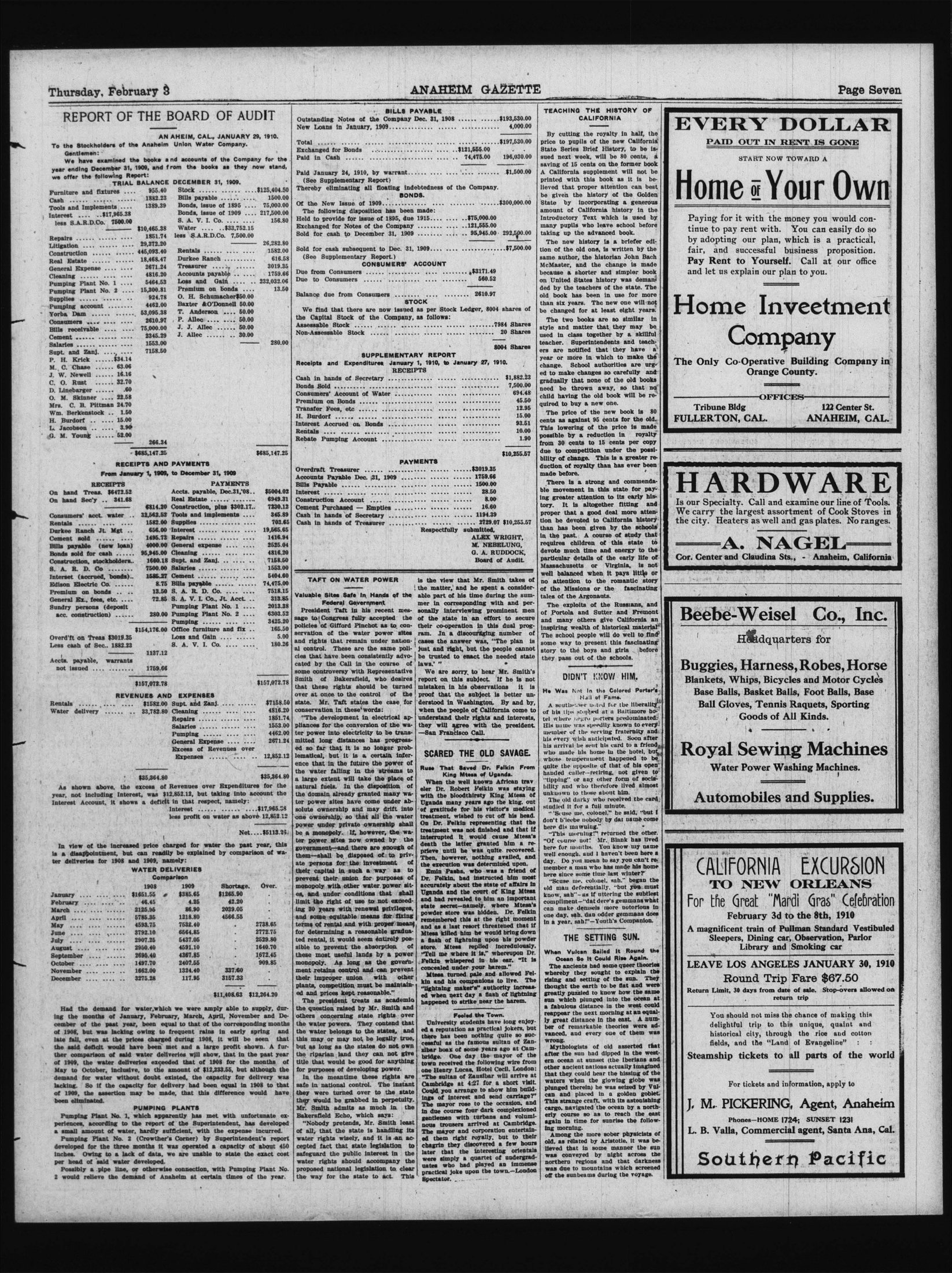
Searchable text
REPORT OF THE BOARD OF AUDIT
AN AHEIM, CAL., JANUARY 29, 1910.
To the Stockholders of the Anaheim Union Water Company.
Gentlemen:
We have examined the books and accounts of the Company for the year ending December 31, 1909, and from the books as they now stand, we offer the following Report:
TRIAL BALANCE DECEMBER 31, 1909.
Furniture and fixtures ... 955.40
Cash ... 1882.23
Tools and Implements ... 1389.39
Interest ... $17,965.38
less S.A.R.D.Co. 7500.00
$10,465.38
Repairs ... 1851.74
Litigation ... 29,372.20
Construction ... 445,093.40
Real Estate ... 18,468.47
General Expense ... 2671.24
Cleaning ... 4816.20
Pumping Plant No. 1 ... 5464.53
Pumping Plant No. 2 ... 15,300.81
Supplies ... 924.78
Pumping account ... 4462.00
Yorba Dam ... 53,095.38
Consumers ... 2610.97
Bills receivable ... 75,000.00
Cement ... 2345.29
Salaries ... 1553.00
Supt. and Zanj. ... 7158.50
P. H. Krick ... $34.14
M. C. Chase ... 63.06
J. W. Newell ... 16.16
C. O. Rust ... 32.70
D. Linebarger ... .60
O. M. Skinner ... 22.58
Mrs. C. B. Pittman 24.70
Wm. Berkenstock ... 1.50
H. Burdorf ... 15.00
L. Jacobson ... 3.90
G. M. Young ... 52.00
Stock ... $125,404.50
Bills payable ... 1500.00
Bonds, issue of 1895 ... 75,000.00
Bonds, issue of 1909 ... 217,500.00
S. A. V. I. Co... 156.80
Water ... $33,752.15
less S.A.R.D.Co. 7,500.00
Rentals ... 1582.00
Durkee Ranch ... 616.58
Treasurer ... 3019.35
Accounts payable ... 1759.66
Loss and Gain ... 232,032.06
Premium on bonds ... 13.50
O. H. Schumacher $50.00
Baxter & O'Donnell 50.00
T. Anderson ... 50.00
P. Allec ... 50.00
J. J. Allec ... 50.00
J. Allec ... 30.00
266.34
$685,147.25
RECEIPTS AND PAYMENTS
From January 1, 1909, to December 31, 1909
Outstanding Notes ...
New Loans in Jan...
Total ...
Exchanged for Bond...
Paid in Cash ...
Paid January 24,
(See Supplement)
Thereby eliminating...
Of the New Issue...
The following dis...
Held to provide for...
Exchanged for Not...
Sold for cash to...
Sold for cash subs...
(See Supplement)
Due from Consumers...
Due to Consumers...
Balance due from...
We find that the Capital Stock Assessable Stock Non-Assessable Stock
Receipts and Expenses:
Cash in hands of Bonds Sold ...
Consumers' Account Premium on Bonds Transfer Fees, etc.
H. Burdorf ...
Interest Accrued or Rentals ...
Rebate Pumping A
RECEIPTS AND PAYMENTS
From January 1, 1909, to December 31, 1909
RECEIPTS
On hand Treas. $6472.52
On hand Sec'y ... 341.68
6814.20
Consumers' acct. water ... 32,562.52
Rentals ... 1582.00
Durkee Ranch Jt. Mgt ... 656.00
Cement sold ... 1495.73
Bills payable (new loan) ... 4000.00
Bonds sold for cash ... 95,945.00
Construction, stockholders... 1660.18
S. A. R. D. Co ... 7500.00
Interset (accrued, bonds)... 1585.27
Edison Electric Co. ... 8.75
Premium on bonds ... 13.50
General Ex., fees, etc. ... 72.85
Sundry persons (deposit acc. construction) ... 280.00
$154,176.00
Overd'ft on Treas $3019.35
Less cash of Sec.. 1882.23
1137.12
Accts. payable, warrants not issued ... 1759.66
$157,072.78
PAYMENTS
Accts. payable, Dec.31,'08... $5004.02
Real Estate ... 6949.31
Construction, plus $302.17... 7230.12
Tools and implements ... 345.89
Supplies ... 703.65
Interest ... 19,565.65
Repairs ... 1416.94
General expense ... 2525.04
Cleaning ... 4816.20
Supt. and Zanj... 7158.50
Salaries ... 1553.00
Cement ... 5404.60
Bills payable ... 74,475.00
S. A. R. D. Co... 7518.15
S. A. V. I. Co., Jt. Acct... 313.85
Pumping Plant No. 1 ... 2013.38
Pumping Plant No. 2 ... 6303.52
Pumping ... 3425.20
Office furniture and fix ... 165.50
Loss and Gain ... 5.00
S. A. V. I. Co... 180.26
REVENUES AND EXPENSES
Rentals $1582.00
Water delivery 33,782.80
Supt. and Zanj... $7158.50
Cleaning 4816.20
Repairs 1851.74
Salaries 1553.00
Pumping 4462.00
General Expense 2671.24
Excess of Revenues over Expenses 12,852.12
$35,364.80
As shown above, the excess of Revenues over Expenditures for the year, not including Interest, was $12,852.12, but taking into account the Interest Account, it shows a deficit in that respect, namely:
Interest $17,965.38
less profit on water as above 12,852.12
Net...$5113.26
In view of the increased price charged for water the past year, this is a disappointment, but can readily be explained by comparison of water deliveries for 1908 and 1909, namely:
WATER DELIVERIES
Comparison
January ..... 1908 ..... 1909 ..... Shortage.. Over.
January ..... $1651.55 ..... $385.65 ..... $1265.90
Interest Account, it shows a deficit in that respect, namely:
Interest ... $17,965.38
less profit on water as above 12,852.12
Net...$5113.26
In view of the increased price charged for water the past year, this is a disappointment, but can readily be explained by comparison of water deliveries for 1908 and 1909, namely:
WATER DELIVERIES
Comparison
1908 1909 Shortage. Over.
January ... $1651.55 $385.65 $1265.90 .
February ... 46.45 4.25 42.20 .
March ... 2125.95 86.90 2039.05 .
April ... 5785.35 1218.80 4566.55 .
May ... 4593.75 7532.40 . 2738.65
June ... 3792.10 6564.85 . 2772.75
July ... 2907.25 5437.05 . 2529.80
August ... 2950.40 4591.10 . 1640.70
September ... 2695.40 4367.85 . 1672.45
October ... 1497.70 2407.55 . 909.85
November ... 1662.00 1324.40 337.60 .
December ... 3275.28 117.95 3157.33 .
$11,408.63 $12,264.20
Had the demand for water, which we were amply able to supply, during the months of January, February, March, April, November and December of the past year, been equal to that of the corresponding months of 1908, but was lacking owing to frequent rains in early spring and late fall, even at the prices charged during 1908, it will be seen that the said deficit would have been met and a large profit shown. A further comparison of said water deliveries will show, that in the past year of 1909, the water deliveries exceeded that of 1908 for the months of May to October, inclusive, to the amount of $12,233.55, but although the demand for water without doubt existed, the capacity for delivery was lacking. So if the capacity for delivery had been equal in 1908 to that of 1909, the assertion may be made, that this difference would have been eliminated.
PUMPING PLANTS
Pumping Plant No. 1, which apparently has met with unfortunate experiences, according to the report of the Superintendent, has developed a small amount of water, hardly sufficient, with the expense incurred.
Pumping Plant No. 2 (Crowther's Corner) by Superintendent's report developed for the three months it was operated a capacity of about 450 inches. Owing to a lack of data, we are unable to state the exact cost per head of said water developed.
Possibly a pipe line, or otherwise connection, with Pumping Plant No. 2 would relieve the demand of Anaheim at certain times of the year.
The president told the question raised by others concerning the water powers.
The water belongs to this may or may not but as long as the riparian land title that would be for purposes of development.
In the meantime safe in national control they were turned into Mr. Smith admits Bakersfield Echo,
"Nobody pretended of all, that the state water rights wisely cepted fact that such safeguard the public water rights should proposed national law the way for the s
ANAHEIM GAZETTE
BILLS PAYABLE
Outstanding Notes of the Company Dec. 31, 1908 ... $193,530.00
New Loans in January, 1909 ... 4,000.00
Total ... $197,530.00
Exchanged for Bonds ... $121,555.00
Paid in Cash ... 74,475.00 196,030.00
Paid January 24, 1910, by warrant ... $1,500.00
(See Supplementary Report)
Thereby eliminating all floating indebtedness of the Company.
BONDS.
Of the New Issue of 1909 ... $300,000.00
The following disposition has been made:
Held to provide for issue of 1895, due 1915 ... $75,000.00
Exchanged for Notes of the Company ... 121,555.00
Sold for cash to December 31, 1909 ... 95,945.00 292,500.00
Sold for cash subsequent to Dec. 31, 1909 ... $7,500.00
(See Supplementary Report)
CONSUMERS' ACCOUNT
Due from Consumers ... $3171.49
Due to Consumers ... 560.52
Balance due from Consumers ... 2610.97
STOCK
We find that there are now issued as per Stock Ledger, 8004 shares of the Capital Stock of the Company, as follows:
Assessable Stock ... 7984 Shares
Non-Assessable Stock ... 20 Shares
8004 Shares
SUPPLEMENTARY REPORT
Receipts and Expenditures January 1, 1910, to January 27, 1910.
RECEIPTS
Cash in hands of Secretary ... $1,882.23
Bonds Sold ... 7,500.00
Consumers' Account of Water ... 694.48
Premium on Bonds ... 45.50
Transfer Fees, etc ... 12.95
H. Burdorf ... 15.00
Interest Accrued on Bonds ... 93.51
Rentals ... 10.00
Rebate Pumping Account ... 1.90
$10,255.57
PAYMENTS
Overdraft Treasurer ... $3019.35
TEACHING THE HISTORY OF CALIFORNIA
By cutting the royalty in half, the price to pupils of the new California State Series Brief History, to be issued next week, will be 80 cents, a saving of 15 cents on the former book A California supplement will not be printed with this book as it is believed that proper attention can best be given the history of the Golden State by incorporating a generous amount of California history in the Introductory Text which is used by many pupils who leave school before taking up the advanced book.
The new history is a briefer edition of the old one, is written by the same author, the historian John Bach McMaster, and the change is made because a shorter and simpler book on United States history was demanded by the teachers of the state. The old book has been in use for more than six years. The new one will not be changed for at least eight years.
The two books are so similar in style and matter that they may be used in class together by a skillful teacher. Superintendents and teachers are notified that they have a year or more in which to make the change. School authorities are urged to make changes so carefully and gradually that none of the old books need be thrown away, so that no child having the old book will be required to buy a new one.
The price of the new book is 80 cents as against 95 cents for the old. This lowering of the price is made possible by a reduction in royalty from 30 cents to 15 cents per copy due to competition under the possibility of change. This is a greater reduction of royalty than has ever been made before.
Cash in hands of Secretary $1,882.23
Bonds Sold 7,500.00
Consumers' Account of Water 694.48
Premium on Bonds 45.50
Transfer Fees, etc 12.95
H. Burdorf 15.00
Interest Accrued on Bonds 93.51
Rentals 10.00
Rebate Pumping Account 1.90
$10,255.57
PAYMENTS
Overdraft Treasurer $3019.35
Accounts Payable Dec. 31, 1909 1759.66
Bills Payable 1500.00
Interest 28.50
Construction Account 8.00
Cement Purchased — Empties 16.60
Cash in hands of Secretary 1194.39
Cash in hands of Treasurer 2729.07 $10,255.57
Respectfully submitted,
ALEX WRIGHT,
M. NEBELUNG,
G. A. RUDDOCK,
Board of Audit.
TAFT ON WATER POWER
Valuable Sites Safe In Hands of the Federal Government
President Taft in his recent message to Congress fully accepted the policies of Gifford Pinchot as to conservation of the water power sites and rights that remain under national control. These are the same policies that have been consistently advocated by the Call in the course of some controversy with Representative Smith of Bakersfield, who desires that these rights should be turned over at once to the control of the state. Mr. Taft states the case for conservation in these words:
"The development in electrical appliances for the conversion of the water power into electricity is transmitted long distances has progressed so far that it is no longer problematical, but it is a certain inference that in the future the power of the water falling in the streams to a large extent will take the place of natural fuels. In the disposition of the domain already granted many water power sites have come under absolute ownership and may drift into one ownership, so that all the water power under private ownership shall be a monopoly. If, however, the water power sites now owned by the government—and there are enough of them—shall be disposed of to private persons for the investment of their capital in such a way as to prevent their union for purposes of monopoly with other water power sites, and under conditions that shall be made by the state."
is the view that Mr. Smith takes of the matter, and he spent a considerable part of his time during the summer in corresponding with and personally interviewing prominent men of the state in an effort to secure their co-operation in this dual program. In a discouraging number of cases the answer was, "The plan is just and right, but the people cannot be trusted to enact the needed state laws.""
We are sorry to hear Mr. Smith's report on this subject. If he is not mistaken in his observations it is proof that the subject is better understood in Washington. By and by, when the people of California come to understand their rights and interests, they will agree with the president—San Francisco Call.
SCARED THE OLD SAVAGE.
Ruse That Saved Dr. Felkin From King Mtesa of Uganda.
When the well known African traveler Dr. Robert Felkin was staying with the bloodthirsty King Mtesa of Uganda many years ago the king, out of gratitude for his visitor's medical treatment, wished to cut off his head. On Dr. Felkin representing that the treatment was not finished and that if interrupted it would cause Mtesa's death the latter granted him a reprieve until he was quite recovered. Then, however, nothing availed, and the execution was determined upon.
Emin Pasha, who was a friend of Dr. Felkin, had instructed him most accurately about the state of affairs in Uganda and the court of King Mtesa and had revealed to him an important
DIDN'T KNOW HIM.
He Was Not In the Colored Porter's Hall of Fame.
A southerner noted for the liberality of his tips stopped at a Baltimore hotel where negro porters predominated. His name was speedily known to every member of the serving fraternity and his every wish anticipated. Soon after his arrival he sent his card to a friend who made his home in the hotel, but whose temperament happened to be quite the opposite of that of his open handed caller—retiring, not given to "tipping" or any other form of sociability and who therefore lived almost unknown to those about him.
The old darky who received the card studied it for a full minute.
"Scuse me, colonel," he said, "but I don't bleebe nobody by dat name come here dis mawning."
"This morning!" returned the other.
"Of course not! Mr. Blank has lived here for months. You know my name well enough, and I haven't been here a day. Do you mean to say you can't remember a man who has made his home here since some time last winter?"
"Scuse me, colonel, sah," began the old man deferentially, "but you must know, sah"—as if uttering the subtlest
ter power sites have come under absolute ownership and may drift into one ownership, so that all the water power under private ownership shall be a monopoly. If, however, the water power sites now owned by the government—and there are enough of them—shall be disposed of to private persons for the investment of their capital in such a way as to prevent their union for purposes of monopoly with other water power sites, and under conditions that shall limit the right of use to not exceeding 30 years with renewal privileges, and some equitable means for fixing terms of rental and with proper means for determining a reasonable graduated rental, it would seem entirely possible to prevent the absorption of these most useful lands by a power monopoly. As long as the government retains control and can prevent their improper union with other plants, competition must be maintained and prices kept reasonable."
The president treats as academia the question raised by Mr. Smith and others concerning state rights over the water powers. They contend that the water belongs to the states, and this may or may not be legally true, but as long as the states do not own the riparian land they can not give title that would be good for anything for purposes of developing power.
In the meantime these rights are safe in national control. The instant they were turned over to the state they would be grabbed in perpetuity. Mr. Smith admits as much in the Bakersfield Echo, which says:
"Nobody pretends, Mr. Smith least of all, that the state is handling its water rights wisely, and it is an accepted fact that state legislation to safeguard the public interest in the water rights should accompany the proposed national legislation to clear the way for the state to act. This Uganda many years ago the king, out of gratitude for his visitor's medical treatment, wished to cut off his head. On Dr. Felkin representing that the treatment was not finished and that if interrupted it would cause Mtesa's death the latter granted him a reprieve until he was quite recovered. Then, however, nothing availed, and the execution was determined upon.
Emin Pasha, who was a friend of Dr. Felkin, had instructed him most accurately about the state affairs in Uganda and the court of King Mtesa and had revealed to him an important state secret—namely, where Mtesa's powder store was hidden. Dr. Felkin remembered this at the right moment and as a last resort threatened that if Mtesa killed him he would bring down a flash of lightning upon his powder store. Mtesa replied incredulously, "Tell me where it is," whereupon Dr. Felkin whispered in his ear, "It is concealed under your harem."
Mtesa turned pale and allowed Felkin and his companions to live. The "lightning maker's" authority increased when next day a flash of lightning happened to strike near the harem.
Fooled the Town.
University students have long enjoyed a reputation as practical jokers, but there has been nothing quite so successful as the famous sultan of Zanzibar hoax of some years ago at Cambridge. One day the mayor of the town received the following wire from one Henry Lucas, Hotel Cecil, London: "The sultan of Zanzibar will arrive at Cambridge at 4:27 for a short visit. Could you arrange to show him buildings of interest and send carriage?" The mayor rose to the occasion, and in due course four dark complexioned gentlemen with turbans and voluminous trousers arrived at Cambridge. The mayor and corporation entertained them right royally, but to their chagrin they discovered a few hours later that the interesting orientals were simply a quartet of undergraduate who had played an immense practical joke upon the town.—London Spectator.
The old darky who received the card studied it for a full minute.
"Scuse me, colonel," he said, "but I don't b'leebe nobody by dat name come here dis mawning."
"This morning!" returned the other. "Of course not! Mr. Blank has lived here for months. You know my name well enough, and I haven't been here a day. Do you mean to say you can't remember a man who has made his home here since some time last winter?"
"Scuse me, colonel, sah." began the old man deferentially. "but you must know, sah"—as if uttering the subtlest compliment—"dat dere's gemmans what can make demisels more notorious in one day, sah, dan odder gemmans does in a year, sah!"—Youth's Companion.
THE SETTING SUN.
When Vulcan Sailed It Round the Ocean So It Could Rise Again.
The ancients had some queer theories whereby they sought to explain the rising and setting of the sun. They thought the earth to be flat and were greatly puzzled to know how the same sun which plunged into the ocean at a fabulous distance in the west could reappear the next morning at an equally great distance in the east. A number of remarkable theories were advanced, and every one of them was wrong.
Mythologists of old asserted that after the sun had dipped in the western ocean at sunset (the Iberians and other ancient nations actually imagined that they could hear the hissing of the waters when the glowing globe was plunged therein) he was seized by Vulcan and placed in a golden goblet. This strange craft, with its astonishing cargo, navigated the ocean by a northerly course so as to reach the east again in time for sunrise the following morning.
Among the more sober physicists of old, as related by Aristotle, it was believed that in some manner the sun was conveyed by night across the northern regions and that darkness was due to mountains which screened off the sunbeams during the voyage.
EVERY DOLLAR
PAID OUT IN RENT IS GONE
START NOW TOWARD A
Home of Your Own
Paying for it with the money you would continue to pay rent with. You can easily do so by adopting our plan, which is a practical, fair, and successful business proposition.
Pay Rent to Yourself. Call at our office and let us explain our plan to you.
Home Investment Company
The Only Co-Operative Building Company in Orange County.
OFFICES
Tribune Bldg
FULLERTON, CAL.
122 Center St.
ANAHEIM, CAL.
OFFICES
Tribune Bldg
FULLERTON, CAL.
122 Center St.
ANAHEIM, CAL.
HARDWARE
Is our Specialty. Call and examine our line of Tools.
We carry the largest assortment of Cook Stoves in
the city. Heaters as well and gas plates. No ranges.
A. NAGEL
Cor. Center and Claudina Sts., - Anaheim, California
Beebe-Weisel Co., Inc.
Headquarters for
Buggies, Harness, Robes, Horse
Blankets, Whips, Bicycles and Motor Cycles
Base Balls, Basket Balls, Foot Balls, Base
Ball Gloves, Tennis Raquets, Sporting
Goods of All Kinds.
Royal Sewing Machines
Water Power Washing Machines.
Automobiles and Supplies.
CALIFORNIA EXCURSION
TO NEW ORLEANS
CALIFORNIA EXCURSION
TO NEW ORLEANS
For the Great "Mardi Gras" Celebration
February 3d to the 8th, 1910
A magnificent train of Pullman Standard Vestibuled Sleepers, Dining car, Observation, Parlor Library and Smoking car
LEAVE LOS ANGELES JANUARY 30, 1910
Round Trip Fare $67.50
Return Limit, 30 days from date of sale. Stop-overs allowed on return trip
You should not miss the chance of making this delightful trip to this unique, quaint and historical city, through the rice and cotton fields, and the "Land of Evangeline":
Steamship tickets to all parts of the world
For tickets and information, apply to
J. M. PICKERING, Agent, Anaheim
Phones—HOME | 724; SUNSET | 231
L. B. Valla, Commercial agent, Santa Ana, Cal.
Southern Pacific