anaheim-gazette 1910-01-27
Scanned page
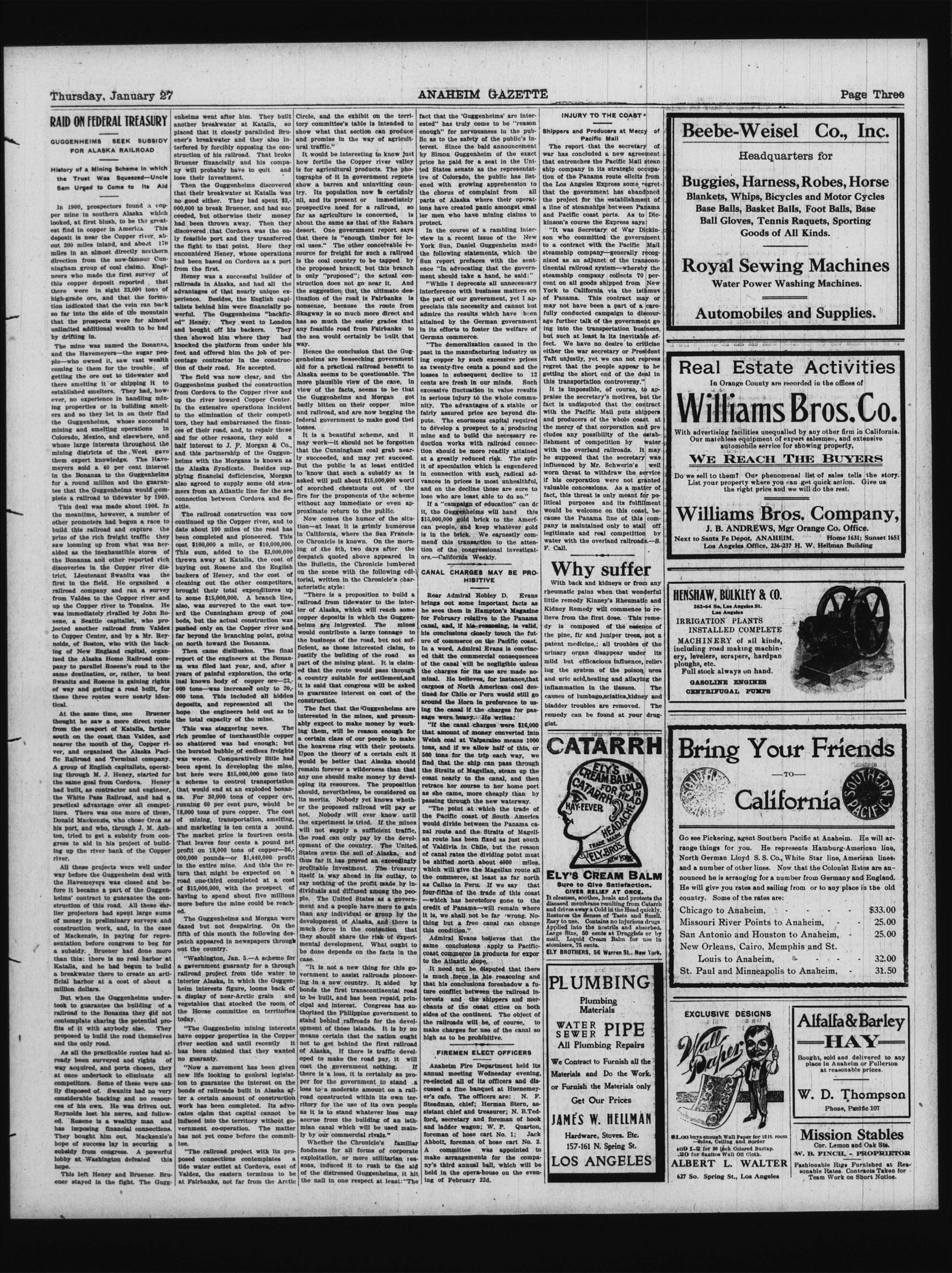
Searchable text
RAID ON FEDERAL TREASURY
GUGGENHEIMS SEEK SUBSIDY FOR ALASKA RAILROAD
History of a Mining Scheme in which the Trust Was Squeezed—Uncle Sam Urged to Come to Its Aid
In 1900, prospectors found a copper mine in southern Alaska which looked, at first blush, to be the greatest find in copper in America. This deposit is near the Copper river, about 200 miles inland, and about 170 miles in an almost directly northern direction from the now-famous Cunningham group of coal claims. Engineers who made the first survey of this copper deposit reported that there were in sight 23,000 tons of high-grade ore, and that the formation indicated that the vein ran back so far into the side of the mountain that the prospects were for almost unlimited additional wealth to be had by drifting in.
The mine was named the Bonanza, and the Havemeyers—the sugar people—who owned it, saw vast wealth coming to them for the trouble of getting the ore out to tidewater and there smelting it or shipping it to established smelters. They had, however, no experience in handling mining properties or in building smelters and so they let in on their find the Guggenheims, whose successful mining and smelting operations in Colorado, Mexico, and elsewhere, and whose large interests throughout the mining districts of the West gave them expert knowledge. The Havemeyers sold a 40 per cent interest in the Bonanza to the Guggenheim's enheims went after him. They built another breakwater at Katalla, so placed that it closely paralleled Bruener's breakwater and they also interfered by forcibly opposing the construction of his railroad. That broke Bruener financially and his company will probably have to quit and lose their investment.
Then the Guggenheim's discovered that their breakwater at Katalla was no good either. They had spent $3,000,000 to break Bruener, and had succeeded, but otherwise their money had been thrown away. Then they discovered that Cordova was the only feasible port and they transferred the fight to that point. Here they encountered Heney, whose operations had been based on Cordova as a port from the first.
Heney was a successful builder of railroads in Alaska, and had all the advantages of that nearly unique experience. Besides, the English capitalists behind him were financially powerful. The Guggenheim's "backfired" Heney. They went to London and bought off his backers. They then showed him where they had knocked the platform from under his feet and offered him the job of percentage contractor in the construction of their road. He accepted.
The field was now clear, and the Guggenheim's pushed the construction from Cordova to the Copper river and up the river toward Copper Center. In the extensive operations incident to the elimination of their competitors, they had embarrassed the finances of their road, and, to repair these and for other reasons, they sold a half interest to J. P. Morgan & Co., and this partnership of the Guggenheim with the Morgans is known as the Alaska Syndicate. Besides supplying financial deficiencies, Morgan Circle, and the extraordinary committee's test show what that secrecy and promise in the rural traffic."
It would be interesting how fertile the Coho is for agricultural photographs of it in green show a barren and try. Its population nil, and its present prospective need far as agriculture about the same as desert. One govern that there is "enormal uses." The other source for freight is the coal country; the proposed branch is only "proposed"; construction does not mention that tination of the road nonsense; because Skagway is so much has so much the any feasible road for the sea would certify way.
Hence the conclusion genheimms are beseeched for a practical Alaska seems to be more plausible view of the facts; the Guggenheimms badly bitten on the railroad, and a federal government losses.
It is a beautiful may work—it shows that the Cunninghamly succeeded, and But the public is to know that such
getting the ore out to tidewater and there smelting it or shipping it to established smelters. They had, however, no experience in handling mining properties or in building smelters and so they let in on their find the Guggenheims, whose successful mining and smelting operations in Colorado, Mexico, and elsewhere, and whose large interests throughout the mining districts of the West gave them expert knowledge. The Havemeyers sold a 40 per cent interest in the Bonanza to the Guggenheim for a round million and the guarantee that the Guggenheim would complete a railroad to tidewater by 1909.
This deal was made about 1906. In the meantime, however, a number of other promoters had begun a race to build this railroad and capture the prize of the rich freight traffic they saw looming up from what was heralded as the inexhaustible stores of the Bonanza and other reported rich discoveries in the Copper river district. Lieutenant Swanitz was the first in the field. He organized a railroad company and ran a survey from Valdez to the Copper river and up the Copper river to Tonsina. He was immediately rivalled by John Rosene, a Seattle capitalist, who projected another railroad from Valdez to Copper Center, and by a Mr. Reynolds, of Boston, who with the backing of New England capital, organized the Alaska Home Railroad company to parallel Rosene's road to the same destination, or, rather, to beat Swanitz and Rosene in gaining rights of way and getting a road built, for these three routes were nearly identical.
At the same time, one Bruener thought he saw a more direct route from the seaport of Katalla, farther south on the coast than Valdez, and nearer the mouth of the Copper river, and organized the Alaska Pacific Railroad and Terminal company. A group of English capitalists, operating through M. J. Heney, started for the same goal from Cordova. Heney had built, as contractor and engineer, the White Pass Railroad, and had a practical advantage over all competitors. There was one more of these, Donald Mackenzie, who chose Orca as his port, and who, through J. M. Ashton, tried to get a subsidy from congress to aid in his project of building up the river bank of the Copper river.
All these projects were well under way before the Guggenheim deal with the Havemeyers was closed and before it became a part of the Guggenheim's contract to guarantee the conThe field was now clear, and the Guggenheim pushed the construction from Cordova to the Copper river and up the river toward Copper Center. In the extensive operations incident to the elimination of their competitors, they had embarrassed the finances of their road, and, to repair these and for other reasons, they sold a half interest to J. P. Morgan & Co., and this partnership of the Guggenheim with the Morgans is known as the Alaska Syndicate. Besides supplying financial deficiencies, Morgan also agreed to supply some old steamers from an Atlantic line for the sea connection between Cordova and Seattle.
The railroad construction was now continued up the Copper river, and to date about 100 miles of the road has been completed and pioneered. This cost $100,000 a mile, or $10,000,000. This sum, added to the $3,000,000 thrown away at Katalla, the cost of buying out Rosene and the English backers of Heney, and the cost of cleaning out the other competitors, brought their total expenditures up to some $15,000,000. A branch line, also, was surveyed to the east toward the Cunningham group of coal beds, but the actual construction was pushed only on the Copper river and far beyond the branching point, going on north toward the Bonanza.
Then came disillusion. The final report of the engineers at the Bonanza was filed last year, and, after 8 years of painful exploration, the original known body of copper ore—23.000 tons—was increased only to 30.000 tons. This included all hidden deposits, and represented all the hope the engineers held out as to the total capacity of the mine.
This was staggering news. The rich promise of inexhaustible copper so shattered was bad enough; but the burst bubble of endless freights was worse. Comparatively little had been spent in developing the mine, but here were $15,000,000 gone into a scheme to control transportation that would end at an exploded bonanza. For 30,000 tons of copper ore, running 60 per cent pure, would be 18,000 tons of pure copper. The cost of mining, transportation, smelting, and marketing is ten cents a pound. The market price is fourteen cents. That leaves four cents a pound net profit on 18,000 tons of copper—36.000,000 pounds—or $1,440,000 profit in the entire mine. And this the return that might be expected on a road one-third completed at a cost of $15,000,000, with the prospect of having to spend about five millions
Alaska seems to be more plausible view of the facts than the Guggenheim badly bitten on their railroad, and a federal government losses.
It is a beautiful may work—it should that the Cunningham succeeded, and But the public is to know that such asked will pull about of scorched chest fire for the proposition without any immediate proximate return to Now comes the situation—at least it is in California where Co Chronicle is knowing of the 8th, two despatch quoted at the Bulletin, the On on the scene with tutorial written in this actistic style:
"There is a problem railroad from tidewater of Alaska which copper deposits in helms are interesting would contribute to business of this efficient as those justify the building part of the mining ed that the route w a country suitable it is said that could guarantee inter-construction.
The fact that tha interested in tha nably expect to mailing them, will be a certain class o f tha heavens ring Upon the theory o would be better forever w any one should ma oping its resources should nevertheless its merits. Nobody er the proposed r re not. Nobody will th e experiment is will not supply o tha road can only opment of tha co States owns she s thus far it has pre profitable investme itself is way ahead say nothing of tha dividuals and diffie ple. The United..."
All these projects were well under way before the Guggenheim deal with the Havemeyers was closed and before it became a part of the Guggenheims' contract to guarantee the construction of this road. All these earlier projectors had spent large sums of money in preliminary surveys and construction work, and, in the case of Mackenzie, in paying for representation before congress to beg for a subsidy. Bruener had done more than this: there is no real harbor at Katalla, and he had begun to build a breakwater there to create an artificial harbor at a cost of about a million dollars.
But when the Guggenheim undertook to guarantee the building of a railroad to the Bonanza they did not contemplate sharing the potential profits of it with anybody else. They proposed to build the road themselves and the only road.
As all the practicable routes had already been surveyed and rights of way acquired, and ports chosen, they at once undertook to eliminate all competitors. Some of these were easily disposed of. Swanitz had no very considerable backing and no resources of his own. He was driven out. Reynolds lost his nerve, and followed. Rosene is a wealthy man and has imposing financial connections. They bought him out. Mackenzie's hope of success lay in securing a subsidy from congress. A powerful lobby at Washington defeated this hope.
This left Heney and Bruener. Bruener stayed in the fight. The Gugg-
running 60 per cent pure, would be 18,000 tons of pure copper. The cost of mining, transportation, smelting, and marketing is ten cents a pound. The market price is fourteen cents. That leaves four cents a pound net profit on 18,000 tons of copper—36,000,000 pounds—or $1,440,000 profit in the entire mine. And this the return that might be expected on a road one-third completed at a cost of $15,000,000, with the prospect of having to spend about five millions more before the mine could be reached.
The Guggenheims and Morgan were dazed but not despairing. On the fifth of this month the following despatch appeared in newspapers through out the country.
"Washington, Jan. 5."—A scheme for a government guaranty for a through railroad project from tide water to interior Alaska, in which the Guggenheim interests figure, looms back of a display of near-Arctic grain and vegetables that stocked the room of the House committee on territories today.
"The Guggenheim mining interests have copper properties in the Copper river section and until recently it has been claimed that they wanted no guaranty.
"Now a movement has been given new life looking to general legislation to guarantee the interest on the bonds of railroads built in Alaska after a certain amount of construction work has been completed. Its advocates claim that capital cannot be induced into the territory without government co-operation. The matter has not yet come before the committee."
"The railroad project with its proposed connections contemplates a tide water outlet at Cordova, east of Valdez, the eastern terminus to be at Fairbanks, not far from the Arctic
ANAHEIM GAZETTE
Circle, and the exhibit on the territory committee's table is intended to show what that section can produce and promise in the way of agricultural traffic."
It would be interesting to know just how fertile the Copper river valley is for agricultural products. The photographs of it in government reports show a barren and uninviting country. Its population now is certainly nil, and its present or immediately prospective need for a railroad, so far as agriculture is concerned, is about the same as that of the Sahara desert. One government report says that there is "enough timber for local uses." The other conceivable resource for freight for such a railroad is the coal country to be tapped by the proposed branch, but this branch is only "proposed"; the actual construction does not go near it. And the suggestion that the ultimate destination of the road is Fairbanks is nonsense, because the route from Skagway is so much more direct and has so much the easier grades that any feasible road from Fairbanks to the sea would certainly be built that way.
Hence the conclusion that the Guggenheims are beseeching government aid for a practical railroad benefit to Alaska seems to be questionable. The more plausible view of the case, in view of the facts, seems to be that the Guggenheims and Morgan got badly bitten on their copper mine and railroad, and are now begging the federal government to make good their losses.
It is a beautiful scheme, and it may work—it should not be forgotten that the Cunningham coal grab nearly succeeded, and may yet succeed. But the public is at least entitled to know that such a subsidy as is fact that the 'Guggenheims' are interested" has truly come to be "reason enough" for nervousness in the public as to the safety of the public's interest. Since the bald announcement by Simon Guggenheim of the exact price he paid for a seat in the United States senate as the representative of Colorado, the public has listened with growing apprehension to the chorus of complaint from all parts of Alaska where their operations have created panic amongst smaller men who have mining claims to protect.
In the course of a rambling interview in a recent issue of the New York Sun, Daniel Guggenheim made the following statements, which the Sun report prefaces with the sentence "In advocating that the government should take a hand, he said:"
"While I deprecate all unnecessary interference with business matters on the part of our government, yet I appreciate this necessity and cannot but admire the results which have been attained by the German government in its efforts to foster the welfare of German commerce.
"The demoralization caused in the past in the manufacturing industry using copper by such excessive prices as twenty-five cents a pound and the losses in subsequent decline to 12 cents are fresh in our minds. Such excessive fluctuation in value results in serious injury to the whole community. The advantages of a stable or fairly assured price are beyond dispute. The enormous capital required to develop a prospect to a producing mine and to build the necessary reduction works with railroad connection should be more readily attained at a greatly reduced risk. The spirit of speculation which is engendered in connection with such radical ad-"
INJURY TO THE COAST*
Shippers and Producers at Mercy of Pacific Mail
The report that the secretary of war has concluded a new agreement that entrenches the Pacific Mail steam ship company in its strategic occupation of the Panama route elicits from the Los Angeles Express some regret that the government has abandoned the project for the establishment of a line of steamships between Panama and Pacific coast ports. As to Dickinson's course the Express says:
"It was Secretary of War Dickinson who committed the government to a contract with the Pacific Mail steamship company—generally recognized as an adjunct of the transcontinental railroad system—whereby the steamship company collects 70 percent on all goods shipped from New York to California via the isthmus of Panama. This contract may or may not have been a part of a carefully conducted campaign to discourage further talk of the government going into the transportation business, but such at least is its inevitable effect. We have no desire to criticise either the war secretary or President Taft unjustly, yet we can not repress regret that the people appear to be getting the short end of the deal in this transportation controversy."
It is impossible, of course, to apraise the secretary's motives, but the fact is undisputed that the contract with the Pacific Mail puts shippers and producers of the whole coast at the mercy of that corporation and precludes any possibility of the establishment of competition by water with the overland railroads. It may be supposed that the secretary was influenced by Mr. Schwerin's well worn threat to withdraw the service
Alaska seems to be questionable. The more plausible view of the case, in view of the facts, seems to be that the Guggenheims and Morgan got badly bitten on their copper mine and railroad, and are now begging the federal government to make good their losses.
It is a beautiful scheme, and it may work—it should not be forgotten that the Cunningham coal grab nearly succeeded, and may yet succeed. But the public is at least entitled to know that such a subsidy as asked will pull about $15,000,000 worth of scorched chestnuts out of the fire for the proponents of the scheme without any immediate or even approximate return to the public.
Now comes the humor of the situation—at least it is grimly humorous in California, where the San Francisco Chronicle is known. On the morning of the 8th, two days after the despatch quoted above appeared in the Bulletin, the Chronicle lumbered on the scene with the following editorial, written in the Chronicle's characteristic style:
"There is a proposition to build a railroad from tidewater to the interior of Alaska, which will reach some copper deposits in which the Guggenheims are interested. The mines would contribute a large tonnage to the business of the road, but not sufficient, as those interested claim, to justify the building of the road as part of the mining plant. It is claimed that the route would pass through a country suitable for settlement, and it is said that congress will be asked to guarantee interest on cost of the construction.
The fact that the Guggenheims are interested in the mines, and presumably expect to make money by working them, will be reason enough for a certain class of our people to make the heavens ring with their protests. Upon the theory of a certain cult it would be better that Alaska should remain forever a wilderness than that any one should make money by developing its resources. The proposition should, nevertheless, be considered on its merits. Nobody yet knows whether the proposed railroad will pay or not. Nobody will ever know until the experiment is tried. If the mines will not supply a sufficient traffic, the road can only pay by the development of the country. The United States owns the soil of Alaska, and thus far it has proved an exceedingly profitable investment. The treasury itself is way ahead in its outlay, to say nothing of the profit made by individuals and diffused among the people. The United States as a governor losses in subsequent decline to 12 cents are fresh in our minds. Such excessive fluctuation in value results in serious injury to the whole community. The advantages of a stable or fairly assured price are beyond dispute. The enormous capital required to develop a prospect to a producing mine and to build the necessary reduction works with railroad connection should be more readily attained at a greatly reduced risk. The spirit of speculation which is engendered in connection with such radical advances in prices is most unhealthful, and on the decline those are sure to lose who are least able to do so."
If a "campaign of education" can do it, the Guggenheims will hand this $15,000,000 gold brick to the American people, and keep whatever gold is in the brick. We earnestly commend this transaction to the attention of the congressional investigators.—California Weekly.
CANAL CHARGES MAY BE PROHIBITIVE
Rear Admiral Robley D. Evans brings out some important facts as he sees them in Hampton's Magazine for February relative to the Panama canal, and, if his reasoning, is valid, his conclusions closely touch the future of commerce on the Pacific coast. In a word, Admiral Evans is convinced that the commercial consequences of the canal will be negligible unless the charges for its use are made nominal. He believes, for instance, that cargoes of North American coal destined for Chile or Peru would still go around the Horn in preference to using the canal if the charges for passage were heavy. He writes:
"If the canal charges were $16,000 that amount of money converted into Welsh coal at Valparaiso means 1000 tons, and if we allow half of this, or 500 tons for the trip each way, we find that the ship can pass through the Straits of Magellan, steam up the coast nearly to the canal, and then retrace her course to her home port as she came, more cheaply than by passing through the new waterway.
"The point at which the trade of the Pacific coast of South America would divide between the Panama canal route and the Straits of Magellan route has been fixed as just south of Valdivia in Chile, but the reason of canal rates the dividing point must be shifted north about 4000 miles, which will give the Magellan route all the commerce, at least as far north as Callao in Peru. If we say that four-fifths of the trade of this coast getting the short end of the deal in this transportation controversy."
It is impossible, of course, to appraise the secretary's motives, but the fact is undisputed that the contract with the Pacific Mail puts shippers and producers of the whole coast at the mercy of that corporation and precludes any possibility of the establishment of competition by water with the overland railroads. It may be supposed that the secretary was influenced by Mr. Schwerin's well worn threat to withdraw the service if his corporation were not granted valuable concessions. As a matter of fact, this threat is only meant for political purposes and its fulfillment would be welcome on this coast, because the Panama line of this company is maintained only to stall off legitimate and real competition by water with the overland railroads.—S. F. Call.
Why suffer
With back and kidneys or from any rheumatic pains when that wonderful little remedy Kinney's Rheumatic and Kidney Remedy will commence to relieve from the first dose. This remedy is composed of the essence of the pine, fir and juniper trees, not a patent medicine; all troubles of the urinary organ disappear under its mild but efficacious influence, relieving the system of the poison urea and uric acid, healing and allaying the inflammation in the tissues. The causes of lumbago,sciatica,kidney and bladder troubles are removed. The remedy can be found at your drug-gist.
CATARRH
ELY'S CREAM BALM
Sure to Give Satisfaction.
GIVES.RELIEF AT ONCE.
It cleanses, soothes, heals and protects th
Nobody yet knows whether the proposed railroad will pay or not. Nobody will ever know until the experiment is tried. If the mines will not supply a sufficient traffic, the road can only pay by the development of the country. The United States owns the soil of Alaska, and thus far it has proved an exceedingly profitable investment. The treasury itself is way ahead in its outlay, to say nothing of the profit made by individuals and diffused among the people. The United States as a government and a people have more to gain than any individual or group by the development of Alaska, and there is much force in the contention that they should share the risk of experimental development. What ought to be done depends on the facts in the case.
"It is not a new thing for this government to assist railroads pioneering in a new country. It aided by bonds the first transcontinental road to be built, and has been repaid, principal and interest. Congress has authorized the Philippine government to stand behind railroads for the development of those islands. It is by no means certain that the nation ought not to get behind the first railroad of Alaska. If there is traffic developed to make the road pay, it will cost the government nothing. If there is a loss, it is certainly as proper for the government to stand a loss to a moderate amount on a railroad constructed within its own territory for the use of its own people as it is to stand whatever loss may accrue from the building of an isthmian canal which will be used mainly by our commercial rivals."
Whether the Chronicle's familiar fondness for all forms of corporate exploitation, or more utilitarian reasons, induced it to rush to the aid of the distressed Guggenheim, it hit the nail in one respect at least: "The
"The point at which the trade of the Pacific coast of South America would divide between the Panama canal route and the Straits of Magellan route has been fixed as just south of Valdivia in Chile, but the reason of canal rates the dividing point must be shifted north about 4000 miles, which will give the Magellan route all the commerce, at least as far north as Callao in Peru. If we say that four-fifths of the trade of this coast—which has heretofore gone to the credit of Panama—will remain where it is, we shall not be far wrong. Nothing but a free canal can change this condition."
Admiral Evans believes that the same conclusions apply to Pacific-coast commerce in products for export to the Atlantic slope.
It need not be disputed that there is much force in his reasoning and that his conclusions foreshadow a future conflict between the railroad interests and the shippers and merchants of the coast cities on both sides of the continent. The object of the railroads will be, of course, to make charges for use of the canal so high as to be prohibitive.
FIREMEN ELECT OFFICERS
Anaheim Fire Department held its annual meeting Wednesday evening, re-elected all of its officers and discussed a fine banquet at Huenemeyer’s cafe. The officers are: N. F. Steadman, chief; Herman Stern, assistant chief and treasurer; N. B.Tedford, secretary and foreman of hook and ladder wagon; W. P. Quarton, foreman of hose cart No. 1; Jack Abbott, foreman of hose cart No. 2. A committee was appointed to make arrangements for the company’s third annual ball, which will be held in the opera-house on the evening of February 22d.
Beebe-Weisel Co., Inc.
Headquarters for
Buggies, Harness, Robes, Horse
Blankets, Whips, Bicycles and Motor Cycles
Base Balls, Basket Balls, Foot Balls, Base
Ball Gloves, Tennis Raquets, Sporting
Goods of All Kinds.
Royal Sewing Machines
Water Power Washing Machines.
Automobiles and Supplies.
Real Estate Activities
In Orange County are recorded in the offices of
Williams Bros. Co.
With advertising facilities unequalled by any other firm in California.
Our matchless equipment of expert salesmen, and extensive
automobile service for showing property,
WE REACH THE BUYERS
In Orange County are recorded in the offices of
Williams Bros. Co.
With advertising facilities unequalled by any other firm in California.
Our matchless equipment of expert salesmen, and extensive
automobile service for showing property,
WE REACH THE BUYERS
Do we sell to them? Our phenomenal list of sales tells the story.
List your property where you can get quick action. Give us
the right price and we will do the rest.
Williams Bros. Company,
J. B. ANDREWS, Mgr Orange Co. Office.
Next to Santa Fe Depot, ANAHEIM.
Home 1631; Sunset 1651
Los Angeles Office, 236-237 H. W. Hellman Building
HENSHAW, BULKLEY & CO.
262-64 So, Los Angeles St.
Los Angeles
IRRIGATION PLANTS
INSTALLED COMPLETE
MACHINERY of all kinds,
including road making machinery, levelers, scrapers, hardpan ploughs, etc.
Full stock always on hand.
GASOLINE ENGINES
CENTRIFUGAL PUMPS
Bring Your Friends
TO
California
Go see Pickering, agent Southern Pacific at Anabeim. He will arrange things for you. He represents Hamburg-American line,
North German Lloyd S. S. Co., White Star line, American lines,
and a number of other lines. Now that the Colonist Rates are announced he is arranging for a number from Germany and England.
He will give you rates and sailing from or to any place in the old country. Some of the rates are:
Go see Pickering, agent Southern Pacific at Anaheim. He will arrange things for you. He represents Hamburg-American line,
North German Lloyd S. S. Co., White Star line, American lines,
and a number of other lines. Now that the Colonist Rates are announced he is arranging for a number from Germany and England.
He will give you rates and sailing from or to any place in the old country. Some of the rates are:
Chicago to Anaheim, $33.00
Missouri River Points to Anaheim, 25.00
San Antonio and Houston to Anaheim, 25.00
New Orleans, Cairo, Memphis and St.
Louis to Anaheim, 32.00
St. Paul and Minneapolis to Anaheim, 31.50
EXCLUSIVE DESIGNS
Wall Paper
$1.00 buys enough Wall Paper for 12 ft. room—Sides, Ceiling and Border
109 1-2 for 36 inch Colored Burlap.
.20 for Sanitos Wall Oil Cloth.
ALBERT L. WALTER
627 So. Spring St., Los Angeles
Alfalfa & Barley HAY
Bought, sold and delivered to any place in Anaheim or Fullerton at reasonable prices.
W. D. Thompson
Phone, Pacific 107
Mission Stables
Cor. Lemon and Oak Sta.
W. B. FINCH, - PROPRIETOR
Fashionable Rigs Furnished at Reasonable Rates. Contracts Taken for Team Work on Short Notice.