anaheim-gazette 1910-01-27
Scanned page
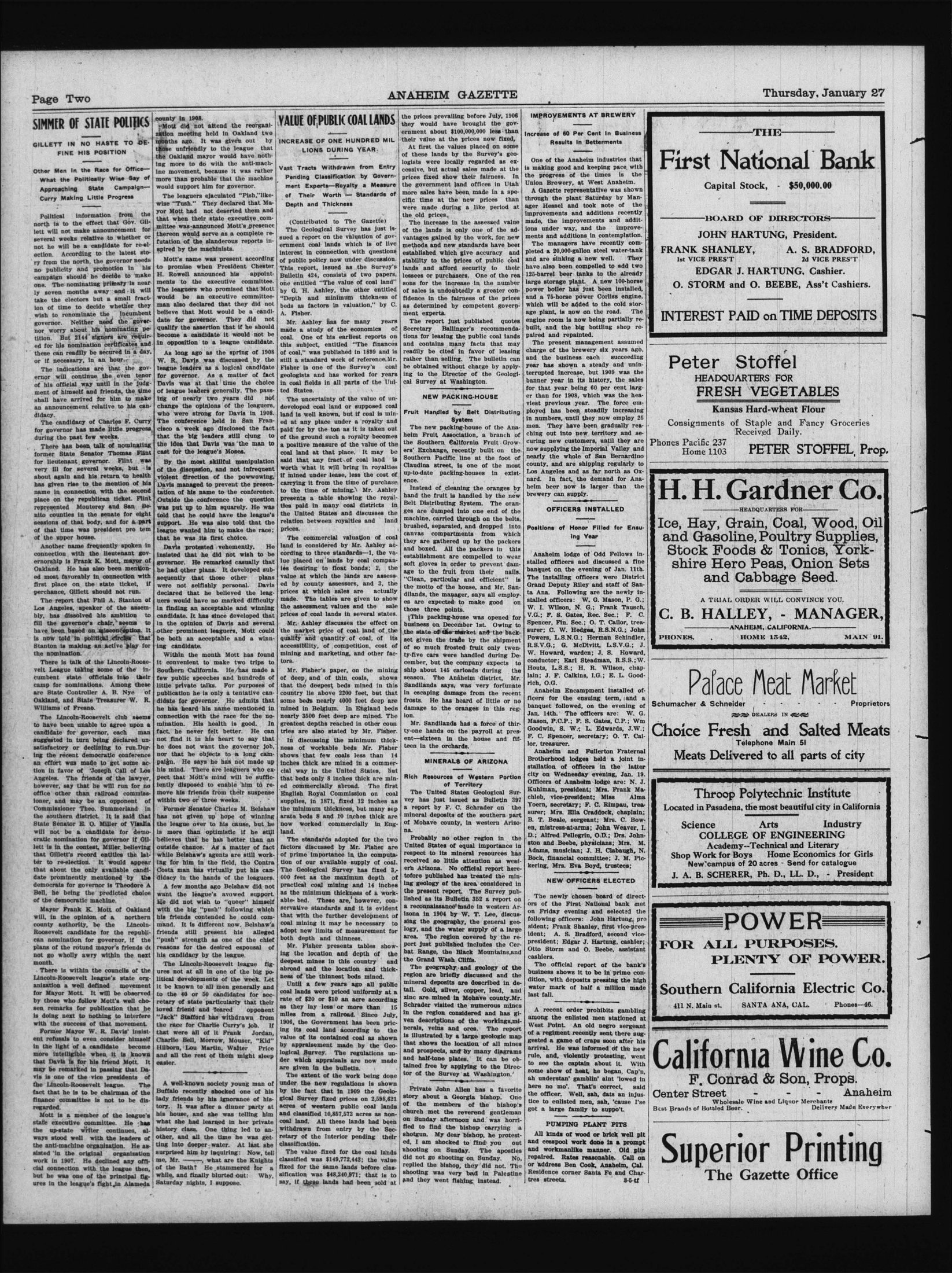
Searchable text
SIMMER OF STATE POLITICS
GILLETT IN NO HASTE TO DEFINE HIS POSITION
Other Men In the Race for Office—What the Politically Wise Say of Approaching State Campaign—Curry Making Little Progress
Political information from the north is to the effect that Gov. Gillett will not make announcement for several weeks relative to whether or not he will be a candidate for re-election. According to the latest story from the north, the governor needs no publicity and promotion in his campaign should he decide to make one. The nominating primary is nearly seven months away and it will take the electors but a small fraction of time to decide whether they wish to renominate the incumbent governor. Neither need the governor worry about his nominating petition. But 2144 signers are required for his nomination certificates and these can readily be secured in a day, or if necessary, in an hour.
The indications are that the governor will continue the even tenor of his official way until in the judgment of himself and friends, the time shall have arrived for him to make an announcement relative to his candidacy.
The candidacy of Charles F. Curry for governor has made little progress during the past few weeks.
There has been talk of nominating former State Senator Thomas Flint for lieutenant governor. Flint was very ill for several weeks, but is county in 1908.
Mott did not attend the reorganization meeting held in Oakland two months ago. It was given out by those unfriendly to the league that the Oakland mayor would have nothing more to do with the anti-machine movement, because it was rather more than probable that the machine would support him for governor.
The leaguers ejaculated "Pish," likewise "Tush." They declared that Mayor Mott had not deserted them and that when their state executive committee was announced Mott's presence thereon would serve as a complete refutation of the slanderous reports inspired by the machinists.
Mott's name was present according to promise when President Chester H. Rowell announced his appointments to the executive committee. The leaguers who promised that Mott would be an executive committeeman also declared that they did not believe that Mott would be a candidate for governor. They did not qualify the assertion that if he should become a candidate it would not be in opposition to a league candidate.
As long ago as the spring of 1908 W. R. Davis was discussed by the league leaders as a logical candidate for governor. As a matter of fact Davis was at that time the choice of league leaders generally. The passing of nearly two years did not change the opinions of the leaguers, who were strong for Davis in 1908. The conference held in San Francisco a week ago disclosed the fact that the big leaders still clung to the idea that Davis was the man to cast for the league's Moses.
By the most skillful manipulation of the discussion, and not infrequent
VALUE OF PUBLIC COOPERATION
INCREASE OF ONE HUNDRED LIONS DURING
Vast Tracts Withdrawn
Pending Classification
Experts—Royalty of Their Worth — Depth and Thickness
(Contributed to The Geological Survey sued a report on the valuation coal lands which interest in connection with public policy now under this report, issued as a Bulletin 424, consists of one entitled "The value by G. H. Ashley, the o' Depth and minimum beds as factors in value A. Fisher.
Mr. Ashley has for made a study of the economic subject, entitled "of coal," was published still a standard work of Fisher is one of the Surge geologists and has worked in coal fields in all partied States.
The uncertainty of the developed coal land or land is well known, but ed at any place under paid for by the ton as it of the ground such a roy positive measure of the coal land at that place said that any tract of worth what it will bring if mined under lease leased
ernor will continue the even tenor of his official way until in the judgment of himself and friends, the time shall have arrived for him to make an announcement relative to his candidacy.
The candidacy of Charles F. Curry for governor has made little progress during the past few weeks.
There has been talk of nominating former State Senator Thomas Flint for lieutenant governor. Flint was very ill for several weeks, but is about again and his return to health has given rise to the mention of his name in connection with the second place on the republican ticket. Flint represented Monterey and San Benito counties in the senate for eight sessions of that body, and for a part of that time was president pro tem of the upper house.
Another name frequently spoken in connection with the lieutenant governorship is Frank K. Mott, mayor of Oakland. He has also been mentioned most favorably in connection with first place on the state ticket, if perchance, Gillett should not run.
The report that Phil A. Stanton of Los Angeles, speaker of the assembly, has dissolved his ambition to fill the governor's chair, seems to have been based on misconception. It is now told in political circles that Stanton is making an active play for the nomination.
There is talk of the Lincoln-Roosevelt League taking some of the incumbent state officials into their camp for nominations. Among these are State Controller A. B. Nye of Oakland, and State Treasurer W. R. Williams of Fresno.
The Lincoln-Roosevelt club seems to have been unable to agree upon a candidate for governor, each man suggested in turn being declared unsatisfactory or declining to run.During the recent democratic conference an effort was made to get some action in favor of Joseph Call of Los Angeles. The friends of the lawyer, however, say that he will run for no office other than railroad commissioner, and may be an opponent of Commissioner Theo. Summerland in the southern district. It is said that State Senator E. O. Miller of Visalia will not be a candidate for democratic nomination for governor if Gillett is in the contest, Miller believing that Gillett's record entitles the latter to re-election. It would appear that about the only available candidate prominently mentioned by the democrats for governor is Theodore A Bell, he being the predicted choice for governor. As a matter of fact Davis was at that time the choice of league leaders generally. The passing of nearly two years did not change the opinions of the leaguers, who were strong for Davis in 1908. The conference held in San Francisco a week ago disclosed the fact that the big leaders still clung to the idea that Davis was 'the man to cast for the league's Moses.
By the most skillful manipulation of the discussion, and not infrequent violent direction of the powwowing, Davis managed to prevent the presentation of his name to the conference. Outside the conference the question was put up to him squarely. He was told that he could have the league's support. He was also told that the league wanted him to make the race; that he was its first choice.
Davis protested vehemently. He insisted that he did not wish to be governor. He remarked casually that he had other plans. It developed subsequently that those other plans were not selfishly personal. Davis declared that he believed the leaguers would have no marked difficulty in finding an acceptable and winning candidate. It has since developed that in the opinion of Davis and several other prominent leaguers, Mott could be both an acceptable and a winning candidate.
Within the month Mott has found it convenient to make two trips to Southern California. He has made a few public speeches and hundreds of little private talks. For purposes of publication he is only a tentative candidate for governor. He admits that he has heard his name mentioned in connection with the race for the nomination. His health is good. In fact, he never felt better. He can not find it in his heart to say that he does not want the governor job, nor that he objects to a long campaign. He says he has not made up his mind. There are leaguers who expect that Mott's mind will be sufficiently disposed to enable him to remove his friends from their suspense within two or three weeks.
Former Senator Charles M. Belshaw has not given up hope of winning the league over to his cause, but he is more than optimistic if he still believes that he has better than an outside chance. As a matter of fact while Belshaw's agents are still working for him in the field, the Contra Costa man has virtually put his candidacy in the hands of the leaguers.
A few months ago Belshaw did not want the league's avowed support for governor. As a matter of fact Davis was at that time the choice of league leaders generally. The passing of nearly two years did not change the opinions of the leaguers, who were strong for Davis in 1908. The conference held in San Francisco a week ago disclosed the fact that the big leaders still clung to the idea that Davis was 'the man to cast for the league's Moses.
By the most skillful manipulation of the discussion, and not infrequent violent direction of the powwowing, Davis managed to prevent the presentation of his name to the conference. Outside the conference the question was put up to him squarely. He was told that he could have the league's support. He was also told that the league wanted him to make the race; that he was its first choice.
Davis protested vehemently. He insisted that he did not wish to be governor. He remarked casually that he had other plans. It developed subsequently that those other plans were not selfishly personal. Davis declared that he believed the leaguers would have no marked difficulty in finding an acceptable and winning candidate. It has since developed that in the opinion of Davis and several other prominent leaguers, Mott could be both an acceptable and a winning candidate.
Within the month Mott has found it convenient to make two trips to Southern California. He has made a few public speeches and hundreds of little private talks. For purposes of publication he is only a tentative candidate for governor. He admits that he has heard his name mentioned in connection with the race for the nomination. His health is good. In fact, he never felt better. He can not find it in his heart to say that he does not want the governor job, nor that he objects to a long campaign. He says he has not made up his mind. There are leaguers who expect that Mott's mind will be sufficiently disposed to enable him to remove his friends from their suspense within two or three weeks.
Former Senator Charles M. Belshaw has not given up hope of winning the league over to his cause, but he is more than optimistic if he still believes that he has better than an outside chance. As a matter of fact while Belshaw's agents are still working for him in the field, the Contra Costa man has virtually put his candidacy in the hands of the leaguers.
A few months ago Belshaw did not want the league's avowed support for governor. As a matter of fact Davis was at that time the choice of league leaders generally. The passing of nearly two years did not change the opinions of the leaguers, who were strong for Davis in 1908. The conference held in San Francisco a week ago disclosed the fact that the big leaders still clung to the idea that Davis was 'the man to cast for the league's Moses.
By the most skillful manipulation of the discussion, and not infrequent violent direction of the powwowing, Davis managed to prevent the presentation of his name to the conference. Outside the conference the question was put up to him squarely. He was told that he could have the league's support. He was also told that the league wanted him to make the race; that he was its first choice.
Davis protested vehemently. He insisted that he did not wish to be governor. He remarked casually that he had other plans. It developed subsequently that those other plans were not selfishly personal. Davis declared that he believed the leaguers would have no marked difficulty in finding an acceptable and winning candidate. It has since developed that in the opinion of Davis and several other prominent leaguers, Mott could be both an acceptable and a winning candidate.
Within the month Mott has found it convenient to make two trips to Southern California. He has made a few public speeches and hundreds of little private talks. For purposes of publication he is only a tentative candidate for governor. He admits that he has heard his name mentioned in connection with the race for the nomination. His health is good. In fact, he never felt better. He can not find it in his heart to say that he does not want the governor job, nor that he objects to a long campaign. He says he has not made up his mind. There are leaguers who expect that Mott's mind will be sufficiently disposed to enable him to remove his friends from their suspense within two or three weeks.
Former Senator Charles M. Belshaw has not given up hope of winning the league over to his cause, but he is more than optimistic if he still believes that he has better than an outside chance. As a matter of fact while Belshaw's agents are still working for him in the field, the Contra Costa man has virtually put his candidacy in the hands of the leaguers.
A few months ago Belshaw did not want the league's avowed support for governor. As a matter of fact Davis was at that time the choice of league leaders generally. The passing of nearly two years did not change the opinions of the leaguers, who were strong for Davis in 1908. The conference held in San Francisco a week ago disclosed the fact that the big leaders still clung to the idea that Davis was 'the man to cast for the league's Moses.
By the most skillful manipulation of the discussion, and not infrequent violent direction of the powwowing, Davis managed to prevent the presentation of his name to the conference. Outside the conference the question was put up to him squarely. He was told that he could have the league's support. He was also told that the league wanted him to make the race; that he was its first choice.
Davis protested vehemently. He insisted that he did not wish to be governor. He remarked casually that he had other plans. It developed subsequently that those other plans were not selfishly personal. Davies declared that he believed the leaguers would have no marked difficulty in finding an acceptable and winning candidate. It has since developed that in the opinion of Davis and several other prominent leaguers, Mott could be both an acceptable and a winning candidate.
Within the month Mott has found it convenient to make two trips to Southern California. He has made a few public speeches and hundreds of little private talks. For purposes of publication he is only a tentative candidate for governor. He admits that he has heard his name mentioned in connection with the race for the nomination. His health is good. In fact, he never felt better. He can not find it in his heart to say that he does not want the governor job, nor that he objects to a long campaign. He says he has not made up his mind. There are leaguers who expect that Mott's mind will be sufficiently disposed to enable him to remove his friends from their suspense within two or three weeks.
Former Senator Charles M. Belshaw has not given up hope of winning the league over to his cause, but he is more than optimistic if he still believes that he has better than an outside chance. As a matter of fact while Belshaw's agents are still working for him in the field, the Contra Costa man has virtually put his candidacy in the hands of the leaguers.
A few months ago Belshaw did not want the league's avowed support for Governor. As a matter of fact Davis was at that time the choice of league leaders generally. The passing of nearly two years did not change the opinions of the leaguers, who were strong for Davis in 1908. The conference held in San Francisco a week ago disclosed the fact that the big leaders still clung to the idea that Davis was 'the man to cast for the league's Moses.
By this uncertainty of their developed coal land or land is well known, but ed at any place under paid for by-the ton as if off-the ground such a royalty-a positive measure of their coal land at that place-said that any tract of worth what it will bring-if mined under lease, less carrying it from time to time-of mining-presents a table showing tiles paid in many coal-The United States and relation between royalties-prices.
The commercial value land is considered by Mr.cording to three standards placed on lands by leses desiring to float below value at which landed by county assessors prices at which sales are made.The tables are giventhe assessment valuesa pricesof coal landsin sMr.Ashley discussesthe market priceof coalqualityandquantityofaccessibility.ofcompetitive miningandmarketing.attoors
Mr.Fisher's paper, oalof deep,andof thincoatthatthedeepestbedscountrylieabove2200some bedsnearly4000minedinBelgium.Innearly3500feet deepandgreatestdepthsreachedtrialsarealsostatedbyIn discussingthemineessofworkablebedsshowsthatfewcoalsthickareminedcialwayintheUnitedthatbedsonly8inchesedcommerciallyabroadEnglishRoyalCommissipsupplies,int1871,fixedtheminimumthicknessaratebeds8and10incornwedcommercialland.
The standards adoptedfactors discussedbyMr.ofprimeimportaininformationinourabilityofouravailablesupportTheGeologicalSurveyy000feetasthemaximaltracticalcoalminingasastheminimumthickness
Mayor Frank K. Mott of Oakland will, in the opinion of a northern county authority, be the Lincoln-Roosevelt candidate for the republican nomination for governor, if the plans of the rotund mayor's friends do not go wholly awry within the next month.
There is within the councils of the Lincoln-Roosevelt league's state organization a well defined movement for Mayor Mott. It will be observed by those who follow Mott's well chosen remarks for publication that he is doing next to nothing to interfere with the success of that movement.
Former Mayor W. R. Davis' insistent refusals to even consider himself in the light of a candidate become more intelligible when it is known that Davis is for his friend Mott. It may be remarked in passing that Davis is one of the vice presidents of the Lincoln-Roosevelt league. The fact that he is to be chairman of the finance committee is not to be disregarded.
Mott is a member of the league's state executive committee. He has the up-state writer continues, always stood well with the leaders of the anti-machine organization. He assisted in the original organization work in 1907. He declined any official connection with the league then, but he was one of the principal figures in the league's fight in Alameda within two or three weeks.
Former Senator Charles M. Belshaw has not given up hope of winning the league over to his cause, but he is more than optimistic if he still believes that he has better than an outside chance. As a matter of fact while Belshaw's agents are still working for him in the field, the Contra Costa man has virtually put his candidacy in the hands of the leaguers.
A few months ago Belshaw did not want the league's avowed support. He did not wish to "queer" himself with the big "push" following which his friends contended he could command. It is different now. Belshaw's friends still present his alleged "push" strength as one of the chief reasons for the desired espousal of his candidacy by the league.
The Lincoln-Roosevelt league figures not at all in one of the big political developments of the week. Let it be known to all men generally and to the 40 or 50 candidates for secretary of state particularly that their loved friend and feared opponent "Jack" Stafford has withdrawn from the race for Charlie Curry's job. If that were all of it Frank Jordan, Charlie Bell, Morrow, Mouser, "Kid" Hilborn, Lou Martin, Walter Price and all the rest of them might sleep easier.
A well-known society young man of Buffalo recently shocked one of his lady friends by his ignorance of history. It was after a dinner party at his house, and she was telling him what she had learned in her private history class. One thing led to another, and all the time he was getting into deeper water. At last she surprised him by asking: Now, tell me, Mr. ——, what are the Knights of the Bath? He stammered for a while, and finally blurted out: Why, Saturday nights, I suppose.
The standards adopted factors discussed by Mr. of prime importance in tion of our available swathe The Geological Survey 000 feet as the maximum practical coal mining as the minimum thickne able-bed. These are, servative standards and that with the further decoal mining it may be adopt new limits of mes both depth and thinner.
Mr. Fisher presents ling the location and deepest mines in this o abroad and the locationness of the thinnest bed.
Until a few years ago coal lands were priced up rate of $20 or $10 an acre as they lay less or more miles from a railroad. 1906, the Government hing its coal land accord value of its contained co by appraisement made logical Survey. The reder which appraisals are given in the bulletin.
The extent of the work under the new regulation by the fact that in 1906 geological Survey fixed prices acres of western public and classified 10,857,572 coal land. All these land withdrawn from entry retary of the Interior p classification.
The value fixed for the classified was $149,772,447 fixed for the same lands sification was $48,240,977 say, if these lands had
VALUE OF PUBLIC COAL LANDS
INCREASE OF ONE HUNDRED MILIONS DURING YEAR.
Vast Tracts Withdrawn from Entry Pending Classification by Government Experts—Royalty a Measure of Their Worth — Standards of Depth and Thickness
(Contributed to The Gazette)
The Geological Survey has just issued a report on the valuation of government coal lands which is of live interest in connection with questions of public policy now under discussion. This report, issued as the Survey's Bulletin 424, consists of two papers, one entitled "The value of coal land" by G. H. Ashley, the other entitled "Depth and minimum thickness of beds as factors in valuation," by C. A. Fisher.
Mr. Ashley has for many years made a study of the economics of coal. One of his earliest reports on this subject, entitled "The finances of coal," was published in 1899 and is still a standard work of reference. Mr. Fisher is one of the Survey's coal geologists and has worked for years in coal fields in all parts of the United States.
The uncertainty of the value of undeveloped coal land or supposed coal land is well known, but if coal is mined at any place under a royalty and paid for by the ton as it is taken out of the ground such a royalty becomes a positive measure of the value of the coal land at that place. It may be said that any tract of coal land is worth what it will bring in royalties if mined under lease less the cost of the prices prevailing before July, 1906 they would have brought the government about $100,000,000 less than their value at the prices now fixed.
At first the values placed on some of these lands by the Survey's geologists were locally regarded as excessive, but actual sales made at the prices fixed show their fairness. In the government land offices in Utah more sales have been made in a specific time at the new prices than were made during a like period at the old prices.
The increase in the assessed value of the lands is only one of the advantages gained by the work, for new methods and new standards have beer established which give accuracy and stability to the prices of public coal lands and afford security to their lessees or purchasers. One of the reasons for the increase in the number of sales is undoubtedly a greater confidence in the fairness of the prices as determined by competent government experts.
The report just published quotes Secretary Ballinger's recommendations for leasing the public coal lands and contains many facts that may readily be cited in favor of leasing rather than selling. The bulletin can be obtained without charge by applying to the Director of the Geological Survey at Washington.
NEW PACKING-HOUSE
Fruit Handled by Belt Distributing System
The new packing-house of the Anaheim Fruit Association, a branch of the Southern California Fruit Growers' Exchange, recently built on the Southern Pacific line at the foot of Claudina street, is one of the most up-to-date packing-houses in exist-
The uncertainty of the value of undeveloped coal land or supposed coal land is well known, but if coal is mined at any place under a royalty and paid for by the ton as it is taken out of the ground such a royalty becomes a positive measure of the value of the coal land at that place. It may be said that any tract of coal land is worth what it will bring in royalties if mined under lease, less the cost of carrying it from the time of purchase to the time of mining. Mr. Ashley presents a table showing the royalties paid in many coal districts in the United States and discusses the relation between royalties and land prices.
The commercial valuation of coal land is considered by Mr. Ashley according to three standards—1, the value placed on lands by coal companies desiring to float bonds; 2, the value at which the lands are assessed by county assessors, and 3, the prices at which sales are actually made. The tables are given to show the assessment values and the sale prices of coal lands in several states.
Mr. Ashley discusses the effect on the market price of coal land of the quality and quantity of coal, of its accessibility, of competition, cost of mining and marketing, and other factors.
Mr. Fisher's paper, on the mining of deep and of thin coals, shows that the deepest beds mined in this country lie above 2200 feet, but that some beds nearly 4000 feet deep are mined in Belgium. In England beds nearly 3500 feet deep are mined. The greatest depths reached in other countries are also stated by Mr. Fisher.
In discussing the minimum thickness of workable beds Mr. Fisher shows that few coals less than 14 inches thick are mined in a commercial way in the United States, but that beds only 8 inches thick are mined commercially abroad. The first English Royal Commission on coal supplies, in 1871, fixed 12 inches as the minimum thickness, but many sep arate beds 8 and 10 inches thick are now worked commercially in England.
The standards adopted for the two factors discussed by Mr. Fisher are of prime importance in the computation of our available supply of coal. The Geological Survey has fixed 2,000 feet as the maximum depth of practical coal mining and 14 inches as the minimum thickness of a workable bed. There are hometown reports to the Director of the Geological Survey at Washington.
NEW PACKING-HOUSE
Fruit Handled by Belt Distributing System
The new packing-house of the Anaheim Fruit Association, a branch of the Southern California Fruit Growers' Exchange, recently built on the Southern Pacific line at the foot of Claudina street, is one of the most up-to-date packing-houses in existence.
Instead of cleaning the oranges by hand the fruit is handled by the new Belt Distributing System. The oranges are dumped into one end of the machine, carried through on the belts, brushed, separated, and dropped into canvas compartments from which they are gathered up by the packers and boxed. All the packers in this establishment are compelled to wear soft gloves in order to prevent damage to the fruit from their nails. "Clean, particular and efficient" is the motto of the house, and Mr. Sandilands, the manager, says all employees are expected to make good on those three points.
This packing-house was opened for business on December 1st. Owing to the state of the market and the backset given the trade by the shipment of so much frosted fruit only twenty-five cars were handled during December, but the company expects to ship about 145 carloads during the season. The Anaheim district, Mr. Sandilands says, was very fortunate in escaping damage from the recent frosts. He has heard of little or no damage to the oranges in this region.
Mr. Sandilands has a force of thirty-one hands on the payroll at present—sixteen in the house and fifteen in the orchards.
MINERALS OF ARIZONA
Rich Resources of Western Portion of Territory
The United States Geological Survey has just issued as Bulletin 397 a report by F. C. Schrader on the mineral deposits of the southern part of Mohave county, in western Arizona.
Probably no other region in the United States of equal importance in respect to its mineral resources has received so little attention as western Arizona. No official report herefore published has treated the mining geology of the area considered in the present report. The Survey published as its Bulletin 352 a report on banner year in its history, the sales for that year being 60 per cent larger than for 1908, which was the heaviest previous year. The force employed has been steadily increasing in numbers, until they now employ 25 men. They have been gradually reaching out into new territory and securing new customers, until they are now supplying the Imperial Valley and nearly the whole of San Bernardino county, and are shipping regularly to Los Angeles and as far north as Oxnard. In fact, the demand for Anaheim beer now is larger than the brewery can supply.
OFFICERS INSTALLED
Positions of Honor Filled for Ensuing Year
Anaheim lodge of Odd Fellows installed officers and discussed a fine banquet on the evening of Jan. 11th. The installing officers were District Grand Deputy Riley and staff of Santa Ana. Following are the newly installed officers: W. G. Mason, P. G.; W. I. Wilson, N. G.; Frank Tausch, V.G.; F. S. Gates, Rec. Sec.; F. C. Spencer, Fin. Sec.; O. T. Callor, treasurer; C. W. Hedges, R.S.N.G.; John Powers, L.S.N.G.; Herman Schindler, R.S.V.G.; G. McDivitt, L.S.V.G.; J. W. Howard, warden; J. S. Howard, conductor; Earl Steadman, R.S.S.; W.Houts, L.S.S.; H. R. Wilson, chaplain; J. F. Calkins, I.G.; E. L Goodrich, O.G.
Anaheim Encampment installed officers for the ensuing term, and a banquet followed, on the evening of Jan. 14th. The officers are: W. G. Mason, P.C.P.; F. S. Gates, C.P.; Wm Goodwin, S.W.; L.Edwards, J.W.; F. C. Spencer, secretary; O.T.Cailor, treasurer.
Anaheim and Fullerton Fraternal Brotherhood lodges held a joint installation of officers in the latter city on Wednesday evening, Jan. 19. Officers of Anaheim lodge are: N.J.Kuhlman, president; Mrs.Frank Machleb, vice-president; Miss Alma Yoern, secretary; F.C.Rimpau, treasurer; Mrs.Ella Craddock, chaplain; B.T.Beale, sergeant; Mrs.C.Bowen,mistress-at-arms;John Weaver.I.D.:Alfred Pellegrin.O.D.:Drs.Johnston and Beebe,physicians;Mrs.M.Adams,musician;J.H.Clabaugh,N.Bock,financial committee;J.M.Pickering,Mrs.Eva Boyd,trustees;
NEW OFFICERS ELECTED
The newly chosen board of direct-
supplies, in 1871, fixed 12 inches as the minimum thickness, but many separate beds 8 and 10 inches thick are now worked commercially in England.
The standards adopted for the two factors discussed by Mr. Fisher are of prime importance in the computation of our available supply of coal. The Geological Survey has fixed 3,000 feet as the maximum depth of practical coal mining and 14 inches as the minimum thickness of a workable bed. These are, however, conservative standards and it is evident that with the further development of coal mining it may be necessary to adopt new limits of measurement for both depth and thinness.
Mr. Fisher presents tables showing the location and depth of the deepest mines in this country and abroad and the location and thickness of the thinnest beds mined.
Until a few years ago all public coal lands were priced uniformly at a rate of $20 or $10 an acre according as they lay less or more than 15 miles from a railroad. Since July, 1906, the Government has been pricing its coal land according to the value of its contained coal as shown by appraisement made by the Geological Survey. The regulations under which appraisals are now made are given in the bulletin.
The extent of the work being done under the new regulations is shown by the fact that in 1909 the Geological Survey fixed prices on 2,598,621 acres of western public coal lands and classified 10,857,572 acres as non-coal land. All these lands had been withdrawn from entry by the Secretary of the Interior pending their classification.
The value fixed for the coal lands classified was $149,772,443; the value fixed for the same lands before classification was $48,240,971; that is to say, if these lands had been sold at
Probably no other region in the United States of equal importance in respect to its mineral resources has received so little attention as western Arizona. No official report herefore published has treated the mining geology of the area considered in the present report. The Survey published as its Bulletin 352 a report on a reconnaissance made in western Arizona in 1904 by W. T. Lee, discussing the geography, the general geology, and the water supply of a large area. The region covered by the report just published includes the Cerat Range, the Black Mountains,and the Grand Wash Cliffs.
The geography and geology of the region are briefly discussed and the mineral deposits are described in detail. Gold, silver, copper, lead, and zinc are mined in Mohave county.Mr. Schrader visited the numerous mines in the region considered and has given descriptions of the workings,minerals, veins and ores. The report is illustrated by a large geologic map that shows the location of all mines and prospects, and by many diagrams and half-tone plates. It can be obtained free by applying to the Director of the Survey at Washington.
Private John Allen has a favorite story about a Georgia bishop. One of the members of the bishop's church met the reverend gentleman on Sunday afternoon and was horrified to find the bishop carrying a shotgun. My dear bishop, he protested, I am shocked to find you out shooting on Sunday. The apostles did not go shooting on Sunday. No, replied the bishop, they did not. The shooting was very bad in Palestine and they went fishing instead.
NEW OFFICERS ELECTED
The newly chosen board of directors of the First National bank met on Friday evening and selected the following officers: John Hartung, president; Frank Shanley, first vice-president; A. S. Bradford, second vice-president; Edgar J. Hartung, cashier; Otto Storm and O. Beebe, assistant cashiers.
The official report of the bank's business shows it to be in prime condition, with deposits pressing the high water mark of half a million made last fall.
A recent order prohibits gambling among the enlisted men stationed at West Point. An old negro sergeant of a regiment recently sent there suggested a game of craps soon after his arrival. He was informed of the new rule, and violently protesting, went to see the captain about it. With some show of heat, he began, Cap'n, ah understan' gamblin' aint 'lowed in here no mo'. That's correct, said the officer. Well, sah, dats an injustice to enlisted men, sah,'cause I'se got a large family to suppo't.
PUMPING PLANT PITS
All kinds of wood or brick well pit and cesspool work done in a prompt and workmanlike manner. Old pits repaired. Rates reasonable. Call on or address Ben Cook, Anaheim, Cal. Residence corner Santa Fe and Char-tres streets.
THURSDAY, January 27
THE
First National Bank
Capital Stock, - $50,000.00
BOARD OF DIRECTORS
JOHN HARTUNG, President.
FRANK SHANLEY, A. S. BRADFORD,
1st VICE PRES'T 2d VICE PRES'T
EDGAR J. HARTUNG, Cashier.
O. STORM and O. BEEBE, Ass't Cashiers.
INTEREST PAID on TIME DEPOSITS
Peter Stoffel
HEADQUARTERS FOR
FRESH VEGETABLES
Kansas Hard-wheat Flour
Consignments of Staple and Fancy Groceries
Received Daily.
Phones Pacific 237
Home 1103
PETER STOFFEL, Prop.
HEADQUARTERS FOR
FRESH VEGETABLES
Kansas Hard-wheat Flour
Consignments of Staple and Fancy Groceries
Received Daily.
Phones Pacific 237
Home 1103 PETER STOFFEL, Prop.
H. H. Gardner Co.
HEADQUARTERS FOR
Ice, Hay, Grain, Coal, Wood, Oil
and Gasoline, Poultry Supplies,
Stock Foods & Tonics, Yorkshire Hero Peas, Onion Sets
and Cabbage Seed.
A TRIAL ORDER WILL CONVINCE YOU.
C. B. HALLEY, - MANAGER,
ANAHEIM, CALIFORNIA.
PHONES. HOME 1542, MAIN 91.
Palace Meat Market
Schumacher & Schneider Proprietors
DEALEPS IN
Choice Fresh and Salted Meats
Telephone Main 51
Meats Delivered to all parts of city
Throop Polytechnic Institute
Located in Pasadena, the most beautiful city in California
Science Arts Industry
COLLEGE OF ENGINEERING
Academy--Technical and Literary
Shop Work for Boys Home Economics for Girls
New campus of 20 acres - Send for catalogue
J. A. B. SCHERER, Ph. D., LL. D., President
Located in Pasadena, the most beautiful city in California
Science Arts Industry
COLLEGE OF ENGINEERING
Academy--Technical and Literary
Shop Work for Boys Home Economics for Girls
New campus of 20 acres - Send for catalogue
J. A. B. SCHERER, Ph. D., LL. D., President
POWER
FOR ALL PURPOSES.
PLENTY OF POWER.
Southern California Electric Co.
411 N. Main st. SANTA ANA, CAL. Phones—46.
California Wine Co.
F. Conrad & Son, Props.
Center Street Anaheim
Wholesale Wine and Liquor Merchants
Best Brands of Bottled Beer.
Delivery Made Everywhere
Superior Printing
The Gazette Office