anaheim-gazette 1909-12-23
Scanned page
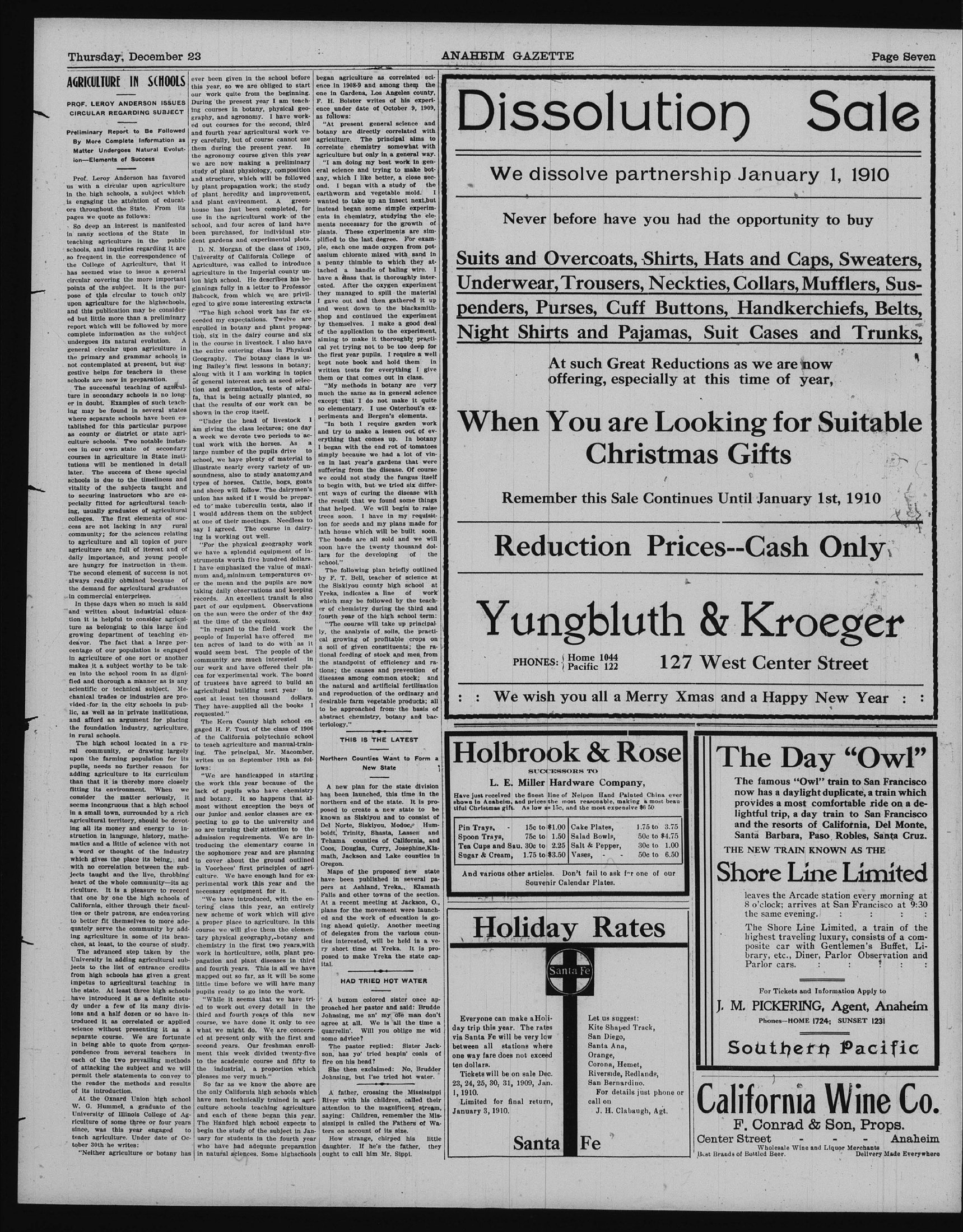
Searchable text
AGRICULTURE IN SCHOOLS
PROF. LEROY ANDERSON ISSUES CIRCULAR REGARDING SUBJECT
Preliminary Report to Be Followed By More Complete Information as Matter Undergoes Natural Evolution—Elements of Success
Prof. Leroy Anderson has favored us with a circular upon agriculture in the high schools, a subject which is engaging the attention of educators throughout the State. From its pages we quote as follows:
So deep an interest is manifested in many sections of the State in teaching agriculture in the public schools, and inquiries regarding it are so frequent in the correspondence of the College of Agriculture, that it has seemed wise to issue a general circular covering the more important points of the subject. It is the purpose of this circular to touch only upon agriculture for the high schools, and this publication may be considered but little more than a preliminary report which will be followed by more complete information as the subject undergoes its natural evolution. A general circular upon agriculture in the primary and grammar schools is not contemplated at present, but suggestive helps for teachers in these schools are now in preparation.
The successful teaching of agriculture in secondary schools is no longer in doubt. Examples of such teaching may be found in several states where separate schools have been established for this particular purpose as county or district or state agriculture schools. Two notable instances in our own state of secondary courses in agriculture in State institutions ever been given in the school before this year, so we are obliged to start our work quite from the beginning. During the present year I am teaching courses in botany, physical geography, and agronomy. I have worked out courses for the second, third and fourth year agricultural work very carefully, but of course cannot use them during the present year. In the agronomy course given this year we are now making a preliminary study of plant physiology, composition and structure, which will be followed by plant propagation work; the study of plant heredity and improvement, and plant environment. A greenhouse has just been completed, for use in the agricultural work of the school, and four acres of land have been purchased, for individual student gardens and experimental plots.
D. N. Morgan of the class of 1909, University of California College of Agriculture, was called to introduce agriculture in the Imperial county union high school. He describes his beginnings fully in a letter to Professor Babcock, from which we are privileged to give some interesting extracts.
"The high school work has far exceeded my expectations. Twelve are enrolled in botany and plant propagation, six in the dairy course and six in the course in livestock. I also have the entire entering class in Physical Geography. The botany class is using Bailey's first lessons in botany; along with it I am working in topics of general interest such as seed selection and germination, tests of alfalfa, that is being actually planted, so that the results of our work can be shown in the crop itself.
"Under the head of livestock I am giving the class lectures; one day a week we devote two periods to actual work with the horses. As a large number of the pupils drive to school we have plenty of material to began agriculture since in 1908-9 one in Garden F. H. Bolster ence under d as follows:
"At present botany are do agriculture. correlate che agriculture but "I am doing eral science any, which I ond. I began earthworm and wanted to take instead began ents in chem ment needs plants. These plified to the ple, each one assium chlorate a penny thing tached a ha have a class ested. After they managed I gave out ad and went do shop and co by themselves of the applica aiming to ma cal yet trying the first year kept note bo written tests them or that "My method much the same except that I so elementary periments an "In both and try to m eerything that I began with simply because
The successful teaching of agriculture in secondary schools is no longer in doubt. Examples of such teaching may be found in several states where separate schools have been established for this particular purpose as county or district or state agriculture schools. Two notable instances in our own state of secondary courses in agriculture in State institutions will be mentioned in detail later. The success of these special schools is due to the timeliness and vitality of the subjects taught and to securing instructors who are especially fitted for agricultural teaching, usually graduates of agricultural colleges. The first elements of success are not lacking in any rural community; for the sciences relating to agriculture and all topics of pure agriculture are full of interest and of daily importance, and young people are hungry for instruction in them. The second element of success is not always readily obtained because of the demand for agricultural graduates in commercial enterprises.
In these days when so much is said and written about industrial education it is helpful to consider agriculture as belonging to this large and growing department of teaching endeavor. The fact that a large percentage of our population is engaged in agriculture of one sort or another makes it a subject worthy to be taken into the school room in as dignified and thorough a manner as is any scientific or technical subject. Mechanical trades or industries are provided for in the city schools in public, as well as in private institutions, and afford an argument for placing the foundation industry, agriculture, in rural schools.
The high school located in a rural community, or drawing largely upon the farming population for its pupils, needs no further reason for adding agriculture to its curriculum than that it is thereby more closely fitting its environment. When we consider the matter seriously, it seems incongruous that a high school in a small town, surrounded by a rich agricultural territory, should be devoting all its money and energy to instruction in language, history, mathematics and a little of science with not a word or thought of the industry which gives the place its being, and with no correlation between the sub-
ing Bailey's first lessons in botany; along with it I am working in topics of general interest such as seed selection and germination, tests of alfalfa, that is being actually planted, so that the results of our work can be shown in the crop itself.
"Under the head of livestock I am giving the class lectures; one day a week we devote two periods to actual work with the horses. As a large number of the pupils drive to school, we have plenty of material to illustrate nearly every variety of unsoundness, also to study anatomy,and types of horses. Cattle, hogs, goats and sheep will follow. The dairymen's union has asked if I would be prepared to make tuberculin tests, also if I would address them on the subject at one of their meetings. Needless to say I agreed. The course in dairying is working out well.
"For the physical geography work we have a splendid equipment of instruments worth five hundred dollars. I have emphasized the value of maximum and minimum temperatures over the mean and the pupils are now taking daily observations and keeping records. An excellent transit is also part of our equipment. Observations on the sun were the order of the day at the time of the equinox.
"In regard to the field work the people of Imperial have offered me ten acres of land to do with as it would seem best. The people of the community are much interested in our work and have offered their places for experimental work. The board of trustees have agreed to build an agricultural building next year to cost at least ten thousand dollars. They have supplied all the books I requested."
The Kern County high school engaged H. F. Tout of the class of 1906 of the California polytechnic school to teach agriculture and manual-training. The principal, Mr. Macomber, writes us on September 19th as follows:
"We are handicapped in starting the work this year because of the lack of pupils who have chemistry and botany. It so happens that almost without exception the boys of our junior and senior classes are expecting to go to the university and so are turning their attention to the admission requirements. We are introducing the elementary course in the sophomore year and are planning to cover about the ground outlined in Voorhees' first principles of agri-
adding agriculture to its curriculum than that it is thereby more closely fitting its environment. When we consider the matter seriously, it seems incongruous that a high school in a small town, surrounded by a rich agricultural territory, should be devoting all its money and energy to instruction in language, history, mathematics and a little of science with not a word or thought of the industry which gives the place its being, and with no correlation between the subjects taught and the live, throbbing heart of the whole community—its agriculture. It is a pleasure to record that one by one the high schools of California, either through their faculties or their patrons, are endeavoring to better fit themselves to more adequately serve the community by adding agriculture in some of its branches, at least, to the course of study.
The advanced step taken by the University in adding agricultural subjects to the list of entrance credits from high schools has given a great impetus to agricultural teaching in the state. At least three high schools have introduced it as a definite study under a few of its many divisions and a half dozen or so have introduced it as correlated or applied science without presenting it as a separate course. We are fortunate in being able to quote from correspondence from several teachers in each of the two prevailing methods of attacking the subject and we will permit their statements to convey to the reader the methods and results of its introduction.
At the Oxnard Union high school W. G. Hummel, a graduate of the University of Illinois College of Agriculture of some three or four years since, was this year engaged to teach agriculture. Under date of October 30th he writes:
"Neither agriculture or botany has
"We are handicapped in starting the work this year because of the lack of pupils who have chemistry and botany. It so happens that almost without exception the boys of our junior and senior classes are expecting to go to the university and so are turning their attention to the admission requirements. We are introducing the elementary course in the sophomore year and are planning to cover about the ground outlined in Voorhees' first principles of agriculture. We have enough land for experimental work this year and the necessary equipment for it.
"We have introduced, with the entering class this year, an entirely new scheme of work which will give a proper place to agriculture. In this course we will give them the elementary physical geography, botany and chemistry in the first two years, with work in horticulture, soils, plant propagation and plant diseases in third and fourth years. This is all we have mapped out so far, as it will be some little time before we will have many pupils ready to go into the work.
"While it seems that we have tried to work out every detail in the third and fourth years of this new course, we have done it only to see what we might do. We are concerned at present only with the first and second years. Our freshman enrollment this week divided twenty-five to the academic course and fifty to the industrial, a proportion which pleases me very much."
So far as we know the above are the only California high schools which have men technically trained in agriculture schools teaching agriculture and each of these began this year. The Hanford high school expects to begin the study of the subject in January for students in the fourth year who have had adequate preparation in natural sciences. Some highschools
ANAHEIM GAZETTE
Dissolution
We dissolve partner
Never before have you l
Suits and Overcoats, Shirts
Underwear, Trousers, Neck
penders, Purses, Cuff Butt
Night Shirts and Pajamas
At such Great Reduction offering, especially
When You are Loving Christmas
began agriculture as correlated science in 1908-9 and among them the one in Gardena, Los Angeles county, F. H. Bolster writes of his experience under date of October 9, 1909, as follows:
"At present general science and botany are directly correlated with agriculture. The principal aims to correlate chemistry somewhat with agriculture but only in a general way.
"I am doing my best work in general science and trying to make botany, which I like better, a close second. I began with a study of the earthworm and vegetable mold. I wanted to take up an insect next, but instead began some simple experiments in chemistry, studying the elements necessary for the growth of plants. These experiments are simplified to the last degree. For example, each one made oxygen from potassium chlorate mixed with sand in a penny thimble to which they attached a handle of baling wire. I have a class that is thoroughly interested. After the oxygen experiment they managed to spill the material I gave out and then gathered it up and went down to the blacksmith shop and continued the experiment by themselves. I make a good deal of the application to the experiment, aiming to make it thoroughly practical yet trying not to be too deep for the first year pupils. I require a well kept note book and hold them in written tests for everything I give them or that comes out in class.
"My methods in botany are very much the same as in general science except that I do not make it quite so elementary. I use Osterhout's experiments and Bergen's elements.
"In both I require garden work and try to make a lessen out of everything that comes up. In botany I began with the end rot of tomatoes simply because we had a lot of vin-
When You are Loving Christmas
Remember this Sale Continues
Reduction Price
Yungbluth
PHONES: Home 1044 Pacific 122
We wish you all a Merry Xmas
THIS IS THE LATEST
Northern Counties Want to Form a New State
A new plan for the state division has been launched, this time in the northern end of the state. It is proposed to create a new state to be known as Siskiyou and to consist of Del Norte, Trinity, Shasta, Lassen and Tehama counties of California, and Coos, Douglas, Curry, Josephine, Klamath, Jackson and Lake counties in Oregon.
Holbrook & Rose Company
SUCCESSORS TO
L. E. Miller Hardware Company,
Have just received the finest line of Neipon Hand Painted China ever shown in Anaheim, and prices the most reasonable, making a most beautiful Christmas gift. As low as 15¢, and the most expensive $6.50.
Pin Trays, 15¢ to $1.00
Spoon Trays, 75¢ to 1.50
Tea Cups and Sauc. 30¢ to 2.25
Sugar & Cream, 1.75 to $3.50
Cake Plates, 1.75 to 3.75
Salad Bowls, 50¢ to $4.75
Salt & Pepper, 30¢ to 1.00
Vases, 50¢ to 6.50
A new plan for the state division has been launched, this time in the northern end of the state. It is proposed to create a new state to be known as Siskiyou and to consist of Del Norte, Siskiyou, Modoc, Humboldt, Trinity, Shasta, Lassen and Tehama counties of California, and Coos, Douglas, Curry, Josephine, Klamath, Jackson and Lake counties in Oregon.
Maps of the proposed new state have been published in several papers at Ashland, Yreka, Klamath Falls and other towns of the section. At a recent meeting at Jackson, O., plans for the movement were launched and the work of education is going ahead quietly. Another meeting of delegates from the various counties interested, will be held in a very short time at Yreka. It is proposed to make Yreka the state capital.
HAD TRIED HOT WATER
A buxom colored sister once approached her pastor and said: Brudde Johnsing, me an' my ole man don't agree at all. We is all the time a quarrelin'. Will you oblige me wid some advice?
The pastor replied: Sister Jackson, has yo' tried heapin' coals of fire on his head?
She then exclaimed: No, Brudder Johnsing, but I'se tried hot water.
A father, crossing the Mississippi River with his children, called their attention to the magnificent stream, saying: Children, remember the Mississippi is called the Fathers of Waters on account of its size.
How strange, chirped his little daughter. If he's the father, they ought to call him Mr. Sippi.
Holiday Rates
Everyone can make a Holiday trip this year. The rates via Santa Fe will be very low between all stations where one way fare does not exceed ten dollars.
Tickets will be on sale Dec. 23, 24, 25, 30, 31, 1909, Jan. 1, 1910.
Limited for final return, January 3, 1910.
Let us suggest:
Kite Shaped Track,
San Diego,
Santa Ana,
Orange,
Corona, Hemet,
Riverside, Redlands,
San Bernardino.
For details just phone or call on
J. H. Clabaugh, Agt.
Revolution Sale
the partnership January 1, 1910
have you had the opportunity to buy
boats, Shirts, Hats and Caps, Sweaters,
users, Neckties, Collars, Mufflers, SusCuff Buttons, Handkerchiefs, Belts,
Pajamas, Suit Cases and Trunks,
Great Reductions as we are now
especially at this time of year,
are Looking for Suitable
Christmas Gifts
Great Reductions as we are now,
especially at this time of year,
are Looking for Suitable
Christmas Gifts
Sale Continues Until January 1st, 1910
on Prices--Cash Only
luth & Kroeger
127 West Center Street
a Merry Xmas and a Happy New Year : :
Rose
Company,
and Painted China ever
able, making a most beaut expensive $6 50
The Day "Owl"
The famous "Owl" train to San Francisco
now has a daylight duplicate, a train which
provides a most comfortable ride on a delightful trip, a day train to San Francisco
and the resorts of California, Del Monte,
Santa Barbara, Paso Robles, Santa Cruz.
THE NEW TRAIN KNOWN AS THE
The famous "Owl" train to San Francisco now has a daylight duplicate, a train which provides a most comfortable ride on a delightful trip, a day train to San Francisco and the resorts of California, Del Monte, Santa Barbara, Paso Robles, Santa Cruz.
THE NEW TRAIN KNOWN AS THE
Shore Line Limited
leaves the Arcade station every morning at 8 o'clock; arrives at San Francisco at 9:30 the same evening.
The Shore Line Limited, a train of the highest traveling luxury, consists of a composite car with Gentlemen's Buffet, Library, etc., Diner, Parlor Observation and Parlor cars.
For Tickets and Information Apply to
J. M. PICKERING, Agent, Anaheim
Phones—HOME [724]; SUNSET [23]
Southern Pacific
California Wine Co.
F. Conrad & Son, Props.
Center Street - Anaheim
Wholesale Wine and Liquor Merchants
Best Brands of Bottled Beer.
Delivery Made Everywhere