anaheim-gazette 1909-10-28
Scanned page
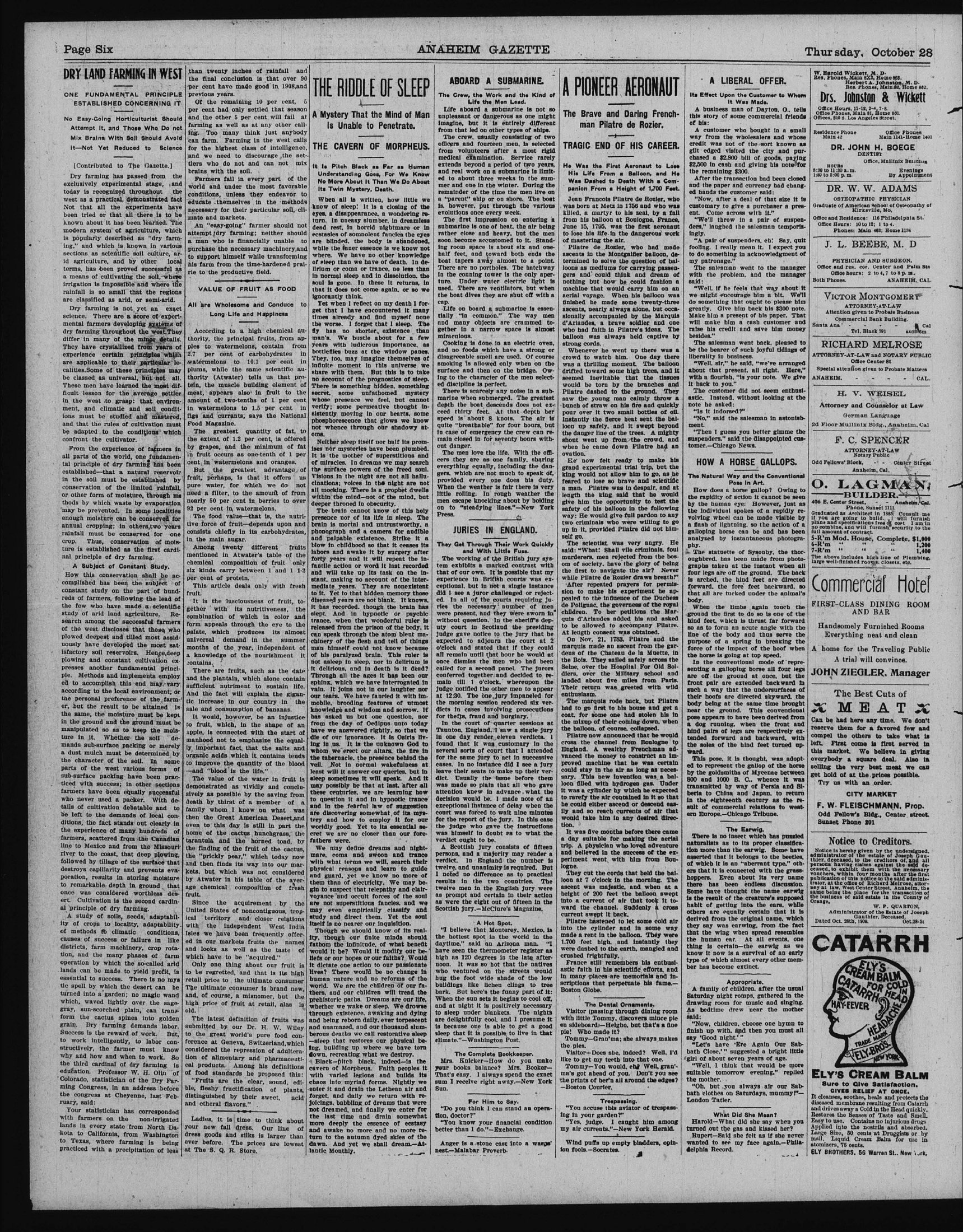
Searchable text
DRY LAND FARMING IN WEST
ONE FUNDAMENTAL PRINCIPLE ESTABLISHED CONCERNING IT
No Easy-Going Horticulturist Should Attempt It, and Those Who Do not Mix Brains With Soil Should Avoid It—Not Yet Reduced to Science
[Contributed to The Gazette.]
Dry farming has passed from the exclusively experimental stage, and today is recognized throughout the west as a practical, demonstrated fact. Not that all the experiments have been tried or that all there is to be known about it has been learned. The modern system of agriculture, which is popularly described as "dry farming," and which is known in various sections as scientific soil culture, arid agriculture, and by other local terms, has been proved successful as a means of cultivating the soil, where irrigation is impossible and where the rainfall is so small that the regions are classified as arid, or semi-arid.
Dry farming is not yet an exact science. There are a score of experimental farmers developing systems of dry farming throughout the west. They differ in many of the minor details. They have crystallized from years of experience certain principles which are applicable to their particular localities. Some of these principles may be classed as universal, but not all. These men have learned the most difficult lesson for the average settler in the west to grasp: that environment, and climatic and soil conditions must be studied and mastered, and that the rules of cultivation must be adapted to the conditions which confront the cultivator.
From the experience of farmers in all parts of the world, one fundamen-than twenty inches of rainfall and the final conclusion is that over 90 per cent have made good in 1908,and previous years.
Of the remaining 10 per cent, 5 per cent had only settled that season and the other 5 per cent will fail at farming as well as at any other calling. Too many think just anybody can farm. Farming in the west calls for the highest class of intelligence, and we need to discourage the settlers who do not and can not mix brains with the soil.
Farmers fall in every part of the world and under the most favorable conditions, unless they endeavor to educate themselves in the methods necessary for their particular soil, climate and markets.
An "easy-going" farmer should not attempt dry farming; neither should a man who is financially unable to purchase the necessary machinery, and to support himself while transforming his farm from the time-hardened prairie to the productive field.
VALUE OF FRUIT AS FOOD
All are Wholesome and Conduce to Long Life and Happiness
According to a high chemical authority, the principal fruits, from apples to watermelons, contain from 2.7 per cent of carbohydrates in watermelons to 10.1 per cent in plums, while the same scientific authority (Atwater) tells us that protein, the muscle building element of meat, appears also in fruit to the amount of two-tenths of 1 per cent in watermelons to 1.5 per cent in figs and currants, says the National Food Magazine.
The greatest quantity of fat, to the extent of 1.2 per cent, is offered by grapes, and the minimum of fat in fruit occurs as one-tenth of 1 per
are applicable to their particular localities. Some of these principles may be classed as universal, but not all. These men have learned the most difficult lesson for the average settler in the west to grasp: that environment, and climatic and soil conditions must be studied and mastered, and that the rules of cultivation must be adapted to the conditions which confront the cultivator.
From the experience of farmers in all parts of the world, one fundamental principle of dry farming has been established—that a natural reservoir in the soil must be established by conservation of the limited rainfall, or other form of moisture, through methods by which waste by evaporation may be prevented. In some localities enough moisture can be conserved for annual cropping; in others, two years rainfall must be conserved for one crop. Thus, conservation of moisture is established as the first cardinal principle of dry farming.
A Subject of Constant Study.
How this conservation shall be accomplished has been the subject of constant study on the part of hundreds of farmers, following the lead of the few who have made a scientific study of arid land agriculture. Research among the successful farmers of the west discloses that those who plowed deepest and tilled most assiduously have developed the most satisfactory soil reservoirs. Hence, deep plowing and constant cultivation expresses another fundamental principle. Methods and implements employed to accomplish this end may vary according to the local environment, or the personal preference of the farmer, but the result to be attained is the same, the moisture must be kept in the ground and the ground must be manipulated so as to keep the moisture in it. Whether the soil demands sub-surface packing or merely a dust mulch must be determined by the character of the soil. In some parts of the west various forms of sub-surface packing have been practiced with success; in other sections farmers have been equally successful who never used a packer. With details of cultivation debatable and to be left to the demands of local conditions, the fact stands out clearly in the experience of many hundreds of farmers, scattered from the Canadian line to Mexico and from the Missouri river to the coast, that deep plowing, followed by tillage of the surface that destroys capillarity and prevents evaporation.
The greatest quantity of fat, to the extent of 1.2 per cent, is offered by grapes, and the minimum of fat in fruit occurs as one-tenth of 1 per cent in watermelons and oranges.
But the greatest advantage of fruit, perhaps, is that it offers us pure water, for which we do not need a filter, to the amount of from nearly 50 per cent in berries to over 92 per cent in watermelons.
The food value—that is, the nutritive force of fruit—depends upon and consists chiefly in its carbohydrates, in the main sugar.
Among twenty different fruits mentioned in Atwater's table of the chemical composition of fruit only six kinds carry between 1 and 1 1/2 per cent of protein.
This article deals only with fresh fruit.
It is the lusciousness of fruit, together with its nutritiveness, the combination of which in color and form appeals through the eye to the palate, which produces its almost universal demand in the summer months of the year, independent of a knowledge of the nourishment it contains.
There are fruits, such as the date and the plantain, which alone contain sufficient nutriment to sustain life. And the fact will explain the gigantic increase in our country in the sale and consumption of bananas.
It would, however, be an injustice to fruit, which, in the shape of an apple, is connected with the start of manhood not to emphasize the equally important fact that the salts and organic acids which it contains tends to improve the quantity of the blood—and "blood is the life."
The value of the water in fruit is demonstrated as vividly and conclusively as possible by the saving from death by thirst of a member of a family whom I know on what was then the Great American Desert, and even to this day is still in part the home of the cactus hunchgrass, the tarantula and the horned toad, by the finding of the fruit of the cactus, the "prickly pear," which today now and then finds its way into our markets but which remains unavailable to them.
Infinite moments share with them no account of them. There is sometimes secret, some whose presence verifies; some persistently moving phosphorescence not whence throngs.
Neither sleep fills nor mystery. It is the mother of miracles. In the surface power Visions in the mindinations; voices all mocking. That within the mind deeper throned it.
The brain can presence nor offen brain is mortal phonograph and palpable e blow in childhood labors and awake forty years and fantile action on and will take u stant, making new mediate years. To it. Yet to that diseased years as it has recorded slept. And in trance. when thre released from tha can speak through chinery of the f man himself coof his paralyzed not asleep in slit it delirious, and Through all ther sphinx, which w vain. It joins n our tears. We he mobile, brooding knowledge and w has asked us b from the day o have we answer die of our ignoring in us. It is whom we erect at the tabernacle. t veil. Not in nu least will it ans眠 sometimes may possibly be these centuries; to question it a and in the fear are discovering tery and how w worldly good. Y cret we are no fathers were.
We may defin mare, coma an with what terms physical reasons
sub-surface packing have been practiced with success; in other sections farmers have been equally successful who never used a packer. With details of cultivation debatable and to be left to the demands of local conditions, the fact stands out clearly in the experience of many hundreds of farmers, scattered from the Canadian line to Mexico and from the Missouri river to the coast, that deep plowing, followed by tillage of the surface that destroys capillarity and prevents evaporation, results in storing moisture to remarkable depth in ground that once was considered worthless desert. Cultivation is the second cardinal principle of dry farming.
A study of soils, seeds, adaptability of crops to locality, adaptability of methods to climatic conditions, causes of success or failure in like districts, farm machinery, crop rotation, and the many phases of farm operation by which the so-called arid lands can be made to yield profit, is essential to success. There is no mystic spell by which the desert can be turned into a garden; no magic wand which, waved lightly over the sage-gray, sun-scorched plain, can transform the cactus spines into golden grain. Dry farming demands labor. Success is the reward of work. But, to work intelligently, to labor constructively, the farmer must know why and how and when to work. So the third cardinal of dry farming is education. Professor W. H. Olin of Colorado, statistician of the Dry Farming Congress, in an address before the congress at Cheyenne, last February, said:
Your statistician has corresponded with farmers on the non-irrigated lands in every state from North Dakota to California, from Washington to Texas, where farming is being practiced with a precipitation of less
The value of the water in fruit is demonstrated as vividly and conclusively as possible by the saving from death by thirst of a member of a family whom I know on what was then the Great American Desert, and even to this day is still in part the home of the cactus hunchgrass, the tarantula and the horned toad, by the finding of the fruit of the cactus, the "prickly pear," which today now and then finds its way into our markets, but which was not considered by Atwater in his table of the average chemical composition of fresh fruit.
Since the acquirement by the United States of noncontiguous tropical territory and closer relations with the independent West India Isles we have been frequently offered in our markets fruits the names and looks as well as the taste of which have to be "acquired."
Only one thing about our fruit is to be regretted, and that is its high retail price to the ultimate consumer. The ultimate consumer is brand new, and, of course, a misnomer, but the high price of fruit at retail, alas is old.
The latest definition of fruits was submitted by our Dr. H. W. Wiley to the great world's pure food conference at Geneva, Switzerland, which considered the repression of adulteration of alimentary and pharmaceutical products. Among his definitions of food standards he proposed this:
"Fruits are the clear, sound, edible, fleshy fructification of plants, distinguished by their sweet, acid and etheral flavors."
Ladies, it is time to think about your new fall dress. Our line of dress goods and silks is larger than ever before. The prices are lowest at The S. Q. R. Store.
THE RIDDLE OF SLEEP
A Mystery That the Mind of Man Is Unable to Penetrate.
THE CAVERN OF MORPHEUS.
It is Pitch Black as Far as Human Understanding Goes, For We Know No More About It Than We Do About Its Twin Mystery, Death.
When all is written, how little we know of sleep! It is a closing of the eyes, a disappearance, a wondering return. In uneasy slumber, in dreamless dead rest, in horrid nightmare or in ecstasies of somnolent fancies the eyes are blinded, the body is abandoned, while the inner essence is we know not where. We have no other knowledge of sleep than we have of death. In delirium or coma or trance, no less than in normal sleep and in dissolution, the soul is gone. In these it returns, in that it does not come again, or so we ignorantly think.
Yet when I reflect on my death I forget that I have encountered it many times already and find myself none the worse. I forget that I sleep. The fly has no shorter existence than man's. We bustle about for a few years with ludicrous importance, as bottleles buzz at the window panes. They, too, may imagine themselves of infinite moment in this universe we share with them. But this is to take no account of the prognostics of sleep. There is something hidden, something secret, some unfathomed mystery whose presence we feel, but cannot verify; some permeative thought insistently moving in our hearts, some phosphorescence that glows we know not whence through our shadowy atoms.
Neither sleep itself nor half its promises nor mysteries have been plumbed. It is the mother of superstitions and
ABOARD A SUBMARINE.
The Crew, the Work and the Kind of Life the Men Lead.
Life aboard a submarine is not so unpleasant or dangerous as one might imagine, but it is entirely different from that led on other types of ships.
The crew, usually consisting of two officers and fourteen men, is selected from volunteers after a most rigid medical examination. Service rarely extends beyond a period of two years, and real work on a submarine is limited to about three weeks in the summer and one in the winter. During the remainder of the time the men live on a "parent" ship or on shore. The boat is, however, put through the various evolutions once every week.
The first impression on entering a submarine is one of heat, the air being rather close and heavy, but the men soon become accustomed to it. Standing room space is about six and one-half feet, and toward both ends the boat tapers away almost to a point. There are no portholes. The hatchway in the conning tower is the only aperture. Under water electric light is used. There are ventilators, but when the boat dives they are shut off with a cap.
Life on board a submarine is essentially "in common." The way men and many objects are crammed together in a narrow space is almost miraculous.
Cooking is done in an electric oven, and no foods which have a strong or disagreeable smell are used. Of course smoking is allowed only when on the surface and then on the bridge. Owing to the character of the men selected discipline is perfect.
There is scarcely any noise in a submarine when submerged. The greatest depth the boat descends does not exceed thirty feet. At that depth her speed is about 8 knots. The air is quite "breathable" for four hours, but in case of emergency the crew can remain closed in for seventy hours without danger.
The men love the life. With the officers they are as one family sharing
A PIONEER AERONAUT
The Brave and Daring Frenchman Pilatre de Rozier.
TRAGIC END OF HIS CAREER.
He Was the First Aeronaut to Lose His Life From a Balloon, and He Was Dashed to Death With a Companion From a Height of 1,700 Feet.
Jean Francois Pilatre de Rozier, who was born at Metz in 1756 and who was killed, a martyr to his zeal, by a fall from his balloon at Boulogne, France, June 15, 1795, was the first aeronaut to lose his life in the dangerous work of mastering the air.
Pilatre de Rozier, who had made ascents in the Montgalfier balloon, determined to solve the question of balloons as mediums for carrying passengers and could think and dream of nothing but how he could fashion a machine that would carry him on an aerial voyage. When his balloon was finished he made some twenty-three ascents, nearly always alone, but occasionally accompanied by the Marquis d'Arlandes, a brave soldier and one who had faith in Pilatre's ideas. The balloon was always held captive by strong cords.
Whenever he went up there was a crowd to watch him. One day there was a thrilling moment. The balloon drifted toward some high trees, and it seemed inevitable that the tissues would be torn by the branches and Pilatre dashed to the ground. They saw the young man calmly throw a bunch of straw on his fire and quickly pour over it two small bottles of oil. Instantly the fierce heat sent the balloon up safely, and it swept beyond the danger line of the trees. A mighty shout went up from the crowd, and when he came down Pilatre had an ovation.
Infinite moment in this universe we share with them. But this is to take no account of the prognostics of sleep. There is something hidden, something secret, some unfathomed mystery whose presence we feel, but cannot verify; some permeative thought insistently moving in our hearts, some phosphorescence that glows we know not whence through our shadowy atoms.
Neither sleep itself nor half its promises nor mysteries have been plumbed. It is the mother of superstitions and of miracles. In dreams we may search the surface powers of the freed soul. Visions in the night are not all hallucinations; voices in the night are not all mocking. There is a prophet dwells within the mind—not of the mind, but deeper throned in obscurity.
The brain cannot know of this holy presence nor of its life in sleep. The brain is mortal and untrustworthy, a phonograph and a camera for audible and palpable existence. Strike it a blow in childhood so that it ceases its labors and awake it by surgery after forty years and it will repeat the infantile action or word it last recorded and will take up its task on the instant, making no account of the intermediate years. They are nonexistent to it. Yet to that hidden memory those diseased years are not blank. It knows, it has recorded, though the brain has slept. And in hypnotic or psychic trance, when that wonderful ruler is released from the prison of the body, it can speak through the atom blent machinery of the flesh and tell of things man himself could not know because of his paralyzed brain. This ruler is not asleep in sleep, nor in delirium is it delirious, and in death is it dead? Through all the ages it has been our sphinx, which we have interrogated in vain. It joins not in our laughter nor our tears. We have fancied it with immobile, brooding features of utmost knowledge and wisdom and sorrow. It has asked us but one question, nor from the day of Oedipus unto today have we answered rightly, so that we die of our ignorance. It is Osiris living in us. It is the unknown God to whom we erect our altars, the fire in the tabernacle, the presence behind the veil. Not in normal wakefulness at least will it answer our queries, but in sleep sometimes it will speak. And it may possibly be that at last, after all these centuries, we are learning how to question it and in hypnotic trance and in the fearful law of suggestion are discovering somewhat of its mystery and how to employ it for our worldly good. Yet to its essential secret we are no closer than our forefathers were.
We may define dreams and nightmare, coma and swoon and trance with what terms we will, search their physical reasons and learn to guide smoking is allowed only when on the surface and then on the bridge. Owing to the character of the men selected discipline is perfect.
There is scarcely any noise in a submarine when submerged. The greatest depth the boat descends does not exceed thirty feet. At that depth her speed is about 8 knots. The air is quite "breathable" for four hours, but in case of emergency the crew can remain closed in for seventy hours without danger.
The men love the life. With the officers they are as one family, sharing everything equally, including the dangers, which are not much to speak of, provided every one does his duty. When the weather is fair there is very little rolling. In rough weather the men escape knocking about by holding on to "steadying lines."—New York Press.
JURIES IN ENGLAND.
They Get Through Their Work Quickly and With Little Fuss.
The working of the British jury system exhibits a marked contrast with that of our own. It is possible that my experience in British courts was exceptional, but in not a single instance did I see a juror challenged or rejected. In all of the courts requiring juries the necessary number of men were present, and they were sworn in without question. In the sheriff's deputy court in Scotland the presiding judge gave notice to the jury that he expected to adjourn the court at 2 o'clock and stated that if they could all remain until that hour he would at once dismiss the men who had been called for a second panel. The jurors conferred together and decided to remain till 1 o'clock, whereupon the judge notified the other men to appear at 12:30. The one jury impaneled for the morning session rendered six verdicts in cases involving prosecutions for thefts, fraud and burglary.
In the court of quarter sessions at Taunton, England, I saw a single jury in one day render eleven verdicts. I found that it was customary in the several sorts of court that I attended for the same jury to act in successive cases. In no instance did I see a jury leave their seats to make up their verdict. Usually the issue before them was made so plain that all who gave attention knew in advance what the decision would be. I made note of an exceptional instance of delay when the court was forced to wait nine minutes for the report of the jury. In this case the judge who gave the instructions was himself in doubt as to what the verdict ought to be.
A Scottish jury consists of fifteen persons, and a majority may render a verdict. In England the number is twelve, and unanimity is required. But was a thrilling moment. The balloon drifted toward some high trees, and it seemed inevitable that the tissues would be torn by the branches and Pilatre dashed to the ground. They saw the young man calmly throw a bunch of straw on his fire and quickly pour over it two small bottles of oil. Instantly the fierce heat sent the balloon up safely, and it swept beyond the danger line of the trees. A mighty shout went up from the crowd, and when he came down Pilatre had an ovation.
He now felt ready to make his grand experimental trial trip, but the king would not allow him to go, as he feared to lose so brave and scientific a man. Pilatre was in despair, and at length the king said that he would give him the opportunity to test the safety of his balloon in the following way: He would give full pardon to any two criminals who were willing to go up in it, provided Pilatre did not himself go.
The scientist was very angry. He said: "What! Shall vile criminals, foul murderers, men rejected from the bosom of society, have the glory of being the first to navigate the air? Never while Pilatre de Rozier draws breath!"
After repeated prayers for permission to make his experiment he appealed to the influence of the Duchess de Polignac, the governess of the royal children. To her petitions the Marquis d'Arlandes added his and asked to be allowed to accompany Pilatre. At length consent was obtained.
On Nov. 21, 1783, Pilatre and the marquis made an ascent from the gardens of the Chateau de la Muette, in the Bois. They sailed safely across the Seline, over the Hospital For Old Soldiers, over the Military school and landed about five miles from Paris. Their return was greeted with wild enthusiasm.
The marquis rode back, but Pilatre had to go first to his house and get a coat, for some one had stolen his in the mixup of their coming down, when the balloon, of course, collapsed.
Pilatre now announced that he would cross the channel from Boulogne to England. A wealthy Frenchman advanced the money to construct an improved machine that he was certain could stay in the air as long as necessary. This new invention was a balloon filled with hydrogen gas. Under it was a cylinder by which he expected to rarefy the air contained in it so that he could either ascend or descend easily and so reach currents of air that would take him in any desired direction.
It was five months before there came a day suitable for making the aerial trip. A physician who loved adventure and believed in the success of the experiment went with him from Boulogne.
fruit is high consumer and new, but the alas is about time of year than lowest.
We may define dreams and nightmare, coma and swoon and trance with what terms we will, search their physical reasons and learn to guide and guard, yet we know no more of them than of electricity. We may begin to suspect that telepathy and clairvoyance and occult forces of the soul are not superstitious fancies, and we may even empirically classify and study and direct them. Yet the soul itself is no nearer our inquisition.
Though we should know of its reality, though our finite minds should fathom the infinitude, of what benefit would it be? Would it modify our beliefs or our hopes or our faiths? Would it dictate one action to our passionate lives? There would be no change in human nature and no reforms of the world. We are the children of our fathers, and our children will tread the prehistoric paths. Dreams are our life, whether we wake or sleep. We drowse through existence, awaking and dying and being reborn daily, ever torpescent and unamazed, and our thousand slumberous deaths we call restorative sleep—sleep that restores our physical being, building up where we have torn down, recreating what we destroy.
Black—pitch black, indeed—is the cavern of Morpheus. Faith peoples it with varied legions and builds its chaos into myriad forms. Nightly we enter it and drain the Lethean air and forget, and daily we return with rejoicing, babbling of dreams that were not dreamed, and finally we enter for the last time and drain somewhat more deeply the essence of ecstasy and awake no more and no more return to the autumn dyed skies of the dawn. And yet we shall dream.—Atlantic Monthly.
Usually the issue before them was made so plain that all who gave attention knew in advance what the decision would be. I made note of an exceptional instance of delay when the court was forced to wait nine minutes for the report of the jury. In this case the judge who gave the instructions was himself in doubt as to what the verdict ought to be.
A Scottish jury consists of fifteen persons, and a majority may render a verdict. In England the number is twelve, and unanimity is required. But I noted no difference as to practical results in the two countries. The twelve men in the English jury were as prompt and certain in their action as were the eight out of fifteen in the Scottish jury.—McClure's Magazine.
A Hot Spot.
"I believe that Monterey, Mexico, is the hottest spot in the world in the daytime," said an Arizona man. "I have seen the thermometer register as high as 120 degrees in the late afternoon. It was so hot that the natives who ventured on the streets would hug the foot wide shade of the low buildings like lichen clings to tree bark. But here's the funny part of it: When the sun sets it begins to cool off, and at night it is positively necessary to sleep under blankets. The nights are delightfully cool, and I presume it is because one is able to get a good sleep that it is possible to live in that climate."—Washington Post.
The Complete Bookkeeper.
Mrs. Knicker—How do you make your books balance? Mrs. Bookker—That's easy. I always spend the exact sum I receive right away.—New York Sun.
For Him to Say.
"Do you think I can stand an operation, doctor?"
"You know your financial condition better than I do."—Exchange.
Anger is a stone cast into a wasp nest.—Malabar Proverb.
This new invention was a balloon filled with hydrogen gas. Under it was a cylinder by which he expected to rarefy the air contained in it so that he could either ascend or descend easily and so reach currents of air that would take him in any desired direction.
It was five months before there came a day suitable for making the aerial trip. A physician who loved adventure and believed in the success of the experiment went with him from Boulogne.
They cut the cords that held the balloon at 7 o'clock in the morning. The ascent was majestic, and when at a height of 200 feet the balloon swept into a current of air that took it toward the channel. Suddenly a cross current swept it back.
Pilatre hastened to let some cold air into the cylinder and in some way made a rent in the balloon. They were 1,700 feet high, and instantly they were dashed to the earth, mangled and crushed frightfully.
France still remembers his enthusiastic faith in his scientific efforts, and in many places are memorials and inscriptions that perpetuate his fame.—Boston Globe.
The Dental Ornaments.
Visitor (passing through dining room with little Tommy, discovers mince pie on sideboard)—Heigho, but that's a fine ple! Who made it?
Tommy—Gran'ma; she always makes the ples.
Visitor—Does she, indeed? Well, I'd like to get my teeth into that one.
Tommy—You would, ebi Well, gran'ma's got ahead of you. Don't you see the prints of her'n all around the edges?—Boston Courier.
Trespassing.
"You accuse this aviator of trespassing in your garden?"
"Yes, judge. I caught him among my air currents."—New York Herald.
Wind puffs up empty bladders, opinion fools.—Socrates.
A LIBERAL OFFER.
Its Effect Upon the Customer to Whom It Was Made.
A business man of Dayton, O., tells this story of some commercial friends of his:
A customer who bought in a small way from the wholesalers and whose credit was not of the sort known as gilt-edged visited the city and purchased a $2,800 bill of goods, paying $2,500 in cash and giving his note for the remaining $300.
After the transaction had been closed and the paper and currency had changed hands the customer said:
"Now, after a deal of that size it is customary to give a purchaser a present. Come across with it."
"We'll throw in a pair of suspenders," laughed the salesman temporarily.
"A pair of suspenders, eh! Say, quit fooling. I really mean it. I expect you to do something in acknowledgment of my patronage."
The salesman went to the manager with the problem, and the manager said:
"Well, if he feels that way about it we might encourage him a bit. We'll do something that ought to please him greatly. Give him back his $300 note. Make him a present of his paper. That will make him a cash customer and raise his credit and save him money besides."
The salesman went back, pleased to be the bearer of such joyful tidings of liberality in business.
"Well, sir," he said, "we've arranged about that present, all right. Here," with a flourish, "is your note. We give it back to you."
The customer did not seem enthusiastic. Instead, without looking at the note he asked:
"Is it indorsed?"
"No," said the salesman in astonishment.
"Then I guess you better gimme the suspenders." said the disappointed customer.—Chicago News.
HOW A HORSE GALLOPS.
The Natural Way and the Conventional Pose In Art.
How does a horse gallop? Owing to the rapidity of action it cannot be seen by the human eye. However, just as the individual spokes of a rapidly revolving wheel can be made visible by a flash of lightning, so the action of a galloping horse can be and has been analyzed by instantaneous photography.
The statuette of Sysonby, the thoroughbred, has been made from photographs taken at the instant when all four legs are off the ground. The back is arched, the hind feet are directed forward, the fore feet backward, so that all are tucked under the animal's body.
When the limbs again touch the ground the first to do so is one of the hind feet, which is thrust far forward so as to form an acute angle with the line of the body and thus serve the purpose of a spring in breaking the force of the impact of the hoof when the horse is going at top speed.
In the conventional mode of representing a galloping horse all four legs are off the ground at once, but the front pair are extended backward in such a way that the undersurfaces of their hoofs are directed skyward, the body being at the same time brought near the ground. This conventional pose appears to have been derived from a dog running, when the front and hind pairs of legs are respectively extended forward and backward, with the soles of the hind feet turned upward.
This pose, it is thought, was adopted to represent the gallop of the horse by the goldsmiths of Mycenae between 800 and 1000 B.C., whence it was transmitted by way of Persia and Siberia to China and Japan, to return in the eighteenth century as the result of commercial relations to western Europe.—Chicago Tribune.
The Earwig.
There is no insect which has puzzled naturalists as to its proper classification more than the earwig. Some have asserted that it belongs to the beetles, of which it is an "aberrant type," others that it is connected with the grass.
The Earwig.
There is no insect which has puzzled naturalists as to its proper classification more than the earwig. Some have asserted that it belongs to the beetles, of which it is an "aberrant type," others that it is connected with the grasshoppers. Even about its very name there has been endless discussion. Some have thought the name earwig is the result of the creature's supposed habit of getting into the ears, while others are equally certain that it is derived from the original name, which they say was earwing, from the fact that the wing when spread resembles the human ear. At all events, one thing is certain—the earwig as we know it now is a survival of an early type of which almost every other member has become extinct.
Appropriate.
A family of children, after the usual Saturday night romps, gathered in the drawing room for music and singing. As bedtime drew near the mother said:
"Now, children, choose one hymn to finish up with, and then you must all say 'Good night.'"
"Let's have 'Ere Again Our Sabbath Close,'" suggested a bright little girl of about seven years of age.
"Well, I think that would be more suitable tomorrow evening," replied the mother.
"Oh, but you always air our Sabbath clothes on Saturdays, mummy!"—London Tatler.
What Did She Mean?
Harold—What did she say when you turned out the gas and kissed her?
Rupert—Said she felt as if she never wanted to see my face again.—Philadelphia Record.