anaheim-gazette 1909-10-14
Scanned page
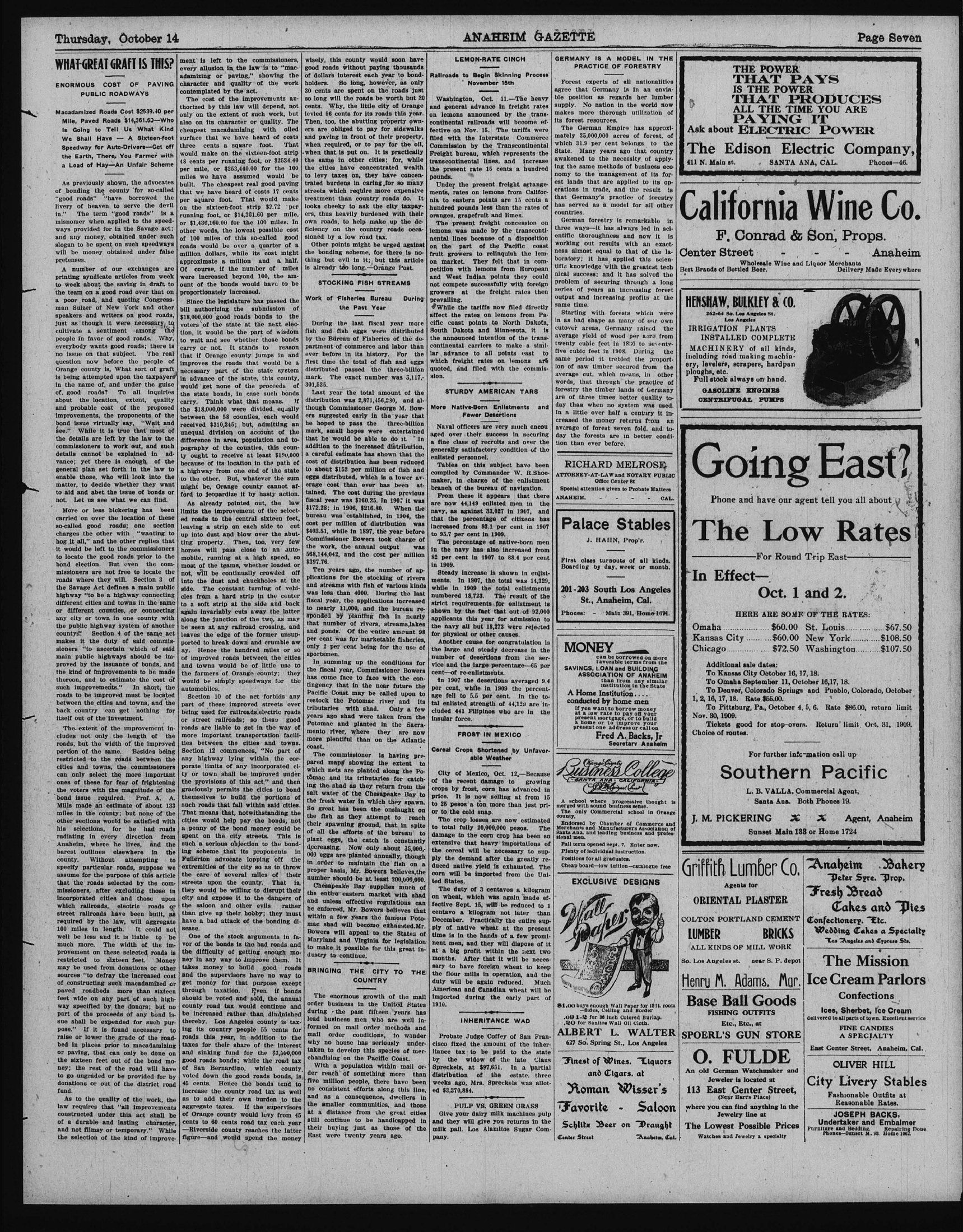
Searchable text
WHAT-GREAT GRAFT IS THIS?
ENORMOUS COST OF PAVING
PUBLIC ROADWAYS
Macadamized Roads Cost $2539.40 per Mile, Paved Roads $14,361.60—Who Is Going to Tell Us What Kind We Shall Have — A Sixteen-foot Speedway for Auto-Drivers—Get off the Earth, There, You Farmer with a Load of Hay—An Unfair Scheme
As previously shown, the advocates of bonding the county for so-called "good roads" "have borrowed the livery of heaven to serve the devil in." The term "good roads" is a misnomer when applied to the speedways provided for in the Savage act; and any money, obtained under such slogan to be spent on such speedways will be money obtained under false pretenses.
A number of our exchanges are printing syndicate articles from week to week about the saving in draft to the team on a good road over that on a poor road, and quoting Congressman Sulzer of New York and other speakers and writers on good roads, just as though it were necessary to cultivate a sentiment among the people in favor of good roads. Why, everybody wants good roads; there is no issue on that subject. The real question now before the people of Orange county is, What sort of graft is being attempted upon the taxpayers in the name of, and under the guise of, good roads? To all inquiries about the location, extent, quality and probable cost of the proposed improvements, the proponents of the bond issue virtually say, "Wait and see." While it is true that most of the details are left by the law to the commissioners to work out, and such details cannot be explained in ad-
ment is left to the commissioners, every allusion in the law is to "macadamizing or paving," showing the character and quality of the work contemplated by the act.
The cost of the improvements authorized by this law will depend, not only on the extent of such work, but also on its character or quality. The cheapest macadamizing with oiled surface that we have heard of costs three cents a square foot. That would make on the sixteen-foot strip 48 cents per running foot, or $2534.40 per mile, or $253,440.00 for the 100 miles we have assumed would be built. The cheapest real good paving that we have heard of costs 17 cents per square foot. That would make on the sixteen-foot strip $2.72 per running foot, or $14,361.60 per mile, or $1,436,160.00 for the 100 miles. In other words, the lowest possible cost of 100 miles of this so-called good roads would be over a quarter of a million dollars, while its cost might approximate a million and a half. Of course, if the number of miles were increased beyond 100, the amount of the bonds would have to be proportionately increased.
Since the legislature has passed the bill authorizing the submission of $18,000,000 good roads bonds to the voters of the state at the next election, it would be the part of wisdom to wait and see whether those bonds carry or not. It stands to reason that if Orange county jumps in and improves the roads that would be a necessary part of the state system in advance of the state, this county, would get none of the proceeds of the state bonds, in case such bonds carry. Think what that means.
If the $18,000,000 were divided equally between the 58 counties, each would received $310,345; but, admitting an unequal division on account of the difference in area, population and topography of the counties, this county ought to receive at least $190,000 wisely, this country good roads without dollars interest holders. So long as 30 cents are spent so long will the reductions. Why, the levied 56 cents for Then, too, the abusers are obliged to and paving in front when required, or when that is put into the same in other cities have to levy taxes on treated burdens in streets which require treatment than can look cheeky to others, thus heavily own roads, to help efficiency on the conditioned by a low rate.
Other points merit the bonding scheme thing but evil in is already too long.
STOCKING F
Work of Fisheries
the Pa
During the last fish and fish egg by the Bureau of Department of commerce ever before in it first time the total distributed passes mark. The exact 301,535.
Last year the distribution was 2 though Commissioners suggested earlier he hoped to pass mark, small hope that he would be addition to the income a careful estimate
More or less bickering has been carried on over the location of these so-called good roads; one section charges the other with "wanting to hog it all," and the other replies that it would be left to the commissioners to locate the good roads prior to the bond election. But even the commissioners are not free to locate the roads where they will. Section 3 of the Savage Act defines a main public highway "to be a highway connecting different cities and towns in the same or different counties, or connecting any city or town in one county with the public highway system of another county." Section 4 of the same act makes it the duty of said commissioners "to ascertain which of said main public highways should be improved by the issuance of bonds, and the kind of improvements to be made thereon, and to estimate the cost of such improvements." In short, the roads to be improved must be located between the cities and towns, and the back country can get nothing for itself out of the investment.
The extent of the improvement includes not only the length of the roads, but the width of the improved portion of the same. Besides being restricted to the roads between the cities and towns, the commissioners can only select the more important ones of these for fear of frightening the voters with the magnitude of the bond issue required. Prof. A. A. Mills made an estimate of about 133 miles in the county; but none of the other sections would be satisfied with his selections, for he had roads radiating in every direction from Anaheim, where he lives, and the barest outlines elsewhere in the county. Without attempting to specify particular roads, suppose we improve the roads that would be a necessary part of the state system in advance of the state, this county, would get none of the proceeds of the state bonds, in case such bonds carry. Think what that means. If the $18,000,000 were divided equally between the 58 counties, each would received $310,345; but, admitting an unequal division on account of the difference in area, population and topography of the counties, this county ought to receive at least $190,000 because of its location in the path of a highway from one end of the state to the other. But, whatever the sum might be, Orange county cannot afford to jeopardize it by hasty action.
As already pointed out, the law limits the improvement of the selected roads to the central sixteen feet, leaving a strip on each side to cut up into dust and blow over the abutting property. Then, too, very few horses will pass close to an automobile, running at a high speed, so most of the teams, whether loaded or not, will be continually crowded off into the dust and chuckholes at the side. The constant turning of vehicles from a hard strip in the center to a soft strip at the side and back again invariably cuts away the latter along the junction of the two, as may be seen at any railroad crossing, and leaves the edge of the former unsupported to break down and crumble away. Hence the hundred miles or so of improved roads between the cities and towns would be of little use to the farmers of Orange county; they would be simply speedways for the automobiles.
Section 10 of the act forbids any part of these improved streets ever being used for railroads, electric roads or street railroads; so these good roads are liable to get in the way of more important transportation facilities between the cities and towns. Section 12 commences, "No part of any highway lying within the corporate limits of any incorporated city or town shall be improved under the provisions of this act," and then graciously permits the cities to bond themselves to build the portions of such roads that fall within said cities. That means that, notwithstanding the cities would help pay the bonds, not a penny of the bond money could be spent on the city streets. This is such a serious objection to the bonding scheme that its proponents in Fullerton advocate lopping off the extremities of the city so as to throw improves the roads that would be a necessary part of the state system in advance of the state, this county, would get none of the proceeds of the state bonds, in case such bonds carry. Think what that means. If the $18,000,000 were divided equally between the 58 counties, each would received $310,345; but, admitting an unequal division on account of the difference in area, population and topography of the counties, this county ought to receive at least $190,000 because of its location in the path of a highway from one end of the state to the other. But, whatever the sum might be, Orange county cannot afford to jeopardize it by hasty action.
As already pointed out, the law limits the improvement of the selected roads to the central sixteen feet, leaving a strip on each side to cut up into dust and blow over the abutting property. Then, too, very few horses will pass close to an automobile, running at a high speed, so most of the teams, whether loaded or not, will be continually crowded off into the dust and chuckholes at the side. The constant turning of vehicles from a hard strip in the center to a soft strip at the side and back again invariably cuts away the latter along the junction of the two, as may be seen at any railroad crossing, and leaves the edge of the former unsupported to break down and crumble away. Hence the hundred miles or so of improved roads between the cities and towns would be of little use to the farmers of Orange county; they would be simply speedways for the automobiles.
Section 10 of the act forbids any part of these improved streets ever being used for railroads,electric roads or street railroads; so these good roads are liable to get in the way of more important transportation facilities between the cities and towns. Section 12 commences, "No part of any highway lying within the corporate limits of any incorporated city or town shall be improved under the provisions of this act," and then graciously permits the cities to bond themselves to build the portions of such roads that fall within said cities. That means that, notwithstanding the cities would help pay the bonds, not a penny of the bond money could be spent on the city streets. This is such a serious objection to the bonding scheme that its proponents in Fullerton advocate lopping off the extremities of the city so as to throw improves the roads that would be a necessary part of the state system in advance of the state, this county, would get none ofthe proceedsofthestatebonds.incasesuchbondscarry.thinkwhatthatmeans.Ifthe$18,000,000weredividedequallybetweenthe58counties.eachwouldreceived$310,345;but.admittinganunequaldivisiononcountofthedifferenceinarea,populationandtopographyofthecounties,thecountryoughttoreceiveatleast$190,000becauseofitslocationintherpathofahighwayfromoneendofthestatetotheother.Butwhateverthesumbehowaf carefulestimatecostofdistributiontoabout$152pereggsdistributed,anderagecostthantained.Thecostfiscalyearwas$172.28;in1906,bureau was estalcofiscalyear,theafoetnearly11,000,spondedbyplanethatnumberoftandponds.Ofthepercentwasforonly2percentsportsmen.
In summing upthefiscalyear,CohascomefacettingencythatinPacificCoastmapparedmapshowwhichnetsarepatomacanditsingthedashasalsaltwaterofthefreshwaterSogreathasbeethefishastheytheirspawninggoalfalltheeffortplanteggs,thedecreasing.Novemberooogearsareplannedinordertomaindifferentmark.Theexact301,535.
Last yearthedistributionwas2thoughCommissioners suggestedearthhehopedtopassmarksmallhopearthhathewouldbesubtiontotheincarefulestimatecostofdistributiontoabout$152pereggsdistributed,anderagecostthantained.Thecostfiscalyearwas$172.28;in1906,bureau was estalcofiscalyear,theafoetnearly11,000,spondedbyplanethatnumberoftandponds.Ofthepercentwasforonly2percentsportsmen.
In summing upthefiscalyear,CohascomefacettingencythatinPacificCoastmapparedmapshowwhichnetsarepatomacanditsingthedashasalsaltwaterofthefreshwaterSogreathasbeethefishastheytheirspawninggoalfalltheeffortplanteggs,thedecreasing.Novemberooogearsareplannedinordertomaindifferentmark.Theexact301,535.
Ten years ago applications fortheandstreamswithwasless than40fiscalyear,theafoetnearly11,000,spondedbyplanethatnumberoftandponds.Ofthepercentwasforonly2percentsportsmen.
In summing upthefiscalyear,CohascomefacettingencythatinPacificCoastmapparedmapshowwhichnetsarepatomacanditsingthedashasalsaltwaterofthefreshwaterSogreathasbeethefishastheytheirspawninggoalfalltheeffortplanteggs,thedecreasing.Novemberooogearsareplannedinordertomaindifferentmark.Theexact301,535.
can only select the more important ones of these for fear of frightening the voters with the magnitude of the bond issue required. Prof. A. A. Mills made an estimate of about 133 miles in the county; but none of the other sections would be satisfied with his selections, for he had roads radiating in every direction from Anaheim, where he lives, and the barest outlines elsewhere in the county. Without attempting to specify particular roads, suppose we assume for the purpose of this article that the roads selected by the commissioners, after excluding those in incorporated cities and those upon which railroads, electric roads or street railroads have been built, as required by the law, will aggregate 100 miles in length. It could not well be less and it is liable to be much more. The width of the improvement on these selected roads is restricted to sixteen feet. Money may be used from donations or other sources "to defray the increased cost of constructing such macadamized or paved roadbeds more than sixteen feet wide on any part of such highway specified by the donors; but no part of the proceeds of any bond issue shall be expended for such purpose." If it is found necessary to raise or lower the grade of the roadbed in places prior to macadamizing or paving, that can only be done on the sixteen feet out of the bond money; the rest of the road will have to go ungraded or be provided for by donations or out of the district road fund.
As to the quality of the work, the law requires that "all improvements constructed under this act shall be of a durable and lasting character, and not flimsy or temporary." While the selection of the kind of improve-
ty or town shall be improved under the provisions of this act," and then graciously permits the cities to bond themselves to build the portions of such roads that fall within said cities. That means that, notwithstanding the cities would help pay the bonds, not a penny of the bond money could be spent on the city streets. This is such a serious objection to the bonding scheme that its proponents in Fullerton advocate lopping off the extremities of the city so as to throw the care of several miles of their streets upon the county. That is, they would be willing to disrupt their city and expose it to the dangers of the saloon and other evils rather than give up their hobby; they must have a bad attack of the bonding disease.
One of the stock arguments in favor of the bonds is the bad roads and the difficulty of getting enough money in any way to improve them. It takes money to build good roads and the supervisors have no way to get money for that purpose except through taxation. Even if bonds should be voted and sold, the annual county road tax would continue and be increased rather than diminished thereby. Los Angeles county is taxing its country people 55 cents for roads this year, in addition to the taxes for their share of the interest and sinking fund for the $3,500,000 good roads bonds; while the road tax of San Bernardino, which county, voted down the good roads bonds, is 45 cents. Hence the bonds tend to increase the county road tax as well as to add their own burden to the aggregate taxes. If the supervisors of Orange county would levy from 45 cents to 60 cents road tax each year—Riverside county reaches the latter figure—and would spend the money
ANAHEIM GAZETTE
wisely, this county would soon have good roads without paying thousands of dollars interest each year to bondholders. So long, however, as only 30 cents are spent on the roads just so long will the roads be worth but 30 cents. Why, the little city of Orange levied 56 cents for its roads this year. Then, too, the abutting property owners are obliged to pay for sidewalks and paving in front of their property, when required, or to pay for the oil, when that is put on. It is practically the same in other cities; for, while the cities have concentrated wealth to levy taxes on, they have concentrated burdens in caring for so many streets which require more expensive treatment than country roads do. It looks cheeky to ask the city taxpayers, thus heavily burdened with their own roads, to help make up the deficiency on the country roads occasioned by a low road tax.
Other points might be urged against the bonding scheme, for there is nothing but evil in it; but this article is already too long.—Orange Post.
STOCKING FISH STREAMS
Work of Fisheries Bureau During the Past Year
During the last fiscal year more fish and fish eggs were distributed by the Bureau of Fisheries of the department of commerce and labor than ever before in its history. For the first time the total of fish and eggs distributed passed the three-billion mark. The exact number was 3,117,301,535.
Last year the total amount of the distribution was 2,871,456,230, and although Commissioner George M. Bowers suggested early in the year that he hoped to pass the three-billion mark, small hopes were entertained that he would be able to do it. In addition to the increased distribution, a careful estimate has shown that the
LEMON-RATE CINCH
Railroads to Begin Skinning Process November 15th
Washington, Oct. 11.—The heavy and general advance in freight rates on lemons announced by the transcontinental railroads will become effective on Nov. 15. The tariffs were filed with the Interstate Commerce Commission by the Transcontinental Freight bureau, which represents the transcontinental lines, and increase the present rate 15 cents a hundred pounds.
Under the present freight arrangements, rates on lemons from California to eastern points are 15 cents a hundred pounds less than the rates of oranges, grapefruit and limes.
The present freight concession on lemons was made by the transcontinental lines because of a disposition on the part of the Pacific coast fruit growers to relinquish the lemon market. They felt that in competition with lemons from European and West Indian points they could not compete successfully with foreign growers at the freight rates then prevailing.
While the tariffs now filed directly affect the rates on lemons from Pacific coast points to North Dakota, South Dakota and Minnesota, it is the announced intention of the transcontinental carriers to make a similar advance to all points east to which freight rates on lemons are quoted, and filed with the commission.
STURDY AMERICAN TARS
More Native-Born Enlistments and Fewer Desertions
Naval officers are very much encouraged over their success in securing a fine class of recruits and over the generally satisfactory condition of the enlisted personnel.
GERMANY IS A MODEL IN THE PRACTICE OF FORESTRY
Forest experts of all nationalities agree that Germany is in an enviable position as regards her lumber supply. No nation in the world now makes more thorough utilization of its forest resources.
The German Empire has approximately 35,000,000 acres of forest, of which 31.9 per cent belongs to the State. Many years ago that country awakened to the necessity of applying the same methods of business economy to the management of its forest lands that are applied to its operations in trade, and the result is that Germany’s practice of forestry has served as a model for all other countries.
German forestry is remarkable in three ways—it has always led in scientific thoroughness and now it is working out results with an exactness almost equal to that of the laboratory; it has applied this scientific knowledge with the greatest technical success; and it has solved the problem of securing through a long series of years an increasing forest output and increasing profits at the same time.
Starting with forests which were in as bad shape as many of our own cutover areas, Germany raised the average yield of wood per acre from twenty cubic feet in 1850 to seventy-five cubic feet in 1908. During the same period it trebled the proportion of saw timber secured from the average cut, which means, in other words, that through the practice of forestry the timber lands of Germany are of three times better quality today than when no system was used. In a little over half a century it increased the money returns from an average of forest seven fold, and today the forests are in better condition than ever before.
Last year the total amount of the distribution was 2,871,456,230, and although Commissioner George M. Bowers suggested early in the year that he hoped to pass the three-billion mark, small hopes were entertained that he would be able to do it. In addition to the increased distribution, a careful estimate has shown that the cost of distribution has been reduced to about $152 per million of fish and eggs distributed, which is a lower average cost than ever has been attained. The cost during the previous fiscal year was $160.25. In 1907 it was $172.28; in 1906, $216.80. When the bureau was established, in 1904, the cost per million of distribution was $403.51, while in 1897, the year before Commissioner Bowers took charge of the work, the annual output was 568,144,042, and the cost per million $397.76.
Ten years ago, the number of applications for the stocking of rivers and streams with fish of various kinds was less than 4000. During the last fiscal year, the applications increased to nearly 11,000, and the bureau responded by planting fish in nearly that number of rivers, streams, lakes and ponds. Of the entire amount 98 per cent was for marketable fisheries, only 2 per cent being for the use of sportsmen.
In summing up the conditions for the fiscal year, Commissioner Bowers has come face to face with the contingency that in the near future the Pacific Coast may be called upon to restock the Potomac river and its tributaries with shad. Only a few years ago shad were taken from the Potomac and planted in the Sacramento river, where they are now more plentiful than on the Atlantic coast.
The commissioner is having prepared maps showing the extent to which nets are planted along the Potomac and its tributaries for catching the shad as they return from the salt water of the Chesapeake Bay to the fresh water in which they spawn. So great has been the onslaught on the fish as they attempt to reach their spawning ground, that in spite of all the efforts of the bureau to plant eggs, the catch is constantly decreasing. Now only about 35,000-000 eggs are planted annually, though in order to maintain the fish on a proper basis Mr. Bowers helplessly quoted, and fled with the commission.
STURDY AMERICAN TARS
More Native-Born Enlistments and Fewer Desertions
Naval officers are very much encouraged over their success in securing a fine class of recruits and over the generally satisfactory condition of the enlisted personnel.
Tables on this subject have been compiled by Commander W. R.Shoe-maker, in charge of the enlistment branch of the bureau of navigation.
From these it appears that there are now 44,149 enlisted men in the navy, as against 33,027 in 1907, and that the percentage of citizens has increased from 93.1 per cent in 1907 to 95.7 per cent in 1909.
The percentage of native-born men in the navy has also increased from 82 per cent in 1907 to 88.4 per cent in 1909.
Steady increase is shown in enlistments. In 1907, the total was 14,329, while in 1909 the total enlistments numbered 18,723. The result of the strict requirements for enlistment is shown by the fact that out of 92,000 applicants this year for admission to the navy all but 18,273 were rejected for physical or other causes.
Another cause for congratulation is the large and steady decrease in the number of desertions from the service and the large percentage—65 per cent—of re-enlistments.
In 1907 the desertions averaged 9.4 per cent, while in 1909 the percentage fell to 5.5 per cent. In the total enlisted strength of 44,129 are included 441 Filipinos who are in the insular force.
FROST IN MEXICO
Cereal Crops Shortened by Unfavorable Weather
City of Mexico, Oct. 12.—Because of the recent damage to growing crops by frost, corn has advanced in price. It is now selling at from 15 to 25 pesos a ton more than just prior to the cold snap.
The crop losses are now estimated to total fully 20,000,000 pesos. The damage to the corn crop has been so extensive that heavy importations of the cereal will be necessary to supply the demand after the greatly reduced native yield is exhausted. The
BRINGING THE CITY TO THE COUNTRY
The enormous growth of the mall order business in the United States during the past fifteen years has lead business men who are well informed on mail order methods and mail order conditions, to wonder why no house has seriously undertaken to develop this species of merchandising on the Pacific Coast.
With a population within mail order reach of something more than five million people, there have been no consistent efforts along this line, and as a consequence, dwellers in the smaller communities, and those at a distance from the great cities still continue to be handicapped in their buying just as those of the East were twenty years ago.
INHERITANCE WAD
Probate Judge Coffey of San Francisco fixed the amount of the inheritance tax to be paid to the state by the widow of the late Claus Spreckels, at $97,651. In a partial distribution of the estate, three weeks ago, Mrs. Spreckels was allotted $3,370,884.
PULP VS. GREEN GRASS
Give your dairy milk machines pulp and they will give you returns in the milk pail. Los Alamitos Sugar Company.
THE POWER
THAT PAYS
IS THE POWER
THAT PRODUCES
ALL THE TIME YOU ARE
PAYING IT
Ask about ELECTRIC POWER
The Edison Electric Company,
411 N. Main st. SANTA ANA, CAL. Phones—46.
California Wine Co.
F. Conrad & Son, Props.
Center Street Anaheim
Wholesale Wine and Liquor Merchants
Best Brands of Bottled Beer. Delivery Made Everywhere
HENSHAW, BULKLEY & CO.
262-64 So. Los Angeles St.
Los Angeles
IRRIGATION PLANTS
INSTALLED COMPLETE
MACHINERY of all kinds,
including road making machinery, levelers, scrapers, hardpan ploughs, etc.
Full stock always on hand.
GASOLINE ENGINES
CENTRIFUGAL PUMPS
Going East?
Phone and have our agent tell you all about
The Low Rates
For Round Trip East
In Effect—
Oct. 1 and 2.
HERE ARE SOME OF THE RATES:
Omaha $60.00 St. Louis $67.50
Kansas City $60.00 New York $108.50
Chicago $72.50 Washington $107.50
Additional sale dates:
To Kansas City October 16, 17, 18.
To Omaha September 11, October 16, 17, 18.
To Denver, Colorado Springs and Pueblo, Colorado, October
1, 2, 16, 17, 18. Rate $55.00.
To Pittsburg, Pa., October 4, 5, 6. Rate $86.00, return limit
Nov. 30, 1909.
Tickets good for stop-overs. Return limit Oct. 31, 1909.
Choice of routes.
For further information call up
Southern Pacific
L. B. VALLA, Commercial Agent,
Santa Ana. Both Phones 19.
J. M. PICKERING Agent, Anaheim
Sunset Main 183 or Home 1724
Southern Pacific
L. B. VALLA. Commercial Agent,
Santa Ana. Both Phones 19.
J. M. PICKERING X X Agent, Anaheim
Sunset Main 183 or Home 1724
Griffith Lumber Co.
Agents for
ORIENTAL PLASTER
COLTON PORTLAND CEMENT
LUMBER BRICKS
ALL KINDS OF MILL WORK
So. Los Angeles st. near S. P. depot
Henry M. Adams. Mgr.
Base Ball Goods
FISHING OUTFITS
Etc., Etc., at
SPOERL'S GUN STORE
O. FULDE
An old German Watchmaker and Jeweler is located at
113 East Center Street,
(Near Hart's Place)
where you can find anything in the Jewelry line at
The Lowest Possible Prices
Watches and Jewelry a specialty
Anaheim Bakery
Peter Syre. Prop.
Fresh Bread
Cakes and Pies
Confectionery. Etc.
Wedding Cakes a Specialty
Los Angeles and Express Sts.
The Mission Ice Cream Parlors
Confections
Ices, Sherbet, Ice Cream delivered to all parts of town. Excellent service
FINE CANDIES A SPECIALTY
East Center Street, Anaheim, Cal.
OLIVER HILL
City Livery Stables
Fashionable Outfits at Reasonable Rates.
JOSEPH BACKS,
Undertaker and Embalmer
Furniture and Bedding. Repairing Done
Phones—Sunset M. 98. Home 1062.