anaheim-gazette 1909-09-30
Scanned page
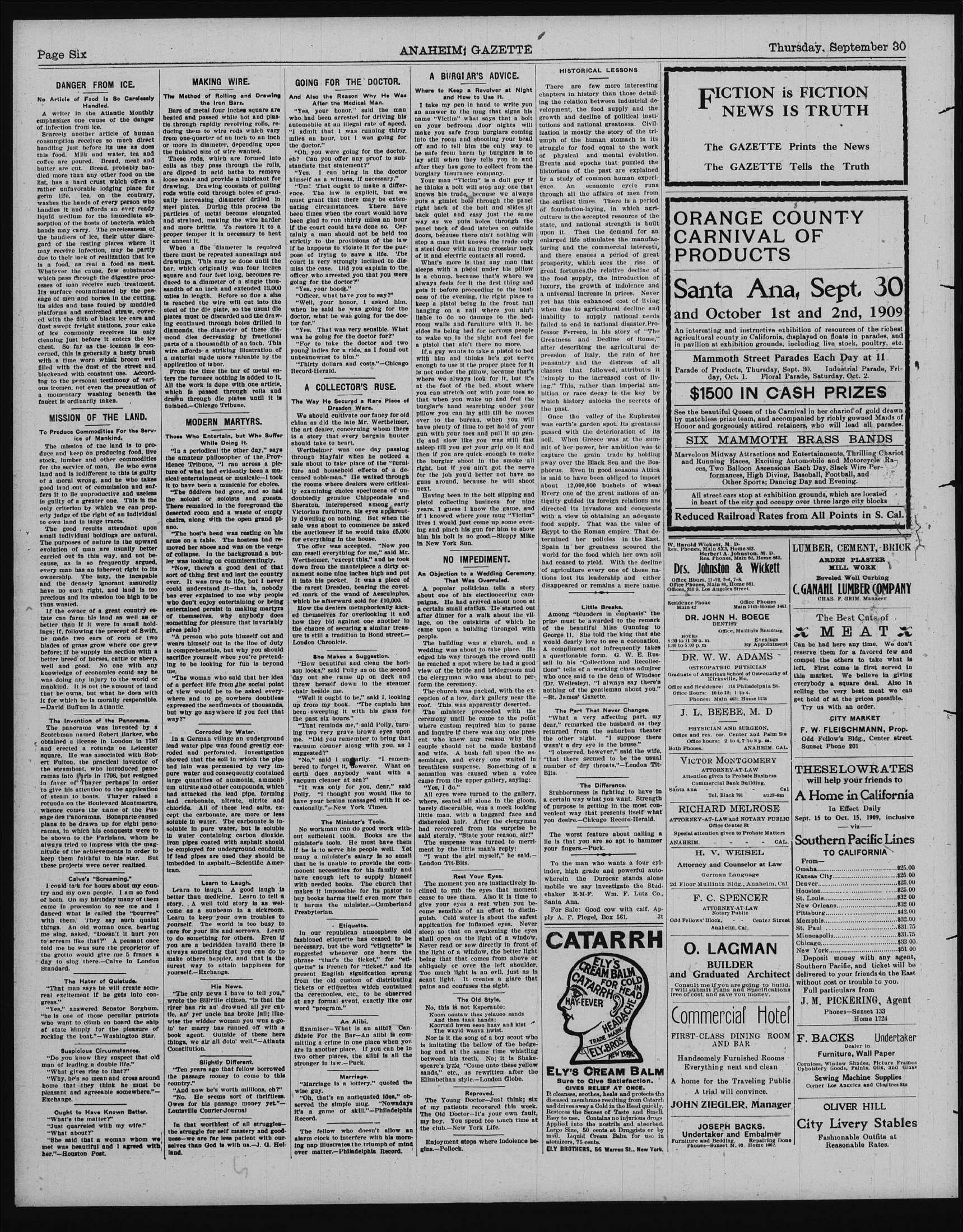
Searchable text
DANGER FROM ICE.
No Article of Food Is So Carelessly Handled.
A writer in the Atlantic Monthly emphasizes one cause of the danger of infection from ice.
Scarcely another article of human consumption receives so much direct handling just before its use as does this food. Milk and water, tea and coffee are poured. Bread, meat and butter are cut. Bread, probably handled more than any other food on the list, has a hard crust which offers a rather unfavorable lodging place for germ life. Ice, on the contrary, washes the hands of every person who handles it and affords an ever ready liquid medium for the immediate absorption of the hosts of bacteria which bands may carry. The carelessness of the handlers of ice, their utter disregard of the resting places where it may receive infection, may be partly due to their lack of realization that ice is a food, as real a food as meat. Whatever the cause, few substances which pass through the digestive processes of man receive such treatment. Its surface contaminated by the passage of men and horses in the cutting, its sides and base fouled by muddled platforms and smirched straw, covered with the fifth of black ice cars and dust swept freight stations, your cake of ice commonly receives its only cleaning just before it enters the ice chest. So far as the iceman is concerned, this is generally a basty brush with a time worn whisk broom well filled with the dust of the street and blackened with constant use. According to the personal testimony of various icemen, not even the precaution of a momentary washing beneath the faucet is ordinarily taken.
MISSION OF THE LAND.
To Produce Commodities For the Service of Mankind.
The mission of the land is to produce and keep on producing food, live stock, lumber and other commodities.
MAKING WIRE.
The Method of Rolling and Drawing the Iron Barz.
Bars of metal four inches square are heated and passed while hot and plastic through rapidly revolving rolls, reducing them to wire rods which vary from one-quarter of an inch to an inch or more in diameter, depending upon the finished size of wire wanted.
These rods, which are formed into collies as they pass through the rolls, are dipped in acid baths to remove loose scale and provide a lubricant for drawing. Drawing consists of pulling rods while cold through holes of gradually increasing diameter drilled in steel plates. During this process the particles of metal become elongated and strained, making the wire harder and more brittle. To restore it to a proper temper it is necessary to heat or anneal it.
When a fine diameter is required there must be repeated annealings and drawings. This may be done until the bar, which originally was four inches square and four feet long, becomes reduced to a diameter of a single thousandth of an inch and extended 13,000 miles in length. Before so fine a size is reached the wire will cut into the steel of the die plate, so the usual die plates must be discarded and the drawing continued through holes drilled in diamonds, the diameter of these diamond dies decreasing by fractional parts of a thousandth of an inch. This wire affords a striking illustration of a material made more valuable by the application of labor.
From the time the bar of metal enters the furnace nothing is added to it. All the work is done with one article, which is passed through rolls and drawn through die plates until it is finished.—Chicago Tribune.
MODERN MARTYRS.
Those Who Entertain, but Who Suffer While Doing It.
"In a periodical the other day," says the amateur philosopher of the Providence.""
GOING FOR THE
And Also the Reason After the Medicine.
"Yes, your honor." who had been arrested at automobile at an illegal "I admit that I was two miles an hour, but I did not doctor."
"Oh, you were going eh? Can you offer any stentiate that statement."
"Yes. I can bring him himself as a witness. I 'Um! That ought to ence. The law is ex- must grant that there- uating circumstances. Been times when the co- been glad to run thirty- if the court could have tainly a man should not strictly to the provisibility if he happens to violate pose of trying to save court is very strongly miss the case. Did your officer who arrested you going for the doctor?" "Yes, your honor."
"Officer, what have you." "Well, your honor, when he said he was doctor, what he was gotor for."
"Yes. That was very was he going for the do-" "For to take the young ladies for a ride unbeknownst to him." "Thirty dollars and Record-Herald."
A COLLECTOR
The Way He Secured Dresden W
We should cultivate china as did the late M art dealer, concern is a story that everyone should take to heart.
Werthelmer was on through Mayfair whe
MISSION OF THE LAND.
To Produce Commodities For the Service of Mankind.
The mission of the land is to produce and keep on producing food, live stock, lumber and other commodities for the service of man. He who owns land and is indifferent to this is guilty of a moral wrong, and he who takes good land out of commission and suffers it to lie unproductive and useless is guilty of a greater one. This is the only criterion by which we can properly judge of the right of an individual to own land in large tracts.
The good results attendant upon small individual holdings are natural. The purposes of nature in the upward evolution of man are usually better carried out in this way, and not because, as is so frequently argued, every man has an inherent right to its ownership. The lazy, the incapable and the densely ignorant assuredly have no such right, and land is too precious and its mission too high to be thus wasted.
If the owner of a great country estate can farm his land as well as or better than if it were in small holdings; if, following the precept of Swift, he made two ears of corn or two blades of grass grow where one grew before; if he supply his section with a better breed of horses, cattle or sheep, well and good. No one with any knowledge of economics could say he was doing any injury to the world or mankind. It is not the amount of land that he owns, but what he does with it for which he is morally responsible.
David Buffum in Atlantic.
The Invention of the Panorama.
The panorama was invented by a Scotchman named Robert Barker, who obtained a license in London in 1787 and erected a rotunda on Leicester square. He was associated with Robert Fulton, the practical inventor of the steamboat, who introduced panoramas into Paris in 1796, but resigned in favor of Thayer perhaps in order to give his attention to the application of steam to boats. Thayer raised a rotunda on the Boulevard Montmartre, whence comes the name of the Passage des Panoramas. Bonaparte caused plans to be drawn up for eight panoramas, in which his conquests were to be shown to the Parisians, whom he always tried to impress with the magnitude of the achievements in order to keep them faithful to his star. But these projects were never realized.
MODERN MARTYRS.
Those Who Entertain, but Who Suffer While Doing It.
"In a periodical the other day," says the amateur philosopher of the Providence Tribune, "I ran across a picture of what had evidently been a musical entertainment or musicale—I took it to have been a musicale for choice.
"The fiddlers had gone, and so had the soloist or soloists and guests. There remained in the foreground the deserted room and a waste of empty chairs, along with the open grand piano.
"The host's head was resting on his arms on a table. The hostess had removed her shoes and was on the verge of collapse. In the background a butter was looking on commiseratingly.
"Now, there's a good deal of that sort of thing first and last the country over. It was true to life, but I never could understand it—that is, nobody has ever explained to me why people who don't enjoy entertaining or being entertained persist in making martyrs of themselves, why anybody does something for pleasure that invariably gives pain?
"A person who puts himself out and wears himself out in the line of duty is comprehensible, but why you should sacrifice yourself when you're pretending to be looking for fun is beyond me.
"The woman who said that her idea of a perfect life from the social point of view would be to be asked everywhere and to go nowhere doubtless expressed the sentiments of thousands, but why go anywhere if you feel that way?"
Corroded by Water.
In a German village an underground lead water pipe was found greatly corroded and perforated. Investigation showed that the soil in which the pipe had lain was permeated by very impure water and consequently contained large quantities of ammonia, ammonium nitrate and other compounds, which had attacked the lead pipe, forming lead carbonate, nitrate, nitrite and chloride. All of these lead salts, except the carbonate, are more or less soluble in water. The carbonate is insoluble in pure water, but is soluble in water containing carbon dioxide. Iron pipes coated with asphalt should be employed for underground conduits. If lead pipes are used they should be imbedded in asphalt. Scientific American...
Calve's "Screaming."
I could talk for hours about my country and my own people. I am so fond of both. On my birthday many of them came in procession to see me and I danced what is called the "bourree" with them. They say such qualit things. An old woman once, bearing me sing, asked, "Doesn't it hurt you to scream like that?" A peasant once told me he was sure the proprietor of the grotto would give me 5 francs a day to sing there.—Calve in London Standard.
The Hater of Quietude.
"That man says he will create some real excitement if he gets into congress."
"Yes," answered Senator Sorghum. "he is one of those peculiar patriots who want to climb on board the ship of state simply for the pleasure of rocking the boat."—Washington Star.
Suspicious Circumstances.
"Do you know they suspect that old man of leading a double life?"
"What gives rise to that?"
"Why, he's so mean and cross around home that they think he must be pleasant and agreeable somewhere."—Exchange.
Ought to Have Known Better.
"What's the matter?"
"Just quarreled with my wife."
"What about?"
"She said that a woman whom we met was beautiful and I agreed with her."—Houston Post.
Learn to Laugh.
Learn to laugh. A good laugh is better than medicine. Learn to tell a story. A well told story is as welcome as a sunbeam in a sickroom. Learn to keep your own troubles to yourself. The world is too busy to care for your ill and sorrows. Learn to do something for others. Even if you are a bedridden invalid there is always something that you can do to make others happier, and that is the surest way to attain happiness for yourself.—Exchange.
His News.
"The only news I have to tell you," wrote the Billville citizen, "is that the river has riz an' drowned all yer cattle, an' yer uncle has broke jail; likewise the widder woman you wuz a-goin' ter marry has runned off with a book agent. Outside of these here things, we air all doin' well."—Atlanta Constitution.
Slightly Different.
"Ten years ago that fellow borrowed the passage money to come to this country."
"And now he's worth millions, eh?"
"No. He seems sort of thriftless. Owes for his passage money yet."—Louisville Courier-Journal
In that worthiest of all struggles—the struggle for self mastery and goodness—we are far less patient with ourselves than God is with us.—J. G. Holland.
GOING FOR THE DOCTOR.
And Also the Reason Why He Was After the Medical Man.
"Yes, your honor," said the man who had been arrested for driving his automobile at an illegal rate of speed. "I admit that I was running thirty miles an hour, but I was going for the doctor."
"Oh, you were going for the doctor, eh? Can you offer any proof to substantiate that statement?"
"Yes. I can bring in the doctor himself as a witness, if necessary."
"Um! That ought to make a difference. The law is explicit, but we must grant that there may be extenuating circumstances. There have been times when the court would have been glad to run thirty miles an hour if the court could have done so. Certainly a man should not be held too strictly to the provisions of the law if he happens to violate it for the purpose of trying to save a life. The court is very strongly inclined to dismiss the case. Did you explain to the officer who arrested you that you were going for the doctor?"
"Yes, your honor."
"Officer, what have you to say?"
"Well, your honor, I asked him, when he said he was going for the doctor, what he was going for the doctor for."
"Yes. That was very sensible. What was he going for the doctor for?"
"For to take the doctor and two young ladies for a ride, as I found out unbeknownst to him."
"Thirty dollars and costs."—Chicago Record-Herald.
A COLLECTOR'S RUSE.
The Way He Secured a Rare Piece of Dresden Ware.
We should cultivate our fancy for old china as did the late Mr. Werthelmer, the art dealer, concerning whom there is a story that every bargain hunter should take to heart.
Werthelmer was one day passing through Mayfair when he noticed a
A BURGLAR'S ADVICE.
Where to Keep a Revolver at Night and How to Use It.
I take my pen in hand to write you an answer to the mug that signs his name "Victim" what says that a bolt on your bedroom door nights will make you safe from burglars coming into the room and shooting your head off and to tell him the only way to be safe from harm by burglars is to lay still when they tells you to and after they has gone to collect from the burglary insurance company.
Your man "Victim" is a dull guy if he thinks a bolt will stop any one that knows his trade, because we always puts a gimlet hole through the panel right back of the bolt and slides it back quiet and easy just the same way as we puts holes through the panel back of dead latches on outside doors, because there ain't nothing will stop a man that knows the trade only a steel door with an iron crossbar back of it and electric contacts all round.
What's more is that any man that sleeps with a pistol under his pillow is a chump, because that's where we always feels for it the first thing and gets it before proceeding to the business of the evening, the right place to keep a pistol being in the front hall hanging on a nail where you ain't liable to do no damage to the bedroom walls and furniture with it, besides its being bad for nervous people to wake up in the night and feel for a pistol that ain't there no more.
If, a guy wants to take a pistol to bed with him and thinks he's got nerve enough to use it the proper place for it is not under the pillow, because that's where we always look for it, but it's at the foot of the bed, about where you can stretch out with your toes so that when you wake up and feel the burglar's hand searching under your pillow you can lay still till he moves over to the bureau, when you will have plenty of time to get hold of your gun with your toes and pull it up gentle and slow like you was still fast asleep till you get your grip on it and then if you are quick enough to make HISTORICAL LESSONS
There are few more interesting chapters in history than those detailing the relation between industrial development, the food supply and the growth and decline of political institutions and national greatness. Civilization is mostly the story of the triumph of the human stomach in its struggle for food equal to the work of physical and mental evolution. Events and epochs that puzzled the historians of the past are explained by a study of common human experience. An economic cycle runs through all the affairs of men from the earliest times. There is a period of foundation-laying, in which agriculture is the accepted resource of the state, and national strength is built upon it. Then the demand for an enlarged life stimulates the manufacturing and the commercial interests, and there ensues a period of great prosperity, which sees the rise of great fortunes,the relative decline of the food supply, the introduction of luxury, the growth of indulence and a universal increase in prices. Never yet has this enhanced cost of living when due to agricultural decline and inability to supply national needs failed to end in national disaster. Professor Ferrero, in his story of "The Greatness and Decline of Rome," after describing the agricultural depression of Italy, the ruin of her peasantry and the distress of all classes that followed, attributes it "simply to the increased cost of living." This, rather than imperial ambition or race decay is the key by which history unlocks the secrets of the past.
Once the valley of the Euphrates was earth's garden spot. Its greatness passed with the deterioration of its soil. When Greece was at the summit of her power, her ambition was to capture the grain trade by holding
A COLLECTOR'S RUSE.
The Way He Secured a Rare Piece of Dresden Ware.
We should cultivate our fancy for old china as did the late Mr. Werthelmer, the art dealer, concerning whom there is a story that every bargain hunter should take to heart.
Werthelmer was one day passing through Mayfair when he noticed a sale about to take place of the "furniture and household effects of a deceased nobleman." He walked through the rooms where dealers were critically examining choice specimens of undoubtedly genuine Chippendale and Sheraton, interspersed among early Victorian furniture, his eyes apparently dwelling on nothing. But when the sale was about to commence he asked the auctioneer if he would take £5,000 for everything in the house.
The offer was accepted. "Now you can resell everything for me," said Mr. Werthelmer, "except this," and he took down from the mantelpiece a dirty ornament some nine inches high and put it into his pocket. It was a piece of the rarest Dresden, bearing the coveted mark of the wand of Aesculapus, which he afterward sold for £10,000.
How the dealers metaphorically kicked themselves for overlooking it and how they bid against one another in the chance of securing a similar treasure is still a tradition in Bond street.—London Chronicle.
She Makes a Suggestion.
"How beautiful and clean the horizon looks," said Polly as on the second day out she came up on deck and threw herself down in the steamer chair beside me.
"Well it ought to be," said I, looking up from my book. "The captain has been sweeping it with his glass for the past six hours."
"That reminds me," said Polly, turning two very grave brown eyes upon me. "Did you remember to bring that vacuum cleaner along with you, as I suggested?"
"No," said I unearily. "I remembered to forget it, however. What on earth does anybody want with a vacuum cleaner at sea?"
"It was only for you, dear," said Polly. "I thought you would like to have your brains massaged with it occasionally."—New York Times.
The Minister's Tools.
No workman can do good work without sufficient tools. Books are the minister's tools. He must have them if he is to serve his people well. Yet many a minister's salary is so small that he is unable to provide the commonest necessities for his family and enough to use it the proper place for it is not under the pillow, because that's where we always look for it, but it's at the foot of the bed, about where you can stretch out with your toes so that when you wake up and feel the burglar's hand searching under your pillow you can lay still till he moves over to the bureau, when you will have plenty of time to get hold of your gun with your toes and pull it up gentle and slow like you was still fast asleep till you get your grip on it and then if you are quick enough to make the burglar shoot in the smoke all right, but if you ain't got the nerve for the job you'd better not have no guns around, because he will shoot next.
Having been in the bolt slipping and pistol collecting business for nine years, I guess I know the game, and if I knew where your mug "Victim" lives I would just come up some evening and pinch his gun for him to show him his bolt is no good.—Sloppy Mike in New York Sun.
NO IMPEDIMENT.
An Objection to a Wedding Ceremony That Was Overruled.
A popular politician tells a story about one of his electioneering campaigns. He had arrived about noon at a certain small station. He started out after dinner for a walk about the village, on the outskirts of which he came upon a building thronged with people.
The building was a church, and a wedding was about to take place. He edged his way through the crowd until he reached a spot where he had a good view of the bride and bridegroom and the clergyman who was about to perform the ceremony.
The church was packed, with the exception of a low, dark gallery near the roof. This was apparently deserted.
The minister proceeded with the ceremony until he came to the point where custom required him to pause and inquire if there was any one present who knew any reason why the couple should not be made husband and wife. A hush fell upon the assemblage, and every one waited in breathless suspense. Something of a sensation was caused when a voice came from the upper gallery, saying:
"Yes, I do."
All eyes were turned to the gallery, where, seated all alone in the gloom, barely discernible, was a meek-looking little man, with a haggard face and disheveled hair. After the clergyman had recovered from his surprise he said sternly, "State your reason, sir!"
The suspense was turned to merriment by the little man's reply:
"I want the girl myself," he said.—London Tit-Bits.
peasantry and the distress of all classes that followed, attributes it "simply to the increased cost of living." This, rather than imperial ambition or race decay is the key by which history unlocks the secrets of the past.
Once the valley of the Euphrates was earth's garden spot. Its greatness passed with the deterioration of its soil. When Greece was at the summit of her power, her ambition was to capture the grain trade by holding sway over the Black Sea and the Bosphorus. Even in good seasons Attica is said to have been obliged to import about 12,000,000 bushels of wheat. Every one of the great nations of antiquity guided its foreign relations and directed its invasions and conquests with a view to obtaining an adequate food supply. That was the value of Egypt to the Roman empire. That determined her policies in the East. Spain in her greatness scoured the world for the food which her own soil had ceased to yield. With the decline of agriculture every one of these nations lost its leadership and either disappeared or remains a mere name.
Little Breaks.
Among "blunders in emphasis" the prize must be awarded to the remark of the beautiful Miss Gunning to George II. She told the king that she would dearly love to see a coronation. A compliment not infrequently takes a questionable form. G. W. E. Russell in his "Collections and Recollections" tells of a working class admirer who once said to the dean of Windsor (Dr. Wellesley), "I always say there's nothing of the gentleman about you."—St. James' Gazette.
The Part That Never Changes.
"What a very affecting part, my dear," remarked the husband as they returned from the suburban theater the other night. "I suppose there wasn't a dry eye in the house."
"I observed, however," said the wife, "that there seemed to be the usual number of dry throats."—London Tit-Bits.
The Difference.
Stubbornness is fighting to have in a certain way what you want. Strength of purpose is getting in the most convenient way that presents itself what you desire.—Chicago Record-Herd.
The worst feature about nailing a lie is that you are so apt to hammer your fingers.—Puck.
To the man who wants a four cylinder high grade and powerful auto-
The Minister's Tools.
No workman can do good work without sufficient tools. Books are the minister's tools. He must have them if he is to serve his people well. Yet many a minister's salary is so small that he is unable to provide the common necessities for his family and have enough left to supply himself with needed books. The church that makes it impossible for its pastor to buy books harms itself even more than it harms the minister.—Cumberland Presbyterian.
Etiquette.
In our republican atmosphere old fashioned etiquette has ceased to be necessary, but the word "etiquette" is suggested whenever one hears the phrase "that's the ticket," for "etiquette" is French for "ticket," and its present English signification sprang from the old custom of distributing tickets or etiquettes which contained the ceremonies, etc., to be observed at any formal event, exactly like our word "program."
An Alibi.
Examiner—What is an alibi? Candidate For the Bar—An alibi is committing a crime in one place when you are in another place. If you can be in two other places, the alibi is all the stronger in law.—Puck.
Marriage.
"Marriage is a lottery," quoted the wise guy.
"Oh, that's an antiquated idea," observed the simple mug. "Nowadays it's a game of skill."—Philadelphia Record.
The fellow who doesn't allow an alarm clock to interfere with his morning nap illustrates the triumph of mind over matter.—Philadelphia Record.
sensation was caused when a voice came from the upper gallery, saying:
"Yes, I do."
All eyes were turned to the gallery, where, seated all alone in the gloom, barely discernible, was a meek looking little man, with a haggard face and disheveled hair. After the clergyman had recovered from his surprise he said sternly. "State your reason, sir!"
The suspense was turned to merriment by the little man's reply:
"I want the girl myself," he said.—London Tit-Bits.
Rest Your Eyes.
The moment you are instinctively inclined to rub the eyes that moment cease to use them. Also it is time to give your eyes a rest when you become sensible of an effort to distinguish. Cold water is about the safest application for inflamed eyes. Never sleep so that on awakening the eyes shall open on the light of a window. Never read or sew directly in front of the light of a window, the better light being that that comes from above or obliquely or over the left shoulder. Too much light is an evil, just as is scant light. It creates a glare that pains and confuses the sight.
The Old Style.
No, this is not Esperanto:
Koom oontaw thez yelauoo sandz
And then taak handz;
Koortsld hwen eeoo haav and kist
The wayld waavz hwist.
Nor is it the song of a boy scout who is imitating the bellow of the hedgehog and at the same time whistling between his teeth. No; it is Shakespeare's lyrics. "Come unto these yellow sands," etc., is rewritten after the Ellizabethan style.—London Globe.
Reproved.
The Young Doctor—Just think; six of my patients recovered this week. The Old Doctor—It's your own fault, my boy. You spend too much time at the club.—New York Life.
Enjoyment stops where indolence begins.—Pollock.
The Difference.
Stubbornness is fighting to have in a certain way what you want. Strength of purpose is getting in the most convenient way that presents itself what you desire.—Chicago Record-Herald.
The worst feature about nailing a lie is that you are so apt to hammer your fingers.—Puck.
To the man who wants a four cylinder, high grade and powerful auto wherein the Durocar stands alone mobile we say investigate the Studebaker E-M-F. Wm. F. Lutz Co., Santa Ana.
For Sale: Good cow with calf. Apply A. F. Plegel, Box 561. 3t
CATARRH
ELY'S CREAM BALM
Sure to Give Satisfaction.
GIVES RELIEF AT ONCE.
It cleanses, soothes, heals and protects the diseased membrane resulting from Catarrh and drives away a Cold in the Head quickly. Restores the Senses of Taste and Smell. Easy to use. Contains no injurious drugs Applied into the nostrils and absorbed. Large Size, 50 cents at Druggists or by mail. Liquid Cream Balm for use in atomizers, 75 cents.
ELY BROTHERS, 56 Warren St., New York.
FICTION is FICTION NEWS IS TRUTH
The GAZETTE Prints the News
The GAZETTE Tells the Truth
ORANGE COUNTY CARNIVAL OF PRODUCTS
Santa Ana, Sept, 30 and October 1st and 2nd, 1909
An interesting and instructive exhibition of resources of the richest agricultural county in California, displayed on floats in parades, and in pavilion at exhibition grounds, including live stock, poultry, etc.
Mammoth Street Parades Each Day at 11
Parade of Products, Thursday, Sept. 30. Industrial Parade, Friday, Oct. 1. Floral Parade, Saturday, Oct. 2.
$1500 IN CASH PRIZES
See the beautiful Queen of the Carnival in her chariot of gold drawn by matchless prize team, and accompanied by richly gowned Maids of Honor and gorgeously attired retainers, who will lead all parades.
SIX MAMMOTH BRASS BANDS
Marvelous Midway Attractions and Entertainments, Thrilling Chariot
Parade of Products, Thursday, Sept. 30. Industrial Parade, Friday, Oct. 1. Floral Parade, Saturday, Oct. 2.
$1500 IN CASH PRIZES
See the beautiful Queen of the Carnival in her chariot of gold drawn by matchless prize team, and accompanied by richly gowned Maids of Honor and gorgeously attired retainers, who will lead all parades.
SIX MAMMOTH BRASS BANDS
Marvelous Midway Attractions and Entertainments, Thrilling Chariot and Running Races, Exciting Automobile and Motorcycle Races, Two Balloon Ascensions Each Day, Slack Wire Performances, High Diving, Baseball, Football, and Other Sports; Dancing Day and Evening.
All street cars stop at exhibition grounds, which are located in heart of the city and occupy over three large city blocks.
Reduced Railroad Rates from All Points in S. Cal.
W. Harold Wickett, M.D.
Res. Phones: Main 8X3, Home 863.
Herbert A. Johnston, M.D.
Res. Phones: Main 82, Home 862.
Drs. Johnston & Wickett
Office Hours: 11-12, 2-4, 7-8.
Office Phones: Main 81, Home 861.
Offices: 310 S. Los Angeles Street.
Residence Phone
Main 42
Office Phones
Main 1141-Home 1401
DR. JOHN H. BOEGE
DENTIST
Office, Mullinix Building
HOURS
8:30 to 11:30 a.m.
1:30 to 5:00 p.m.
Evenings
By Appointment
DR. W. W. ADAMS
OSTEOPATHIC PHYSICIAN
Graduate of American School of Osteopathy of Kirksville, Mo.
Office and Residence: 116 Philadelphia St.
Office Hours: 10 to 12; 1 to 4.
Phones: Main 463; Home 1134
J. L. BEEBE, M.D
PHYSICIAN AND SURGEON.
Office and res. cor. Center and Palm Sis
Office hours: 2 to 4, 7 to 8 p.m.
Both Phones.
ANAHEIM.CAL.
VICTOR MONTGOMERY
ATTORNEY-AT-LAW
Attention given to Probate Business
Commercial Bank Building.
Santa Ana
Cal.
Tel. Black 791 au23-6m
RICHARD MELROSE
ATTORNEY-AT-LAW and NOTARY PUBLIC
Office Center St
Special attention given to Probate Matters
ANAHEIM.
CAL.
H. V. WEISEL
Attorney and Counselor at Law
LUMBER, CEMENT, BRICK
ARDEN PLASTER
MILL WORK
Beveled Well Curbing
C. GANAHL LUMBER COMPANY
CHAS. F. GRIM. Manager
The Best Cuts of MEAT
Can be had here any time. We don't reserve them for a favored few and compel the others to take what is left. First come is first served in this market. We believe in giving everybody a square deal. Also in selling the very best meat we can get hold of at the prices possible.
Try us with an order.
CITY MARKET
F. W. FLEISCHMANN, Prop.
Odd Fellow's Bldg., Center street
Sunset Phone 201
THESELOWRATES will help your friends to A Home in California
In Effect Daily
Sept. 15 to Oct. 15, 1909, inclusive — via—
Southern Pacific Lines TO CALIFORNIA
From—
Omaha... $25.00
Attention given to Probate Business
Commercial Bank Building.
Santa Ana Cal
Tel. Black 791 au23-6m
RICHARD MELROSE
ATTORNEY-AT-LAW and NOTARY PUBLIC
Office Center 8t
Special attention given to Probate Matters
ANAHEIM. CAL.
H. V. WEISEL
Attorney and Counselor at Law
German Language
2d Floor Mullinix Bldg., Anaheim, Cal
F. C. SPENCER
ATTORNEY-AT-LAW
Notary Public
Odd Fellows' Block, Center Street
Anaheim, Cal.
O. LAGMAN
BUILDER and Graduated Architect
Consult me if you are going to build.
I will submit Plans and Specifications free of cost, and save you money.
Commercial Hotel
FIRST-CLASS DINING ROOM AND BAR
Handsomely Furnished Rooms
Everything neat and clean
A home for the Traveling Public
A trial will convince.
JOHN ZIEGLER, Manager
JOSEPH BACKS,
Undertaker and Embalmer
Furniture and Bedding. Repairing Done
Phones—Sunset M. 93. Home 1062.
will help your friends to
A Home in California
In Effect Daily
Sept. 15 to Oct. 15, 1909, inclusive
via—
Southern Pacific Lines
TO CALIFORNIA
From—
Omaha.....$25.00
Kansas City.....$25.00
Denver.....$25.00
Houston.....$25.00
St. Louis.....$32.00
New Orleans.....$32.00
Pittsburg.....$42.00
Memphis.....$32.00
St. Paul.....$31.75
Minneapolis.....$31.75
Chicago.....$33.00
New York.....$51.00
Deposit money with any agent,
Southern Pacific, and ticket will be delivered to your friends in the East without cost or trouble to you.
Full particulars from
J. M. PICKERING, Agent
Phones—Sunset 133
Home 1724
F. BACKS Undertaker
Dealer in
Furniture, Wall Paper
Cornices, Window Shades, Picture Frames
Upholstery Goods, Paints, Oils, and Glass
Sewing Machine Supplies
Corner Los Angeles and Chartres Sts
OLIVER HILL
City Livery Stables
Fashionable Outfits at Reasonable Rates.