anaheim-gazette 1909-08-12
Scanned page
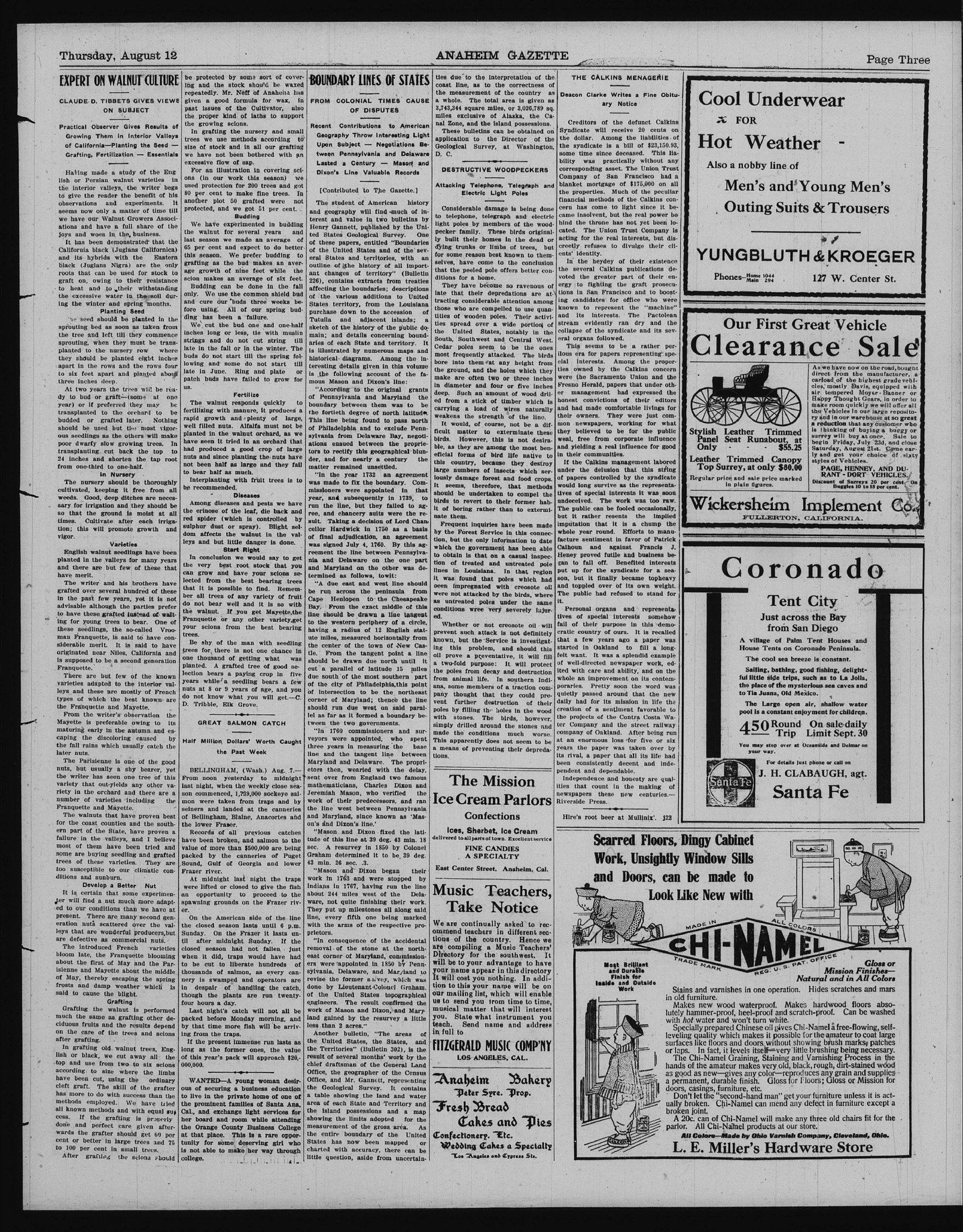
Searchable text
EXPERT ON WALNUT CULTURE
CLAUDE D. TIBBETS GIVES VIEWS ON SUBJECT
Practical Observer Gives Results of Growing Them in Interior Valleys of California—Planting the Seed — Grafting, Fertilization — Essentials
Having made a study of the English or Persian walnut varieties in the interior valleys, the writer begs to give the reader the benefit of his observations and experiments. It seems now only a matter of time till we have our Walnut Growers Associations and have a full share of the joys and woes in the business.
It has been demonstrated that the California black (Juglans Californica) and its hybrids with the Eastern black (Juglans Nigra) are the only roots that can be used for stock to graft on, owing to their resistance to heat and to their withstanding the excessive water in the soil during the winter and spring months.
Planting Seed
The seed should be planted in the sprouting bed as soon as taken from the tree and left till they commence sprouting, when they must be transplanted to the nursery row where they should be planted eight inches apart in the rows and the rows four to six feet apart and planted about three inches deep.
At two years the trees will be ready to bud or graft—(some at one year) or if preferred they may be transplanted to the orchard to be budded or grafted later. Nothing should be used but the most vigorous seedlings as the others will make poor dwarf slow growing trees. In transplanting cut back the top to 24 inches and shorten the tap root be protected by some sort of covering and the stock should be waxed repeatedly. Mr. Neff of Anaheina has given a good formula for wax, in past issues of the Cultivator, also the proper kind of laths to support the growing scions.
In grafting the nursery and small trees we use methods according to size of stock and in all our grafting we have not been bothered with an excessive flow of sap.
For an illustration in covering scions (in our work this season) we used protection for 200 trees and got 80 per cent to make fine trees. In another plot 50 grafted were not protected, and we got 51 per cent.
Budding
We have experimented in budding the walnut for several years and last season we made an average of 65 per cent and expect to do better this season. We prefer budding to grafting as the bud makes an average growth of nine feet while the scion makes an average of six feet.
Budding can be done in the fall only. We use the common shield bud and cure our buds three weeks before using. All of our spring budding has been a failure.
We cut the bud one and one-half inches long or less, tie with muslin strings and do not cut string till late in the fall or in the winter. The buds do not start till the spring following and some do not start till late in June. Ring and plate or patch buds have failed to grow for us.
Fertilize
The walnut responds quickly to fertilizing with manure, it produces a rapid growth and plenty of large, well filled nuts. Alfalfa must not be planted in the walnut orchard, as we have seen it tried in an orchard that had produced a good crop of large nuts and since planting the nuts have
At two years the trees will be ready to bud or graft—(some at one year) or if preferred they may be transplanted to the orchard to be budded or grafted later. Nothing should be used but the most vigorous seedlings as the others will make poor dwarfy slow growing trees. In transplanting cut back the top to 24 inches and shorten the tap root from one-third to one-half.
In Nursery
The nursery should be thoroughly cultivated, keeping it free from all weeds. Good, deep ditches are necessary for irrigation and they should be so that the ground is moist at all times. Cultivate after each irrigation; this will promote growth and vigor.
Varieties
English walnut seedlings have been planted in the valleys for many years and there are but few of these that have merit.
The writer and his brothers have grafted over several hundred of these in the past few years, yet it is not advisable although the parties prefer to have these grafted instead of waiting for young trees to bear. One of these seedlings, the so-called Vrooman Franquette, is said to have considerable merit. It is said to have originated near Niles, California and is supposed to be a second generation Franquette.
There are but few of the known varieties adapted to the interior valleys and these are mostly of French types of which the best known are the Franquette and Mayette.
From the writer's observation the Mayette is preferable owing to its maturing early in the autumn and escaping the discoloring caused by the fall rains which usually catch the later nuts.
The Parisienne is one of the good nuts, but usually a shy bearer, yet the writer has seen one tree of this variety that out-yields any other variety in the orchard and there are a number of varieties including the Franquette and Mayette.
The walnuts that have proven best for the coast counties and the southern part of the State, have proven a failure in the valleys, and I believe most of them have been tried and some are buying seedling and grafted trees of these varieties. They are too susceptible to our climatic con-
lowing and some do not start till late in June. Ring and plate or patch buds have failed to grow for us.
Fertilize
The walnut responds quickly to fertilizing with manure, it produces a rapid growth and plenty of large, well filled nuts. Alfalfa must not be planted in the walnut orchard, as we have seen it tried in an orchard that had produced a good crop of large nuts and since planting the nuts have not been half as large and they fail to bear half as much.
Interplanting with fruit trees is to be recommended.
Diseases
Among diseases and pests we have the erinose of the leaf, die back and red spider (which is controlled by sulphur dust or spray). Blight seldom affects the walnut in the valleys and but little danger is done.
Start Right
In conclusion we would say to get the very best root stock that you can grow and have your scions selected from the best bearing trees that it is possible to find. Remember all trees of any variety of fruit do not bear well and it is so with the walnut. If you get Mayette,the Franquette or any other variety,get your scions from the best bearing trees.
Be shy of the man with seedling trees for there is not one chance in one thousand of getting what was planted. A grafted tree of good selection bears a paying crop in five years while a seedling bears a few nuts at 8 or 9 years of age, and you do not know what you will get.—C. D. Tribble, Elk Grove.
GREAT SALMON CATCH
Half Million Dollars' Worth Caught
the Past Week
BELLINGHAM, (Wash.) Aug. 7.—From noon yesterday to midnight last night, when the weekly close season commenced, 1,739,000 sockeye salmon were taken from traps and by seiners and landed at the canneries of Bellingham, Blaine, Anacortes and the lower Frazer.
Records of all previous catches have been broken, and salmon to the value of more than $500,000 are being packed by the canneries of Puget Sound, Gulf of Georgia and lower Frazer river.
"According to of Pennsylvania boundary between the fortieth degree This line being of Philadelphia Pennsylvania from Duttonia ensued bators to rectify th der, and for new matter remained
"A due east a be run across Cape Henlopen Bay. From the line should be o to the western p having a radius mile, measure center of th tle. From the should be drawn cut a parallel o due south of th of the city of P intersection corner of Maryland should run due le as far as it f tween the two n
"In 1760 surveyors were app three years in m line and the ta Maryland and D etors then, wea sent over from mathematicians, Jeremiah Mason work of their p the line west b Maryland, son's and Dixon's.
"Mason and H tude of this line sec. A resurvey Graham determine 43 min. 26 sec."
the writer has seen one tree of this variety that out-yields any other variety in the orchard and there are a number of varieties including the Franquette and Mayette.
The walnuts that have proven best for the coast counties and the southern part of the State, have proven a failure in the valleys, and I believe most of them have been tried and some are buying seedling and grafted trees of these varieties. They are too susceptible to our climatic conditions and sunburn.
Develop a Better Nut
It is certain that some experimenter will find a nut much more adapted to our conditions than we have at present. There are many second generation nuts scattered over the valleys that are wonderful producers, but are defective as commercial nuts.
The introduced French varieties bloom late, the Franquette blooming about the first of May and the Parisienne and Mayette about the middle of May, thereby escaping the spring frosts and damp weather which is said to cause the blight.
Grafting
Grafting the walnut is performed much the same as grafting other deciduous fruits and the results depend on the care of the trees and scions after grafting.
In grafting old walnut trees, English or black, we cut away all the top and use from two to six scions according to size where the limbs have been cut, using the ordinary cleft graft. The skill of the grafter has more to do with success than the methods employed. We have tried all known methods and with equal success. If the grafting is properly done and perfect care given afterwards the grafter should get 60 per cent or better in large trees and 75 to 100 per cent in small trees.
After grafting the scions should From noon yesterday to midnight last night, when the weekly close season commenced, 1,739,000 sockeye salmon were taken from traps and by seiners and landed at the canneries of Bellingham, Blaine, Anacortes and the lower Fraser.
Records of all previous catches have been broken, and salmon to the value of more than $500,000 are being packed by the canneries of Puget Sound, Gulf of Georgia and lower Frazer river.
At midnight last night the traps were lifted or closed to give the fish an opportunity to proceed to the spawning grounds on the Frazer river.
On the American side of the line the closed season lasts until 6 p.m. Sunday. On the Frazer it lasts until after midnight Sunday. If the closed season had not fallen just when it did, traps would have had to be cut to liberate hundreds of thousands of salmon, as every cannery is swamped and operators are in despair of handling the catch, though the plants are run twenty-four hours a day.
Last night's catch will not all be packed before Monday morning, and by that time more fish will be arriving from the traps.
If the present immense run lasts as long as the former ones, the value of this year's pack will approach $20,-000,000.
WANTED—A young woman desirous of securing a business education to live in the private home of one of the prominent families of Santa Ana, Cal., and exchange light services for her board and room while attending the Orange County Business College at that place. This is a rare opportunity for some deserving girl who is not able to make her way through college.
ANAHEIM GAZETTE
BOUNDARY LINES OF STATES
FROM COLONIAL TIMES CAUSE OF DISPUTES
Recent Contributions to American Geography Throw Interesting Light Upon Subject — Negotiations Between Pennsylvania and Delaware Lasted a Century — Mason and Dixon's Line Valuable Records
[Contributed to The Gazette.]
The student of American history and geography will find much of interest and value in two bulletins by Henry Gannett, published by the United States Geological Survey. One of these papers, entitled "Boundaries of the United States and of the several States and territories, with an outline of the history of all important changes of territory" (Bulletin 226), contains extracts from treaties affecting the boundaries; descriptions of the various additions to United States territory, from the Louisiana purchase down to the accession of Tutuila and adjacent islands; a sketch of the history of the public domain; and details concerning boundaries of each State and territory. It is illustrated by numerous maps and historical diagrams. Among the interesting details given in this volume is the following account of the famous Mason and Dixon's line:
"According to the original grants of Pennsylvania and Maryland the boundary between them was to be the fortyth degree of north latitude. This line being found to pass north of Philadelphia and to exclude Pennsylvania from Delaware Bay, negotiations ensued between the proprietors to rectify this geographical blunder and for nearly a century, the ties due to the interpretation of the coast line, as to the correctness of the measurement of the country as a whole. The total area is given as 3,743,344 square miles, or 3,026,789 sq. miles exclusive of Alaska, the Canal Zone, and the island possessions.
These bulletins can be obtained on application to the Director of the Geological Survey, at Washington, D.C.
DESTRUCTIVE WOODPECKERS
Attacking Telephone, Telegraph and Electric Light Poles
Considerable damage is being done to telephone, telegraph and electric light poles by members of the woodpecker family. These birds originally built their homes in the dead or dying trunks or limbs of trees, but for some reason best known to themselves, have come to the conclusion that the peeled pole offers better conditions for a home.
They have become so ravenous of late that their depredations are attracting considerable attention among those who are compelled to use quantities of wooden poles. Their activities spread over a wide portion of the United States, notably in the South, Southwest and Central West. Cedar poles seem to be the ones most frequently attacked. The birds bore into them at any height from the ground, and the holes which they make are often two or three inches in diameter and four or five inches deep. Such an amount of wood drilled from a stick of timber which is carrying a load of wires naturally weakens the strength of the line.
It would, of course, not be a difficult matter to exterminate these birds. However, this is not desirable, as they are among the most beneficial forms of bird life native to THE CALKINS MENAGERIE
Deacon Clarke Writes a Fine Obituary Notice
Creditors of the defunct Calkins Syndicate will receive 20 cents on the dollar. Among the liabilities of the syndicate is a bill of $23,150.93, some time since deceased. This liability was practically without any corresponding asset. The Union Trust Company of San Francisco had a blanket mortgage of $175,000 on all the properties. Much of the peculiar financial methods of the Calkins concern has come to light since it became insolvent, but the real power behind the throne has not yet been located. The Union Trust Company is acting for the real interests, but discreetly refuses to divulge their clients' identity.
In the heydey of their existence the several Calkins publications devoted the greater part of their energy to fighting the graft prosecutions in San Francisco and to boosting candidates for office who were known to represent the "machine" and its interests. The Pactolean stream evidently ran dry and the collapse of the syndicate and its several organs followed.
This seems to be a rather perilous era for papers representing special interests. Among the properties owned by the Calkins concern were the Sacramento Union and the Fresno Herald, papers that under other management had expressed the honest convictions of their editors and had made comfortable livings for their owners. They were just common newspapers, working for what they believed to be for the public weal, free from corporate influence and yielding a real influence for good in their communities.
teresting details given in this volume is the following account of the famous Mason and Dixon's line:
"According to the original grants of Pennsylvania and Maryland the boundary between them was to be the fortyth degree of north latitude. This line being found to pass north of Philadelphia and to exclude Pennsylvania from Delaware Bay, negotiations ensued between the proprietors to rectify this geographical blunder, and for nearly a century the matter remained unsettled.
In the year 1732 an agreement was made to fix the boundary. Commissioners were appointed in that year, and subsequently in 1739, to run the line, but they failed to agree, and chancery suits were the result. Taking a decision of Lord Chancellor Hardwick in 1750 as a basis of final adjudication, an agreement was signed July 4, 1760. By this agreement the line between Pennsylvania and Delaware on the one part and Maryland on the other was determined as follows, toowit:
"A due east and west line should be run across the peninsula from Cape Henlopen to the Chesapeake Bay. From the exact middle of this line should be drawn a line tangent to the western periphery of a circle, having a radius of 12 English statute miles, measured horizontally from the center of the town of New Castle. From the tangent point a line should be drawn due north until it cut a parallel of latitude 15 miles due south of the most southern part of the city of Philadelphia, this point of intersection to be the northeast corner of Maryland; thence the line should run due west on said parallel as far as it formed a boundary between the two governments.
"In 1760 commissioners and surveyors were appointed, who spent three years in measuring the base line and the tangent line between Maryland and Delaware. The proprietors then, weared with the delay, sent over from England two famous mathematicians, Charles Dixon and Jeremiah Mason, who verified the work of their predecessors, and ran the line west between Pennsylvania and Maryland, since known as 'Mason's and Dixon's line.'
"Mason and Dixon fixed the latitude of this line at 39 deg. 43 min. 18 sec. A resurvey in 1850 by Colonel Graham determined it to be 39 deg. 43 min. 26 sec. .3."
"The Mission Ice Cream Parlors Confections
Ices, Sherbet, Ice Cream delivered to all parts of town. Excellent service
FINE CANDIES
A SPECIALTY
East Center Street, Anaheim, Cal."
The Mission Ice Cream Parlors Confessions
Ices, Sherbet, Ice Cream delivered to all parts of town. Excellent service
FINE CANDIES
A SPECIALTY
East Center Street, Anaheim, Cal.
Music Teachers, Take Notice
We are continually asked to recommend teachers in different sections of the country. Hence we are compiling a Music Teachers' Directory for the southwest. It will be to your advantage to have your name appear in this directory. It will cost you nothing. In addition to this your name will be on our mailing list, which will enable us to send you from time to time, musical matter that will interest you. State what instrument you teach. Send name and address in full to FITZGERALD MUSIC COMP’NY
LOS ANGELES, CAL.
Anaheim Bakery
Peter Syre. Prop.
Fresh Bread
Cakes and Pies
Confectionery. Etc.
Wedding Cakes a Specialty
Los Angeles and Cypress Sts.
Cool Underwear
FOR
Hot Weather -
Also a nobby line of
Men's and Young Men's
Outing Suits & Trousers
YUNGBLUTH & KROEGER
Phones—Home 1044
Main 294
127 W. Center St.
Our First Great Vehicle
Clearance Sale
Stylish Leather Trimmed
Panel Seat Runabout, at Only $55.25
Leather Trimmed Canopy
As we have now on the road, bought direct from the manufacturer, a carload of the highest grade vehicles, mostly Davis, equipped with air tempered Moyer-Banner or Happy Thought Gears, in order to make room quickly we will offer all the Vehicles in our large repository and in our warehouse at so great a reduction that any customer who is thinking of buying a buggy or surrey will buy at once. Sale to begin Friday, July 23d, and close Saturday, August 21st. Come early and get your choice of sixty
Stylish Leather Trimmed Panel Seat Runabout, at Only $55.25
Leather Trimmed Canopy Top Surrey, at only $80.00
Regular price and sale price marked in plain figures.
Wickersheim Implement Co.
FULLERTON, CALIFORNIA.
Coronado
Tent City
Just across the Bay from San Diego
A village of Palm Tent Houses and House Tents on Coronado Peninsula.
The cool sea breeze is constant.
Sailing, bathing, good fishing, delightful little side trips, such as to La Jolla, the place of the mysterious sea caves and to Tia Juana, Old Mexico.
The Large open air, shallow water pool is a constant enjoyment for children.
450 Round On sale daily Trip Limit Sept. 30
You may stop over at Oceanside and Delmar on your way.
For details just phone or call on
J. H. CLABAUGH, agt.
Santa Fe
carred Floors, Dingy Cabinet Work, Unsightly Window Sills and Doors, can be made to Look Like New with
MADE IN
CHI-NAMEL
TRADE MARK
REG. U. S. PAT. OFFICE
Gloss or Mission Finishes—Natural and in All Colors
Stains and varnishes in one operation. Hides scratches and mars in old furniture.
Makes new wood waterproof. Makes hardwood floors absolutely hammer-proof, heel-proof and scratch-proof. Can be washed with hot water and won't turn white.
Specially prepared Chinese oil gives Chi-Namel a free-flowing, self-leveling quality which makes it possible for the amateur to coat large surfaces like floors and doors without showing brush marks, patches or laps. In fact, it levels itself—very little brushing being necessary.
The Chi-Namel Graining, Staining and Varnishing Process in the hands of the amateur makes very old, black, rough, dirt-stained wood as good as new—gives any color—reproduces any grain and supplies a permanent, durable finish. Gloss for Floors; Gloss or Mission for doors, casings, furniture, etc.
Don't let the "second-hand man" get your furniture unless it is actually broken. Chi-Namel can mend any defect in furniture except a broken joint.
A 20c. can of Chi-Namel will make any three old chairs fit for the parlor. All Chi-Namel products at our store.
All Colors—Made by Ohio Varnish Company, Cleveland, Ohio.
L. E. Miller's Hardware Store