anaheim-gazette 1909-08-12
Scanned page
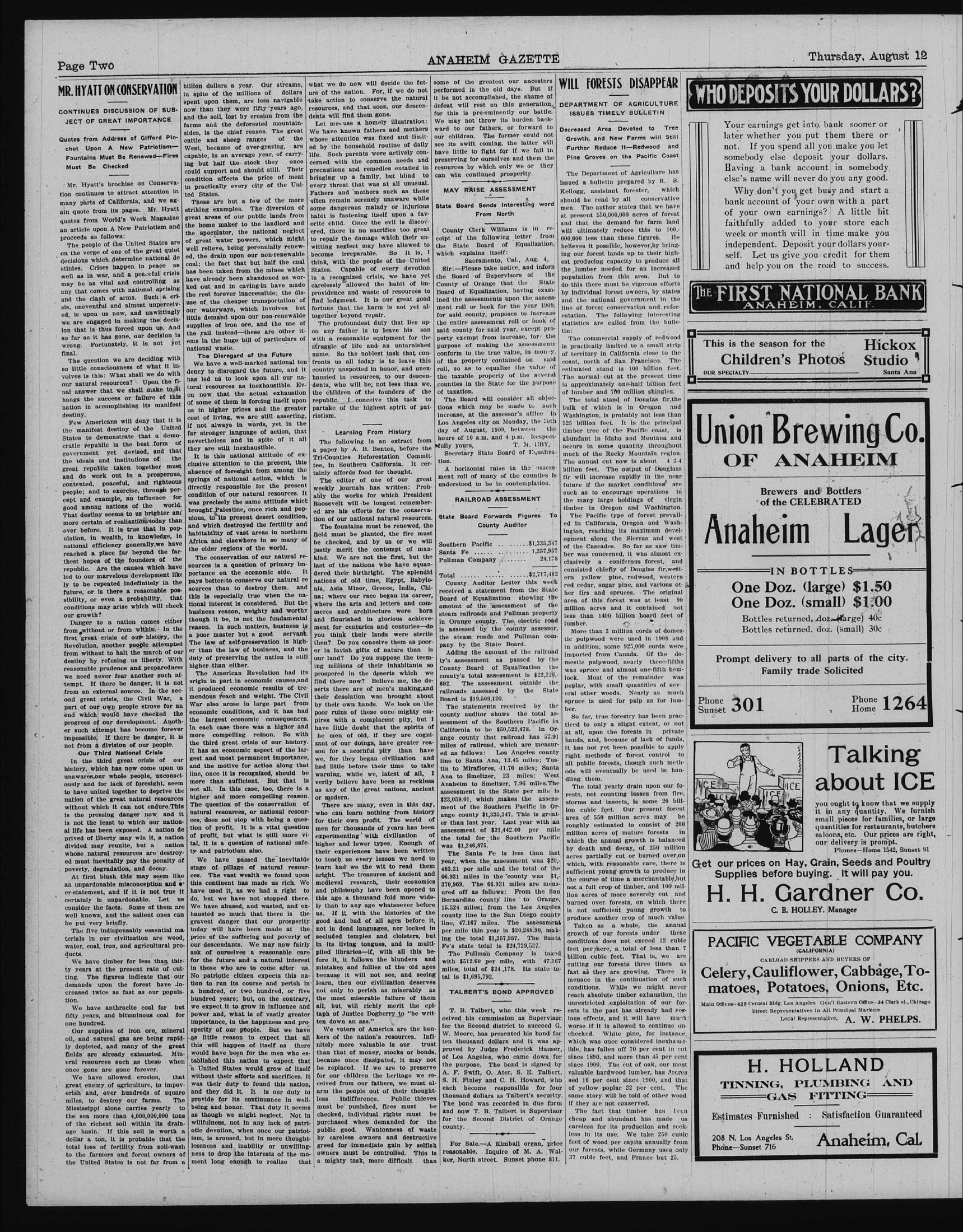
Searchable text
MR. HYATT ON CONSERVATION
CONTINUES DISCUSSION OF SUBJECT OF GREAT IMPORTANCE
Quotes from Address of Gifford Pinchot Upon A New Patriotism—Fountains Must Be Renewed—Fires Must Be Checked
Mr. Hyatt's brochise on Conservation continues to attract attention in many parts of California, and we again quote from its pages. Mr. Hyatt quotes from World's Work Magazine an article upon A New Patriotism and proceeds as follows:
The people of the United States are on the verge of one of the great quiet decisions which determine national destinies. Crises happen in peace as well as in war, and a peaceful crisis may be as vital and controlling as any that comes with national uprising and the clash of arms. Such a crisis, uneventful and almost unperceived, is upon us now, and unwittingly we are engaged in making the decision that is thus forced upon us. And so far as it has gone, our decision is wrong. Fortunately, it is not yet final.
The question we are deciding with so little consciousness of what it involves is this: What shall we do with our natural resources? Upon the final answer that we shall make to it hangs the success or failure of this nation in accomplishing its manifest destiny.
Few Americans will deny that it is the manifest destiny of the United States to demonstrate that a democratic republic is the best form of government yet devised, and that the ideals and institutions of the
billion dollars a year. Our streams, in spite of the millions of dollars spent upon them, are less navigable now than they were fifty years ago, and the soil, lost by erosion from the farms and the deforested mountainsides, is the chief reason. The great cattle and sheep ranges of the West, because of over-grazing, are capable, in an average year, of carrying but half the stock they once could support and should still. Their condition affects the price of meat in practically every city of the United States.
These are but a few of the more striking examples. The diversion of great areas of our public lands from the home maker to the landlord and the speculator, the national neglect of great water powers, which might well relieve, being perennially renewed, the drain upon our non-renewable coal; the fact that but half the coal has been taken from the mines which have already been abandoned as worked out and in caving-in have made the rest forever inaccessible; the disuse of the cheaper transportation of our waterways, which involves but little demand upon our non-renewable supplies of iron ore, and the use of the rail instead—these are other items in the huge bill of particulars of national waste.
The Disregard of the Future
We have a well-marked national tenancy to disregard the future, and it has led us to look upon all our natural resources as inexhaustible. Even now that the actual exhaustion of some of them is forcing itself upon us in higher prices and the greater cost of living, we are still asserting, if not always in words, yet in the far stronger language of action, that nevertheless and in spite of it all they are still inexhaustible.
It is this national attitude of exwhat we do nowure of the nationtake action toresources,and thydents will find thetLet me use sWe have knownwhose attentioned by the houselife.Such parentcerned with thpecautionsandbringing up aevery threat thaFathers and mofften remain se somedangeroushabit is fastenorite child.Onerered, there is no to repair the dawitting neglectbecome irreparthink,withtheStates.Capablena recognizedcarelessly allowprovidence andfind lodgment fortune that therogether beyondThe profoundon any fatherwith a reasonablestruggle of lifename.So thefronts us all tcountry unspot hausted in residents,who willthe children otherepublic.I canpartake of theriotism.
Learning
The followinga paper by A.Tri-Counties
so little consciousness of what it involves is this: What shall we do with our natural resources? Upon the final answer that we shall make to it hangs the success or failure of this nation in accomplishing its manifest destiny.
Few Americans will deny that it is the manifest destiny of the United States to demonstrate that a democratic republic is the best form of government yet devised, and that the ideals and institutions of the great republic taken together must and do work out in a prosperous, contented, peaceful, and righteous people; and to exercise, through percept and example, an influence for good among nations of the world. That destiny seems to us brighter and more certain of realization today than ever before. It is true that in population, in wealth, in knowledge, in national efficiency generally, we have reached a place far beyond the farthest hopes of the founders of the republic. Are the causes which have led to our marvelous development likely to be repeated indefinitely in the future, or is there a reasonable possibility, or even a probability, that conditions may arise which will check our growth?
Danger to a nation comes either from without or from within. In the first great crisis of our history, the Revolution, another people attempted from without to halt the march of our destiny by refusing us liberty. With reasonable prudence and preparedness we need never fear another such attempt. If there be danger, it is not from an external source. In the second great crisis, the Civil War, a part of our own people strove for an end which would have checked the progress of our development. Another such attempt has become forever impossible. If there be danger, it is not from a division of our people.
Our Third National Crisis
In the third great crisis of our history, which has now come upon us unawares, our whole people, unconsciously and for lack of foresight, seem to have united together to deprive the nation of the great natural resources without which it can not endure. This is the pressing danger now and it is not the least to which our national life has been exposed. A nation devired of liberty may win it, a nation divided may reunite, but a nation whose natural resources are destroyed must inevitably pay the penalty of poverty, degradation, and decay.
We have a well-marked national tendency to disregard the future, and it has led us to look upon all our natural resources as inexhaustible. Even now that the actual exhaustion of some of them is forcing itself upon us in higher prices and the greater cost of living, we are still asserting, if not always in words, yet in the far stronger language of action, that nevertheless and in spite of it all they are still inexhaustible.
It is this national attitude of exclusive attention to the present, this absence of foresight from among the springs of national action, which is directly responsible for the present condition of our natural resources. It was precisely the same attitude which brought Palestine, once rich and populous, to its present desert condition, and which destroyed the fertility and habitability of vast areas in northern Africa and elsewhere in so many of the older regions of the world.
The conservation of our natural resources is a question of primary importance on the economic side. It pays better to conserve our natural resources than to destroy them. and this is especially true when the national interest is considered. But the business reason, weighty and worthy though it be, is not the fundamental reason. In such matters, business is a poor master but a good servant. The law of self-preservation is higher than the law of business, and the duty of preserving the nation is still higher than either.
The American Revolution had its origin in part in economic causes,and it produced economic results of tremendous reach and weight. The Civil War also arose in large part from economic conditions, and it has had the largest economic consequences. In each case there was a higher and more compelling reason. So with the third great crisis of our history. It has an economic aspect of the largest and most permanent importance, and the motive for action along that line, once it is recognized, should be more than sufficient. But that is not all. In this case, too, there is a higher and more compelling reason. The question of the conservation of natural resources, or national resources, does not stop with being a question of profit. It is a vital question of profit, but what is still more vital, it is a question of national safety and patriotism also.
We have passed the inevitable stage of pillage of natural resour-
Learning
The following paper by A. Tri-Counties Butee, in Southern tainly affords tha
The editor has weekly journalably the work Roosevelt will ed are his effusion of our natu
The fountain field must be be checked, and justly merit tha kind. We are last of the nai dered their bish nations of old nia, Asia Minna; where our where the art merce and ar en and flourished ment for centru you think tha then? Do you er in lavish gow our land? Do ing millions o prospered in tha find there now serts there are their desolation by their own b poor ruins of pires with a ha have little do he men of o zant of our do son for a scoo we, for they h ad little before warning, whil verily believe as any of tha or modern.
There are no who can learn for their own men for thous experimenting higher and lo their experienc to teach us e learn had we
unawares, our whole people, unconsciously and for lack of foresight, seem to have united together to deprive the nation of the great natural resources without which it can not endure. This is the pressing danger now and it is not the least to which our national life has been exposed. A nation deprived of liberty may win it, a nation divided may reunite, but a nation whose natural resources are destroyed must inevitably pay the penalty of poverty, degradation, and decay.
At first blush this may seem like an unpardonable misconception and er-statement, and if it is not true it certainly is unpardonable. Let us consider the facts. Some of them are well known, and the salient ones can be put very briefly.
The five indispensably essential materials in our civilization are wood, water, coal, iron, and agricultural products.
We have timber for less than thirty years at the present rate of cutting. The figures indicate that our demands upon the forest have increased twice as fast as our population.
We have anthracite coal for fifty years, and bituminous coal for one hundred.
Our supplies of iron ore, mineral oil, and natural gas are being rapidly depleted, and many of the great fields are already exhausted. Mineral resources such as these when once gone are gone forever.
We have allowed erosion, that great enemy of agriculture, to impoverish and over hundreds of square miles, to destroy our farms. The Mississippi alone carries yearly to the sea more than 4,000,000,000 tons of the richest soil within its drainage basin. If this soil is worth a dollar a ton, it is probable that the total loss of fertility from soil-wash to the farmers and forest owners of the United States is not far from a
line, once it is recognized, should be more than sufficient. But that is not all. In this case, too, there is a higher and more compelling reason. The question of the conservation of natural resources, or national resources, does not stop with being a question of profit. It is a vital question of profit, but what is still more vital, it is a question of national safety and patriotism also.
We have passed the inevitable stage of pillage of natural resources. The vast wealth we found upon this continent has made us rich. We have used it, as we had a right to do, but we have not stopped there. We have abused, and wasted, and exhausted so much that there is the gravest danger that our prosperity today will have been made at the price of the suffering and poverty of our descendants. We may now fairly ask of ourselves a reasonable care for the future and a natural interest in those who are to come after us. No patriotic citizen expects this nation to run its course and perish in a hundred, or two hundred, or five hundred years; but, on the contrary, we expect it to grow in influence and power and, what is of vastly greater importance, in the happiness and prosperity of our people. But we have as little reason to expect that all this will happen of itself as there would have been for the men who established this nation to expect that a United States would grow of itself without their efforts and sacrifices. It was their duty to found this nation, and they did it. It is our duty to provide for its continuance in well-being and honor. That duty it seems as though we might neglect. Not in willfulness, not in any lack of patriotic devotion, when once our patriotism, is aroused, but in mere thoughtlessness and inability or unwillingness to drop the interests of the moment long enough to realize that
ANAHEIM GAZETTE
what we do now will decide the future of the nation. For, if we do not take action to conserve the natural resources, and that soon, our descendants will find them gone.
Let me use a homely illustration: We have known fathers and mothers whose attention was fixed and limited by the household routine of daily life. Such parents were actively concerned with the common needs and precautions and remedies entailed in bringing up a family, but blind to every threat that was at all unusual. Fathers and mothers such as these often remain serenely unaware while some dangerous malady or injurious habit is fastening itself upon a favorite child. Once the evil is discovered, there is no sacrifice too great to repair the damage which their unwitting neglect may have allowed to become irreparable. So it is, I think, with the people of the United States. Capable of every devotion in a recognized crisis, we have yet carelessly allowed the habit of improvidence and waste of resources to find lodgment. It is our great good fortune that the harm is not yet altogether beyond repair.
The profoundest duty that lies upon any father is to leave his son with a reasonable equipment for the struggle of life and an untarnished name. So the noblest task that confronts us all today is to leave this country unspotted in honor, and unexhausted in resources, to our descendants, who will be, not less than we, the children of the founders of the republic. I conceive this task to partake of the highest spirit of patriotism.
Learning From History
The following is an extract from a paper by A. B. Benton, before the Tri-Counties Reforestation Committee.
WILL FORESTS DISAPPEAR
DEPARTMENT OF AGRICULTURE ISSUES TIMELY BULLETIN
Decreased Area Devoted to Tree Growth, and New Farms will Still Further Reduce It—Redwood and Pine Groves on the Pacific Coast
The Department of Agriculture has issued a bulletin prepared by R. S. Kellogg, assistant forester, which should be read by all conservative men. The author states that we have at present 550,000,000 acres of forest and that the demand for farm land will ultimately reduce this to 100,000,000 less than these figures. He believes it possible, however, by bringing our forest lands up to their highest producing capacity to produce all the lumber needed for an increased population from this area. But to do this there must be vigorous efforts by individual forest owners, by states and the national government in the line of forest conservation and reforestation. The following interesting statistics are culled from the bulletin:
The commercial supply of redwood is practically limited to a small strip of territory in California close to the coast, north of San Francisco. The estimated stand is 100 billion feet. The normal cut at the present time is approximately one-half billion feet of lumber and 700 million shingles.
The total stand of Douglas fir, the bulk of which is in Oregon and Washington, is probably not less than 525 billion feet. It is the principal timber tree of the Pacific coast, is abundant in Idaho and Montana and occurs in some quantity throughout much of the Rocky Mountain region.
Learning From History
The following is an extract from a paper by A. B. Benton, before the Tri-Counties Reforestation Committee, in Southern California. It certainly affords food for thought.
The editor of one of our great weekly journals has written: Probably the works for which President Roosevelt will be longest remembered are his efforts for the conservation of our national natural resources.
The fountains must be renewed, the field must be planted, the fire must be checked, and by us or we will justly merit the contempt of mankind. We are not the first, but the last of the nations who have squandered their birthright. The splendid nations of old time, Egypt, Babylonia, Asia Minor, Greece, India, China; where our race began its career, where the arts and letters and commerce and architecture were born and flourished in glorious achievement for centuries and centuries—do you think their lands were sterile then? Do you conceive them as poorer in lavish gifts of nature than is our land? Do you suppose the teeming millions of their inhabitants so prospered in the deserts which we find there now? Believe me, the deserts there are of men's making,and their desolation was brought about by their own hands. We look on the poor ruins of these once-mighty empires with a complacent pity, but I have little doubt that the spirits of he men of old, if they are cognizant of our doings, have greater reason for a scornful pity than have we, for they began civilization and had little before their time to take warning, while we, latest of all, I verily believe have been as reckless as any of the great nations, ancient or modern.
There are many, even in this day, who can learn nothing from history for their own profit. The world of men for thousands of years has been experimenting with civilization of higher and lower types. Enough of their experiences have been written to teach us every lesson we need to learn had we the wit to read them roll, so as to equalize the value of the taxable property of the several counties in the State for the purpose of taxation.
The Board will consider all objections which may be made to such increase, at the assessor's office in Los Angeles city on Monday, the 30th day of August, 1909, between the hours of 10 a.m. and 4 p.m. Kespectfully yours,
T. M. LBY,
Secretary State Board of Equalization.
A horizontal raise in the assessment roll of many of the counties is understood to be in contemplation.
RAILROAD ASSESSMENT
State Board Forwards Figures To County Auditor
Southern Pacific ... $1,335,347
Santa Fe ... 1,357,957
Pullman Company ... 24,178
Total ... $2,717,482
County Auditor Lester this week received a statement from the State Board of Equalization showing the amount of the assessment of the steam railroads and Pullman property in Orange county. The electric road is assessed by the county assessor, the steam roads and Pullman company by the State Board.
Adding the amount of the railroad's assessment as passed by the County Board of Equalization the county's total assessment is $22,225.602. The assessment outside the railroads assessed by the State Board is $19,509,120.
The statements received by the county auditor shows the total assessment of the Southern Pacific in California to be $50,522,478. In Orange county that railroad has 57.91 miles of railroad, which are measured as follows: Los Angeles county line to Santa Ana, 13.45 miles; Tustin to Miraflores, 11.70 miles; Santa Ana to Smeltzer, 23 miles; West Anaheim to Smeltzer, 7.96 miles.The assessment in the State per mile is $23,059.01, which makes the assessment of the Southern Pacific in Orange county $1,335,347. This is greater than last year. Last year with an assessment of $21,442.40 per mile the total for the Southern Pacific was $1,246,875.
The Santa Fe is less than last year, when the assessment was $20,483.31 per mile and the total of the property united in California united in Washington, is probably not less than 525 billion feet. It is the principal timber tree of the Pacific coast, is abundant in Idaho and Montana and occurs in some quantity throughout much of the Rocky Mountain region. The annual cut now is about 4 3-4 billion feet. The output of Douglas fir will increase rapidly in the near future if the market conditions are such as to encourage operations in the many large holdings of virgin timber in Oregon and Washington.
The Pacific type of forest prevailed in California, Oregon and Washington, reaching its maximum development along the Sierras and west of the Cascades. So far as saw timber was concerned, it was almost exclusively a coniferous forest, and consisted chiefly of Douglas fir, western yellow pine, redwood, western red cedar, sugar pine, and various other firs and spruces. The original area of this forest was at least 96 million acres and it contained no less than 1400 billion board feet o lumber.
More than 3 million cords of domestic pulpwood were used in 1908 and in addition, some 925,000 cords were imported from Canada. Of the domestic pulpwood, nearly three-fifth was spruce and almost one-fifth hemlock. Most of the remainder was poplar, with small quantities of several other woods. Nearly as much spruce is used for pulp as for lumber.
So far, true forestry has been practiced to only a slight extent, or not at all, upon the forests in private hands, and because of lack of funds it has not yet been possible to apply right methods of forest control to all public forests, though such methods will eventually be used in hard dling them.
The total yearly drain upon our forests, not counting losses from fire storms and insects, is some 20 billion cubic feet. Our present forest area of 550 million acres may be roughly estimated to consist of 20 million acres of mature forests in which the annual growth is balanced by death and decay, of 250 million acres partially cut or burned over, which with reasonable care, there sufficient young growth to produce
warning, while we, latest of all, verily believe have been as reckless as any of the great nations, ancient or modern.
There are many, even in this day, who can learn nothing from history for their own profit. The world of men for thousands of years has been experimenting with civilization of higher and lower types. Enough of their experiences have been written to teach us every lesson we need to learn had we the wit to read them aright. The treasures of ancient and medieval research, their economics and philosophy have been opened to this age a thousand fold more widely than to any age whatsoever before us. If it with the histories of the good and bad of all ages before it, not in dead languages, nor locked in secluded temples and cloisters, but in its living tongues, and in multiplied libraries—if, with all this before it, it follows the blunders and mistakes and follies of the old ages because it will not see, and seeing learn, then our civilization deserves not only to perish as miserably as the most miserable failure of them all, but will richly merit the epitaph of Justice Dogberry to "be written down an ass."
We voters of America are the bankers of the nation's resources. Infinitely more valuable is our trust than that of money, stocks or bonds, because once dissipated, it may not be replaced. If we are to preserve for our children the heritage we received from our fathers, we must alarm the people out of their thoughtless indifference. Public thieves must be punished, fires must be checked, individual rights must be purchased when demanded for the public good. Wantonness of waste by careless owners and destructive greed for immediate gain by selfish owners must be controlled. This is a mighty task, more difficult than Ana to Smeltzer, 23 miles; West Anaheim to Smeltzer, 7.96 miles.The assessment in the State per mile is $23,059.01, which makes the assessment of the Southern Pacific in Orange county $1,335,347. This is greater than last year. Last year with an assessment of $21,442.40 per mile the total for the Southern Pacific was $1,246,875.
The Santa Fe is less than last year, when the assessment was $20,-483.31 per mile and the total of the 66.931 miles in the county was $1,-370,969. The 66.931 miles are measured off as follows: From the San Bernardino county line to Orange, 15.524 miles; from the Los Angeles county line to the San Diego county line, 47.167 miles. The assessment per mile this year is $20,288.90, making the total $1,357,957. The Santa Fe's state total is $24,729,537.
The Pullman Company is taxed with $512.60 per mile, with 47.167 miles, total of $24,178. Its state total is $1,695,792.
TALBERT'S BOND APPROVED
T. B. Talbert, who this week received his commission as Supervisor for the Second district to succeed G. W. Moore, has presented his bond for ten thousand dollars and it was approved by Judge Frederick Hauser, of Los Angeles, who came down for the purpose. The bond is signed by A. F. Swift, O. Ater, S. E. Talbert, S. H. Finley and C. H. Howard, who each become responsible for four thousand dollars as Talbert's security. The bond was recorded in due form and now T. B. Talbert is Supervisor for the Second District of Orange county.
For Sale.-A Kimball organ, price reasonable. Inquire of M. A. Walker, North street. Sunset phone 811.
The total yearly drain upon our forests, not counting losses from fire storms and insects, is some 20 billion cubic feet. Our present forest area of 550 million acres may be roughly estimated to consist of 20 million acres of mature forests in which the annual growth is balanced by death and decay, of 250 million acres partially cut or burned over, which, with reasonable care, there is sufficient young growth to produce in the course of time a merchantable but not a full crop of timber, and 100 million acres of more severely cut and burned over forests, on which they is not sufficient young growth to produce another crop of much value.
Taken as a whole, the annual growth of our forests under these conditions does not exceed 12 cubic feet per acre, a total of less than one billion cubic feet. That is, we are cutting our forests three times fast as they are growing. There menace in the continuation of such conditions. While we might never reach absolute timber exhaustion, the unrestricted exploitation of our forests in the past has already had serious effects, and it will have much worse if it is allowed to continue until checked. White pine, for instance which was once considered inexhaustible, has fallen off 70 per cent in since 1890, and more than 45 per cent since 1900. The cut of oak, our most valuable hardwood lumber, has decreased 16 per cent since 1900, and that of yellow poplar 22 per cent. The same story will be told of other woods if they are not conserved.
The fact that timber has been cheap and abundant has made careless for its production and reduced in its use. We take 250 cubic feet of wood per capita annually from our forests, while Germany uses only 37 cubic feet, and France but 25...
WHO DEPOSITS YOUR DOLLARS?
Your earnings get into bank sooner or later whether you put them there or not. If you spend all you make you let somebody else deposit your dollars. Having a bank account in somebody else's name will never do you any good.
Why don't you get busy and start a bank account of your own with a part of your own earnings? A little bit faithfully added to your store each week or month will in time make you independent. Deposit your dollars yourself. Let us give you credit for them and help you on the road to success.
THE FIRST NATIONAL BANK
ANAHEIM, CALIF.
This is the season for the Children’s Photos Studio
OUR SPECIALTY___ Santa Ana
Union Brewing Co.
Union Brewing Co.
OF ANAHEIM
Brewers and Bottlers
of the CELEBRATED
Anaheim Lager
IN BOTTLES
One Doz. (large) $1.50
One Doz. (small) $1.00
Bottles returned, doz. (large) 40c
Bottles returned, doz. (small) 30c
Prompt delivery to all parts of the city.
Family trade Solicited
Phone Sunset 301
Phone Home 1264
Talking about ICE
you ought to know that we supply it in any quantity. We furnish small pieces for families, or large quantities for restaurants, butchers saloons, etc. Our prices are right, our delivery is prompt.
Phones—Home 1542, Sunset 91
Get our prices on Hay, Grain, Seeds and Poultry
yearly drain upon our focounting losses from fire.
insects, is some 20 billseet. Our present forest
million acres may be
eliminated to consist of 200
of mature forests in
annual growth is balanced
and decay, of 250 million
fully cut or burned over on
reasonable care, there is
young growth to produce in
of time a merchantable, but
drop of timber, and 100 milof more severely cut and
forests, on which there
efficient young growth to
other crop of much value.
a whole, the annual
our forests under these
does not exceed 12 cubic
are, a total of less than 7
feet. That is, we are
forests three times as
y are growing. There is
the continuation of such
While we might never
exploitation of our forpast has already had ser-
, and it will have much
is allowed to continue unWhite pine, for instance,
once considered inexhaustllen off 70 per cent in cut
and more than 45 per cent
The cut of oak, our most
hardwood lumber, has decreacent since 1900, and that
poplar 22 per cent. The
will be told of other wood
not conserved.
Get our prices on Hay, Grain, Seeds and Poultry Supplies before buying. It will pay you.
H. H. Gardner Co.
C. B. HOLLEY, Manager
PACIFIC VEGETABLE COMPANY
(CALIFORNIA)
CARLOAD SHIPPERS AND BUYERS OF
Celery, Cauliflower, Cabbage, Tomatoes, Potatoes, Onions, Etc.
Main Offices—625 Central Bldg. Los Angeles Gen'l Eastern Office—34 Clark st., Chicago
Direct Representatives in All Principal Markets
Local Representative, A. W. PHELPS.
H. HOLLAND
TINNING, PLUMBING AND
GAS FITTING
Estimates Furnished : Satisfaction Guaranteed
208 N. Los Angeles St.
Phone—Sunset 716 Anaheim, Cal.