anaheim-gazette 1909-06-24
Scanned page
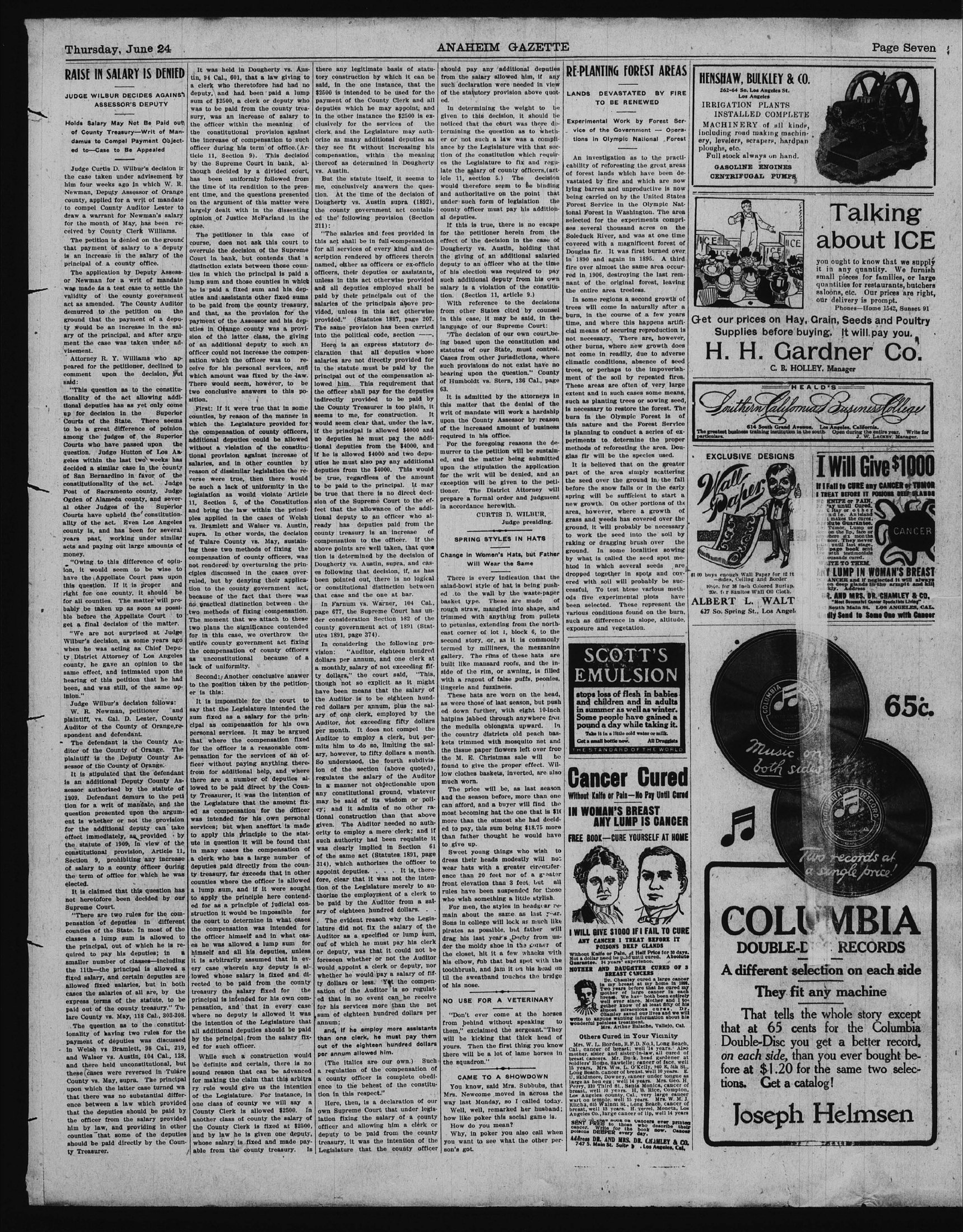
Searchable text
RAISE IN SALARY IS DENIED
JUDGE WILBUR DECIDES AGAINST ASSESSOR'S DEPUTY
Holds Salary May Not Be Paid out of County Treasury—Writ of Mandamus to Compel Payment Objected to—Case to Be Appealed
Judge Curtis D. Wilbur's decision in the case taken under advisement by him four weeks ago in which W. R. Newman, Deputy Assessor of Orange county, applied for a writ of mandate to compel County Auditor Lester to draw a warrant for Newman's salary for the month of May, has been received by County Clerk Williams.
The petition is denied on the ground that payment of salary to a deputy is an increase in the salary of the principal of a county office.
The application by Deputy Assessor Newman for a writ of mandate was made as a test case to settle the validity of the county government act as amended. The County Auditor demurred to the petition on the ground that the payment of a deputy would be an increase in the salary of the principal, and after argument the case was taken under advisement.
Attorney R. Y. Williams who appeared for the petitioner, declined to comment upon the decision, but said:
"This question as to the constitutionality of the act allowing additional deputies has as yet only come up for decision in the Superior Courts of the State. There seems to be a great difference of opinion among the judges of the Superior Courts who have passed upon the question. Judge Hutton of Los Angeles within the last two weeks has it was held in Dougherty vs. Austin, 94 Cal., 601, that a law giving to a clerk who theretofore had had no deputy, and had been paid a lump sum of $2500, a clerk or deputy who was to be paid from the county treasury, was an increase of salary to the officer within the meaning of the constitutional provision against the increase of compensation to such officer during his term of office.(Article 11, Section 9). This decision by the Supreme Court in bank, although decided by a divided court, has been uniformly followed from the time of its rendition to the present time, and the questions presented on the argument of this matter were largely dealt with in the dissenting opinion of Justice McFarland in the case.
The petitioner in this case of course, does not ask this court to overrule the decision of the Supreme Court in bank, but contends that a distinction exists between those counties in which the principal is paid a lump sum and those counties in which he is paid a fixed sum and his deputies and assistants other fixed sums to be paid from the county treasury, and that, as the provision for the payment of the Assessor and his deputies in Orange county was a provision of the latter class, the giving of an additional deputy to such an officer could not increase the compensation which the officer was to receive for his personal services, and which amount was fixed by the law. There would seem, however, to be two conclusive answers to this position.
First: If it were true that in some counties, by reason of the manner in which the Legislature provided for the compensation of county officers, additional deputies could be allowed without a violation of the constitutional provision against increase of there any legal history constructive said, in the $2500 is intended payment of the deputies which in the other instance exclusively for clerk and therefore as many they see fit compensation thereof as deeds vs. Austin.
But the statement, conclusively at the Dougherty vs. the county generalized the following 211):
"The salaries this act shall for all services described render named, either officers, their unless in this case and all deputies paid by their salaries of these vided, unless provided." (S. The same proceed into the politics.
Here is an claration that salaries are not in the statute principal outlawed him. The officer shall indirectly proclaim the County Trust seems to me, would seem clear if the principle no deputies had national deputies if he is allowed
"This question as to the constitutionality of the act allowing additional deputies has as yet only come up for decision in the Superior Courts of the State. There seems to be a great difference of opinion among the judges of the Superior Courts who have passed upon the question. Judge Hutton of Los Angeles within the last two weeks has decided a similar case in the county of San Bernardino in favor of the constitutionality of the act. Judge Post of Sacramento county, Judge Ogden of Alameda county, and several other Judges of the Superior Courts have upheld the constitutionality of the act. Even Los Angeles county is, and has been for several years past, working under similar acts and paying out large amounts of money.
"Owing to this difference of opinion, it would seem to be wise to have the Appellate Court pass upon this question. If it is proper and right for one county, it should be for all counties. The matter will probably be taken up as soon as possible before the Appellate Court to get a final decision of the matter.
"We are not surprised at Judge Wilbur's decision, as some years ago when he was acting as Chief Deputy District Attorney of Los Angeles county, he gave an opinion to the same effect, and intimated upon the hearing of this petition that he had been, and was still, of the same opinion."
Judge Wilbur's decision follows:
W. R. Newman, petitioner and plaintiff, vs. Cal. D. Lester, County Auditor of the County of Orange, respondent and defendant.
The defendant is the County Auditor of the County of Orange. The plaintiff is the Deputy County Assessor of the County of Orange.
It is stipulated that the defendant is an additional Deputy County Assessor authorized by the statute of 1909. Defendant demurs to the petition for a writ of mandate, and the question presented upon the argument is whether or not the provision for the additional deputy can take effect immediately, as provided by the statute of 1909, in view of the constitutional provision, Article 11, Section 9, prohibiting any increase of salary to a county officer during receive for his personal services, and which amount was fixed by the law. There would seem, however, to be two conclusive answers to this position.
First: If it were true that in some counties, by reason of the manner in which the Legislature provided for the compensation of county officers, additional deputies could be allowed without a violation of the constitutional provision against increase of salaries, and in other counties by reason of dissimilar legislation the reverse were true, then there would be such a lack of uniformity in the legislation as would violate Article 11, Section 5, of the Constitution and bring the law within the principles applied in the cases of Welsh vs. Bramlett and Walser vs. Austin, supra. In other words, the decision of Tulare County vs. May, sustaining these two methods of fixing the compensation of county officers, was not rendered by overturning the principles discussed in the cases overruled, but by denying their application to the county government act, because of the fact that there was no practical distinction between the two methods of fixing compensation. The moment that we attach to these two plans the significance contended for in this case, we overthrow the entire county government act fixing the compensation of county officers as unconstitutional because of a lack of uniformity.
Second: Another conclusive answer to the position taken by the petitioner is this:
It is impossible for the court to say that the Legislature intended the sum fixed as a salary for the principal as compensation for his own personal services. It may be argued that where the compensation fixed for the officer is a reasonable compensation for the services of an officer without paying anything therefrom for additional help, and where there are a number of deputies allowed to be paid direct by the County Treasurer, it was the intention of the Legislature that the amount fixed as compensation for the officer was intended for his own personal services; but when an effort is made to apply this principle to the statute in question it will be found that in many cases the compensation of a clerk who has a large number of deputies paid directly from the coun-
In Farnum page 677, the order considerates county governors 1891, page 682.
In consideration vision: "Auditors per annum pay monthly salary dollars," though not so much have been met by Auditors in red dollars per year of one clerk Auditor, not per month. Auditors to embody him to satisfy however, So understoodion of the regulations they in a manner any constitution may be said by cy; and it a tional construc given. The Authority to employ such authority was clearly clear of the same as 314), which a
It is stipulated that the defendant is an additional Deputy County Assessor authorized by the statute of 1909. Defendant demurs to the petition for a writ of mandate, and the question presented upon the argument is whether or not the provision for the additional deputy can take effect immediately, as provided by the statute of 1909, in view of the constitutional provision, Article 11, Section 9, prohibiting any increase of salary to a county officer during the term of office for which he was elected.
It is claimed that this question has not heretofore been decided by our Supreme Court.
"There are two rules for the compensation of deputies in different counties of the State. In most of the classes a lump sum is allowed to the principal, out of which he is required to pay his deputies; in a smaller number of classes—including the 11th—the principal is allowed a fixed salary, and certain deputies are allowed fixed salaries, but in both cases the salaries of all are, by the express terms of the statute, to be paid out of the county treasury." Tulare County vs. May, 118 Cal., 303-308.
The question as to the constitutionality of having two rules for the payment of deputies was discussed in Welsh vs Bramlett, 98 Cal., 219, and Walser vs. Austin, 104 Cal., 128, and there held unconstitutional, but these cases were reversed in Tulare County vs. May, supra. The principal upon which the latter case turned wa that there was no substantial difference between a law which provided that the deputies should be paid by the officer from the salary provided him by law, and providing in other counties that some of the deputies should be paid directly by the County Treasurer.
While such a construction would be definite and certain, there is no sound reason that can be advanced for making the claim that this arbitrary rule would give us the intention of the Legislature. For instance, in one class of county we will say a County Clerk is allowed $2500. In another class of county the salary of the County Clerk is fixed at $2500, and by law he is given one deputy, whose salary is fixed and made payable from the county treasury. Is there a number of deputies allowed to be paid direct by the County Treasurer, it was the intention of the Legislature that the amount fixed as compensation for the officer was intended for his own personal services; but when an effort is made to apply this principle to the statute in question it will be found that in many cases the compensation of a clerk who has a large number of deputies paid directly from the county treasury, far exceeds that in other counties where the officer is allowed a lump sum, and if it were sought to apply the principle here contended for as a principle of judicial construction it would be impossible for the court to determine in what cases the compensation was intended for the officer himself and in what cases he was allowed a lump sum for himself and all his deputies, unless it is arbitrarily assumed that in every case wherein any deputy is allowed whose salary is fixed and directed to be paid from the county treasury the salary fixed for the principal is intended for his own compensation, and that in every case where no deputy is allowed it was the intention of the Legislature that all additional deputies should be paid by the principal from the salary fixed for such officer.
The evidence lature did not Auditor as a out of which or deputy, we foreseen where would appoint whether he wity dollars or sation of them ed that in na for his service sum of eight annum;
and, if he than one clear out of the e per annum al
(The italic a regulation a county offence to the tion in this r
Here, then own Supreme lation fixing officer and a deputy to be treasury, it w Legislature
ANAHEIM GAZETTE
there any legitimate basis of statutory construction by which it can be said, in the one instance, that the $2500 is intended to be used for the payment of the County Clerk and all deputies which he may appoint; and in the other instance the $2500 is exclusively for the services of the clerk and the Legislature may authorize as many additional deputies as they see fit without increasing his compensation within the meaning thereof as determined in Dougherty vs. Austin.
But the statute itself, it seems to me, conclusively answers the question. At the time of the decision of Dougherty vs. Austin supra (1892), the county government act contained the following provision (Section 211):
"The salaries and fees provided in this act shall be in full-compensation for all services of every kind and description rendered by officers therein named, either as officers or ex-officio officers, their deputies or assistants, unless in this act otherwise provided and all deputies employed shall be paid by their principals out of the salaries of the principals above provided, unless in this act otherwise provided." (Statutes 1887, page 207. The same provision has been carried into the political code, section —).
Here is an express statutory declaration that all deputies whose salaries are not directly provided for in the statute must be paid by the principal out of the compensation allowed him. This requirement that the officer shall pay for the deputies indirectly provided to be paid by the County Treasurer is too plain, it seems to me, for construction. It would seem clear that, under the law, if the principal is allowed $4000 and no deputies he must pay the additional deputies from the $4000, and if he is allowed $4000 and two deputies should pay any additional deputies from the salary allowed him, if any such declaration were needed in view of the statutory provision above quoted.
In determining the weight to be given to this decision, it should be noticed that the court was there determining the question as to whether or not such a law was a compliance by the Legislature with that section of the constitution which requires the Legislature to fix and regulate the salary of county officers,(article 11, section 5.) The decision would therefore seem to be binding and authoritative on the point that under such form of legislation the county officer must pay his additional deputies.
If this is true, there is no escape for the petitioner herein from the effect of the decision in the case of Dougherty vs. Austin, holding that the giving of an additional salaried deputy to an officer who at the time of his election was required to pay such additional deputy from his own salary is a violation of the constitution. (Section 11, article 9.)
With reference to the decisions from other States cited by counsel in this case, it may be said, in the language of our Supreme Court:
"The decision of our own court, being based upon the constitution and statutes of our State, must control. Cases from other jurisdictions, where such provisions do not exist have no bearing upon the question." County of Humboldt vs. Stern, 136 Cal., page 63.
It is admitted by the attorneys in this matter that the denial of the writ of mandate will work a hardship upon the County Assessor by reason of the increased amount of business required in his office.
For the foregoing reasons the demurrer to the petition will be sustained and the matter being submitted
RE-PLANTING FOREST AREA
LANDS DEVASTATED BY FIRE TO BE RENEWED
Experimental Work by Forest Service of the Government — Operations in Olympic National Forest
An investigation as to the practical capability of reforesting the great areas of forest lands which have been devastated by fire and which are now lying barren and unproductive is now being carried on by the United States Forest Service in the Olympic National Forest in Washington. The area selected for the experiments comprises several thousand acres on the Soleduck River, and was at one time covered with a magnificent forest of Douglas fir. It was first burned over in 1890 and again in 1895. A third fire over almost the same area occurred in 1906, destroying the last remnant of the original forest, leaving the entire area treeless.
In some regions a second growth of trees will come in naturally after a burn, in the course of a few years time, and where this happens artificial means of securing reproduction are not necessary. There are, however, other burns, where new growth does not come in readily, due to adverse climatic conditions, absence of seen trees, or perhaps to the impoverishment of the soil by repeated fires. These areas are often of very large extent and in such cases some means such as planting trees or sowing seeds is necessary to restore the forest. The burn in the Olympic Forest is on this nature and the Forest Service is planning to conduct a series of experiments to determine the proper methods of reforesting the area. Douglas fir will be the species used.
in some banner in provided for officers, allowed constituent release of ties by the reeve would in the Article institution the principle of Welsh Austin, decision sustaining the terms, was the princes over-applicant act, where was seen the sensation to these contended how the fixing officers use of a answer petition-court to undated the print this own argued on fixed com- of an off-ing there-nd where duties all the Counciliation ofount fixe officer personal is made the stat-und thatation of member of the counc-
in the statute must be paid by the principal out of the compensation allowed him. This requirement that the officer shall pay for the deputies indirectly provided to be paid by the County Treasurer is too plain, it seems to me, for construction. It would seem clear that, under the law, if the principal is allowed $4000 and no deputies he must pay the additional deputies from the $4000, and if he is allowed $4000 and two deputies he must also pay any additional deputies from the $4000. This would be true, regardless of the amount to be paid to the principal. It may be true that there is no direct decision of the Supreme Court to the effect that the allowance of the additional deputy to an officer who already has deputies paid from the county treasury is an increase of compensation to the officer. If the above points are well taken, that question is determined by the decision of Dougherty vs. Austin, supra, and cases following that decision, if, as has been pointed out, there is no logical or constitutional distinction between that case and the one at bar.
In Farnum vs. Warner, 104 Cal., page 677, the Supreme Court has under consideration Section 182 of the county government act of 1891 (Statutes 1891, page 374).
In considering the following provision: "Auditor, eighteen hundred dollars per annum, and one clerk at a monthly salary of not exceeding fifty dollars," the court said, "This, though not so explicit as it might have been means that the salary of the Auditor is to be eighteen hundred dollars per annum, plus the salary of one clerk, employed by the Auditor, not exceeding fifty dollars per month. It does not compel the Auditor to employ a clerk, but permits him to do so, limiting the salary, however, to fifty dollars a month. So understood, the fourth subdivision of the section (above quoted), regulates the salary of the Auditor in a manner not objectionable upon any constitutional ground, whatever may be said of its wisdom or policy; and it admits of no other rational construction than that above given. The Auditor needed no authority to employ a mere clerk; and if such authority had been requisite it was clearly implied in Section 61 of the same act (Statutes 1891, page 314), which authorizes the officer to such provisions do not exist have no bearing upon the question." County of Humboldt vs. Stern, 136 Cal., page 63.
It is admitted by the attorneys in this matter that the denial of the writ of mandate will work a hardship upon the County Assessor by reason of the increased amount of business required in his office.
For the foregoing reasons the demurrer to the petition will be sustained, and the matter being submitted upon the stipulation the application for the writ will be denied, and an exception will be given to the petitioner. The District Attorney will prepare a formal order and judgment in accordance herewith.
CURTIS D. WILBUR,
Judge presiding.
SPRING STYLES IN HATS
Change in Women's Hats, but Father Will Wear the Same
There is every indication that the salad-bowl style of hat is being pushed to the wall by the waste-paper basket type. These are made of rough straw, mangled into shape, and trimmed with anything from pullets to petunias, extending from the northeast corner of lot 1, block 6, to the second story, or, as it is commonly termed by milliners, the mezzanine gallery. The rims of these hats are built like mansard roofs, and inside of the rim, or awning, is filled with a ragout of false puffs, peonies, lingerle and fuzziness.
These hats are worn on the head, as were those of last season, but pushed down further, with eight 10-inch hatpins jabbed through anywhere from the medulla oblongata upward. In the country districts old peach baskets trimmed with mosquito net and the tissue paper flowers left over from the M. E. Christmas sale will be found to give the proper effect. Willow clothes baskets, inverted, are also much worn.
The price will be, as last season and the season before, more than one can afford, and a buyer will find the most becoming hat the one that is $10 more than the utmost she had decided to pay, this sum being $18.75 more than father thought he would have to give up.
Sweet young things who wish to dress their heads modestly will now wear hats with a greater circumfer-
regulates the salary of the Auditor in a manner not objectionable upon any constitutional ground, whatever may be said of its wisdom or policy; and it admits of no other rational construction than that above given. The Auditor needed no authority to employ a mere clerk; and if such authority had been requisite it was clearly implied in Section 61 of the same act (Statutes 1891, page 314), which authorizes the officer to appoint deputies. It is, therefore, clear that it was not the intention of the Legislature merely to authorize the employment of a clerk to be paid by the Auditor from a salary of eighteen hundred dollars.
The evident reason why the Legislature did not fix the salary of the Auditor as a specified or lump sum, out of which he must pay his clerk or deputy, was that it could not be foreseen whether or not the Auditor would appoint a clerk or deputy, nor whether he would pay a salary of fifty dollars or less. Yet the compensation of the Auditor is so regulated that in no event can he receive for his services more than the net sum of eighteen hundred dollars per annum;
and, if he employ more assistants than one clerk, he must pay them out of the eighteen hundred dollars per annum allowed him.
(The italics are our own.) Such a regulation of the compensation of a county officer is complete obedience to the behest of the constitution in this respect."
Here, then, is a declaration of our own Supreme Court that under legislation fixing the salary of a county officer and allowing him a clerk or deputy to be paid from the county treasury, it was the intention of the Legislature that the county officer
The price will be, as last season and the season before, more than one can afford, and a buyer will find the most becoming hat the one that is $10 more than the utmost she had decided to pay, this sum being $18.75 more than father thought he would have to give up.
Sweet young things who wish to dress their heads modestly will not wear hats with a greater circumference than 20 feet nor of a greater front elevation than 3 feet, but all rules have been suspended for those who wish something a little stylish.
For men, the styles in headgear remain about the same as last year. Sons in college will lock as much like pirates as possible, but father will drag his last year's Derby from under the moldy shoe in the corner of the closet, hit it a few whacks with his elbow, rub that bad spot with the toothbrush, and jam it on his head until the sweatband touches the bridge of his nose.
NO USE FOR A VETERINARY
"Don't ever come at the horses from behind without speaking to them," exclaimed the sergeant. "They will be kicking that thick head of yours. Then the first thing you know there will be a lot of lame horses in the squadron."
CAME TO A SHOWDOWN
You know, said Mrs. Subbubs, that Mrs. Newcome moved in across the way last Monday, so I called today.
Well, well, remarked her husband; how like poker this social game is.
How do you mean?
Why, in poker you also call when you want to see what the other person's got.
HENSHAW, BULKLEY & CO.
262-64 So. Los Angeles St.
Los Angeles
IRRIGATION PLANTS
INSTALLED COMPLETE
MACHINERY of all kinds,
including road making machinery, levelers, scrapers, hardpan ploughs, etc.
Full stock always on hand.
GASOLINE ENGINES
CENTRIFUGAL PUMPS
Talking about ICE
you ought to know that we supply it in any quantity. We furnish small pieces for families, or large quantities for restaurants, butchers saloons, etc. Our prices are right, our delivery is prompt.
Phones—Home 1542, Sunset 91
Get our prices on Hay, Grain, Seeds and Poultry Supplies before buying. It will pay you.
H. H. Gardner Co.
C. B. HOLLEY, Manager
HEALD'S
Southern California Business College
614 South Grand Avenue, Los Angeles, California.
The greatest business training institution in the south. Open during the entire year. Write for particulars.
J. W. LACKEY, Manager.
EXCLUSIVE DESIGNS
C. B. HOLLEY, Manager
HEALD'S Southern California Business College
614 South Grand Avenue, Los Angeles, California.
The greatest business training institution in the south. Open during the entire year. Write for particulars.
EXCLUSIVE DESIGNS
Wall Paper
$100 buys enough Wall Paper for 12 ft.—Sides, Ceiling and Border
10½c. for 38 inch Colored Burlap.
20e. for Sanitos Wall Oil Cloth.
ALBERT L. WALT
627 So. Spring St., Los Angeles
I Will Give $1000
If I Fall to CURE any CANCER or TUMOR
I TREAT BEFORE IT POSSESSES DEEP Glands
KNIFE or PAIN.
May until Cured.
Ray or other handles. An island makes the cures.
Guarantee.
Tumor, Lump or scar on the lip, face or there six months after it never until last stage.
Page book sent with testimonials of thousands cured.
LUMP IN WOMAN'S BREAST
CANCER and if neglected it will always en deep glands in the armpit and kill kily. Address
L. AND MRS. DR. CHAMLEY & CO.
"Most Successful Cancer Specialists Living"
South Main St. LOS ANGELES, CAL.
Daily Send to Some One with Cancer
65¢.
Music on both sides
COLUMBIA
DOUBLE-DISC RECORDS
A different selection on each side
They fit any machine
That tells the whole story except that at 65 cents for the Columbia Double-Disc you get a better record, on each side, than you ever bought before at $1.20 for the same two selections. Get a catalog!
Joseph Helmsen