anaheim-gazette 1909-06-24
Scanned page
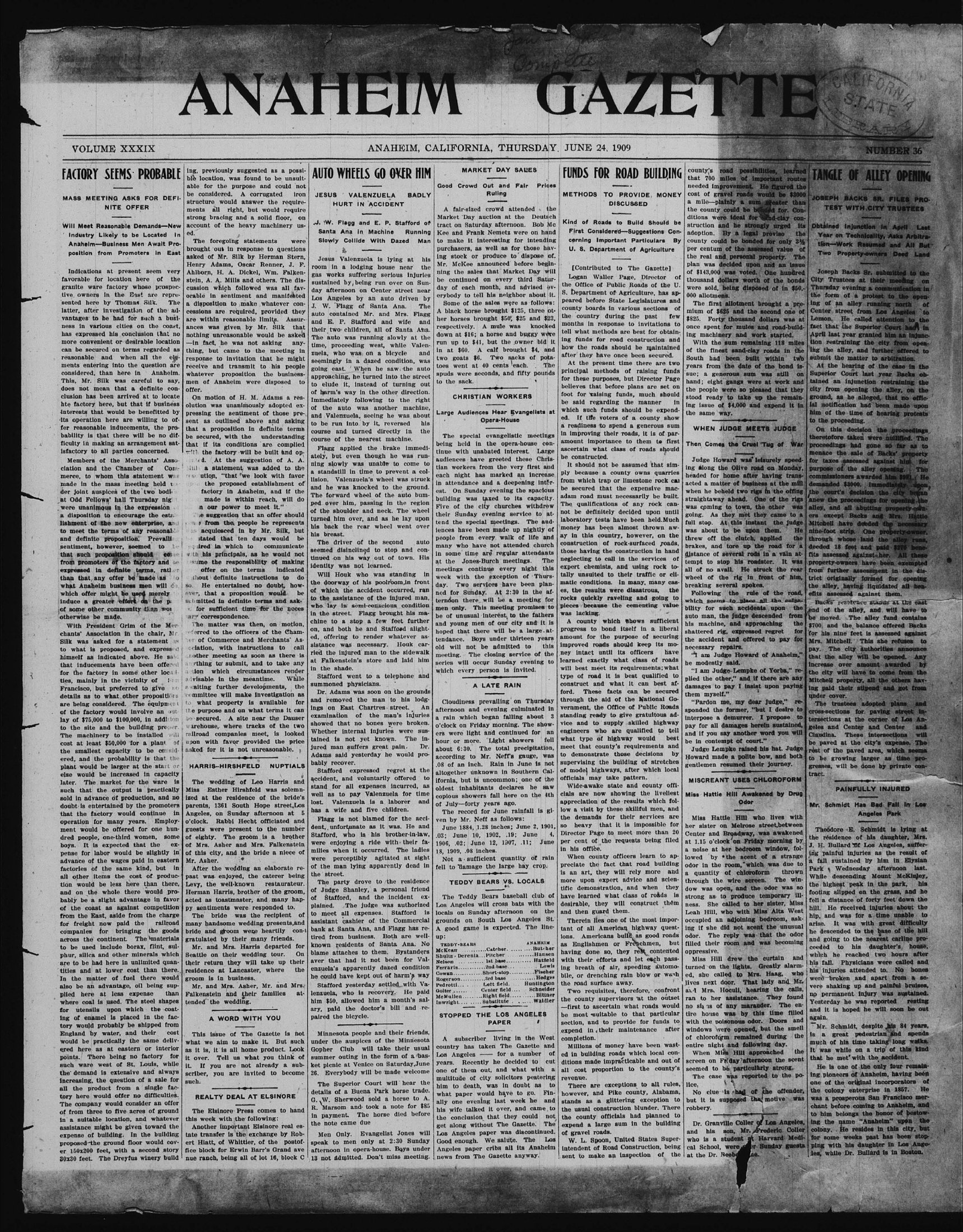
Searchable text
FACTORY SEEMS PROBABLE
MASS MEETING ASKS FOR DEFINITE OFFER
Will Meet Reasonable Demands—New Industry Likely to be Located in Anaheim—Business Men Await Proposition from Promoters in East
Indications at present seem very favorable for location here of the granite ware factory whose prospective owners in the East are represented here by Thomas Silk. The latter, after investigation of the advantages to be had for such a business in various cities on the coast, has expressed his conclusion that no more convenient or desirable location can be secured on terms regarded as reasonable and when all the elements entering into the question are considered, than here in Anaheim. This, Mr. Silk was careful to say, does not mean that a definite conclusion has been arrived at to locate the factory here, but that if business interests that would be benefitted by its operation here are willing to offer reasonable inducements, the probability is that there will be no difficulty in making an arrangement satisfactory to all parties concerned.
ing, previously suggested as a possible location, was found to be unsuitable for the purpose and could not be considered. A corrugated iron structure would answer the requirements all right, but would require strong bracing and a solid floor, on account of the heavy machinery used.
The foregoing statements were brought out in response to questions asked of Mr. Silk by Herman Stern, Henry Adams, Oscar Renner, J. F. Ahlborn, H. A. Dickel, Wm. Falkenstein, A. A. Mills and others. The discussion which followed was all favorable in sentiment and manifested a disposition to make whatever concessions are required, provided they are within reasonable limits. Assurances was given by Mr. Silk that nothing unreasonable would be asked—in fact, he was not asking anything, but came to the meeting in response to invitation that he might receive and transmit to his people whatever proposition the businessmen of Anaheim were disposed to offer.
On motion of H. M. Adams a resolution was unanimously adopted expressing the sentiment of those present as outlined above and asking that a proposition in definite terms be secured, with the understanding that if its conditions are complied with the factory will be built and op-
Members of the Merchants' Association and the Chamber of Commerce, to whom this statement was made in the mass meeting held under joint auspices of the two bodies at Odd Fellows' hall Thursday night were unanimous in the expression of a disposition to encourage the establishment of the new enterprise, and to meet the terms of any reasonable and definite proposition. Prevailing sentiment, however, seemed to be that such proposition should come from promoters of the factory and be expressed in definite terms, rather than that any offer be made as to what Anaheim business men will do, which offer might be used merely to induce a greater effort on the part of some other community than would otherwise be made.
With President Grim of the Merchants' Association in the chair, Mr. Silk was asked for a statement as to what is proposed, and expressed himself as indicated above. He said that inducements have been offered for the factory in some other locations, mainly in the vicinity of San Francisco, but preferred to give no details as to what other propositions are being considered. The equipment of the factory would involve an outlay of $75,000 to $100,000, in addition to the site and the building proper. The machinery to be installed will cost at least $50,000 for a plant of the smallest capacity to be considered, and the probability is that the plant would be larger at the start or else would be increased in capacity later. The market for the ware is such that the output is practically sold in advance of production, and no doubt is entertained by the promoters that the factory would continue in operation for many years. Employment would be offered for one hundred people, one-third women, some boys. It is expected that the expense for labor would be slightly in advance of the wages paid in eastern factories of the same kind, but in receive and transmit to his people whatever proposition the businessmen of Anaheim were disposed to offer.
On motion of H. M. Adams a resolution was unanimously adopted expressing the sentiment of those present as outlined above and asking that a proposition in definite terms be secured, with the understanding that if its conditions are complied with the factory will be built and operated. At the suggestion of A. A. Milhil a statement was added to the resolution, "that we look with favor upon the proposed establishment of the factory in Anaheim, and if the made is within reach, will do our power to meet it."
The suggestion that an offer should come from the people he represents was acquiesced in by Mr. Silk, but stated that ten days would be required in which to communicate with his principals, as he would not assume the responsibility of making an offer on the terms indicated without definite instructions to do so. He entertained no doubt, however, that a proposition would be submitted in definite terms and asked for sufficient time for the necesary correspondence.
The matter was then, on motion referred to the officers of the Chamber of Commerce and Merchants' Association, with instructions to call another meeting as soon as there is anything to submit, and to take any action which circumstances render advisable in the meantime. While awaiting further developments, the committee will make investigation as to what property is available for the purpose and on what terms it can be secured. A site near the Dauser warehouse, where tracks of the two railroad companies meet, is looked upon with favor provided the price asked for it is not unreasonable.
HARRIS--HIRSHFELD NUPTIALS
The wedding of Leo Harris and Miss Esther Hirshfeld was solemnized at the residence of the bride's parents, 1361 South Hope street, Los Angeles, on Sunday afternoon at 5 o'clock. Rabbi Hecht officiated and guests were present to the number of eighty. The groom is a brother of Mrs. Asher and Mrs. Falkenstein of this city, and the bride a niece of Mr. Asher.
After the wedding an elaborate re-
else would be increased in capacity later. The market for the ware is such that the output is practically sold in advance of production, and no doubt is entertained by the promoters that the factory would continue in operation for many years. Employment would be offered for one hundred people, one-third women, some boys. It is expected that the expense for labor would be slightly in advance of the wages paid in eastern factories of the same kind, but in all other items the cost of production would be less here than there, and on the whole there would probably be a slight advantage in favor of the coast as against competition from the East, aside from the charge for freight now paid the railroad companies for bringing the goods across the continent. The materials to be used include borax, flint, sulphur, silica and other minerals which are to be had here in unlimited quantities and at lower cost than there. In the matter of fuel there would also be an advantage, oil being supplied here at less expense than where coal is used. The steel shapes for utensils upon which the coating of enamel is placed in the factory would probably be shipped from England by water, and their cost would be practically the same delivered here as at eastern or interior points. There being no factory for such ware west of St. Louis, while the demand is extensive and always increasing, the question of a sale for all the product from a single factory here would offer no difficulties. The company would consider an offer of from three to five acres of ground in a suitable location, and whatever assistance might be given toward the expense of building. In the building proposed—the ground floor would cover 150x200 feet, with a second story 30x30 feet. The Dreyfus winery build
The wedding of Leo Harris and Miss Esther Hirshfeld was solemnized at the residence of the bride's parents, 1361 South Hope street, Los Angeles, on Sunday afternoon at 5 o'clock. Rabbi Hecht officiated and guests were present to the number of eighty. The groom is a brother of Mrs. Asher and Mrs. Falkenstein of this city, and the bride a niece of Mr. Asher.
After the wedding an elaborate reast was enjoyed, the caterer being Levy, the well-known restaurateur. Herman Harris, brother of the groom, acted as toastmaster, and many happy sentiments were responded to.
The bride was the recipient of many handsome wedding presents,and bride and groom were heartily congratulated by their many friends.
Mr. and Mrs. Harris departed for Seattle on their wedding tour. On their return they will take up their residence at Lancaster, where the groom is in business.
Mr. and Mrs. Asher, Mr. and Mrs. Falkenstein and their families attended the wedding.
A WORD WITH YOU
This issue of The Gazette is not what we aim to make it. But such as it is, it is all home product. Look it over. Tell us what you think of it. If you are not already a subscriber, you are invited to become such.
REALTY DEAL AT ELSINORE
The Elsinore Press comes to hand this week with the following:
Another important Elsinore real estate transfer is the exchange by Robert Hiatt, of Whittier, of the postoffice block for Erwin Barr's Grand ave nue ranch, being all of lot 16, block C
ANAHEIM, CALIFORNIA, THURSDAY. JUNE 24, 1909
AUTO WHEELS GO OVER HIM
JESUS VALENZUELA BADLY HURT IN ACCIDENT
J. W. Flagg and E. P. Stafford of Santa Ana in Machine Running Slowly Collide With Dazed Man
Jesus Valenzuela is lying at his room in a lodging house near the gas works suffering serious injuries sustained by being run over on Sunday afternoon on Center street near Los Angeles by an auto driven by J. W. Flagg of Santa Ana. The auto contained Mr. and Mrs. Flagg and E. P. Stafford and wife and their two children, all of Santa Ana. The auto was running slowly at the time, proceeding west, while Valenzuela, who was on a bicycle and seemingly in a dazed condition, was going east. When he saw the auto approaching, he turned into the street to elude it, instead of turning out of harm's way in the other direction. Immediately following to the right of the auto was another machine, and Valenzuela, seeing he was about to be run into by it, reversed his course and turned directly in the course of the nearest machine.
Flagg applied the brake immediately, but even though he was run-
MARKET DAY SALES
Good Crowd Out and Fair Prices Ruling
A fair-sized crowd attended the Market Day auction at the Deutsch tract on Saturday afternoon. Bob McKee and Frank Nemetz were on hand to make it interesting for intending purchasers, as well as for those having stock or produce to dispose of. Mr. McKee announced before beginning the sales that Market Day will be continued on every third Saturday of each month, and advised everybody to tell his neighbor about it.
Some of the sales were as follows: A black horse brought $125, three other horses brought $50, $25 and $23, respectively. A mule was knocked down at $16; a horse and buggy were run up to $41, but the owner bid it in at $60. A calf brought $4, and two goats $6. Two sacks of potatoes went at 40 cents each. The spuds were seconds, and fifty pounds to the sack.
CHRISTIAN WORKERS
Large Audiences Hear Evangelists at Opera-House
The special evangelistic meetings being held in the opera-house continue with unabated interest. Large audiences have greeted these Chris-
FUNDS FOR ROAD BUILDING
METHODS TO PROVIDE MONEY DISCUSSED
Kind of Roads to Build Should be First Considered—Suggestions Concerning Important Particulars By U. S. Department of Agriculture
[Contributed to The Gazette]
Logan Waller Page, Director of the Office of Public Roads of the U.S. Department of Agriculture, has appeared before State Legislatures and county boards in various sections of the country during the past few months in response to invitations to tell what methods are best for obtaining funds for road construction and how the roads should be maintained after they have once been secured.
At the present time there are two principal methods of raising funds for these purposes, but Director Page believes that before plans are set on foot for raising funds, much should be said regarding the manner in which such funds should be expended. If the voters of a county show a readiness to spend a generous sum in improving their roads, it is of paramount importance to them to first ascertain what class of roads should be constructed.
When he saw the auto approaching, he turned into the street to elude it, instead of turning out of harm's way in the other direction. Immediately following to the right of the auto was another machine, and Valenzuela, seeing he was about to be run into by it, reversed his course and turned directly in the course of the nearest machine.
Flagg applied the brake immediately, but even though he was running slowly was unable to come to a standstill in time to prevent a collision. Valenzuela's wheel was struck and he was knocked to the ground. The forward wheel of the auto bumped over him, passing in the region of the shoulder and neck. The wheel turned him over, and as he lay upon his back the rear wheel went over his breast.
The driver of the second auto seemed disinclined to stop and continued on his way out of town. His identity was not learned.
Will Houk who was standing in the doorway of his poolroom, in front of which the accident occurred, ran to the assistance of the injured man, who lay in semi-conscious condition in the street. Flagg brought his machine to a stop a few feet further on, and both he and Stafford alighted, offering to render whatever assistance was necessary. Houk carried the injured man to the sidewalk at Falkenstein's store and laid him in the shade.
Stafford went to a telephone and summoned physicians.
Dr. Adams was soon on the grounds and removed the man to his lodgings on East Chartres street. An examination of the man's injuries showed that no bones were broken. Whether internal injuries were sustained is not yet known. The injured man suffers great pain. Dr. Adams said yesterday he would probably recover.
Stafford expressed regret at the accident, and voluntarily offered to stand for all expenses incurred, as well as to pay Valenzuela for time lost. Valenzuela is a laborer and has a wife and five children.
Flagg is not blamed for the accident, unfortunate as it was. He and Stafford, who is his brother-in-law, were enjoying a ride with their families when it occurred. The ladies were perceptibly agitated at sight of the man lying apparently dead in
toes went at 40 cents each. The spuds were seconds, and fifty pounds to the sack.
CHRISTIAN WORKERS
Large Audiences Hear Evangelists at Opera-House
The special evangelistic meetings being held in the opera-house continue with unabated interest. Large audiences have greeted these Christian workers from the very first and each night has marked an increase in attendance and a deepening interest. On Sunday evening the spacious building was taxed to its capacity. Five of the city churches withdrew their Sunday evening service to attend the special meetings. The audiences have been made up nightly of people from every walk of life and many who have not attended church in some time are regular attendants at the Jones-Burch meetings. The meetings continue every night this week with the exception of Thursday. Two services have been planned for Sunday. At 2:30 in the afternoon there will be a meeting for men only. This meeting promises to be of unusual interest to the fathers and young men of our city and it is hoped that there will be a large attendance. Boys under thirteen years old will not be admitted to this meeting. The closing service of the series will occur Sunday evening to which every person is invited.
A LATE RAIN
Cloudiness prevailing on Thursday afternoon and evening culminated in a rain which began falling about 3 o'clock on Friday morning. The showers were light and continued for an hour or more. Light showers fell about 6:30. The total precipitation, according to Mr. Neff's gauge, was .08 of an inch. Rain in June is not altogether unknown in Southern California, but is uncommon; one of the oldest inhabitants declares he saw copious showers fall here on the 4th of July—forty years ago.
The record for June rainfall is given by Mr. Neff as follows:
June 1884, 1.28 inches; June 2, 1901,.03; June 10, 1902,.19; June 4, 1906,.02; June 12, 1907,.11; June 18, 1909,.08 inches.
Not a sufficient quantity of rain fell to damage the large hay crop.
At the present time there are two principal methods of raising funds for these purposes, but Director Page believes that before plans are set on foot for raising funds, much should be said regarding the manner in which such funds should be expended. If the voters of a county show a readiness to spend a generous sum in improving their roads, it is of paramount importance to them to first ascertain what class of roads should be constructed.
It should not be assumed that simply because a county owns quarries from which trap or limestone rock can be secured that the expensive macadam road must necessarily be built. The qualifications of any rock cannot be definitely decided upon until laboratory tests have been held.Much money has been almost thrown away in this country, however, on the construction of rock-surfaced roads, those having the construction in hand neglecting to call in the services of expert chemists, and using rock totally unsuited to their traffic or climatic conditions. In many, many cases, the results were disastrous, the rocks quickly raveling and going to pieces because the cementing value was lacking.
A county which shows sufficient progress to bond itself in a liberal amount for the purpose of securing improved roads should keep its money intact until its officers have learned exactly what class of roads will best meet its requirements; what type of road it is best qualified to construct and what it can best afford. These facts can be secured through the aid of the National Government, the Office of Public Roads standing ready to give gratuitous advice and to supply skilled highway engineers who are qualified to tell what type of highway would best meet that county's requirements and to demonstrate those decisions by supervising the building of stretches of model highways, after which local officials may take pattern.
Wide-awake state and county officials are now showing the liveliest appreciation of the results which follow a visit by these skillful men, and the demands for their services are so heavy that it is impossible for Director Page to meet more than 20 per cent of the requests being filed in his office.
When county officers learn to appreciate the fact that road building
accident, and voluntarily offered to stand for all expenses incurred, as well as to pay Valenzuela for time lost. Valenzuela is a laborer and has a wife and five children.
Flagg is not blamed for the accident, unfortunate as it was. He and Stafford, who is his brother-in-law, were enjoying a ride with their families when it occurred. The ladies were perceptibly agitated at sight of the man lying apparently dead in the street.
The party drove to the residence of Judge Shanley, a personal friend of Stafford, and the incident explained. The judge was authorized to meet all expenses. Stafford is assistant cashier of the Commercial bank at Santa Ana, and Flagg has retired from business. Both are well-known residents of Santa Ana. No blame attaches to them. Bystanders aver that had it not been for Valenzuela's apparently dazed condition he could have kept out of harm's way.
Stafford yesterday settled with Valenzuela, who is recovery. He paid him $50, allowed him a month's salary, paid the doctor's bill and repaired the bicycle.
Minnesota people and their friends, under the auspices of the Minnesota Gopher Club will take their usual summer outing in the form of a basket picnic at Venice on Saturday, June 26. Everybody will be made welcome.
The Superior Court will hear the details of a Buena Park horse trade. G. W. Sherwood sold a horse to A. R. Marsom and took a note for $85 in payment. The horse died before the note came due.
Men Only. Evangelist Jones will speak to men only at 2:30 Sunday afternoon in opera-house. Boys under 13 not admitted. Don't miss meeting.
TEDDY BEARS VS. LOCALS
The Teddy Bears baseball club of Los Angeles will cross bats with the locals on Sunday afternoon on the grounds on South Los Angeles St. A good game is expected. The lineup:
TEDDY-BEARS ANAHEIM
McKearn Catcher Butcher
Shultz Derenla Pitcher Hansen
Nelson 1st base Hatfield
Ferraris 2nd base Lewis
Cowan Short-stop Fischer
Rogerson 3rd base Hedges
Pedrotti Lett field Huntington
Golter Center field Schneider
McMullen Right field Bittner
Inwright Substitute Walder
STOPPED THE LOS ANGELES PAPER
A subscriber living in the West country has taken The Gazette and Los Angeles — for a number of years. Recently he decided to cut one of them out, and what with a multitude of city solicitors pestering him to death, was in doubt as to what paper would have to go. Finally one evening last week he and his wife talked it over, and came to the conclusion that they could not get along without The Gazette. The Los Angeles paper was discontinued. Good enough. We salute. The Los Angeles paper cribs all its Anaheim news from The Gazette anyway.
Wide-awake state and county officials are now showing the liveliest appreciation of the results which follow a visit by these skillful men, and the demands for their services are so heavy that it is impossible for Director Page to meet more than 20 per cent of the requests being filed in his office.
When county officers learn to appreciate the fact that road building is an art, they will rely more and more upon expert advice and scientific demonstration, and when they have learned what class of roads is desirable, they will construct them and then guard them.
Therein lies one of the most important of all American highway questions. Americans build as good roads as Englishmen or Frenchmen, but having done so, they rest contented with their efforts and let each passing breath of air, speeding automobile, or drenching rain blow or wash the road surface away.
Two requisites, therefore, confront the county supervisors at the outset—first to ascertain what roads would be most suitable to that particular section, and to provide for funds to expend in their maintenance after completion.
Millions of money have been wasted in building roads which local conditions made impracticable and out of all cost proportion to the county's revenue.
There are exceptions to all rules, however, and Pike county, Alabama, stands as a glittering exception to the usual construction blunder. There the county officials had planned to expend a large sum in the building of gravel roads.
W. L. Spoon, United States Superintendent of Road Construction, being sent to make an inspection of the official may take pattern.
Wide-awake state and county officials are now showing the liveliest appreciation of the results which follow a visit by these skillful men, and the demands for their services are so heavy that it is impossible for Director Page to meet more than 20 per cent of the requests being filed in his office.
When county officers learn to appreciate the fact that road building is an art, they will rely more and more upon expert advice and scientific demonstration, and when they have learned what class of roads is desirable, they will construct them and then guard them.
Therein lies one of the most important of all American highway questions. Americans build as good roads as Englishmen or Frenchmen, but having done so, they rest contented with their efforts and let each passing breath of air, speeding automobile, or drenching rain blow or wash the road surface away.
Two requisites, therefore, confront the county supervisors at the outset—first to ascertain what roads would be most suitable to that particular section, and to provide for funds to expend in their maintenance after completion.
Millions of money have been wasted in building roads which local conditions made impracticable and out of all cost proportion to the county's revenue.
There are exceptions to all rules, however, and Pike county, Alabama, stands as a glittering exception to the usual construction blunder. There the county officials had planned to expend a large sum in the building of gravel roads.
W. L. Spoon, United States Superintendent of Road Construction, being sent to make an inspection of the official may take pattern.
Wide-awake state and county officials are now showing the liveliest appreciation of the results which follow a visit by these skillful men, and the demands for their services are so heavy that it is impossible for Director Page to meet more than 20 per cent of the requests being filed in his office.
When county officers learn to appreciate the fact that road building is an art, they will rely more and more upon expert advice and scientific demonstration, and when they have learned what class of roads is desirable, they will construct them and then guard them.
Therein lies one of the most important of all American highway questions. Americans build as good roads as Englishmen or Frenchmen, but having done so, they rest contented with their efforts and let each passing breath of air, speeding automobile, or drenching rain blow or wash the road surface away.
Two requisites, therefore, confront the county supervisors at the outset—first to ascertain what roads would be most suitable to that particular section, and to provide for funds to expend in their maintenance after completion.
Millions of money have been wasted in building roads which local conditions made impracticable and out of all cost proportion to the county's revenue.
There are exceptions to all rules, however, and Pike county, Alabama, stands as a glittering exception to the usual construction blunder. There the county officials had planned to expend a large sum in the building of gravel roads.
W. L. Spoon, United States Superintendent of Road Construction, being sent to make an inspection of the official may take pattern.
Wide-awake state and county officials are now showing the liveliest appreciation of the results which follow a visit by these skillful men, and the demands for their services are so heavy that it is impossible for Director Page to meet more than 20 per cent of the requests being filed in his office.
When county officers learn to appreciate the fact that road building is an art, they will rely more and more upon expert advice and scientific demonstration, and when they have learned what class of roads is desirable, they will construct them and then guard them.
Therein lies one of the most important of all American highway questions. Americans build as good roads as Englishmen or Frenchmen, but having done so, they rest contented with their efforts and let each passing breath of air, speeding automobile, or drenching rain blow or wash the road surface away.
Two requisites, therefore, confront the county supervisors at the outset—first to ascertain what roads would be most suitable to that particular section, and to provide for funds to expend in their maintenance after completion.
Millions of money have been wasted in building roads which local conditions made impracticable and out of all cost proportion to the county's revenue.
There are exceptions to all rules, however, and Pike county, Alabama, stands as a glittering exception to the usual construction blunder. There the county officials had planned to expend a large sum in the building of gravel roads.
W. L. Spoon, United States Superintendent of Road Construction, being sent to make an inspection of the official may take pattern.
Wide-awake state and county officials are now showing the liveliest appreciation of the results which follow a visit by these skillful men, and the demands for their services are so heavy that it is impossible for Director Page to meet more than 20 per cent of the requests being filed in his office.
When county officers learn to appreciate the fact that road building is an art, they will rely more and more upon expert advice and scientific demonstration, and when they have learned what class of roads is desirable, they will construct them and then guard them.
Therein lies one of the most important of all American highway questions. Americans build as good roads as Englishmen or Frenchmen, but having done so, they rest contented with their efforts and let each passing breath of air, speeding automobile, or drenching rain blow or wash the road surface away.
Two requisites, therefore, confront the county supervisors at the outset—first to ascertain what roads would be most suitable to that particular section, and to provide for funds to expend in their maintenance after completion.
Millions of money have been wasted in building roads which local conditions made impracticable and out of all cost proportion to the county's revenue.
There are exceptions to all rules, however, and Pike county, Alabama, stands as a glittering exception to the usual construction blunder. There the county officials had planned to expend a large sum in the building of gravel roads.
W. L. Spoon, United States Superintendent of Road Construction, being sent to make an inspection of the official may take pattern.
Wide-awake state and county officials are now showing the liveliest appreciation of the results which follow a visit by these skillful men, and the demands for their services are so heavy that it is impossible for Director Page to meet more than 20 per cent of the requests being filed in his office.
When county officers learn to appreciate the fact that road building is an art, they will rely more and more upon expert advice and scientific demonstration, and when they have learned what class of roads is desirable, they will construct them and then guard them.
Therein lies one of the most important of all American highway questions. Americans build as good roads as Englishmen or Frenchmen, but having done so, they rest contented with their efforts and let each passing breath of air, speeding automobile, or drenching rain blow or wash the road surface away.
Two requisites, therefore confront the county supervisors at the outset—first to ascertain what roads would be most suitable to that particular section, and to provide for funds to expend in their maintenance after completion.
Millions of money have been wasted in building roads which local conditions made impracticable and out of all cost proportion to the county's revenue.
There are exceptions to all rules, however, and Pike county, Alabama, stands as a glittering exception to the usual construction blunder. There the county officials had planned to expend a large sum in the building of gravel roads.
W. L. Spoon, United States Superintendent of Road Construction, being sent to make an inspection of the official may take pattern.
AZETTE
4, 1909
NUMBER 36
R ROAD BUILDING
TO PROVIDE MONEY DISCUSSED
roads to Build Should be considered—Suggestions Con- important Particulars By Department of Agriculture
ed to The Gazette]
Miller Page, Director of Public Roads of the U.
of Agriculture, has appeared State Legislatures and is in various sections of during the past few response to invitations to methods are best for obtain- er road construction and should be maintained have once been secured.
sent time there are two methods of raising funds poses, but Director Page before plans are set on long funds, much shouldording the manner in funds should be expend- roters of a county show so spend a generous sum their roads, it is of par- tance to them to first at class of roads should.
county's road possibilities, learned that 700 miles of important routes needed improvement. He figured the cost of gravel roads would be $2000 a mile—plainly a sum greater than the county could be bonded for. Conditions were ideal for sand-clay construc-tion and he strongly urged its adoption. By a legal proviso the county could be bonded for only 3½ per centum of the assessed value of the real and personal property. The plan was decided upon and an issue of $143,000 was voted. One hundred thousand dollars worth of the bonds were sold, being disposed of in $50,-000 allotmens.
The first allotment brought a premium of $625 and the second one of $825. Forty thousand dollars was at once spent for mules and road-building machinery and work started.
With the sum remaining 118 miles of the finest sand-clay roads in the South had been built within two years from the date of the bond issu-e; a generous sum was still on hand; eight gangs were at work and the people were so pleased that they stood ready to take up the remain- ing issue of $4,000 and expend it in the same way.
WHEN JUDGE MEETS JUDGE
Then Comes the Cruel Tug of War
TANGLE OF ALLEY OPENING
JOSEPH BACKS SR. FILES PROTEST WITH CITY TRUSTEES
Obtained injunction in April Last Year on Technicality, Asks Arbitra-tion—Work Resumed and All But Two Property owners Deed Land
Joseph Backs Sr. submitted to the City Trustees at their meeting on Thursday evening a communication in the form of a protest to the opening of an alley running north of Center street from Los Angeles to Lemon. He called attention to the fact that the Superior Court had in April last year granted him an injunction restraining the city from open- ing the alley, and further offered to submit the matter to arbitration.
At the hearing of the case in the Superior Court last year Backs obtained an injunction restraining the city from opening the alley, on the ground, as he alleged, that no official notification had been made upon him of the time of hearing protests to the proceeding.
On this decision the proceedings theretofore taken were nullified. The proceedings had gone so far as to menace the sale of Backs' property
WHEN JUDGE MEETS JUDGE
Then Comes the Cruel Tug of War
Judge Howard was leisurely speeding along the Olive road on Monday, headed for home after having transacted a matter of business at the mill when he beheld two rigs in the offing straightaway ahead. One of the rigs was coming to town, the other was going. As they met they came to a full stop. At this instant the judge was about to be upon them. He threw off the clutch, applied the brakes, and tore up the road for a distance of several rods in a vain attempt to stop his roadster. It was all of no avail. He struck the rear wheel of the rig in front of him, breaking several spokes.
Following the rule of the road, which seems to place all the culpability for such accidents upon the auto man, the judge descended from his machine, and approaching the shattered rig, expressed regret for the accident and offered to pay for necessary repairs.
"I am Judge Howard of Anaheim," he modestly said.
"I am Judge Lempke of Yorba," replied the other," and if there are any damages to pay I insist upon paying them myself."
"Pardon me, my dear judge," responded the former, "but I desire to interpose a demurrer. I propose to pay for all damages herein sustained, and if you say another word you will be in contempt of court."
Judge Lempke raised his hat. Judge Howard made a polite bow, and both gentlemen resumed their journey.
MISCREANT USES CHLOROFORM
Miss Hattie Hill Awakened by Drug Odor
Miss Hattie Hill who lives with her sister on Melrose street, between Center and Broadway, was awakened at 1:15 o'clock on Friday morning by a noise at her bedroom window, followed by *the scent of a strange odor in the room*, which was due to years from the date of the bond issue; a generous sum was still on hand; eight gangs were at work and the people were so pleased that they stood ready to take up the remaining issue of $4,000 and expend it in the same way.
At the hearing of the case in the Superior Court last year Backs obtained an injunction restraining the city from opening the alley, on the ground, as he alleged, that no official notification had been made upon him of the time of hearing protests to the proceeding.
On this decision the proceedings theretofore taken were nullified. The proceedings had gone so far as to menace the sale of Backs' property for taxes assessed against him for purpose of the alley opening. The commissioners awarded him $901. He demanded $3000. Immediately upon the court's decision the city began anew the proceedings for opening the alley, and all abutting property-owners except Backs and Mrs. Hattie Mitchell have deeded the necessary nine-foot strip. One property owner, through whose land the alley runs, deeded 18 feet and paid $270 benefits assessed against her. All these property owners have been exempted from further assessment in the district originally formed for opening the alley, having liquidated all benefits assessed against them.
Backs' residence stands at the east end of the alley, and will have to be moved. The alley fund contains $700 and the balance offered Backs for his nine feet is assessed against Mrs. Mitchell. This she refuses to pay. The city authorities announce that the alley will be opened. Any increase over amount awarded by the city will have to come from the Mitchell property, all the others having paid their stipend and got from under cover.
The trustees adopted plans and cross-sections for paving street intersections at the corner of Los Angeles and Center and Center and Claudina. These intersections will be paved at the city's expense. The rest of the paved area, which seems to be growing larger as time progresses, will be done by private contract.
PAINFULLY INJURED
Mr. Schmidt Has Bad Fall in Los Angeles Park
Theodore E. Schmidt is lying at the residence of his daughter, Mrs. J. H. Bullard Of Los Angeles, suffering painful injuries as the result of a fall sustained by him in Elysian Park Wednesday afternoon last.
Miss Hattle Hill who lives with her sister on Melrose street, between Center and Broadway, was awakened at 1:15 o'clock on Friday morning by a noise at her bedroom window, followed by the scent of a strange odor in the room, which was due to a quantity of chloroform thrown through the wire screen. The window was open, and the odor was so strong as to produce temporary illness. She called to her sister, Miss Leah Hill, who with Miss Alta West occupied an adjoining bedroom, asking if she did not scent the unusual odor. The reply was that the odor filled their room and was becoming oppressive.
Miss Hill drew the curtain and turned on the lights. Greatly alarmed, she called to Mrs. Haag, who lives next door. That lady and Mr. and Mrs. Hoculi, hearing the calls, ran to her assistance. They found no signs of any marauder. The entire house was by this time filled with the poisonous odor. Doors and windows were opened, but the smell of chloroform remained during the entire night and following day.
When Miss Hill approached the screen on Friday afternoon the scent seemed to be particularly strong.
The case was reported to the police.
No clue is had of the offender, but it is supposed the motive was robbery.
Dr. Granville Coller of Los Angeles, and his son, Mr. Frederic Coller who is a student at Harvard Medical School, were over Sunday guests at the Dr. Reebert home.
PAINFULLY INJURED
Mr. Schmidt Has Bad Fall In Los Angeles Park
Theodore E. Schmidt is lying at the residence of his daughter, Mrs. J. H. Bullard of Los Angeles, suffering painful injuries as the result of a fall sustained by him in Elysian Park Wednesday afternoon last. While descending Mount McKinley, the highest peak in the park, his footing slipped on the grass, and he fell a distance of forty feet down the hill. He received injuries about the hip, and was for a time unable to arise. It was with great difficulty he descended to the base of the hill and going to the nearest carline proceeded to his daughter's house, which he reached two hours after his fall. Physicians were called and his injuries attended to. No bones were broken and apart from a severe shaking up and painful bruises, no permanent injury was sustained. Yesterday he was reported resting and it is hoped he will soon be out again.
Mr. Schmidt, despite his 84 years, is a great pedestrian and spends much of his time taking long walks. It was while on a trip of this kind that he met with the accident.
He is one of the only four remaining pioneers of Anaheim, having been one of the original incorporators of the colony enterprise in 1857. He was a prosperous San Francisco merchant before coming to Anaheim, and to him belongs the honor of bestowing the name "Anaheim" upon the colony. He resides in this city, but for some weeks past has been stopping with his daughter in Los Angeles, while Dr. Bullard is in Boston.