anaheim-gazette 1909-05-13
Scanned page
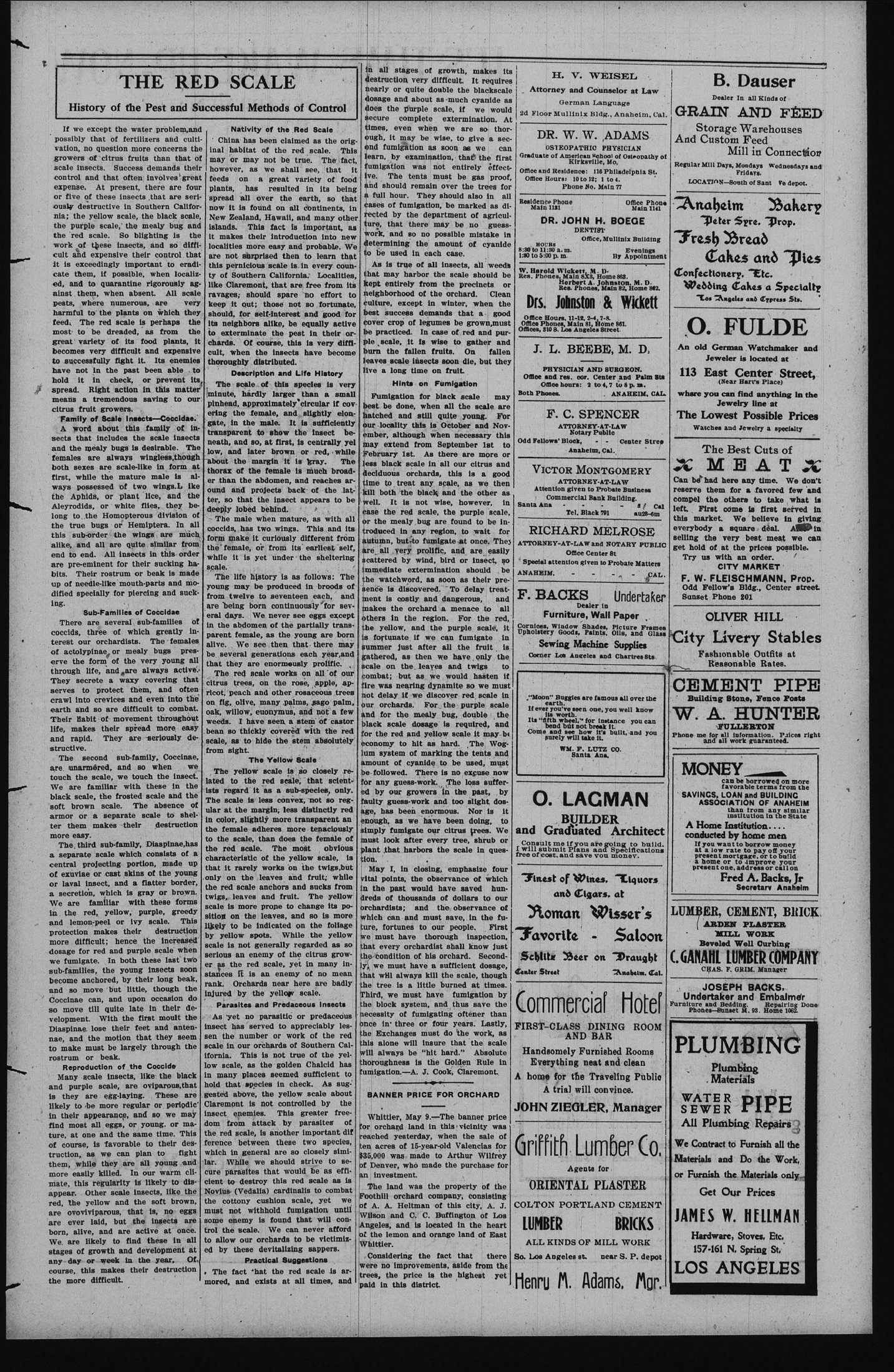
Searchable text
THE RED SCALE
History of the Pest and Successful Methods of Control
If we except the water problem, and possibly that of fertilizers and cultivation, no question more concerns the growers of citrus fruits than that of scale insects. Success demands their control and that often involves great expense. At present, there are four or five of these insects that are seriously destructive in Southern California; the yellow scale, the black scale, the purple scale, the mealy bug and the red scale. So blighting is the work of these insects, and so difficult and expensive their control that it is exceedingly important to eradicate them, if possible, when localized, and to quarantine rigorously against them, when absent. All scale pests, where numerous, are very harmful to the plants on which they feed. The red scale is perhaps the most to be dreaded, as from the great variety of its food plants, it becomes very difficult and expensive to successfully fight it. Its enemies have not in the past been able to hold it in check, or prevent its spread. Right action in this matter means a tremendous saving to our citrus fruit growers.
Family of Scale Insects—Coccidae.
A word about this family of insects that includes the scale insects and the mealy bugs is desirable. The females are always wingless, though both sexes are scale-like in form at first, while the mature male is always possessed of two wings. Like the Aphids, or plant lice, and the Aleyrodids, or white flies, they be-
Nativity of the Red Scale
China has been claimed as the final habitat of the red scale. May or may not be true. However, as we shall see, these feeds on a great variety of plants, has resulted in its spread all over the earth, so now it is found on all continents: New Zealand, Hawaii, and many islands. This fact is important it makes their introduction into localities more easy and probably are not surprised then to learn this pernicious scale is in every city of Southern California. Local like Claremont, that are free from ravages; should spare no effort keep it out; those not so fortunate should, for self-interest and good its neighbors alike, be equally able to exterminate the pest in their chards. Of course, this is very cult, when the insects have been thoroughly distributed.
Description and Life History
The scale of this species is minute, hardly larger than a pinhead, approximately circular dering the female, and slightly gate, in the male. It is sufficient transparent to show the insect neath, and so, at first, is central low, and later brown or red, about the margin it is gray. Thorax of the female is much longer than the abdomen, and reaches around and projects back of the ter, so that the insect appears deeply lobed behind.
Family of Scale Insects—Coccidae.
A word about this family of insects that includes the scale insects and the mealy bugs is desirable. The females are always wingless, though both sexes are scale-like in form at first, while the mature male is always possessed of two wings. Like the Aphids, or plant lice, and the Aleyrodids, or white flies, they belong to the Homopterous division of the true bugs or Hemiptera. In all this sub-order the wings are much alike, and all are quite similar from end to end. All insects in this order are pre-eminent for their sucking habits. Their rostrum or beak is made up of needle-like mouth-parts and modified specially for piercing and sucking.
Sub-Families of Coccidae
There are several sub-families of coccids, three of which greatly interest our orchardists. The females of actolypinae or mealy bugs preserve the form of the very young all through life, and are always active. They secrete a waxy covering that serves to protect them, and often crawl into crevices and even into the earth and so are difficult to combat. Their habit of movement throughout life, makes their spread more easy and rapid. They are seriously destructive.
The second sub-family, Coccinae, are unarmored, and so when we touch the scale, we touch the insect. We are familiar with these in the black scale, the frosted scale and the soft brown scale. The absence of armor or a separate scale to shelter them makes their destruction more easy.
The third sub-family, Diaspinae, has a separate scale which consists of a central projecting portion, made up of exuviae or cast skins of the young or laval insect, and a flatter border, a secretion, which is gray or brown. We are familiar with these forms in the red, yellow, purple, greedy and lemon-peel or ivy scale. This protection makes their destruction more difficult; hence the increased dosage for red and purple scale when we fumigate. In both these last two sub-families the young insects soon pinhead, approximately circular ering the female, and slightly gate, in the male. It is sufficient transparent to show the insects neath, and so, at first, is centrally low, and later brown or red, about the margin it is gray. Thorax of the female is much longer than the abdomen, and reaches ground and projects back of the ter, so that the insect appears deeply lobed behind.
The male when mature, as with coccids, has two wings. This an form make it curiously different from the female, or from its earliest while it is yet under the shell scale.
The life history is as follows: young may be produced in brood from twelve to seventeen each, are being born continuously for several days. We never see eggs eject in the abdomen of the partially parent female, as the young are alive. We see then that there be several generations each year that they are enormously prolific.
The red scale works on all of citrus trees, on the rose, apple ricot, peach and other rosaceous on fig, olive, many palms, sago oak, willow, euonymus, and not a weeds. I have seen a stem of citrus bean so thickly covered with the scale, as to hide the stem absolutely from sight.
The Yellow Scale
The yellow scale is so closely related to the red scale, that scientists regard it as a sub-species. The scale is less convex, not so angular at the margin; less distinctly in color, slightly more transparent; the female adheres more tenaciously to the scale, than does the female the red scale. The most objectionable characteristic of the yellow scale that it rarely works on the twig only on the leaves and fruit; the red scale anchors and sucks twigs, leaves and fruit. The yellow scale is more prone to change its position on the leaves, and so is likely to be indicated on the foliage by yellow spots. While the yellow scale is not generally regarded as serious an enemy of the citrus giver as the red scale, yet in man
central projecting portion, made up of exuviae or cast skins of the young or laval insect, and a flatter border, a secretion, which is gray or brown. We are familiar with these forms in the red, yellow, purple, greedy and lemon-peel or ivy scale. This protection makes their destruction more difficult; hence the increased dosage for red and purple scale when we fumigate. In both these last two sub-families, the young insects soon become anchored, by their long beak, and so move but little, though the Coccinae can, and upon occasion do so move till quite late in their development. With the first moult the Diaspinae lose their feet and antennae, and the motion that they seem to make must be largely through the rostrum or beak.
Reproduction of the Coccide
Many scale insects, like the black and purple scale, are oviparous, that is they are egg-laying. These are likely to be more regular or periodic in their appearance, and so we may find most all eggs, or young. or mature, at one and the same time. This of course, is favorable to their destruction, as we can plan to fight them, while they are all young and more easily killed. In our warm climate, this regularity is likely to disappear. Other scale insects, like the red, the yellow and the soft brown, are ovoviviparous, that is, no eggs are ever laid, but the insects are born, alive, and are active at once. We are likely to find these in all stages of growth and development at any day or week in the year. Of course, this makes their destruction the more difficult.
Parasites and Predaceous Insects
As yet no parasitic or predacious insect has served to appreciably sen the number or work of the scale in our orchards of Southernifornia. This is not true of the low scale, as the golden Chalcidium in many places seemed sufficient hold that species in check. As gested above, the yellow scale and Claremont is not controlled by insect enemies. This greater dom from attack by parasites the red scale, is another importantference between these two species which in general are so closely lar. While we should strive to cure parasites that would be as client to destroy this red scale as Novius (Vedalia) cardinalis to control the cottony cushion scale, yet must not withhold fumigation some enemy is found that will trol the scale. We can never allow our orchards to be victimed by these devitalizing sappers.
Practical Suggestions
The fact that the red scale is moreed, and exists at all times,
SALE
Methods of Control
of the Red Scale
been claimed as the origin of the red scale. This
is not be true. The fact,
we shall see, that it
has a great variety of food
resulted in its being
over the earth, so that
and on all continents, in
Hawaii, and many other
fact is important, as
an introduction into new
easy and probable. We
reised then to learn that
scale is in every counCalifornia. Localities,
that are free from its
hold spare no effort to
those not so fortunate,
self-interest and good for
allike, be equally active
the pest in their orcourse, this is very difficute insects have become
distributed.
ion and Life History
of this species is very
very larger than a small
exximately circular if covmale, and slightly elonmale. It is sufficiently
to show the insect beat first, is centrally yel
or brown or red, while
margin it is gray. The
female is much broaddomen, and reaches artejects back of the latne insect appears to be
behind.
in all stages of growth, makes its destruction very difficult. It requires nearly or quite double the blackscale dosage and about as much cyanide as does the purple scale, if we would secure complete extermination. At times, even when we are so thorough, it may be wise, to give a second fumigation as soon as we can learn, by examination, that the first fumigation was not entirely effective. The tents must be gas proof, and should remain over the trees for a full hour. They should also in all cases of fumigation, be marked as directed by the department of agriculture, that there may be no guesswork, and so no possible mistake in determining the amount of cyanide to be used in each case.
As is true of all insects, all weeds that may harbor the scale should be kept entirely from the precincts or neighborhood of the orchard. Clean culture, except in winter, when the best success demands that a good cover crop of legumes be grown, must be practiced. In case of red and purple scale, it is wise to gather and burn the fallen fruits. On fallen leaves scale insects soon die, but they live a long time on fruit.
Hints on Fumigation
Fumigation for black scale may best be done, when all the scale are hatched and still quite young. For our locality this is October and November, although when necessary this may extend from September 1st to February 1st. As there are more or less black scale in all our citrus and deciduous orchards, this is a good time to treat any scale, as we then kill both the black and the other as well. It is not wise, however, in case the red scale the purple scale...
exactly circular if covnale, and slightly elonnale. It is sufficiently
to show the insect beat first, is centrally yel
or brown or red, while
margin it is gray. The
female is much broaddomen, and reaches artejects back of the latthe insect appears to be
behind.
When mature, as with all
two wings. This and its
curiously different from
from its earliest self,
let under the sheltering
story is as follows: The
produced in broods of
seventeen each, and
continuously for sevever see eggs except
of the partially transas the young are born
then that there may
operations each year,and
enormously prolific.
Works on all of our
on the rose, apple, apand other rosaceous trees
many palms, sago palm,
monymus, and not a few
seen a stem of castor
covered with the red
side the stem absolutely
Yellow Scale
scale is so closely rered scale, that scientists a sub-species, only.
less convex, not so reggin, less distinctly red
more transparent antheres more tenaciously
than does the female of
The most obvious
of the yellow scale, is
works on the twigs,but
leaves and fruit; while
anchors and sucks from
and fruit. The yellow prope to change its poleaves, and so is more
indicated on the foliage.
While the yellow
generally regarded as so
many of the citrus growscale, yet in many in-
works on the twigs, but leaves and fruit; while anchors and sucks from sand fruit. The yellow prone to change its po-leaves, and so is more indicated on the foliage stems. While the yellow generally regarded as so many of the citrus grow-scale, yet in many in-an enemy of no mean near here are badly the yellow scale.
And Predaceous Insects parasitic or predaceous lived to appreciably lesser or work of the red chards of Southern Calis not true of the yel- the golden Chalcid has seemed sufficient to dies in check. As sug-gate the yellow scale about not controlled by the s. This greater free-back by parasites of this another important dif-ten these two species, real are so closely simi- should strive to se-that would be as effi-ly this red scale as is (a) cardinalis to combat rushion scale, yet we hold fumigation until is found that will con-We can never afford chardds to be victimiz-evitalizing sappers.
Tactical Suggestions at the red scale is artists at all times, and
May I, in closing, emphasize four vital points, the observance of which in the past would have saved hundreds of thousands of dollars to our orchardists; and the observance of which can and must save, in the future, fortunes to our people. First we must have thorough inspection, that every orchardist shall know just the condition of his orchard. Secondly, we must have a sufficient dosage, that will always kill the scale, though the tree is a little burned at times. Third, we must have fumigation by the block system, and thus save the necessity of fumigating oftener than once in three or four years. Lastly, the Exchanges must do the work, as this alone will insure that the scale will always be "hit hard." Absolute thoroughness is the Golden Rule in fumigation.—A. J. Cook, Claremont.
BANNER PRICE FOR ORCHARD
Whittier, May 9.—The banner price for orchard land in this vicinity was reached yesterday, when the sale of ten acres of 15-year-old Valencias for $35,000 was made to Arthur Wilfrey of Denver, who made the purchase for an investment.
The land was the property of the Foothill orchard company, consisting of A. A. Heltman of this city, A. J. Wilson and C. C. Buffington of Los Angeles, and is located in the heart of the lemon and orange land of East Whittier.
Considering the fact that there were no improvements, aside from the trees, the price is the highest yet paid in this district.
E. V. WEISEL
Psych and Counselor at Law
German Language
Mullinix Bldg., Anaheim, Cal.
W. W. ADAMS
EPATHIC PHYSICIAN
American School of Osteopathy of Kirksville, Mo.
Residence: 116 Philadelphia St.
Rs: 10 to 12; 1 to 4.
Phone No. Main 77
JOHN H. BOEGE
DENTIST
Office, Mullinix Building
Wickett, M. D.
Main 8X8, Home 863.
Herbert A. Johnston, M. D.
Res. Phones, Main 82, Home 862.
Johnston & Wickett
Rs, 11-12, 2-4, 7-8.
Rs, Main 81, Home 861.
Los Angeles Street.
BEEBE, M. D.
MUSICIAN AND SURGEON.
Res. cor. Center and Palm Sts
hours: 2 to 4, 7 to 8 p.m.
ANAHEIM, CAL.
C. SPENCER
ATTORNEY-AT-LAW
Notary Public
Block, - - Center Street
Anaheim, Cal.
FOR MONTGOMERY
ATTORNEY-AT-LAW
Given to Probate Business
Commercial Bank Building.
B. Dauser
Dealer In all Kinds of
GRAIN AND FEED
Storage Warehouses
And Custom Feed
Mill in Connection
Regular Mill Days, Mondays Wednesdays and Fridays.
LOCATION—South of Sant Fe depot.
Anaheim Bakery
Peter Syre. Prop.
Fresh Bread
Cakes and Pies
Confectionery. Etc.
Wedding Cakes a Specialty
Los Angeles and Cypress Sts.
O. FULDE
An old German Watchmaker and Jeweler is located at
113 East Center Street,
(Near Hart's Place)
where you can find anything in the Jewelry line at
The Lowest Possible Prices
Watches and Jewelry a specialty
The Best Cuts of MEAT
Can be had here any time. We don't reserve them for a favored few and compel the others to take what is left. First come is first served in
C. SPENCER
ATTORNEY-AT-LAW
Notary Public
Block, Center Street
Anaheim, Cal.
FOR MONTGOMERY
ATTORNEY-AT-LAW
given to Probate Business
Commercial Bank Building.
Cal
Tel. Black 791 au28-6m
ARD MELROSE
ATTORNEY-AT-LAW and NOTARY PUBLIC
Office Center St
ention given to Probate Matters
CAL.
CKS Undertaker
Dealer in
Furniture, Wall Paper
Window Shades, Picture Frames
Goods, Paints, Oils, and Glass
Machine Supplies
Los Angeles and Chartres Sts.
uggies are famous all over the
I've seen one, you well know
worth.
wheel," for instance you can
but not break it.
I see how it's built, and you
will take it.
WM. F. LUTZ CO.
Santa Ana.
LAGMAN
BUILDER
Graduated Architect
me if you are going to build.
It Plans and Specifications
and save you money.
of Wines, Liquors
and Cigars. at
man Wisser's
rite - Saloon
Beer on Draught
Jewelry line at
The Lowest Possible Prices
Watches and Jewelry a specialty
The Best Cuts of MEAT
Can be had here any time. We don't reserve them for a favored few and compel the others to take what is left. First come is first served in this market. We believe in giving everybody a square deal. And in selling the very best meat we can get hold of at the prices possible.
Try us with an order.
CITY MARKET
F. W. FLEISCHMANN, Prop.
Odd Fellow's Bldg., Center street
Sunset Phone 201
OLIVER HILL
City Livery Stables
Fashionable Outfits at
Reasonable Rates.
CEMENT PIPE
Building Stone, Fence Posts
W. A. HUNTER
FULLERTON
Phone me for all information. Prices right and all work guaranteed.
MONEY
can be borrowed on more favorable terms from the SAVINGS, LOAN and BUILDING ASSOCIATION OF ANAHEIM than from any similar institution in the State
A Home Institution.... conducted by home men
If you want to borrow money at a low rate to pay off your present mortgage, or to build a home or to improve your present one, address or call on
Fred A. Backs, Jr
Secretary Anaheim
LUMBER, CEMENT, BRICK
ARDEN PLASTER
MILL WORK
Beveled Well Curbing
C. GANAHL LUMBER COMPANY
PLUMBING
Plumbing
Materials
WATER PIPE
All Plumbing Repairs
We Contract to Furnish all the Materials and Do the Work,
or Furnish the Materials only
Get Our Prices
JAMES W. HELLMAN
Hardware, Stoves, Etc.
157-161 N. Spring St.
LOS ANGELES