anaheim-gazette 1909-05-13
Scanned page
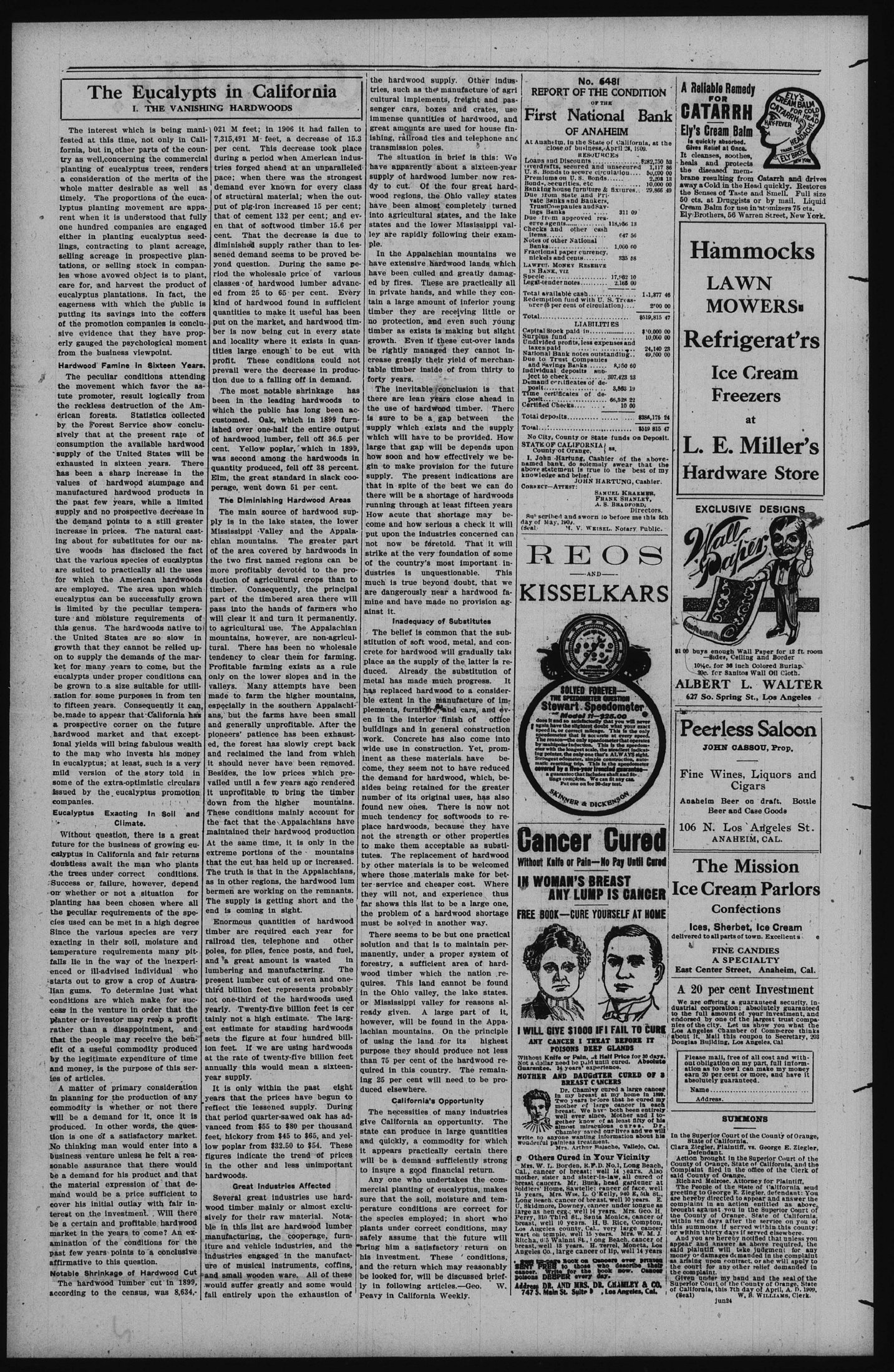
Searchable text
The Eucalyptus in California
I. THE VANISHING HARDWOODS
The interest which is being manifested at this time, not only in California, but in other parts of the country as well, concerning the commercial planting of eucalyptus trees, renders a consideration of the merits of the whole matter desirable as well as timely. The proportions of the eucalyptus planting movement are apparent when it is understood that fully one hundred companies are engaged either in planting eucalyptus seedlings, contracting to plant acreage, selling acreage in prospective plantations, or selling stock in companies whose avowed object is to plant, care for, and harvest the product of eucalyptus plantations. In fact, the eagerness with which the public is putting its savings into the coffers of the promotion companies is conclusive evidence that they have properly gauged the psychological moment from the business viewpoint.
Hardwood Famine in Sixteen Years.
The peculiar conditions attending the movement which favor the astute promoter, result logically from the reckless destruction of the American forests. Statistics collected by the Forest Service show conclusively that at the present rate of consumption the available hardwood supply of the United States will be exhausted in sixteen years. There has been a sharp increase in the values of hardwood stumpage and manufactured hardwood products in the past few years, while a limited supply and no prospective decrease in 021 M feet; in 1906 it had failed 7,315,491 M-feet, a decrease per cent. This decrease took place during a period when American tries forged ahead at an unpace; when there was the steady demand ever known for every class of structural material; when the put of pig-iron increased 15 percent that of cement 132 per cent; and en that of softwood timber 12 percent. That the decrease is diminished supply rather than seized demand seems to be beyond question. During the said riod the wholesale price of classes of hardwood lumber ed from 25 to 65 per cent. Kind of hardwood found in such quantities to make it useful had put on the market, and hardwood ber is now being cut in every and locality where it exists in titles large enough to be cut profit. These conditions could prevail were the decrease in价 tion due to a falling off in dem.
The most notable shrinkage been in the leading hardwood which the public has long been customed. Oak, which in 1899 ished over one-half the entire of hardwood lumber, fell off 30 per cent. Yellow poplar, which in was second among the hardwood quantity produced, fell off 38 per Elm, the great standard in slack perage, went down 51 per cent.
The Diminishing Hardwood A
the reckless destruction of the American forests. Statistics collected by the Forest Service show conclusively that at the present rate of consumption the available hardwood supply of the United States will be exhausted in sixteen years. There has been a sharp increase in the values of hardwood stumpage and manufactured hardwood products in the past few years, while a limited supply and no prospective decrease in the demand points to a still greater increase in prices. The natural casting about for substitutes for our native woods has disclosed the fact that the various species of eucalyptus are suited to practically all the uses for which the American hardwoods are employed. The area upon which eucalyptus can be successfully grown is limited by the peculiar temperature and moisture requirements of this genus. The hardwoods native to the United States are so slow in growth that they cannot be relied upon to supply the demands of the market for many years to come, but the eucalypts under proper conditions can be grown to a size suitable for utilization for some purposes in from ten to fifteen years. Consequently it can be made to appear that California has a prospective corner on the future hardwood market and that exceptional yields will bring fabulous wealth to the man who invests his money in eucalyptus; at least, such is a very mild version of the story told in some of the extra-optimistic circulars issued by the eucalyptus promotion companies.
Eucalyptus Exacting In Soil and Climate.
Without question, there is a great future for the business of growing eucalyptus in California and fair returns doubtless await the man who plants the trees under correct conditions. Success or failure, however, depend on whether or not a situation for planting has been chosen where all the peculiar requirements of the species used can be met in a high degree. Since the various species are very exacting in their soil, moisture and temperature requirements many pitfalls lie in the way of the inexperienced individual who
which the public has long been customed. Oak, which in 1895 ished over one-half the entire quantity produced, fell off 36 percent. Yellow poplar, which in was second among the hardwood quantities produced, fell off 38 per Elm, the great standard in slack perage, went down 51 per cent.
The Diminishing Hardwood A
The main source of hardwood supply is in the lake states, the Mississippi Valley and the Appalachian mountains. The greater of the area covered by hardwood, the two first named regions can more profitably devoted to the production of agricultural crops than timber. Consequently, the primary part of the timbered area there pass into the hands of farmers will clear it and turn it permanent to agricultural use. The Appalachian mountains, however, are non-native. There has been no tendency to clear them for farm Profitable farming exists as only on the lower slopes and valleys. Many attempts have made to farm the higher mountains especially in the southern Appalachians, but the farms have been generally unprofitable. After pioneers' patience has been exiled, the forest has slowly crept and reclaimed the land from it should never have been remade. Besides, the low prices which vailed until a few years ago remain unprofitable to bring the timber down from the higher mountains.
These conditions mainly account for the fact that the Appalachians maintained their hardwood product. At the same time, it is only in extreme portions of the mountain that the cut has held up or increased. The truth is that in the Appalachias as in other regions, the hardwood bermen are working on the remnants. The supply is getting short and end is coming in sight.
Enormous quantities of hardwood timber are required each year for railroad ties, telephone and poles, for piles, fence posts, and a great amount is wasted lumbering and manufacture.
doubtless await the man who plants the trees under correct conditions. Success or failure, however, depend on whether or not a situation for planting has been chosen where all the peculiar requirements of the species used can be met in a high degree. Since the various species are very exacting in their soil, moisture and temperature requirements many pitfalls lie in the way of the inexperienced or ill-advised individual who starts out to grow a crop of Australian gums. To determine just what conditions are which make for success in the venture in order that the planter or investor may reap a profit rather than a disappointment, and that the people may receive the benefit of a useful commodity produced by the legitimate expenditure of time and money, is the purpose of this series of articles.
A matter of primary consideration in planning for the production of any commodity is whether or not there will be a demand for it, once it is produced. In other words, the question is one of a satisfactory market. No thinking man would enter into a business venture unless he felt a reasonable assurance that there would be a demand for his product and that the material expression of that demand would be a price sufficient to cover his initial outlay with fair interest on the investment. Will there be a certain and profitable hardwood market in the years to come? An examination of the conditions for the past few years points to a conclusive affirmative to this question.
Notable Shrinkage of Hardwood Cut
The hardwood lumber cut in 1899, according to the census, was 8,634,-
California Hardwoods
In 1906 it had fallen to the feet, a decrease of 15.3. This decrease took place period when American industries ahead at an unparalleled there was the strongest known for every class of material; when the outton increased 15 per cent; went 132 per cent; and evo-softwood timber 15.6 per cent. The decrease is due to supply rather than to less seems to be proved been. During the same peblesale price of various hardwood lumber advance to 65 per cent. Every hardwood found in sufficient make it useful has been market, and hardwood timber being cut in every state where it exists in quan-enough to be cut with these conditions could not the decrease in produc- falling off in demand.
Notable shrinkage has leading hardwoods to public has long been ac-Oak, which in 1899 furn-one-half the entire output lumber, fell off 36.5 per poplar, which in 1899, among the hardwoods in produced, fell off 38 percent. At standard in slack coo-down 51 per cent.
Shing Hardwood Areas source of hardwood sun-
the hardwood supply. Other industries, such as the manufacture of agricultural implements, freight and passenger cars, boxes and crates, use immense quantities of hardwood, and great amounts are used for house finishing, railroad ties and telephone and transmission poles.
The situation in brief is this: We have apparently about a sixteen-year supply of hardwood lumber now ready to cut. Of the four great hardwood regions, the Ohio valley states have been almost completely turned into agricultural states, and the lake states and the lower Mississippi valley are rapidly following their example.
In the Appalachian mountains we have extensive hardwood lands which have been culled and greatly damaged by fires. These are practically all in private hands, and while they contain a large amount of inferior young timber they are receiving little or no protection, and even such young timber as exists is making but slight growth. Even if these cut-over lands be rightly managed they cannot increase greatly their yield of merchantable timber inside of from thirty to forty years.
The inevitable conclusion is that there are lean years close ahead in the use of hardwood timber. There is sure to be a gap between the supply which exists and the supply which will have to be provided. How large that gap will be depends upon how soon and how effectively we begin to make provision for the future supply. The present indications are that in spite of the best we can do there will be a shortage of hardwood running through at least fifteen years.
No. 6481 REPORT OF THE CONFIRMATION OF THE First National OF ANAHEIM
At Anaheim, in the State of Californi- close of business, April 28,
RESOURCES
Loans and Discounts
Overdrafts, secured and unsecured
U. S. Bonds to secure circulation.
Premiums on U. S. Bonds.
Bonds, securities, etc.
Banking house furniture & fixtures
Due from State and Private Banks and Bankers,
Trust Companies and Savings Banks
Due from approved reserve agents
Checks and other cash items
Notes of other National Banks
1,000
Fractional paper currency,
nickels and cents
LAWFUL MONEY RESERVE IN BANK, VIZ
Specie
Legal tender notes
Total available cash
Redemption fund with U. S. Treasurer (5 per cent of circulation)
Total
LIABILITIES
Capital Stock paid in
Surplus fund
Undivided profits, less expenses and taxes paid
National Bank notes outstanding.
Due to Trust Companies and Savings Banks
Individual deposits subject to check
Demand certificates of deposit
Time certificates of deposit
Certified Checks
Total deposits
Total
No City, County or State funds
STATE OF CALIFORNIA
County of Orange,
I. John Hartung, Cashier of named bank, do solemnly swear above statement is true to the knowledge and belief.
JOHN HARTUNG
CORRECT—ATTEST:
SAMUEL KRIG
FRANK SHAH
A. S. BRADFORD
Public has long been Oak, which in 1899 furnished half the entire output of lumber, fell off 36.5 per cent. Poplar, which in 1899, among the hardwoods in produced, fell off 38 percent. That standard in slack coo-down 51 per cent.
Hardwood Areas
Source of hardwood supply lake states, the lower Valley and the Appalachians. The greater part covered by hardwoods in named regions can be partly devoted to the agricultural crops than to consequently, the principal timbered area there will be hands of farmers who turn it permanently. All use. The Appalachian however, are non-agricultural has been no wholesale clear them for farming. Farming exists as a rule lower slopes and in the may attempts have been in the higher mountains, the southern Appalachi-farms have been small unprofitable. After the science has been exhausted has slowly crept back the land from which ever have been removed. Low prices which pre-few years ago rendered it to bring the timber the higher mountains. Rows mainly account for the Appalachians have their hardwood production time, it is only in the tons of the mountains was held up or increased. What in the Appalachians, regions, the hardwood lum working on the remnants. Getting short and the in sight.
Quantities of hardwood acquired each year for telephone and other fence posts, and fuel, amount is wasted in manufacturing. The use of hardwood timber. There is sure to be a gap between the supply which exists and the supply which will have to be provided. How large that gap will be depends upon how soon and how effectively we begin to make provision for the future supply. The present indications are that in spite of the best we can do there will be a shortage of hardwoods running through at least fifteen years. How acute that shortage may become and how serious a check it will put upon the industries concerned can not now be foretold. That it will strike at the very foundation of some of the country's most important industries is unquestionable. This much is true beyond doubt, that we are dangerously near a hardwood famine and have made no provision against it.
Inadequacy of Substitutes
The belief is common that the substitution of soft wood, metal, and concrete for hardwood will gradually take place as the supply of the latter is reduced. Already the substitution of metal has made much progress. It has replaced hardwood to a considerable extent in the manufacture of implements, furniture, and cars, and even in the interior finish of office buildings and in general construction work. Concrete has also come into wide use in construction. Yet, prominent as these materials have become, they seem not to have reduced the demand for hardwood, which, besides being retained for the greater number of its original uses, has also found new ones. There is now not much tendency for softwoods to replace hardwoods, because they have not the strength or other properties to make them acceptable as substitutes. The replacement of hardwood by other materials is to be welcomed where those materials make for better service and cheaper cost. Where they will not, and experience thus far shows this list to be a large one, the problem of a hardwood shortage must be solved in another way.
There seems to be but one practical solution and that is to maintain permanently, under a proper system of forestry, a sufficient area of hard-
quantities of hardwood required each year for telephone and other fence posts, and fuel, amount is wasted in manufacturing. The cut of seven and one-sheet represents probably 50% of the hardwood used by five billion feet is ceramic estimate. The larger standing hardwoods at four hundred billiards are using hardwood twenty-five billion feet would mean a sixteen-inch in the past eight years prices have begun to worsen supply. During quarter-sawed oak has added 55 to $80 per thousand from $45 to $65, and yellow $32.50 to $54. These are the trend of prices and less unimportant industries Affected that industries use hard-mainly or almost exclusive raw material. Notable are hardwood lumber for the cooperage, furnace industries, and the aged in the manufactur instruments, coffins, den ware. All of these greatly and some would upon the exhaustion of by other materials is to be welcomed where those materials make for better service and cheaper cost. Where they will not, and experience thus far shows this list to be a large one, the problem of a hardwood shortage must be solved in another way.
There seems to be but one practical solution and that is to maintain permanently, under a proper system of forestry, a sufficient area of hardwood timber which the nation requires. This land cannot be found in the Ohio valley, the lake states. or Mississippi valley for reasons already given. A large part of it, however, will be found in the Appalachian mountains. On the principle of using the land for its highest purpose they should produce not less than 75 per cent of the hardwood required in this country. The remaining 25 per cent will need to be produced elsewhere.
California's Opportunity
The necessities of many industries give California an opportunity. The state can produce in large quantities and quickly, a commodity for which it appears practically certain there will be a demand sufficiently strong to insure a good financial return.
Any one who undertakes the commercial planting of eucalyptus, makes sure that the soil, moisture and temperature conditions are correct for the species employed; in short who plants under correct conditions, may safely assume that the future will bring him a satisfactory return on his investment. These conditions, and the return which may reasonably be looked for, will be discussed briefly in following articles.—Geo. W. Peavy in California Weekly.
No. 6481
ART OF THE CONDITION
OF THE
National Bank
OF ANAHEIM
RESOURCES
Discounts ... $282,750 53
Secured and unsecured ... 1,117 86
To secure circulation ... 50,000 00
On U. S. Bonds ... 2,208 13
urities, etc ... 10,000 00
Use furniture & fixtures ... 29,866 49
State and Pritions and Bankers,
Panies and Savvors ... 311 09
Approved resests ... 118,956 13
All other cash ... 647 56
Other National ... 1,000 00
Paper currency,
and cents ... 335 58
HONEY RESERVE
VIZ ... 17,962 10
Notes ... 2,165 00
Table cash ... 1,1,377 46
Fund with U. S. Treascent of circulation) ... 2,000 00
$519,815 47
LIABILITIES
Bank paid in ... $70,000 00
Bond ... 10,000 00
Profits, less expenses and ...
Bank notes outstanding ... 49,500 00
Just Companies
Banks ... 8,350 60
Deposits subock ... 307,423 23
Certificates of decisions of decisions of deseeks ... 10,000
Itts ... $386,175 24
$519,815 47
County or State funds on Deposit.
CALIFORNIA
of Orange.
Martung, Cashier of the abovek, do solemnly swear that the
ment is true to the best of my
and belief.
JOHN HARTUNG, Cashier.
TEST:
SAMUEL KRAEMER,
FRANK SHANLEY,
A. S. BRADFORD;
Directors.
A Reliable Remedy
FOR
CATARRH
Ely's Cream Balm
Is quickly absorbed.
Gives Relief at Once.
It cleanses, soothes,
heals and protects
the diseased membrane resulting from Catarrh and drives away a Cold in the Head quickly. Restores the Senses of Taste and Smell. Full size 50 cts. at Druggists or by mail. Liquid Cream Balm for use in atomizers 75 cts.
Ely Brothers, 56 Warren Street, New York.
Hammocks
LAWN
MOWERS:
Refrigerat'rs
Ice Cream
Freezers
at
L. E. Miller's
Hardware Store
EXCLUSIVE DESIGNS
at
L. E. Miller's
Hardware Store
EXCLUSIVE DESIGNS
$1 00 buys enough Wall Paper for 12 ft. room
—Sides, Ceiling and Border
10¼c. for 36 inch Colored Burlap.
20c. for Sanitos Wall Oil Cloth.
ALBERT L. WALTER
627 So. Spring St., Los Angeles
Peerless Saloon
JOHN CASSOU, Prop.
Fine Wines, Liquors and
Cigars
Anaheim Beer on draft. Bottle
Beer and Case Goods
106 N. Los Angeles St.
ANAHEIM, CAL.
The Mission
Ice Cream Parlors
Confections
Ices, Sherbet, Ice Cream
delivered to all parts of town. Excellent s
FINE CANDIES
A SPECIALTY
The Mission Ice Cream Parlors
Confections
Ices, Sherbet, Ice Cream
delivered to all parts of town. Excellent service.
FINE CANDIES
A SPECIALTY
East Center Street, Anaheim, Cal.
A 20 per cent Investment
We are offering a guaranteed security, industrial corporation; absolutely guaranteed to the full amount of your investment, and endorsed by one of the largest trust companies of the city. Let us show you what the Los Angeles Chamber of Commerce thinks about it. Mail this coupon to Secretary, 203 Douglas Building, Los Angeles, Cal.
Please mail, free of all cost and without obligation on my part, full information as to how I can make my money earn 20 per cent or more, and have it absolutely guaranteed.
Name..... Address.
SUMMONS
In the Superior Court of the County of Orange,
State of California.
Clara Ziegler, Plaintiff, vs. George E. Ziegler,
Defendant.
Action brought in the Superior Court of the County of Orange, State of California, and the Complaint filed in the office of the Clerk of said County of Orange.
Richard Melrose, Attorney for Plaintiff.
The People of the State of California send greeting to George E. Ziegler, defendant: You are hereby directed to appear and answer the complaint in an action entitled as above, brought against you in the Superior Court of the County of Orange. State of California, within ten days after the service on you of this summons if served within this county; or within thirty days if served elsewhere.
And you are hereby notified that unless you appear and answer as above required, the said plaintiff will take judgment for any money or damages demanded in the complaint as arising upon contract, or she will apply to the court for any other relief demanded in the complaint.
Given under my hand and the seal of the Superior Court of the County of Orange, State of California, this 7th day of April, A. D. 1909.
(Seal)
W. B. WILLIAMS, Clerk.
jun24