anaheim-gazette 1909-03-25
Scanned page
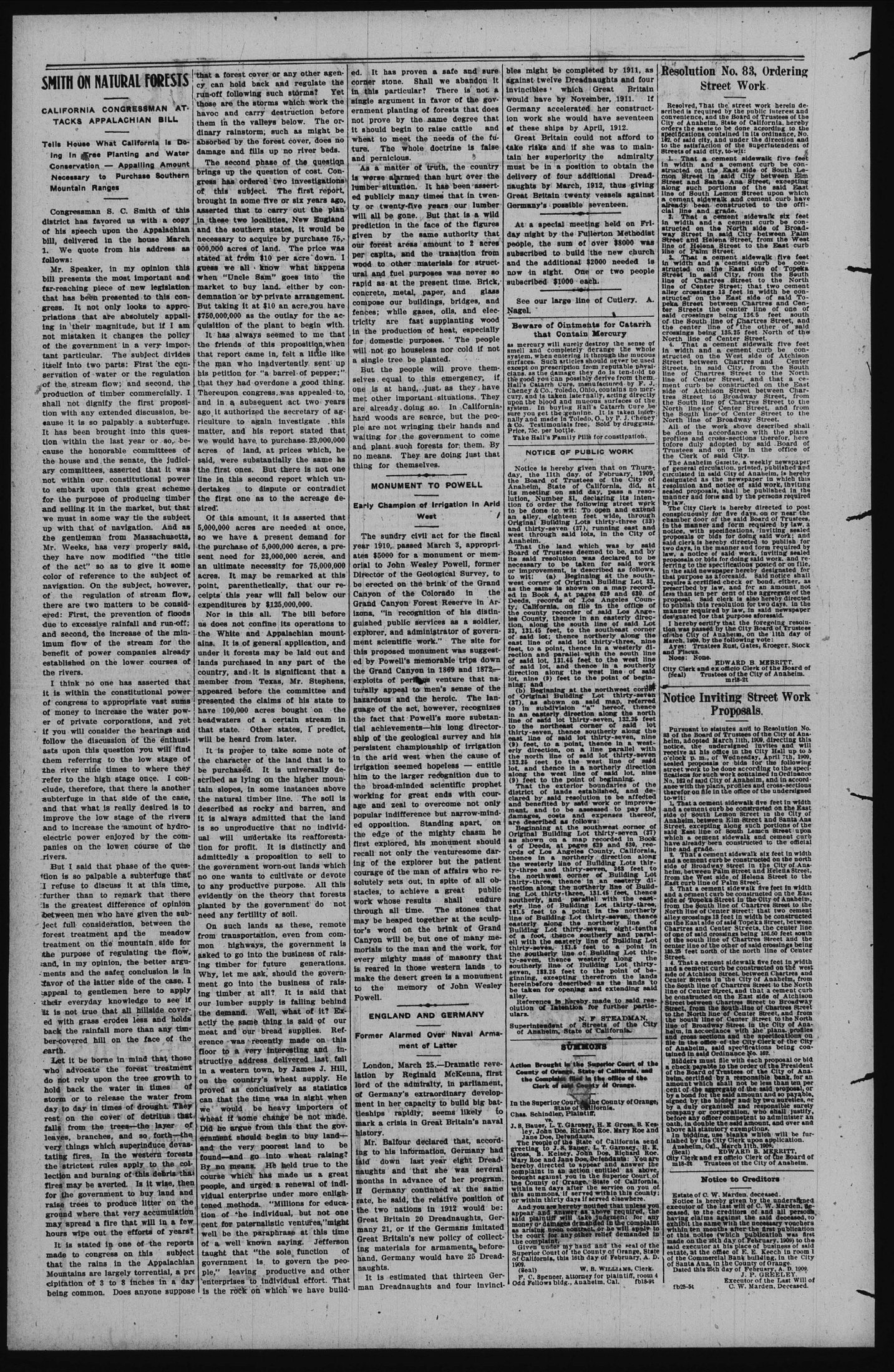
Searchable text
SMITH ON NATURAL FORESTS
CALIFORNIA CONGRESSMAN ATTACKS APPALACHIAN BILL
Tells House What California is Doing in Tree Planting and Water Conservation — Appalling Amount Necessary to Purchase Southern Mountain Ranges
Congressman S. C. Smith of this district has favored us with a copy of his speech upon the Appalachian bill, delivered in the house March 1. We quote from his address as follows:
Mr. Speaker, in my opinion this bill presents the most important and far-reaching piece of new legislation that has been presented to this congress. It not only looks to appropriations that are absolutely appalling in their magnitude, but if I am not mistaken it changes the policy of the government in a very important particular. The subject divides itself into two parts: First the conservation of water or the regulation of the stream flow; and second, the production of timber commercially. I shall not dignify the first proposition with any extended discussion, because it is so palpably a subterfuge. It has been brought into this question within the last year or so, because the honorable committees of the house and the senate, the judiciary committees, asserted that it was not within our constitutional power to embark upon this great scheme for the purpose of producing timber and selling it in the market, but that a forest cover or any other agency can hold back and regulate the run-off following such storms? Those are the storms which work to havoc and carry destruction before them in the valleys below. The diary rainstorm; such as might absorb by the forest cover, does damage and fills up no river bed.
The second phase of the question brings up the question of cost. Congress has ordered two investigations of this subject. The first report brought in some five or six years ago asserted that to carry out the plan in these two localities, New England and the southern states, it would be necessary to acquire by purchase 700,000 acres of land. The price we stated at from $10 per acre downward guess we all know what happens when "Uncle Sam" goes into the market to buy land. either by demnation or by private arrangement. But taking it at $10 an acre, you have $750,000,000 as the outlay for the acquisition of the plant to begin when it has always seemed to me that the friends of this proposition, who that report came in, felt a little loss the man who inadvertently sent his petition for "a barrel of pepper that they had overdone a good thing." Thereupon congress, was appealed and in a subsequent act two years ago it authorized the secretary of agriculture to again investigate the matter, and his report stated that we would have to purchase 23,000 acres of land, at prices which, said, were substantially the same as the first ones. But there is not one line in this second report which dertakes to dispute or contradicts the first one as to the acreage acquired.
shall not dignify the first proposition with any extended discussion, because it is so palpably a subterfuge.
It has been brought into this question within the last year or so, because the honorable committees of the house and the senate, the judiciary committees, asserted that it was not within our constitutional power to embark upon this great scheme for the purpose of producing timber and selling it in the market, but that we must in some way tie the subject up with that of navigation. And as the gentleman from Massachusetts, Mr. Weeks, has very properly said, they have now modified "the title of the act" so as to give it some color of reference to the subject of navigation. On the subject, however, of the regulation of stream flow, there are two matters to be considered: First, the prevention of floods due to excessive rainfall and run-off; and second, the increase of the minimum flow of the stream for the benefit of power companies already established on the lower courses of the rivers.
I think no one has asserted that it is within the constitutional power of congress to appropriate vast sums of money to increase the water power of private corporations, and yet if you will consider the hearings and follow the discussion of the enthusiasts upon this question you will find them referring to the low stage of the river nine times to where they refer to the high stage once. I conclude, therefore, that there is another subterfuge in that side of the case, and that what is really desired is to improve the low stage of the rivers and to increase the amount of hydroelectric power enjoyed by the companies on the lower course of the rivers.
But I said that phase of the question is so palpable a subterfuge that I refuse to discuss it at this time, further than to remark that there is the greatest difference of opinion between men who have given the subject full consideration, between the forest treatment and the meadow treatment on the mountain side for the purpose of regulating the flow, and, in my opinion, the better argument with any extended discussion, because it is so palpably a subterfuge.
It has been brought into this question within the last year or so, because the honorable committees of the house and the senate, the judiciary committees, asserted that it was not within our constitutional power to embark upon this great scheme for the purpose of producing timber and selling it in the market, but that we must in some way tie the subject up with that of navigation. And as the gentleman from Massachusetts, Mr. Weeks, has very properly said, they have now modified "the title of the act" so as to give it some color of reference to the subject of navigation. On the subject, however, of the regulation of stream flow, there are two matters to be considered: First, the prevention of floods due to excessive rainfall and run-off; and second, the increase of the minimum flow of the stream for the benefit of power companies already established on the lower courses of the rivers.
I think no one has asserted that it is within the constitutional power of congress to appropriate vast sums of money to increase the water power of private corporations, and yet if you will consider the hearings and follow the discussion of the enthusiasts upon this question you will find them referring to the low stage of the river nine times to where they refer to the high stage once. I conclude, therefore, that there is another subterfuge in that side of the case, and that what is really desired is to improve the low stage of the rivers and to increase the amount of hydroelectric power enjoyed by the companies on the lower course of the rivers.
But I said that phase of the question is so palpable a subterfuge that I refuse to discuss it at this time, further than to remark that there is the greatest difference of opinion between men who have given the subject full consideration, between the forest treatment and the meadow treatment on the mountain side for the purpose of regulating the flow, and, in my opinion, the better argument with any extended discussion, because it is so palpably a subterfuge.
It has been brought into this question within the last year or so, because the honorable committees of the house and the senate, the judiciary committees, asserted that it was not within our constitutional power to embark upon this great scheme for the purpose of producing timber and selling it in the market, but that we must in some way tie the subject up with that of navigation. And as the gentleman from Massachusetts, Mr. Weeks, has very properly said, they have now modified "the title of the act" so as to give it some color of reference to the subject of navigation. On the subject, however, of the regulation of stream flow, there are two matters to be considered: First, the prevention of floods due to excessive rainfall and run-off; and second, the increase of the minimum flow of the stream for the benefit of power companies already established on the lower courses of the rivers.
I think no one has asserted that it is within the constitutional power of congress to appropriate vast sums of money to increase the water power of private corporations, and yet if you will consider the hearings and follow the discussion of the enthusiasts upon this question you will find them referring to the low stage of the river nine times to where they refer to the high stage once. I conclude, therefore, that there is another subterfuge in that side of the case, and that what is really desired is to improve the low stage of the rivers and to increase the amount of hydroelectric power enjoyed by the companies on the lower course of the rivers.
But I said that phase of the question is so palpable a subterfuge that I refuse to discuss it at this time, further than to remark that there is the greatest difference of opinion between men who have given the subject full consideration, between the forest treatment and meadow treatment on the mountain side for the purpose of regulating the flow, and in my opinion, the better argument with any extended discussion, because it is so palpably a subterfuge.
It has been brought into this question within the last year or so, because the honorable committees of the house and the senate, the judiciary committees, asserted that it was not within our constitutional power to embark upon this great scheme for the purpose of producing timber and selling it in the market, but that we must in some way tie the subject up with that of navigation. And as the gentleman from Massachusetts, Mr. Weeks, has very properly said, they have now modified "the title of the act" so as to give it some color of reference to the subject of navigation. On the subject, however, of the regulation of stream flow, there are two matters to be considered: First, the prevention of floods due to excessive rainfall and run-off; and second, the increase of the minimum flow of the stream for the benefit of power companies already established on the lower courses of the rivers.
I think no one has asserted that it is within the constitutional power of congress to appropriate vast sums of money to increasethe water powerof private corporations,and yet if you will considerthe hearingsandfollowthediscussionoftheenthusiastsuponthisquestionyouwillfindthemreferringtothelowstageoftheriverninetimestowheretheyrefertothehighstageonce.Iconclude,theforethereathereisanothersubterfugelinthatsideofthecase,andthatwhatisreallydesiredistotimprovethelowstageoftheriversandtoincreasetheamountofhydroelectricpowerenjoyedbythecompaniesonthelowercourseoftherivers.
But I said that phase ofthequestionissopalpableasubterfugelthatIrefusetoconsiderthetreatmentonthemountainsideforthepurposeofregulatingtheflow,andinyopinion,thebetterargumentwithanyextendeddiscussion,becauseitissopalpablyasubterfugelthatIrefusetoconsiderthetreatmentonthemountainsideforthepurposeofregulatingtheflow,andinyopinion,thebetterargumentwithanyextendeddiscussion,becauseitissopalpiblyasubterfugelthatIrefusetoconsiderthetreatmentonthemountainsideforthepurposeofregulatingtheflow,andinyopinion,thebetterargumentwithanyextendeddiscussion,becauseitissopalpiblyasubterfugelthatIrefusetoconsiderthetreatmentonthemountainsideforthepurposeofregulatingtheflow,andinyopinion,thebetterargumentwithanyextendeddiscussion,becauseitissopalpiblyasubterfugelthatIrefusetoconsiderthetreatmentonthemountainsideforthepurposeofregulatingtheflow,andinyopinion,thebetterargumentwithanyextendeddiscussion,becauseitissopalpiblyasubterfugelthatIrefusetoconsiderthetreatmentonthemountainsideforthepurposeofregulatingtheflow,andinyopinion,thebetterargumentwithanyextendeddiscussion,becauseitissopalpiblyasubterfugelthatIrefusetoconsiderthetreatmentonthemountainsideforthepurposeofregulatingtheflow,andinyopinion,thebetterargumentwithanyextendeddiscussion,becauseitissopalpiblyasubterfugelthatIrefusetoconsiderthetreatmentonthemountainsideforthepurposeofregulatingtheflow,andinyopinion,thebetterargumentwithanyextendeddiscussion,becauseitissopalpiblyasubterfugelthatIrefusetoconsiderthetreatmentonthemountainsideforthepurposeofregulatingtheflow,andinyopinion,thebetterargumentwithanyextendeddiscussion,becauseitissopalpiblyasubterfugelthatIrefusetoconsiderthetreatmentonthemountainsideforthepurposeofregulatingtheflow,andinyopinion,thebetterargumentwithanyextendeddiscussion,becauseitissopalpiblyasubterfugelthatIrefusetoconsiderthetreatmentonthemountainsideforthepurposeofregulatingtheflow,andinyopinion,thebetterargumentwithanyextendeddiscussion,becauseitissopalpiblyasubterfugelthatIrefusetoconsiderthetreatmentonthemountainsideforthepurposeofregulatingtheflow,andinyopinion,thebetterargumentwithanyextendeddiscussion,becauseitissopalpiblyasubterfugelthatIrefusetoconsiderthetreatmentonthemountainsideforthepurposeofregulatingtheflow,andinyopinion,thebetterargumentwithanyextendeddiscussion,becauseitissopalpiblyasubterfugelthatIrefusetoconsiderthetreatmentonthemountainsideforthepurposeofregulatingtheflow,andinyopinion,thebetterargumentwithanyextendeddiscussion,becauseitissopalpiblyasubterfugelthatIrefusetoconsiderthetreatmentonthemountainsideforthepurposeofregulatingtheflow,andinyopinion,thebetterargumentwithanyextendeddiscussion,becauseitissopalpiblyasubterfugelthatIrefusetoconsiderthetreatmentonthemountainsideforthepurposeofregulatingtheflow,andinyopinion,thebetterargumentwithanyextendeddiscussion,becauseitissopalpiblyasubterfugelthatIrefusetoconsiderthetreatmentonthemountainsideforthepurposeofregulatingtheflow,andinyopinion,thebetterargumentwithanyextendeddiscussion,becauseitissopalpiblyasubterfugelthatIrefusetoconsiderthetreatmentonthemountainsideforthepurposeofregulatingtheflow,andinyopinion,thebetterargumentwithanyextendeddiscussion,becauseitissopalpiblyasubterfugelthatIrefusetoconsiderthetreatmentonthemountainsideforthepurposeofregulatingtheflow,andinyopinion,thebetterargumentwithanyextendeddiscussion,becauseitissopalpiblyasubterfugelthatIrefusetoconsiderthetreatmentonthemountainsideforthepurposeofregulatingtheflow,andinyopinion,thebetterargumentwithanyextendeddiscussion,becauseitissopalpiblyasubterfugelthatIrefusetoconsiderthetreatmentonthemountainsideforthepurposeofregulatingtheflow,andinyopinion,thebetterargumentwithanyextendeddiscussion,becauseitissopalpiblyasubterfugelthatIrefusetoconsiderthetreatmentonthemountainsideforthepurposeofregulatingtheflow,andinyopinion,thebetterargumentwithanyextendeddiscussion,becauseitissopalpiblyasubterfugelthatIrefusetoconsiderthetreatmentonthemountainsideforthepurposeofregulatingtheflow,andinyopinion,thebetterargumentwithanyextendeddiscussion,becauseitissopalpiblyasubterfugelthatIrefusetoconsiderthetreatmentonthemountainsideforthepurposeofregulatingtheflow,andinyopinion,thebetterargumentwithanyextendeddiscussion,becauseitissopalpiblyasubterfugelthatIrefusetoconsiderthetreatmentonthemountainsideforthepurposeofregulatingtheflow,andinyopinion,thebetterargumentwithanyextendeddiscussion,becauseitissopalpiblyasubterfugelthatIrefusetoconsiderthetreatmentonthemountainsideforthepurposeofregulatingtheflow,andinyopinion,thebetterargumentwithanyextendeddiscussion,becauseitissopalpiblyasubterfugelthatIrefusetoconsiderthetreatmentonthemountainsideforthepurposeofregulatingtheflow,andinyopinion,thebetterargumentwithanyextendeddiscussion,becauseitissopalpiblyasubTERFUGELATTHELOWSTAGE OF THE RIVER NINE TIMES TO WHERE THE REFERENCE IS UPON THE LOWSTAGE OF THE RIVER NINE TIMES TO WHERE THE REFERENCE IS UPON THE LOWSTAGE OF THE RIVER NINE TIMES TO WHERE THE REFERENCE IS UPON THE LOWSTAGE OF THE RIVER NINE TIMES TO WHERE THE REFERENCE IS UPON THE LOWSTAGE OF THE RIVER NINE TIMES TO WHERE THE REFERENCE IS UPON THE LOWSTAGE OF THE RIVER NINE TIMES TO WHERE THE REFERENCE IS UPON THE LOWSTAGE OF THE RIVER NINE TIMES TO WHERE THE REFERENCE IS UPON THE LOWSTAGE OF THE RIVER NINE TIMES TO WHERE THE REFERENCE IS UPON THE LOWSTAGE OF THE RIVER NINE TIMES TO WHERE THE REFERENCE IS UPON THE LOWSTAGE OF THE RIVER NINE TIMES TO WHERE THE REFERENCE IS UPON THE LOWSTAGE OF THE RIVER NINE TIMES TO WHERE THE REFERENCE IS UPON THE LOWSTAGE OF THE RIVER NINE TIMES TO WHERE THE REFERENCE IS UPON THE LOWSTAGE OF THE RIVER NINE TIMES TO WHERE THE REFERENCE IS UPON THE LOWSTAGE OF THE RIVER NINE TIMES TO WHERE THE REFERENCE IS UPON THE LOWSTAGE OF THE RIVER NINE TIMES TO WHERE THE REFERENCE IS UPON THE LOWSTAGE OF THE RIVER NINE TIMES TO WHERE THE REFERENCE IS UPON THE LOWSTAGE OF THE RIVER NINE TIMES TO WHERE THE REFERENCE IS UPON THE LOWSTAGE OF THE RIVER NINE TIMES TO WHERE THE REFERENCE IS UPON THE LOWSTAGE OF THE RIVER NINE TIMES TO WHERE The REFERENCE IS UPON THE LOWSTAGE OF THE RIVER NINE TIMES TO WHERE The REFERENCE IS UPON THE LOWSTAGE OF THE RIVER NINE TIMES TO WHERE The REFERENCE IS UPON THE LOWSTAGE OF THE RIVER NINE TIMES TO WHERE The REFERENCE IS UPON THE LOWSTAGE OF THE RIVER NINE TIMES TO WHERE The REFERENCE IS UPON THE LOWSTAGE OF THE RIVER NINE TIMES TO WHERE The REFERENCE IS UPON THE LOWSTAGE OF THE RIVER NINE TIMES TO WHERE The REFERENCE IS UPON THE LOWSTAGE OF THE RIVER NINE TIMES TO WHERE The REFERENCE IS UPON THE LOWSTAGE OF THE RIVER NINE TIMES TO WHERE The REFERENCE IS UPONThe LOWSTAGE OF THE RIVER NINE TIMES TO WHERE The REFERENCE IS UPONThe LOWSTAGE OF The RIVER NINE TIMES TO WHERE The REFERENCE IS UP ONThe LOWSTAGE OF The RIVER NINE TIMES TO WHERE The REFERENCE IS UP ONThe LOWSTAGE OF The RIVER NINE TIMES TO WHERE The REFFERENCY IS UP ONThe LOWSTAGE OF The RIVER NINE TIMES TO WHERE The REFFERENCY IS UP ONThe LOWSTAGE OF The RIVER NINE TIMES TO WHERE The REFFERENCY IS UP ONThe LOWSTAGE OF The RIVER NINE TIMES TO WHERE The REFFERENCY IS UP ONThe LOWSTAGE OF The RIVER NINE TIMES TO WHERE The REFFERENCY IS UP ONThe LOWSTAGE OF The RIVER NINE TIMES TO WHERE The REFFERENCY IS UP ONThe LOWSTAGE OF The RIVER NINE TIMES TO WHERE The REFFERENCY IS UP ONThe LOWSTAGE OF The RIVER NINE TIMES TO WHERE The REFFERENCY IS UP ONThe LOWSTAGE OF The RIVER NINE TIMES TO WHERE The REFFERENCY IS UP ONThe LOWSTAGE OF The RIVER NINE TIMES TO WHERE The REFFERENCY IS UP ONThe LOWSTAGE OF The RIVER NINE TIMES TO WHERE The REFFERENCY IS UP ONThe LOWSTAGE OfThe RIVER NINE TIMES TO WHERE The REFFERENCY Is Up ONThe LOWSTAGE OfThe RIVER NINE TIMES To Where The REFFERENCY Is Up ONThe LOWSTAGE OfThe RIVER NINE TIMES To Where The REFFERENCY Is Up ONThe LLOWSTAGE OfThe RIVER NINE TIMES To Where The REFFERENCY Is Up ONThe LLOWSTAGE OfThe RIVER NINE TIMES To Where The REFFERENCY Is Up ONThe LLOWSTAGE OfThe RIVER NINE TIMES To Where The REFFERENCY Is Up ONThe LLOWSTAGE OfThe RIVER NINE TIMES To Where The REFFERENCY Is Up ONThe LLOWSTAGE OfThe RIVER NINE TIMES To Where The REFFERENCY Is Up ONThe LLOWSTAGE OfThe RIVER NINE TIMES To Where The REFFERENCY Is Up ONThe LLOWSTAGE OfThe RIVER NINE TIMES To Where The REFFERENCY Is Up ONThe LLOWSTAGE OfThe RIOURNINESS TIME TO WHEN IT WAS USED FOR BUSINESS OR INDUSTRY
On such lands as these, remain from transportation even from common highways; he government worn-out lands which no one wants to cultivate or devote any productive purpose. All they evidently on-the-ground or certain streams planted by government do need any fertility or soil.
On such lands as these, remain from transportation even from common highways; he government worn-out lands which no one wants to cultivate or devote any productive purpose. All they evidently on-the-ground or certain streams planted by government do need any fertility or soil.
On such lands as these, remain from transportation even from common highways; he government worn-out lands which no one wants to cultivate or devote any productive purpose. All they evidently on-the-ground or certain streams planted by government do need any fertility or soil.
On such lands as these, remain from transportation even from common highways; he government worn-out lands which no one wants to cultivate or devote any productive purpose. All they evidently on-the-ground or certain streams planted by government do need any fertility or soil.
On such lands as these,remain from transportation even from common highways; he government worn-out lands which no one wants to cultivate or devote any productive purpose. All they evidently on-the-ground or certain streams planted by government do need any fertility or soil.
On such lands as these,remain from transportation even from common highways; he government worn-out lands which no one wants to cultivate or devote any productive purpose. All they evidently on-the-ground or certain streams planted by government do need any fertility or soil.
On such lands as these,remain from transportation even from common highways; he government worn-out lands which no one wants to cultivate or devote any productive purpose. All they evidently on-the-ground or certain streams planted by government do need any fertility or soil.
On such lands as these,remain from transportation even from common highways; he government worn-out lands which no one wants to cultivate or devote any productive purpose. All they evidently on-the-ground or certain streams planted by government do need any fertility or soil.
On such lands as these,remain from transportation even from common highways; he government worn-out lands which no one wants to cultivate or devote any productive purpose. All they evidently on-the-ground or certain streams planted by government do need any fertility or soil.
On such lands as these,remain from transportation even from common highways; he government worn-out lands which no one wants to cultivate or devote any productive purpose. All they evidently on-the-ground or certain streams planted by government do need any fertility or soil.
On such lands as these,remain from transportation even from common highways; he government worn-out lands which no one wants to cultivate or devote any productive purpose. All they evidently on-the-ground or certain streams planted by government do need any fertility or soil.
On such lands as these,remain from transportation even from common highways; he government worn-out lands which no one wants to cultivate or devote any productive purpose. All they evidently on-the-ground or certain streams planted by government do need any fertility or soil.
On such lands as these,remain from transportation even from common highways; he government worn-out lands which no one wants to cultivate or devote any productive purpose. All they evidently on-the-ground or certain streams planted by government do need any fertility or soil.
On such lands as these,remain from transportation even from common highways; he government worn-out lands which no one wants to cultivate or devote any productive purpose. All they evidently on-the-ground or certain streams planted by government do need any fertility or soil.
On such lands as these,remain from transportation even from common highways; he government worn-out lands which no one wants to cultivate or devote any productive purpose. All they evidently on-the-ground or certain streams planted by government do need any fertility or soil.
On such lands as these,remain from transportation even from common highways; he government worn-out lands which no one wants to cultivate or devote any productive purpose. All they evidently on-the-ground或 certain streams planted by government do need any fertility or soil.
On such lands as these,remain from transportation even from common highways; he government worn-out lands which no one wants to cultivate or devote any productive purpose. All they evidently on-the-ground或 certain streams planted by government do need any fertility or soil.
On such lands as these,remain从交通运输even从交通运输even从交通运输even从交通运输even从交通运输even从交通运输even从交通运输even从交通运输even从交通运输even从交通运输even从交通运输even从交通运输even从交通运输even从交通运输even从交通运输even从交通运输even从交通运输even从交通运输even从交通运输even从交通运输even从交通运输even从交通运输even从交通运输even从交通运输even从交通运输even从交通运输even从交通运输even从交通运输even从交通运输even从交通运输even从交通运输even从交通运输even从交通运输even从交通运输even从交通运输even从交通运输even从交通运输甚至从交通运输甚至从交通 transport甚至从交通 transport甚至从交通 transport甚至从交通 transport甚至从交通 transport甚至从交通 transport甚至从交通 transport甚至从交通 transport甚至从交通 transport甚至从交通 transport甚至从交通 transport甚至从交通 transport甚至从交通 transport甚至从交通 transport甚至从交通 transport甚至从交通 transport甚至从交通 transport甚至从交通 transport甚至从交通 transport甚至从交通 transport甚至从交通 transport甚至从交通 transport甚至从交通 transport甚至从交通 transport甚至以 至 从交通 transport甚至以 至 从交通 transport甚至以 至 从交通 transport甚至以 至 从交通 transport甚至以 至 从交通 transport甚至以 至 从、交通 transport甚至以 至 从、交通 Transport甚至以 至 从、交通 Transport甚至以 至 从、交通 Transport甚至以 至 从、交通 Transport甚至以 至 从、交通 Transport,甚至以 至 从、交通 Transport,甚至以 至 从、交通 Transport,甚至以 至 从、交通 Transport,甚至以 至 从、交通 Transport,甚至以 至 从、交通 Transport,甚至以 至 从、交通 Transport,甚至以 至 从、交通 Transport,甚至以 至 从、交通 Transport,甚至以 至 从、交通 Transport,甚至以 至 从、交通 Transport,甚至以 至 从、交通 Transport,甚至以 至 从、交通 Transport,甚至以 至 从、交通 Transport,甚至以 至 从、交通 Transport,甚至 以 至 从、交通 Transport,甚至以 至 从、交通 Transport,甚至以 至 从、交通 Transport,甚至以 至 从、交通 Transport,甚至以 至 From、交通 Transport,甚至以 至 From、交通 Transport,甚至以 至 From、交通 Transport,甚至以 至 From、交通 Transport,甚至以 至 From、交通 Transport,甚至以 至 From、交通 Transport,甚至以 至 From、交通 Transport,甚至以 至 From、交通 Transport,甚至以 至 From、交通 Transport,甚至以 至 From、交通 Transport,甚至以 至 From、交通安全Transport,甚至以 至 From、交通安全Transport,甚至以 至 From、交通安全Transport,甚至以 至 From、交通安全Transport,甚至以 至 From、交通安全Transport,甚至以 至 From、交通安全Transport,甚至以 至 From、交通安全Transport,甚至以 至 From、交通安全Transport,甚至以 至 From、交通安全Transport,甚至以 至 From、交通安全Transport,甚至以 至 From、交通安全Transport,甚至以 至 From、交通安全Transport,甚至以 至 From、交通安全Transport,
在某些情况下,从公共道路上行驶时,应遵守各项规定,以确保安全和畅通。
在某些情况下,从公共道路上行驶时,应遵守各项规定,以确保安全和畅通。
在某些情况下,从公共道路上行驶时,应遵守各项规定,以确保安全和畅通。
在某些情况下,从公共道路上行驶时,应遵守各项规定,以确保安全和畅通。
在某些情况下,从公共道路上行驶时,应遵守各项规定,以确保安全和畅通。
在某些情况下,从公共道路上行驶时,应遵守各项规定,以确保安全和畅通。
在某些情况下,从公共道路上行驶时,应遵守各项规定,以确保安全和畅通。
在某些情况下,从公共道路上行驶时,应遵守各项规定,以确保安全和畅通。
在某些情况下,从公共道路上行驶时,应遵守各项规定,以确保安全和畅通。
在某些情况下,从公共道路上行驶时,应遵守各项规定,以确保安全和畅通。
在某些情况下,从公共道路上行驶时,应遵守各项规定,以确保安全和畅通。
在某些情况下,从公共道路上行驶时,应
But I said that phase of the question is so palpable a subterfuge that I refuse to discuss it at this time, further than to remark that there is the greatest difference of opinion between men who have given the subject full consideration, between the forest treatment and the meadow treatment on the mountain side for the purpose of regulating the flow, and, in my opinion, the better arguments and the safer conclusion is in favor of the latter side of the case. I appeal to gentlemen here to apply their everyday knowledge to see if it is not true that all hillside covered with grass erodes less and holds back the rainfall more than any timber-covered hill on the face of the earth.
Let it be borne in mind that those who advocate the forest treatment do not rely upon the tree growth to hold back the water in times of storm or to release the water from day to day in times of drought. They rest on the cover of detritus that falls from the trees—the layer of leaves, branches, and so forth—the very things which superinduce devastating fires. In the western forests the strictest rules apply to the collection and burning of this debris that fires may be averted. Is it wise, then for the government to buy land and raise trees to produce litter on the ground where that very accumulation may spread a fire that will in a few hours wipe out the efforts of years?
It is stated in one of the reports made to congress on this subject that the rains in the Appalachian Mountains are largely torrential, a precipitation of 3 to 8 inches in a day being common. Does anyone suppose
the government worn-out lands which no one wants to cultivate or develop to any productive purpose. All they evidently on the theory that forests planted by the government do need any fertility of soil.
On such lands as these, remain from transportation, even from common highways, the government asked to go into the business of raising timber for future generation. Why, let me ask, should the government go into the business of raising timber at all? It is said that our lumber supply is falling behind the demand. Well, what of it? Actually the same thing is said of meat and our bread supplies. Herence was recently made on the floor to a very interesting and constructive address delivered last year in a western town, by James J. H. on the country's wheat supply. Proved as conclusively as statistics can that the time was in sight when we would be heavy importers of wheat if some change be not made. Did he argue from this that the government should begin to buy land and the very poorest land to found—and go into wheat raisht By no means. He held true to course which has made us a great people, and urged a renewal of individual enterprise under more enhanced methods. "Millions for education of 'he individual, but not percent for paternalistic ventures,'" well be the paraphrase at this time of a well known saying. Jefferson taught that "the sole function of government is to govern the people," leaving productive and other enterprises to individual effort. This is the rock on which we have been
or any other agenrick and regulate the
such storms? Yet
forms which work the
destruction before
leys below. The orsuch as might be
forest cover, does no
up no river beds.
case of the question
question of cost. Cond two investigations
at. The first report,
five or six years ago,
carry out the plan
qualities, New England
in states, it would be
require by purchase 75,
Island. The price was
$10 per acre down. I
know what happens
"um" goes into the
Island. either by conprivate arrangement.
$10 an acre, you have
the outlay for the acplant to begin with.
seemed to me that
this proposition, when
he in, felt a little like
advertently sent up
a barrel of pepper;"
overdone a good thing.
press, was appealed to,
sequent act two years
and the secretary of again investigate this
report stated that
to purchase 23,000,000
at prices which, he
essentially the same as
But there is not one
cond report which undispute or contradict
to the acreage de-
ed. It has proven a safe and sure corner stone. Shall we abandon it in this particular? There is not a single argument in favor of the government planting of forests that does not prove by the same degree that it should begin to raise cattle and wheat to meet the needs of the future. The whole doctrine is false and pernicious.
As a matter of truth, the country is worse alarmed than hurt over the lumber situation. It has been asserted publicly many times that in twenty or twenty-five years our lumber will all be gone. But that is a wild prediction in the face of the figures given by the same authority that our forest areas amount to 2 acres per capita, and the transition from wood to other materials for structural and fuel purposes was never so rapid as at the present time. Brick, concrete, metal, paper, and glass compose our buildings, bridges, and fences; while gases, oils, and electricity are fast supplanting wood in the production of heat, especially for domestic purposes. The people will not go houseless nor cold if not a single tree be planted.
But the people will prove themselves equal to this emergency, if one is at hand, just as they have met other important situations. They are already doing so. In California hard woods are scarce, but the people are not wringing their hands and waiting for the government to come and plant such forests for them. By no means. They are doing just that thing for themselves.
MONUMENT TO POWELL
Early Champion of Irrigation in Arid
blies might be completed by 1918 against twelve Dreadnaughts and invincibles' which Great Britain would have by November, 1911. Germany accelerated her conslusion work she would have seven of these ships by April, 1912.
Great Britain could not afford take risks and if she was to retain her superiority the adminmust be in a position to obtain delivery of four additional naughts by March, 1912, thus Great Britain twenty vessels and Germany's possible seventeen.
At a special meeting held on day night by the Fullerton Metpeople, the sum of over $8000 subscribed to build the new cottage and the additional $2000 needed now in sight. One or two subscribed $1000 each.
See our large line of Cutlery Nagel.
Beware of Ointments for Catathat Contain Mercury
as mercury will surely destroy the sea smell and completely derange the system, when entering it through the surfaces. Such articles should never except on prescription from reputable clans. as the damage they do is tenthe good you can possibly derive from Hall's Catarrh Cure, manufactured by Cheney & Co., Toledo, Ohio, contains no cury, and is taken internally, acting upon the blood and mucous surfaces system. In buying Hall's Catarrh Cure you get the genuine. It is taken nally and made in Toledo, O., by F. J. & Co. Testimonials free. Sold by druPrice, 75c. per bottle.
Take Hall's Family Pills for constipa-
NOTICE OF PUBLIC WORK
Notice is hereby given that on Tuesday, the 11th day of February, the Board of Trustees of the Onaheim, State of California, did its meeting on said day, pass a lution, Number 81, declaring its intention to order the following street to be done to wit: To open and
MONUMENT TO POWELL
Early Champion of Irrigation in Arid West
The sundry civil act for the fiscal year 1910, passed March 3, appropriates $5000 for a monument or memorial to John Wesley Powell, former Director of the Geological Survey, to be erected on the brink of the Grand Canyon of the Colorado in the Grand Canyon Forest Reserve in Arizona, "in recognition of his distinguished public services as a soldier, explorer, and administrator of government scientific work." The site for this proposed monument was suggested by Powell's memorable trips down the Grand Canyon in 1869 and 1872—exploits of perilous venture that naturally appeal to men's sense of the hazardous and the heroic. The language of the act, however, recognizes the fact that Powell's more substantial achievements—his long directorship of the geological survey and his persistent championship of irrigation in the arid west when the cause of irrigation seemed hopeless — entitle him to the larger recognition due to the broad-minded scientific prophet working for great ends with courage and zeal to overcome not only popular indifference but narrow-minded opposition. Standing apart, on the edge of the mighty chasm he first explored, his monument should recall not only the venturesome daring of the explorer but the patient courage of the man of affairs who resolutely sets out, in spite of all obstacles, to achieve a great public work whose results shall endure through all time. The stones that may be heaped together at the sculptor's word on the brink of Grand Canyon will be, but one of many memorials to the man and the work, for every mighty mass of masonry that is reared in those western lands to are already doing so. In California hard woods are scarce, but the people are not wringing their hands and waiting for the government to come and plant such forests for them. By no means. They are doing just that thing for themselves.
NOTICE OF PUBLIC WORK
Notice is hereby given that on Tuesday, the 11th day of February, the Board of Trustees of the City Anaheim, State of California, does its meeting on said day, pass its lution, Number 81, declaring its intention to order the following street to be done to wit: To open and an alley, eighteen feet wide, the Original Building Lots thirty-three and thirty-seven (37), running east-west through said lots, in the City Anaheim.
That the land which was by Board of Trustees deemed to be, its said resolution was declared necessary to be taken for sale or improvement, is described as follows:
(a) Beginning at the west corner of Original Building Lots as the same is shown on a map ed in Book 4, at pages 629 and 630.
(b) Beginning at the northwest corner of Original Building Lot thirty (37), as shown on said map, re- to in subdivision "a" hereof, in an easterly direction along the line of said lot thirty-seven, 132.25 feet to the southeast corner of said lot; thence northerly along east line of said lot thirty-three feet, to a point, thence in a westerly section and parallel with the south of said lot, 131.45 feet to the west of said lot, and thence in a southerly direction along the west line of lot, nine (9) feet to the point of beginning;
(c) Beginning at the northwest corner of Original Building Lot thirty-seven as shown on a map recorded in 4 of Deeds, at pages 629 and 630.
(d)ords of Los Angeles County, Cali- thence in a northerly direction, the westerly line of Building Lot thirty-three and thirty-seven, 363 feet to the northwest corner of Building Lot thirty-three, thence in an easterly section along the northerly line of ing Lot thirty-three, 131.45 feet, southerly, and parallel with the early line of Building Lot thirty-181.5 feet to a point in the no- line of Building Lot thirty-seven, easterly along the northerly line Building Lot thirty-seven, eight of a foot, thence southerly and ell with the easterly line of Building Lot thirty-seven, 181.5 feet to a point in the southerly line of Building Lot thirty-seven, thence westerly along southerly line of Building Lot
ING of the explorer but the patient courage of the man of affairs who resolutely sets out, in spite of all obstacles, to achieve a great public work whose results shall endure through all time. The stones that may be heaped together at the sculptor's word on the brink of Grand Canyon will be but one of many memorials to the man and the work, for every mighty mass of masonry that is reared in those western lands to make the desert green is a monument to the memory of John Wesley Powell.
ENGLAND AND GERMANY
Former Alarmed Over Naval Armament of Latter
London, March 25.—Dramatic revelation by Reginald McKenna, first lord of the admiralty, in parliament, of Germany's extraordinary development in her capacity to build big battleships rapidly, seems likely to mark a crisis in Great Britain's naval history.
Mr. Balfour declared that, according to his information, Germany had laid down last year eight Dreadnaughts and that she was several months in advance of her program. If Germany continued at the same rate, he said, the relative position of the two nations in 1912 would be: Great Britain 20 Dreadnaughts, Germany 21, or if the Germans imitated Great Britain's new policy of collecting materials for armaments beforehand, Germany would have 25 Dreadnaughts.
It is estimated that thirteen German Dreadnaughts and four invinci-
the westerly line of Building Lot thirty-three and thirty-seven, 363 feet to the northwest corner of Building thirty-three, thence in an eastern section along the northerly line of ing Lot thirty-three, 131.45 feet, southerly, and parallel with the early line of Building Lot thirty-181.5 feet to a point in the no line of Building Lot thirty-seven, easterly along the northerly line of Building Lot thirty-seven, 181.5 feet to a point in the southerly line of Building Lot seventy-seven, thence westerly along southerly line of Building Lot seven, 182.25 feet to the point ginning, excepting therefrom the hereinbefore described as the law be taken for opening and extending alley.
Reference is hereby made to solution of Intention for further ulara.
N. F STEADM
Superintendent of Streets of the of Anaheim, State of California.
SUMMONS
Action Brought in the Superior Court County of Orange, State of California
the Complaint filed in the office of Clerk of said County of Orange
In the Superior Court County of California.
Chas. Schindler, Plaintiff,
vs.
J. S. Bauer, L. T. Garnsey, H. E Grossley, John Doe, Richard Roe, Mary Jane Doe, Derendants.
The People of the State of California greeting to J. S. Bauer, L. T. Garnsey Gross, B. Kelsey, John Doe, Richa Mary Roe and Jane Doe, Defendants: hereby directed to appear and answer complaint in an action entitled as brought against you in the Superior Court of Orange, State of California within ten days after the service on this summons, if served within this or within thirty days if served elsewhere.
And you are hereby notified that unappear and answer as above requalified plaintiff will take judgment money or damages demanded in the case arising upon contract, or he will the court for any other relief demis the complaint.
Given under my hand and the se Superior Court of County of Orlando of California, this 16th day of February 1909.
(Seal)
W. B. WILLIAMS,
F. C. Spencer, attorney for plaintiff Odd Fellows bldg., Anaheim, Cal.
Resolution No. 83, Ordering Street Work
Resolved, That the street work herein described is required by the public interest and convenience, and the Board of Trustees of the City of Anaheim, State of California, hereby orders the same to be done according to the specifications contained in its ordinance, No. 162, of said city, and under the direction and to the satisfaction of the Superintendent of Streets of said city, to-wit:
1. That a cement sidewalk five feet in width and a cement curb be constructed on the East side of South Lemon Street in said City between Elm Street and Santa Ana Street, excepting along such portions of the said East line of South Lemon Street upon which a cement sidewalk and cement curb have already been constructed to the official line and grade.
2. That a cement sidewalk six feet in width and a cement curb be constructed on the North side of Broadway Street in said City between Palm Street and Helena Street, from the West line of Helena Street to the East curb line of Palm Street.
3. That a cement sidewalk five feet in width and a cement curb be constructed on the East side of Topeka Street in said City, from the South line of Chartres Street to the North line of Center Street; that two cement alley crossings 13 feet in width be constructed on the East side of said Topeka Street between Chartres and Center Streets the center line of one of said crossings being 136.5 feet south of the South line of Chartres Street, and the center line of the other of said crossings being 135.25 feet North of the North line of Center Street.
4. That a cement sidewalk five feet in width and a cement curb be constructed on the West side of Atchison Street between Chartres and Center Streets, in said City, from the South line of Chartres Street to the North line of Center Street, and that a cement curb be constructed on the East side of Atchison Street between Chartres Street to Broadway Street, from the South line of Chartres Street to the North line of Center Street, and from the South line of Center Street to the North line of Broadway Street.
All of the work above described shall be done in accordance with the plans profiles and cross-sections thereof, here tofore duly adopted by said Board of Trustees and on file in the office of the Clerk of said City.
The Anaheim Gazette, a weekly newspaper of general circulation, printed, published and circulated in said City of Anaheim, is hereby designated as the newspaper in which this resolution and notice of said work, inviting sealed proposals, shall be published in the manner and form and by the persons required by law.
The City Clerk is hereby directed to post
OF PUBLIC WORK
Hereby given that on Thursday, day of February, 1909, Trustees of the City of California did, at ten said day, pass a resolution 31, declaring its intention to open and extend between feet wide, through Lots thirty-three (33) then (37), running east and said lots, in the City of Anaheim which was by said proposals deemed to be, and by intention was declared to be taken for said work it is described as follows:
Beginning at the southwest Original Building Lot 33, shown on a map recorded at pages 629 and 630, of Los Angeles County on file in the office of Recorder of said Los Angelese in an easterly direction south line of said Lot to the southeast corner hence northerly along the said lot thirty-three, nine point, thence in a westerly parallel with the south line 11.45 feet to the west line and thence in a southerly line the west line of said street to the point of beginning.
Exterior boundaries of the lands established, and detailed resolution to be affected by said work or improvement are assessed to pay the bills and expenses thereof as follows:
At the southwest corner of Lots thirty-seven (37) a map recorded in Book 629 and 630, Angeles County, California, northerly direction along line of Building Lots thirty-seven, 363 feet to corner of Building Lot hence in an easterly direction northwest line of Build- three, 131.45 feet, thence parallel with the east-Building Lot thirty-three, a point in the northerly Lots thirty-seven, thence for the northerly line of thirty-seven, eight-tenths hence southerly and parallelerly line of Building Lot 181.5 feet to a point in line of Building Lots thirty-seven westerly along the building Lot thirty-three.
The Anaheim Gazette, a weekly newspaper of general circulation, printed, published and circulated in said City of Anaheim, is hereby designated as the newspaper in which this resolution and notice of said work, inviting sealed proposals, shall be published in the manner and form and by the persons required by law.
The City Clerk is hereby directed to post conspicuously for five days, on or near the chamber door of the said Board of Trustees, in the manner and form required by law, a notice with specifications, inviting sealed proposals or bids for doing said work; and said clerk is hereby directed to publish for two days, in the manner and form required by law, a notice of said work, inviting sealed proposals or bids for doing said work, and referring to the specifications posted or on file, in the said newspaper hereby designated for that purpose as aforesaid. Said notice shall require a certified check or bond, either as prescribed by law, and for an amount not less than ten per cent of the aggregate of the proposal. Said clerk is also hereby directed to publish this resolution for two days, in the manner required by law, in said newspaper designated for that purpose aforesaid.
I hereby certify that the foregoing resolution was passed by the City Board of Trustees of the City of Anaheim, on the 11th day of March, 1909, by the following vote:
Ayes: Trustees Rust, Gates, Kroeger. Stock and Fiscus.
Noes: None.
EDWARD B. MERRITT.
City Clerk and ex-officio Clerk of the Board of (Seal) Trustees of the City of Anaheim.
mrls-2t
Notice Inviting Street Work Proposals.
Pursuant to statutes and to Resolution No. 83 of the Board of Trustees of the City of Anaheim, adopted March 11th, 1909, directing this notice, the undersigned invites and will receive at his office in the City Hall up to 5 o'clock p.m., of Wednesday, April 7th, 1909, sealed proposals or bids for the following street work to be done according to the specifications for such work contained in Ordinance No. 162 of said City of Anaheim, and in accordance with the plans, profiles and cross-sections therefor on file in the office of the undersigned to-wit:
1. That a cement sidewalk five feet in width and a cement curb be constructed on the East side of South Lemon Street in the City of Anaheim, between Elm Street and Santa Ana Street, excepting along such portions of the said East line of South Lemon Street upon which a cement sidewalk and cement curb have already been constructed to the official line and grade.
2. That a cement sidewalk six feet in width and a cement curb be constructed on the north side of Broadway Street in the City of Anaheim, between Palm Street and Helena Street, from the West side of Helena Street to the East curb line of Palm Street.
3. That a cement sidewalk five feet in width and a cement curb be constructed on the East side of Topeka Street in the City of Anaheim, from the South line of Chartres Street to the North line of Center Street; that two cement alley crossings 13 feet in width be constructed on the East side of Topeka Street, between Chartres and Center Streets, the center line one of said crossings being 186.50 feet south of the south line of Chartres Street and the center line of the other of said crossings being 185.25 feet north of the north line of Center Street.
4. That a cement sidewalk five feet in width and a cement curb be constructed on the west side
Notice to Creditors
Estate of C. W. Marden deceased.
Notice is hereby given by the undersigned executor of the last will of C. W. Marden, deceased, to the creditors of and all persons having claims against the said deceased, to exhibit the same with the necessary vouchers within ten months after the first publication of this notice (which publication was first made on the 25th day of February, 1909) to the said executor at his place of business of said estate, at the office of E. E. Keech in room 1 of the Commercial Bank building, in the City of Santa Ana, in the County of Orange.
Dated this 25th day of February, A. D. 1909.
J. P. GREELEY.
Executor of the Last Will of C. W. Marden, Deceased.