anaheim-gazette 1909-03-11
Scanned page
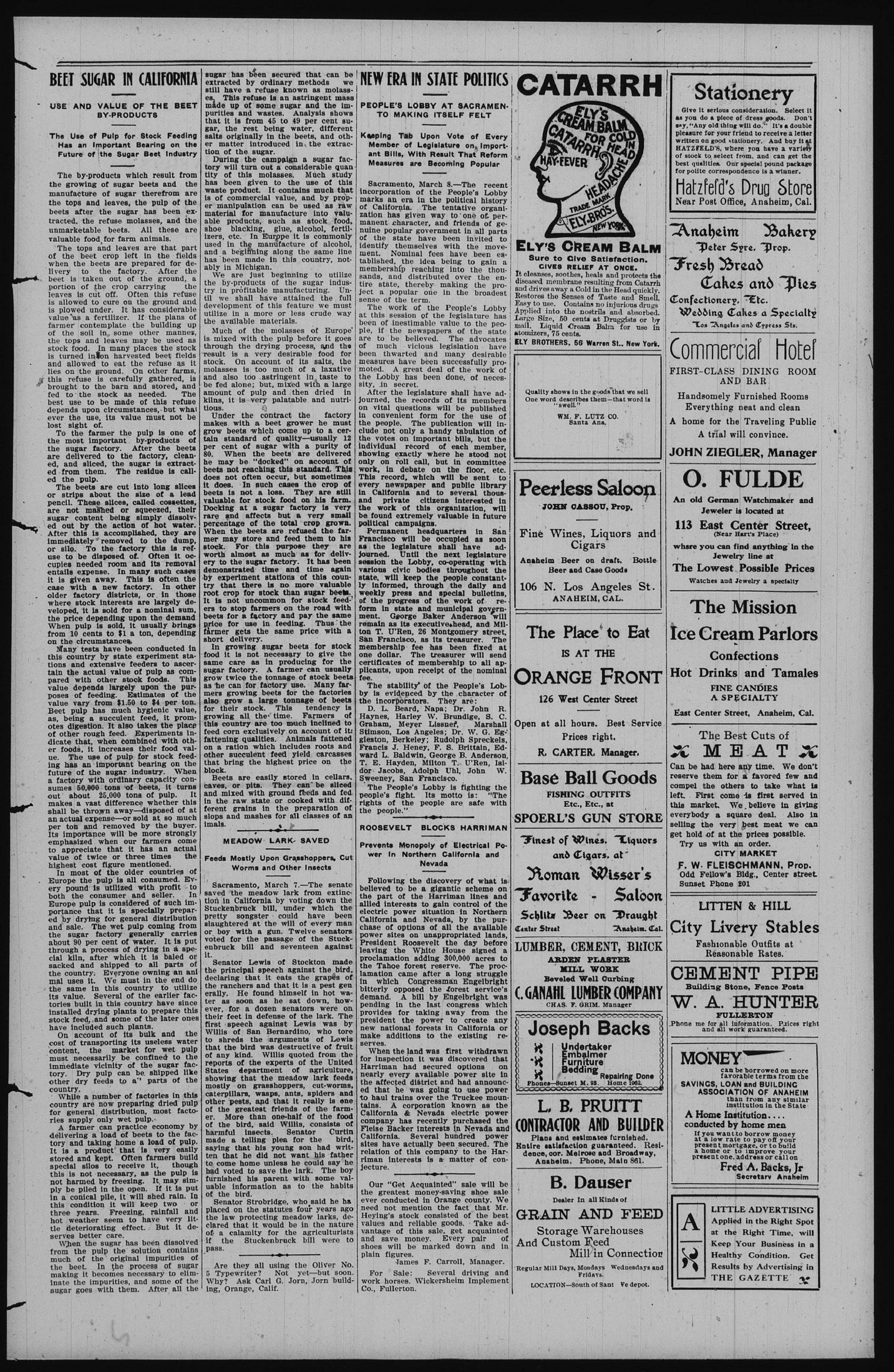
Searchable text
BEET SUGAR IN CALIFORNIA
USE AND VALUE OF THE BEET BY-PRODUCTS
The Use of Pulp for Stock Feeding Has an Important Bearing on the Future of the Sugar Beet Industry
The by-products which result from the growing of sugar beets and the manufacture of sugar therefrom are the tops and leaves, the pulp of the beets after the sugar has been extracted, the refuse molasses, and the unmarketable beets. All these are valuable food for farm animals.
The tops and leaves are that part of the beet crop left in the fields when the beets are prepared for delivery to the factory. After the beet is taken out of the ground, a portion of the crop carrying the leaves is cut off. Often this refuse is allowed to cure on the ground and is plowed under. It has considerable value as a fertilizer. If the plans of farmer contemplate the building up of the soil in some other manner, the tops and leaves may be used as stock food. In many places the stock is turned into harvested beet fields and allowed to eat the refuse as it lies on the ground. On other farms, this refuse is carefully gathered, is brought to the barn and stored, and fed to the stock as needed. The best use to be made of this refuse depends upon circumstances, but what ever the use, its value must not be lost sight of.
To the farmer the pulp is one of the most important by-products of the sugar factory. After the beets are delivered to the factory, cleaned, and sliced, the sugar is extracted from them. The residue is called the pulp.
The beets are cut into long slices or strips about the size of a lead pencil. These slices, called cossettes, are not mashed or squeezed, their sugar has been secured that can extract by ordinary methods still have a refuge known as mores. This refuse is an astringent made up of some sugar and the purities and wastes. Analysis shows that it is from 45 to 49 per cent sugar, the rest being water, different salts originally in the beets, and er matter introduced in the extinction of the sugar.
During the campaign a sugar factory will turn out a considerable quantity of this molasses. Much sugar has been given to the use of waste product. It contains much is of commercial value, and by her manipulation can be used as material for manufacture into able products, such as stock shoe blacking, glue, alcohol, fizers, etc. In Europe it is commonly used in the manufacture of alcohols and a beginning along the same has been made in this country, ably in Michigan.
We are just beginning to use the by-products of the sugar industry in profitable manufacturing. till we shall have attained the development of this feature we will utilize in a more or less crude form of available materials.
Much of the molasses of Europe is mixed with the pulp before it through the drying process, and result is a very desirable food stock. On account of its salts, molasses is too much of a laxative and also too astringent in taste be fed alone; but, mixed with a large amount of pulp and then dried kilns, it is very palatable and nuttious.
Under the contract the fact makes with a beet grower he may grow beets which come up to a certain standard of quality—usually per cent of sugar with a purity 80. When the beets are delivered he may be "docked" on account beets not reaching this standard does not often occur, but sometimes it does. In such cases the crop beets is not a loss. They are valuable for stock food on his farm. Docking at a sugar factory is
To the farmer the pulp is one of the most important by-products of the sugar factory. After the beets are delivered to the factory, cleaned, and sliced, the sugar is extracted from them. The residue is called the pulp.
The beets are cut into long slices or strips about the size of a lead pencil. These slices, called cossettes, are not mashed or squeezed, their sugar content being simply dissolved out by the action of hot water. After this is accomplished, they are immediately removed to the dump, or silo. To the factory this is refuse to be disposed of. Often it occupies needed room and its removal entails expense. In many such cases it is given away. This is often the case with a new factory. In other older factory districts, or in those where stock interests are largely developed, it is sold for a nominal sum, the price depending upon the demand. When pulp is sold, it usually brings from 10 cents to $1 a ton, depending on the circumstances.
Many tests have been conducted in this country by state experiment stations and extensive feeders to ascertain the actual value of pulp as compared with other stock foods. This value depends largely upon the purposes of feeding. Estimates of the value vary from $1.50 to $4 per ton. Beet pulp has much hygienic value, as being a succulent feed, it promotes digestion. It also takes the place of other rough feed. Experiments indicate that, when combined with other foods, it increases their food value. The use of pulp for stock feeding has an important bearing on the future of the sugar industry. When a factory with ordinary capacity consumes 50,000 tons of beets, it turns out about 25,000 tons of pulp. It makes a vast difference whether this shall be thrown away—disposed of at an actual expense—or sold at so much per ton and removed by the buyer. Its importance will be more strongly emphasized when our farmers come to appreciate that it has an actual value of twice or three times the highest cost figure mentioned.
In most of the older countries of Europe the pulp is all consumed. Every pound is utilized with profit to both the consumer and seller. In Europe pulp is considered of such importance that it is specially prepared by drying for general distribution and sale. The wet pulp coming from the sugar factory generally carries about 90 per cent of water. It is put through a process of drying in a special kiln, after which it is baled or sacked and shipped to all parts of
Under the contract the fact makes with a beet grower he will grow beets which come up to a certain standard of quality—usually per cent of sugar with a purity 80. When the beets are delivered he may be "docked" on account beets not reaching this standard does not often occur, but sometimes it does. In such cases the crop beets is not a loss. They are valuable for stock food on his farm. Docking at a sugar factory is rare and affects but a very small percentage of the total crop grown. When the beets are refused they mer may store and feed them to stock. For this purpose they worth almost as much as for delivery to the sugar factory. It has demonstrated time and time again by experiment stations of this country that there is no more valuable crop for stock than sugar beets. It is not uncommon for stock farmers to stop farmers on the road beets for a factory and pay the same price for use in feeding. Thus farmer gets the same price with short delivery.
In growing sugar beets for food it is not necessary to give same care as in producing for sugar factory. A farmer can grow twice the tonnage of stock as he can for factory use. Manymers growing beets for the factory also grow a large tonnage of b for their stock. This tendency growing all the time. Farmers this country are too much inclining feed corn exclusively on account of fattening qualities. Animals fatten on a ration which includes roots; other succulent feed yield carcass that bring the highest price on a block.
Beets are easily stored in cell caves, or pits. They can be stored and mixed with ground feeds and in the raw state or cooked with ferent grains in the preparation slops and mashes for all classes of imals.
MEADOW LARK SAVED
Feeds Mostly Upon Grasshoppers
Worms and Other Insects
Sacramento, March 7.-The seeds saved the meadow lark from extinction in California by voting down Stuckenbruck bill, under which pretty songster could have slaughtered at the will of every boy with a gun. Twelve senators voted for the passage of the Stuckenbruck bill and seventeen agit it.
Senator Lewis of Stockton
In most of the older countries of Europe the pulp is all consumed. Every pound is utilized with profit to both the consumer and seller. In Europe pulp is considered of such importance that it is specially prepared by drying for general distribution and sale. The wet pulp coming from the sugar factory generally carries about 90 per cent of water. It is put through a process of drying in a special kiln, after which it is baled or sacked and shipped to all parts of the country. Everyone owning an animal uses it. We must in the end do the same in this country to utilize its value. Several of the earlier factories built in this country have since installed drying plants to prepare this stock feed, and some of the later ones have included such plants.
On account of its bulk and the cost of transporting its useless water content, the market for wet pulp must necessarily be confined to the immediate vicinity of the sugar factory. Dry pulp can be shipped like other dry feeds to a" parts of the country.
While a number of factories in this country are now preparing dried pulp for general distribution, most factories supply only wet pulp.
A farmer can practice economy by delivering a load of beets to the factory and taking home a load of pulp. It is a product that is very easily stored and kept. Often farmers build special silos to receive it, though this is not necessary, as the pulp is not harmed by freezing. It may simply be piled in the open. If it is put in a conical pile, it will shed rain. In this condition it will keep two or three years. Freezing, rainfall and hot weather seem to have very little deteriorating effect. But it deserves better care.
When the sugar has been dissolved from the pulp the solution contains much of the original impurities of the beet. In the process of sugar making it becomes necessary to eliminate the impurities, and some of the sugar goes with them. After all the highest cost figure mentioned.
Sacramento, March 7.—The secretes saved the meadow lark from extinction in California by voting down Stuckenbruck bill, under which pretty songster could have slaughtered at the will of every boy or boy with a gun. Twelve senators voted for the passage of the Stuckenbruck bill and seventeen agenit it.
Senator Lewis of Stockton made the principal speech against the declaring that it eats the grape the ranchers and that it is a pest erally. He found himself in hotter as soon as he sat down, ever, for a dozen senators were their feet in defense of the lark. First speech against Lewis was Willis of San Bernardino, who told shreds the arguments of L. that the bird was destructive of any kind. Willis quoted from reports of the experts of the United States department of agriculture showing that the meadow lark mostly on grasshoppers, cut-wet caterpillars, wasps, ants, spiders, other pests, and that it really is of the greatest friends of the ter. More than one-half of the bird, said Willis, consists harmful insects. Senator Cohen made a telling plea for the saying that his young son had ten that he did not want his father to come home unless he could save had voted to save the lark. The furnished his parent with some valuable information as to the health of the bird.
Senator Strobridge, who said he placed on the statutes four years the law protecting meadow larks clared that it would be in the name of a calamity for the agriculture if the Stuckenbruck bill were pass.
Are they all using the Oliver 5 Typewriter? Not yet—but Why? Ask Carl G. Jorn, Jorn Ting, Orange, Calif.
NEW ERA IN STATE POLITICS
PEOPLE'S LOBBY AT SACRAMENTO MAKING ITSELF FELT
Keeping Tab Upon Vote of Every Member of Legislature on Important Bills, With Result That Reform Measures are Becoming Popular
Sacramento, March 8.—The recent incorporation of the People's Lobby marks an era in the political history of California. The tentative organization has given way to one of permanent character, and friends of genuine popular government in all parts of the state have been invited to identify themselves with the movement. Nominal fees have been established, the idea being to gain a membership reaching into the thousands, and distributed over the entire state, thereby making the project a popular one in the broadest sense of the term.
The work of the People's Lobby at this session of the legislature has been of inestimable value to the people, if the newspapers of the state are to be believed. The advocates of much vicious legislation have been thwarted and many desirable measures have been successfully promoted. A great deal of the work of the Lobby has been done, of necessity, in secret.
After the legislature shall have adjourned, the records of its members on vital questions will be published in convenient form for the use of the people. The publication will include not only a handy tabulation of the votes on important bills, but the individual record of each member, showing exactly where he stood not only on roll call, but in committee work, in debate on the floor, etc. This record, which will be sent to every newspaper and public library in California and to several thousand private citizens interested in the work of this organization, will
contract the factory beet grower he must which come up to a cer- of quality—usually 12 sugar with a purity of beets are delivered stocked" on account of being this standard. This occur, but sometimes such cases the crop of loss. They are still stock food on his farm. Sugar factory is very beets but a very small total crop grown. Bees are refused the far- and feed them to his purpose they are as much as for deliver- factory. It has been time and time again stations of this coun- is no more valuable stock than sugar beets. Common for stock feeders on the road with history and pay the same in feeding. Thus the same price with a sugar beets for stock necessary to give the in producing for the A farmer can usually tonnage of stock beets factory use. Many far-beets for the factories large tonnage of beets. This tendency is late time. Farmers of too much inclined to actively on account of it ties. Animals fattened which includes roots and not feed yield carcasses highest price on the easily stored in cellars. They can be sliced in ground feeds and fed or cooked with dif- in the preparation ofanes for all classes of an
LARK SAVED
Upon Grasshoppers, Cut and Other Insects
March 7.—The senate window lark from extinc- nia by voting down the bill, under which the er could have been the will of every man gun. Twelve senators passage of the Stuck- and seventeen against wis of Stockton made smooth against the bird on vital questions will be published in convenient form for the use of the people. The publication will include not only a handy tabulation of the votes on important bills, but the individual record of each member, showing exactly where he stood not only on roll call, but in committee work, in debate on the floor, etc. This record, which will be sent to every newspaper and public library in California and to several thousand private citizens interested in the work of this organization, will be found extremely valuable in future political campaigns.
Permanent headquarters in San Francisco will be occupied as soon as the legislature shall have adjourned. Until the next legislature session the Lobby, co-operating with various civic bodies throughout the state, will keep the people constantly informed, through the daily and weekly press and special bulletins, of the progress of the work of reform in state and municipal government. George Baker Anderson will remain as its executive head, and Milton T. U'Ren, 26 Montgomery street, San Francisco, as its treasurer. The membership fee has been fixed at one dollar. The treasurer will send certificates of membership to all applicants, upon receipt of the nominal fee.
The stability of the People's Lobby is evidenced by the character of the incorporators. They are:
D. L. Beard, Napa; Dr. John R. Haynes, Harley W. Brundige, S. C. Graham, Meyer Lissner, Marshall Stimson, Los Angeles; Dr. W. G. Eggleston, Berkeley; Rudolph Spreckels, Francis J. Heney, F. S. Brittain, Edward L. Baldwin, George B. Anderson, T. E. Hayden, Milton T. U'Ren, Isl-dor Jacobs, Adolph Uhl, John W. Sweeney, San Francisco.
The People's Lobby is fighting the people's fight. Its motto is: "The rights of the people are safe with the people."
ROOSEVELT BLOCKS HARRIMAN
Prevents Monopoly of Electrical Power in Northern California and Nevada
Following the discovery of what is believed to be a gigantic scheme on the part of the Harriman lines and allied interests to gain control of the electric power situation in Northern California and Nevada, by the purchase of options of all the available power sites on unappropriated lands, President Roosevelt the day before leaving the White House signed a proclamation adding 300,000 acres to the Tahoe forest reserve. The proc-
March 7.—The senate shadow lark from extincnia by voting down the bill, under which the order could have been the will of every man in the gun. Twelve senators passage of the Stuck- and seventeen against Lewis of Stockton made speech against the bird, but it eats the grapes of land that it is a pest gen and himself in hot was he sat down, how-ozen senators were on defense of the lark. The against Lewis was by Bernardino, who tore arguments of Lewis was destructive of fruit Willis quoted from the experts of the Unitedument of agriculture, the meadow lark feeds grasshoppers, cut-worms, wasps, ants, spiders and that it really is one friend of the farm-on one-half of the food said Willis, consists of nuts. Senator Curtin beg plea for the bird, as young son had writ-ed not want his father unless he could say he save the lark. The boy parent with some valtion as to the habits bridge, who said he has statutes four years ago setting meadow larks, dewould be in the nature for the agriculturistsankenbruck bill were to
Nevada
Following the discovery of what is believed to be a gigantic scheme on the part of the Harriman lines and allied interests to gain control of the electric power situation in Northern California and Nevada, by the purchase of options of all the available power sites on unappropriated lands, President Roosevelt the day before leaving the White House signed a proclamation adding 300,000 acres to the Tahoe forest reserve. The proclamation came after a long struggle in which Congressman Engelbright bitterly opposed the forest service's demand. A bill by Engelbright was pending in the last congress which provides for taking away from the president the power to create any new national forests in California or make additions to the existing reserves.
When the land was first withdrawn for inspection it was discovered that Harriman had secured options on nearly every available power site in the affected district and had announced that he was going to use power to haul trains over the Truckee mountains. A corporation known as the California & Nevada electric power company has recently purchased the Fleise Backer interests in Nevada and California. Several hundred power sites have actually been secured. The relation of this company to the Harriman interests is a matter of conjecture.
Our "Get Acquainted" sale will be the greatest money-saving shoe sale ever conducted in Orange county. We need not mention the fact that Mr. Heying's stock consisted of the best values and reliable goods. Take advantage of this sale, get acquainted and save money. Every pair of shoes will be marked down and in plain figures.
James F. Carroll, Manager.
For Sale: Several driving and work horses. Wickersheim Implement Co., Fullerton.
TARRH
ELY'S CREAM BALM FOR COLD IN TARRH HEAD NEVER HEADACHE
TRADE MARK ELY-BRO'S.
NEW YORK
Stationery
Give it serious consideration. Select it as you do a piece of dress goods. Don't say, "Any old thing will do." It's a double pleasure for your friend to receive a letter written on good stationery. And buy it at HATZFELD'S, where you have a variety of stock to select from, and can get the best qualities. Our special pound package for polite correspondence is a winner.
Hatzfeld's Drug Store
Near Post Office, Anaheim, Cal.
Anaheim Bakery
Peter Syre, Prop.
Fresh Bread
Cakes and Pies
Confectionery, Etc.
Wedding Cakes a Specialty
Los Angeles and Cypress Sts.
Commercial Hotel
FIRST-CLASS DINING ROOM AND BAR
Handsomely Furnished Rooms Everything neat and clean
A home for the Traveling Public A trial will convince.
JOHN ZIEGLER, Manager
O. FULDE
An old German Watchmaker and Jeweler is located at
less Saloon
IN CASSOU, Prop.
Wines, Liquors and
Cigars
Beer on draft. Bottle
er and Case Goods
Los Angeles St.
NAHEIM, CAL.
Place to Eat
IS AT THE
NGE FRONT
West Center Street
All hours. Best Service
Prices right.
ARTER. Manager.
Ball Goods
HING OUTFITS
Etc., Etc., at
L'S GUN STORE
of Wines. Liquors
and Cigars, at
man Wisser's
ite - Saloon
Beer on Draught
Anaheim, Cal.
R, CEMENT, BRICK
DEN PLASTER
MILL WORK
Everything neat and clean
A home for the Traveling Public
A trial will convince.
JOHN ZIEGLER, Manager
O. FULDE
An old German Watchmaker and
Jeweler is located at
113 East Center Street,
(Near Hart's Place)
whsre you can find anything in the
Jewelry line at
The Lowest Possible Prices
Watches and Jewelry a specialty
The Mission
Ice Cream Parlors
Confections
Hot Drinks and Tamales
FINE CANDIES
A SPECIALTY
East Center Street, Anaheim, Cal.
The Best Cuts of MEAT
Can be had here any time. We don't
reserve them for a favored few and
compel the others to take what is left. First come is first served in this market. We believe in giving everybody a square deal. Also in selling the very best meat we can get hold of at the prices possible.
Try us with an order.
CITY MARKET
F. W. FLEISCHMANN, Prop.
Odd Fellow's Bldg., Center street.
Sunset Phone 201
LITTEN & HILL
City Livery Stables
Fashionable Outfits at
Reasonable Rates.
ANN Wisser's
ite - Saloon
Beer on Draught
Anahiem, Cal.
R, CEMENT, BRICK
DEN PLASTER
MILL WORK
Heled Well Gurbing
LUMBER COMPANY
S. F. GRIM. Manager
Jeph Backs
Undertaker
Embalmer
Furniture
Bedding
Repairing Done
Sunset M. 98. Home 1062.
B. PRUITT
ATOR AND BUILDER
and estimates furnished.
Refaction guaranteed. Resit. Melrose and Broadway,
im. Phone, Main 861.
B. Dauser
Dealer In all Kinds of
N AND FEED
Mage Warehouses
Tom Feed
Mill in Connection
Days, Mondays Wednesdays and Fridays.
F. W. FLEISCHMANN, Prop.
Odd Fellow's Bldg., Center street
Sunset Phone 201
LITTEN & HILL
City Livery Stables
Fashionable Outfits at
Reasonable Rates.
CEMENT PIPE
Building Stone, Fence Posts
W. A. HUNTER
FULLERTON
Phone me for all information. Paices right
and all work guaranteed.
MONEY
can be borrowed on more
favorable terms from the
SAVINGS, LOAN and BUILDING
ASSOCIATION OF ANAHEIM
than from any similar
institution in the State
A Home Institution.....
conducted by home men
If you want to borrow money
at a low rate to pay off your
present mortgage, or to build
a home or to improve your
present one, address or call on
Fred A. Backs, Jr
Secretary Anaheim
LITTLE ADVERTISING
Applied in the Right Spot
at the Right Time, will
Keep Your Business in a Healthy Condition. Get Results by Advertising in THE GAZETTE