anaheim-gazette 1908-10-08
Scanned page
Searchable text
WHAT'S DOING IN POLITICS
BRILLIANT RECORD OF A POLITICAL SAINT
A Glance at Estudillo's Record as Assemblyman Throws Interesting Side Light Upon Record of Machine Man Anpther Article on Proposed Tax Amendment—Vote Against It.
Charge Mr. Estudillo with dodging a vote upon the reciprocal demurrage bill, and he crosses his arms upon his breast and lifting his eyes heavenward, solemnly protests that he voted against the prize-fight bill!
Accuse him of voting for the change-of-venue bill, which was admittedly drawn in the interest of Ruef and Schmitz, in order to give them a better chance of escaping prison stripes, and this saint in politics, still assuming an air of injured innocence, solemnly asserts that he voted for the anti-race-track gambling bill!
Charge him with voting for amendments to the constitution increasing pay of state officials and members of the legislature by hundreds of thousands of dollars annually, and he protests he voted in support of woman suffrage.
Accuse him of voting for the state-capital removal bill, which if enacted into law will cost taxpayers of the state millions of dollars, and he asservates, with an air of pained surprise, that he voted for the pure-food bill.
Let us sum up this record of Mr. Estudillo’s achievements and see what he has accomplished. The anti-prize fight bill was aimed at the year to year. They cannot take it to account the extraordinary tax which the people have already voted or will hereafter vote, upon their selves for schools and school houses, city halls, jails, water works, sewers gas and electric light plant courthouses and county jails, parks and hospitals, good roads and other public improvements.
The amendment provides for separation of state from local taxation by designating certain class of property which shall be taxed at the following rates, applicable to their gross earnings from operation:
1. Railroads, including street railroads, four per cent on gross earnings.
2. Sleeping car and other car companies, three per cent on gross earnings.
3. Express companies, two per cent on gross earnings.
4. Telegraph and telephone companies, three and one-half per cent on gross earnings.
5. Light, heat and power companies, four per cent on gross earnings.
6. The premiums collected by surance companies, the rate being one and one-half per cent thereon.
7. The capital an surplus banks, less the assessed value of real estate taxed locally, the rest being one per cent thereon.
Accuse him of voting for the state-capital removal bill, which if enacted into law will cost taxpayers of the state millions of dollars, and he asservates, with an air of pained surprise, that he voted for the pure-food bill.
Let us sum up this record of Mr. Estudillo's achievements and see what he has accomplished. The anti-prize fight bill was aimed at the suppression of prize fights, but it never said a word about boxing contests. We have no prize fights as such in California, thanks to the statesmanlike qualities of Mr. Estudillo and his associates in the legislature, but we have boxing contests pulled off every week or two at Jim Jeffries' arena and at other points in the state. The anti-prize-fight bill indeed! That is a great feather in Mr. Estudillo's cap.
The anti-race track bill, which the push permitted Estudillo to support, was discreetly killed by machine leaders, headed by Senator Leavitt of Alameda. The machine never intended to destroy horse racing in California, and it flourishes at Arcadia and Emeryville, despite the protestations of Mr. Estudillo that he supported a bill which never became law.
Eliminating these two great statesmanlike deeds on his part, we find his record stands upon two legs, his support of woman suffrage and his vote in favor of the pure-food law. But as the woman-suffrage amendment was defeated by the legislature, there is only one remaining leg for this great patriot to stand upon, and that his vote upon the pure-food bill. A notable achievement, verily, for this pulsant statesman.
Now the reciprocal-demurrage bill was and is of far greater importance than the anti-prize fight bill and the race-track gambling bill, for it affects the welfare of the entire state in many ways. It was a bill of far-reaching economic importance, far outranking the minor ills of prize fights and racetrack gambling, bad as they are. The bills increasing salaries affect the interests of taxpayers vitally, as does that providing for capital removal.
Mr. Estudillo's position upon those paines, three and one-half per cent on gross earnings.
5. Light, heat and power companies, four per cent on gross earnings.
B. The premiums collected by surance companies, the rate be one and one-half per cent thereon.
C. The capital an surplus banks, less the assessed value of real estate taxed locally, the r being one per cent thereon.
D. Miscellaneous franchises, o er than those covered by the fo going taxes. The taxes upon corpations in this class are fixed proportion to the capital stock each, ranging from $10 for a capit alization of $10,000 or less, up to $20 for a capitalization over $5 000,000.
E. All franchises, not otherwise provided or shall be assessed by the state board of equalization their actual value, and shall pay taxes to the state at the rate of o per cent thereon each year.
No reservation is made in classes of any property for local taxation but in classes B and C, the real tate reserved for local taxation, may be seen in the following s tence: "This (state) tax shall be lieu of all other taxes and licens state, county and municipal, up the property of such companies, except county and municipal taxes real estate." Nothing is said ab excepting the real estate of co panies in classes D and E; but we fer that these two classes would treated, in that respect, the same the two preceding ones.
All other taxable property is to subject to local taxation as now.
Let us take the city of Los Angeles as an illustration of the operation of this new taxing system. Short time ago that city bonded itself for $23,000,000 for the Ow river water supply. More recently bonded itself and the county for $500,000 for good roads. In addition to these enormous sums, the o had previously obligated itself hundreds of thousands of dollars sewers, schoolhouses, city hall, cour house, jail, etc. Under the new l every one of the hundreds of wealth corporations in the city will pay
ance than the anti-prize fight bill and the race-track gambling bill, for it affects the welfare of the entire state in many ways. It was a bill of far-reaching economic importance, far outranking the minor ills of prize fights and racetrack gambling, bad as they are. The bills increasing salaries affect the interests of taxpayers vitally, as does that providing for capital removal.
Mr. Estudillo's position upon these bills is this: The railroad opposed the reciprocal-demurrage bill, and he, being a creature of the railroad machine, failed to cast his vote in support of it. The machine wished the enactment into law of these salary-grabbing bills, and that referring to capital removal, and Mr. Estudillo, being an integral part of the push, took program, did as he was bidden to do, and, as in the case of the reciprocal-demurrage bill, forgot the interests of his constituents and the people of the state of California.
When we see the republican state convention endorsing Senate Constitutional Amendment No. 1, the San Diego chamber of commerce concluding that its city would lose nothing by the change, and none of the large newspapers saying anything on the subject, we wonder, says S. Armor in the Santa Ana Register, whether we can possibly be mistaken about the dangers of the new taxing scheme. It seems to us rather that such examinations and comparisons o the old and the new systems of taxation as have been made have been cursory and superficial, dealing only with the regular expenses of government, which do not vary much from
self for $23,000,000 for the Owens river water supply. More recently bonded itself and the county for $500,000 for good roads. In addition to these enormous sums, the city had previously obligated itself hundreds of thousands of dollars to sewers, schoolhouses, city hall, courthouse, jail, etc. Under the new law every one of the hundreds of wealthy corporations in the city will pay little per cent to the state, and thereby escape its just share of taxation for these local improvements, for the law specifically says, "this (state) tax shall be in lieu of all other taxes and licenses, state, county and municipal, upon the property of such companies." Besides, we don't see anything to hinder every mercantile establishment or other enterprise; that opulent city, from incorporation and thus, under class D, withdraws all of its merchandise, or other personal property, not only from the special taxation, but from all local taxation. Certainly every inducement seems to be offered in this amendment for the withdrawal of the burden of the personal property from local taxation, as well as all realty under class A. As a matter of course, the burdens from which the corporations may be relieved, will be piled upon the small taxpayers who cannot belong to a corporation.
Now, what is true of Los Angeles is true, to a greater or less extent of every city in the state—yes, of every school district and voting precinct where there are special tax and corporation property. Of course if the corporations were not benefited by the local improvements, they would be some reason for relieving
They cannot take in extraordinary taxes
we have already voted over vote, upon themools and school housalls, water works, sewelectric light plants,
all county jails, poor
initials, good roads and
improvements.
It provides for the
state from local taxatating certain classes
which shall be taxed for
only, and provides
which such class may
property selected for
only are:
Native property of the
s of public service
such corporations to be
allowing rates, applied
earnings from operaincluding street railcent on gross earncar and other car comcent on gross earncompanies, two per
earnings.
and telephone comand one-half per cent
gifts.
at and power comcent on gross earncolums collected by inmales, the rate being
per cent thereon.
Total an surplus of
assessed value of
locally, the rate
thereon.
them from all burdens for such improvements; but corporations abound
and are most prosperous where the
greatest local improvements are made
—in fact, many of the corporations
are dependent upon these improvements for their very existence. Under these conditions it is unfair, unjust and dishonest to relieve them
from their pro rata of the taxation necessary to secure such local improvements. If this amendment prevails, the effect will be to kill off the small taxpayers and crush out all local improvements; then the corporaations will fail for lack of support. It is just as true of the body politic as it is of the human body that "whether one member suffer, all the members suffer with it; or one member be honored, all the members rejoice with it." Temporary advantages may be gained by one class over another through the shifting of the burdens of taxation; but sooner or later there will be a leveling process, which will entail great loss and suffering upon all
In view of the foregoing facts and conclusions, it behooves the taxpayers of this county and state to ventilate Senate Constitutional Amendment No. 1 and secure its defeat Take no chances!
Roosevelt is "a bonny fighter," in the words of Alan Breck. If we come nearer home to the Chicago philosophy of Mr. Dooley, "he has the punch." The campaign has become a war of words. The bewildered citizen is up to his neck, almost submerged, in passionate argument and ginger is hot in the mouth. The newspapers are not big enough to make room for the shouts of the
Roosevelt is "a bonny fighter," in the words of Alan Breck. If we come nearer home to the Chicago philosophy of Mr. Dooley, "he has the punch." The campaign has become a war of words. The bewildered citizen is up to his neck, almost submerged, in passionate argument and ginger is hot in the mouth. The newspapers are not big enough to make room for the shouts of the champions. Wherever you see a head hit it. This is Donnybrook fair.
Roosevelt walks all over Bryan. He wears hobnailled boots and is off the official reservation doing a ghost dance on the prostrate form of the unterrified Nebraskan. Yet this is no mean antagonist. Bryan will come again and, truth to say, there is just one man who can best him in this sort of rough and tumble fighting. In the arts of rhetoric and the adroit handling of words the democratic candidate has no equal. He is a master of fence and the only useful weapon against him is a club. Roosevelt carries the club.
Have you read Roosevelt's reply to Bryan, asks the Call? There is a lot of it, but it is full of fight and "good stuff." It is a masterly defense of the administration policies and performances. On the latter point especially it is worth reading because the subsidized press in the pay of the corporations has made it a practice to indulge in profitable sneers with ill concealed rejoicing over every failure of justice where predatory wealth has escaped punishment. The cancellation of the $29,-230,000 fine was inspiration for exuberant jubilation in these quarters. But Standard Oil is not out of the woods yet.
A brief enumeration of the suits brought to a successful close or now in prosecution by the government against trusts and railway companies may be given in President Roosevelt's words:
Under this administration a mass of such cases have been brought, including the case against the Northern securities company, against the beef packers, against the Federal salt company, against the General pa-
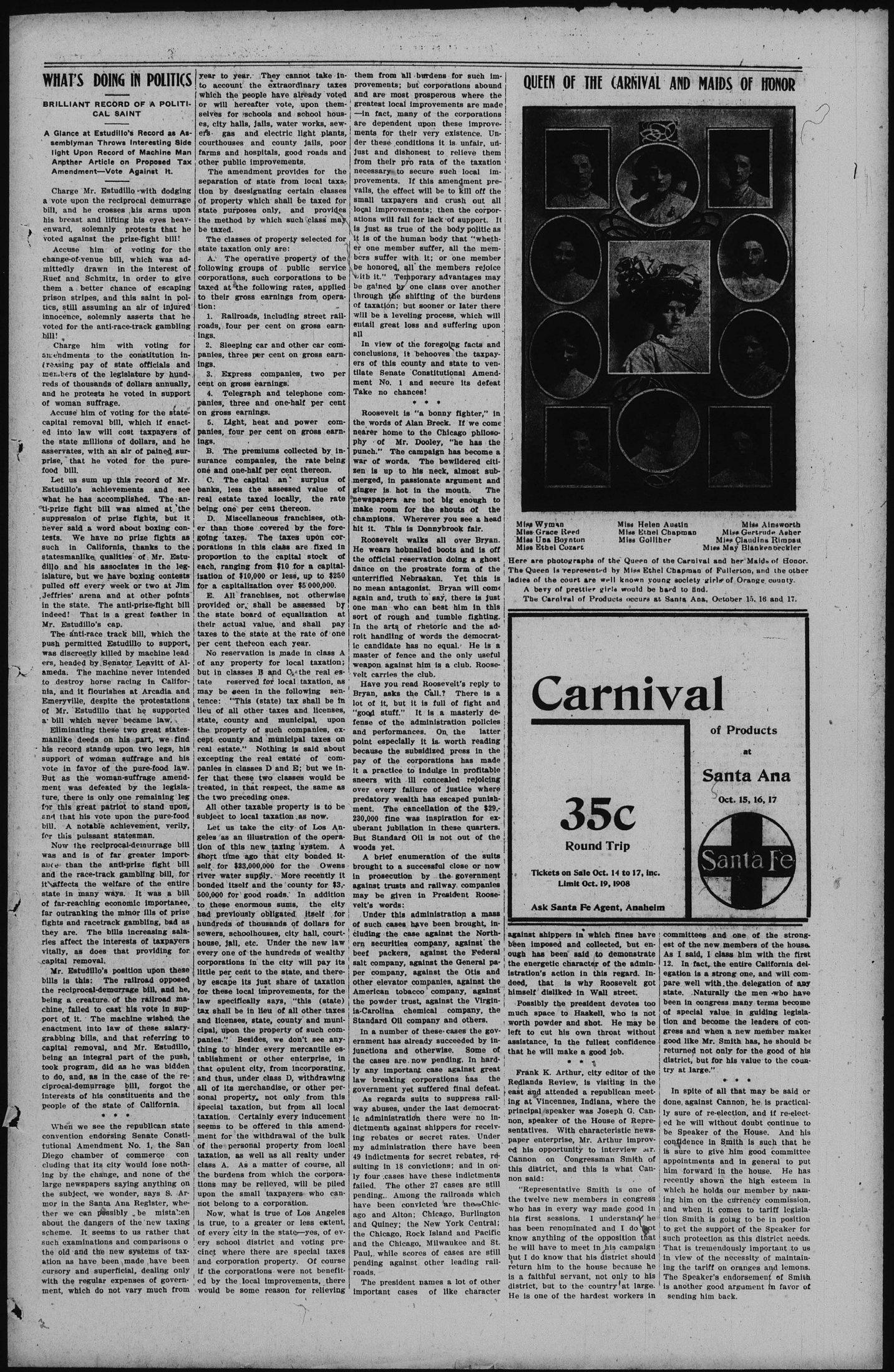
Miss Wyman Miss Grace Reed Miss Uda Boynton Miss Ethel Cozart
Here are photographs of the Queen. The Queen is represented by Mrs. ladies of the court are well known.
A bevy of prettier girls would The Carousel of Products o
Carn
35c Round Trip
Tickets on Sale Oct. 14 to Limit Oct. 19, 1908
Ask Santa Fe Agent, A
against shippers in which fines been imposed and collected, bough has been said to demon-
1000 for the Owens Valley. More recently it had the county for $3,- in roads. In addition these sums, the city obligated itself for thousands of dollars for houses, city hall, court.
Under the new law hundreds of wealthy in the city will pay its share of the state, and there is share of taxation improvements, for the city says, "this (state) rule of all other taxes state, county and municipal property of such com-
we don't see any mercantile es-
other enterprise, in-
from incorporating, class D, withdrawing standise, or other per-
not only from this but from all local only every inducement offered in this amend-
thdrawal of the bulk property from local as all realty under matter of course, all in which the corpora-
believed, will be piled taxpayers who can-corporation.
true of Los Angeles greater or less extent, the state—yes, of evict and voting pre-
are special taxes property. Of course were not benefit-improvements, there reason for relieving brought to a successful close or now in prosecution by the government against trusts and railway companies may be given in President Roosevelt's words:
Under this administration a mass of such cases have been brought, including the case against the Northern securities company, against the beef packers, against the Federal salt company, against the General paper company, against the Otis and other elevator companies, against the American tobacco company, against the powder trust, against the Virginia-Carolina chemical company, the Standard Oil company and others.
In a number of these cases the government has already succeeded by injunctions and otherwise. Some of the cases are now pending. In hardly any important case against great law breaking corporations has the government yet suffered final defeat.
As regards suits to suppress railway abuses, under the last democratic administration there were no indictments against shippers for receiving rebates or secret rates. Under my administration there have been 49 indictments for secret rebates, resulting in 18 convictions; and in only four cases have these indictments failed. The other 27 cases are still pending. Among the railroads which have been convicted are the Chicago and Alton; Chicago, Burlington and Quincy; the New York Central; the Chicago, Rock Island and Pacific and the Chicago, Milwaukee and St. Paul, while scores of cases are still pending against other leading railroads.
The president names a lot of other important cases of like character against shippers in which fines have imposed and collected, butough has been said to demonstrate the energetic character of the instruitation's action in this regard deed, that is why Roosevelt himself disliked in Wall street.
Possibly the president devoted much space to Haskell, who is worth powder and shot. He must left to cut his own throat with assistance, in the fullest confi-
that he will make a good job.
Frank K. Arthur, city editor of Redlands Review, is visiting east and attended a republican ing at Vincennes, Indiana, when principal speaker was Joseph Gannon, speaker of the House of Senatives. With characteristic paper enterprise, Mr. Arthur im- ed his opportunity to interview Cannon on Congressman Smith this district, and this is what non said:
"Representative Smith is one of the twelve new members in co-
who has in every way made go his first sessions. I understand has been renominated and I do know anything of the opposition he will have to meet in his camp but I do know that his district is return him to the house because is a faithful servant, not only district, but to the country at He is one of the hardest work-
OF THE CARNIVAL AND MAIDS OF HONOR
Miss Helen Austin
Miss Ethel Chapman
Miss Golliver
Miss Ainsworth
Miss Gertrude Asher
Miss Claudina Rimpau
Miss May Blankenbeckler
Photographs of the Queen of the Carnival and her Maids of Honor,
represented by Miss Ethel Chapman of Fullerton, and the other
court are well known young society girls of Orange county.
If prettier girls would be hard to find.
Carnival of Products occurs at Santa Ana, October 15, 16 and 17.
Carnival
of Products
at
Santa Ana
Oct. 15, 16, 17
35c
Round Trip
On Sale Oct. 14 to 17, Inc.
Limit Oct. 19, 1908
Santa Fe Agent, Anaheim
ers in which fines have
and collected, but enen said to demonstrate
character of the admin-
committees and one of the strongest of the new members of the house.
As I said, I class him with the first
12. In fact, the entire California del-
ers in which fines have
and collected, but entened said to demonstrate
the character of the admintion in this regard. In
is why Roosevelt got
kicked in Wall street.
The president devotes too
to Haskell, who is not
and shot. He may be
his own throat without
the fullest confidence
make a good job.
Arthur, city editor of the
view, is visiting in the
ended a republican meetnies, Indiana, where the
maker was Joseph G. Canof the House of RepreWith characteristic newsrise, Mr. Arthur improvunity to interview mr.
Congressman Smith of
and this is what Canative Smith is one of
new members in congress
every way made good in
sions. I understand he
nominated and I do not
g of the opposition that
to meet in his campaign
that his district should
to the house because he
servant, not only to his
to the country at large.
the hardest workers in
committees and one of the strongest of the new members of the house.
As I said, I class him with the first 12. In fact, the entire California delegation is a strong one, and will compare well with the delegation of any state. Naturally the men who have been in congress many terms become
of special value in guiding legislation and become the leaders of congress and when a new member makes
good like Mr. Smith has, he should be returned not only for the good of his district, but for his value to the country at large."
In spite of all that may be said or done against Cannon, he is practically sure of re-election, and if re-elected he will without doubt continue to be Speaker of the House. And his confidence in Smith is such that he is sure to give him good committee appointments and in general to put him forward in the house. He has recently shown the high esteem in which he holds our member by naming him on the currency commission,
and when it comes to tariff legislation Smith is going to be in position to get the support of the Speaker for such protection as this district needs. That is tremendously important to us in view of the necessity of maintaining the tariff on oranges and lemons.
The Speaker's endorsement of Smith is another good argument in favor of sending him back.