anaheim-gazette 1908-08-13
Scanned page
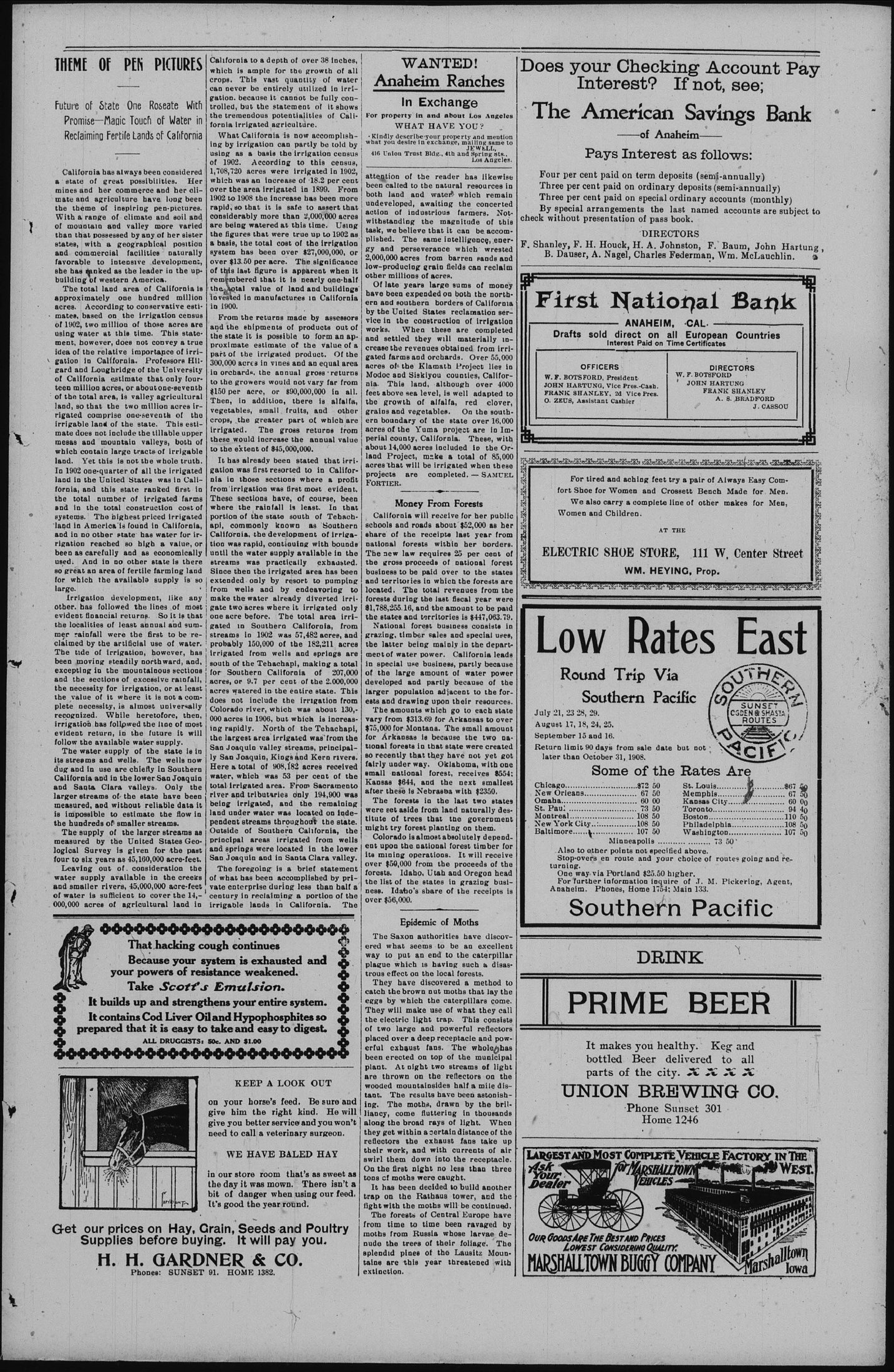
Searchable text
THEME OF PEN PICTURES
Future of State One Roseate With Promise—Magic Touch of Water in Reclaiming Fertile Lands of California
California has always been considered a state of great possibilities. Her mines and her commerce and her climate and agriculture have long been the theme of inspiring pen-pictures. With a range of climate and soil and of mountain and valley more varied than that possessed by any of her sister states, with a geographical position and commercial facilities naturally favorable to intensive development, she has ranked as the leader in the upbuilding of western America.
The total land area of California is approximately one hundred million acres. According to conservative estimates, based on the irrigation census of 1902, two million of those acres are using water at this time. This statement, however, does not convey a true idea of the relative importance of irrigation in California. Professors Hillgard and Loughridge of the University of California estimate that only fourteen million acres, or about one-seventh of the total area, is valley agricultural land, so that the two million acres irrigated comprise one-seventh of the irrigable land of the state. This estimate does not include the tillable upper mesas and mountain valleys, both of which contain large tracts of irrigable land. Yet this is not the whole truth. In 1902 one-quarter of all the irrigated land in the United States was in California, and this state ranked first in the total number of irrigated farms and in the total construction cost of California to a depth of over 38 inches which is ample for the growth of crops. This vast quantity of can never be entirely utilized in irrigation because it cannot be fully trolled, but the statement of it is the tremendous potentialities of fornia irrigated agriculture.
What California is now accomplishing by irrigation can partly be traced using as a basis the irrigation data of 1902. According to this data, 1,708,720 acres were irrigated in which was an increase of 18.2 per cent over the area irrigated in 1899. From 1902 to 1908 the increase has been rapid, so that it is safe to assume considerably more than 2,000,000 acres being watered at this time. The figures that were true up to this basis, the total cost of the irrigation system has been over $27,000,000 over $13.50 per acre. The significance of this last figure is apparent when remembered that it is nearly one-third the total value of land and built invested in manufactures in California in 1900.
From the returns made by assays and the shipments of products to the state it is possible to form an approximate estimate of the value part of the irrigated product. 300,000 acres in vines and an equal in orchards, the annual gross rent to the growers would not vary far above $150 per acre, or $90,000,000 if then, in addition, there is a vegetable, small fruits, and crops, the greater part of which irrigated. The gross returns these would increase the annual return to the extent of $45,000,000.
It has already been stated that irrigation was first resorted to in California in those sections where rainfall is least. These sections have, of course, where the rainfall is least.
land, so that the two million acres irrigated comprise one-seventh of the irrigable land of the state. This estimate does not include the tillable upper mesas and mountain valleys, both of which contain large tracts of irrigable land. Yet this is not the whole truth.
In 1902 one-quarter of all the irrigated land in the United States was in California, and this state ranked first in the total number of irrigated farms and in the total construction cost of systems. The highest priced irrigated land in America is found in California, and in no other state has water for irrigation reached so high a value, or been as carefully and as economically used. And in no other state is there so great an area of fertile farming land for which the available supply is so large.
Irrigation development, like any other, has followed the lines of most evident financial returns. So it is that the localities of least annual and summer rainfall were the first to be reclaimed by the artificial use of water. The tide of irrigation, however, has been moving steadily northward, and, excepting in the mountainous sections and the sections of excessive rainfall, the necessity for irrigation, or at least the value of it where it is not a complete necessity, is almost universally recognized. While heretofore, then, irrigation has followed the line of most evident return, in the future it will follow the available water supply.
The water supply of the state is in its streams and wells. The wells now dug and in use are chiefly in Southern California and in the lower San Joaquin and Santa Clara valleys. Only the larger streams of the state have been measured, and without reliable data it is impossible to estimate the flow in the hundreds of smaller streams.
The supply of the larger streams as measured by the United States Geological Survey is given for the past four to six years as 45,160,000 acre-feet.
Leaving out of consideration the water supply available in the creeks and smaller rivers, 45,000,000 acre-feet of water is sufficient to cover the 14,-000,000 acres of agricultural land in
It has already been stated that irrigation was first resorted to in California in those sections where irrigation was first most even. These sections have, of course, where the rainfall is least. In portion of the state south of Tehachapi, commonly known as Southern California, the development of irrigation was rapid, continuing with but until the water supply available to streams was practically exhausted. Since then the irrigated area has extended only by resort to pumps from wells and by endeavor make the water already diverted gate two acres where it irrigated one acre before. The total areas gated in Southern California, streams in 1902 was 57,482 acres probably 150,000 of the 182,211 irrigated from wells and springs south of the Tehachapi, making for Southern California of 2 acres, or 9.7 per cent of the 2.0 acres watered in the entire state does not include the irrigation Colorado river, which was about 000 acres in 1906, but which is ing rapidly. North of the Tehachapi the largest area irrigated was from San Joaquin valley streams, primarily San Joaquin, Kings and Kern Here a total of 908,182 acres rewater, which was 53 per cent of total irrigated area. From Sacramento river and tributaries only 194,900 being irrigated, and the remainder under water was located on dependent streams throughout the Outside of Southern California principal areas irrigated from and springs were located in the San Joaquin and in Santa Clara v
The foregoing is a brief statement of what has been accomplished by late enterprise during less than century in reclaiming a portion irrigable lands in California.
Leaving out of consideration the water supply available in the creeks and smaller rivers, 45,000,000 acre-feet of water is sufficient to cover the 14,-000,000 acres of agricultural land in
That hacking cough continues
Because your system is exhausted and your powers of resistance weakened.
Take Scott's Emulsion.
It builds up and strengthens your entire system.
It contains Cod Liver Oil and Hypophosphites so prepared that it is easy to take and easy to digest.
ALL DRUGGISTS: 50c. AND $1.00
KEEP A LOOK OUT on your horse's feed. Be sure give him the right kind. He give you better service and you need to call a veterinary surgeon.
WE HAVE BALED HAY in our store room that's as sweet the day it was mown. There is bit of danger when using our It's good the year round.
Get our prices on Hay, Grain, Seeds and Poultry Supplies before buying. It will pay you.
H. H. GARDNER & CO.
Phones: SUNSET 91. HOME 1382.
WANTED!
Anaheim Ranches
In Exchange
For property in and about Los Angeles
WHAT HAVE YOU?
Kindly describe your property and mention what you desire in exchange, mailing same to JEWELL,
416 Union Trust Bldg., 4th and Spring Sts., Los Angeles.
Attention of the reader has likewise been called to the natural resources in both land and water which remain undeveloped, awaiting the concerted action of industrious farmers. Notwithstanding the magnitude of this task, we believe that it can be accomplished. The same intelligence, energy and perseverance which wrested 2,000,000 acres from barren sands and low-producing grain fields can reclaim other millions of acres.
Of late years large sums of money have been expended on both the northern and southern borders of California by the United States reclamation service in the construction of irrigation works. When these are completed and settled they will materially increase the revenues obtained from irrigated farms and orchards. Over 55,000 acres of the Klamath Project lies in Modoc and Siskiyou counties, California. This land, although over 4000 feet above sea level, is well adapted to the growth of alfalfa, red clover, grains and vegetables. On the southern boundary of the state over 16,000 acres of the Yuma project are in Imperial county, California. These, with about 14,000 acres included in the Orland Project, make a total of 85,000 acres that will be irrigated when these projects are completed. — SAMUEL FORTIER.
Money From Forests
Does your Child Interest
The Americas
Pays In
Four per cent paid on
Three per cent paid on
Three per cent paid on
By special arrangement
check without presentation
F. Shanley, F. H. Houck,
B. Dauser, A. Nagel,
First N
Drafts sold direct
Interest
OFFICERS
W.F. BOTSFORD, President
JOHN HARTUNG, Vice Pres
FRANK SHANLEY, 2d V
O. ZEUS, Assistant Cashier
For tired and ac
fort Shoe for Wome
We also carry a
Woman and Child
Money From Forests
California will receive for her public schools and roads about $52,000 as her share of the receipts last year from national forests within her borders. The new law requires 25 per cent of the gross proceeds of national forest business to be paid over to the states and territories in which the forests are located. The total revenues from the forests during the last fiscal year were $1,788,255.16, and the amount to be paid the states and territories is $447,063.79.
National forest business consists in grazing, timber sales and special uses, the latter being mainly in the department of water power. California leads in special use business, partly because of the large amount of water power developed and partly because of the larger population adjacent to the forests and drawing upon their resources.
The amounts which go to each state vary from $313.69 for Arkansas to over $75,000 for Montana. The small amount for Arkansas is because the two national forests in that state were created so recently that they have not yet got fairly under way. Oklahoma, with one small national forest, receives $554; Kansas $644, and the next smallest after these is Nebraska with $2350.
The forests in the last two states were set aside from land naturally destitute of trees that the government might try forest planting on them.
Colorado is almost absolutely dependent upon the national forest timber for its mining operations. It will receive over $50,000 from the proceeds of the forests. Idaho, Utah and Oregon head the list of the states in grazing business. Idaho’s share of the receipts is over $56,000.
Epidemic of Moths
The Saxon authorities have discovered what seems to be an excellent way to put an end to the caterpillar plague which is having such a disas-
Epidemic of Moths
The Saxon authorities have discovered what seems to be an excellent way to put an end to the caterpillar plague which is having such a disastrous effect on the local forests.
They have discovered a method to catch the brown nut moths that lay the eggs by which the caterpillars come. They will make use of what they call the electric light trap. This consists of two large and powerful reflectors placed over a deep receptacle and powerful exhaust fans. The whole has been erected on top of the municipal plant. At night two streams of light are thrown on the reflectors on the wooded mountainsides half a mile distant. The results have been astonishing. The moths, drawn by the brilliancy, come fluttering in thousands along the broad rays of light. When they get within a certain distance of the reflectors the exhaust fans take up their work, and with currents of air swirl them down into the receptacle. On the first night no less than three tons of moths were caught.
It has been decided to build another trap on the Rathaus tower, and the fight with the moths will be continued.
The forests of Central Europe have from time to time been ravaged by moths from Russia whose larvae denude the trees of their foliage. The splendid pines of the Lausitz Mountains are this year threatened with extinction.
Does your Checking Account Pay Interest? If not, see;
The American Savings Bank
of Anaheim
Pays Interest as follows:
1. per cent paid on term deposits (semi-annually)
2. per cent paid on ordinary deposits (semi-annually)
3. per cent paid on special ordinary accounts (monthly)
4. special arrangements the last named accounts are subject to without presentation of pass book.
DIRECTORS
Ray, F. H. Houck, H. A. Johnston, F. Baum, John Hartung,
Dauser, A. Nagel, Charles Federman, Wm. McLauchlin.
First National Bank
ANAHEIM, CAL.
crafts sold direct on all European Countries
Interest Paid on Time Certificates
OFFICERS
W. BOTSFORD, President
JOHN HARTUNG, Vice Pres.-Cash.
BANK SHANLEY, 2d Vice Pres.
EUS, Assistant Cashier
DIRECTORS
W. F. BOTSFORD
JOHN HARTUNG
FRANK SHANLEY
A. S. BRADFORD
J. CASSOU
For tired and aching feet try a pair of Always Easy Comfort Shoe for Women and Crossett Bench Made for Men.
We also carry a complete line of other makes for Men,
For tired and aching feet try a pair of Always Easy Comfort Shoe for Women and Crossett Bench Made for Men.
We also carry a complete line of other makes for Men,
Women and Children.
AT THE
ELECTRIC SHOE STORE, 111 W. Center Street
WM. HEYING, Prop.
Low Rates East
Round Trip Via
Southern Pacific
23 28, 29.
17, 18, 24, 25.
15 and 16.
A limit 90 days from sale date but not
than October 31, 1908.
Some of the Rates Are
O.....$72 50 St. Louis.....$67 50
Orleans.....67 50 Memphis.....67 50
60 00 Kansas City.....60 00
73 50 Toronto.....94 40
Seal.....108 50 Boston.....110 50
New York City.....108 50 Philadelphia.....108 50
Store.....107 50 Washington.....107 50
Minneapolis ..... 73 50
Also to other points not specified above.
Stop-overs en route and your choice of routes going and rerning.
One way via Portland $25.50 higher.
For further information inquire of J. M. Pickering, Agent,
Haheim. Phones, Home 1754; Main 133.
Southern Pacific
DRINK
DRINK
PRIME BEER
It makes you healthy. Keg and bottled Beer delivered to all parts of the city.
UNION BREWING CO.
Phone Sunset 301
Home 1246
ST AND MOST COMPLETE VEHICLE FACTORY IN THE
FOR MARSHALLTOWN WEST
VEHICLES
FOODS ARE THE BEST AND PRICES
LOWEST CONSIDERING QUALITY.
MARSHALLTOWN BUGGY COMPANY
Marshalltown
Iowa