anaheim-gazette 1908-04-30
Scanned page
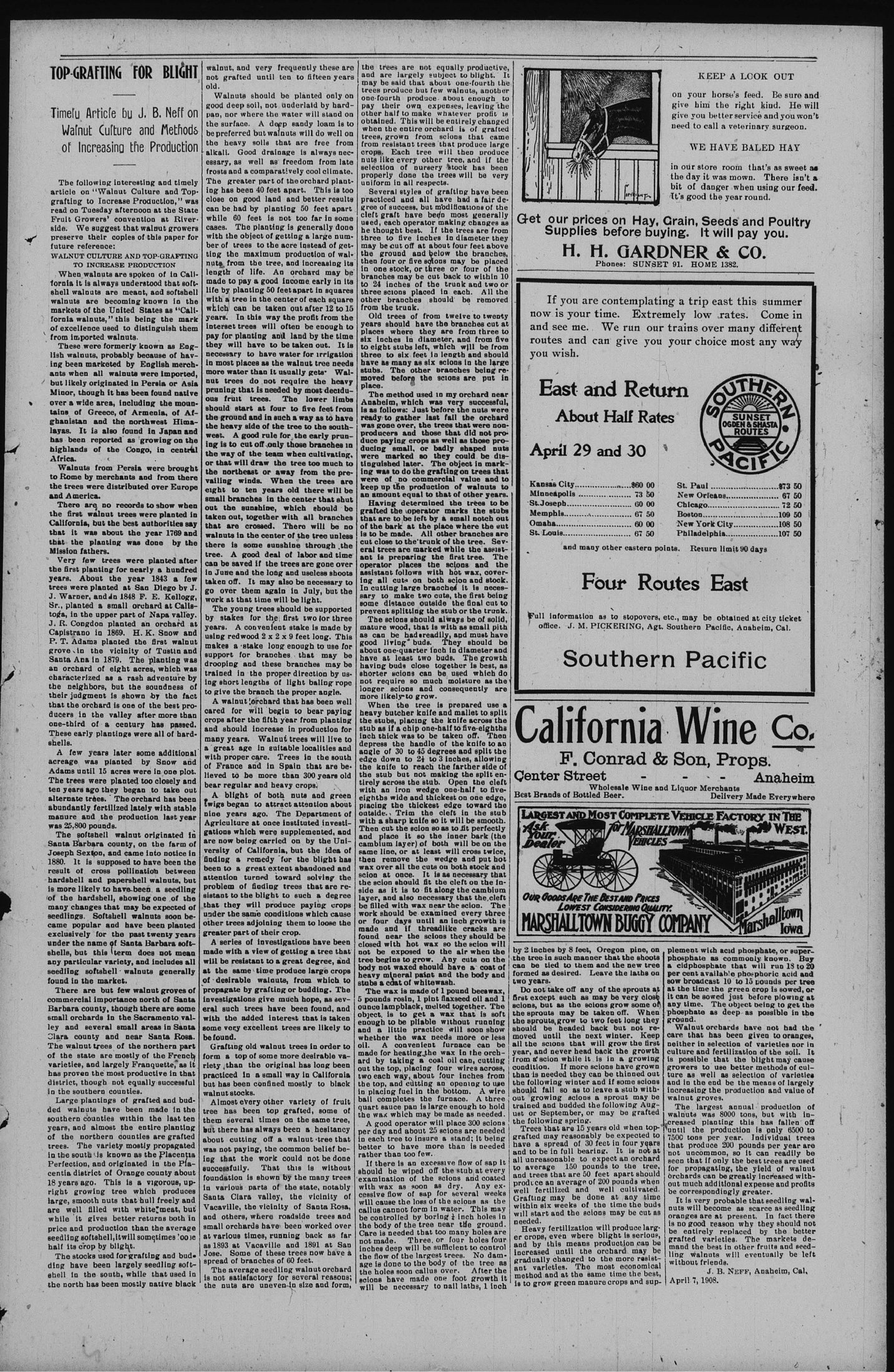
Searchable text
TOP-GRAFTING FOR BLIGHT
Timely Article by J. B. Neff on Walnut Culture and Methods of Increasing the Production
The following interesting and timely article on "Walnut Culture and Top-grafting to Increase Production," was read on Tuesday afternoon at the State Fruit Growers' convention at River-side. We suggest that walnut growers preserve their copies of this paper for future reference:
WALNUT CULTURE AND TOP-GRAFTING TO INCREASE PRODUCTION
When walnuts are spoken of in California it is always understood that softshell walnuts are meant, and softshell walnuts are becoming known in the markets of the United States as "California walnuts," this being the mark of excellence used to distinguish them from imported walnuts.
These were formerly known as English walnuts, probably because of having been marketed by English merchants when all walnuts were imported, but likely originated in Persia or Asia Minor, though it has been found native over a wide area, including the mountains of Greece, of Armenia, of Afghanistan and the northwest Himalayas. It is also found in Japan and has been reported as growing on the highlands of the Congo, in central Africa.
Walnuts from Persia were brought to Rome by merchants and from there the trees were distributed over Europe and America.
There are no records to show when walnut, and very frequently these not grafted until ten to fifteen old.
Walnuts should be planted on good deep soil, not underlaid by pan, nor where the water will stand the surface. A deep sandy loam be preferred but walnuts will do well the heavy soils that are free of alkali. Good drainage is always necessary, as well as freedom from frosts and a comparatively cool climate. The greater part of the orchard planting has been 40 feet apart. This close on good land and better real can be had by planting 50 feet apart while 60 feet is not too far in cases. The planting is generally with the object of getting a large number of trees to the acre instead of ting the maximum production of nuts from the tree, and increasing length of life. An orchard made to pay a good income early life by planting 50 feet apart in squares with a tree in the center of each square which can be taken out after 12 years. In this way the profit from interset trees will often be enough to pay for planting and land by them they will have to be taken out. Necessary to have water for irrigation in most places as the walnut tree more water than it usually gets nut trees do not require the pruning that is needed by most deserts fruit trees. The lower should start at four to five feet the ground and in such a way as to the heavy side of the tree to the sea west. A good rule for the early planting is to cut off only those branches the way of the team when cultivation or that will draw the tree too much the northeast or away from the vailing winds. When the trees eight to ten years old there will small branches in the center that out the sunshine, which should
Walnuts from Persia were brought to Rome by merchants and from there the trees were distributed over Europe and America.
There are no records to show when the first walnut trees were planted in California, but the best authorities say that it was about the year 1769 and that the planting was done by the Mission fathers.
Very few trees were planted after the first planting for nearly a hundred years. About the year 1843 a few trees were planted at San Diego by J. J. Warner, and in 1848 F. E. Kellogg, Sr., planted a small orchard at Callistoga, in the upper part of Napa valley. J. R. Congdon planted an orchard at Capistrano in 1869. H. K. Snow and P. T. Adams planted the first walnut grove in the vicinity of Tustin and Santa Ana in 1879. The planting was an orchard of eight acres, which was characterized as a rash adventure by the neighbors, but the soundness of their judgment is shown by the fact that the orchard is one of the best producers in the valley after more than one-third of a century has passed. These early plantings were all of hardshells.
A few years later some additional acreage was planted by Snow and Adams until 15 acres were in one plot. The trees were planted too closely and ten years ago they began to take out alternate trees. The orchard has been abundantly fertilized lately with stable manure and the production last year was 25,800 pounds.
The softshell walnut originated in Santa Barbara county, on the farm of Joseph Sexton, and came into notice in 1880. It is supposed to have been the result of cross pollination between hardshell and papershell walnuts, but is more likely to have been a seedling of the hardshell, showing one of the many changes that may be expected of seedlings. Softshell walnuts soon became popular and have been planted exclusively for the past twenty years under the name of Santa Barbara softshells, but this term does not mean any particular variety, and includes all should start at four to five feet from the ground and in such a way as to the heavy side of the tree to the west. A good rule for the early planting is to cut off only those branches the way of the team when cultivating or that will draw the tree too much to the northeast or away from the vailing winds. When the trees eight to ten years old there will be small branches in the center that out the sunshine, which should taken out, together with all branches that are crossed. There will be walnuts in the center of the tree where there is some sunshine through tree. A good deal of labor and can be saved if the trees are gone in June and the long and useless staked off. It may also be necessary go over them again in July, but work at that time will be light.
The young trees should be supported by stakes for the first two for years. A convenient stake is made using redwood 2 x 2 x 9 feet long makes a stake long enough to use support for branches that may drooping and these branches may trained in the proper direction being short lengths of light baling to give the branch the proper angle.
A walnut orchard that has been cared for will begin to bear pears after the fifth year from plan and should increase in production many years. Walnut trees will live a great age in suitable localities with proper care. Trees in the state of France and in Spain that are lieved to be more than 300 years bear regular and heavy crops.
A blight of both nuts and twigs began to attract attention nine years ago. The Department Agriculture at once instituted investigations which were supplemented, are now being carried on by the University of California, but the idea finding a remedy for the blight been to a great extent abandoned attention turned toward solving problem of finding trees that are resistant to the blight to such a degree that they will produce paying crops under the same conditions which other trees adjoining them to loose greater part of their crop.
A series of investigations have made with a view of getting a tree will be resistant to a great degree,
It is supposed to have been the result of cross pollination between hardshell and papershell walnuts, but is more likely to have been a seedling of the hardshell, showing one of the many changes that may be expected of seedlings. Softshell walnuts soon became popular and have been planted exclusively for the past twenty years under the name of Santa Barbara softshells, but this term does not mean any particular variety, and includes all seedling softshell walnuts generally found in the market.
There are but few walnut groves of commercial importance north of Santa Barbara county, though there are some small orchards in the Sacramento valley and several small areas in Santa Clara county and near Santa Rosa. The walnut trees of the northern part of the state are mostly of the French varieties, and largely Franquette, as it has proven the most productive in that district, though not equally successful in the southern counties.
Large plantings of grafted and budded walnuts have been made in the southern counties within the last ten years, and almost the entire planting of the northern counties are grafted trees. The variety mostly propagated in the south is known as the Placentia Perfection, and originated in the Placentia district of Orange county about 18 years ago. This is a vigorous, upright growing tree which produces large, smooth nuts that hull freely and are well filled with white meat, but while it gives better returns both in price and production than the average seedling softshell, it will sometimes lose half its crop by blight.
The stocks used for grafting and budding have been largely seedling softshell in the south, while that used in the north has been mostly native black
A series of investigations have made with a view of getting a tree will be resistant to a great degree at the same time produce large quantities of desirable walnuts, from which propagate by grafting or budding. Investigations give much hope, as several such trees have been found, with the added interest that is taking some very excellent trees are likely to be found.
Grafting old walnut trees in order form a top of some more desirable variety than the original has long practiced in a small way in California but has been confined mostly to balsam walnut stocks.
Almost every other variety of tree has been top grafted, some them several times on the same tree but there has always been a hesitation about cutting off a walnut tree was not paying, the common belief that the work could not be successfully. That this is with foundation is shown by the many in various parts of the state, not Santa Clara valley, the vicinity Vacaville, the vicinity of Santa Rita and others, where roadside trees small orchards have been worked at various times, running back as as 1893 at Vacaville and 1891 at Jose. Some of these trees now have spread of branches of 60 feet.
The average seedling walnut orchard is not satisfactory for several reasons: the nuts are uneven in size and f
every frequently these are planted only on not underlaid by hard-water the water will stand on deep sandy loam is to nut walnuts will do well on soils that are free from drainage is always necessary as freedom from late comparatively cool climate. Part of the orchard plant-50 feet apart. This is too land and better results in planting 50 feet apart. It is not too far in some planting is generally done of getting a large number of the acre instead of get-mum production of walnut tree, and increasing its size. An orchard may be good income early in its 50 feet apart in squares the center of each square taken out after 12 to 15 days way the profit from the will often be enough to grow and land by the time it to be taken out. It is save water for irrigation as the walnut tree needs it usually gets. Walnut not require the heavy needed by most deciduous. The lower limbs four to five feet from in such a way as to have of the tree to the south-rule for the early pruned only those branches in team when cultivating. Now the tree too much to nor away from the pre-When the trees are years old there will be in the center that shut fine, which should be the trees are not equally productive, and are largely subject to blight. It may be said that about one-fourth the trees produce but few walnuts, another one-fourth produce about enough to pay their own expenses, leaving the other half to make whatever profit is obtained. This will be entirely changed when the entire orchard is of grafted trees, grown from scions that came from resistant trees that produce large crops. Each tree will then produce nuts like every other tree, and if the selection of nursery stock has been properly done the trees will be very uniform in all respects.
Several styles of grafting have been practiced and all have had a fair degree of success, but modifications of the cleft graft have been most generally used, each operator making changes as he thought best. If the trees are from three to five inches in diameter they may be cut off at about four feet above the ground and below the branches, then four or five scions may be placed in one stock, or three or four of the branches may be cut back to within 10 to 24 inches of the trunk and two or three scions placed in each. All the other branches should be removed from the trunk.
Old trees of from twelve to twenty years should have the branches cut at places where they are from three to six inches in diameter, and from five to eight stubs left, which will be from three to six feet in length and should have as many as six scions in the large stubs. The other branches being removed before the scions are put in place.
The method used in my orchard near Anaheim, which was very successful, is as follows: Just before the nuts were ready to gather last fall the orchard was gone over, the trees that were non-producers and those that did not produce paying crops as well as those producing small, or badly shaped nuts were marked so they could be distinguished later. The object in marking was to do the grafting on trees that were of no commercial value and to keep up the production of walnuts to an amount equal to that of other years.
Having determined the trees to be grafted the operator marks the stubs
Get our prices on Supplies before H. H. G.
Phones:
If you are content now is your time.
and see me. We run routes and can give you wish.
East and F
About Half
April 29 and 31
Kansas City
Minneapolis
St.Joseph
When the trees are 2 years old there will be in the center that shut down, which should be further with all branches used. There will be no center of the tree unless the sunshine through the deal of labor and time. The trees are gone over the long and useless shoots may also be necessary to again in July, but the tree will be light.
Trees should be supported by the first two for three convenient stake is made by 2 x 2 x 9 feet long. This is long enough to use for branches that may be these branches may be proper direction by using of light baling rope such the proper angle.
Hard that has been well begun to bear paying fifth year from planting increase in production for Walnut trees will live to suitable localities and live. Trees in the south in Spain that are be more than 300 years old and heavy crops.
Both nuts and green fruit attract attention about so. The Department of once instituted investigative supplemented, and carried on by the Uni- California, but the idea of needy for the blight has not extent abandoned and led toward solving the leading trees that are re- sight to such a degree produce paying crops conditions which cause limiting them to loose their crop.
Investigations have been row of getting a tree that it to a great degree, and produced a coat of
About Hall
April 29 and 31
Kansas City
Minneapolis
St. Joseph
Memphis
Omaha
St. Louis
and many other areas
Four
Full information as to stock office. J. M. PICKERIN
South
California
F. Conrae
Center Street
Wholesale
Best Brands of Bottled Beer.
LARGEST AND MOST COMMON
Ask Your Dealer
OUR GOODS ARE THE BEST AND LOWEST CONSIDERED
MARSHALLTOWN BUY
Investigations have been made of getting a tree that is to a great degree, and some produce large crops of walnuts, from which to crafting or budding. The live much hope, as sewers have been found, and interest that is taken in silent trees are likely to be more desirable than the original has long been small way in California confined mostly to black walnut trees in order to come more desirable value.
Top grafted, some of times on the same tree, always been a hesitancy off a walnut tree that the common belief work could not be done. That this is without known by the many trees of the state, notably Valley, the vicinity of Vicinity of Santa Rosa, were roadside trees and have been worked over, running back as far asville and 1891 at San Francisco these trees now have a height of 60 feet.
Seedling walnut orchard dry for several reasons; uneven in size and form, wax over all the cuts on both stock and scion at once. It is as necessary that the scion should fit the cleft on the inside as it is to fit along the cambium layer, and also necessary that the cleft be filled with wax near the scion. The work should be examined every three or four days until an inch growth is made and if threadlike cracks are found near the scions they should be closed with hot wax so the scion will not be exposed to the air when the tree begins to grow. Any cuts on the body not waxed should have a coat of heavy mineral paint and the body and stubs a coat of whitewash.
The wax is made of 1 pound beeswax, 5 pounds rosin, 1 pint flaxseed oil and 1 ounce lampblack, melted together. The object is to get a wax that is soft enough to be pliable without running and a little practice will soon show whether the wax needs more or less oil. A convenient furnace can be made for heating the wax in the orchard by taking a coal oil can, cutting out the top, placing four wires across, two each way, about four inches from the top, and cutting an opening to use in placing fuel in the bottom. A wire ball completes the furnace. A three quart sauce pan is large enough to hold the wax which may be made as needed.
A good operator will place 300 scions per day and about 25 scions are needed in each tree to insure a stand; it being better to have more than is needed rather than too few.
If there is an excessive flow of sap it should be wiped off the stub at every examination of the scions and coated with wax as soon as dry. Any excessive flow of sap for several weeks will cause the loss of the scions as the callus cannot form in water. This may be controlled by boring half holes in the body of the tree near the ground. Care is needed that too many holes are not made. Three or four holes four inches deep will be sufficient to control the flow of the largest trees. No damage is done to the body of the tree as the holes soon callus over. After the scions have made one foot growth it will be necessary to nail laths, 1 inch by 2 inches by 8 feet, Oregon ply the tree in such manner that they can be tied to them and then formed as desired. Leave the last two years.
Do not take off any of the spines first except such as may be very scions, but as the scions grow the sprouts may be taken off. The sprouts grow to two feet long should be headed back but not moved until the next winter. All the scions that will grow this year, and never head back the tree from a scion while it is in a good condition. If more scions have than is needed they can be thinned during winter and if some should fall so as to leave a stub out growing scions a sprout trained and budded the followingust or September, or may be in the following spring.
Trees that are 15 years old when grafted may reasonably be expected have a spread of 30 feet in four and to be in full bearing. It is all unreasonable to expect an average 150 pounds to the tree and trees that are 50 feet apart produce an average of 200 pounds well fertilized and well cultured. Grafting may be done at age within six weeks of the time they will start and the scions may be needed.
Heavy fertilization will produce crops, even where blight is end by this means production increased until the orchard gradually changed to the more ant varieties. The most economical method and at the same time it is to grow green manure crops
KEEP A LOOK OUT
on your horse's feed. Be sure and
give him the right kind. He will
give you better service and you won't
need to call a veterinary surgeon.
WE HAVE BALED HAY
in our store room that's as sweet as
the day it was mown. There isn't a
bit of danger when using our feed.
It's good the year round.
Our prices on Hay, Grain, Seeds and Poultry
supplies before buying. It will pay you.
H. H. GARDNER & CO.
Phones: SUNSET 91. HOME 1382.
You are contemplating a trip east this summer
as your time. Extremely low rates. Come in
see me. We run our trains over many different
s and can give you your choice most any way
ish.
Fast and Return
About Half Rates
April 29 and 30
City.....$60 00
Polis.....73 50
Oh.....60 00
St. Paul.....$73 50
New Orleans.....67 50
Chicago.....72 50
About Half Rates
April 29 and 30
City.....$60 00 St. Paul.....$73 50
Polis.....73 50 New Orleans.....67 50
Oh.....60 00 Chicago.....72 50
Is.....67 50 Boston.....109 50
Es.....60 00 New York City.....108 50
Es.....67 50 Philadelphia.....107 50
and many other eastern points. Return limit 90 days
Four Routes East
Information as to stopovers, etc., may be obtained at city ticket
J. M. PICKERING, Agt. Southern Pacific, Anaheim, Cal.
Southern Pacific
California Wine Co.
F. Conrad & Son, Props.
Street - Anaheim
Wholesale Wine and Liquor Merchants
of Bottled Beer.
Delivery Made Everywhere
T AND MOST COMPLETE VEHICLE FACTORY IN THE
FOR MARSHALLTOWN
VEHICLES
ARE THE BEST AND PRICES
LOWEST CONSIDERING QUALITY.
MARSHALLTOWN BUGGY COMPANY
Marshalltown Iowa
by 8 feet, Oregon pine, on each manner that the shoots to them and the new treeplement with acid phosphate, or super-phosphate as commonly known. Buy a cidphosphate that will run 18 to 20
are the best and prices
lowest considering quality.
shalltown buggy company
Marshalltown Iowa
by 8 feet, Oregon pine, on such manner that the shoots to them and the new tree is sired. Leave the laths on off any of the sprouts at such as may be very close as the scions grow some of may be taken off. When grow to two feet long they headed back but not re-read the next winter. Keep it that will grow the first over head back the growth while it is in a growing If more scions have grown they can be thinned out for winter and if some scions so as to leave a stub with scions a sprout may be budded the following August, or may be grafted for spring.
are 15 years old when top-reasonably be expected to dead of 30 feet in four years full bearing. It is not at able to expect an orchard of 150 pounds to the tree, that are 50 feet apart should average of 200 pounds when seeded and well cultivated. May be done at any time weeks of the time the buds and the scions may be cut as fertilization will produce large where blight is serious, means production can be until the orchard may be changed to the more resistant. The most economical at the same time the best, green manure crops and supplement with acid phosphate, or super-phosphate as commonly known. Buy a cidphosphate that will run 18 to 20 per cent available phosphoric acid and sow broadcast 10 to 15 pounds per tree at the time the green crop is sowed, or it can be sowed just before plowing at any time. The object being to get the phosphate as deep as possible in the ground.
Walnut orchards have not had the care that has been given to oranges, neither in selection of varieties nor in culture and fertilization of the soil. It is possible that the blight may cause growers to use better methods of culture as well as selection of varieties and in the end be the means of largely increasing the production and value of walnut groves.
The largest annual production of walnuts was 8000 tons, but with increased planting this has fallen off until the production is only 6500 to 7500 tons per year. Individual trees that produce 200 pounds per year are not uncommon, so it can readily be seen that if only the best trees are used for propagating, the yield of walnut orchards can be greatly increased without much additional expense and profits be correspondingly greater.
It is very probable that seedling walnuts will become as scarce as seedling oranges are at present. In fact there is no good reason why they should not be entirely replaced by the better grafted varieties. The markets demand the best in other fruits and seedling walnuts will eventually be left without friends.
J. B. NEFF, Anaheim, Cal.
April 7, 1908.