anaheim-gazette 1908-04-09
Scanned page
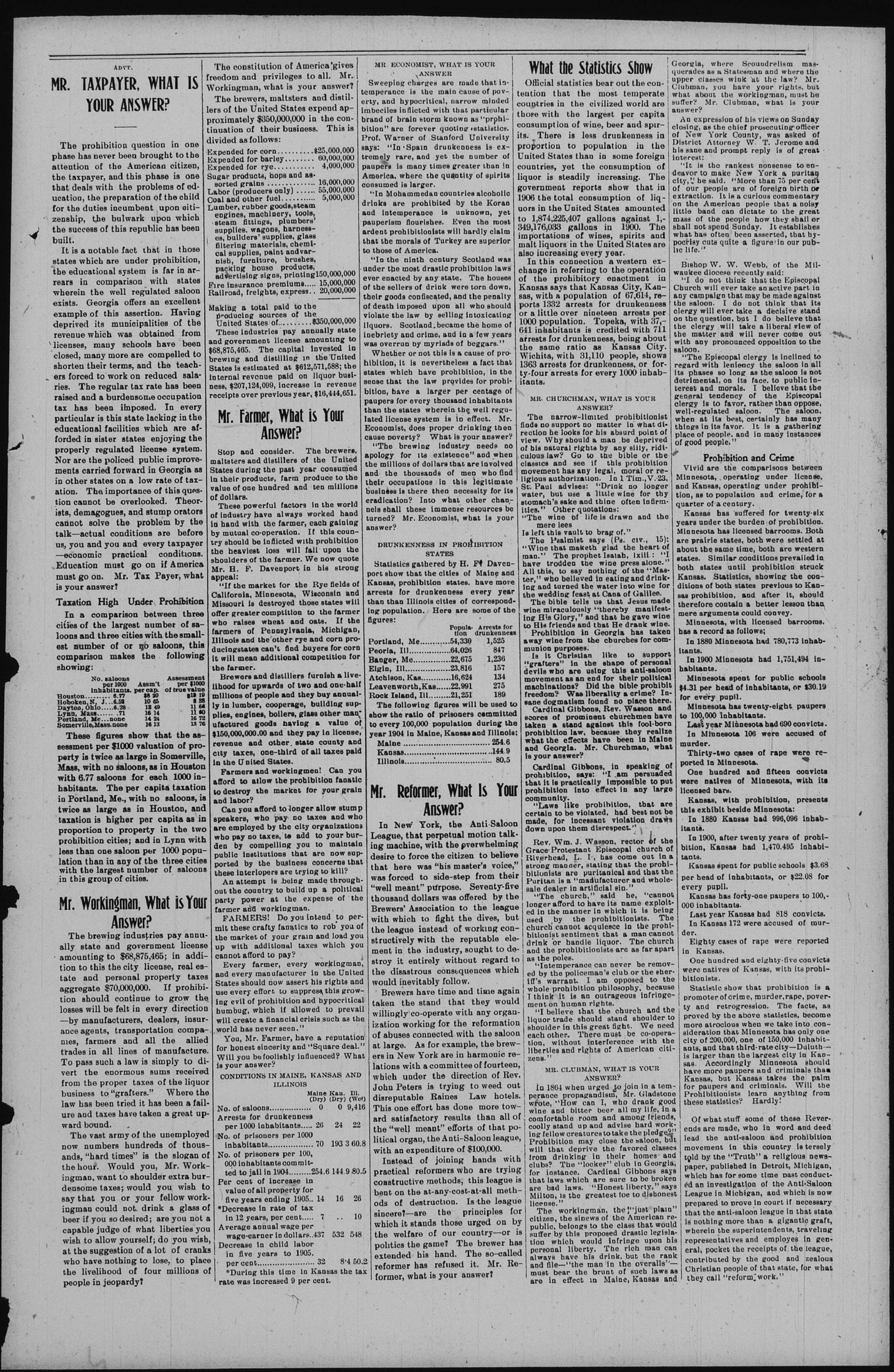
Searchable text
MR. TAXPAYER, WHAT IS YOUR ANSWER?
The prohibition question in one phase has never been brought to the attention of the American citizen, the taxpayer, and this phase is one that deals with the problems of education, the preparation of the child for the duties incumbent upon citizenship, the bulwark upon which the success of this republic has been built.
It is a notable fact that in those states which are under prohibition, the educational system is far in arrears in comparison with states wherein the well regulated saloon exists. Georgia offers an excellent example of this assertion. Having deprived its municipalities of the revenue which was obtained from licenses, many schools have been closed, many more are compelled to shorten their terms, and the teachers forced to work on reduced salaries. The regular tax rate has been raised and a burdensome occupation tax has been imposed. In every particular is this state lacking in the educational facilities which are afforded in sister states enjoying the properly regulated license system. Nor are the policed public improvements carried forward in Georgia as in other states on a low rate of taxation. The importance of this question cannot be overlooked. Theorists demagogues and stump orators
The constitution of America's freedom and privileges to all. Workingman, what is your answer.
The brewers, maltsters and distillers of the United States expend approximately $350,000,000 in their tinuation of their business. They divided as follows:
Expended for corn... $25,000
Expended for barley... 60,000
Expended for rye... 4,000
Sugar products, hops and assorted grains... 16,000
Labor (producers only)... 55,000
Coal and other fuel... 5,000
Lumber, rubber goods, steam engines, machinery, tools, steam fittings, plumbers' supplies. wagons, harnesses, builders' supplies, glass filtering materials, chemical supplies, paint and varnish, furniture, brushes, packing house products, advertising signs, printing 150,000
Fire insurance premiums... 15,000
Railroad, freights, express... 20,000
Making a total paid to the producing sources of the United States of... $350,000
These industries pay annually and government license amounts $68,875,465. The capital investment brewing and distilling in the U.S. is estimated at $612,571,588 internal revenue paid on liquorness, $207,124,099, increase in receipts over previous year, $16,444
Mr. Farmer, What is Your Answer?
Stop and consider. The brewers maltsters and distillers of the U.S. States during the past year con- in their products, farm produce value of one hundred and ten m- of dollars.
These powerful factors in the
tax has been imposed. In every particular is this state lacking in the educational facilities which are afforded in sister states enjoying the properly regulated license system. Nor are the policed public improvements carried forward in Georgia as in other states on a low rate of taxation. The importance of this question cannot be overlooked. Theorists, demagogues, and stump orators cannot solve the problem by the talk—actual conditions are before us, you and you and every taxpayer—economic practical conditions. Education must go on if America must go on. Mr. Tax Payer, what is your answer?
Taxation High Under Prohibition
In a comparison between three cities of the largest number of saloons and three cities with the smallest number of or no saloons, this comparison makes the following showing:
| No. saloons per 1000 inhabitants | Assm't per cap. | Assessment per $1000 of true value |
| :--- | :--- | :--- |
| Houston | 6.77 | $820 | $1819 |
| Hoboken, N.J. | 6.52 | 1065 | 888 |
| Dayton, Ohio | 6.28 | 1349 | 1166 |
| Lynn, Mass. | .71 | 1614 | 1160 |
| Portland, Me. none | 1424 | 1672 | 1876 |
| Somerville, Mass. none | 1613 | 1876 |
These figures show that the assessment per $1000 valuation of property is twice as large in Somerville, Mass, with no saloons, as in Houston with 6.77 saloons for each 1000 inhabitants. The per capita taxation in Portland, Me., with no saloons, is twice as large as in Houston, and taxation is higher per capita as in proportion to property in the two prohibition cities; and in Lynn with less than one saloon per 1000 population than in any of the three cities with the largest number of saloons in this group of cities.
Mr. Workingman, What is Your Answer?
The brewing industries pay annually state and government license amounting to $68,875,465; in addition to this the city license, real es-
Mr. Farmer, What is Your Answer?
Stop and consider. The brass maltsters and distillers of the United States during the past year conceive in their products, farm produce a value of one hundred and ten million dollars.
These powerful factors in the industry have always worked in hand with the farmer, each giving by mutual co-operation. If this try should be inflicted with prohibition the heaviest loss will fall upon shoulders of the farmer. We now Mr. H. F. Davenport in his appeal:
“If the market for the Rye farmland for upwards of two and o-millions of people and they buy only in lumber, cooperage, bulldiplies, engines, boilers, glass other manufactured goods having a value $150,000,000.00 and they pay in revenue and other state county city taxes, one-third of all taxes in the United States.
Farmers and workingmen! Our afford to allow the prohibition to destroy the market for you and labor?
Can you afford to longer allow speakers, who pay no taxes and are employed by the city organ who pay no taxes, to add to you den by compelling you to make public institutions that are not ported by the business concern these interlopers are trying to keep.
An attempt is being made out the country to build up a party power at the expense farmer and workingman.
FARMERS! Do you intend mit these crafty fanatics to rob the market of your grain and up with additional taxes which cannot afford to pay?
Every farmer, every work-
Mr. Workingman, What is Your Answer?
The brewing industries pay annually state and government license amounting to $68,875,465; in addition to this the city license, real estate and personal property taxes aggregate $70,000,000. If prohibition should continue to grow the losses will be felt in every direction—by manufacturers, dealers, insurance agents, transportation companies, farmers and all the allied trades in all lines of manufacture. To pass such a law is simply to divert the enormous sums received from the proper taxes of the liquor business to "grafters." Where the law has been tried it has been a failure and taxes have taken a great upward bound.
The vast army of the unemployed now numbers hundreds of thousands, "hard times" is the slogan of the hour. Would you, Mr. Workingman, want to shoulder extra burdensome taxes; would you wish to say that you or your fellow workingman could not drink a glass of beer if you so desired; are you not a capable judge of what liberties you wish to allow yourself; do you wish, at the suggestion of a lot of cranks who have nothing to lose, to place the livelihood of four millions of people in jeopardy?
A notification of America's privileges to all. Mr. Brown asks what is your answer? Is maltsters and distilled States expend approximately $350,000,000 in the consumer their business. This is known as:
corn...$25,000,000
barley...60,000,000
rye...4,000,000
hops and assments...16,000,000
fuel...5,000,000
mer goods, steam machinery, tools,
logs, plumbers'
gons, harnesses,
supplies, glass
materials, chemipaint and varure, brushes,
house products,
signs, printing 150,000,000
premiums...15,000,000
rights, express...20,000,000
Total paid to the sources of the taxes of...$350,000,000
Entries pay annually state tax license amounting to The capital invested in distilling in the United States at $612,571,588; the base paid on liquor business 1999, increase in revenue previous year, $16,444,651.
Here, What is Your Answer?
Consider. The brewers, distillers of the United States past year consumed facts, farm produce to the hundred and ten millions
Forful factors in the world MR. ECONOMIST, WHAT IS YOUR ANSWER
Sweeping charges are made that intemperance is the main cause of poverty, and hypocritical, narrow minded imbeciles inflicted with that particular brand of brain storm known as "prohibition" are forever quoting statistics. Prof. Warner of Stanford University says: "In Spain drunkenness is extremely rare, and yet the number of paupers is many times greater than in America, where the quantity of spirits consumed is larger.
"In Mohammedan countries alcoholic drinks are prohibited by the Koran and intemperance is unknown, yet pauperism flourishes. Even the most ardent prohibitionists will hardly claim that the morals of Turkey are superior to those of America.
"In the ninth century Scotland was under the most drastic prohibition laws ever enacted by any state. The houses of the sellers of drink were torn down, their goods confiscated, and the penalty of death imposed upon all who should violate the law by selling intoxicating liquors. Scotland became the home of inebriety and crime, and in a few years was overrun by myriads of beggars."
Whether or not this is a cause of prohibition, it is nevertheless a fact that states which have prohibition, in the sense that the law provides for prohibition, have a larger per centage of paupers for every thousand inhabitants than the states wherein the well regulated license system is in effect. Mr. Economist, does proper drinking then cause poverty? What is your answer?
"The brewing industry needs no apology for its existence" and when the millions of dollars that are involved and the thousands of men who find their occupations in this legitimate business is there then necessity for its eradication? Into what other channels shall these immense resources be
What the Statistics Show
Official statistics bear out a tention that the most ten countries in the civilized world those with the largest per cent consumption of wine, beer and its. There is less drunker proportion to population in United States than in some countries, yet the consumptive liquor is steadily increasing government reports show in 1906 the total consumption of juices in the United States and to 1,874,225,407 gallons again 349,176,033 gallons in 1906 importations of wines, spirit malt liquors in the United States also increasing every year.
In this connection a west change in referring to the one of the prohibitory enactment Kansas says that Kansas City has a population of 67 ports 1332 arrests for drunken or a little over nineteen are 1000 population. Topeka, with 641 inhabitants is credited arrests for drunkenness being the same ratio as Kansas Wichita, with 31,110 people 1363 arrests for drunkenness ty-four arrests for every 100 itants.
MR. CHURCHMAN, WHAT IS ANSWER?
The narrow-limited problem finds no support no matter in direction he looks for his absurd view. Why should a man be of his natural rights by any sane law? Go to the bible classics and see if this movement has any legal, moral ligious authorization. In 1 T St. Paul advises: "Drink water, but use a little wine stomach's sake and thine oft itities." Other quotations:
DER, What is Your Answer?
consider. The brewers, distillers of the United States, past year consumed facts, farm produce to the hundred and ten millions
ful factors in the world have always worked hand in the farmer, each gaining operation. If this couninflicted with prohibition loss will fall upon the farmer. We now quote Davenport in his strong
ket for the Rye fields of Minnesota, Wisconsin and destroyed those states will compition to the farmer wheat and oats. If the Pennsylvania, Michigan, the other rye and corn prodistillers furnish a live-awards of two and one-half people and they buy annual cooperage, building supplies, boilers, glass other man-goods having a value of 100 and they pay in license, or other state county and one-third of all taxes paid in States.
and workingmen! Can you show the prohibition fanatic the market for your grain
ford to longer allow stump no pay no taxes and who will by the city organizations taxes, to add to your bur-pelling you to maintain unions that are now supthe business concerns that papers are trying to kill?
It is being made through try to build up a political effort at the expense of the workingman.
IS! Do you intend to per-hafty fanatics to rob you of your grain and load you additional taxes which you will to pay?
mer, every workingman,
than the states wherein the well regulated license system is in effect. Mr. Economist, does proper drinking then cause poverty? What is your answer?
"The brewing industry needs no apology for its existence" and when the millions of dollars that are involved and the thousands of men who find their occupations in this legitimate business is there then necessity for its eradication? Into what other channels shall these immense resources be turned? Mr. Economist, what is your answer?
DRUNKENNESS IN PROHIBITION STATES
Statistics gathered by H. F. Davenport show that the cities of Maine and Kansas, prohibition states, have more arrests for drunkenness every year than than Illinois cities of corresponding population. Here are some of the figures:
Population Arrests for drunkenness
Portland, Me.....54,330 1,525
Peoria, Ill.....64,026 847
Banger, Me.....22,675 1,236
Elgin, Ill.....23,816 157
Atchison, Kas.....16,624 134
Leavenworth, Kas.....22,991 275
Rock Island, Ill.....21,251 189
The following figures will be used to show the ratio of prisoners committed to every 100,000 population during the year 1904 in Maine, Kansas and Illinois:
Maine .....254.6
Kansas .....144.9
Illinois .....80.5
Mr. Reformer, What Is Your Answer?
In New York, the Anti-Saloon League, that perpetual motion talking machine, with the overwhelming desire to force the citizen to believe that here was "his master's voice," was forced to side-step from their "well meant" purpose. Seventy-five thousand dollars was offered by the Brewers' Association to the league with which to fight the dives, but the league instead of working constructively with the reputable element in the industry, sought to destroy it entirely without regard to ANSWER?
The narrow-limited problem finds no support no matter in direction he looks for his absurd view. Why should a man be of his natural rights by any culous law? Go to the bible classics and see if this pro- movement has any legal, morligious authorization. In I T St. Paul advises: "Drink my water, but use a little wine stomach's sake and thine ofties." Other quotations:
"The wine of life is drawn mere lees Is left this vault to brag of."
The Psalmist says (Ps. "Wine that maketh glad thou man." The prophet Isaiah, have trodden the wine pre- All this, to say nothing of her ter," who believed in eating and turned the water into the wedding feast at Cana of The bible tells us that J wine miraculously "thereby ing His Glory," and that he to His friends and that He du Prohibition in Georgia haw away wine from the church munion purposes.
Is it Christian like to "grafters" in the shape of devils who are using this movement as an end for their machinations? Did the bible freedom? Was liberality a sane dogmatism found no p Cardinal Gibbons, Rev. W scores of prominent church taken a stand against this prohibition law, because that what the effects have been and Georgia. Mr. Church is your answer?
Cardinal Gibbons, in sp prohibition, says: "I am that it is practically impossibly prohibition into effect in community.
"Laws like prohibition, certain to be violated, had made, for incessant violation down upon them disrespect.
Rev. Wm. J. Wasson, rec Grace Protestant Episcopal Riverhead, L. I., has come strong manner, stating that bitionists are puritanical a Puritan is a "manufacturer sale dealer in artificial sin."
"The church," said he longer afford to have its named in the manner in which used by the prohibition church cannot acquiesce in bitionist sentiment that a drink or handle liquor. And the prohibitionists are as the poles.
"Intemperance can never
the business concerns that
pers are trying to kill?
that is being made throughtry to build up a political
or at the expense of the
workingman.
Do you intend to per妨ty fanatics to rob you of
of your grain and load you
additional taxes which you
will to pay?
Farmer, every workingman,
manufacturer in the United
and now assert his rights and
fort to suppress this growprohibition and hypocritical
which if allowed to prevail
in financial crisis such as the
ever seen."
Farmer, have a reputation
ncerity and "Square deal."
foolishly influenced? What
wer?
IN MAINE, KANSAS AND
ILLINOIS
Maine Kan. Ill.
(Dry) (Dry) (Wet)
tons..... 0 0 9,416
drunkenness
inhabitants..... 26 24 22
owners per 1000
ents..... 70 193 3 60.8
owners per 100,
stants commitin 1904.....254.6 144.9 80.5
of increase in
total property for
ending 1905.. 14 16 26
on rate of tax
taxs, per cent..... 7 .. 10
annual wage per
owner in dollars..437 532 548
in child labor
years to 1905.
this time in Kansas the tax
increased 9 per cent.
that here was "his master's voice," was forced to side-step from their "well meant" purpose. Seventy-five thousand dollars was offered by the Brewers' Association to the league with which to fight the dives, but the league instead of working constructively with the reputable element in the industry, sought to destroy it entirely without regard to the disastrous consequences which would inevitably follow.
Brewers have time and time again taken the stand that they would willingly co-operate with any organization working for the reformation of abuses connected with the saloon at large. As for example, the brewers in New York are in harmonic relations with a committee of fourteen, which under the direction of Rev. John Peters is trying to weed out disreputable Raines Law hotels.
This one effort has done more toward satisfactory results than all of the "well meant" efforts of that political organ, the Anti-Saloon league, with an expenditure of $100,000.
Instead of joining hands with practical reformers who are trying constructive methods, this league is bent on the at-any-cost-at-all methods of destruction. Is the league sincere?—are the principles for which it stands those urged on by the welfare of our country—or is politics the game? The brewer has extended his hand. The so-called reformer has refused it. Mr. Reformer, what is your answer?
The church," said he longer afford to have its name used in the manner in which he used by the prohibition church cannot acquiesce in bitionist sentiment that a drink or handle liquor. To and the prohibitionists are as the poles.
"Intemperance can never be ed by the policeman's club oriff's warrant. I am oppose whole prohibition philosophy. I think it is an outrageoument on human rights.
"I believe that the church liquor trade should stand shoulder in this great fight. Each other. There must be tension, without interference, liberties and rights of Americans."
MR. CLUBMAN, WHAT IS ANSWER?
In 1864 when urged to join perance propagandism, Mr. wrote, "How can I, who wine and bitter beer all my comfortable room and am coolly stand up and advise ing fellow creatures to take the Prohibition may close them will that deprive the favor from drinking in their clubs? The 'locker' club for instance. Cardinal G that laws which are sure they are bad laws. "Honest lil Milton, is the greatest fool license."
The workingman, the "citizen, the sinews of the A public, belongs to the class suffer by this proposed draction which would infringe personal liberty. The rich always have his drink, but and file—"the man in them must bear the brunt of s are in effect in Maine,
The Statistics Show
Statistics bear out the conclusion that the most temperate climate in the civilized world are among the largest per capita consumption of wine, beer and spirits is less drunkenness in relation to population in the states than in some foreign countries yet the consumption of alcohol steadily increasing. The latest reports show that in total consumption of liquor United States amounted to 25,407 gallons against 1,365 gallons in 1900. The tons of wines, spirits and oils in the United States are rising every year.
Connection a western ex-terreferring to the operation prohibitory enactment in laws that Kansas City, Kan., population of 67,614, re-arrests for drunkenness over nineteen arrests per station. Topeka, with 37,381 arrests is credited with 711 drunkenness, being about one ratio as Kansas City, with 31,110 people, shows its fordrents for drunkenness, or forrests for every 1000 inhabitable.
ARCHMAN, WHAT IS YOUR ANSWER?
Arrow-limited prohibitionist support no matter in what looks for his absurd point of why should a man be deprived of real rights by any silly, ridiculous Go to the bible or the and see if this prohibition has any legal, moral or re-historization. In 1 Tim., V.23, advises: "Drink no longer but use a little wine for thy sake and thine often inform other quotations:
Georgia, where Scoundrelism masquerades as a Statesman and where the upper classes wink at the law? Mr. Clubman, you have your rights, but what about the workingman, must he suffer? Mr. Clubman, what is your answer?
An expression of his views on Sunday closing, as the chief prosecuting officer of New York County, was asked of District Attorney W. T. Jerome and his sane and prompt reply is of great interest:
"It is the rankest nonsense to endeavor to make New York a puritan city," he said. "More than 75 per cent of our people are of foreign birth or extraction. It is a curious commentary on the American people that a noisy little band can dictate to the great mass of the people how they shall or shall not spend Sunday. It establishes what has often been asserted, that hypocrisy cuts quite a figure in our public life."
Bishop W. W. Webb, of the Milwaukee diocese recently said:
"I do not think that the Episcopal Church will ever take an active part in any campaign that may be made against the saloon. I do not think that its clergy will ever take a decisive stand on the question, but I do believe that the clergy will take a liberal view of the matter and will never come out with any pronounced opposition to the saloon.
"The Episcopal clergy is inclined to regard with leniency the saloon in all its phases so long as the saloon is not detrimental, on its face, to public interest and morals. I believe that the general tendency of the Episcopal clergy is to favor, rather than oppose, well-regulated saloon. The saloon, when at its best, certainly has many things in its favor. It is a gathering place of people, and in many instances of good people."
Prohibition and Crime
Vivid are the comparisons between Minnesota, operating under license, and Kansas, operating under prohibition, as to population and crime, for a quarter of a century.
PROBIBITION AND CRIME
Vivid are the comparisons between Minnesota, operating under license, and Kansas, operating under prohibition, as to population and crime, for a quarter of a century.
Kansas has suffered for twenty-six years under the burden of prohibition. Minnesota has licensed barrooms. Both are prairie states, both were settled at about the same time, both are western states. Similar conditions prevailed in both states until prohibition struck Kansas. Statistics, showing the conditions of both states previous to Kansas prohibition, and after it, should therefore contain a better lesson than mere arguments could convey.
Minnesota, with licensed barrooms, has a record as follows;
In 1880 Minnesota had 780,773 inhabitants.
In 1900 Minnesota had 1,751,494 inhabitants.
Minnesota spent for public schools $4.31 per head of inhabitants, or $30.19 for every pupil.
Minnesota has twenty-eight paupers to 100,000 inhabitants.
Last year Minnesota had 690 convicts.
In Minnesota 106 were accused of murder.
Thirty-two cases of rape were reported in Minnesota.
One hundred and fifteen convicts were natives of Minnesota, with its licensed bars.
Kansas, with prohibition, presents this exhibit beside Minnesota:
In 1880 Kansas had 996,096 inhabitants.
In 1900, after twenty years of prohibition, Kansas had 1,470,495 inhabitants.
Kansas spent for public schools $3.68 per head of inhabitants, or $22.08 for every pupil.
Kansas has forty-one paupers to 100,-000 inhabitants.
Last year Kansas had 818 convicts.
In Kansas 172 were accused of murder.
Eighty cases of rape were reported in Kansas.
One hundred and eighty-five convicts were natives of Kansas, with its prohibition.
CLUBMAN, WHAT IS YOUR ANSWER?
When urged to join in a temperate propagandism, Mr. Gladstone How can I, who drank good and bitter beer all my life, in a table room and among friends, stand up and advise hard work creatures to take the pledge? Motion may close the saloon, but not deprive the favored classes drinking in their homes and The "locker" club in Georgia,rance. Cardinal Gibbons says which are sure to be broken by laws. "Honest liberty," says as the greatest foe to dishonest workingman, the "just plain" the sinews of the American rebelongs to the class that would by this proposed drastic legislation would infringe upon his liberty. The rich man can have his drink, but the rank—"the man in the overalls"—clear the brunt of such laws as effect in Maine, Kansas and
Kansas spent for public schools $3.68 per head of inhabitants, or $22.08 for every pupil.
Kansas has forty-one paupers to 100,-000 inhabitants.
Last year Kansas had 818 convicts.
In Kansas 172 were accused of murder.
Eighty cases of rape were reported in Kansas.
One hundred and eighty-five convicts were natives of Kansas, with its prohibitionists.
Statistic show that prohibition is a promoter of crime, murder, rape, poverty and retrogression. The facts, as proved by the above statistics, become more atrocious when we take into consideration that Minnesota has only one city of 200,000, one of 150,000 inhabitants, and that third-rate city—Duluth—is larger than the largest city in Kansas. Accordingly Minnesota should have more paupers and criminals than Kansas, but Kansas takes the palm for paupers and criminals. Will the Prohibitionists learn anything from these statistics? Hardly!
Of what stuff some of these Reverends are made, who in word and deed lead the anti-saloon and prohibition movement in this country is tersely told by the "Truth" a religious newspaper, published in Detroit, Michigan, which has for some time past conducted an investigation of the Anti-Saloon League in Michigan, and which is now prepared to prove in court if necessary that the anti-saloon league in that state is nothing more than a gigantic graft, wherein the superintendents, traveling representatives and employes in general, pocket the receipts of the league, contributed by the good and zealous Christian people of that state, for what they call "reform work."