anaheim-gazette 1908-02-27
Scanned page
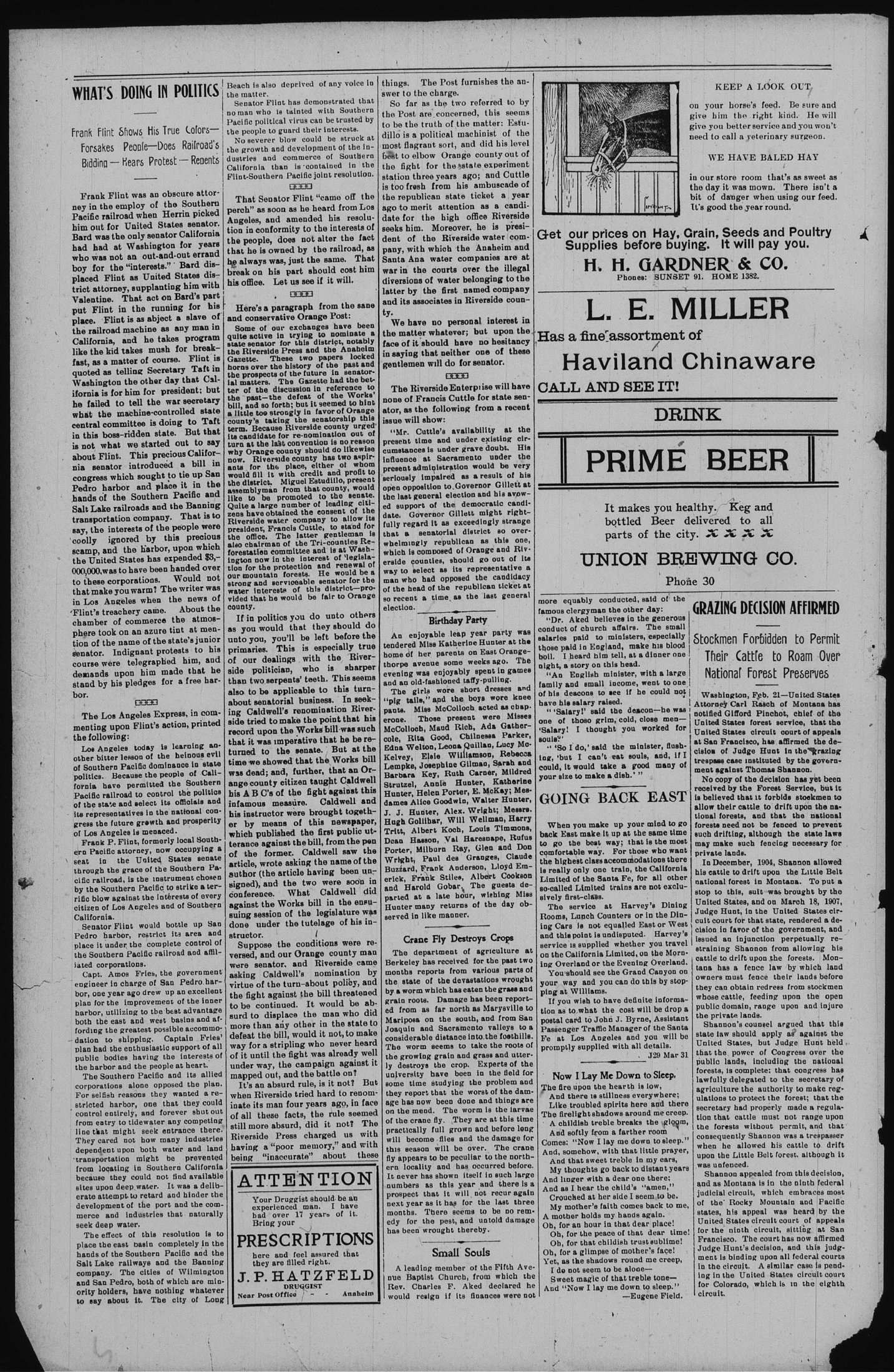
Searchable text
WHAT'S DOING IN POLITICS
Frank Flint Shows His True Colors—Forsakes People—Does Railroad's Bidding — Hears Protest — Repents
Frank Flint was an obscure attorney in the employ of the Southern Pacific railroad when Herrin picked him out for United States senator. Bard was the only senator California had had at Washington for years who was not an out-and-out errand boy for the "interests." Bard displaced Flint as United States district attorney, supplanting him with Valentine. That act on Bard's part put Flint in the running for his place. Flint is as abject a slave of the railroad machine as any man in California, and he takes program like the kid takes mush for breakfast, as a matter of course. Flint is quoted as telling Secretary Taft in Washington the other day that California is for him for president; but he failed to tell the war secretary what the machine-controlled state central committee is doing to Taft in this boss-ridden state. But that is not what we started out to say about Flint. This precious California senator introduced a bill in congress which sought to tie up San Pedro harbor and place it in the hands of the Southern Pacific and Salt Lake railroads and the Banning Beach is also deprived of all the matter.
Senator Flint has demonstrated no man who is tainted with Pacific political virus can be the people to guard their intention in conformity to the interests of the people, does not alter that he is owned by the race he always was, just the same break on his part should his office. Let us see if it
Here's a paragraph from and conservative Orange Press
Some of our exchanges quite active in trying to make state senator for this district the Riverside Press and the Gazette. These two papers horns over the history of the prospects of the future in matters. The Gazette hitherto of the discussion in recent past—the defeat of the bill, and so forth; but it seems a little too strongly in favor county's taking the senate term. Because Riverside county its candidate for re-nomination turn at the last convention why Orange county should do now. Riverside county has ants for the place, either would fill it with credit and the district. Miguel Estudi assemblyman from that country like to be promoted to Quite a large number of leagues have obtained the consent.
what the machine-controlled state central committee is doing to Taft in this boss-ridden state. But that is not what we started out to say about Flint. This precious California senator introduced a bill in congress which sought to tie up San Pedro harbor and place it in the hands of the Southern Pacific and Salt Lake railroads and the Banning transportation company. That is to say, the interests of the people were coolly ignored by this precious scamp, and the harbor, upon which the United States has expended $3,000,000 was to have been handed over to these corporations. Would not that make you warm? The writer was in Los Angeles when the news of Flint's treachery came. About the chamber of commerce the atmosphere took on an azure tint at mention of the name of the state's junior senator. Indignant protests to his course were telegraphed him, and demands upon him made that he stand by his pledges for a free harbor.
The Los Angeles Express, in commenting upon Flint's action, printed the following:
Los Angeles today is learning another bitter lesson of the heinous evil of Southern Pacific dominance in state politics. Because the people of California have permitted the Southern Pacific railroad to control the politics of the state and select its officials and its representatives in the national congress the future growth and prosperity of Los Angeles is menaced.
Frank P. Flint, formerly local Southern Pacific attorney, now occupying a seat in the United States senate through the grace of the Southern Pacific railroad, is the instrument chosen by the Southern Pacific to strike a terrific blow against the interests of every citizen of Los Angeles and of Southern California.
Senator Flint would bottle up San Pedro harbor, restrict its area and place it under the complete control of the Southern Pacific railroad and affiliated corporations.
If in politics you do unknow as you would that they unto you, you'll be left primaries. This is especial of our dealings with the side politician, who is less than two serpents' teeth. It also to be applicable to about senatorial business. Caldwell's renomination side tried to make the point record upon the Works bill that it was imperative that turned to the senate. In time we showed that the W was dead; and, further, the ange county citizen taught his ABC's of the fight and infamous measure. Caldwell's instructor were brought by means of this which published the first terrace against the bill, freed of the former. Caldwell article, wrote asking the author (the article having signed), and the two were conference. What Caldwell against the Works bill insuing session of the legislature done under the tutelage structor.
Suppose the condition versed, and our Orange county's taking the senate term. Because Riverside county's candidate for re-nomination turn at the last convention in why Orange county should do now. Riverside county hasants for the place, either would fill it with credit and the district. Miguel Estudi assemblyman from that could like to be promoted to Quite a large number of leases have obtained the consulate Riverside water company to president, Francis Cuttle, to the office. The latter gets also chairman of the Tri-co forestation committee andington now in the interest tion for the protection and our mountain forests. He is strong and serviceable senate water interests of this divided that he would be fair county.
```markdown
what the machine-controlled state central committee is doing to Taft in this boss-ridden state. But that is not what we started out to say about Flint. This precious California senator introduced a bill in congress which sought to tie up San Pedro harbor and place it in the hands of the Southern Pacific and Salt Lake railroads and the Banning transportation company. That is to say, the interests of the people were coolly ignored by this precious scamp, and the harbor, upon which the United States has expended $3,000,000 was to have been handed over to these corporations. Would not that make you warm? The writer was in Los Angeles when the news of Flint's treachery came. About the chamber of commerce the atmosphere took on an azure tint at mention of the name of the state's junior senator. Indignant protests to his course were telegraphed him, and demands upon him made that he stand by his pledges for a free harbor.
The Los Angeles Express, in commenting upon Flint's action, printed the following:
Los Angeles today is learning another bitter lesson of the heinous evil of Southern Pacific dominance in state politics. Because the people of California have permitted the Southern Pacific railroad to control the politics of the state and select its officials and its representatives in the national congress the future growth and prosperity of Los Angeles is menaced.
Frank P. Flint, formerly local Southern Pacific attorney, now occupying a seat in the United States senate through the grace of the Southern Pacific railroad, is the instrument chosen by the Southern Pacific to strike a terrific blow against the interests of every citizen of Los Angeles and of Southern California.
Senator Flint would bottle up San Pedro harbor, restrict its area and place it under the complete control of the Southern Pacific railroad and affiliated corporations.
```
Senator Flint would bottle up San Pedro harbor, restrict its area and place it under the complete control of the Southern Pacific railroad and affiliated corporations.
Capt. Amos Fries, the government engineer in charge of San Pedro harbor, one year ago drew up an excellent plan for the improvement of the inner harbor, utilizing to the best advantage both the east and west basins and affording the greatest possible accommodation to shipping. Captain Fries' plan had the enthusiastic support of all public bodies having the interests of the harbor and the people at heart.
The Southern Pacific and its allied corporations alone opposed the plan. For selfish reasons they wanted a restricted harbor, one that they could control entirely, and forever shut out from entry to tidewater any competing line that might seek entrance there. They cared not how many industries dependent upon both water and land transportation might be prevented from locating in Southern California because they could not find available sites upon deep water. It was a deliberate attempt to retard and hinder the development of the port and the commerce and industries that naturally seek deep water.
The effect of this resolution is to place the east basin completely in the hands of the Southern Pacific and the Salt Lake railways and the Banning company. The cities of Wilmington and San Pedro, both of which are minority holders, have nothing whatever to say about it. The city of Long
also deprived of any voice in
war.
Senator Flint has demonstrated that
who is tainted with Southern
political virus can be trusted by
the to guard their interests.
There blow could be struck at
both and development of the inland commerce of Southern
than is contained in the
Southern Pacific joint resolution.
Senator Flint "came off the
is soon as he heard from Los
and amended his resoluconformity to the interests of
state, does not alter the fact
is owned by the railroad, as
was, just the same. That
his part should cost him
. Let us see if it will.
A paragraph from the sane
Conservative Orange Post:
Of our exchanges have been
have in trying to nominate a
voter for this district, notably
Riverside Press and the Anaheim
These two papers locked
over the history of the past and
acts of the future in senatorers. The Gazette had the bete discussion in reference to
—the defeat of the Works'
so forth; but it seemed to hint
strongly in favor of Orange
taking the senatorship this
because Riverside county urged
late for re-nomination out of
the last convention is no reason
range county should do likewise
Riverside county has two aspiring place, either of whom
it with credit and profit to
act. Miguel Estudillo, present
man from that county, would
be promoted to the senate.
Large number of leading cititained the consent of the
things. The Post furnishes the answer to the charge.
So far as the two referred to by
the Post are concerned, this seems
to be the truth of the matter: Estudillo is a political machinist of the most flagrant sort, and did his level best to elbow Orange county out of
the fight for the state experiment station three years ago; and Cuttle is too fresh from his ambuscade of
the republican state ticket a year ago to merit attention as a candidate for the high office Riverside seeks him. Moreover, he is president of the Riverside water company, with which the Anaheim and Santa Ana water companies are at war in the courts over the illegal diversions of water belonging to the latter by the first named company and its associates in Riverside county.
We have no personal interest in the matter whatever; but upon the face of it should have no hesitancy in saying that neither one of these gentlemen will do for senator.
The Riverside Enterprise will have none of Francis Cuttle for state senator, as the following from a recent issue will show:
"Mr. Cuttle's availability at the present time and under existing circumstances is under grave doubt. His influence at Sacramento under the present administration would be very seriously impaired as a result of his open opposition to Governor Gillett at the last general election and his avowed support of the democratic candi-
strongly in favor of Orange taking the senatorship this because Riverside county urged late for re-nomination out of the last convention is no reason range county should do likewise Riverside county has two aspirants the place, either of whom it with credit and profit to elect. Miguel Estudillo, present man from that county, would be promoted to the senate. Large number of leading citizens obtained the consent of the water company to allow its use, Francis Cuttle, to stand for office. The latter gentleman iserman of the Tri-counties Recon committee and is at Washnow in the interest of 'legislation the protection and renewal of certain forests. He would be a serviceable senator for the interests of this district—prot he would be fair to Orange politics you do unto others would that they should do so, you'll be left before them. This is especially true dealings with the River-Politician, who is sharper than serpents' teeth. This seems too applicable to this turn-eneratorial business. In seek-Caldwell's renomination River-Id to make the point that his upon the Works bill was such was imperative that he be reto the senate. But at the showed that the Works bill; and, further, that an Or-dentity citizen taught Caldwell C's of the fight against this measure. Caldwell and director were brought together means of this newspaper, published the first public ut-against the bill, from the pen former. Caldwell saw the wrote asking the name of the article having been un- and the two were soon in place. What Caldwell did the Works bill in the ensu-sion of the legislature was under the tutelage of his in-come the conditions were re- and our Orange county maninator, and Riverside came
Mr. Cuttle's availability at the present time and under existing circumstances is under grave doubt. His influence at Sacramento under the present administration would be very seriously impaired as a result of his open opposition to Governor Gillett at the last general election and his avowed support of the democratic candidate. Governor Gillett might rightfully regard it as exceedingly strange that a senatorial district so overwhelmingly republican as this one, which is composed of Orange and Riverside counties, should go out of its way to select as its representative a man who had opposed the candidacy of the head of the republican ticket at so recent a time as the last general election.
Birthday Party
An enjoyable leap year party was tendered Miss Katherine Hunter at the home of her parents on East Orange-thorpe avenue some weeks ago. The evening was enjoyably spent in games and an old-fashioned taffy-pulling.
The girls wore short dresses and "pig tail," and the boys wore knee pants. Miss McColloch acted as chaperone. Those present were Misses McColloch, Maud Rich, Ada Gathercole, Rita Good, Chilnessa Parker, Edna Welton, Leona Quillan, Lucy McKelvey, Elsie Williamson, Rebecca Lempke, Josephine Gilman, Sarah and Barbara Key, Ruth Carner, Mildred Strutzel, Annie Hunter, Katherine Hunter, Helen Porter, E. McKay; Mes-dames Alice Goodwin, Walter Hunter, J. J. Hunter, Alex. Wright; Messrs. Hugh Gollihar, Will Wellman, Harry Tritt, Albert Koch, Louis Timmons, Dean Hasson, Val Haresape, Rufus Porter, Milburn Ray, Glen and Don Wright, Paul des Granges, Claude Buzzard, Frank Anderson, Lloyd Emerick, Frank Stiles, Albert Cookson and Harold Gobar. The guests departed at a late hour, wishing Miss Hunter many returns of the day observed in like manner.
Crane Fly Destroys Crops
The department of agriculture at Berkeley has received for the past two years from various parts of more equably conducted famous clergyman the other.
"Dr. Aked believes in conduct of church affairs salaries paid to ministers those paid in England, re-boll. I heard him tell a night, a story on this hearsome English minister family and small income of his deacons to see if have his salary raised.
"'Salary!" said the d-one of those grim, color 'Salary! I thought your souls?'
"'So I do,' said the ring,' but I can't eat so could, it would take a your size to make a dish.
GOING BACK
When you make up your back East make it up at to go the best way; there comfortable way. For ther highest class accom-munity is really only one train,Limited of the Santa Fe so-called Limited trains sively first-class.
The service at Ha-Rooms, Lunch Counters ing Cars is not equalled and this point is undispu-service is supplied whet on the California Limite ing Overland or the Ever-
Crane Fly Destroys Crops
The department of agriculture at Berkeley has received for the past two months reports from various parts of the state of the devastations wrought by a worm which has eaten the grass and grain roots. Damage has been reported from as far north as Marysville to Mariposa on the south, and from San Joaquin and Sacramento valleys to a considerable distance into the foothills. The worm seems to take the roots of the growing grain and grass and utterly destroys the crop. Experts of the university have been in the field for some time studying the problem and they report that the worst of the damage has now been done and things are on the mend. The worm is the larvae of the crane fly. They are at this time practically full grown and before long will become flies and the damage for this season will be over. The crane fly appears to be peculiar to the northern locality and has occurred before. It never has shown itself in such large numbers as this year and there is a prospect that it will not recur again next year as it has for the last three months. There seems to be no remedy for the pest, and untold damage has been wrought thereby.
Small Souls
A leading member of the Fifth Avenue Baptist Church, from which the Rev. Charles F. Aked declared he would resign if its finances were not
KEEP A LOOK OUT
on your horse's feed. Be sure and give him the right kind. He will give you better service and you won't need to call a veterinary surgeon.
WE HAVE BALED HAY
in our store room that's as sweet as the day it was mown. There isn't a bit of danger when using our feed. It's good the year round.
our prices on Hay, Grain, Seeds and Poultry Supplies before buying. It will pay you.
H. H. GARDNER & CO.
Phones: SUNSET 91. HOME 1382.
L. E. MILLER
is a fine assortment of Haviland Chinaware
LL AND SEE IT!
DRINK
PRIME BEER
It makes you healthy. Keg and
DRINK
PRIME BEER
It makes you healthy. Keg and bottled Beer delivered to all parts of the city.
UNION BREWING CO.
Phone 30
equably conducted, said of the clergyman the other day:
Aked believes in the generous object of church affairs. The small taxes paid to ministers, especially paid in England, make his blood I heard him tell, at a dinner one, a story on this head.
An English minister, with a large pay and small income, went to one deacons to see if he could not his salary raised.
Salary!' said the deacon—he was of those grim, cold, close men—very! I thought you worked for So I do,' said the minister, flush-but I can't eat souls, and, if I did, it would take a good many of size to make a dish.'"
GRAZING DECISION AFFIRMED
Stockmen Forbidden to Permit Their Cattle to Roam Over National Forest Preserves
Washington, Feb. 21—United States Attorney Carl Rasch of Montana has notified Gifford Pinchot, chief of the United States forest service, that the United States circuit court of appeals at San Francisco, has affirmed the decision of Judge Hunt in the grazing trespass case instituted by the government against Thomas Shannon.
No copy of the decision has yet been received by the Forest Service, but it is believed that it forbids stockmen to allow their cattle to drift upon the national forests, and that the national forests need not be fenced to prevent such drifting, although the state laws may make such fencing necessary for private lands.
In December, 1904, Shannon allowed his cattle to drift upon the Little Belt national forest in Montana. To put a stop to this, suit was brought by the United States, and on March 18, 1907, Judge Hunt, in the United States circuit court for that state, rendered a decision in favor of the government, and issued an injunction perpetually restraining Shannon from allowing his cattle to drift upon the forests. Montana has a fence law by which land
Now I lay Me Down to Sleep.
I dare upon the hearth is low,
and there is stillness everywhere;
I have troubled spirits here and there
firelight shadows around me creep.
Childish treble breaks the gloom,
and softly from a farther room
lies: "Now I lay me down to sleep."
Somehow, with that little prayer,
and that sweet treble in my ears,
my thoughts go back to distant years
longer with a dear one there;
as I hear the child's "amen,"
mouched at her side I seem to be.
My mother's faith comes back to me,
other holds my hands again.
For an hour in that dear place!
for the peace of that dear time!
for that childish trust sublime!
For a glimpse of mother's face!
as the shadows round me creep,
do not seem to be alone—
Sweet magic of that treble tone—
"Now I lay me down to sleep."
—Eugene Field.
In December, 1904, Shannon allowed his cattle to drift upon the Little Belt national forest in Montana. To put a stop to this, suit was brought by the United States, and on March 18, 1907, Judge Hunt, in the United States circuit court for that state, rendered a decision in favor of the government, and issued an injunction perpetually restraining Shannon from allowing his cattle to drift upon the forests. Montana has a fence law by which land owners must fence their lands before they can obtain redress from stockmen whose cattle, feeding upon the open public domain, range upon and injure the private lands.
Shannon's counsel argued that this state law should apply as against the United States, but Judge Hunt held that the power of Congress over the public lands, including the national forests, is complete; that congress has lawfully delegated to the secretary of agriculture the authority to make regulations to protect the forest; that the secretary had properly made a regulation that cattle must not range upon the forests without permit, and that consequently Shannon was a trespasser when he allowed his cattle to drift upon the Little Belt forest, although it was unfenced.
Shannon appealed from this decision, and as Montana is in the ninth federal judicial circuit, which embraces most of the Rocky Mountain and Pacific states, his appeal was heard by the United States circuit court of appeals for the ninth circuit, sitting at San Francisco. The court has now affirmed Judge Hunt's decision, and this judgment is binding upon all federal courts in the circuit. A similar case is pending in the United States circuit court for Colorado, which is in the eighth circuit.