anaheim-gazette 1907-12-26
Scanned page
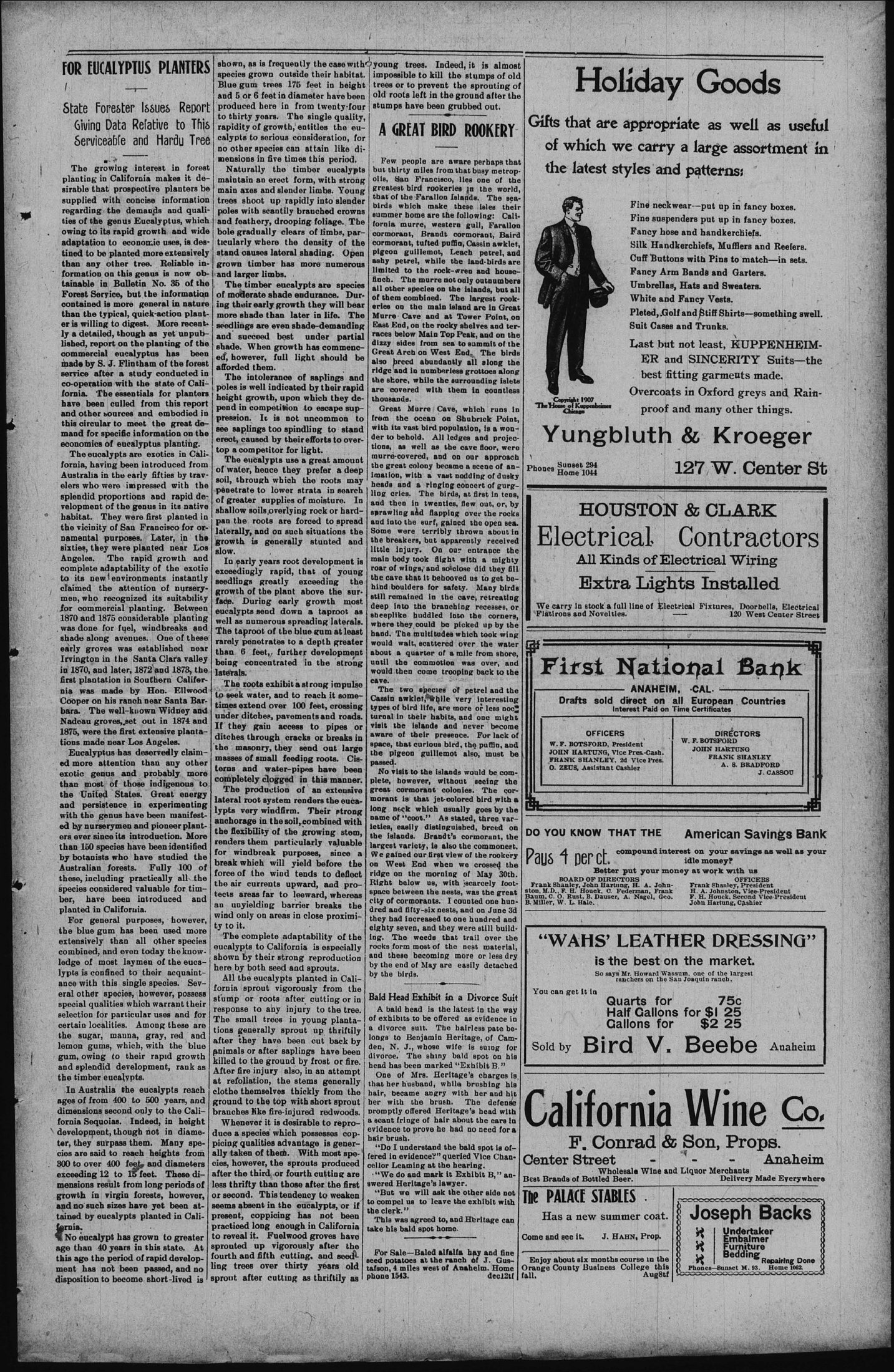
Searchable text
FOR EUCALYPTUS PLANTERS
State Forester Issues Report
Giving Data Relative to This Serviceable and Hardy Tree
The growing interest in forest planting in California makes it desirable that prospective planters be supplied with concise information regarding the demands and qualities of the genus Eucalyptus, which owing to its rapid growth and wide adaptation to economic uses, is destined to be planted more extensively than any other tree. Reliable information on this genus is now obtainable in Bulletin No. 35 of the Forest Service, but the information contained is more general in nature than the typical, quick-action planter is willing to digest. More recently a detailed, though as yet unpublished, report on the planting of the commercial eucalyptus has been made by S. J. Flintham of the forest service after a study conducted in co-operation with the state of California. The essentials for planters have been culled from this report and other sources and embodied in this circular to meet the great demand for specific information on the economics of eucalyptus planting.
The eucalypts are exotics in California, having been introduced from Australia in the early fifties by travelers who were impressed with the splendid proportions and rapid development of the genus in its native shown, as is frequently the case species grown outside their Blue gum trees 175 feet in and 5 or 6 feet in diameter have produced here in from twenty to thirty years. The single rapidity of growth, entitles eucalypts to serious consideration no other species can attain dimensions in five times this period.
Naturally the timber eucalypts maintain an erect form, with main axes and slender limbs. Trees shoot up rapidly into poles with scantily branched and feathery, drooping foliage gradually clears of limbicularly where the density stands causes lateral shading. Grown timber has more nuanced and larger limbs.
The timber eucalypts are of moderate shade enduranceing their early growth they will more shade than later in life seedlings are even shade-demanding and succeed best under shade. When growth has come, however, full light should afforded them.
The intolerance of saplings poles is well indicated by their height growth, upon which they tend in competition to escape pression. It is not uncommon see saplings too spindling to erect, caused by their efforts to top a competitor for light.
The eucalypts use a great amount of water, hence they prefer soil, through which the root penetrate to lower strata in greater supplies of moisture shallow soils overlying rock or
have been called from this report and other sources and embodied in this circular to meet the great demand for specific information on the economics of eucalyptus planting.
The eucalypts are exotics in California, having been introduced from Australia in the early fifties by travelers who were impressed with the splendid proportions and rapid development of the genus in its native habitat. They were first planted in the vicinity of San Francisco for ornamental purposes. Later, in the sixties, they were planted near Los Angeles. The rapid growth and complete adaptability of the exotic to its new environments instantly claimed the attention of nurserymen, who recognized its suitability for commercial planting. Between 1870 and 1875 considerable planting was done for fuel, windbreaks and shade along avenues. One of these early groves was established near Irvington in the Santa Clara valley in 1870, and later, 1872 and 1873, the first plantation in Southern California was made by Hon. Ellwood Cooper on his ranch near Santa Barbara. The well-known Widney and Nadeau groves, set out in 1874 and 1875, were the first extensive plantations made near Los Angeles.
Eucalyptus has deservedly claimed more attention than any other exotic genus and probably more than most of those indigenous to the United States. Great energy and persistence in experimenting with the genus have been manifested by nurserymen and pioneer planters ever since its introduction. More than 150 species have been identified by botanists who have studied the Australian forests. Fully 100 of these, including practically all the species considered valuable for timber, have been introduced and planted in California.
For general purposes, however, the blue gum has been used more extensively than all other species combined, and even today the knowledge of most laymen of the eucalyptus is espirable by their strong reproduction by both seed and sprout.
In early years root development exceedingly rapid, that of seedlings greatly exceeding growth of the plant above the face. During early growth, eucalyptus send down a taproot well as numerous spreading lanceolate penetrates to a depth greater than 6 feet, further developing being concentrated in the laterals.
The roots exhibit a strong ability to seek water, and to reach it times extend over 100 feet, under ditches, pavements and if they gain access to pit ditches through cracks or breaks the masonry, they send out masses of small feeding roots terns and water-pipes have completely clogged in this manner.
The production of an external root system renders the lycopts very windfirm. Their anchorage in the soil combines the flexibility of the growing renders them particularly valuable for windbreak purposes, so break which will yield before force of the wind tends to the air currents upward, and infects areas far to leeward, where an unyielding barrier break wind only on areas in close proximity to it.
The complete adaptability of eucalyptus to California is especially shown by their strong reproduction here by both seed and sprout.
Australian forests. Fully 100 of these, including practically all the species considered valuable for timber, have been introduced and planted in California.
For general purposes, however, the blue gum has been used more extensively than all other species combined, and even today the knowledge of most laymen of the eucalypts is confined to their acquaintance with this single species. Several other species, however, possess special qualities which warrant their selection for particular uses and for certain localities. Among these are the sugar, manna, gray, red and lemon gums, which, with the blue gum, owing to their rapid growth and splendid development, rank as the timber eucalypts.
In Australia the eucalypts reach ages of from 400 to 500 years, and dimensions second only to the California Sequoias. Indeed, in height development, though not in diameter, they surpass them. Many species are said to reach heights from 300 to over 400 feet and diameters exceeding 12 to 15 feet. These dimensions result from long periods of growth in virgin forests, however, and no such sizes have yet been attained by eucalypts planted in California.
No eucalypt has grown to greater age than 40 years in this state. At this age the period of rapid development has not been passed, and no disposition to become short-lived is
The complete adaptability of eucalypts to California is especially shown by their strong reproduction here by both seed and sprouts.
All the eucalypts planted in formia sprout vigorously from stump or roots after cutting response to any injury to the small trees in young populations generally sprout up the after they have been cut by animals or after saplings have killed to the ground by frost. After fire injury also, in an attempt at refoliation, the stems generally clothe themselves thickly from ground to the top with short branches like fire-injured redwoods.
Whenever it is desirable to reduce a species which possesses pacing qualities advantage is greatly taken of them. With many species, however, the sprouts proceed after the third or fourth cutting less thrifty than those after the second. This tendency to weaken seems absent in the eucalypts present, coppicing has not practiced long enough in California to reveal it. Fuelwood groves sprouted up vigorously after fourth and fifth cutting, and living trees over thirty years sprout after cutting as thrift.
is frequently the case with
own outside their habitat.
trees 175 feet in height
feet in diameter have been
here in from twenty-four
years. The single quality,
growth, entitles the euserious consideration, for
species can attain like difine times this period.
by the timber eucalypts
erect form, with strong
and slender limbs. Young
up rapidly into slender
scantily branched crowns
ery, drooping foliage. The
ally clears of limbs, parhere the density of the
less lateral shading. Open
ber has more numerous
limbs.
eucalypts are species
the shade endurance. Durarly growth they will bear
more than later in life. The
are even shade-demanding
best under partial
en growth has commencfull light should be
em.
tolerance of saplings and
indicated by their rapid
growth, upon which they depetition to escape supit is not uncommon to
too spindling to stand
by their efforts to overtitor for light.
eucalypts use a great amount
once they prefer a deep
which the roots may
lower strata in search
supplies of moisture. In
overlying rock or hard-
young trees. Indeed, it is almost impossible to kill the stumps of old trees or to prevent the sprouting of old roots left in the ground after the stumps have been grubbed out.
A GREAT BIRD ROOKERY
Few people are aware perhaps that but thirty miles from that busy metropolis, San Francisco, lies one of the greatest bird rookeries in the world, that of the Farallon Islands. The sea-birds which make these isles their summer home are the following: California murre, western gull, Farallon cormorant, Brandt cormorant, Baird cormorant, tufted puffin, Cassin awklet, pigeon guillemot, Leach petrel, and ashy petrel, while the land-birds are limited to the rock-wren and house-finch. The murre not only outnumbers all other species on the islands, but all of them combined. The largest rookeries on the main island are in Great Murre Cave and at Tower Point, on East End, on the rocky shelves and terraces below Main Top Peak, and on the dizzy sides from sea to summit of the Great Arch on West End. The birds also breed abundantly all along the ridge and in numberless grottoes along the shore, while the surrounding islets are covered with them in countless thousands.
Great Murre Cave, which runs in from the ocean on Shubrick Point, with its vast bird population, is a wonder to behold. All ledges and projections, as well as the cave floor, were murre-covered, and on our approach the great colony became a scene of animation, with a vast nodding of dusky heads and a ringing concert of gurgling cries. The birds, at first in tens, and then in twenties, flew out, or, by sprawling old flapping over
Great Murre Cave, which runs in from the ocean on Shubrick Point, with its vast bird population, is a wonder to behold. All ledges and projections, as well as the cave floor, were murre-covered, and on our approach the great colony became a scene of animation, with a vast nodding of dusky heads and a ringing concert of gurgling cries. The birds, at first in tens, and then in twenties, flew out, or, by sprawling and flapping over the rocks and into the surf, gained the open sea. Some were terribly thrown about in the breakers, but apparently received little injury. On our entrance the main body took flight with a mighty roar of wings, and so close did they fill the cave that it behooved us to get behind boulders for safety. Many birds still remained in the cave, retreating deep into the branching recesses, or sheeplike huddled into the corners, where they could be picked up by the hand. The multitudes which took wing would wait, scattered over the water about a quarter of a mile from shore, until the commotion was over, and would then come trooping back to the cave.
The two species of petrel and the Cassin awklet, while very interesting types of bird life, are more or less nocturnal in their habits, and one might visit the islands and never become aware of their presence. For lack of space, that curious bird, the puffin, and the pigeon guillemot also, must be passed.
No visit to the islands would be complete, however, without seeing the great cormorant colonies. The cormorant is that jet-colored bird with a long neck which usually goes by the name of "coot." As stated, three varieties, easily distinguished, breed on the islands. Brandt's cormorant, the largest variety, is also the commonest. We gained our first view of the rookery on West End when we crossed the ridge on the morning of May 30th. Right below us, with scarcely foot-space between the nests, was the great city of cormorants. I counted one hundred and fifty-six nests, and on June 3d they had increased to one hundred and eighty seven, and they were still building. The weeds that trail over the rocks form most of the nest material, and these becoming more or less dry by the end of May are easily detached.
"WAHS' LIFE is the..."
Bald Head Exhibit in a Divorce Suit
A bald head is the latest in the way of exhibits to be offered as evidence in a divorce suit. The hairless pate belongs to Benjamin Heritage, of Camden, N. J., whose wife is suing for divorce. The shiny bald spot on his head has been marked "Exhibit B."
One of Mrs. Heritage's charges is that her husband, while brushing his hair, became angry with her and hit her with the brush. The defense promptly offered Heritage's head with a scant fringe of hair about the ears in evidence to prove he had no need for a hair brush.
"Do I understand the bald spot is offered in evidence?" queried Vice Chancellor Leaming at the hearing.
"We do and mark it Exhibit B," answered Heritage's lawyer.
But we will ask the other side not to compel us to leave the exhibit with the clerk."
This was agreed to, and Heritage can take his bald spot home.
For Sale—Baled alfalfa hay and fine seed potatoes at the ranch of J. Gustafson, 4 miles west of Anaheim. Home phone 1543.
Holiday Goods
that are appropriate as well as useful
which we carry a large assortment in
the latest styles and patterns:
Fine neckwear—put up in fancy boxes.
Fine suspenders put up in fancy boxes.
Fancy hose and handkerchiefs.
Silk Handkerchiefs, Mufflers and Reefers.
Cuff Buttons with Pins to match—in sets.
Fancy Arm Bands and Garters.
Umbrellas, Hats and Sweaters.
White and Fancy Vests.
Pleted, Golf and Stiff Shirts—something swell.
Suit Cases and Trunks.
Last but not least, KUPPENHEIMER and SINCERITY Suits—the best fitting garments made.
Overcoats in Oxford greys and Rain-proof and many other things.
ungbluth & Kroeger
127 W. Center St
proof and many other things.
ungbluth & Kroeger
Sunset 294
Home 1044
127 W. Center St
HOUSTON & CLARK
Electrical Contractors
All Kinds of Electrical Wiring
Extra Lights Installed
erry in stock a full line of Electrical Fixtures, Doorbells, Electrical
ons and Novelties. — 120 West Center Street
first National Bank
ANAHEIM, CAL.
Drafts sold direct on all European Countries
Interest Paid on Time Certificates
OFFICERS
F. BOTSFORD, President
JOHN HARTUNG, Vice Pres.-Cash.
ANK SHANLEY, 2d Vice Pres.
ZEUS, Assistant Cashier
DIRECTORS
W. F. BOTSFORD
JOHN HARTUNG
FRANK SHANLEY
A. S. BRADFORD
J. CASSOU
U KNOW THAT THE American Savings Bank
compound interest on your savings as well as your
idle money?
Better put your money at work with us
BOARD OF DIRECTORS
Janley, John Hartung, H. A. JohnF. H. Houck, C. Federman, Frank
D. Rust, B. Dauser, A. Nagel, Geo.
V. L. Hale.
OFFICERS
Frank Shanley, President
H. A. Johnston, Vice-President
F. H. Houck, Second Vice-President
John Hartung, Cashler
VAHS' LEATHER DRESSING"
is the best on the market.
Better put your money at work with us
BOARD OF DIRECTORS
Danley, John Hartung, H. A. JohnF. H. Houck, C. Federman, Frank
D. Rust, B. Dauser, A. Nagel, Geo.
V. L. Hale.
OFFICERS
Frank Shanley, President
H. A. Johnston, Vice-President
F. H. Houck, Second Vice-President
John Hartung, Cashier
"WAHS' LEATHER DRESSING"
is the best on the market.
So says Mr. Howard Wassum, one of the largest
ranchers on the San Joaquin ranch.
Quarts for 75c
Half Gallons for $1 25
Gallons for $2 25
by Bird V. Beebe Anaheim
California Wine Co.
F. Conrad & Son, Props.
For Street - Anaheim
Wholesale Wine and Liquor Merchants
Bands of Bottled Beer.
Delivery Made Everywhere
PLACE STABLES
Is a new summer coat.
See it. J. HAHN, Prop.
About six months course in the
County Business College this
Aug8tf
Joseph Backs
Undertaker
Embalmer
Furniture
Bedding
Repairing Done
Phones—Sunset M. 93. Home 1062.