anaheim-gazette 1907-11-14
Scanned page
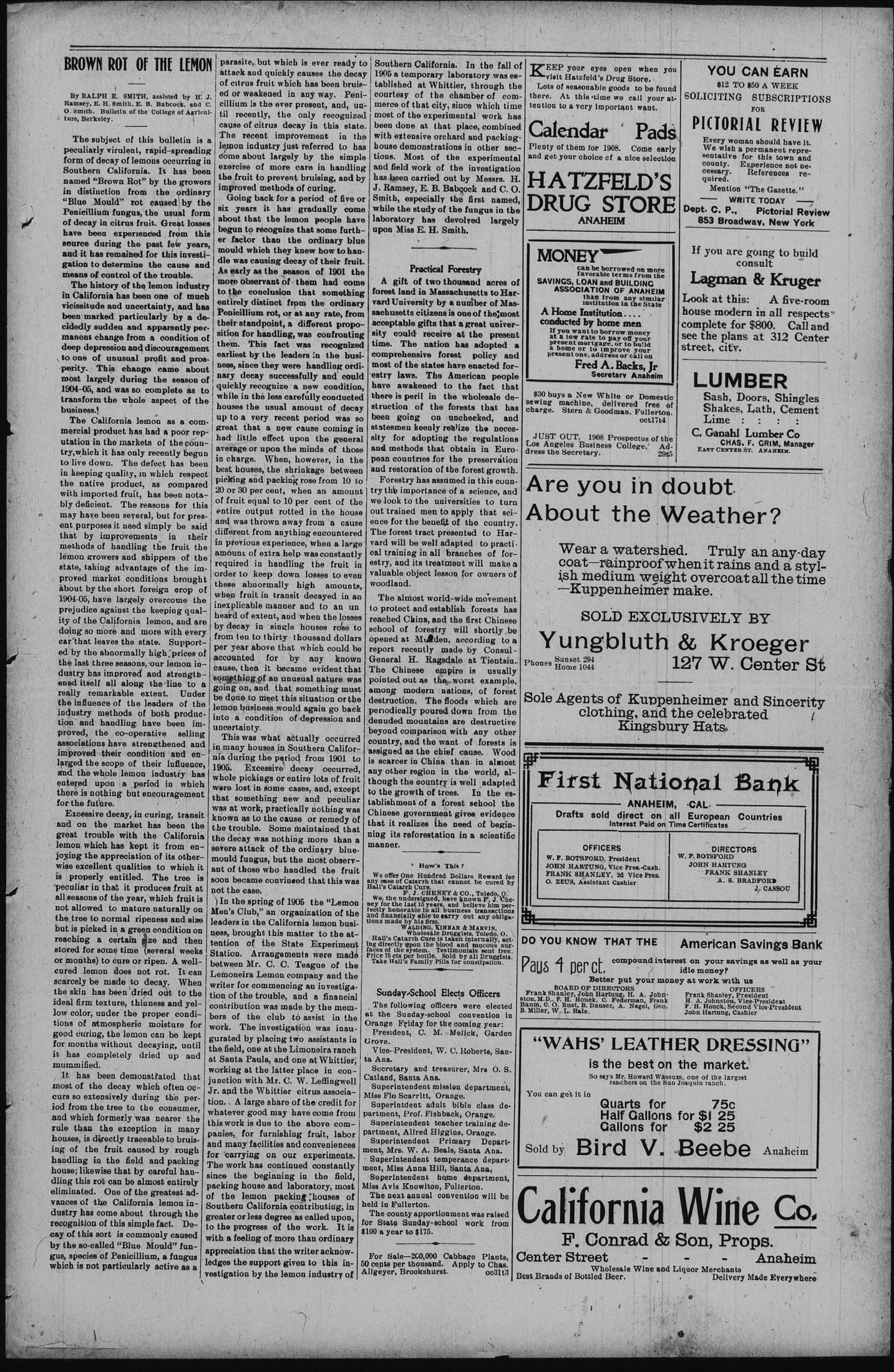
Searchable text
BROWN ROT OF THE LEMON
By RALPH E. SMITH, assisted by H. J. Ramsey, E. H. Smith, E. B. Babcock, and C. O. Smith. Bulletin of the College of Agriculture, Berkeley.
The subject of this bulletin is a peculiarly virulent, rapid-spreading form of decay of lemons occurring in Southern California. It has been named "Brown Rot" by the growers in distinction from the ordinary "Blue Mould" rot caused by the Penicillium fungus, the usual form of decay in citrus fruit. Great losses have been experienced from this source during the past few years, and it has remained for this investigation to determine the cause and means of control of the trouble.
The history of the lemon industry in California has been one of much vicissitude and uncertainty, and has been marked particularly by a decidedly sudden and apparently permanent change from a condition of deep depression and discouragement to one of unusual profit and prosperity. This change came about most largely during the season of 1904-05, and was so complete as to transform the whole aspect of the business!
The California lemon as a commercial product has had a poor reputation in the markets of the country, which it has only recently begun to live down. The defect has been in keeping quality, in which respect the native product, as compared with imported fruit, has been notably deficient. The reasons for this parasite, but which is ever attack and quickly causes the of citrus fruit which has been ed or weakened in any way, cillium is the ever present, and til recently, the only recause of citrus decay in this.
The recent improvement in lemon industry just referred to come about largely by their exercise of more care in horticulture to prevent bruising improved methods of curing.
Going back for a period of six years it has gradually about that the lemon people begun to recognize that some er factor than the ordinal mould which they knew how did was causing decay of them. As early as the season of 1904 more observant of them had to the conclusion that some entirely distinct from the Penicillium rot, or at any rate their standpoint, a different situation for handling, was confined them. This fact was earliest by the leaders in the ness, since they were handling nary decay successfully and quickly recognize a new con while in the less carefully con houses the usual amount o up to a very recent period great that a new cause con had little effect upon the average or upon the minds on in charge. When, however, best houses, the shrinkage b picking and packing rose from 20 or 30 per cent, when an of fruit equal to 10 per cent entire output rotted in the
The California lemon as a commercial product has had a poor reputation in the markets of the country, which it has only recently begun to live down. The defect has been in keeping quality, in which respect the native product, as compared with imported fruit, has been notably deficient. The reasons for this may have been several, but for present purposes it need simply be said that by improvements in their methods of handling the fruit the lemon growers and shippers of the state, taking advantage of the improved market conditions brought about by the short foreign crop of 1904-05, have largely overcome the prejudice against the keeping quality of the California lemon, and are doing so more and more with every car that leaves the state. Supported by the abnormally high prices of the last three seasons, our lemon industry has improved and strengthened itself all along the line to a really remarkable extent. Under the influence of the leaders of the industry methods of both production and handling have been improved, the co-operative selling associations have strengthened and improved their condition and enlarged the scope of their influence, and the whole lemon industry has entered upon a period in which there is nothing but encouragement for the future.
Excessive decay, in curing, transit and on the market has been the great trouble with the California lemon which has kept it from enjoying the appreciation of its otherwise excellent qualities to which it is properly entitled. The tree is peculiar in that it produces fruit at all seasons of the year, which fruit is not allowed to mature naturally on the tree to normal ripeness and size but is picked in a green condition on reaching a certain size and then stored for some time (several weeks or months) to cure or ripen. A well-used house the usual amount of up to a very recent period was great that a new cause could had little effect upon the average or upon the minds of in charge. When, however, best houses, the shrinkage by picking and packing rose from 20 or 30 per cent, when an amount of fruit equal to 10 per cent of entire output rotted in them and was thrown away from a different from anything encountered in previous experience, when an amount of extra help was required in handling the fruit order to keep down losses these abnormally high and when fruit in transit decayed inexplicable manner and to heard of extent, and when they by decay in single houses from ten to thirty thousand per year above that which accounted for by any cause, then it became evident something of an unusual nature going on, and that something be done to meet this situation lemon business would again go into a condition of depression uncertainty.
This was what actually occurred in many houses in Southern California during the period from 1904-05. Excessive decay occurred whole pickings or entire lots of were lost in some cases, and, that something new and perished was at work, practically nothing known as to the cause or reminding the trouble. Some maintained the decay was nothing more severe attack of the ordinary mould fungus, but the most ominous ant of those who handled them soon became convinced that they not the case.
In the spring of 1905 the "I Men's Club," an organization of leaders in the California lemoniness, brought this matter to the attention of the State Experiment Station. Arrangements were made between Mr. C. C. Teague
wise excellent qualities to which it is properly entitled. The tree is peculiar in that it produces fruit at all seasons of the year, which fruit is not allowed to mature naturally on the tree to normal ripeness and size but is picked in a green condition on reaching a certain size and then stored for some time (several weeks or months) to cure or ripen. A well-cured lemon does not rot. It can scarcely be made to decay. When the skin has been dried out to the ideal firm texture, thinness and yellow color, under the proper conditions of atmospheric moisture for good curing, the lemon can be kept for months without decaying, until it has completely dried up and mummified.
It has been demonstrated that most of the decay which often occurs so extensively during the period from the tree to the consumer, and which formerly was nearer the rule than the exception in many houses, is directly traceable to bruising of the fruit caused by rough handling in the field and packing house; likewise that by careful handling this rot can be almost entirely eliminated. One of the greatest advances of the California lemon industry has come about through the recognition of this simple fact. Decay of this sort is commonly caused by the so-called "Blue Mould" fungus, species of Penicillium, a fungus which is not particularly active as a
In the spring of 1905 the "Men's Club," an organization of leaders in the California lemoniness, brought this matter to the attention of the State Experiment Station. Arrangements were made between Mr. C. C. Teague of Lemoneira Lemon company and writer for commencing an investigation of the trouble, and a final contribution was made by the members of the club to assist in work. The investigation was guided by placing two assists in the field, one at the Limoneira plant at Santa Paula, and one at Whittier working at the latter place in junction with Mr. C. W. Lefflin Jr. and the Whittier citrus association. A large share of the credit whatever good may have come from this work is due to the above panies, for furnishing fruit, and many facilities and conveniences for carrying on our experiment. The work has continued constantly since the beginning in the packing house and laboratory, of the lemon packing house Southern California contributing greater or less degree as called up to the progress of the work. With a feeling of more than ordinal appreciation that the writer acknowledges the support given to this investigation by the lemon industry
but which is ever ready to
quickly causes the decay
of fruit which has been bruisened in any way. Penithe ever present, and, unonly, the only recognized
fruit decay in this state.
That improvement in the
industry just referred to has
largely by the simple
of more care in handling
to prevent bruising, and by
methods of curing.
Back for a period of five or
it has gradually come
in the lemon people have
recognize that some furththan the ordinary blue
which they knew how to hanusing decay of their fruit.
In the season of 1901 the
avant of them had come
inclusion that something
distinct from the ordinary
rot, or at any rate, from
point, a different propohandling, was confronting
this fact was recognized
the leaders in the busithey were handling ordisuccessfully and could
recognize a new condition,
he less carefully conducted
usual amount of decay
recent period was so
a new cause coming in
effect upon the general
upon the minds of those
When, however, in the
the shrinkage between
packing rose from 10 to
cent, when an amount
al to 10 per cent of the
out rotted in the house
Southern California. In the fall of
1905 a temporary laboratory was established at Whittier, through the
courtesy of the chamber of commerce of that city, since which time
most of the experimental work has
been done at that place, combined
with extensive orchard and packihouse demonstrations in other sections. Most of the experimental
and field work of the investigation
has been carried out by Messrs. H.
J. Ramsey, E. B. Babcock and C. O.
Smith, especially the first named,
while the study of the fungus in the
laboratory has devolved largely
upon Miss E. H. Smith.
Practical Forestry
A gift of two thousand acres of forest land in Massachusetts to Harvard University by a number of Massachusetts citizens is one of the most acceptable gifts that a great university could receive at the present time. The nation has adopted a comprehensive forest policy and most of the states have enacted forestry laws. The American people have awakened to the fact that there is peril in the wholesale destruction of the forests that has been going on unchecked, and statesmen keenly realize the necessity for adopting the regulations and methods that obtain in European countries for the preservation and restoration of the forest growth.
Forestry has assumed in this country the importance of a science, and we look to the universities to turn out trained men to apply that sci-
usual amount of decay
very recent period was so
a new cause coming in
effect upon the general
upon the minds of those
When, however, in the
the shrinkage between
packing rose from 10 to
cent, when an amount
al to 10 per cent of the
out rotted in the house
down away from a cause
from anything encountered
experience, when a large
extra help was constantly
handling the fruit in
keep down losses to even
formally high amounts,
in transit decayed in an
manner and to an ungent, and when the losses
a single houses rose to
thirty thousand dollars
love that which could be
for by any known
it became evident that
of an unusual nature was
and that something must
meet this situation or the
less would again go back
edition of depression and
what actually occurred
cases in Southern Califorthe period from 1901 to
passive decay occurred,
lags or entire lots of fruit
some cases, and, except
new and peculiar
practically nothing was
the cause or remedy of
Some maintained that
was nothing more than a
ark of the ordinary blues, but the most observwho handled the fruit
convinced that this was
ing of 1905 the "Lemon"
an organization of the
California lemon busit this matter to the atthe State Experiment
arrangements were made
C. C. Teague of the
instruction of the forests that has been going on unchecked, and statesmen keenly realize the necessity for adopting the regulations and methods that obtain in European countries for the preservation and restoration of the forest growth.
Forestry has assumed in this country the importance of a science, and we look to the universities to turn out trained men to apply that science for the benefit of the country. The forest tract presented to Harvard will be well adapted to practical training in all branches of forestry, and its treatment will make a valuable object lesson for owners of woodland.
The almost world-wide movement to protect and establish forests has reached China, and the first Chinese school of forestry will shortly be opened at Mudden, according to a report recently made by Consul-General H. Ragsdale at Tientsiu. The Chinese empire is usually pointed out as the worst example, among modern nations, of forest destruction. The floods which are periodically poured down from the denuded mountains are destructive beyond comparison with any other country, and the want of forests is assigned as the chief cause. Wood is scarcer in China than in almost any other region in the world, although the country is well adapted to the growth of trees. In the establishment of a forest school the Chinese government gives evidence that it realizes the need of beginning its reforestation in a scientific manner.
How's This?
We offer One Hundred Dollars Reward for any case of Catarrh that cannot be cured by Hall's Catarrh Cure.
F. J. CHENEY & CO., Toledo, O.
We, the undersigned, have known F. J. Cheney for the last 16 years, and believe him perfectly honorable in all business transactions and financially able to carry out any obligations made by his firm.
WALDING, KINNAN & MARVIN,
Wholesale Druggists, Toledo, O.
Hall's Catarrh Cure is taken internally, acting directly upon the blood and mucous surfaces of the system. Testimonials sent free. Price 75 cts per bottle. Sold by all Druggists.
Take Hall's Family Pills for constipation.
Sunday-School Elects Officers
The following officers were elected at the Sunday-school convention in Orange Friday for the coming year:
President, C. M. Melick, Garden Grove.
Vice-President, W. C. Roberts, Santa Ana.
Secretary and treasurer, Mrs O. S. Catland, Santa Ana.
Superintendent mission department, Miss Flo Scarritt, Orange.
Superintendent adult bible class department, Prof. Fishback, Orange.
Superintendent teacher training department, Alfred Higgins, Orange.
Superintendent Primary Department, Mrs. W. A. Beals, Santa Ana.
Superintendent temperance department, Miss Anna Hill, Santa Ana.
Superintendent home department, Miss Avis Knowlton, Fullerton.
The next annual convention will be held in Fullerton.
The county apportionment was raised for State Sunday-school work from $100 a year to $175.
For Sale—200,000 Cabbage Plants,
50 cents per thousand. Apply to Chas.
Allgeyer, Brookshurst. oc31t3
YOU CAN EARN
$12 TO $50 A WEEK
SOLICITING SUBSCRIPTIONS
FOR
PICTORIAL REVIEW
Every woman should have it.
We wish a permanent representative for this town and county.
Experience not necessary.
References required.
Mention "The Gazette."
WRITE TODAY
Dept. C. P., Pictorial Review
853 Broadway, New York
If you are going to build consult
Lagman & Kruger
Look at this: A five-room house modern in all respects complete for $800. Call and see the plans at 312 Center street, city.
LUMBER
Sash, Doors, Shingles
Shakes, Lath, Cement
Lime : : : :
C. Ganahl Lumber Co
CHAS. F. CRIM, Manager
EAST CENTER ST. ANAHEIM.
Are you in doubt about the Weather?
Wear a watershed. Truly an any-day coat—rainproof when it rains and a stylish medium weight overcoat all the time—Kuppenheimer make.
SOLD EXCLUSIVELY BY
ungbluth & Kroeger
127 W. Center St
Agents of Kuppenheimer and Sincerity clothing, and the celebrated Kingsbury Hats.
First National Bank
ANAHEIM, CAL.
Drafts sold direct on all European Countries
Interest Paid on Time Certificates
OFFICERS
W. BOTSFORD, President
JOHN HARTUNG, Vice Pres.-Cash.
FRANK SHANLEY, 2d Vice Pres.
EUS, Assistant Cashier
DIRECTORS
W. F. BOTSFORD
JOHN HARTUNG
FRANK SHANLEY
A. S. BRADFORD
J. CASSOU
KNOW THAT THE American Savings Bank compound interest on your savings as well as your idle money?
Better put your money at work with us
BOARD OF DIRECTORS
Anley, John Hartung, H. A. JohnH. Houck, C. Federman, Frank
Rust, B. Dauser, A. Nagel, Geo.
L. Hale.
OFFICERS
Frank Shanley, President
H. A. Johnston, Vice-President
F. H. Houck, Second Vice-President
John Hartung, Cashier
WAHS' LEATHER DRESSING"
is the best on the market.
So says Mr. Howard Wassum, one of the largest ranchers on the San Joaquin ranch.
get it in
Quarts for 75c
Half Gallons for $1 25
Gallons for $2 25
by Bird V. Beebe Anaheim
California Wine Co.
F. Conrad & Son, Props.
Street - - Anaheim
Wholesale Wine and Liquor Merchants
of Bottled Beer.
Delivery Made Everywhere