anaheim-gazette 1907-05-30
Scanned page
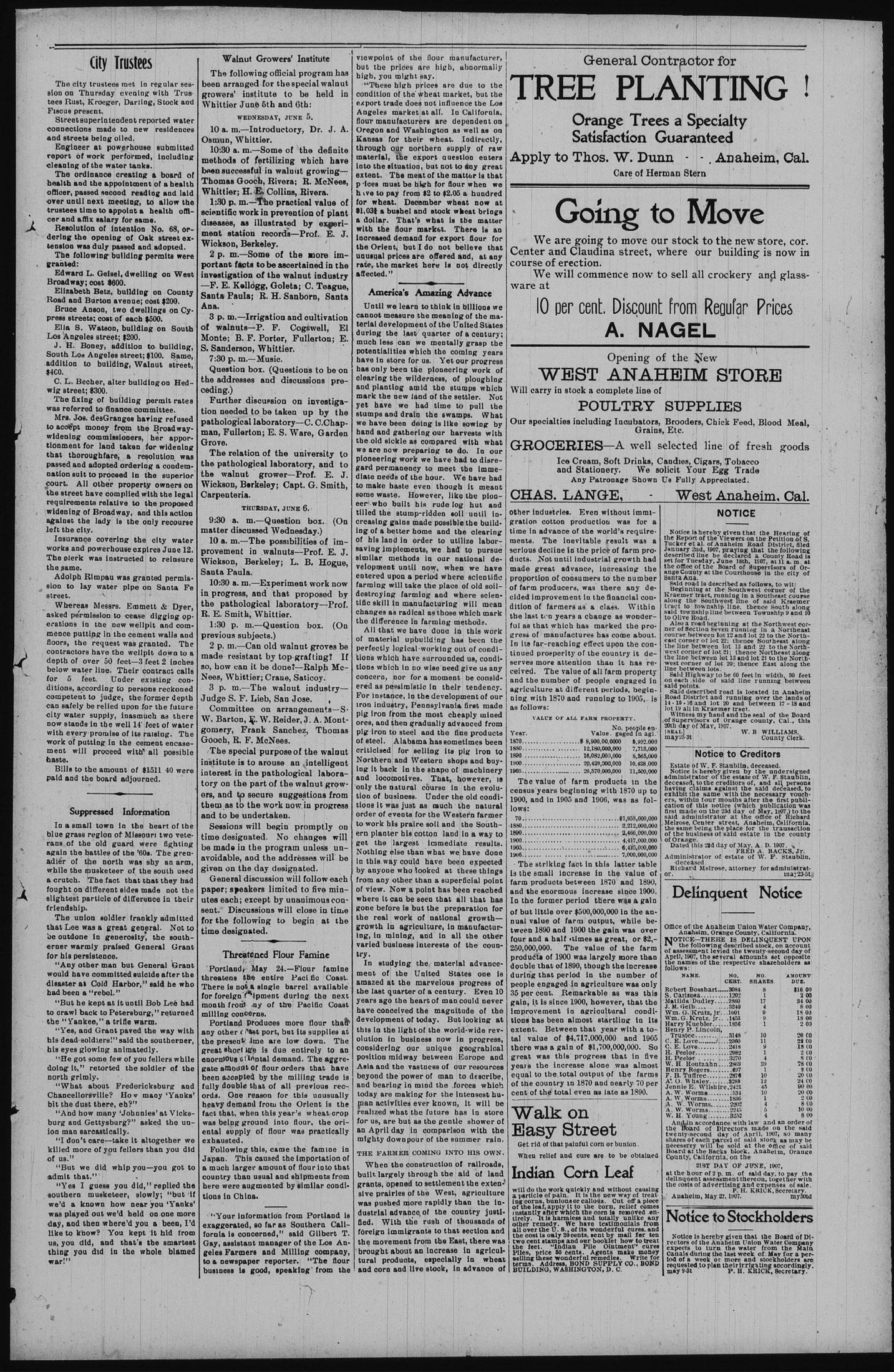
Searchable text
City Trustees
The city trustees met in regular session on Thursday evening with Trustees Rust, Kroeger, Darling, Stock and Fiscus present.
Street superintendent reported water connections made to new residences and streets being oiled.
Engineer at powerhouse submitted report of work performed, including cleaning of the water tanks.
The ordinance creating a board of health and the appointment of a health officer, passed second reading and laid over until next meeting, to allow the trustees time to appoint a health officer and affix salary for same.
Resolution of intention No. 68, ordering the opening of Oak street extension was duly passed and adopted.
The following building permits were granted:
Edward L. Geisel, dwelling on West Broadway; cost $600.
Elizabeth Betz, building on County Road and Burton avenue; cost $200.
Bruce Anson, two dwellings on Cypress streets; cost of each $500.
Ella S. Watson, building on South Los Angeles street; $200.
J. H. Boney, addition to building, South Los Angeles street; $100. Same, addition to building, Walnut street, $400.
C. L. Becher, alter building on Hedwig street; $300.
The fixing of building permit rates was referred to finance committee.
Mrs. Jos. desGranges having refused to accept money from the Broadway-widening commissioners, her apportionment for land taken for widening that thoroughfare, a resolution was passed and adopted ordering a condemnation suit to proceed in the superior court. All other property owners on the street have complied with the legal requirements relative to the proposed widening of Broadway, and this action
Walnut Growers' Institute
The following official program has been arranged for the special walnut growers' institute to be held at Whittier June 5th and 6th:
WEDNESDAY, JUNE 5.
10 a.m.-Introductory, Dr. J. Osmun, Whittier.
10:30 a.m.-Some of the definite methods of fertilizing which have been successful in walnut growing Thomas Gooch, Rivera; R. McNeil Whittier; H. E. Collins, Rivera.
1:30 p.m.-The practical value scientific work in prevention of plant diseases, as illustrated by experiment station records—Prof. E. Wickson, Berkeley.
2 p.m.-Some of the more important facts to be ascertained in investigation of the walnut industry—F. E. Kellogg, Goleta; C. Teag Santa Paula; R. H. Sanborn, San Ana.
3 p.m.-Irrigation and cultivation of walnuts—P. F. Cogawell, Monte; B. F. Porter, Fullerton; S. Sanderson, Whittier.
7:30 p.m.-Music.
Question box. (Questions to be the addresses and discussions preceding.) Further discussion on investigation needed to be taken up by pathological laboratory—C. C. Chisman, Fullerton; E. S. Ware, Gar Grove.
The relation of the university to the pathological laboratory, and the walnut grower—Prof. E. Wickson, Berkeley; Capt. G. Sm Carpenteria.
THURSDAY, JUNE 6.
Mrs. Jos. desGranges having refused to accept money from the Broadway-widening commissioners, her apportionment for land taken for widening that thoroughfare, a resolution was passed and adopted ordering a condemnation suit to proceed in the superior court. All other property owners on the street have complied with the legal requirements relative to the proposed widening of Broadway, and this action against the lady is the only recourse left the city.
Insurance covering the city water works and powerhouse expires June 12. The clerk was instructed to reinsure the same.
Adolph Rimpau was granted permission to lay water pipe on Santa Fe street.
Whereas Messrs. Emmett & Dyer, asked permission to cease digging operations in the new wellpit and commence putting in the cement walls and floors, the request was granted. The contractors have the wellpit down to a depth of over 50 feet—3 feet 2 inches below water line. Their contract calls for 5 feet. Under existing conditions, according to persons reckoned competent to judge, the former depth can safely be relied upon for the future city water supply, inasmuch as there now stands in the well 14 feet of water with every promise of its raising. The work of putting in the cement encasement will proceed with all possible haste.
Bills to the amount of $1511 40 were paid and the board adjourned.
Suppressed Information
In a small town in the heart of the blue grass region of Missouri two veterans of the old guard were fighting again the battles of the '60s. The grenadier of the north was shy an arm, while the musketeer of the south used a crutch. The fact that they had fought on different sides made not the slightest particle of difference in their friendship.
The union soldier frankly admitted that Lee was a great general. Not to be outdone in generosity, the southern warmly praised General Grant for his persistence.
"Any other man but General Grant needed to be taken up by pathological laboratory—C. C. Chuhan, Fullerton; E. S. Ware, Garland Grove.
The relation of the university to the pathological laboratory, and the walnut grower—Prof. E. Wickson, Berkeley; Capt. G. Smith, Carpenteria.
THURSDAY, JUNE 6.
9:30 a.m.-Question box. (matter discussed Wednesday.)
10 a.m.-The possibilities of provement in walnuts—Prof. E. Wickson, Berkeley; L. B. Hogan, Santa Paula.
10:30 a.m.-Experiment work in progress, and that proposed the pathological laboratory—P. R. E. Smith, Whittier.
1:30 p.m.-Question box. (previous subjects.)
2 p.m.-Can old walnut groves made resistant by top-grafting? so, how can it be done?—Ralph Nees, Whittier; Crane, Saticoy.
3 p.m.-The walnut industry Judge S. F. Lieb, San Jose.
Committee on arrangements-W. Barton, E. W. Reider, J. A. McGomery, Frank Sanchez, Thomas Gooch, R. F. McNees.
The special purpose of the walnut institute is to arouse an intelligent interest in the pathological laboratory on the part of the walnut growers, and to secure suggestions from them as to the work now in progress and to be undertaken.
Sessions will begin promptly time designated. No changes will be made in the program unless avoidable, and the addresses will given on the day designated.
General discussion will follow paper; speakers limited to five minutes each; except by unanimous consent. Discussions will close in time designated.
Threatened Flour Famine
adler of the north was shy an arm,
while the musketeer of the south used
a crutch. The fact that they had
fought on different sides made not the
slightest particle of difference in their
friendship.
The union soldier frankly admitted
that Lee was a great general. Not to
be outdone in generosity, the southerner warmly praised General Grant
for his persistence.
"Any other man but General Grant would have committed suicide after the disaster at Cold Harbor," said he who
had been a "rebel."
"But he kept at it until Bob Lee had to crawl back to Petersburg," returned the "Yankee," a trifle warm.
"Yes, and Grant paved the way with his dead soldiers!" said the southerner, his eyes glowing animatedly.
"He got some few of you fellers while doing it," retorted the soldier of the north grimly.
"What about Fredericksburg and Chancellorsville? How many 'Yanks' bit the dust there, eh?"
"And how many 'Johnnies' at Vicksburg and Gettysburg?" asked the union man sarcastically.
"I don't care—take it altogether we killed more of you fellers than you did of us."
"But we did whip you—you got to admit that."
"Yes I guess you did," replied the southern musketeer, slowly; "but if we'd a known how near you 'Yanks' was played out we'd held on one more day, and then where'd you a been, I'd like to know? You kept it hid from us, you did, and that's the smartest thing you did in the whole blamed war!"
General discussion will follow e-mail paper; speakers limited to five minutes each; except by unanimous consent. Discussions will close in time designated.
Threatened Flour Famine
Portland, May 24.—Flour famine threatens the entire Pacific Coast. There is not a single barrel available for foreign equipment during the next month from any of the Pacific Coast milling concerns.
Portland produces more flour than any other coast port, but its supply the present time are low down. Great shortage is due entirely to enormous demand. The aggregate amount of flour orders that have been accepted by the milling trade fully double that of all previous orders. One reason for this unusual heavy demand from the Orient is that, when this year's wheat crop was being ground into flour, the central supply of flour was practically exhausted.
Following this, came the famine Japan. This caused the importation of a much larger amount of flour into country than usual and shipments here were augmented by similar conditions in China.
"Your information from Portland exaggerated, so far as Southern California is concerned," said Gilbert Gay, assistant manager of the Los Angeles Farmers and Milling company to a newspaper reporter. "The business is good, speaking from
Growers' Institute
ing official program has
for the special walnut
dute to be held in
5th and 6th:
SUNDAY, JUNE 5.
Productory, Dr. J. A.
Ber.
Some of the definite
fertilizing which have
in walnut growing—
Rivera; R. McNees,
S. Collins, Rivera.
The practical value of
in prevention of plant
illustrated by experirecords—Prof. E. J.
Boley.
One of the more imto be ascertained in the
of the walnut industry
Goleta; C. Teague,
R. H. Sanborn, Santa
gation and cultivation
F. Cogawell, El
Porter, Fullerton; E.
Whittier.
Music.
(Questions to be on
and discussions precussion on investigabe taken up by the
laboratory—C. C. Chap-
; E. S. Ware, Garden
of the university to
real laboratory, and to
grower—Prof. E. J.
Boley; Capt. G. Smith,
SUNDAY, JUNE 6.
viewpoint of the flour manufacturer,
but the prices are high, abnormally
high, you might say.
"These high prices are due to the
condition of the wheat market, but the
export trade does not influence the Los
Angeles market at all. In California,
flour manufacturers are dependent on
Oregon and Washington as well as on
Kansas for their wheat. Indirectly,
through our northern supply of raw
material, the export question enters
into the situation, but not to any great
extent. The meat of the matter is that
prices must be high for flour when we
have to pay from $2 to $2.05 a hundred
for wheat. December wheat now at
$1,034 a bushel and stock wheat brings
a dollar. That's what is the matter
with the flour market. There is an
increased demand for export flour for
the Orient, but I do not believe that
unusual prices are offered and, at any
rate, the market here is not directly
affected."
America's Amazing Advance
Until we learn to think in billions we cannot measure the meaning of the material development of the United States during the last quarter of a century;
much less can we mentally grasp the potentialities which the coming years have in store for us. Yet our progress has only been the pioneering work of clearing the wilderness, of ploughing and planting amid the stumps which mark the new land of the settler. Not yet have we had time to pull the stumps and drain the swamps. What we have been doing is like sowing by hand and gathering our harvests with the old sickle as compared with what we are now preparing to do. In our pioneering work we have had to disregard permanency to meet the immediate needs of the hour. We have had to make haste even though it meant some waste. However, like the pioneer who built his rude log hut and tilled the stump hidden behind it...
of the university to
real laboratory, and to
grower—Prof. E. J.
Huley; Capt. G. Smith,
Tuesday, June 6.
Question box. (On
Wednesday.)
possibilities of imwalnuts—Prof. E. J.
Keeley; L. B. Hogue,
Experiment work now
that proposed by
real laboratory—Prof.
Whittier.
Question box. (On
ents.)
old walnut groves be
by top-grafting? If
be done?—Ralph McCrane, Saticoy.
walnut industry—
Job, San Jose.
ion arrangements—S.
W. Reider, J. A. MontkSanchez, Thomas
McNees.
purpose of the walnut
mouse an intelligent
pathological laboration of the walnut growure suggestions from
work now in progress
taken.
begin promptly on
No changes will
program unless unthe addresses will be
designated.
passion will follow each
limited to five minpt by unanimous conons will close in time
to begin at the end.
Red Flour Famine
24 — Flour famine
yet have we had time to pull the
stumps and drain the swamps. What
we have been doing is like sowing by
hand and gathering our harvests with
the old sickle as compared with what
we are now preparing to do. In our
ploneering work we have had to disregard permanency to meet the immediate needs of the hour. We have had to make haste even though it meant some waste. However, like the pioneer who built his rude log hut and tilled the stump-ridden soil until increasing gains made possible the building of a better home and the clearing of his land in order to utilize labor-saving implements, we had to pursue similar methods in our national development until now, when we have entered upon a period where scientific farming will take the place of old soil-destroying farming and where scientific skill in manufacturing will mean changes as radical as those which mark the difference in farming methods.
All that we have done in this work of material upbuilding has been the perfectly logical working out of conditions which have surrounded us, conditions which in no wise need give us any concern, nor for a moment be considered as pessimistic in their tendency. For instance, in the development of our iron industry, Pennsylvania first made pig iron from the most cheaply mined ores, and then gradually advanced from pig iron to steel and the fine products of steel. Alabama has sometimes been criticised for selling its pig iron to Northern and Western shops and buying it back in the shape of machinery and locomotives. That, however, is only the natural course in the evolution of business. Under the old conditions it was just as much the natural order of events for the Western farmer to work his prairie soil and the Southern planter his cotton land in a way to get the largest immediate results. Nothing else than what we have done in this way could have been expected by anyone who looked at these things from any other than a superficial point of view. Now a point has been reached where it can be seen that all that has gone before is but the preparation for the real work of national growth—growth in agriculture, in manufacturing, in mining, and in all the other varied business interests of the country.
In studying the material advance-
Our specialties including IncumGROCERIES—A v
Ice Cream, Soft Drink
and Stationery.
Any Patronage
CHAS. LANGE,
other industries. Even without any migration cotton production was not time in advance of the world's rements. The inevitable result is serious decline in the price of farm products. Not until industrial growth made great advance, increasing proportion of consumers to the number of farm producers, was there any cided improvement in the financial dition of farmers as a class. With the last ten years a change as well as that which has marked thress of manufactures has come. In its far-reaching effect upon the continued prosperity of the country serves more attention than it has received. The value of all farm products and the number of people engaged agriculture at different periods, ning with 1870 and running to 1905 as follows:
VALUE OF ALL FARM PROPERTY
Year. Value.gaged
1870 $ 8,900,00,000
1880 12,180,000,000
1890 16,082,000,000
1900 20,439,300,000
1905 26,570,000,000
The value of farm products in census years beginning with 1870 1900, and in 1905 and 1906, was low:
70 $1,935
1880 2,215
1890 2,466
1900 4,416
1905 6,416
1906 7,006
The striking fact in this latter is the small increase in the var farm products between 1870 and 1890 and 1900 the gain was four and a half times as great,
250,000,000. The value of the products of 1900 was largely more double that of 1890, though the in
Flour famine
July 24.—Flour famine entire Pacific Coast single barrel available moment during the next of the Pacific Coast produces more flour than export, but its supplies at are low down. The is due entirely to an real demand. The aggre-fluor orders that have by the milling trade is out of all previous recoon for this unusually from the Orient is the this year's wheat crop and into flour, the ori-flour was practically came the famine in used the importation of amount of flour into that usual and shipments from vented by similar condi-ation from Portland is far as Southern Cali-nued," said Gilbert T. manager of the Los An- and Milling company, reporter. "The flour od, speaking from the
In studying the material advancement of the United States one is amazed at the marvelous progress of the last quarter of a century. Even 10 years ago the heart of man could never have conceived the magnitude of the development of today. But looking at this in the light of the world-wide revolution in business now in progress, considering our unique geographical position midway between Europe and Asia and the vastness of our resources beyond the power of man to describe, and bearing in mind the forces which today are making for the intensest human activities ever known, it will be realized what the future has in store for us, are but as the gentle shower of an April day in comparison with the mighty downpour of the summer rain.
THE FARMER COMING INTO HIS OWN.
When the construction of railroads, built largely through the aid of land grants, opened to settlement the extensive prairies of the West, agriculture was pushed more rapidly than the industrial advance of the country justified. With the rush of thousands of foreign immigrants to that section and the movement from the East, there was brought about an increase in agricultural products, especially in wheat and corn and live stock, in advance of
The striking fact in this latter is the small increase in the var farm products between 1870 and and the enormous increase since In the former period there was of but little over $500,000,000 in annual value of farm output, whtween 1890 and 1900 the gain was four and a half times as great, 250,000,000. The value of the products of 1900 was largely more double that of 1890, though the in during that period in the num people engaged in agriculture was 35 per cent. Remarkable as was gain, it is since 1900, however, th improvement in agricultural tions has been almost startling extent. Between that year with tal value of $4,717,000,000 and there was a gain of $1,700,000,00 great was this progress that years the increase alone was equal to the total output of the of the country in 1870 and nearly cent of the total even as late as
Walk on Easy Street
Get rid of that painful corn or bunion
When relief and cure are to be o Indian Corn Leaf
will do the work quickly and without a particle of pain. It is the new way ing corns, bunions or callous. Cut out of the leaf, apply it to the corn, reli- instantly after which the corn is remi- trely. It is harmless and totally un other remedy. We have testimonial all over the U.S., of its wonderful cove the cost is only 20 cents, sent by mail two cent stamps and our booklet howe- feet. "Indian Pile Ointment Piles, price 50 cents. Agents make selling these wonderful remedies. W terms. Address, BOND SUPPLY CO BUILDING, WASHINGTON, D.C.
General Contractor for
FREE PLANTING!
Orange Trees a Specialty
Satisfaction Guaranteed
Thos. W. Dunn - Anaheim, Cal.
Care of Herman Stern
Going to Move
are going to move our stock to the new store, cor.
and Claudina street, where our building is now in
erection.
will commence now to sell all crockery and glassper cent. Discount from Regular Prices
A. NAGEL
Opening of the New
WEST ANAHEIM STORE
a stock a complete line of
POULTRY SUPPLIES
ties including Incubators, Brooders, Chick Feed, Blood Meal,
Grains, Etc.
ERIES—A well selected line of fresh goods
Ice Cream, Soft Drinks, Candies, Cigars, Tobacco
and Stationery. We solicit Your Egg Trade
Any Patronage Shown Us Fully Appreciated.
LANGE, West Anaheim, Cal.
POULTRY SUPPLIES
ties including Incubators, Brooders, Chick Feed, Blood Meal,
Grains, Etc.
ERIES—A well selected line of fresh goods
ice Cream, Soft Drinks, Candies, Cigars, Tobacco
and Stationery. We solicit Your Egg Trade
Any Patronage Shown Us Fully Appreciated.
LANGE, West Anaheim, Cal.
NOTICE
Notice is hereby given that the Hearing of
the Report of the Viewers on the Petition of S.
Tucker et al. of Anaheim Road District, filed
January 2nd, 1907, praying that the following
described line be declared a County Road is
set for Tuesday, June 18th, 1907, at 11 a.m. at
the office of the Board of Supervisors of Orange County at the Courthouse in the city of
Santa Ana.
Said road is described as follows, to wit:
Beginning at the Southwest corner of the
Kraemer tract, running in a Southeast course
along the Southwest line of said Kraemer
tract to township line, thence South along
said township line between Township 9 and 10
to Olive Road.
Also a road beginning at the Northwest corner of Section Seven running in a Northeast
course between lot 12 and lot 22 to the Northeast
corner of lot 22; thence Southeast along
the line between lot 13 and 22 to the Northwest
corner of lot 21; thence Northeast along
the line between lot 13 and lot 21 to the Northwest
corner of lot 20; thence East along the
line between lots.
Said Highway to be 60 feet in width, 30 feet
on each side of said line running between
said points.
Said described road is located in Anaheim
Road District and running over the lands of
14-15-16 and lot 20 and between 17-18 and
lot 19 all in Kraemer tract.
Witness my hand and the seal of the Board
of Supervisors of Orange county, Cal., this
20th day of May, 1907.
[SEAL]
W. B WILLIAMS,
may 23 st
Notice to Creditors
Estate of W. F. Staublin, deceased.
Notice is hereby given by the undersigned
administrator of the estate of W. F. Staublin,
deceased, to the creditors of, and all persons
having claims against the said deceased, to
exhibit the same with the necessary vouchers, within four months after the first publization of this notice (which publication was
first made on the 23d day of May, 1907) to the
said administrator at the office of Richard
Melrose, Center street, Anaheim, California,
the same being the place for the transaction
of the business of said estate in the county
of Orange.
Dated this 22d day of May, A. D. 1907.
FRED A. BACKS, Jr.
Administrator of estate of W. F. Staublin,
deceased.
Richard Melrose, attorney for administrator.
may 23 st
Delinquent Notice
Office of the Anaheim Union Water Company,
Anaheim, Orange County, California.
NOTICE—THERE IS DELINQUENT UPON
the following described stock, on account
of assessment levied the twenty-second day of
April, 1907, the several amounts set opposite
the names of the respective shareholders as follows:
Delinquent Notice
Office of the Anaheim Union Water Company,
Anaheim, Orange County, California.
NOTICE—THERE IS DELINQUENT UPON
the following described stock, on account
of assessment levied the twenty-second day of
April, 1907, the several amounts set opposite
the names of the respective shareholders as follows:
NAME. NO. CERT. NO. SHARES AMOUNT DUE.
Robert Bosshart...3084 8 $16 00
S. Carizosa...1202 1 2 00
Matilda Dudley...2860 17 34 00
J. M. Gelb...3240 4 8 00
Wm. G. Krutz, jr...1001 9 18 00
Wm. G. Krutz, jr...1453 9 18 00
Harry Kuebler...1856 1 2 00
Henry P. Lincoln,
Trustee...3148 10 29 00
C. E. Love...2360 11 29 00
C. E. Love...2418 9 18 00
H. Peelor...2082 1 2 00
H. Peelor...3270 4 8 00
W. H. Routzahn...2869 39 78 00
Henry Rogers...697 1 2 00
F. B. Tuffree...2876 10 20 00
A. O. Whaley...3289 12 24 00
Jennie E. Wilshire...2421 45 90 00
A. W. Worms...534 10 20 00
A. W. Worms...1836 1 2 00
A. W. Worms...2202 4 8 00
A. W. Worms...2245 5 10 00
W. H. Young...3252 4 8 00
And in accordance with law and an order of
the Board of Directors made on the said
twenty-second day of April, 1907, so many
shares of each parcel of said stock as may be
necessarily will be sold at the office of said
Board at the Backs block, Anaheim, Orange
County, California, on the
21ST DAY OF JUNE, 1907,
at the hour of 2 p.m., of said day, to pay the
delinquent assessment thereon, together with
the costs of advertising and expenses of sale.
P. H. KRICK, Secretary.
Anaheim, May 27, 1907.
Notice to Stockholders
Notice is hereby given that the Board of Directors of the Anaheim Union Water Company expects to turn the water from the Main Canals during the last week of May for a period of a week or more and stockholders are requested to plan their irrigation accordingly.
May 9-3t
P. H. KRICK, Secretary.