anaheim-gazette 1907-03-28
Scanned page
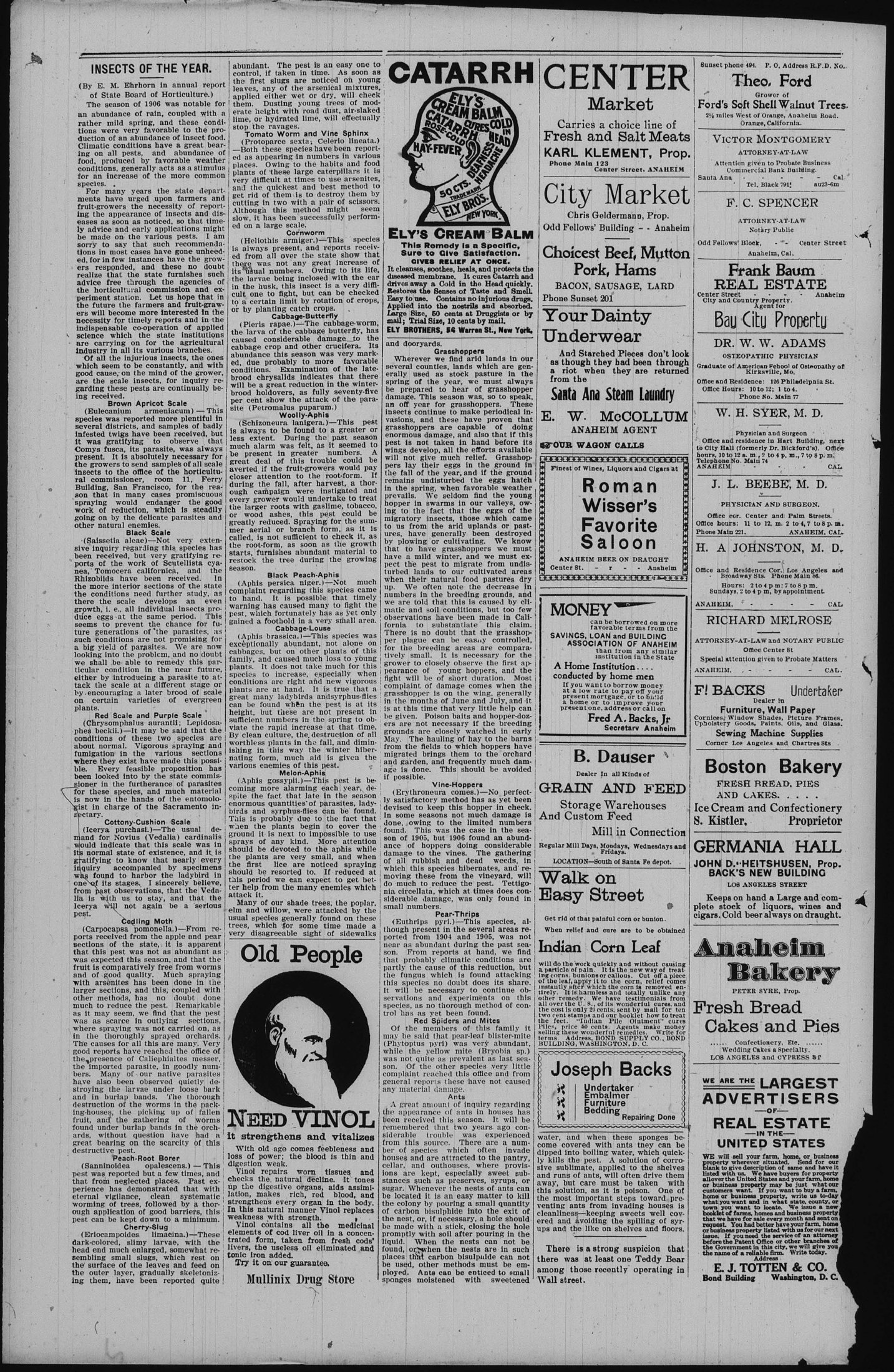
Searchable text
INSECTS OF THE YEAR.
(By E. M. Ehrhorn in annual report of State Board of Horticulture.)
The season of 1906 was notable for an abundance of rain, coupled with a rather mild spring, and these conditions were very favorable to the production of an abundance of insect food. Climatic conditions have a great bearing on all pests, and abundance of food, produced by favorable weather conditions, generally acts as a stimulus for an increase of the more common species.
For many years the state departments have urged upon farmers and fruit-growers the necessity of reporting the appearance of insects and diseases as soon as noticed, so that timely advice and early applications might be made on the various pests. I am sorry to say that such recommendations in most cases have gone unheeded, for in few instances have the growers responded, and these no doubt realize that the state furnishes such advice free through the agencies of the horticultural commission and experiment station. Let us hope that in the future the farmers and fruit-growers will become more interested in the necessity for timely reports and in the indispensable co-operation of applied science which the state institutions are carrying on for the agricultural industry in all its various branches.
Of all the injurious insects, the ones which seem to be constantly, and with good cause, on the mind of the grower, are the scale insects, for inquiry regarding these pests are continually being received.
Brown Apricot Scale
(Eulecanium armeniacum) — This species was reported more plentiful in several districts, and samples of badly infested twigs have been received, but it was gratifying to observe that Comys fusca, its parasite, was always present. It is absolutely necessary for the growers to send samples of all scale insects to the office of the horticultural commissioner, room 11, Ferry Building, San Francisco, for the reason that in many cases promiscuous spraying would endanger the good work of reduction, which is steadily abundant. The pest is an control, if taken in time. The first slugs are noticeable leaves, any of the arsenic applied either wet or dry them. Dusting young trees height with road dust lime, or hydrated lime, will stop the ravages.
Tomato Worm and Vine (Protoparce sexta; Celec—Both these species have ed as appearing in number places. Owing to the habit plants of these large caterpillars very difficult at times to uu and the quickest and best get rid of them is to destroy cutting in two with a pair. Although this method may slow, it has been successful on a large scale.
Cornworm (Heliothis armiger.)—This is always present, and reped from all over the state there was not any great its usual numbers. Owing to the larvae being inclosed w in the husk, this insect is cult one to fight, but can be to a certain limit by rotation or by planting catch crops.
Cabbage-Butterfly (Pieris rapae.)—The cabbage larva of the cabbage caused considerable damage cabbage crop and other cru abundance this season was ed, due probably to more conditions. Examination of brood chrysalids indicates will be a great reduction in brood holdovers, as fully per cent show the attack on site (Petromalus puparum).
Woolly-Aphis (Schizoneura lanigera.)—is always to be found to a less extent. During the much alarm was felt, as it be present in greater n great deal of this trouble averted if the fruit-growers closer attention to the roo during the fall, after harvough campaign were inst every grower would undertake the larger roots with gasline
Brown Apricot Scale
(Eulecanium armeniacum)—This species was reported more plentiful in several districts, and samples of badly infested twigs have been received, but it was gratifying to observe that Comys fusca, its parasite, was always present. It is absolutely necessary for the growers to send samples of all scale insects to the office of the horticultural commissioner, room 11, Ferry Building, San Francisco, for the reason that in many cases promiscuous spraying would endanger the good work of reduction, which is steadily going on by the delicate parasites and other natural enemies.
Black Scale
(Saissetia aleae)—Not very extensive inquiry regarding this species has been received, but very gratifying reports of the work of Scutellista cyanea, Tomocera californica, and the Rhizobilids have been received. In the more interior sections of the state the conditions need further study, as there the scale develops an even growth, i.e., all individual insects produce eggs at the same period. This seems to prevent the chance for future generations of the parasites, as such conditions are not promising for a big yield of parasites. We are now looking into the problem, and no doubt we shall be able to remedy this particular condition in the near future, either by introducing a parasite to attack the scale at a different stage or by encouraging a later brood of scale on certain varieties of evergreen plants.
Red Scale and Purple Scale
(Chrysomphalus aurantii; Lepidosaphes beckii.)—It may be said that the conditions of these two species are about normal. Vigorous spraying and fumigation in the various sections where they exist have made this possible. Every feasible proposition has been looked into by the state commissioner in the furtherance of parasites for these species, and much material is now in the hands of the entomologist in charge of the Sacramento insectary.
Cottony-Cushion Scale
(Icerya purchasi.)—The usual demand for Novius (Vedalia) cardinalis would indicate that this scale was in its normal state of existence, and it is gratifying to know that nearly every inquiry accompanied by specimens was found to harbor the ladybird in one of its stages. I sincerely believe, from past observations, that the Vedalia is with us to stay, and that the Icerya will not again be a serious pest.
Codling Moth
(Carpocapsa pomonella.)—From reports received from the apple and pear sections of the state, it is apparent that this pest was not as abundant as was expected this season, and that the fruit is comparatively free from worms site (Petromalus puparum).
Woolly-Aphis
(Schizoneura lanigera.)—is always to be found to a less extent. During the much alarm was felt, as it be present in greater nu great deal of this trouble averted if the fruit-growers closer attention to the root during the fall, after harvest campaign were instill every grower would undertake the larger roots with gasline or wood ashes, this pest greatly reduced. Spraying for mer aerial or branch form called, is not sufficient to o the root-form, as soon as starts, furnishes abundant restock the tree during the season.
Black Peach-Aphis
(Aphis persica niger.)—complaint regarding this spit to hand. It is possible that warning has caused many pest, which fortunately has gained a foothold in a very Cabbage-Louse
(Aphis brassica.)—This exceptionally abundant, no cabbages, but on other plant family, and caused much loss plants. It does not take many species to increase, especially conditions are right and new plants are at hand. It is great many ladybirds and can be found when the per height, but these are not sufficient numbers in the spitivate the rapid increase at By clean culture, the destru worthless plants in the fall, ishing in this way the wilting form, much aid is various enemies of this pest.
Melon-Aphis
(Aphis gossypii.)—This coming more alarming each spite the fact that late in enormous quantities of parabirds and syrphus-flies can This is probably due to th when the plants begin to ground it is next to imposs sprays of any kind. More should be devoted to the at the plants are very small, the first lice are notice should be resorted to. If this period we can expect ter help from the many ene attack it.
Many of our shade trees, elm and willow, were attach usual species generally four trees, which for some time very disagreeable sight of
Codling Moth
(Carpocapsa pomonella.)—From reports received from the apple and pear sections of the state, it is apparent that this pest was not as abundant as was expected this season, and that the fruit is comparatively free from worms and of good quality. Much spraying with arsenites has been done in the larger sections, and this, coupled with other methods, has no doubt done much to reduce the pest. Remarkable as it may seem, we find that the pest was as scarce in outlying sections, where spraying was not carried on, as in the thoroughly sprayed orchards. The causes for all this are many. Very good reports have reached the office of the presence of Caliephialtes messer, the imported parasite, in goodly numbers. Many of our native parasites have also been observed quietly destroying the larvae under loose bark and in burlap bands. The thorough destruction of the worms in the packing-houses, the picking up of fallen fruit, and the gathering of worms found under burlap bands in the orchards, without question have had a great bearing on the scarcity of this destructive pest.
Peach-Root Borer
(Sanninoidea opalescens.)—This pest was reported but a few times, and that from neglected places. Past experience has demonstrated that with eternal vigilance, clean systematic worming of trees, followed by a thorough application of good barriers, this pest can be kept down to a minimum.
Cherry-Slug
(Eriocampoides limacina.)—These dark-colored, slimy larvae, with the head end much enlarged, somewhat resembling small slugs, which rest on the surface of the leaves and feed on the outer layer, gradually skeletonizing them, have been reported quite
The pest is an easy one to control if taken in time. As soon as slugs are noticed on young plants of the arsenical mixtures, either wet or dry, will check Dusting young trees of moderate height with road dust, air-slaked hydrated lime, will effectually ravages.
Kato Worm and Vine Sphinx (oparce sexta; Celerio lineata.) These species have been reported appearing in numbers in various areas. Owing to the habits and food of these large caterpillars it is difficult at times to use arsenites, quickest and best method to destroy them by spin two with a pair of scissors. With this method might seem has been successfully performed large scale.
Cornworm (this armiger.)—This species lives present, and reports receiving all over the state show that it has not any great increase of adult numbers. Owing to its life, aae being inclosed with the earusk, this insect is a very difficult to fight, but can be checked against limit by rotation of crops, planting catch crops.
Cabbage-Butterfly (raspae.)—The cabbage-worm, aka of the cabbage butterfly, has considerable damage to the crop and other crucifera. Its once this season was very marked probably to more favorable ones. Examination of the late-nrrysalids indicates that there is great reduction in the winter-boldovers, as fully seventy-five show the attack of the parasitic malus puparum.
Woolly-Aphis (oneura lanigera.)—This pest is to be found to a greater or less extent. During the past season the farm was felt, as it seemed to ent in greater numbers. A real of this trouble could be if the fruit-growers would pay attention to the root-form. If the fall, after harvest, a thor-mampaign were instigated and power would undertake to treat our roots with gaslime, tobacco,
CATARRH
ELY'S CREAM BALM
CURES COLD IN CATARRH HEAD ROSE-COLD HAY-FEVER
50 CTS. DEAFNESS HEADACHE
TRADE MARK
ELY BROTHS.
NEW YORK
ELY'S CREAM BALM
This Remedy is a Specific,
Sure to Give Satisfaction.
GIVES RELIEF AT ONCE.
It cleanses, soothes, heals, and protects the diseased membrane. It cures Catarrh and drives away a Cold in the Head quickly. Restores the Senses of Taste and Smell. Easy to use. Contains no injurious drugs. Applied into the nostrils and absorbed. Large Size, 50 cents at Druggists or by mail; Trial Size, 10 cents by mail.
ELY BROTHERS, EG Warren St., New York.
and dooryards.
Grasshoppers
Wherever we find arid lands in our several counties, lands which are generally used as stock pasture in the spring of the year, we must always be prepared to hear of grasshopper damage. This season was, so to speak, an off year for grasshoppers. These insects continue to make periodical invasions, and these have proven that grasshoppers are capable of doing enormous damage, and also that if this pest is not taken in hand before its wings develop, all the efforts available will not give much relief. Grasshoppers lay their eggs in the ground in the fall of the year, and if the ground remains undisturbed the eggs hatch in the spring, when favorable weather prevails. We seldom find the young hopper in swarms in our valleys, owing to the fact that the eggs of the
Woolly-Aphis
(oneura lanigera.)—This pest is to be found to a greater or extent. During the past season warm was felt, as it seemed to present in greater numbers. A total of this trouble could be if the fruit-growers would pay attention to the root-form. If the fall, after harvest, a thorny campaign were instigated and power would undertake to treat their roots with gaslime, tobacco, ashes, this pest could be reduced. Spraying for the sum total or branch form, as it is not sufficient to check it, as form, as soon as the growth furnishes abundant material to the tree during the growing
Black Peach-Aphis
( persica niger.)—Not much is regardning this species came. It is possible that timely has caused many to fight the chich fortunately has as yet only a foothold in a very small area.
Cabbage-Louse
( brassica.)—This species was usually abundant, not alone on it, but on other plants of this kind caused much loss to young plants does not take much for this to increase, especially when these are right and new vigorous are at hand. It is true that a many ladybirds and syrphus-flies found when the pest is at its out these are not present in the numbers in the spring to obe rapid increase at that time. Culture, the destruction of all plants in the fall, and diminishing this way the winter hibernorm, much aid is given the enemies of this pest.
Melon-Aphis
(gossypii.)—This pest is become alarming each year, due fact that late in the season quantities of parasites, ladybird syrphus-flies can be found. Probably due to the fact that the plants begin to cover the soil is next to impossible to use of any kind. More attention are devoted to the aphis while adults are very small, and whenlice are noticed spraying are resorted to. If reduced at food we can expect to get bet from the many enemies which of our shade trees, the poplar, willow, were attacked by the species generally found on these which for some time made a disagreeable sight of sidewalks
Old People
an off year for grasshoppers. These insects continue to make periodical invasions, and these have proven that grasshoppers are capable of doing enormous damage, and also that if this pest is not taken in hand before its wings develop, all the efforts available will not give much relief. Grasshoppers lay their eggs in the ground in the fall of the year, and if the ground remains undisturbed the eggs hatch in the spring, when favorable weather prevails. We seldom find the young hopper in swarms in our valleys, owing to the fact that the eggs of the migratory insects, those which came to us from the arid uplands or pastures, have generally been destroyed by plowing or cultivating. We know that to have grasshoppers we must have a mild winter, and we must expect the pest to migrate from undisturbed lands to our cultivated areas when their natural food pastures dry up. We often note the decrease in numbers in the breeding grounds, and we are told that this is caused by climatic and soil conditions, but too few observations have been made in California to substantiate this claim. There is no doubt that the grasshopper plague can be easily controlled, for the breeding areas are comparatively small. It is necessary for the grower to closely observe the first appearance of young hoppers, and the fight will be of short duration. Most complaint of damage comes when the grasshopper is on the wing, generally in the months of June and July, and it is at this time that very little help can be given. Poison baits and hopper-dozers are not necessary if the breeding grounds are closely watched in early May. The hauling of hay to the barns from the fields to which hoppers have migrated brings them to the orchard and garden, and frequently much damage is done. This should be avoided if possible.
Vine-Hoppers
(Erythroneura comes.)—No perfectly satisfactory method has as yet been devised to keep this hopper in check. In some seasons not much damage is done, owing to the limited numbers found. This was case in the season of 1905, but 1906 found an abundance of hoppers doing considerable damage to the vines. The gathering of all rubbish and dead weeds, in which this species hibernates, and removing these from the vineyard, will do much to reduce the pest. Tettigonia circellata, which at times does considerable damage, was only found in small numbers.
Pear-Thrips
(Euthrips pyri.)—This species, although present in several areas reported from 1904 and 1905, was not near as abundant during the past season. From reports at hand, we find that probably climatic conditions are partly the cause of this reduction, but
Old People
RED VINOL
lengthens and vitalizes
Old age comes feebleness and power; the blood is thin and weak.
Repairs worn tissues and the natural decline. It tones digestive organs, aids assimilates rich, red blood, and tons every organ in the body. Natural manner Vinol replaces with strength.
Contains all the medicinal of cod liver oil in a concentrate, taken from fresh cods' use useless oil eliminated and added. On our guarantee.
Illinix Drug Store
Pear-Thrips
(Euthrips pyri.)—This species, although present in the several areas reported from 1904 and 1905, was not near as abundant during the past season. From reports at hand, we find that probably climatic conditions are partly the cause of this reduction, but the fungus which is found attacking this species no doubt does its share. It will be necessary to continue observations and experiments on this species, as no thorough method of control has as yet been found.
Red Spiders and Mites
Of the members of this family it may be said that pear-leaf blister-mite (Phytoptus pyri) was very abundant, while the yellow mite (Bryobia sp.) was not quite as prevalent as last season. Of the other species very little complaint reached this office and from general reports these have not caused any material damage.
Ants
A great amount of inquiry regarding the appearance of ants in houses has been received this season. It will be remembered that two years ago considerable trouble was experienced from this source. There are a number of species which often invade houses and are attracted to the pantry, cellar, and outhouses, where provisions are kept, especially sweet substances such as preserves, syrups, or sugar. Whenever the nests of ants can be located it is an easy matter to kill the colony by pouring a small quantity of carbon bisulphide into the exit of the nest, or, if necessary, a hole should be made with a stick, closing the hole promptly with soil after pouring in the liquid. When the nests can not be found, or when the nests are in such places that carbon bisulphide can not be used, other methods must be employed. Ants can be enticed to small sponges moistened with sweetened water, and when these come covered with ants dipped into boiling water kills the pest. A soluble sublimate, applied to and runs of ants, will oft away, but care must be this solution, as it is possible the most important step preventing ants from invading cleanliness—keeping sweered and avoiding the scrups and the like on shelves.
There is a strong surge there was at least one among those recently Wall street.
CENTER Market
Carries a choice line of fresh and Salt Meats
RRL KLEMENT, Prop.
One Main 123
Center Street, ANAHEIM
City Market
Chris Geldermann, Prop.
Fellows' Building - Anaheim
Noicest Beef, Mutton Pork, Hams
BACON, SAUSAGE, LARD
One Sunset 201
Four Dainty Underwear
And Starched Pieces don't look though they had been through stript when they are returned from the
Santa Ana Steam Laundry
W. McCOLLUM
ANAHEIM AGENT
UR WAGON CALLS
nest of Wines, Liquors and Cigars at Roman Wisser's
Sunset phone 494. P. O. Address R.F.D. No.
Theo, Ford
Grower of Ford's Soft Shell Walnut Trees.
2½ miles West of Orange, Anaheim Road.
Orange, California.
VICTOR MONTGOMERY
ATTORNEY-AT-LAW
Attention given to Probate Business Commercial Bank Building.
Santa Ana - Cal.
Tel. Black 791! au23-6m
F. C. SPENCER
ATTORNEY-AT-LAW
Notary Public
Odd Fellows' Block, Center Street
Anaheim, Cal.
Frank Baum REAL ESTATE
Center Street Anaheim City and Country Property.
Agent for Bay City Property
DR. W. W. ADAMS
OSTEOPATHIC PHYSICIAN
Graduate of American School of Osteopathy of Kirksville, Mo.
Office and Residence: 126 Philadelphia St.
Office Hours: 10 to 12; 1 to 4.
Phone No. Main 77
W. H. SYER, M. D.
Physician and Surgeon
Office and residence in Hart Building, next to City Hall (formerly Dr. Bickford's). Office hours, 10 to 12 a.m., 2 to 4 p.m., 7 to 8 p.m.
Telephone No. Main 74
ANAHEIM - CAL.
J. L. BEEBE, M. D.
PHYSICIAN AND SURGEON.
W. McCOLLUM
ANAHEIM AGENT
OUR WAGON CALLS
nest of Wines, Liquors and Cigars at
Roman
Wisser's
Favorite
Saloon
ANAHEIM BEER ON DRAUGHT
Enter St. - r - Anaheim
MONEY
can be borrowed on more favorable terms from the
VININGS, LOAN and BUILDING ASSOCIATION OF ANAHEIM
than from any similar institution in the State
Home Institution... conducted by home men
If you want to borrow money at a low rate to pay off your present mortgage, or to build a home or to improve your present one, address or call on Fred A. Backs, Jr
Secretary Anaheim
B. Dauser
Dealer In all Kinds of
CAIN AND FEED
Storage Warehouses
Custom Feed
Mill in Connection
or Mill Days, Mondays, Wednesdays and Fridays.
Talk on Easy Street
rid of that painful corn or bunion.
in relief and cure are to be obtained
ian Corn Leaf
W. H. SYER, M. D.
Physician and Surgeon
Office and residence in Hart Building, next to City Hall (formerly Dr. Bickford's). Office hours, 10 to 12 a.m., 2 to 4 p.m., 7 to 8 p.m.
Telephone No. Main 74
ANAHEIM
J. L. BEEBE, M. D.
PHYSICIAN AND SURGEON.
Office cor. Center and Palm Streets.
Office hours: 11 to 12, m. 2 to 4, 7 to 8 p.m.
Phone Main 221.
ANAHEIM, CAL.
H. A JOHNSTON, M. D.
Office and Residence Cor., Los Angeles and Broadway Sts. Phone Main 86.
Hours: 2 to 4 p.m; 7 to 8 p.m.
Sundays, 2 to 4 p.m, by appointment.
ANAHEIM.
RICHARD MELROSE
ATTORNEY-AT-LAW and NOTARY PUBLIC
Office Center St
Special attention given to Probate Matters
ANAHEIM.
F! BACKS Undertaker
Dealer in
Furniture, Wall Paper
Cornices, Window Shades, Picture Frames,
Upholstery Goods, Paints, Oilis, and Glass.
Sewing Machine Supplies
Corner Los Angeles and Chartres Sts
Boston Bakery
FRESH BREAD, PIES AND CAKES.
Ice Cream and Confectionery
S. Kistler, Proprietor
GERMANIA HALL
JOHN D..HEITSHUSEN, Prop.
BACK'S NEW BUILDING
LOS ANGELES STREET
Keeps on hand a Large and complete stock of liquors, wines and cigars. Cold beer always on draught.
Anaheim
Walk on Easy Street
rid of that painful corn or bunion.
a relief and cure are to be obtained
Indian Corn Leaf
the work quickly and without causing
circle of pain. It is the new way of treatants, bunions or callous. Cut off a piece
leaf, apply it to the corn, relief comes
only after which the corn is removed entitl. It is harmless and totally unlike any
remedy. We have testimonials from
for the U.S., of its wonderful cures, and
it is only 20 cents, sent by mail for ten
stamps and our booklet how to treat
et. "Indian Pile Ointment" cures
price 50 cents. Agents make money
these wonderful remedies. Write for
Address, BOND SUPPLY CO., BOND
DING, WASHINGTON, D.C.
Joseph Backs
Undertaker
Embalmer
Furniture
Bedding
Repairing Done
and when these sponges becovered with ants they can be
into boiling water, which quickly the pest. A solution of corrosublimate, applied to the shelves
of ants, will often drive them
but care must be taken with
solution, as it is poison. One of
most important steps toward pregants from invading houses is
business—keeping sweets well covand avoiding the spilling of syrdid the like on shelves and floors.
There is a strong suspicion that
was at least one Teddy Bear
going those recently operating in
street.
JOHN D...HEITSHUSEN, Prop.
BACK'S NEW BUILDING
LOS ANGELES STREET
Keeps on hand a Large and complete stock of liquors, wines and
cigars. Cold beer always on draught.
Anaheim Bakery
PETER SYRE, Prop.
Fresh Bread
Cakes and Pies
Confectionery, Ete...
Wedding Cakes a Specialty.
LOS ANGELES and CYPRESS ST
WE ARE THE LARGEST ADVERTISERS OF REAL ESTATE IN THE UNITED STATES
WE will sell your farm, home, or business property wherever situated. Send for our blank to give description of same and have it listed with us. We have buyers for property all over the United States and your farm, home or business property may be just what our customers want. If you want to buy a farm, home or business property, write us to-day what you want and in what state, county, or town you want to locate. We issue a new booklet of farms, homes and business property that we have for sale every month and sent on request. You had better have your farm, home or business property listed with us for our next issue. If you need the service of an attorney before the Patent Office or other branches of the Government in this city, we will give you the name of a reliable firm. Write today.
E. J. TOTTEN & CO.
Bond Building Washington, D.C.