anaheim-gazette 1907-02-14
Scanned page
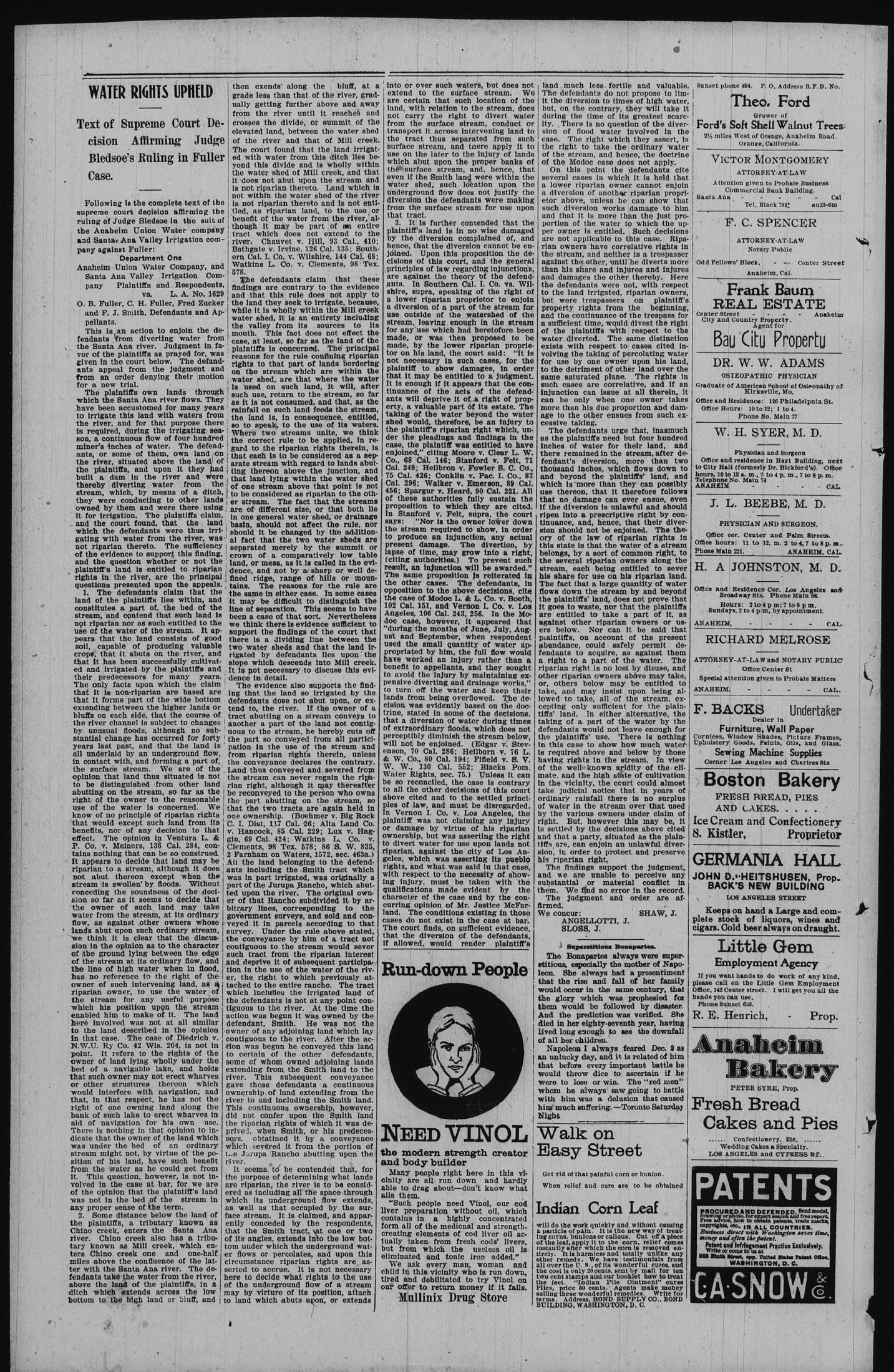
Searchable text
WATER RIGHTS UPHELD
Text of Supreme Court Decision Affirming Judge Bledsoe’s Ruling in Fuller Case.
Following is the complete text of the supreme court decision affirming the ruling of Judge Bledsoe in the suit of the Anaheim Union Water company and Santa Ana Valley Irrigation company against Fuller:
Department One
Anaheim Union Water Company, and Santa Ana Valley Irrigation Company Plaintiffs and Respondents,
vs. L. A. No. 1629
O. B. Fuller, C. H. Fuller, Fred Zucker and F. J. Smith, Defendants and Appellants.
This is an action to enjoin the defendants from diverting water from the Santa Ana river. Judgment in favor of the plaintiffs as prayed for, was given in the court below. The defendants appeal from the judgment and from an order denying their motion for a new trial.
The plaintiffs own lands through which the Santa Ana river flows. They have been accustomed for many years to irrigate this land with waters from the river, and for that purpose there is required, during the irrigating season, a continuous flow of four hundred miner’s inches of water. The defendants, or some of them, own land on the river, situated above the land of the plaintiffs, and upon it they had built a dam in the river and were thereby diverting water from the stream, which, by means of a ditch, they were conducting to other lands owned by them and were there using then exends along the grade less than that of the usually getting further above from the river until it crosses the divide, or surpassed land, between the of the river and that of The court found that the defendant with water from this day beyond this divide and is with the water shed of Mill creep it does not abut upon the is not riparian thereto. Law not within the water shed is not riparian thereto and tled, as riparian land, to benefit of the water from though it may be part of tract which does not extract river. Chauvet v. Hill, 98 Bathgate v. Irvine, 126 Cal.ern Cal. I. Co. v. Wilshire, Watkins L. Co. v. Clemer 578.
The defendants claim findings are contrary to and that this rule does not land they seek to irrigate while it is wholly within the water shed, it is an entire valley from its source mouth. This fact does not case, at least, so far as the plaintiffs is concerned. The reasons for the rule confining rights to that part of land on the stream which are water shed, are that where is used on such land, it such use, return to the strata as it is not consumed, and rainfall on such land feeds the land is, in consequence so to speak, to the use of Where two streams unite the correct rule to be applied to the riparian rights that each is to be considerate stream with regard to ting thereon above the juxta that land lying within the of one stream above that pto be considered as riparian stream. The fact that are of different size, or th
have been accustomed for many years to irrigate this land with waters from the river, and for that purpose there is required, during the irrigating season, a continuous flow of four hundred miner's inches of water. The defendants, or some of them, own land on the river, situated above the land of the plaintiffs, and upon it they had built a dam in the river and were thereby diverting water from the stream, which, by means of a ditch, they were conducting to other lands owned by them and were there using it for irrigation. The plaintiffs claim, and the court found, that the land which the defendants were thus irrigating with water from the river, was not riparian thereto. The sufficiency of the evidence to support this finding, and the question whether or not the plaintiff's land is entitled to riparian rights in the river, are the principal questions presented upon the appeals.
1. The defendants claim that the land of the plaintiffs lies within, and constitutes a part of, the bed of the stream, and contend that such land is not riparian nor as such entitled to the use of the water of the stream. It appears that the land consists of good soil, capable of producing valuable crops, that it abuts on the river, and that it has been successfully cultivated and irrigated by the plaintiffs and their predecessors for many years. The only facts upon which the claim that it is non-riparian are based are that it forms part of the wide bottom extending between the higher lands or bluffs on each side, that the course of the river channel is subject to changes by unusual floods, although no substantial change has occurred for forty years last past, and that the land is all underlaid by an underground flow, in contact with, and forming a part of, the surface stream. We are of the opinion that land thus situated is not to be distinguished from other land abutting on the stream, so far as the right of the owner to the reasonable use of the water is concerned. We know of no principle of riparian rights that would except such land from its benefits, nor of any decision to that effect. The opinion in Ventura L. & P. Co. v. Meiners, 136 Cal. 284, contains nothing that can be so construed. It appears to decide that land may be riparian to a stream, although it does not abut thereon except when the stream is swollen by floods. Without conceding the soundness of the decision so far as it seems to decide that the owner of such land may take water from the stream, at its ordinary flow, as against other owners whose lands abut upon such ordinary stream, we think it is clear that the discussion in the opinion as to the character of the ground lying between the edge of the stream at its ordinary flow, and the line of high water when in flood rainfall on such land feeds into the land is, in consequence so to speak, to the use of Where two streams unite the correct rule to be applied to the riparian rights that each is to be considered arate stream with regard to ting thereon above the juxta that land lying within the area of one stream above that just to be considered as riparian stream. The fact that there are different size, or that in one general water shed, basin, should not affect this should it be changed by this al fact that the two waters separated merely by the crown of a comparatively land, or mesa, as it is called dence, and not by a sharp fined ridge, range of hills attains. The reasons for this same in either case. In it may be difficult to distill line of separation. This seen been a case of that sort. Now we think there is evidence to support the findings of these there is a dividing line between two water sheds and that it rigated by defendants lies slope which descends into it. It is not necessary to discuclation in detail.
The evidence also supporting that the land so irrigated defendants dose not abut undert to, the river. If the tract abutting on a stream another a part of the landuous to the stream, he herethe part so conveyed from his pation in the use of the sea from riparian rights there,the conveyance declares that Land thus conveyed and sevei the stream can never regain right, although it may be reconveyed to the person who part abutting on the river that the two tracts are again one ownership. (Boehmer v C. I. Dist, 117 Cal. 26; Alta v. Hancock, 85 Cal. 229; Lagin, 69 Cal. 424; Watkins J Clements, 98 Tex. 578; 86 J 2 Farnham on Waters, 1572; All the land belonging to those including the Smith tran was in part irrigated, was o part of the Jurupa Rancho, wted upon the river. The order of that Rancho subdivide bitrary lines, corresponding government surveys, and surveyed it in parcels accordance survey. Under the rule above the conveyance by him of a contiguous to the stream w such tract from the riparia and deprive it of subsequent
It appears to decide that land may be riparian to a stream, although it does not abut thereon except when the stream is swollen by floods. Without conceding the soundness of the decision so far as it seems to decide that the owner of such land may take water from the stream, at its ordinary flow, as against other owners whose lands abut upon such ordinary stream, we think it is clear that the discussion in the opinion as to the character of the ground lying between the edge of the stream at its ordinary flow, and the line of high water when in flood, has no reference to the right of the owner of such intervening land, as a riparian owner, to use the water of the stream for any useful purpose which his position upon the stream enabled him to make of it. The land here involved was not at all similar to the land described in the opinion in that case. The case of Diedrich v. N.W.U. Ry Co. 42 Wis. 264, is not in point. It refers to the rights of the owner of land lying wholly under the bed of a navigable lake, and holds that such owner may not erect wharves or other structures thereon which would interfere with navigation, and that, in that respect, he has not the right of one owning land along the bank of such lake to erect wharves in aid of navigation for his own use. There is nothing in that opinion to indicate that the owner of the land which was under the bed of an ordinary stream might not, by virtue of the position of his land, have such benefit from the water as he could get from it. This question, however, is not involved in the case at bar, for we are of the opinion that the plaintiff's land was not in the bed of the stream in any proper sense of the term.
2. Some distance below the land of the plaintiffs, a tributary known as Chino creek, enters the Santa Ana river. Chino creek also has a tributary known as Mill creek, which enters Chino creek one and one-half miles above the confluence of the latter with the Santa Ana river. The defendants take the water from the river, above the land of the plaintiffs, in a ditch which extends across the low bottom to the high land or bluff, and
All the land belonging to them includes the Smith trunk was in part irrigated, was on part of the Jurupa Rancho, wetted upon the river. The order of that Rancho subdivides bitrary lines, corresponding government surveys, and surveyed it in parcels according survey. Under the rule above the conveyance by him of contiguous to the stream such tract from the riparian and deprive it of subsequent in the use of the water er, the right to which pre- tached to the entire rancho. Which includes the irrigate defendants is not at any tenuous to the river. At this action was begun it was owned defendant, Smith. He was owner of any adjoining land contiguous to the river. Action was begun he conveyed to certain of the other some of whom owned adjoin extending from the Smith la river. This subsequent gave those defendants a ownership of land extending river to and including the S This continuous ownership did not confer upon the S the riparian rights of which prived, when Smith, or his sors, obtained it by a c which severed it from the S the Jurupa Rancho abutting river.
It seems to be contended the purpose of determining where are riparian, the river is to ered as including all the space which its underground flows as well as that occupied by face stream. It is claimed, aently conceded by the rea that the Smith tract, at one of its angles, extends into thom under which the undergrer flows or percolates, and circumstance riparian right serted to accrue. It is not here to decide what rights thof the underground flow of may by virtue of its position to land which abuts upon, o
extends along the bluff, at a less than that of the river, grading further above and away the river until it reaches and divides or summit of the land, between the water shed river and that of Mill creek. It found that the land irrigated by water from this ditch lies below its divide and is wholly within the shed of Mill creek, and that not abut upon the stream and riparian thereto. Land which is in the water shed of the river riparian thereto and is not entirapian land, to the use or of the water from the river, alit may be part of an entire which does not extend to the Chauvet v. Hill, 93 Cal., 410; see v. Irvine, 126 Cal. 135; South I. Co. v. Wilshire, 144 Cal. 68; L. Co. v. Clements, 98 Tex.
Defendants claim that these facts are contrary to the evidence that this rule does not apply to them seek to irrigate, because, as wholly within the Mill creekhed, it is an entirely including they from its sources to its source. This fact does not effect the least, so far as the land of the creek is concerned. The principal for the rule confining riparian to that part of lands bordering stream which are within the creek, are that where the water on such land, it will, after return to the stream, so far not consumed, and that, as the on such land feeds the stream, it is, in consequence, entitled, break, to the use of its waters. Two streams unite, we think direct rule to be applied, in rethe riparian rights therein, is to be considered as a seepam with regard to lands abutreon above the junction, and lying within the water shed stream above that point is not considered as riparian to the othm. The fact that the streams different size, or that both lie into or over such waters, but does not extend to the surface stream. We are certain that such location of the land, with relation to the stream, does not carry the right to divert water from the surface stream, conduct or transport it across intervening land to the tract thus separated from such surface stream, and there apply it to use on the later to the injury of lands which abut upon the proper banks of the surface stream, and hence, that even if the Smith land were within the water shed, such location upon the underground flow does not justify the diversion the defendants were making from the surface stream for use upon that tract.
3. It is further contended that the plaintiff's land is in no wise damaged by the diversion complained of, and hence, that the diversion cannot be enjoined. Upon this proposition the decisions of this court, and the general principles of law regarding injunctions, are against the theory of the defendants. In Southern Cal. I. Co. vs. Wilshire, supra, speaking of the right of a lower riparian proprietor to enjoin a diversion of a part of the stream for use outside of the watershed of the stream, leaving enough in the stream for any use which had heretofore been made, or was then proposed to be made, by the lower riparian proprietor on his land, the court said: "It is not necessary in such cases, for the plaintiff to show damages, in order that it may be entitled to a judgment. It is enough if it appears that the continuance of the acts of the defendants will deprive it of a right of property, a valuable part of its estate. The taking of the water beyond the water shed would, therefore, be an injury to the plaintiff's riparian right which, under the pleadings and findings in the case, the plaintiff was entitled to have enjoined," citing Moore v. Clear L. W. Co., 68 Cal. 146; Stanford v. Felt, 71 Cal. 249; Heilbron v. Fowler S. C. Co., 75 Cal. 426; Conklin v. Pac. I. Co., 87 Cal. 296; Walker v. Emerson, 89 Cal. 456; Spargur v. Heard, 90 Cal. 221. All of these authorities fully sustain the proposition to which they are cited.
land much less fertile. The defendants do not it the diversion to times but, on the contrary, that during the time of its city. There is no question of flood water in case. The right which is right to take the right of the stream, and hence of the Modoc case does.
On this point the several cases in which a lower riparian owner has corrected the stream, and neither against the other, until he than his share and injury and damages the other defenders were now to the land irrigated, but were trespassers property rights from that and the continuance of a sufficient time, would owe of the plaintiffs with water diverted. The same exists with respect to involving the taking of perfor use by one owner to the detriment of other same saturated plane. Such cases are correlative injunction can issue at can be only when one more than his due propoage to the other ensuescessive taking.
The defendants urge as the plaintiffs need but inches of water for there remained in the stifendant's diversion, many thousand inches, which and beyond the plaintiff which is more than their use thereon, that it they that no damage can ever if the diversion is unlawful
The fact that the streams different size, or that both lie general water shed, or drainage should not affect the rule, nor be changed by the addition of a comparatively low table mesa, as it is called in the evidence not by a sharp or well degrade, range of hills or mount. The reasons for the rule are in either case. In some cases too difficult to distinguish the separation. This seems to have ease of that sort. Nevertheless there is evidence sufficient to the findings of the court that a dividing line between the river sheds and that the land irrigated by defendants lies upon the which descends into Mill creek necessary to discuss this evident detail.
Evidence also supports the finding that the land so irrigated by the rivers dose not abut upon, or exert the river. If the owner of a settling on a stream conveys to a part of the land not contigliate the stream, he hereby cuts off so conveyed from all participles of the use of the stream and riparian rights therein, unless evance declares the contrary. As conveyed and severed from can never regain the riparian, although it may thereafter be eyed to the person who owns it abutting on the stream, so two tracts are again held in trustship. (Boehmer v. Big Rock, 117 Cal. 26; Alta Land Co., Rock, 85 Cal. 229; Lux v. Hagalal, 424; Watkins L. Co. v., 98 Tex. 578; 86 S. W. 835, on Waters, 1572, sec. 463a.) And belonging to the defending Smith tract which art irrigated, was originally a Jurupa Rancho, which abutting the river. The original owner Rancho subdivided it by arches, corresponding to the extent surveys, and sold and contain parcels according to that Under the rule above stated, evance by him of a tract not to the stream would sever from the riparian interest give it of subsequent participa-
erty, a valuable part of its estate. The taking of the water beyond the water shed would, therefore, be an injury to the plaintiff's riparian right which, under the pleadings and findings in the case, the plaintiff was entitled to have enjoined," citing Moore v. Clear L. W. Co., 68 Cal. 146; Stanford v. Felt, 71 Cal. 249; Heilbron v. Fowler S. C. Co., 75 Cal. 426; Conklin v. Pac. I. Co., 87 Cal. 296; Walker v. Emerson, 89 Cal. 456; Spargur v. Heard, 90 Cal. 221. All of these authorities fully sustain the proposition to which they are cited. In Stanford v. Felt, supra, the court says: "Nor is the owner lower down the stream required to show, in order to produce an injunction, any actual present damage. The divertion, by lapse of time, may grow into a right, (citing authorities.) To prevent such result, an injunction will be awarded."
The same proposition is reiterated in other cases. The defendants, in opposition to the above decisions, cite the case of Modoc L. & L. Co. v. Booth, 102 Cal. 151, and Vernon I. Co. v. Los Angeles, 106 Cal. 243, 256. In the Modoc case, however, it appeared that "during the months of June, July, August and September, when respondent used the small quantity of water appropriated by him, the full flow would have worked an injury rather than a benefit to appellants, and they sought to avoid the injury by maintaining expensive diverting and drainage works," to turn off the water and keep their lands from being overflowed. The decision was evidently based on the doctrine, stated in some of the decisions, that a diversion of water during times of extraordinary floods, which does not perceptibly diminish the stream below, will not be enjoined.
(Edgar v. Stevenson, 70 Cal. 286; Heilborn v. 76 L. & W. Co., 80 Cal. 194; Fifield v. S. V. W., 130 Cal. 552; Blacks Pom. Water Rights, sec. 75.) Unless it can be so reconciled, the case is contrary to all the other decisions of this court above cited and to the settled principles of law, and must be disregarded.
In Vernon I. Co. v. Los Angeles, the plaintiff was not claiming any injury or damage by virtue of his riparian ownership, but was asserting the right to divert water for use upon lands not riparian, against the city of Los Angeles, which was asserting its pueblo rights, and what was said in that case, with respect to the necessity of showing injury, must be taken with the qualifications made evident by the character of the case and by the concurring opinion of Mr. Justice McFarland. The conditions existing in those cases do not exist in the case at bar. The court finds, on sufficient evidence, that the diversion of the defendants, if allowed, would render plaintiff's more than his due proportion to other ensues excessive taking.
The defendants urge as the plaintiffs need but inches of water for that there remained in the state fendant's diversion, many thousand inches, which is and beyond the plaintiff which is more than their use thereon, that it they that no damage can ever if the diversion is unlawful ripen into a prescriptive tinuance, and hence,the sion should not be enjoined or of the law of riparian this state is that the water belongs, by a sort of cone several riparian owners stream, each being entitle his share for use on his share for use on his share for use on his share for use on his share for use on his share for use on his share for use on his share for use on his share for use on his share for use on his share for use on his share for use on his share for use on his share for use on his share for use on his share for use on his share for use on his share for use on his share for use on his share for use on his share for use on his share for use on his share for use on his share for use on his share for use on his share for use on his share for use on his share for use on his share for use on his share for use on his share for use on his share for use on his share for use on his share for use on his share for use on his share for use on his share for use on his share for use on his share for use on his share for use on his share for use on his share for use on his share for use on his share for use on his share for use on his share for use on his share for use on his share for use on his share for use on his share for use on his share for use on his share for use on his share for use on his share for use on his share for use on his share for use on his share for use on his share for use on his share for use on his share foruse onhisshareforuseonhisshareforuseonhisshareforuseonhisshareforuseonhisshareforuseonhisshareforuseonhisshareforuseonhisshareforuseonhisshareforuseonhisshareforuseonhisshareforuseonhisshareforuseonhisshareforuseonhisshareforuseonhisshareforuseonhisshareforuseonhisshareforuseonhisshareforuseonhisshareforuseonhisshareforuseonhisshareforuseonhisshareforuseonhisshareforuseonhis ShareforUseOnHisShareForUseOnHisShareForUseOnHisShareForUseOnHisShareForUseOnHisShareForUseOnHisShareForUseOnHisShareForUseOnHisShareForUseOnHisShareForUseOnHisShareForUseOnHisShareForUseOnHisShareForUseOnHisShareForUseOnHisShareForUseOnHisShareForUseOnHisShareForUseOnHisShareForUseOnHisShareForUseOnHisShareForUseOnHisShareForUseOnHisShareForUse On His Share For Use On His Share For Use On His Share For Use On His Share For Use On His Share For Use On His Share For Use On His Share For Use On His Share For Use On His Share For Use On His Share For Use On His Share For Use On His Share For Use On His Share For Use On His Share For Use On His Share For Use On His Share For Use On His Share For Use On His Share For Use On His Share For Use On His Share For Use On His Share For Use On His Share For Use On His Share For Use On His Share For Use On His Share For Use On His Share For Use On His Share For Use On His Share For Use On His Share For Use On His Share For Use On His Share For Use On His Share For Use On His Share For Use On His Share For Use On His Share For Use On His Share For Use On His Share For Use On His Share For Use On His Share For Use On His Share For Use On His Share For Use On His Share For Use On His Share For Use On His Share For Use On His Share For Use On His Share For Use On His Share For Use On His Share For Use On His Share For Use On His Share For Use On His Share For Use On His Share For Use On His Share For Use On His Share For Use On His Share For Use On His Share For Use On His SharedForUseOnHisSharedForUseOnHisSharedForUseOnHisSharedForUseOnHisSharedForUseOnHisSharedForUseOnHisSharedForUseOnHisSharedForUseOnHisSharedForUseOnHisSharedForUseOnHisSharedForUseOnHisSharedForUseOnHisSharedForUseOnHisSharedForUseOnHisSharedForUseOnHisSharedForUseOnHisSharedForUseOnHisSharedForUseOnHisSharedForUseOnHisSharedForUseOnHis SharedForUseOnHis SharedForUseOnHis SharedForUseOnHis SharedForUseOnHis SharedForUseOnHis SharedForUseOnHis SharedForUseOnHis SharedForUseOnHis SharedForUseOnHis SharedForUseOnHis SharedForUseOnHis SharedForUseOnHis SharedForUseOnHis SharedForUseOnHis SharedForUseOnHis SharedForUseOnHis SharedForUseOnHis SharedForUseOnHis SharedForUseOnHis SharedForUseOnHis SharedForUsesToBeUsedByTheLawOfRiparianThisStateIsThatTheWaterBelongsByASortOfConceivingTinuanceAndHenceTheSionShouldNotBeEnJOinedOrTheLawOfRiparianThisStateIsThatTheWaterBelongsByASortOfConceivingTinuanceAndHenceTheSionShouldNotBeEnJOinedOrTheLawOfRiparianThisStateIsThatTheWaterBelongsByASortOfConceivingTinuanceAndHenceTheSionShouldNotBeEnJOinedOrTheLawOfRiparianThisStateIsThatTheWaterBelongsByASortOfConceivingTinuanceAndHenceTheSionShouldNotBeEnJOinedOrTheLawOfRiparianThisStateIsThatTheWaterBelongsByASortOfConceivingTinuanceAndHenceTheSionShouldNotBeEnJOinedOrTheLawOfRiparianThisStateIsThatTheWaterBelongsByASortOfConceivingTinuanceAndHenceTheSionShouldNotBeEnJOinedOrTheLawOfRiparianThisStateIsThatTheWaterBelongsByASortOfConceivingTinuanceAndHenceTheSionShouldNotBeEnJOinedOrTheLawOfRiparianThisStateIsThatTheWaterBelongsByA SortOfConceivingTinuanceAndHenceTheSionShouldNotBeEnJOinedOrTheLawOfRiparianThisStateIsThatTheWaterBelongsByA SortOfConceivingTinuanceAndHenceTheSionShouldNotBeEnJOinedOrTheLawOfRiparianThisStateIsThatTheWaterBelongsByA SortOfConceivingTinuanceAndHenceTheSionShouldNotBeEnJOinedOrTheLawOfRiparianThisStateIsThatTheWaterBelongsByA SortOfConceivingTinuanceAndHenceTheSionShouldNotBeEnJOinedOrTheLawOfRiparianThisStateIsThatTheWaterBelongsByA SortOfConceivingTinuanceAndHenceTheSionShouldNotBeEnJOinedOrTheLawOfRiparianThisStateIsThatTheWaterBelongsByA SortOfConceivingTinuanceAndHenceTheSionShouldNotBeEnJOinedOrTheLawOfRiparianThisStateIsThatTheWaterBelongsByA SortOfConceivingTinuanceAndHenceTheSionShouldNotBeEnJOinedOrTheLawOfRiparianThisStateIsThatTheWaterBelongsByA SortOfConceivingTinuanceAndHenceTheSionShouldNotBeEnJOinedOrTheLawOfRiparianThisStateIsThatTheWaterBelongsByA SortOfConceivingTinuanceAndHenceTheSionShouldNotBeEnJOinedOrTheLawOfRiparianThisStateIsThatTheWaterBelongsByA SortOFConceivingTinuanceAndHenceTheSionShouldNotBeEnJOinedOrTheLawOfRiparianThisStateIsThatTheWaterBelongsByA SortOFConceivingTinuanceAndHenceTheSionShouldNotBeEnJOinedOrTheLawOfRiparianThisStateIsThatTheWaterBelongsByA SortOFConceivingTinuanceAndHenceTheSionShouldNotBeEnJOinedOrTheLawOfRiparianThisStateIsThatTheWaterBelongsByA SortOFConceivingTinuanceAndHenceTheSionShouldNotBeEnJOinedOrTheLawOfRiparianThis StateIs That The Water Belongs By A Sort Of Conceiving Tintuance And Hence The Sion Should Not Be EnJoined Or The Law Of Riparian This State Is That The Water Belongs By A Sort Of Conceiving Tintuance And Hence The Sion Should Not Be EnJoined Or The Law Of Riparian This State Is That The Water Belongs By A Sort Of Conceiving Tintuance And Hence The Sion Should Not Be EnJoined Or The Law Of Riparian This State Is That The Water Belongs By A Sort Of Conceiving Tintuance And Hence The Sion Should Not Be EnJoined Or The Law Of Riparian This State Is That The Water Belongs By A Sort Of Conceiving Tintuance And Hence The Sion Should Not Be EnJoined Or The Law Of Riparian This State Is That The Water Belongs By A Sort Of Conceiving Tintuance And Hence The Sion Should Not Be EnJoined Or The Law Of Riparian This State Is That The Water Belongs By A Sort OF Conceiving Tintuance And Hence The Sion Should Not Be EnJoined Or The Law Of Riparian This State Is That The Water Belongs By A Sort OF Conceiving Tintuance And Hence The Sion Should Not Be EnJoined Or The Law Of Riparian This State Is That The Water Belongs By A Sort OF Conceiving Tintuance And Hence The Sion Should Not Be EnJoined Or The Law Of Riparian This State Is That The Water Belongs By A Sort OF Conceiving Tintuance And Hence The Sion Should Not Be EnJoined Or The Law Of Riparian This State Is That The Water Belongs By A Sort OF Conceiving Tintuance And Hence The Sion Should Not Be EnJoined Or THE LAW OF RIPARIAN THIS STATE IS THAT THE WATER BELONGS BY A SORT OF CONCEIVING TINUANCE AND HENCE THE SION RIGHTS ARE NOT BEEN ENJOINED OR THE LAW OF RIPARIAN THIS STATE IS THAT THE WATER BELONGS BY A SORT OF CONCEIVING TINUANCE AND HENCE THE SION RIGHTS ARE NOT BEEN ENJOINED OR THE LAW OF RIPARIAN THIS STATE IS THAT THE WATER BELONGS BY A SORT OF CONCEIVING TINUANCE AND HENCE THE SION RIGHTS ARE NOT BEEN ENJOINED OR THE LAW OF RIPARIAN THIS STATE IS THAT THE WATER BELONGS BY A SORT OF CONCEIVING TINUANCE AND HENCE THE SION RIGHTS ARE NOT BEEN ENJOINED OR THE LAW OF RIPARIAN THIS STATE IS THAT THE WATER BELONGS BY A SORT OF CONCEIVING TINUANCE AND HENCE THE SION RIGHTS ARE NOT BEEN ENJOINED OR THE LAW OF RIPARIAN THIS STATE IS THAT THE WATER BELONGS BY A SORT OF CONCEIVING TINUANCE AND HENCE THE SION RIGHTS ARE NOT BEEN ENJOINED OR THE LAW OF RIPARIAN THIS STATE IS THAT THE WATER BELONGS BY A SORT OF CONCEIVING TINUANCE AND HENCE THE SION RIGHTS ARE NOT BEEN ENJOINED OR THE LAW OF RIPARIAN THIS STATE IS THAT THE WATER BELONGS BY A SORT OF CONCEIVING TINUANCE AND HENCE THE SION RIGHTS ARE NOT BEEN ENJOINED OR THE LAW OF RIPARIAN THIS STATE IS THAT THE WATER BELONGS BY A SORT OF CONCEIVING TINUANCE AND HENCE THE SION RIGHTS ARE NOT BEEN ENJOINED OR THE LAW OF RIPARIAN THIS STATE IS THAT THE WATER BELONGS BY A SORT OF CONCEIVING TINUANCE AND HENCE THE SION RIGHTS ARE NOT BEEN ENJOINED OR THE LAW OF RIPARIAN THIS STATE IS THAT THE WATER BELONGS BY A SORT OF CONCEIVING TINUANCE AND HENCE THE SION RIGHTS ARE NOT BEEN ENJOINED OR THE LAW OF RIPARIAN THIS STATE IS THAT THE WATER BELONGS BY A SORT OF CONCEIVING TINUANCE AND HENCE THE SION RIGHTS ARE NOT BEEN ENJOINED OR THE LAW OF RIPARIAN THIS STATE IS THAT THE WATER BELONGS BY A SORT OF CONCEIVING TINUANCE AND HENCE THE SION RIGHTS ARE NOT BEEN ENJOINED OR THE LAW OF RIPARIAN THIS STATE IS THAT THE WATER BELONGS BY A SORT OF CONCEIVING TINUANCE AND HENCE THE SION RIGHTS ARE NOT BEEN ENJOINED OR THE LAW OF RIPARIAN THIS STATE IS THAT THE WATER BELONGS BY A SORT OF CONCEIVING TINUANCE AND HENCE THE SION RIGHTS ARE NOT BEEN ENJOINED OR THE LAW OF RIPARIAN THIS STATE IS THAT THE WATER BELONGS BY A SORT OF CONCEIVING TINUANCE AND HENCE THE SION RIGHTS ARE NOT BEEN ENJOINED OR THE LAW OF RIPARIAN THIS STATE IS THAT THE WATER BELONGS BY A SORT OF CONCEIVING TINUANCE AND HENCE THE SION RIGHTS ARE NOT BEEN ENJOINED OR THE LAW OF RIPARIAN THIS STATE IS THAT THE WATER BELONGS BY A SORT OF CONCEIVING TINUANCE AND HENCE THE SION RIGHTS ARE NOT BEEN ENJOINED OR THE LAW OF RIPARIAN THIS STATE IS THAT THE WATER BELONGS BY A SORT OF CONCEIVING TINUANCE AND HENCE THE SION RIGHTS ARE NOT BEEN ENJOINED OR THE LAW OF RIPARIAN THIS STATE IS THAT THE WATER BELONGS BY A SORT OF CONCEIVING TINUANCE AND HENCE THE SION RIGHTS ARE NOT BEEN ENJOINED OR THE LAW OF RIPARIAN THIS STATE IS THAT THE WATER BELONGS BY A SORT OF CONCEIVING TINUANCE AND HENCE THE SION RIGHTS ARE NOT BEEN ENJOINED OR THE LAW OF RIPARIAN THIS STATE IS THAT THE WATER BELONGS BY A SORT OF CONCEIVING TINUANCE AND HENCE THE SION RIGHTS ARE NOT BEEN ENJOUNDED OR THE LAW OF RIPARIAN THIS STATE IS THAT THE WATER BELONGS BY A SORT OF CONCEIVING TINUANCE AND HENCE THE SION RIGHTS ARE NOT BEEN ENJOUNDED OR THE LAW OF RIPARIAN THIS STATE IS THAT THE WATER BELONGS BY A SORT OF CONCEIVING TINUICE AND HENCE THE SION RIGHTS ARE NOT BEEN ENJOUNDED OR THE LAW OF RIPARIAN THIS STATE IS THAT THE WATER BELONGS BY A SORT OF CONCEIVING TINUICE AND HENCE THE SION RIGHTS ARE NOT BEEN ENJOUNDED OR THE LAW OF RIPARIAN THIS STATE IS THAT THE WATER BELONGS BY A SORT OF CONCEIVING TINUICE AND HENCE THE SION RIGHTS ARE NOT BEEN ENJOUNDED ORTHE LAW OF RIPARIAN THIS STATE IS THAT THE WATER BELONGS BY A SORT OF CONCEIVING TINUICE AND HENCE THE SION RIGHTS ARE NOT BEEN ENJOUNDED ORTHE LAW OF RIPARIAN THIS STATE IS THAT THE WATER BELONGS BY A SORT OF CONCEIVING TINUICE AND HENCE THE SION RIGHTS ARE NOT BEEN ENJOUNDED ORTHE LAW OF RIPARIAN THIS STATE IS THAT THE WATER BELONGS BY A SORT OF CONCEIVING TINUICE AND HENCE THE SION RIGHTS ARE NOT BEEN ENJOUNDED ORTHE LAW OF RIPARIAN THIS STATE IS THAT THE WATER BELONGS BY A SORT OF CONCEIVING TINUICE AND HENCETHE LAWOFRIPARIANTTHISSTATEISTHATTHEWATERBELONGSBYASORTOFCONCEIVINGTINTUICEANDHENCESOFTWAREFORUSEONARBITERTHISSTATEISTHATTHEWATERBELONGSBYASORTOFCONCEIVINGTINTUICEANDHENCESOFTWAREFORUSEONARBITERTHISSTATEISTHATTHEWATERBELONGSBYASORTOFCONCEIVINGTINTUICEANDHENCESOFTWAREFORUSEONARBITERTHISSTATEISTHATTHEWATERBELONGSBYASORTOFCONCEIVINGTINTUICEANDHENCESOFTWAREFORUSEONARBITERTHISSTATEISTHATTHEWATERBELONGSBYASORTOFCONCEIVINGTINTUICEANDHENCESOFTWAREFORUSEONARBITERTHISSTATEISTHATTHEWATERBELONGSBYASORTOFCONCEIVINGTINTUICEANDHENCESOFTWAREFORUSEONARBITERTHISSTATEISTHATTHEWATERBELONGSBYASORTOFCONCEIVINGTINTUICEANDHENCESOFTWAREFORUSEONARBITERTHISSTATEISTHATTHEWATERBELONGSBYASORTOFCONCEIVINGTINTUICEANDHENCESOFTWAREFORUSEONARBITERTHISSTATEISTHATTHEWATERBELONGSBYASORTOFCONCEIVINGTINTUICEANDHENCESOFTWAREFORUSEONARBITERTHISSTATEISTHATTHEWATERBELONGSBYASORTOFCONCEIVINGTINTUICEANDHENCESOFTWAREFORUSEONARBITERTHISSTATEISTHATTHEWATERBELONGSBYASORTOFCONCEIVINGTINTUICEANDHENCESOFTWAREFORUSEONARBITERTHISSTATEISTHATTHEWATERBELONGSBYASORTOFCONCEIVINGTINTUICEANDHENCESOFTWAREFORUSEONARBITERTHISSTATEISTHATTHEWATERBELONGSBYASORTOFCONCEIVINGTINTUICEANDHENCESOFTWAREFORUSEONARBITERTHISSTATEISTHATTHEWATERBELONGSBYASORTOFCONCEIVINGTINTUICEANDHENCESOFTWAREFORUSEONARBITERTHISSTATEISTHATTHEWATERBELONGSBYASORTOFCONCEIVINGTINTUICEANDHENCESOFTWAREFORUSEONARBITERTHISSTATEISTHATTHEWATERBELONGSBYASORTOFCONCEIVINGTINTUICEANDHENCESOFTWAREFORUSEONARBITERTHISSTATEISTHATTHEWATERBELONGSBYASORTOFCONCEIVINGTINTUICEANDHENCESOFTWAREFORUSEONARBITERTHISSTATEISTHATTHEWATERBELONGSBYASORTOFCONCEIVINGTINTUICEANDHENCESOFTWAREFORUSEONARBITERTHISSTATEISTHATTHEWATERBELONGSBYASORTOFCONCEIVINGTINTUICEANDHENCESOFTWAREFORUSEONARBITERTHISSTATEISTHATTHEWATERBELONGSBYASORTOFCONCEIVINGTINTUICEANDHENCESOFTWAREFORUSEONARBITERTHISSTATEISTHATTHEWATERBELONGSBYASORTOFCONCEIVINGTINTUICEANDHENCESOFTWAREFORUSEONARBITERTHISSTATEISTHATTHEWATERBELONGSBYASORTOFCONCEIVINGTINTUICEANDHENCESOFTWAREFORUSEONARBITERTHISSTATEISTHATTHEWATERBELONGSBYASortOFCONCEIVINGTINTUICEANDHENCESOFTWAREFORUSEONARBITERTHISSTATEISTHATTHEWATERBELONGSBYASortOFCONCEIVINGTINTUICEANDHENCESOFTWAREFORUSEONARBITERTHISSTATEISTHATTHEWATERBELONGSBYASortOFCONCEIVINGTINTUICEANDHENCESOFTWAREFORUSEONARBITERTHISSTATEISTHATTHEWATERBELongSBYASortOFCONCEIVINGTINTUICEANDHENCESOFTWAREFORUSEONARBITERTHISSTATEISTHATTHEWATERBELong SBYASortOFCONCEIVINGTINTUICEANDHENCESOFTWAREFORUSEONARBITERTHISSTATEISTHATTHEWATERBelong SBYASortOFCONCEIVINGTINTUICEANDHENCESOFTWAREFORUSEONARBITERTHISSTATEISTHATTHEWATERBelong SBYASortOFCONCEIVINGTINT
Run-down People
NEED VINOL
the modern strength creator and body builder
Many people right here in this vicinity are all run down and hardly able to drag about—don't know what ails them.
"Such people need Vinol, our cod liver preparation without oil, which contains in a highly concentrated form all of the medicinal and strength-creating elements of cod liver oil actually taken from fresh cods' livers, but from which the useless oil is eliminated and tonic iron added."
We ask every man, woman and child in this vicinity who is run down, tired and debilitated to try Vinol on our offer to return money if it falls.
Mullinix Drug Store
much less fertile and valuable.
defendants do not propose to limthe diversion to times of high water,
on the contrary, they will take it
the time of its greatest scarcity.
There is no question of the diverof flood water involved in the
The right which they assert, is
right to take the ordinary water
stream, and hence, the doctrine
Modoc case does not apply.
In this point the defendants cite
federal cases in which it is held that
over riparian owner cannot enjoin
version of another riparian propriabove, unless he can show that
diversion works damage to him
that it is more than the just proportion of the water to which the upowner is entitled. Such decisions
not applicable to this case. Ripaowners have correlative rights in
stream, and neither is a trespasser
just the other, until he diverts more
his share and injures and injures
damages the other thereby. Here
defendants were not, with respect
to land irrigated, riparian owners,
were trespassers on plaintiff's
property rights from the beginning,
the continuance of the trespass for
incident time, would divest the right
to plaintiffs with respect to the
diverted. The same distinction
is with respect to cases cited ingoing the taking of percolating water
case by one owner upon his land,
the detriment of other land over the
saturated plane. The rights in
cases are correlative, and if an
action can issue at all therein, it
be only when one owner takes
less than his due proportion and damto the other ensues from such exeve taking.
The defendants urge that, inasmuch
the plaintiffs need but four hundred
tons of water for their land, and
remained in the stream, after detent's diversion, more than two
and inches, which flows down to
beyond the plaintiffs' land, and
is more than they can possibly
thereon, that it therefore follows
no damage can ever ensue, even
diversion is unlawful and should
Sunset phone 494. P.O. Address R.F.D. No.
Theo, Ford
Grower of
Ford's Soft Shell Walnut Trees:
2½ miles West of Orange, Anaheim Road.
Orange, California.
VICTOR MONTGOMERY
ATTORNEY-AT-LAW
Attention given to Probate Business
Commercial Bank Building.
Santa Ana - Cal.
Tel. Black 791² au23-6m
F. C. SPENCER
ATTORNEY-AT-LAW
Notary Public
Odd Fellows' Block,
Center Street
Anaheim, Cal.
Frank Baum
REAL ESTATE
Center Street - Anaheim
City and Country Property.
Agent for
DR. W. W. ADAMS
OSTEOPATHIC PHYSICIAN
Graduate of American School of Osteopathy of Kirksville, Mo.
Office and Residence: 126 Philadelphia St.
Office Hours: 10 to 12; 1 to 4.
Phone No. Main 77
W. H. SYER, M. D.
Physician and Surgeon
Office and residence in Hart Building, next to City Hall (formerly Dr. Bickford's). Office hours, 10 to 12 a.m., 2 to 4 p.m., 7 to 8 p.m.
Telephone No. Main 74
ANAHEIM - CAL
J. L. BEEBE, M. D.
than his due proportion and damto the other ensues from such exe taking.
The defendants urge that, inasmuch
the plaintiffs need but four hundred
tons of water for their land, and
remained in the stream, after dent's diversion, more than two
and inches, which flows down to
beyond the plaintiffs' land, and
is more than they can possibly
thereon, that it therefore follows
no damage can ever ensue, even
diversion is unlawful and should
into a prescriptive right by confidence, and, hence, that their divershould not be enjoined. The therof the law of riparian rights in
state is that the water of a stream
falls, by a sort of common right, to
several riparian owners along the
m., each being entitled to sever
share for use on his riparian land.
Act that a large quantity of water
down the stream by and beyond
plaintiffs' land, does not prove that
it is waste, nor that the plaintiffs
untitled to take a part of it, as
most other riparian owners or uselow. Nor can it be said that
plaintiffs, on account of the present
dance, could safely permit deents to acquire, as against them
at to a part of the water. The
man right is no lost by disuse, and
riparian owners above may take,
others below may be entitled to
and may insist upon being alto take, all of the stream, exing only sufficient for the plainland. In either alternative, the
king of a part of the water by the
drivers would not leave enough for
plaintiffs' use. There is nothing
case to show how much water
required above and below by those
rights in the stream. In view
we well known aridity of the cliand the high state of cultivation
vicinity, the court could almost
judicial notice that in years of
very rainfall there is no surplus
water in the stream over that used
the various owners under claim of
But, however this may be, it
led by the decisions above cited
that a party, situated as the plainre, can enjoin an unlawful divernion order to protect and preserve
riparian right.
findings support the judgment,
we are unable to perceive any
essential or material conflict in
We find no error in the record.
judgment and order are afcur: SHAW, J.
ANGELLOTTI, J.
SLOSS, J.
Superstitious Bonaparte.
Bonapartes always were superasia, especially the mother of Napo-
Office Hours: 10 to 12; 1 to 4.
Phone No. Main 77
W. H. SYER, M. D.
Physician and Surgeon
Office and residence in Hart Building, next
to City Hall (formerly Dr. Bickford's). Office
hours, 10 to 12 a.m., 2 to 4 p.m., 7 to 8 p.m.
Telephone No. Main 74
ANAHEIM CAL
J. L. BEEBE, M. D.
PHYSICIAN AND SURGEON.
Office cor. Center and Palm Streets.
Office hours: 11 to 12 m., 2 to 4,7 to 8 p.m.
Phone Main 221. ANAHEIM CAL
H. A JOHNSTON, M. D.
Office and Residence Cor. Los Angeles and
Broadway Sts. Phone Main 86.
Hours: 2 to 4 p.m.; 7 to 8 p.m.
Sundays, 2 to 4 p.m., by appointment.
ANAHEIM CAL.
RICHARD MELROSE
ATTORNEY-AT-LAW and NOTARY PUBLIC
Office Center St
Special attention given to Probate Matters
ANAHEIM CAL.
F. BACKS Undertaker
Dealer in
Furniture, Wall Paper
Cornices, Window Shades, Picture Frames,
Upholstery Goods, Paints, Oils, and Glass.
Sewing Machine Supplies
Corner Los Angeles and Chartres Sts
Boston Bakery
FRESH BREAD, PIES
AND CAKES.
Ice Cream and Confectionery
S. Kistler, Proprietor
GERMANIA HALL
JOHN D...HEITSHUSEN, PropBACK'S NEW BUILDING
LOS ANGELES STREET
Keeps on hand a Large and complete stock of liquors, wines and cigars. Cold beer always on draught.
Little Gem
Employment Agency
findings support the judgment,
we are unable to perceive any
mental or material conflict in
We find no error in the record.
judgment and order are afconcur:
SHAW, J.
ANGELLOTTI, J.
SLOSS, J.
Superstitious Bonaparte.
Bonapartes always were supermas, especially the mother of NapoShe always had a presentiment
the rise and fall of her family
occur in the same century, that
glory which was prophesied for
would be followed by disaster.
The prediction was verified. She
in her eighty-seventh year, having
long enough to see the downfall
of her children.
Pooleon I always feared Dec. 2 as
lucky day, and it is related of him
before every important battle he
throw dice to ascertain if he
to lose or win. The "red men"
he always saw going to battle
him was a delusion that caused
much suffering.—Toronto Saturday
alk on
asy Street
of that painful corn or bunion.
relief and cure are to be obtained
ian Corn Leaf
the work quickly and without causing
tle of pain. It is the new way of treatns, bunions or callous. Cut off a piece
leaf, apply it to the corn, relief comes
after which the corn is removed enIt is harmless and totally unlike any
remedy. We have testimonials from
the U. S., of its wonderful cures, and
is only 20 cents, sent by mail for ten
stamps and our booklet how to treat
it. "Indian Pile Ointment" cures
price 50 cents. Agents make money
these wonderful remedies. Write for
Address, BOND SUPPLY CO., BOND
ING, WASHINGTON, D. C.
GERMANIA HALL
JOHN D...HEITSHUSEN, Prop.
BACK'S NEW BUILDING
LOS ANGELES STREET
Keeps on hand a Large and complete stock of liquors, wines and
cigars. Cold beer always on draught.
Little Gem
Employment Agency
If you want hands to do work of any kind,
please call on the Little Gem Employment
Office, 142 Center street. I will get you all the
hands you can use.
Phone Sunset 653.
R. E. Henrich, - Prop.
Anaheim Bakery
PETER SYRE, Prop.
Fresh Bread
Cakes and Pies
Confectionery, Ete....
Wedding Cakes a Specialty.
LOS ANGELES and CYPRESS ST.
PATENTS
PROCURED AND DEFINED. Send model,
drawing or photo for expert search and free report.
Free advice, how to obtain patents, trade marks,
copyrights, etc., IN ALL COUNTRIES.
Business direct with Washington saves time,
money and often the patent.
Patent and Infringement Practice Exclusively.
Write or come to us at
529 Ninth Street, opp. United States Patent Office,
WASHINGTON, D. C.
CA·SNOW &