anaheim-gazette 1906-11-01
Scanned page
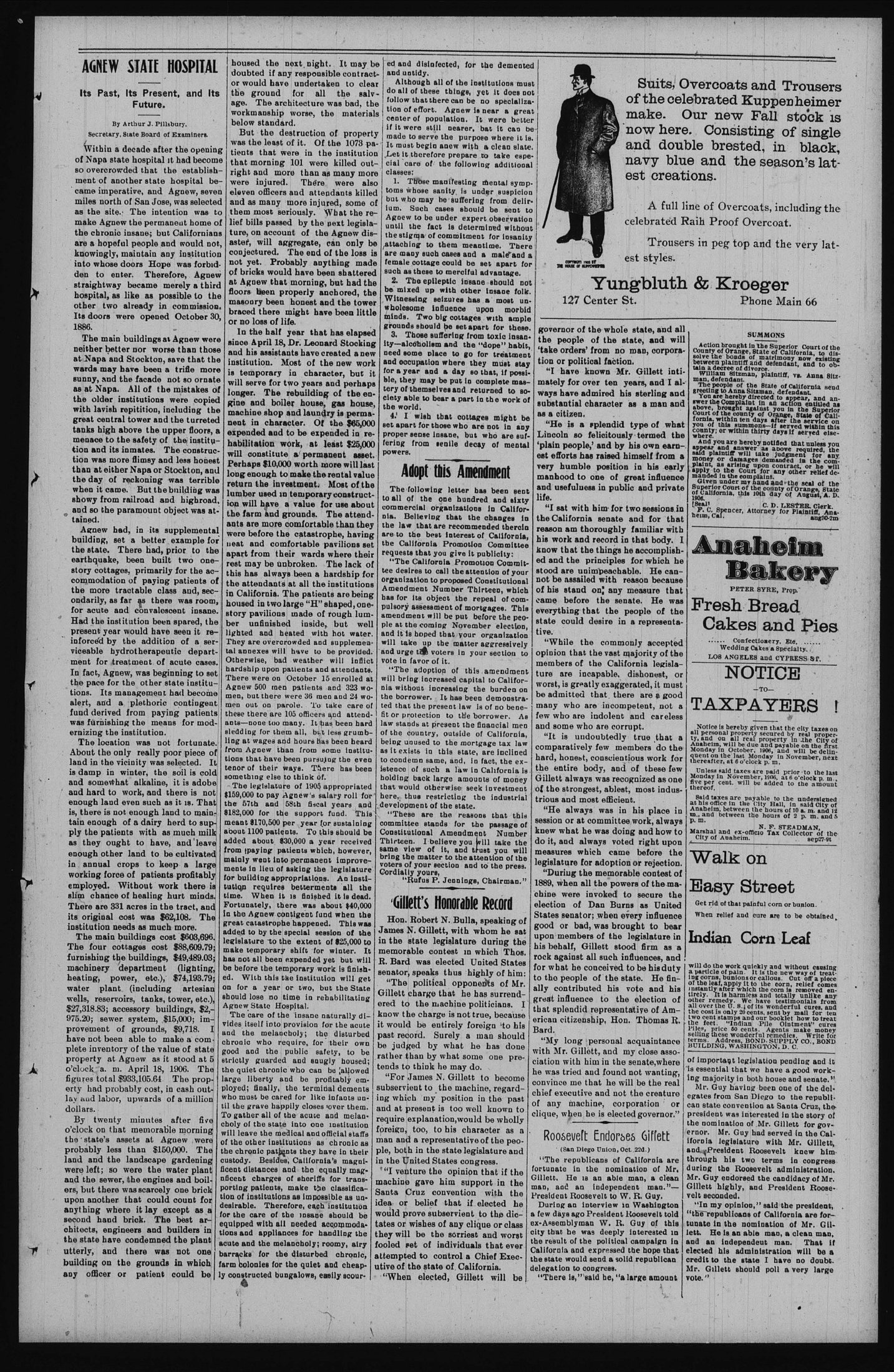
Searchable text
AGNEW STATE HOSPITAL
Its Past, Its Present, and Its Future.
By Arthur J. Pillsbury,
Secretary, State Board of Examiners.
Within a decade after the opening of Napa state hospital it had become so overcrowded that the establishment of another state hospital became imperative, and Agnew, seven miles north of San Jose, was selected as the site. The intention was to make Agnew the permanent home of the chronic insane; but Californians are a hopeful people and would not, knowingly, maintain any institution into whose doors Hope was forbidden to enter. Therefore, Agnew straightway became merely a third hospital, as like as possible to the other two already in commission. Its doors were opened October 30, 1886.
The main buildings at Agnew were neither better nor worse than those at Napa and Stockton, save that the wards may have been a trifle more sunny, and the facade not so ornate as at Napa. All of the mistakes of the older institutions were copied with lavish repetition, including the great central tower and the turreted tanks high above the upper floors, a menace to the safety of the institution and its inmates. The construction was more flimsy and less honest than at either Napa or Stockton, and the day of reckoning was terrible when it came. But the building was showy from railroad and highroad, and so the paramount object was housed the next night. Doubted if any responsible or would have undertaken the ground for all age. The architecture was workmanship worse, the below standard.
But the destruction of was the least of it. Of the patients that were in the that morning 101 were right and more than as were injured. There eleven officers and attendants and as many more injured them most seriously. We lief bills passed by the nature, on account of the Aster, will aggregate, can conjectured. The end of not yet. Probably anything of bricks would have been at Agnew that morning, but floors been properly ancien masonry been honest and braced there might have or no loss of life.
In the half year that has since April 18, Dr. Leonard and his assistants have creat institution. Most of the is temporary in character will serve for two years and longer. The rebuilding gine and boiler house, machine shop and laundry went in character. Of the expended and to be expenditure work, at less will constitute a permanent Perhaps $10,000 worth mo long enough to make the return the investment. M lumber used in temporary ion will have a value for
with lavish repitation, including the great central tower and the turreted tanks high above the upper floors, a menace to the safety of the institution and its inmates. The construction was more flimsy and less honest than at either Napa or Stockton, and the day of reckoning was terrible when it came. But the building was showy from railroad and highroad, and so the paramount object was attained.
Agnew had, in its supplemental building, set a better example for the state. There had, prior to the earthquake, been built two one-story cottages, primarily for the accommodation of paying patients of the more tractable class and, secondarily, as far as there was room, for acute and convalescent insane. Had the institution been spared, the present year would have seen it reinforced by the addition of a serviceable hydrotherapeutic department for treatment of acute cases. In fact, Agnew, was beginning to set the pace for the other state institutions. Its management had become alert, and a plethoric contingent fund derived from paying patients was furnishing the means for modernizing the institution.
The location was not fortunate. About the only really poor piece of land in the vicinity was selected. It is damp in winter, the soil is cold and somewhat alkaline, it is adobe and hard to work, and there is not enough land even such as it is. That is, there is not enough land to maintain enough of a dairy herd to supply the patients with as much milk as they ought to have, and leave enough other land to be cultivated in annual crops to keep a large working force of patients profitably employed. Without work there is slim chance of healing hurt minds. There are 331 acres in the tract, and its original cost was $62,108. The institution needs as much more.
The main buildings cost $603,696. The four cottages cost $88,609.79; furnishing the buildings, $49,489.03; machinery department (lighting
machine shop and laundry plant in character. Of the expended and to be expenditure habilitation work, at least will constitute a permanent Perhaps $10,000 worth more long enough to make the return the investment. M lumber used in temporary ion will have a value for the farm and grounds. Theants are more comfortable were before the catastrophe neat and comfortable apart from their wards w rest may be unbroken. This has always been a hail the attendants at all the in California. The patients housed in two large "H" shi story pavilions made of ro ber unfinished inside, lighted and heated with They are overcrowded and s tal annexes will have to be Otherwise, bad weather w hardship upon patients and a There were on October 15 e Agnew 500 men patients an men, but there were 36 men men out on parole. To ta these there are 105 officers an ants—none too many. It has sledding for them all, but le ling at wages and hours has b from Agnew than from sou tions that have been pursuing tenor of their ways. There something else to think of.
The legislature of 1905 app $159,000 to pay Agnew's salary the 57th and 58th fiscal y $182,000 for the support fu meant $170,500 per year for about 1100 patients. To this added about $30,000 a year from paying patients which mainly went into permanent ments in lieu of asking the l for building appropriations. tution requires betterment time. When it is finished Fortunately, there was abo in the Agnew contigent fund great catastrophe happened. added to by the special sessie legislature to the extent of make temporary shift for w has not all been expended yet be before the temporary work
in annual crops to keep a large working force of patients profitably employed. Without work there is slim chance of healing hurt minds. There are 331 acres in the tract, and its original cost was $62,108. The institution needs as much more.
The main buildings cost $603,696. The four cottages cost $88,609.79; furnishing the buildings, $49,489.03; machinery department (lighting, heating, power, etc.), $74,193.79; water plant (including artesian wells, reservoirs, tanks, tower, etc.), $27,318.83; accessory buildings, $2,-975.20; sewer system, $15,000; improvement of grounds, $9,718. I have not been able to make a complete inventory of the value of state property at Agnew as it stood at 5 o'clock a.m. April 18, 1906. The figures total $933,105.64. The property had probably cost, in cash outlay and labor, upwards of a million dollars.
By twenty minutes after five o'clock on that memorable morning the state's assets at Agnew were probably less than $150,000. The land and the landscape gardening were left; so were the water plant and the sewer, the engines and boilers, but there was scarcely one brick upon another that could count for anything where it lay except as a second hand brick. The best architects, engineers and builders in the state have condemned the plant utterly, and there was not one building on the grounds in which any officer or patient could be
In the next night. It may be said if any responsible contract had undertaken to clear ground for all the salvage of the architecture was bad, the ownership worse, the materials standard.
The destruction of property at least of it. Of the 1073 patrons that were in the institution during 101 were killed outwardly more than as many more injured. There were also officers and attendants killed many more injured, some of most seriously. What the reins passed by the next legislature account of the Agnew disillusion aggregate, can only be borne. The end of the loss is probably anything made would have been shattered now that morning, but had the been properly anchored, the been honest and the tower there might have been little loss of life.
A half year that has elapsed April 18, Dr. Leonard Stocking assistants have created a newton. Most of the new work library in character, but it cee for two years and perhaps The rebuilding of the enclosed boiler house, gas house, shop and laundry is perma-character. Of the $65,000 paid and to be expended in reion work, at least $25,000 constitute a permanent asset. $10,000 worth more will last enough to make the rental value the investment. Most of the used in temporary constructive have a value for use about
ed and disinfected, for the demented and untidy.
Although all of the institutions must do all of these things, yet it does not follow that there can be no specialization of effort. Agnew is near a great center of population. It were better if it were still nearer, bat it can be made to serve the purpose where it is. It must begin anew with a clean slate. Let it therefore prepare to take especial care of the following additional classes:
1. Those manifesting mental symptoms whose sanity is under suspicion but who may be suffering from delirium. Such cases should be sent to Agnew to be under expert observation until the fact is determined without the stigma of commitment for insanity attaching to them meantime. There are many such cases and a male and a female cottage could be set apart for such as these to merciful advantage.
2. The epileptic insane should not be mixed up with other insane folk. Witnessing seizures has a most unwholesome influence upon morbid minds. Two big cottages with ample grounds should be set apart for these.
3. Those suffering from toxic insanity—alcoholism and the "dope" habit, need some place to go for treatment and occupation where they must stay for a year and a day so that, if possible, they may be put in complete mastery of themselves and returned to society able to bear a part in the work of the world.
4. I wish that cottages might be set apart for those who are not in any proper sense insane, but who are suffering from senile decay of mental powers.
Adopt this Amendment
The following letter has been sent to all of the one hundred and sixty commercial organizations in Califor-
governor of the whole people of the state 'take orders' from no nation or political faction.
"I have known Mr. Mately for over ten years ways have admired his substantial character as a citizen.
"He is a splendid Lincoln so felicitously 'plain people,' and by best efforts has raised him very humble position manhood to one of great and usefulness in public life.
"I sat with him for two
Adopt this Amendment
The following letter has been sent to all of the one hundred and sixty commercial organizations in California. Believing that the changes in the law that are recommended therein are to the best interest of California, the California Promotion Committee requests that you give it publicity:
"The California Promotion Committee desires to call the attention of your organization to proposed Constitutional Amendment Number Thirteen, which has for its object the repeal of compulsory assessment of mortgages. This amendment will be put before the people at the coming November election, and it is hoped that your organization will take up the matter aggressively and urge the voters in your section to vote in favor of it.
"The adoption of this amendment will bring increased capital to California without increasing the burden on the borrower. It has been demonstrated that the present law is of no benefit or protection to the borrower. As law stands at present the financial men of the country, outside of California, being unused to the mortgage tax law as it exists in this state, are inclined to condemn same, and, in fact, the existence of such a law in California is holding back large amounts of money that would otherwise seek investment here, thus restricting the industrial development of the state.
"These are the reasons that this committee stands for the passage of Constitutional Amendment Number Thirteen. I believe you will take the same view of it, and trust you will bring the matter to the attention of the voters of your section and to the press. Cordially yours,
"Rufus P. Jennings, Chairman."
Gillett's Honorable Record
Hon. Robert N. Bulla, speaking of James N. Gillett, with whom he sat in the state legislature during the memorable contest in which Thos. R. Bard was elected United States representative.
Gillett's Honorable Record
Hon. Robert N. Bulla, speaking of James N. Gillett, with whom he sat in the state legislature during the memorable contest in which Thos. R. Bard was elected United States senator, speaks thus highly of him:
"The political opponents of Mr. Gillett charge that he has surrendered to the machine politicians. I know the charge is not true, because it would be entirely foreign to his past record. Surely a man should be judged by what he has done rather than by what some one pretends to think he may do.
"For James N. Gillett to become subservient to the machine, regarding which my position in the past and at present is too well known to require explanation, would be wholly foreign, too, to his character as a man and a representative of the people, both in the state legislature and in the United States congress.
"I venture the opinion that if the machine gave him support in the Santa Cruz convention with the idea or belief that if elected he would prove subservient to the dictates or wishes of any clique or class they will be the sorriest and worst fooled set of individuals that ever attempted to control a Chief Executive of the state of California.
"When elected, Gillett will be..."
Suits, Overcoats and Trousers of the celebrated Kuppenheimer make. Our new Fall stock is now here. Consisting of single and double brested, in black, navy blue and the season's latest creations.
A full line of Overcoats, including the celebrated Raih Proof Overcoat.
Trousers in peg top and the very latest styles.
Yungbluth & Kroeger
127 Center St.
Phone Main 66
SUMMONS
Action brought in the Superior Court of the County of Orange, State of California, to dissolve the bonds of matrimony now existing between plaintiff and defendant, and to obtain a decree of divorce.
William Sitzman, plaintiff, vs. Anna Sitzman, defendant.
The people of the State of California send greeting to Anna Sitzman, defendant.
You are hereby directed to appear, and answer the Complaint in an action entitled as above, brought against you in the Superior Court of the county of Orange, State of California, within ten days after the service on you of this summons—if served within this county; or within thirty days if served elsewhere.
And you are hereby notified that unless you appear and answer as above required, the said plaintiff will take judgment for any money or damages demanded in the complaint, as arising upon contract, or he will apply to the Court for any other relief demanded in the complaint.
Given under my hand and the seal of the Superior Court of the county of Orange, State of California, this 10th day of August, A. D. 1906.
C. D. LESTER, Clerk.
F. C. Spencer, Attorney for Plaintiff.
Anaheim Bakery
PETER SYRE, Prop.
Fresh Bread
Cakes and Pies
Confectionery, Etc.
Wedding Cakes a Specialty.
LOS ANGELES and CYPRESS ST.
NOTICE
TO TAXPAYERS!
Notice is hereby given that the city taxes on all personal property secured by real property, and on all real property in the City of Anaheim, will be due and payable on the first Monday in October, 1906, and will be delinquent on the last Monday in November, next thereafter, at 6 o'clock p.m.
Unless said taxes are paid prior to the last Monday in November, 1906, at 6 o'clock p.m., five per cent. will be added to the amount thereof.
Said taxes are payable to the undersigned at his office in the City Hall, in said City of Anaheim, between the hours of 10 a.m. and 12 m., and between the hours of 2 p.m. and 5 p.m.
N. F. STEADMAN,
Marshal and ex-officio Tax Collector of the City of Anaheim.
Sep 27-9t
Walk on
Easy Street
Get rid of that painful corn or bunion.
When relief and cure are to be obtained,
Indian Corn Leaf
will do the work quickly and without causing
Easy Street
Get rid of that painful corn or bunion.
When relief and cure are to be obtained.
Indian Corn Leaf
will do the work quickly and without causing a particle of pain. It is the new way of treating corns, bunions or callous. Cut off a piece of the leaf, apply it to the corn, relief comes instantly after which the corn is removed entirely. It is harmless and totally unlike any other remedy. We have testimonials from all over the U.S. of its wonderful cures, and the cost is only 20 cents, sent by mail for ten two cent stamps and our booklet how to treat the feet. "Indian Pile Ointment" cures Piles, price 50 cents. Agents make money selling these wonderful remedies. Write for terms. Address, BOND. SUPPLY CO., BOND BUILDING, WASHINGTON, D.C.
of important legislation pending and it is essential that we have a good working majority in both house and senate."
Mr. Guy having been one of the delegates from San Diego to the republican state convention at Santa Cruz, the president was interested in the story of the nomination of Mr. Gillett for governor. Mr. Guy had served in the California legislature with Mr. Gillett, and President Roosevelt knew him through his two terms in congress during the Roosevelt administration. Mr. Guy endorsed the candidacy of Mr. Gillett highly, and President Roosevelt seconded.
"In my opinion," said the president, "the republicans of California are fortunate in the nomination of Mr. Gillett. He is an able man, a clean man, and an independent man. That if elected his administration will be a credit to the state I have no doubt. Mr. Gillett should poll a very large vote."