anaheim-gazette 1906-08-30
Scanned page
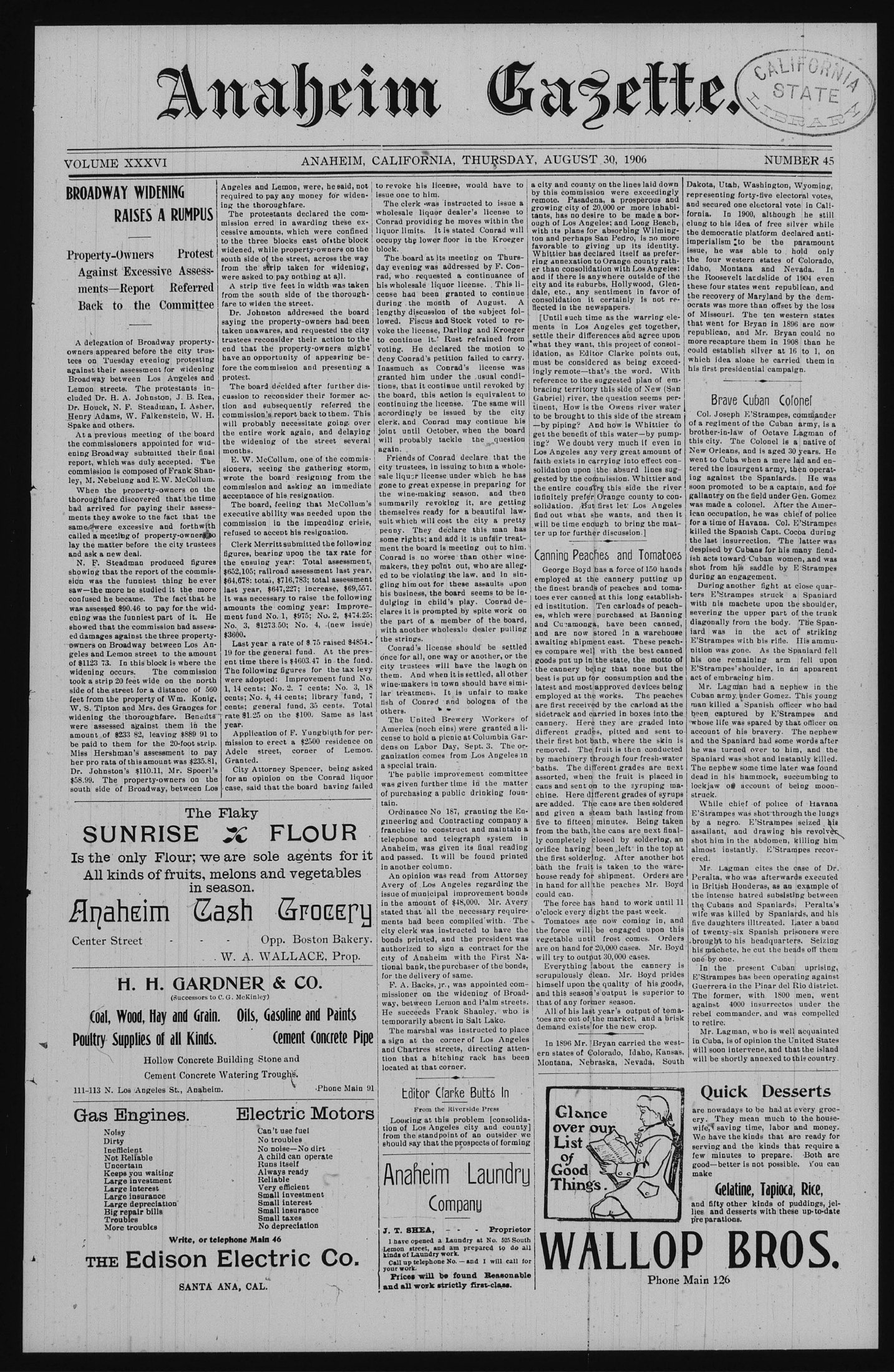
Searchable text
BROADWAY WIDENING
RAISES A RUMPUS
Property-Owners Protest
Against Excessive Assessments—Report Referred
Back to the Committee
A delegation of Broadway property-owners appeared before the city trustees on Tuesday evening protesting against their assessment for widening Broadway between Los Angeles and Lemon streets. The protestants included Dr. H. A. Johnston, J. B. Rea, Dr. Houck, N. F. Steadman, I. Asher, Henry Adams, W. Falkenstein, W. H. Spake and others.
At a previous meeting of the board the commissioners appointed for widening Broadway submitted their final report, which was duly accepted. The commission is composed of Frank Shanley, M. Nebelung and E. W. McCollum.
When the property-owners on the thoroughfare discovered that the time had arrived for paying their assess-
Dr. Houck, N. F. Steadman, I. Asher,
Henry Adams, W. Falkenstein, W. H.
Spake and others.
At a previous meeting of the board
the commissioners appointed for widening Broadway submitted their final report, which was duly accepted. The commission is composed of Frank Shanley, M. Nebelung and E. W. McCollum.
When the property-owners on the thoroughfare discovered that the time had arrived for paying their assessments they awoke to the fact that the same were excessive and forthwith called a meeting of property-owners to lay the matter before the city trustees and ask a new deal.
N. F. Steadman produced figures showing that the report of the commission was the funniest thing he ever saw—the more he studied it the more confused he became. The fact that he was assessed $90.46 to pay for the widening was the funniest part of it. He showed that the commission had assessed damages against the three property-owners on Broadway between Los Angeles and Lemon street to the amount of $1123 73. In this block is where the widening occurs. The commission took a strip 20 feet wide on the north side of the street for a distance of 560 feet from the property of Wm. Konig, W. S. Tipton and Mrs. des Granges for widening the thoroughfare. Benefits were assessed against them in the amount of $233 82, leaving $889 91 to be paid to them for the 20-foot strip. Miss Hershman’s assessment to pay her pro rata of this amount was $235.81, Dr. Johnston’s $110.11, Mr. Spoerl’s $58.99. The property-owners on the south side of Broadway, between Los
The Flaky
SUNRISE FLOUR
Is the only Flour; we are sole agents
All kinds of fruits, melons and vegetables in season.
Anaheim Cash Grocer
Center Street - - Opp. Boston
W. A. WALLACE,
All kinds of fruits, melons and vegetain season.
Anaheim Cash Groc
Center Street - - - Opp. Boston
W. A. WALLACE,
H. H. GARDNER & CO.
(Successors to C. G. McKinley)
Coal, Wood, Hay and Grain. Oils, Gasoline and P
Poultry Supplies of all Kinds. Cement Concr
Hollow Concrete Building Stone and
Cement Concrete Watering Troughs.
111-113 N. Los Angeles St., Anaheim.
Gas Engines. Electric Mo
Noisy Can't use fuel
Dirty No troubles
Inefficient No noise—No dirt
Not Reliable A child can operate
Uncertain Runs itself
Keeps you waiting Always ready
Large investment Reliable
Large interest Very efficient
Large insurance Small investment
Large depreciation Small interest
Big repair bills Small insurance
Troubles Small taxes
More troubles No depreciation
Write, or telephone Main 46
THE Edison Electric Co
SANTA ANA, CAL.
ANAHEIM, CALIFORNIA, THURSDAY, AUGUST 30, 1859
and Lemon, were, he said, not to pay any money for widening thoroughfare.
Testants declared the compared in awarding these excounts, which were confined
the blocks east of the block while property-owners on the of the street, across the way strip taken for widening,
to pay nothing at all.
Five feet in width was taken south side of the thoroughen the street.
Conston addressed the board property-owners had been wares, and requested the city consider their action to the property-owners might opportunity of appearing becommission and presenting a decision after further disconsider their former acsubsequently referred the man's report back to them. This probably necessitate going over work again, and delaying filing of the street several McCollum, one of the commisseeing the gathering storm, board resigning from the man and asking an immediate file of his resignation.
And feeling that McCollum's ability was needed upon the to revoke his license, would have to issue one to him.
The clerk was instructed to issue a wholesale liquor dealer's license to Conrad providing he moves within the liquor limits. It is stated Conrad will occupy the lower floor in the Kroeger block.
The board at its meeting on Thursday evening was addressed by F. Conrad, who requested a continuance of his wholesale liquor license. This license had been granted to continue during the month of August. A lengthy discussion of the subject followed. Fiscus and Stock voted to revoke the license, Darling and Kroeger to continue it.' Rust refrained from voting. He declared the motion to deny Conrad's petition failed to carry. Inasmuch as Conrad's license was granted him under the usual conditions, that it continue until revoked by the board, this action is equivalent to continuing the license. The same will accordingly be issued by the city clerk, and Conrad may continue his joint until October, when the board will probably tackle the question again.
Friends of Conrad declare that the city trustees, in issuing to him a wholesale liquor license under which he has gone to great expense in preparing for the wine-making season, and then summarily revoking it, are getting themselves ready for a beautiful law-a city and county on the line by this commission were remote. Pasadena, a progrowing city of 20,000 or more tants, has no desire to be brought to Los Angeles; and with its plans for absorbing ton and perhaps San Pedro favorable to giving up Whittier has declared itself ring annexation to Orange er than consolidation with and if there is anywhere o city and its suburbs, Holly dale, etc., any sentiment consolidation it certainly flected in the newspapers.
[Until such time as the ments in Los Angeles get settle their differences and what they want, this projectation, as Editor Clarke must be considered as being remotely—that's the reference to the suggested bracing territory this side Gabriel) river, the questioninent, How is the Owens to be brought to this side —by piping? And how is get the benefit of this water ing? We doubt very much Los Angeles any very great faith exists in carrying in solidation upon the absu-gested by the commission. The entire country this si-infinitely prefer Orange c solidation. But first let
McCollum, one of the commissioners seeing the gathering storm, board resigning from the man and asking an immediate leave of his resignation. Lord, feeling that McCollum's inability was needed upon the man in the impending crisis, accent his resignation.
Erritt submitted the following hearing upon the tax rate for the year: Total assessment, railroad assessment last year, tai, $716,783; total assessment $647,227; increase, $69,557. necessary to raise the following the coming year: Improvement No. 1, $975; No. 2, $474.25; $273.50; No. 4, (new issue)
A rate of $75 raised $4854.-general fund. At the pres-sence is $4603.47 in the fund.wing figures for the tax levy listed: Improvement fund No. 1; No. 2. 7 cents; No. 3, 18 4, 44 cents; library fund, 7 general fund, 35 cents. Total on the $100. Same as last station of F. Yungbluth for per-rect a $2500 residence on street, corner of Lemon.
Attorney Spencer, being asked opinion on the Conrad liquor that the board having failed
FLOUR
ole agents for it
and vegetables
Grocery
Opp. Boston Bakery.
WALLACE, Prop.
Friends of Conrad declare that the city trustees, in issuing to him a wholesale liquor license under which he has gone to great expense in preparing for the wine-making season, and then summarily revoking it, are getting themselves ready for a beautiful lawsuit which will cost the city a pretty penny. They declare this man has some rights; and add it is unfair treatment the board is meeting out to him. Conrad is no worse than other wine-makers, they point out, who are alleged to be violating the law, and in singling him out for these assaults upon his business, the board seems to be indulging in child's play. Conrad declares it is prompted by spite work on the part of a member of the board, with another wholesale dealer pulling the strings.
Conrad's license should be settled once for all, one way or another, or the city trustees will have the laugh on them. And when it is settled, all other wine-makers in town should have similar treatment. It is unfair to make fish of Conrad and bologna of the others.
The United Brewery Workers of America (noch eins) were granted a license to hold a picnic at Columbia Gardens on Labor Day, Sept. 3. The organization comes from Los Angeles in a special train.
The public improvement committee was given further time in the matter of purchasing a public drinking fountain.
Ordinance No 187, granting the Engineering and Contracting company a franchise to construct and maintain a telephone and telegraph system in Anaheim, was given its final reading and passed. It will be found printed in another column.
An opinion was read from Attorney Avery of Los Angeles regarding the issue of municipal improvement bonds in the amount of $48,000. Mr. Avery stated that all the necessary requirements had been complied with. The city clerk was instructed to have the bonds printed, and the president was authorized to sign a contract for the city of Anaheim with the First National bank, the purchaser of the bonds,
continuing the license. The same will accordingly be issued by the city clerk, and Conrad may continue his joint until October, when the board will probably tackle the question again.
Friends of Conrad declare that the city trustees, in issuing to him a wholesale liquor license under which he has gone to great expense in preparing for the wine-making season, and then summarily revoking it, are getting themselves ready for a beautiful lawsuit which will cost the city a pretty penny. They declare this man has some rights; and add it is unfair treatment the board is meeting out to him. Conrad is no worse than other wine-makers, they point out, who are alleged to be violating the law, and in singling him out for these assaults upon his business, the board seems to be indulging in child's play. Conrad declares it is prompted by spite work on the part of a member of the board, with another wholesale dealer pulling the strings.
Conrad's license should be settled once for all, one way or another, or the city trustees will have the laugh on them. And when it is settled, all other wine-makers in town should have similar treatment. It is unfair to make fish of Conrad and bologna of the others.
The United Brewery Workers of America (noch eins) were granted a license to hold a picnic at Columbia Gardens on Labor Day, Sept. 3. The organization comes from Los Angeles in a special train.
The public improvement committee was given further time in the matter of purchasing a public drinking fountain.
Ordinance No 187, granting the Engineering and Contracting company a franchise to construct and maintain a telephone and telegraph system in Anaheim, was given its final reading and passed. It will be found printed in another column.
An opinion was read from Attorney Avery of Los Angeles regarding the issue of municipal improvement bonds in the amount of $48,000. Mr. Avery stated that all the necessary requirements had been complied with. The city clerk was instructed to have the bonds printed, and the president was authorized to sign a contract for the city of Anaheim with the First National bank, the purchaser of the bonds,
continuing the license. The same will accordingly be issued by the city clerk, and Conrad may continue his joint until October, when the board will probably tackle the question again.
Friends of Conrad declare that the city trustees, in issuing to him a wholesale liquor license under which he has gone to great expense in preparing for the wine-making season, and then summarily revoking it, are getting themselves ready for a beautiful lawsuit which will cost the city a pretty penny. They declare this man has some rights; and add it is unfair treatment the board is meeting out to him. Conrad is no worse than other wine-makers, they point out, who are alleged to be violating the law, and in singling him out for these assaults upon his business, the board seems to be indulging in child's play. Conrad declares it is prompted by spite work on the part of a member of the board, with another wholesale dealer pulling the strings.
Conrad's license should be settled once for all, one way or another, or the city trustees will have the laugh on them. And when it is settled, all other wine-makers in town should have similar treatment. It is unfair to make fish of Conrad and bologna of the others.
The United Brewery Workers of America (noch eins) were granted a license to hold a picnic at Columbia Gardens on Labor Day, Sept. 3. The organization comes from Los Angeles in a special train.
The public improvement committee was given further time in the matter of purchasing a public drinking fountain.
Ordinance No 187, granting the Engineering and Contracting company a franchise to construct and maintain a telephone and telegraph system in Anaheim, was given its final reading and passed. It will be found printed in another column.
An opinion was read from Attorney Avery of Los Angeles regarding the issue of municipal improvement bonds in the amount of $48,000. Mr. Avery stated that all the necessary requirements had been complied with. The city clerk was instructed to have the bonds printed, and the president was authorized to sign a contract for the city of Anaheim with the First National bank, the purchaser of the bonds,
continuing the license. The same will accordingly be issued by the city clerk, and Conrad may continue his joint until October, when the board will probably tackle the question again.
Friends of Conrad declare that the city trustees, in issuing to him a wholesale liquor license under which he has gone to great expense in preparing for the wine-making season, and then summarily revoking it, are getting themselves ready for a beautiful lawsuit which will cost the city a pretty penny. They declare this man has some rights; and add it is unfair treatment the board is meeting out to him. Conrad is no worse than other wine-makers, they point out, who are alleged to be violating the law, and in singling him out for these assaults upon his business, the board seems to be indulging in child's play. Conrad declares it is prompted by spite work on the part of a member of the board, with another wholesale dealer pulling the strings.
Conrad's license should be settled once for all, one way or another, or the city trustees will have the laugh on them. And when it is settled, all other wine-makers in town should have similar treatment. It is unfair to make fish of Conrad and bologna of the others.
The United Brewery Workers of America (noch eins) were granted a license to hold a picnic at Columbia Gardens on Labor Day, Sept. 3. The organization comes from Los Angeles in a special train.
The public improvement committee was given further time in the matter of purchasing a public drinking fountain.
Ordinance No 187, granting the Engineering and Contracting company a franchise to construct and maintain a telephone and telegraph system in Anaheim, was given its final reading and passed. It will be found printed in another column.
An opinion was read from Attorney Avery of Los Angeles regarding the issue of municipal improvement bonds in the amount of $48,000. Mr. Avery stated that all the necessary requirements had been complied with. The city clerk was instructed to have the bonds printed, and the president was authorized to sign a contract for the city of Anaheim with the First National bank, the purchaser of the bonds,
continuing the license. The same will accordingly be issued by the city clerk, and Conrad may continue his joint until October, when the board will probably tackle the question again.
George Boyd has a force employed at the cannery,the finest brands of peachesto ever canned at this lowed institution.Ten carloeswhich were purchasedand Cuamonga,have therand are now stored intawaiting shipment east.es compare well withthe goods put up in this state,the cannery being thatbest is put up for consum-latest and most approvedemployed atthe works.aare first received bythe cisidetrack and carriedinbancery.Here they are different grades,pitted their first hot bath whereremoved.The fruit is theruby machinery through fourbaths.The different gra-artsassorted,whenthe fruita-cansand sentontothechine.Here different gra-artsadded.The cans areand givena steam bathfive to fifteen minutes.fromthe bath,the cansaplenty completely closedbyorifice having beenleftthefirst soldering.Afterbaththe fruitis takenhouse ready for shipmentinhandforallthe peachcouldcan.
The force has handtoo'clock every dightthe patTomatoes are now cooledthe force will be engagedvegetable until frostcoatedon hand for 20,000 caseswill try to output 30,000casesaboutthe
and vegetables
Grocery
Opp. Boston Bakery.
WALLACE, Prop.
R & CO.
Gasoline and Paints
Cement Concrete Pipe
Stone and
Troughs.
Phone Main 91
Electric Motors
can't use fuel
No troubles
No noise—No dirt
A child can operate
Tuns itself
Always ready
Reliable
Very efficient
Small investment
Small interest
Small insurance
Small taxes
No depreciation
in another column.
An opinion was read from Attorney Avery of Los Angeles regarding the issue of municipal improvement bonds in the amount of $48,000. Mr. Avery stated that all the necessary requirements had been complied with. The city clerk was instructed to have the bonds printed, and the president was authorized to sign a contract for the city of Anaheim with the First National bank, the purchaser of the bonds, for the delivery of same.
F. A. Backs, Jr., was appointed commissioner on the widening of Broadway, between Lemon and Palm streets. He succeeds Frank Shanley, who is temporarily absent in Salt Lake.
The marshal was instructed to place a sign at the corner of Los Angeles and Chartres streets, directing attention that a hitching rack has been located at that corner.
Editor Clarke Butts In
From the Riverside Press
Looking at this problem [consolidation of Los Angeles city and county] from the standpoint of an outsider we should say that the prospects of forming
Anaheim Laundry Company
J. T. SHEA, Proprietor
I have opened a Laundry at No. 525 South Lemon street, and am prepared to do all kinds of Laundry work.
Call up telephone No. — and I will call for your work.
Prices will be found Reasonable and all work strictly first-class.
August 30, 1906 NUMBER 45
and county on the lines laid down
commission were exceedingly
Pasadena, a prosperous and
city of 20,000 or more inhabihas no desire to be made a borLos Angeles; and Long Beach,
plans for absorbing Wilmingperhaps San Pedro, is no more
able to giving up its identity.
Her has declared itself as prefernexation to Orange county rathconsolidation with Los Angeles:
there is anywhere outside of the
its suburbs, Hollywood, Glenc., any sentiment in favor of
relation it certainly is not rein the newspapers.
All such time as the warring elein Los Angeles get together,
their differences and agree upon
they want, this project of consolas Editor Clarke points out,
be considered as being exceedremote—that's the word. With
face to the suggested plan of emterritory this side of New (San
) river, the question seems perHow is the Owens river water
rought to this side of the stream
ping? And how is Whittier to
benefit of this water—by pumpWe doubt very much if even in
angeles any very great amount of
exists in carrying into effect conupon the absurd lines sugby the commission. Whittier and
fire country this side the river
prefer Orange county to conon. But first let: Los Angeles
Dakota, Utah, Washington, Wyoming,
representing forty-five electoral votes,
and secured one electoral vote in California. In 1900, although he still
clung to his idea of free silver while
the democratic platform declared anti-imperialism to be the paramount issue, he was able to hold only
the four western states of Colorado,
Idaho, Montana and Nevada. In
the Roosevelt landslide of 1904 even
these four states went republican, and
the recovery of Maryland by the democrats was more than offset by the loss
of Missouri. The ten western states
that went for Bryan in 1896 are now
republican, and Mr. Bryan could no
more recapture them in 1908 than he
could establish silver at 16 to 1, on
which idea alone he carried them in
his first presidential campaign.
Brave Cuban Colonel
Col. Joseph E'Strampes, commander
of a regiment of the Cuban army, is a
brother-in-law of Octave Lagman of
this city. The Colonel is a native of
New Orleans, and is aged 30 years. He
went to Cuba when a mere lad and entered the insurgent army, then operating against the Spaniards. He was
soon promoted to be a captain, and for
gallantry on the field under Gen. Gomez
was made a colonel. After the Ame-
How is the Owens river water brought to this side of the stream flowing? And how is Whittier to benefit of this water—by pumping it? We doubt very much if even in Angeles any very great amount of exists in carrying into effect conduction upon the absurd lines suggested by the commission. Whittier and fire country this side the river only prefer Orange county to conduction. But first let: Los Angeles at what she wants, and then it will time enough to bring the matter for further discussion.
Mining Peaches and Tomatoes
George Boyd has a force of 150 hands armed at the cannery putting up best brands of peaches and tomato canned at this long establishment. Ten carloads of peach which were purchased at Banning Cuamonga, have been canned, are now stored in a warehouse along shipment east. These peach prepare well with the best canned put up in the state, the motto of cannery being that none but the output up for consumption and the most approved devices being used at the works. The peaches last received by the carload at the back and carried in boxes into the army. Here they are graded into tent grades, pitted and sent to first hot bath, where the skin is dried. The fruit is then conducted machinery through four fresh-water different grades are next dried, when the fruit is placed in and sent on to the syruping machine. Here different grades of syrups added. The cans are then soldered given a steam bath lasting from fifteen minutes. Being taken the bath, the cans are next finally closed by soldering, and having been left in the top at first soldering. After another hot fruit is taken to the ware-ready for shipment. Orders are made for all the peaches Mr. Boyd canan.
Force has hand to work until 11 or every night the past week. Tomatoes are now coming in, and force will be engaged upon this table until frost comes. Orders hand for 20,000 cases. Mr. Boyd may to output 30,000 cases.
Col. Joseph E'Strampes, commander of a regiment of the Cuban army, is a brother-in-law of Octave Lagman of this city. The Colonel is a native of New Orleans, and is aged 30 years. He went to Cuba when a mere lad and entered the insurgent army, then operating against the Spaniards. He was soon promoted to be a captain, and for gallantry on the field under Gen. Gomez was made a colonel. After the American occupation, he was chief of police for a time of Havana. Col. E'Strampes killed the Spanish Capt. Cocoa during the last insurrection. The latter was despised by Cubans for his many fiendish acts toward Cuban women, and was shot from his saddle by E'Strampes during an engagement.
During another fight at close quarters E'Strampes struck a Spaniard with his machete upon the shoulder, severing the upper part of the trunk diagonally from the body. The Spaniard was in the act of striking E'Strampes with his rifle. His ammunition was gone. As the Spaniard fell his one remaining arm fell upon E'Strampes' shoulder, in an apparent act of embracing him.
Mr. Lagman had a nephew in the Cuban army under Gomez. This young man killed a Spanish officer who had been captured by E'Strampes and whose life was spared by that officer on account of his bravery. The nephew and the Spaniard had some words after he was turned over to him, and the Spaniard was shot and instantly killed. The nephew some time later was found dead in his hammock, succumbing to lockjaw or account of being moon-struck.
While chief of police of Havana E'Strampes was shot through the lungs by a negro. E'Strampes seized his assailant, and drawing his revolver shot him in the abdomen, killing him almost instantly. E'Strampes recovered.
Mr. Lagman cites the case of Dr. Peralta, who was afterwards executed in British Honderas, as an example of the intense hatred subsisting between the Cubans and Spaniards. Peralta's wife was killed by Spaniards, and his five daughters illtreated. Later a band of twenty-six Spanish prisoners were brought to his headquarters. Seizing his machete, he cut the heads off them one by one.
In the present Cuban uprising,
Mr. Lagman cites the case of Dr. Peralta, who was afterwards executed in British Honderas, as an example of the intense hatred subsisting between the Cubans and Spaniards. Peralta’s wife was killed by Spaniards, and his five daughters illtreated. Later a band of twenty-six Spanish prisoners were brought to his headquarters. Seizing his machete, he cut the heads off them one by one.
In the present Cuban uprising, E’Strampes has been operating against Guerrera in the Pinar del Rio district. The former, with 1800 men, went against 4000 insurrectos under the rebel commander, and was compelled to retire.
Mr. Lagman, who is well acquainted in Cuba, is of opinion the United States will soon intervene, and that the island will be shortly annexed to this country.
Quick Desserts
are nowadays to be had at every grocery. They mean much to the housewife, saving time, labor and money. We have the kinds that are ready for serving and the kinds that require a few minutes to prepare. Both are good—better is not possible. You can make
Gelatine, Tapioca, Rice,
and fifty other kinds of puddings, jellies and desserts with these up-to-date preparations.
VALLOP BROS.
Phone Main 126